
Jaune Quick-to-See Smith: Memory Map
2023
-
500
Introduction
Audio, Verbal description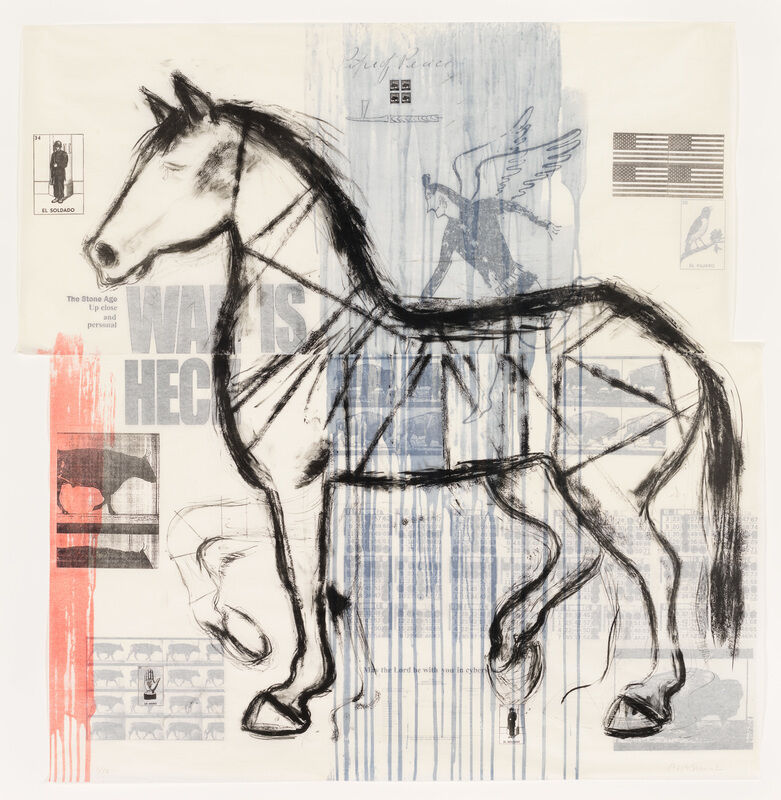
-
501
Trade Canoe: Forty Days and Forty Nights, 2015
Audio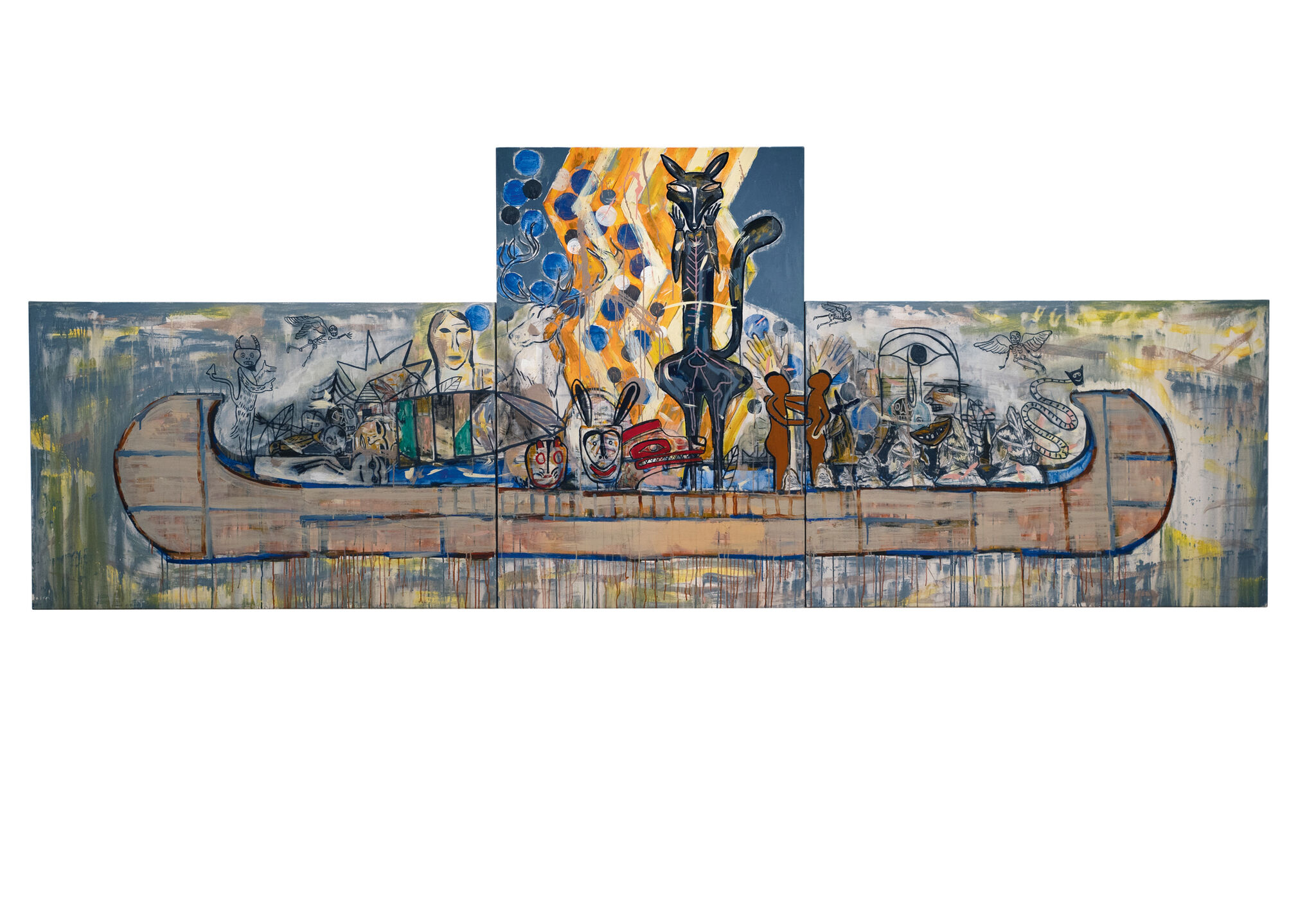
-
502
Indian Madonna Enthroned, 1974
Audio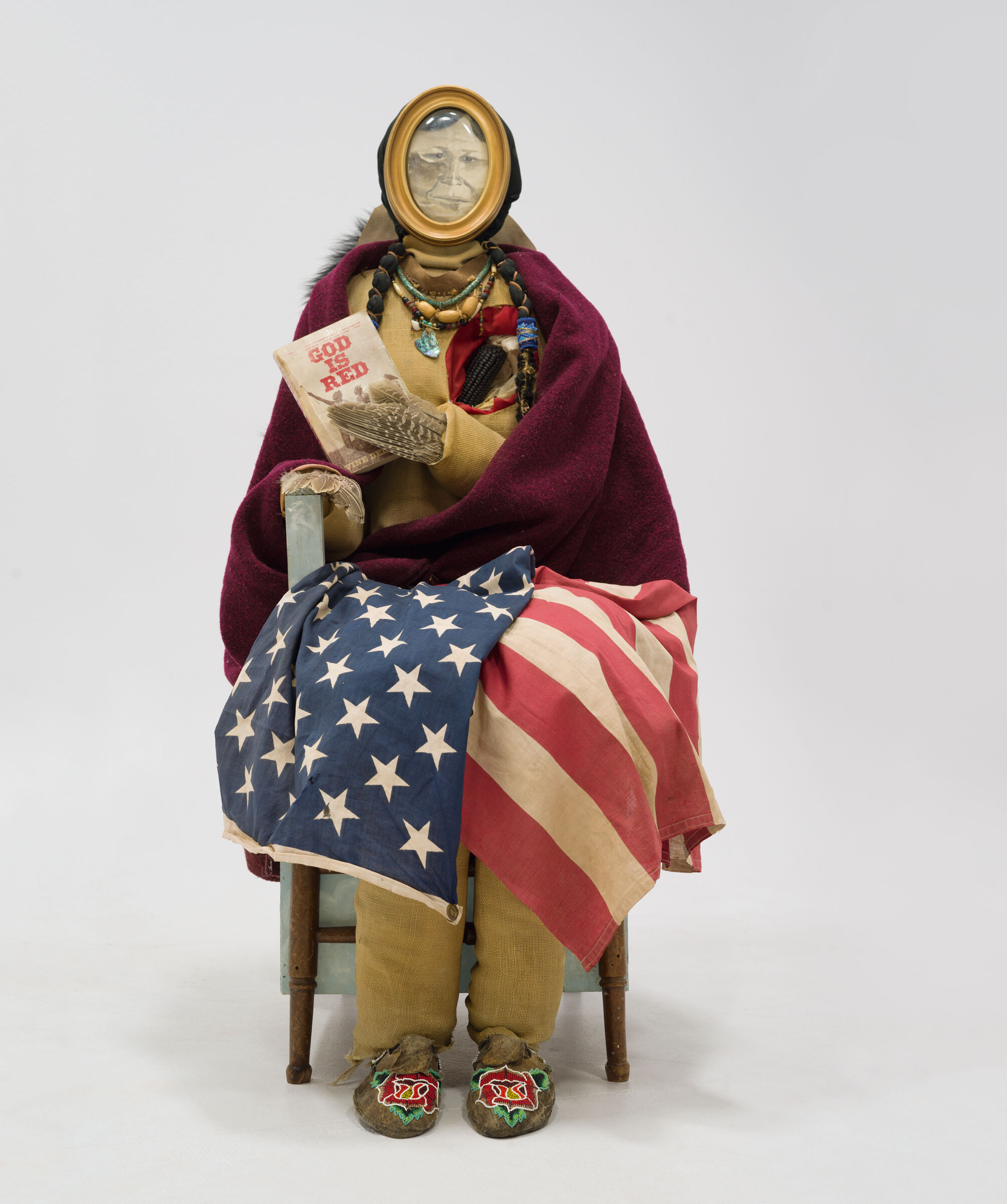
-
503
Kalispell #1, 1979
Audio, Verbal description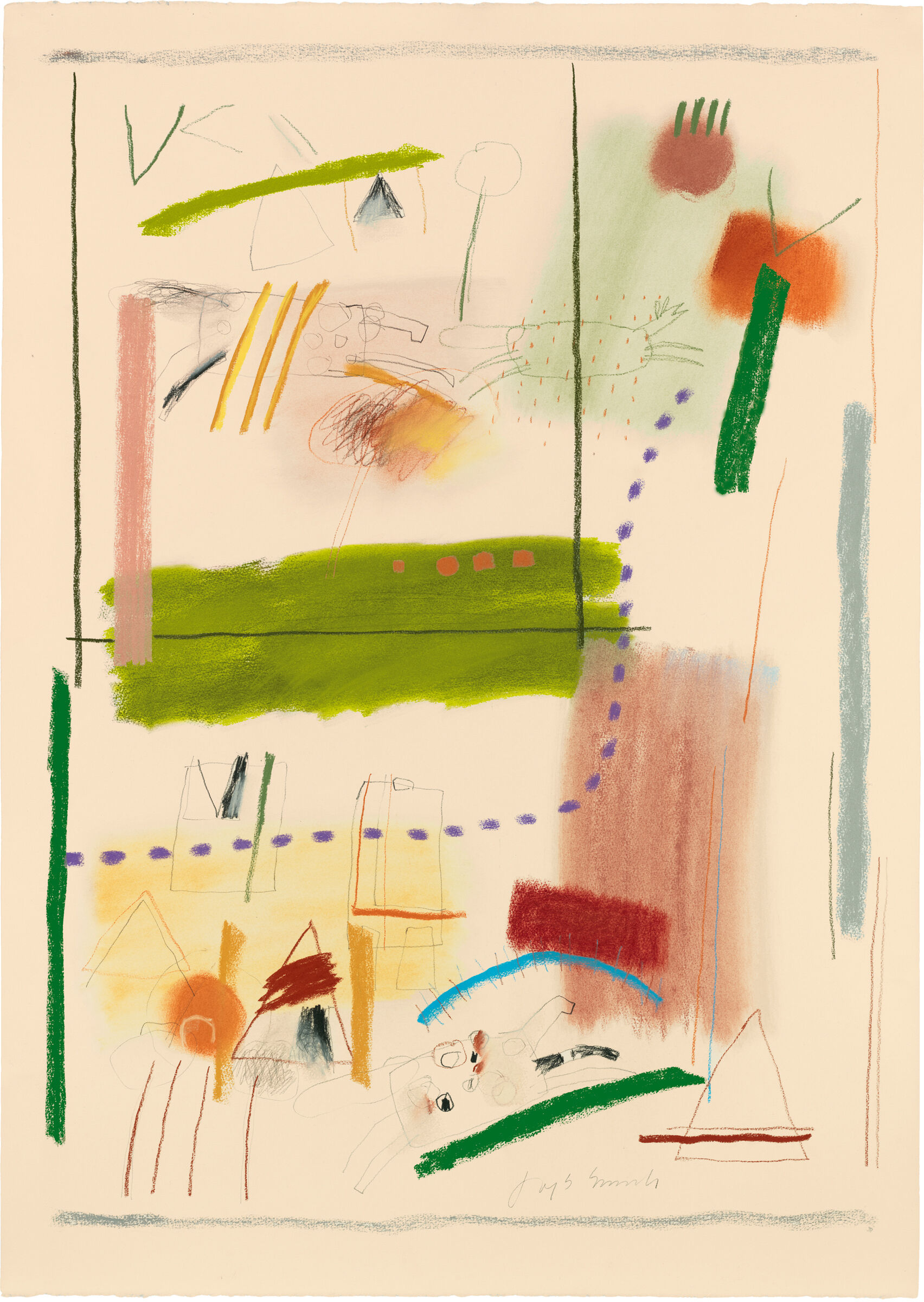
-
504
Blackwater Draw II, 1983
Audio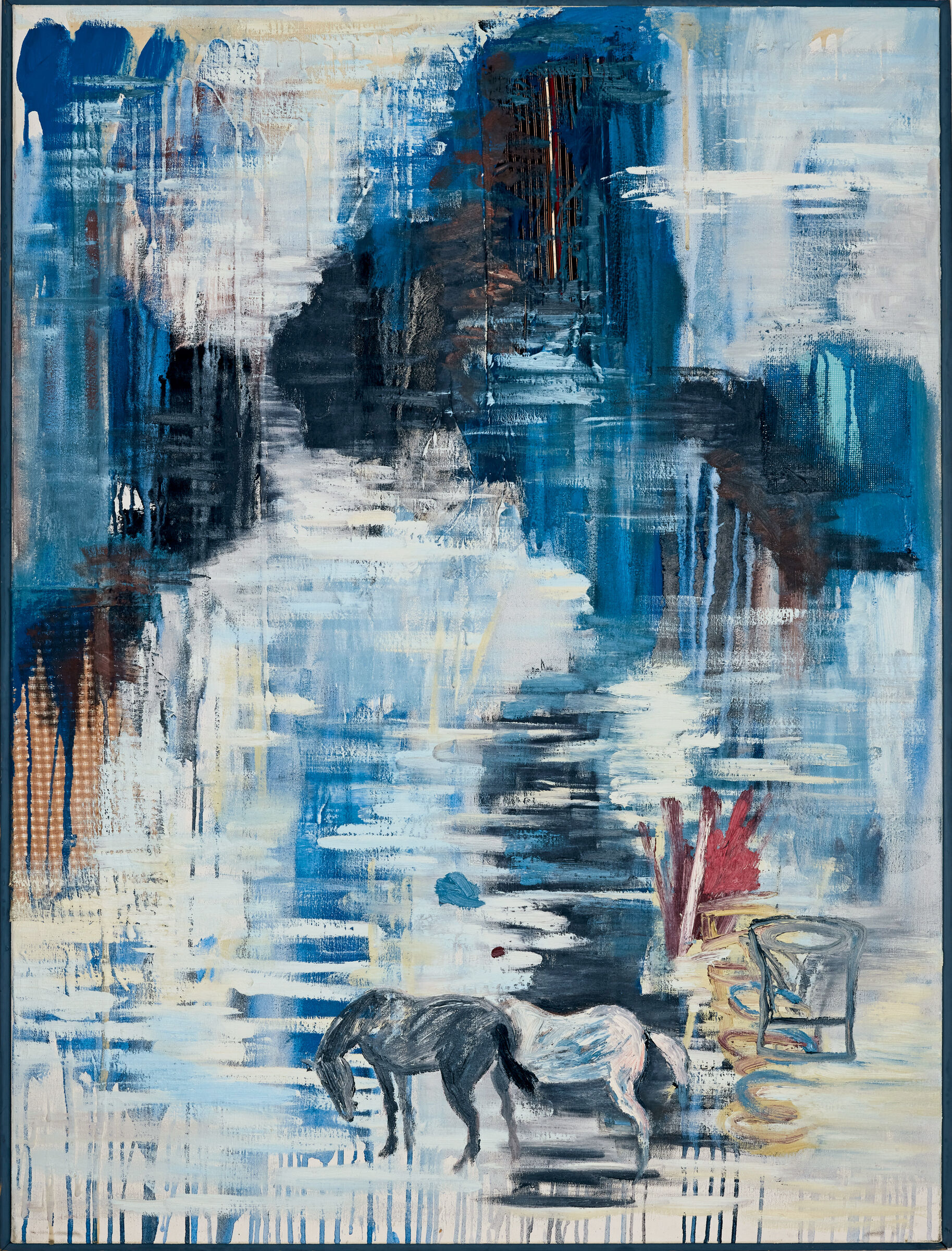
-
505
Escarpment, 1987
Audio -
506
Rain (C.S., 1854), 1990
Audio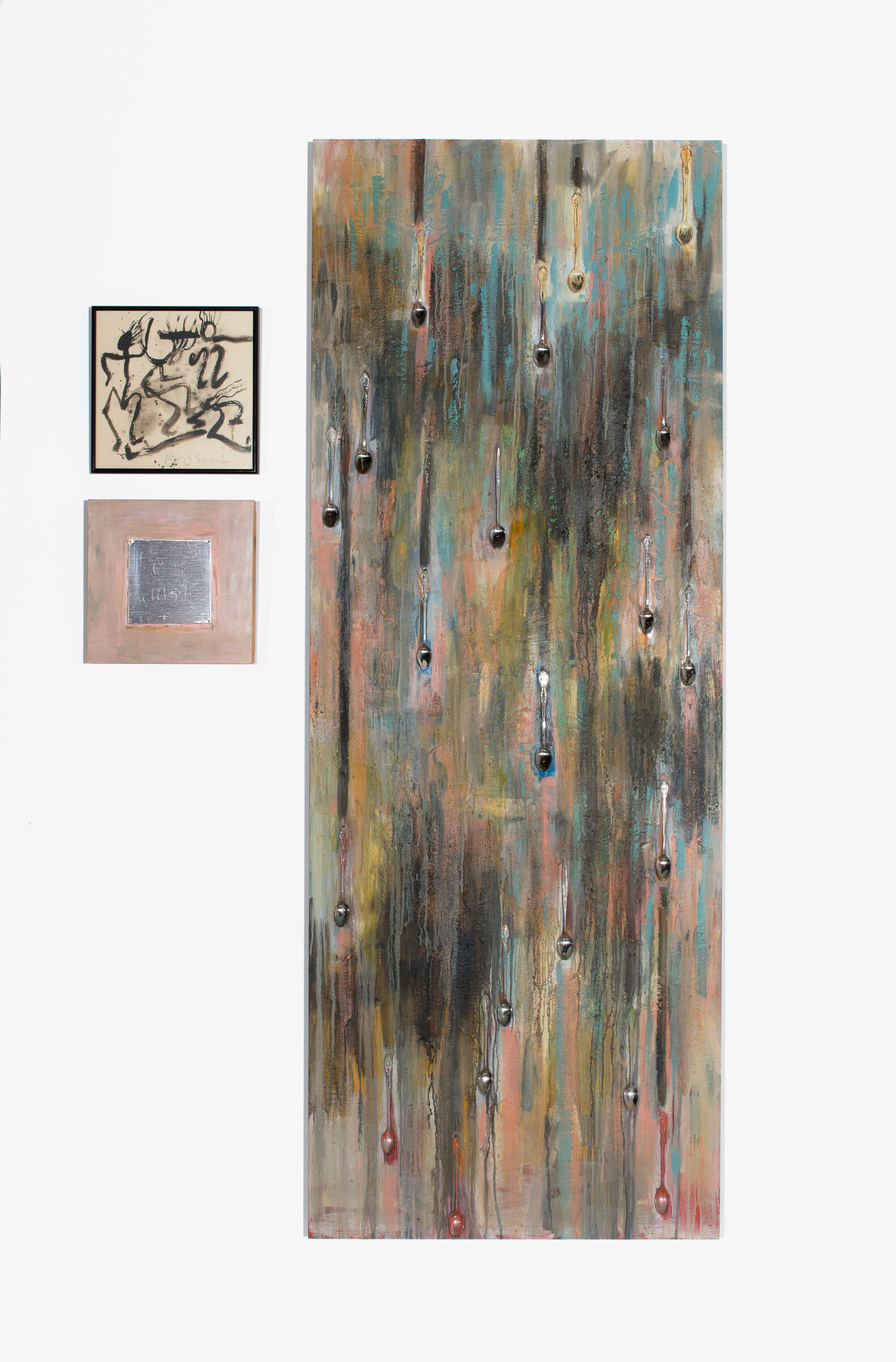
-
507
Trade Canoe (Gifts for Trading Land with White People, 1992
Audio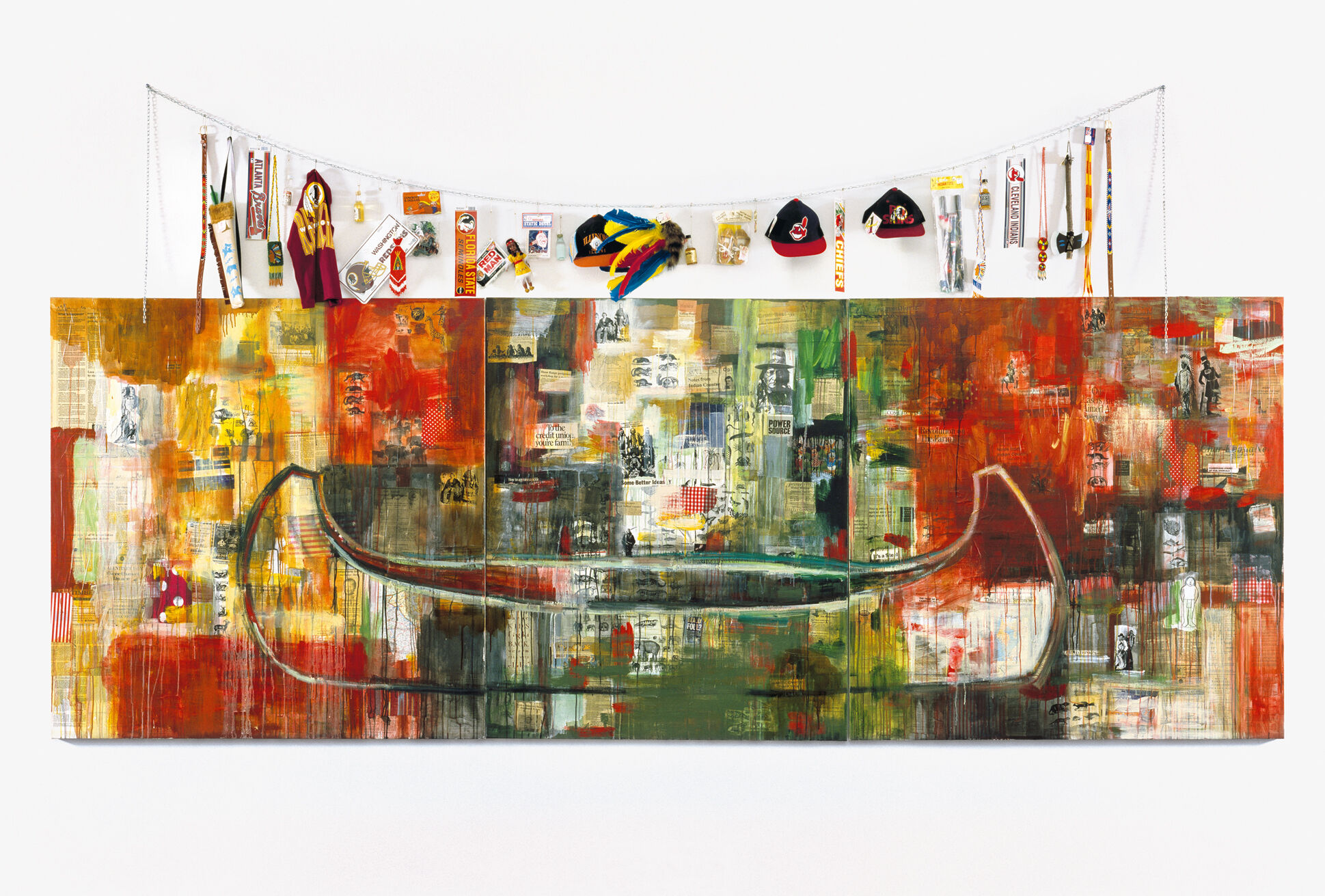
-
508
Paper Dolls for a Postcolonial World, 1991
Audio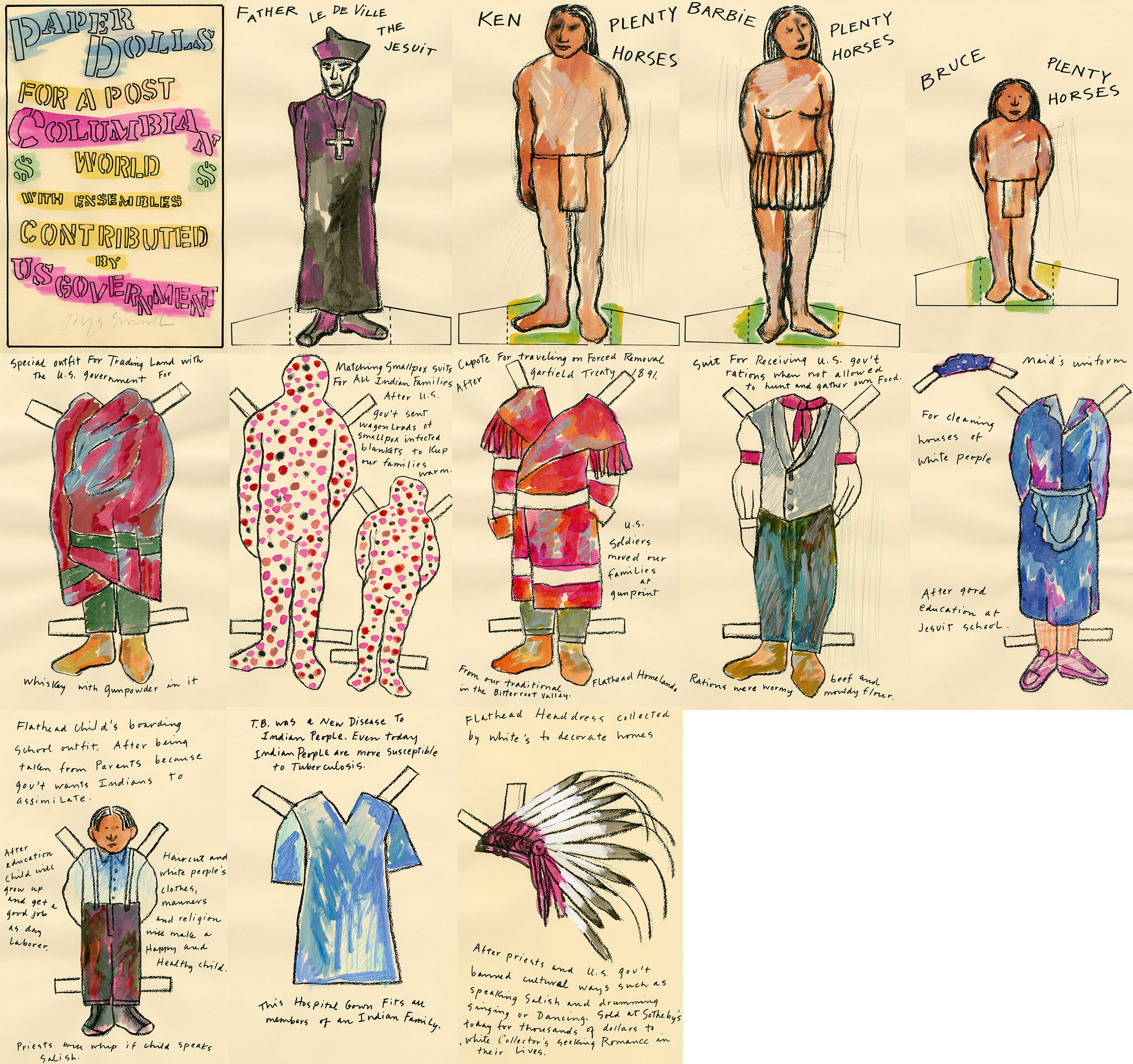
-
509
The Vanishing American, 1994
Audio, Verbal description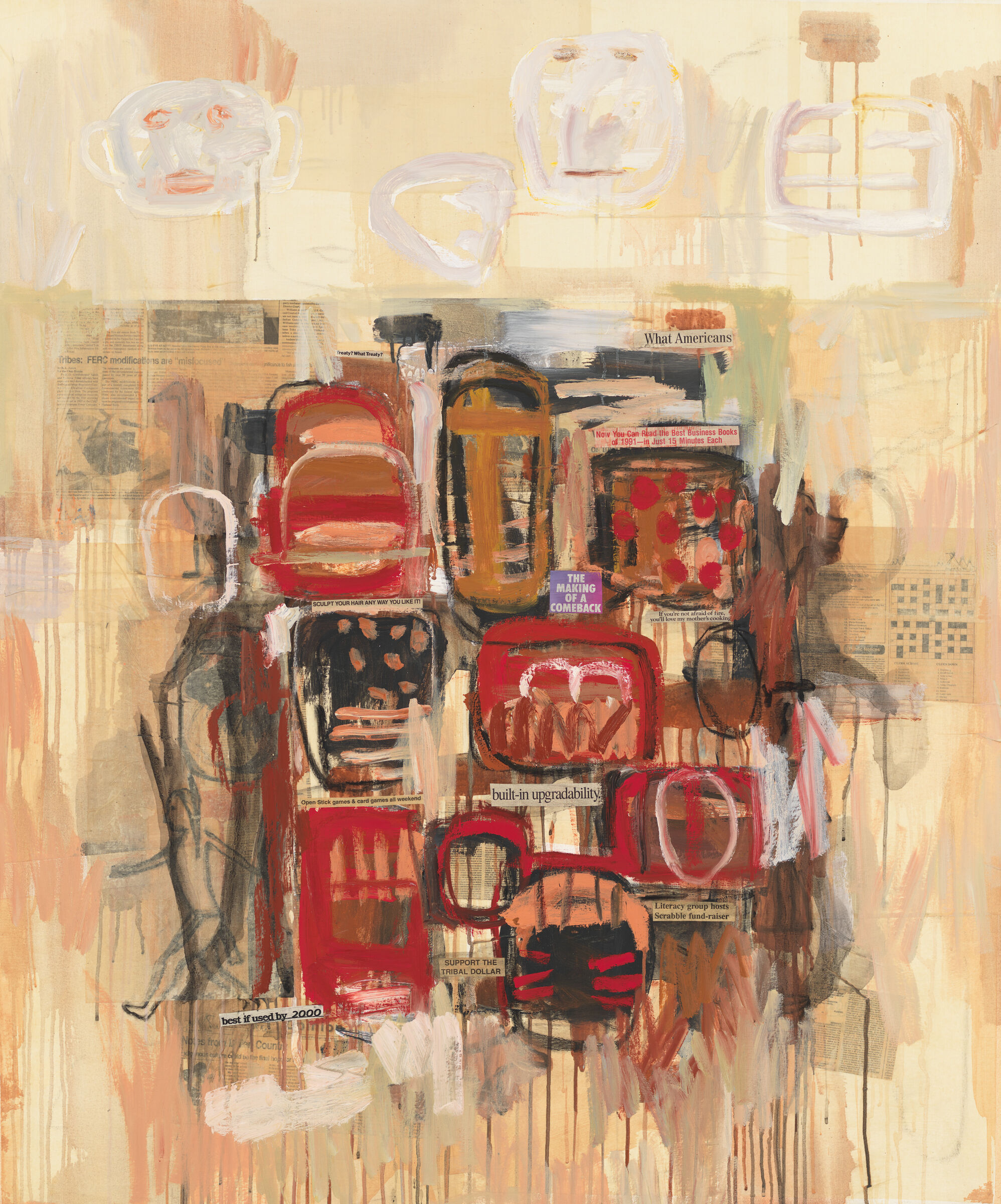
-
510
War is Heck, 2002
Audio, Verbal description
-
511
Rain 1, 1993
Audio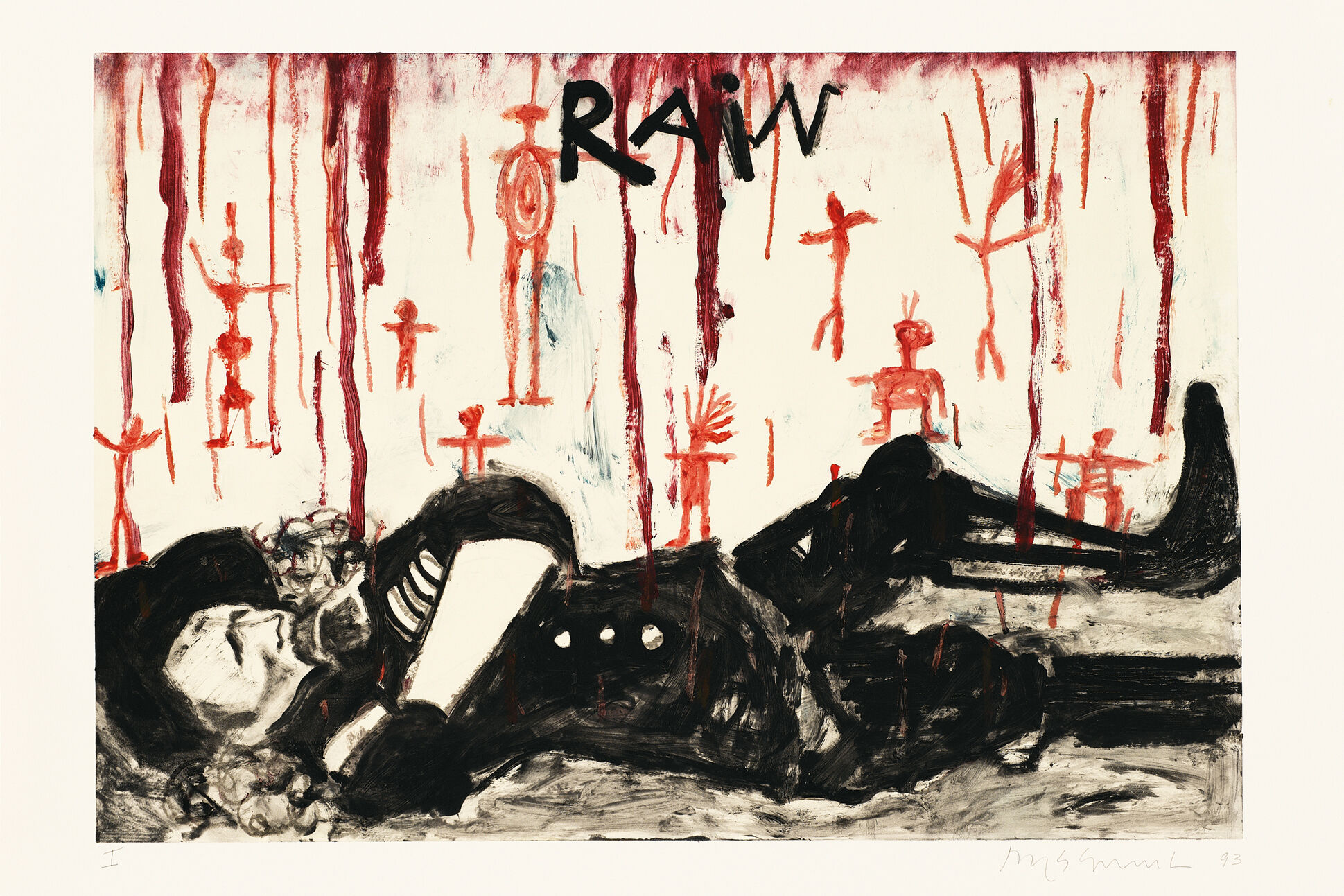
-
512
McFlag, 1996
Audio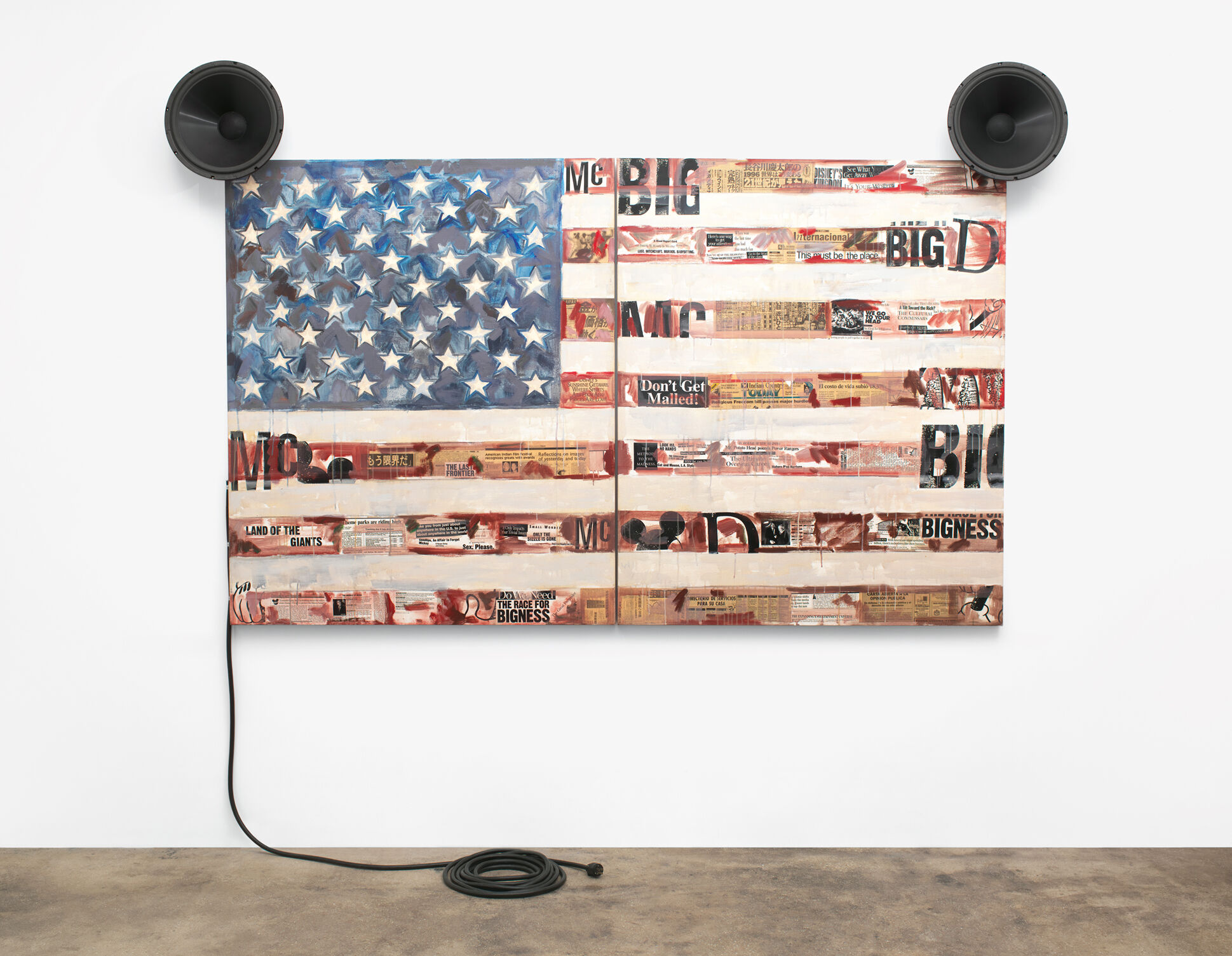
-
513
Target: The Wild West, 1999
Audio -
514
Going Forward/Looking Back, 1996
Audio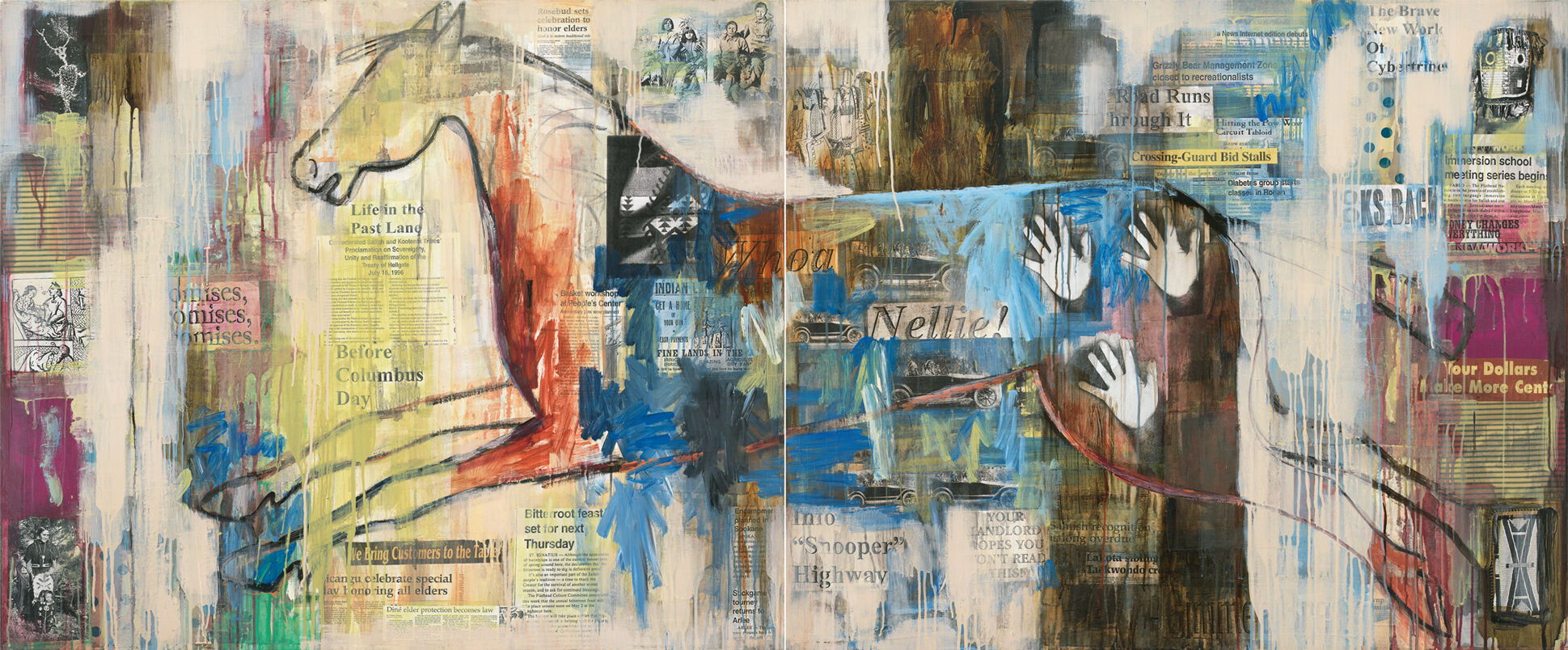
-
515
Flathead Dress: Women Who Run with the Wolves, 1998
Audio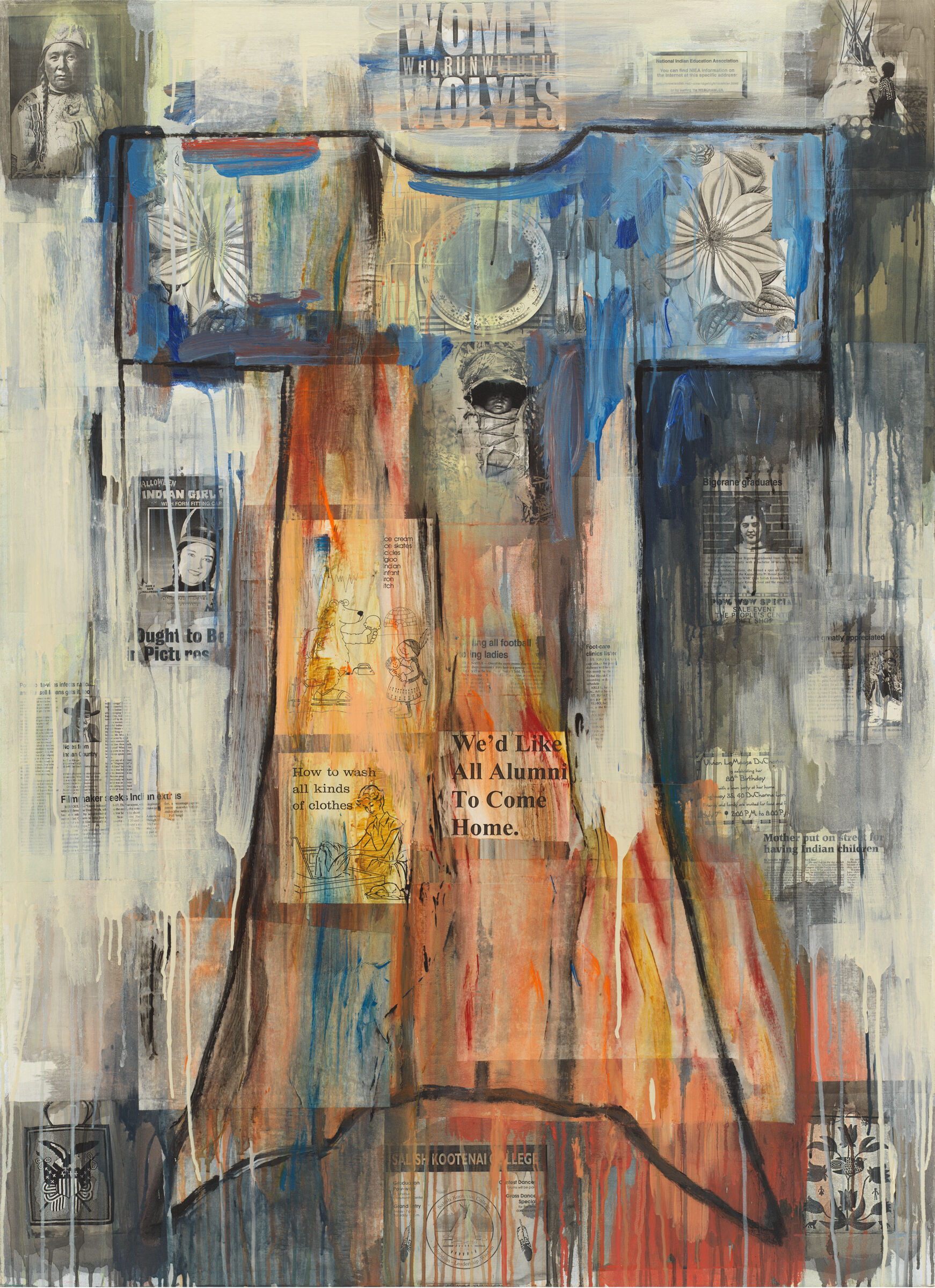
-
516
Warrior for the Twenty First Century, 1999
Audio, Transcription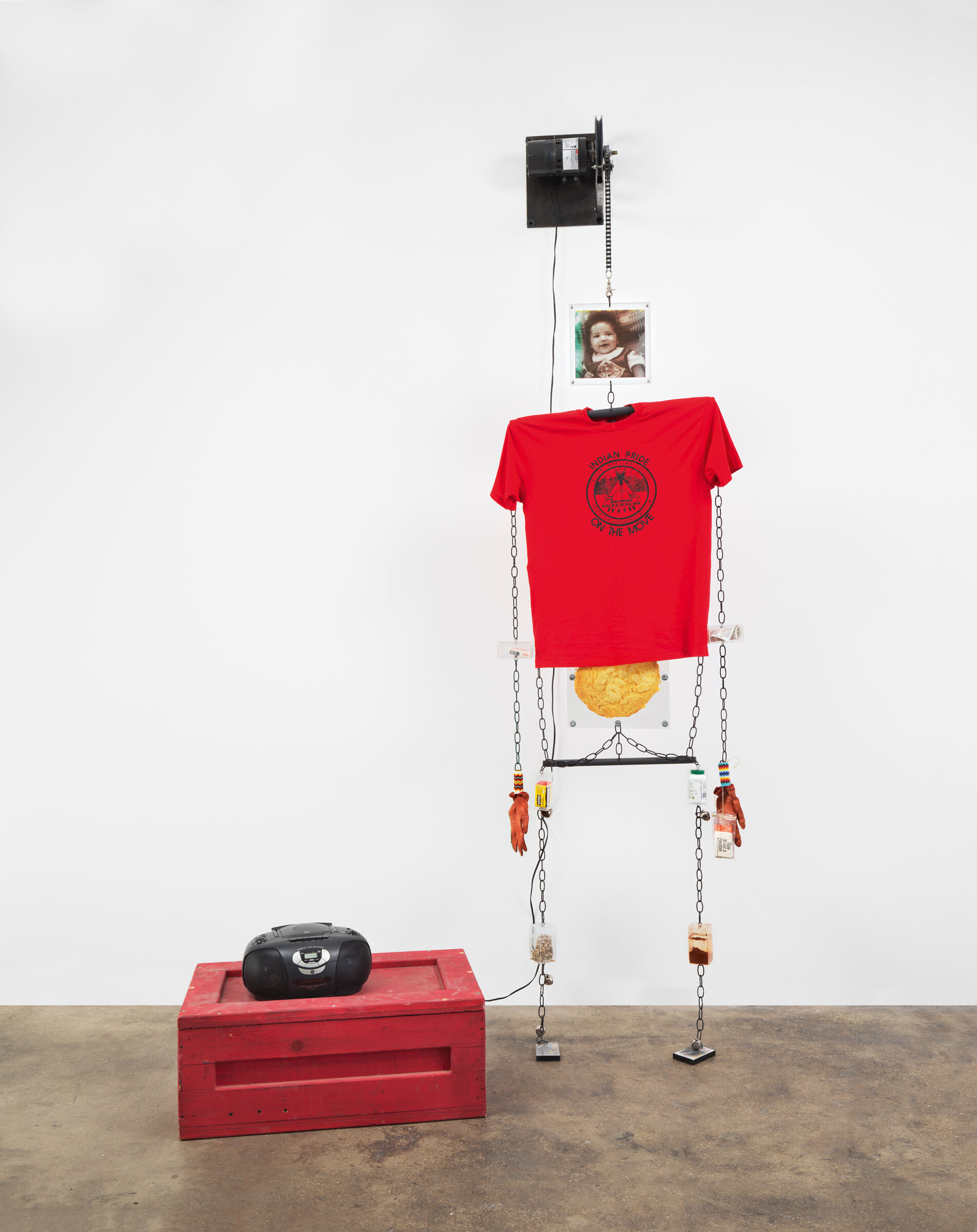
-
517
Survival Map, 2021
Audio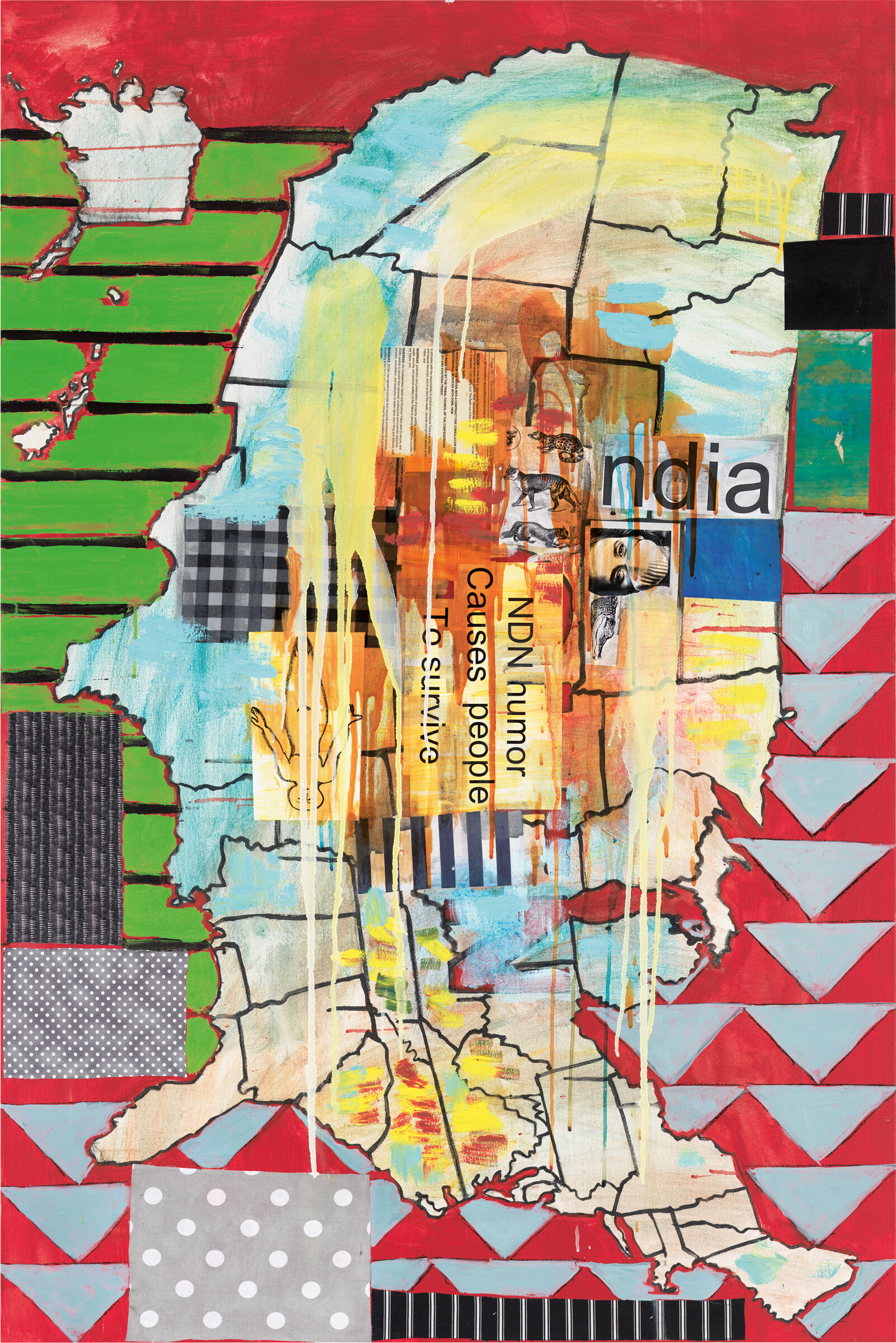
-
518
Trade Canoe for the North Pole, 2017
Audio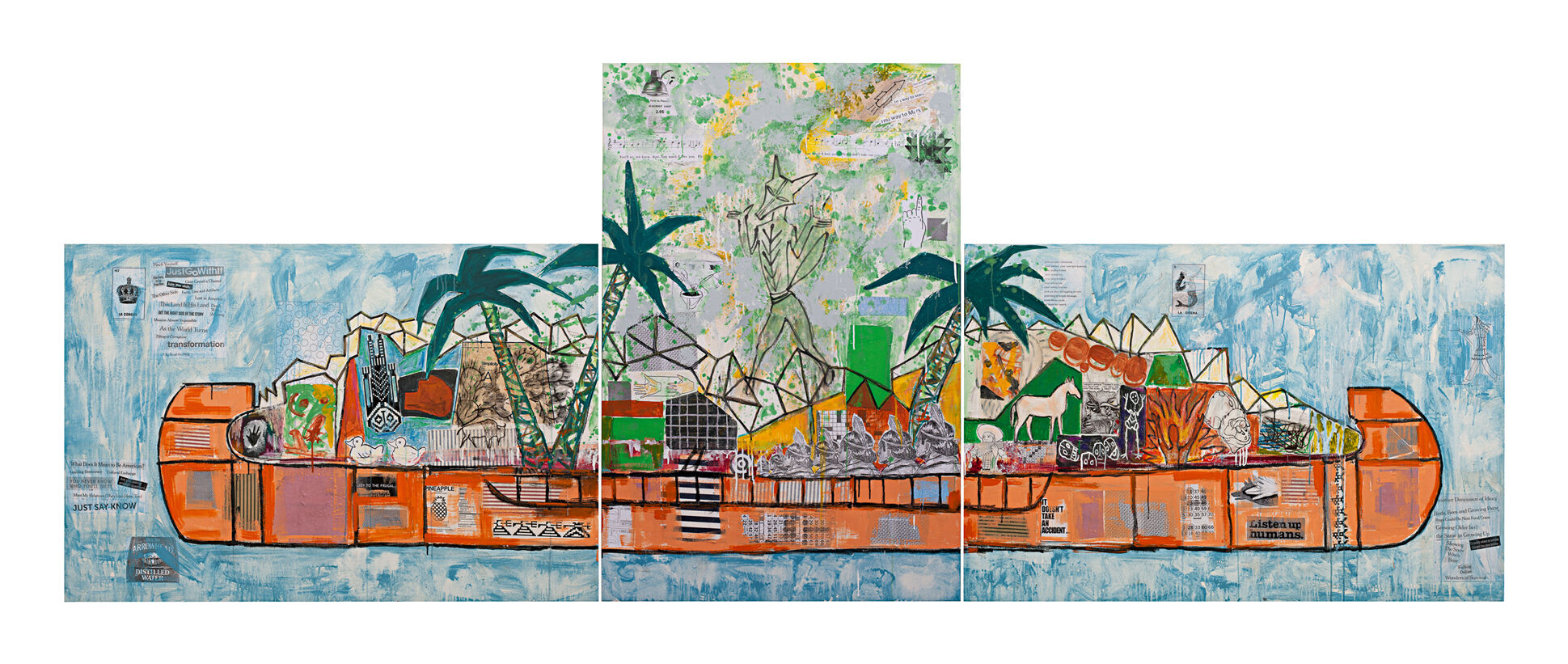
-
519
Transcription: Vision Maker Media, American Indian Artist Series II: Jaune Quick-to-See Smith, 1982
Transcription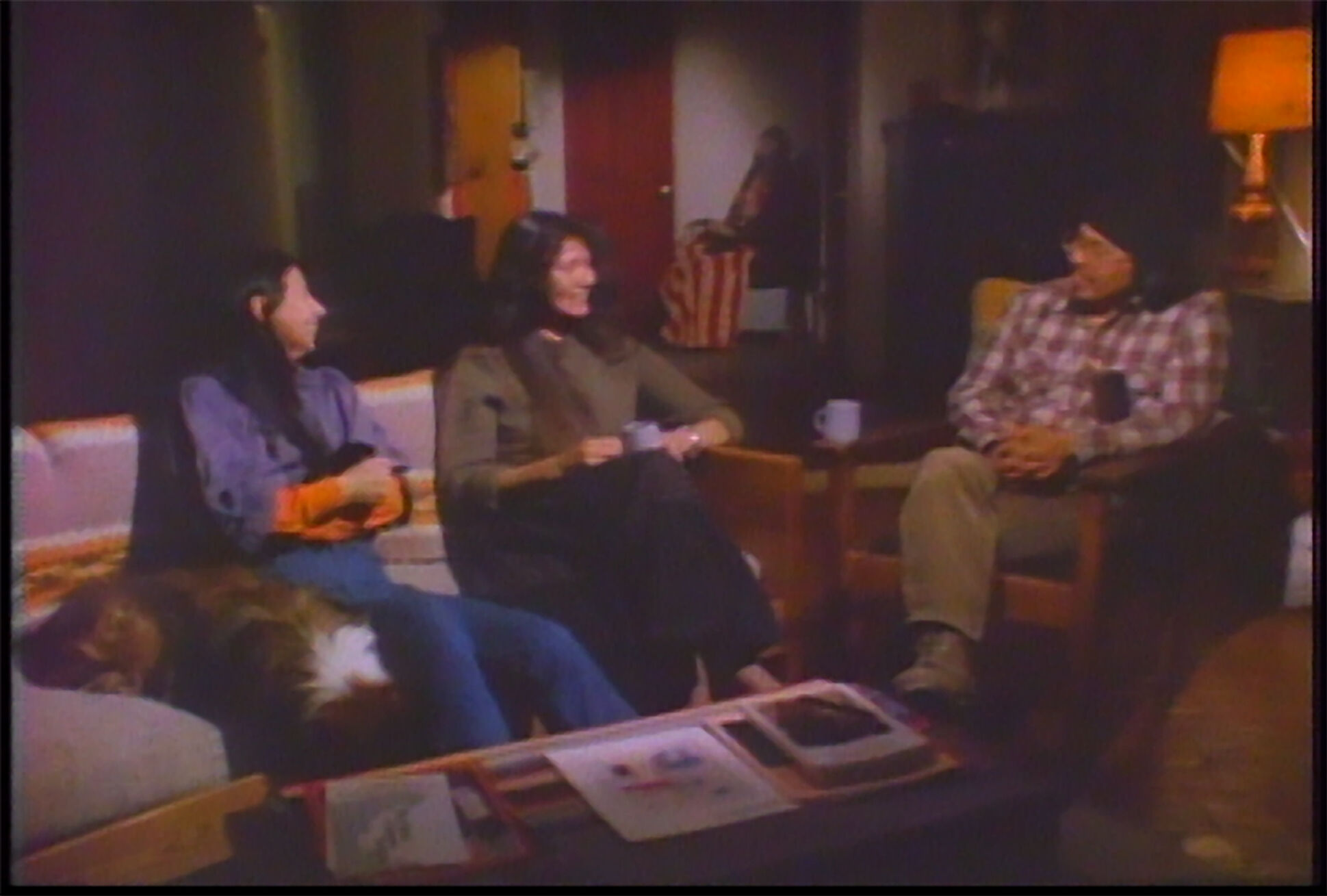
-
300
Celebrate 40,000 Years of American Art, 1995
Audio, Verbal description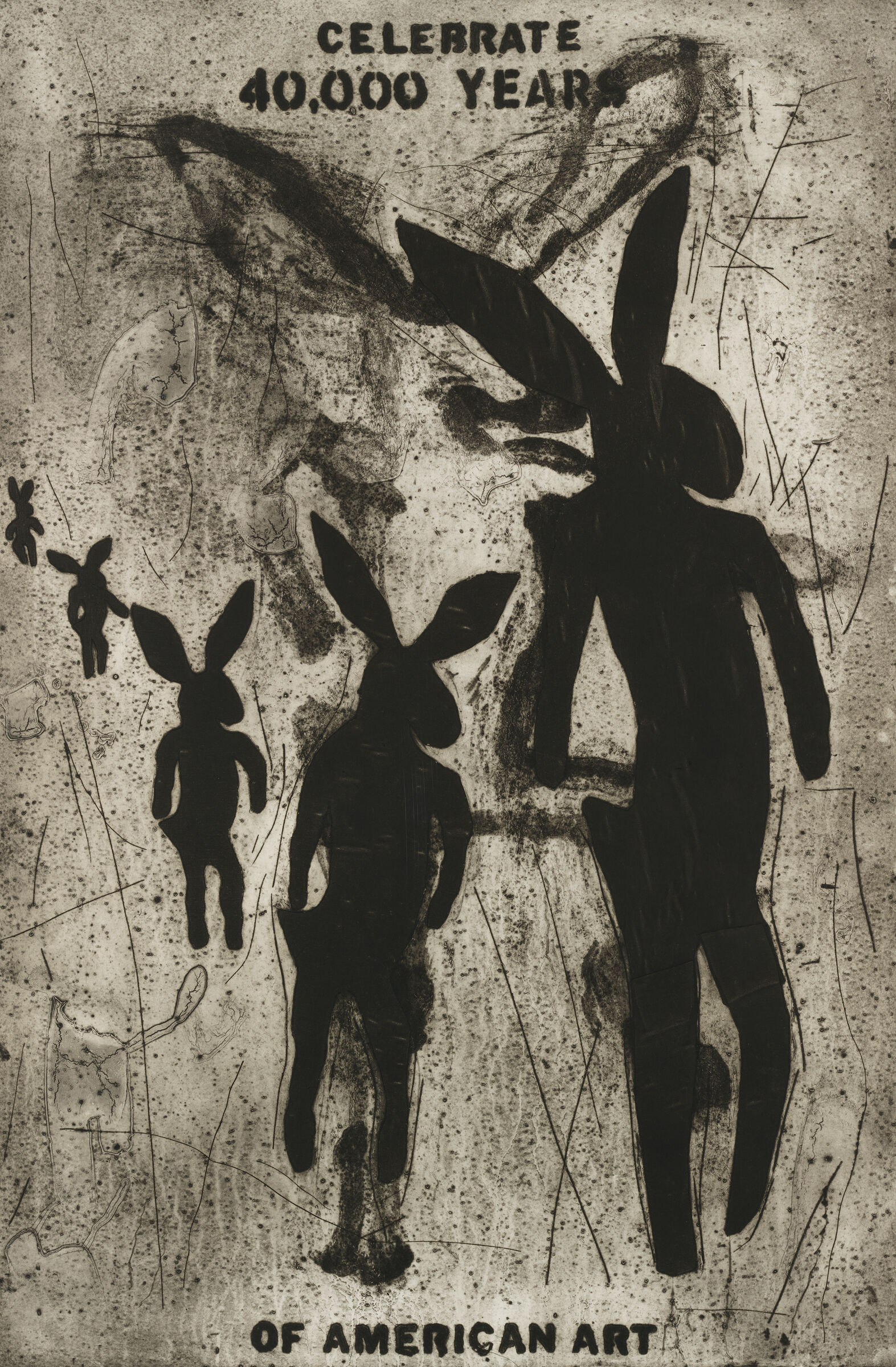
-
301
Memories of Childhood, 1994
Audio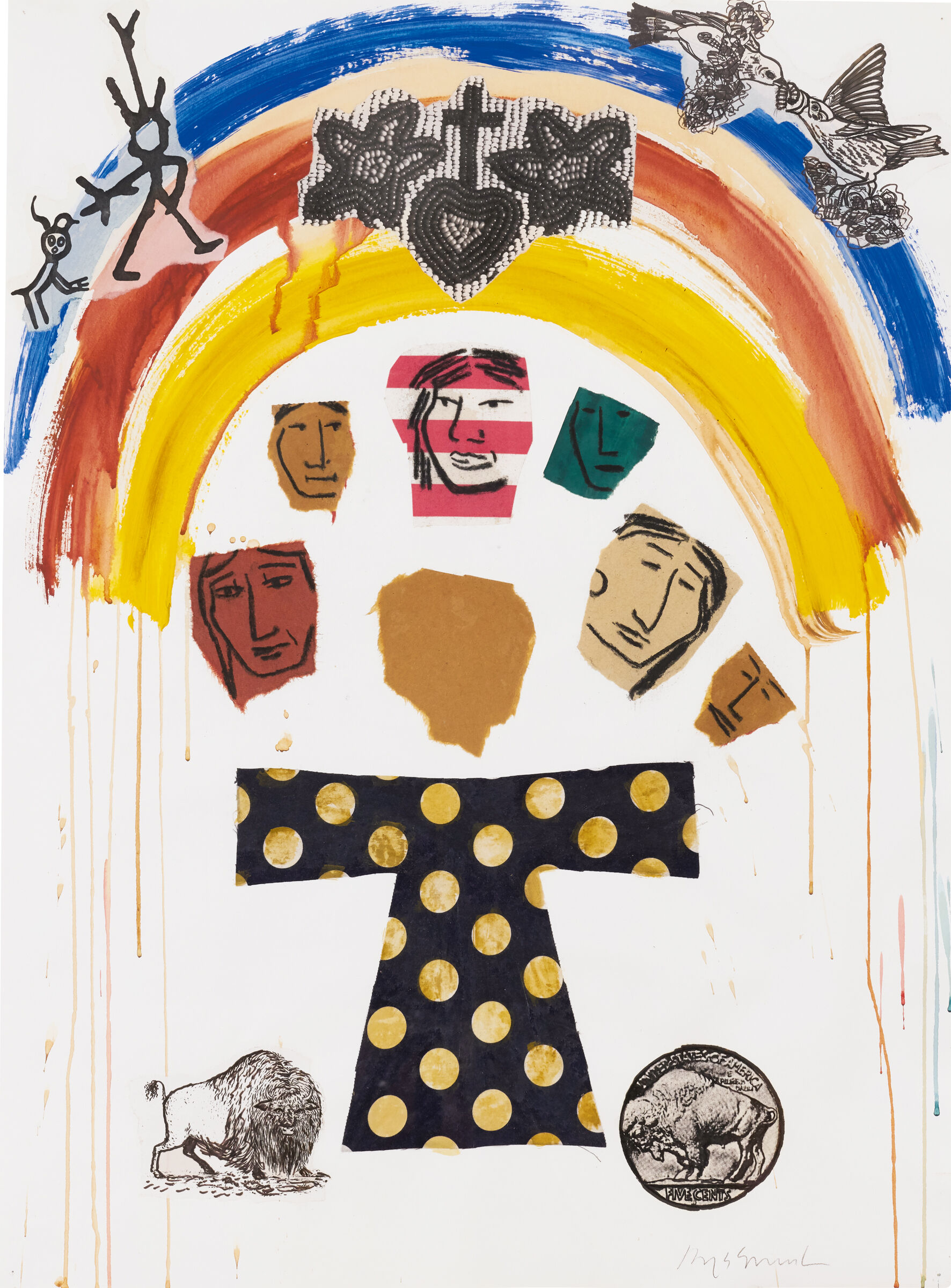
-
302
Verbal Description: Survival Suite: Nature/Medicine, 1996
Verbal description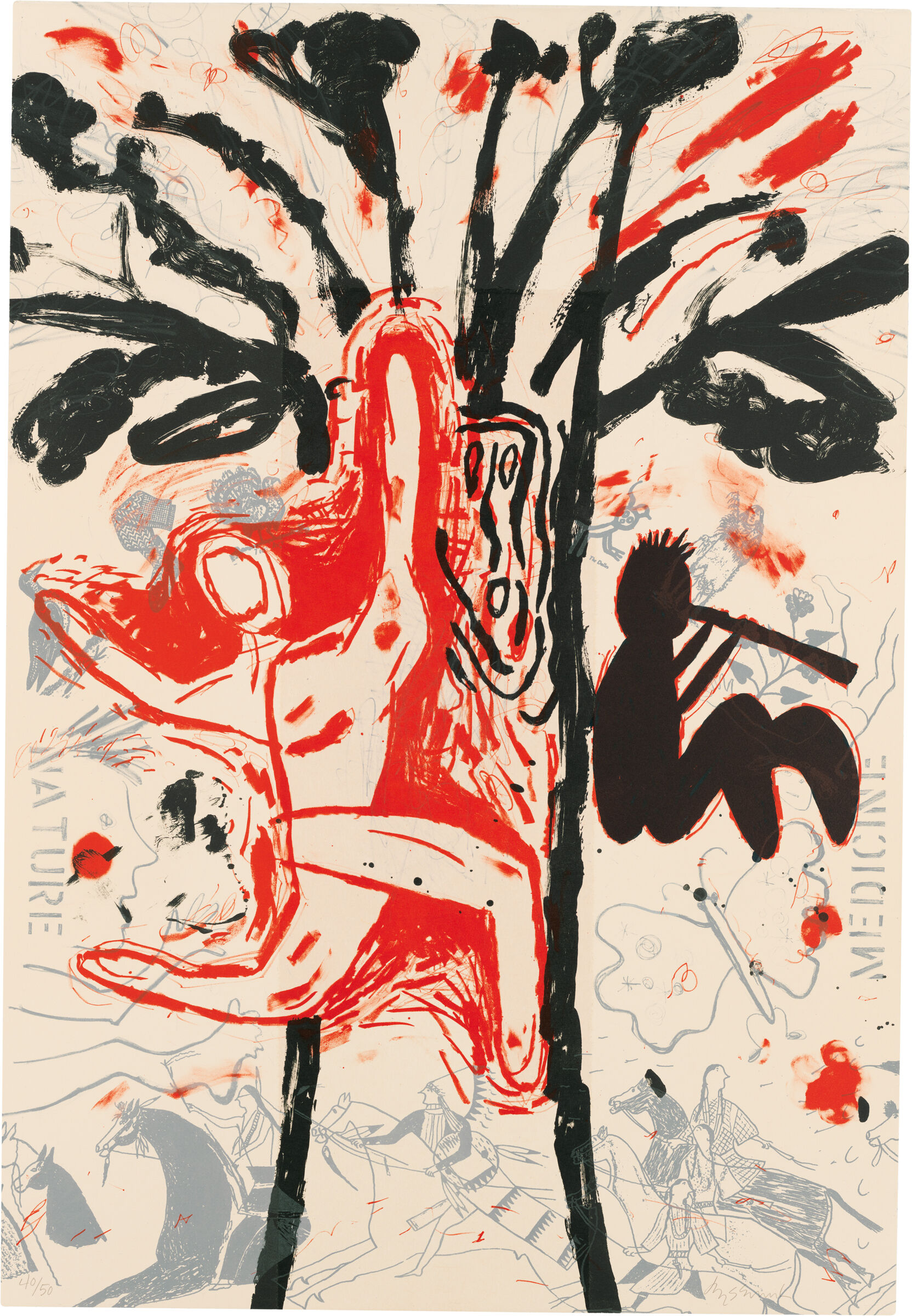
Narrator: Welcome to Jaune Quick-to-See Smith: Memory Map. Together we’ll explore five decades of Smith’s career, looking at paintings, prints, drawings and sculpture.
Jaune Quick-to-See Smith: Most people will never have heard of me. And that’s not off-putting.
Narrator: Jaune Quick-to-See Smith.
Jaune Quick-to-See Smith: It’s that maybe it will start to crack this whole issue of Native Americans being invisible. Being Indigenous in making art means that you’re looking at the world through lenses that are curved or changed by your upbringing and by your worldview.
Narrator: For Smith, who is a citizen of the Confederated Salish and Kootenai Nation, that worldview first began to form in the Pacific Northwest and western Montana. Today, Smith lives and works in New Mexico. Throughout her life and work, she has underscored the importance of the land and of Indigenous communities. As we move through the exhibition, we’ll look at the ways in which Smith addresses the traumas of Native American people with rigor, inventiveness, and critical humor.
You can use this guide to explore the works in any order you wish. As you go, you’ll be hearing not only from Smith but from writers and other artists including Neil Ambrose-Smith, Andrea Carlson, Jeffrey Gibson, G. Peter Jemison, Josie Lopez, and Marie Watt.
Narrator: When you exit the elevators, you will be confronted by two walls offset from the center. To the right is a darker painted wall with the Josh Kline exhibition information, and to the left is a soft white wall with a large painting by Jaune Quick-to-See Smith, as well as the introductory information for the exhibition. This retrospective exhibition’s full title is Jaune Quick-to-See Smith: Memory Map, and the large artwork featured alongside the information is Trade Canoe: Forty Days and Forty Nights, 2015. This piece spans three separate canvases which have all been connected; the two on the left and right are oriented horizontally, and the one in the middle is oriented vertically. The work measures sixty inches tall by one hundred inches long, and through various mediums, depicts a scene of a canoe filled up with many items and creatures, including flying skeletons with feathery wings, a buck head, a snake, a rabbit, a crying eye, and most notably, a tall, dark coyote figure oriented just right of center. This painting will have caution strips on the floor in front of it.
This first gallery space revolves around a large sculpture entitled Indian Madonna Enthroned, 1974, which is situated on a eight inch tall platform in the middle of the space. This sculpture depicts a human figure sitting sideways on a wooden chair: an American flag lies across her lap, a picture frame encases her face, and an ear of corn sits in the place of her heart. In one of her hands is a book titled God Is Red. The cradleboard on her back supports her baby, whose body is made out of sheepskin and whose face is also encased in a picture frame. This sculpture measures 52 inches by 34 inches by 20 inches. On either side of this sculpture against the wall are two works, Ronan Robe #2, 1977 and Ronan Robe #4, 1977. The Ronan Robe works include lodgepoles, or poles of pine, leaning against canvas hangings on the walls of the gallery. A strip of friction tape precedes them, but they are not secured to the wall, so please navigate around the perimeter of the room with care.
The exhibition was designed in collaboration with the artist to prioritize collectivity and a connection to outdoor spaces, informed by the artist’s own Native American ideology and values. With that in mind, the exhibition was designed not as a series of discrete galleries, but as one diffuse space where the placement of works on view are not predetermined by strict chronology or thematic elements, but a mix of both strategies. Open corners, offset walls, and large entryways between galleries encourage a cyclical and cross-pollinated approach to viewing and interacting with the work.
The center of the exhibition is a sort of segmented hallway created between the north and south sides of the whole exhibition space by the offset entrances to the galleries. Each section of wall is accented by a monumental painting, ferrying the visitor toward the wall of windows on the south side of the fifth floor. Throughout this exhibition, visitors are encouraged to reflect on their own position and the connective relationship to nature and the outdoors.
Throughout the galleries, you will find opportunities to commune with other visitors: large openings to each space and custom furniture designed to encourage conversation allow for a variety of ways to enjoy and be present in the galleries.
The first gallery space with Indian Madonna Enthroned is oriented around the earliest works of Smith’s career. The gallery opens at a forty-five degree angle into the larger exhibition space. It is not necessary, but if you would like to follow the narrative curatorial thread, you should proceed to the right after encountering Tongass Trade Canoe and work down the south side of the galleries first.
If this is the route you choose to take, you will find yourself first in the gallery containing some of Smith’s earliest maps and activism. You are invited to sit on the benches situated in the middle of this room. Moving east, the next space is focused on the early environmentalism of Smith’s Chief Seattle series, a slightly smaller gallery space. This opens into the large fourth room, featuring works made around the Columbian quincentenary. The large space has generous communal seating in the middle. The next space is oriented around the themes of imperialism and colonialism, and includes a number of works that the artist made in critique of war. If you continue east, you will find a large wall of windows, a few couches where you are invited to sit and view a cast bronze sculpture of a coyote head tilted Urban Trickster, 2021. If you loop around back toward the northside of the galleries, you’ll find yourself in a room focused on the theme of American capitalism and consumerism. In the center of this gallery, a pinewood lath and synthetic sinew canoe sculpture, titled Trade Canoe: Making Medicine, 2018, hangs suspended from the ceiling. A five inch tall platform sits below it on the ground. Continuing through the rest of the northwest galleries, you will experience two galleries subdivided by a floating wall. These spaces address the importance of Indigenous traditions and the leadership of Native American women. On the west side of the floating wall, a motorized, animatronic sculpture, titled Warrior for the 21st Century, periodically dances, moving up and down from the floor. You can find a full audio description for this piece on our mobile guide. The final gallery in this route returns to the idea of mapping with a focus on depictions of the U.S. map, and also has a view of the first gallery space with the earliest maps that were encountered in the beginning of this path. This vantage articulates the cyclical and overarching ideas that guide this exhibition.
The final gallery with work by Jaune Quick-to-See Smith on this floor is the Kaufman Gallery that can be accessed through the hallway that leads north. In the corridors as you approach the final gallery are drawings on paper, as well as a documentary video and some ephemera related to Smith’s curatorial organizing. There is a bench in this space to make watching the twenty-five minute video more comfortable. The final gallery in Kaufman is centered around the future and the environment.
It is important to note that moving south and looping around to the north is not a prescription for how you should navigate through the space. You are welcome to meander in and around through the offset entryways and exits to each gallery space. It is also important to note that while the primary exhibition is on the fifth and third floors, work by Jaune Quick-to-See Smith is also sprinkled throughout the Museum: including coyote drawings and paintings on the lower level floor with coat check, to the hallways on the sixth and seventh floor, and a coyote sculpture on the outdoor terrace on the eighth floor.
Jaune Quick-to-See Smith, War is Heck, 2002. Lithograph, photolithograph, and collage. 58 9/16 × 57 5/8 in. (148.7 × 146.4 cm). Printed and published by P.R.I.N.T. Press. Whitney Museum of American Art, New York; gift of Dorothee Peiper-Riegraf and Hinrich Peiper. Courtesy the artist and the Garth Greenan Gallery, New York.
Narrator: This painting is one of Smith’s “Trade Canoes”. It’s from 2015, but she began making them in 1992—around the 500th anniversary of Christopher Columbus’s arrival in North America.
Andrea Carlson: The idea around the “Columbian Exchange” is that the “new” world and the “old” world exchanged goods and things and ideas, but what did the Natives really get out of that exchange?
Narrator: Artist Andrea Carlson belongs to Grand Portage Ojibwe.
Andrea Carlson: We got disease, we got colonization, we got land loss, we lost species. And what did Europe get out of it? Lots of resources.
Narrator: Smith subtitled this trade canoe Forty Days and Forty Nights, evoking the Old Testament story of Noah’s Ark.
Andrea Carlson: The title is so incredibly interesting to me because, as we know, Christianity has been a colonial force throughout the Americas and colonized world, but I feel like this isn't a title in support of Christianity. But it can be about general ideas around this story of forty days and forty nights, of this flooding of the earth.
A number of us have access to Christian stories and storytelling through colonization where we wouldn't have access to a Salish creation story. In this vessel, the things that are being saved are beings, they are spirits, they are stories.
I love how at the center of this piece, Coyote emerges, Coyote as a central character with these bright beams behind him.
Narrator: Coyote is an important figure in the creation myths of tribes rooted in the Great Plains, like Smith’s Salish ancestors. Coyote is also a trickster and a productive troublemaker. As you’ll see as you explore the exhibition, he shows up a lot in Smith’s work.
Jaune Quick-to-See Smith, Trade Canoe: Forty Days and Forty Nights, 2015. Oil, acrylic, oil crayon, paper, and charcoal on canvas, three panels: 60 × 160 in. (152.4 × 406.4 cm) overall. Collection of Judith Liff Barker and Joseph N. Barker; courtesy Hood Museum of Art, Dartmouth College, Hanover, New Hampshire. © Jaune Quick-to-See Smith. Photograph by Brian Wagner
Narrator: Take a moment to look at the materials Smith used in this early sculpture, which she called Indian Madonna Enthroned. She has corn at her heart, and pheasant wings for hands. She holds a book by the Standing Rock Sioux writer Vine Deloria, which contrasts Christianity to Native religions, with their focus on the interconnectedness of all living things. While these elements suggest the figure’s connection to nature, other aspects of the work point to the ways she’s constrained by colonial forces. Her face is literally framed. If you walk around to the back of the sculpture, you’ll see that her child also appears in a frame. Look closely at the hide behind the figure’s head on the frame of the chair, and you’ll see that Smith has stenciled on the words “Property of the BIA”—or Bureau of Indian Affairs.
Smith often collaborates with her son, the artist Neal Ambrose-Smith, who restored parts of this sculpture after many years in storage. He’s talked about the flag on the Madonna’s lap, and its symbolic complexities for Native Americans.
Neal Ambrose-Smith: Many people have different identities regarding flag and flag etiquette and things that are connected to that, like war, for instance, which traditionally is the most documented way of documenting history. When we talk about history, it's always like every 200 years because there's a war connected to it or something. In Native identity, we talk about history through the land, and so it goes back 10,000 years, it goes back 40,000 years. We talk about the glaciers, we talk about the winds and the trees and how we're connected to all that, and so I think for me, that aspect of that flag really brings a lot of those things together.
Jaune Quick-to-See Smith, Indian Madonna Enthroned, 1974. Burlap, fabric, polyester batting, dried corn, leather thongs, beaded leather bands, necklaces, book (God Is Red by Vine Deloria Jr.), pheasant wings, American flag, beaded hide moccasins, two framed ink and graphite pencil drawings, Masonite cradleboard, animal hide, sheepskin and fleece, bird feet, wood chair, and painted plywood, 52 × 34 × 20 in. (132.1 × 86.4 × 50.8 cm). Collection of the artist; courtesy Garth Greenan Gallery, New York. Fabricated by Andy Ambrose. © Jaune Quick-to-See Smith. Photograph by Neal Ambrose-Smith
Narrator: In the late 1970s, Smith began making landscapes of Montana, where she’d grown up. With their abstract forms, her works stand outside of the U.S. landscape tradition that began in the nineteenth century. Those painters had a white East Coast audience in mind, and painted canvases of the western landscape suggesting that the land there was as empty as it was beautiful—ready to be claimed. In the works on view here, Smith made modest gestures to show that, in fact, the landscape had always been inhabited. Jaune Quick-to-See Smith.
Jaune Quick-to-See Smith: You know, when I go home, I would see fields of mustard, fields of fireweed, or plowed fields. And also, because there was so much talk about the wilderness being empty space, I put bird tracks in, and sometimes little animals, horses. And in some cases here, I've got pictographs that you would see on the plateau. So they're kind of made up landscapes, but they're all based on what I would see at home.
Narrator: Kalispell #1 is a vertical pastel and charcoal drawing on paper, 41 3/4 inches high by 29 5/8 inches wide. The paper is a beige color with both abstract and abstract and colorful marks often related to animal, human or natural themes. Several thick and thin lines of gray, brown, black and green create a vertical rectangle by the edges of the paper outlining the image. This composition appears like frames within frames. In the upper left corner of this rectangle, black lines create another vertical rectangle that takes up a bit more than one quarter of the space. There are a few large, washy rectangular shapes throughout the composition that the artist would have drawn first before layering the thinner pictorial drawings on top. In the middle of the work, slightly off-center to the left, is a green horizontal rectangle shape made from at least two green pastel houses. Hanging down vertically off that green rectangle’s lower right edge is a light pink rectangle about the same size. In the lower left quadrant, there is a whisper of yellow in the shape of another horizontal rectangle. And in the upper right quadrant there is a very faint green vertical patch. The greens, pinks, and yellows echo and repeat in other lines and marks throughout the work, creating a visual cohesion. There are only two marks whose colors do not repeat: one is a dotted purple line that travels in an L-shape from the upper right quadrant to the mid-lower left part of the page. The other is a slim blue arc shape in the middle/bottom area. The hue of the blue is vivid and brilliant, in contrast to the mellow, earthy tones of most of the shapes and lines.
The colors, taken together with the composition, suggest a kind of cartography or charting of the natural environment. The thinnest lines in this drawing are the least abstract ones, and if we inspect them, they reveal triangular tipis and animal shapes. Centered at the bottom of the image is an abstracted animal with a thin black outline, a boxy spotted body, and rounded tail. The animal leaps over a thick stroke of green and above it is a curved stroke of blue with thin brown and blue lines intersecting the blue curve. To the right of this animal, there are thick vertical yellow lines on either side of a tipi outline, with a charcoal-drawn entrance. In the upper left frame mentioned before, there are two, four-legged animals drawn with loose and very thin simple lines. The left animal is drawn with black lines and appears similar to a horse with a long neck and a boxy body and face. There is a faint wash of light pink behind it. It has a sketchy tail, and its body has several circular spots. Three yellow diagonal lines overlap its body. The animal on the right is drawn with green lines and has a long round body and tail. It has thin pointy legs and a small pointed face with an open mouth, and across its body are rows of orange dots reminiscent of falling rain. The animals leap over a cluster of brown scribble-like loops smudged with yellow above a thick horizontal patch of green with a row of four small orange dots, and behind them is a long vertical stroke of pink.
Above the animals are triangular shapes, a swipe of green, two short horizontal lines, and a circle with a line coming down from inside the middle of the circle. The artist signs her name small and in cursive at the bottom of the image in between the leaping animal, triangle and a gray horizontal line that frames the image.
Kalispell, the title of the work, is the name of a city just north of the reservation of the Confederated Salish and Kootenai, where Quick-to-See Smith grew up.
Jaune Quick-to-See Smith, Kalispell #1, 1979. Pastel and charcoal on paper, 41 3/4 × 29 5/8 in. (106 × 75.2 cm). Whitney Museum of American Art, New York; gift of Altria Group, Inc. 2008.137. © Jaune Quick-to-See Smith
Narrator: In Blackwater Draw II, Smith layered fabric, painted abstraction, and images of horses. It’s from a series of paintings she made reimagining ancient Native sites. She named them after the sites, many of which she had researched but hadn’t seen firsthand.
Jaune Quick-to-See Smith: So I have to imagine what I might think a Blackwater Draw might be.
And that means a sort of canyon-like place, a narrow place between the rocks. And so that's what I'm forming here. You can see these narrow channels of water, and they’re dark. And so my imagination has to make it up if I can't find a picture. Remember, in the days when I did this, 1983, there were no computers. There were no cell phones. There was only the library.
And I'm interested in what information is available. It's very hard to find. There's not a lot written on our history. So threaded all the way through this show are little soundbites in some way about this history in the United States that's not told and not known.
Jaune Quick-to-See Smith, Blackwater Draw II, 1983. Acrylic and fabric on canvas, 48 × 36 in. (121.9 × 91.4 cm). The John and Susan Horseman Collection; courtesy The Horseman Foundation. © Jaune Quick-to-See Smith. Photograph by Jenna Carlie
Narrator: Smith made Escarpment and a number of other works nearby during a battle to save a sacred site near Albuquerque, New Mexico, not far from her home and studio. Developers wanted to build a highway through the area, destroying access to the ancient petroglyphs there. In this work—and many others in the exhibition—Smith’s activism became a driving force behind the content and her compositional choices. Josie Lopez is the Head Curator at the Albuquerque Museum.
Josie Lopez: You can feel this frenetic energy that's coming from the work, and that's really about the entrenched struggle that was happening. And then of course to the left you see these line drawings that are echoing the glyphs that are carved into the rocks in this particular park that are what makes them sacred land, but also is what draws many Indigenous people to those lands in order to practice different beliefs and rituals.
Narrator: Thanks to the work of Smith and other activists, Petroglyph National Monument was created in 1990, though the site remains vulnerable to development.
Narrator: Smith called this work Rain (C.S., 1854). G. Peter Jemison is a member of the Seneca Nation heron clan.
G. Peter Jemison: As you move around the painting, you would be struck by this light being reflected from the spoons. And I like that idea, because it's difficult to capture, really, what rain looks like if you try to paint it.
Narrator: The “C.S.” of the painting’s subtitle stands for Chief Seattle, who was a Suquamish and Duwamish chief during the middle of the nineteenth century.
G. Peter Jemison: Chief Seattle, of course, is famous for making an early statement about the necessity to live in harmony with the natural world, and not to be in the process of destroying it. Perhaps Jaune's commentary here is related to what is it, that is, now not only in the soil, but what is coming from the atmosphere. Because of the kind of air pollution that we now live with.
Narrator: Smith made this painting after traveling around the northeastern United States with Jemison, and encountering the effects of acid rain on forests in upstate New York.
Jaune Quick-to-See Smith, Blackwater Draw II, 1983. Acrylic and fabric on canvas, 48 × 36 in. (121.9 × 91.4 cm). The John and Susan Horseman Collection; courtesy The Horseman Foundation. © Jaune Quick-to-See Smith. Photograph by Jenna Carlie
Narrator: This is one of Smith’s earliest “Trade Canoes”. From the beginning, she drew on the importance of canoes to Native peoples in order to make complex statements about their experience of American history.
Jeffrey Gibson: I think for Indigenous people, it is mobility. It is the ability to be able to travel.
My name is Jeffrey Gibson. I'm an artist. I live in the Hudson Valley, and I'm a member of the Mississippi Band of Choctaw Indians and half Cherokee.
What's interesting about this painting is we don't know the direction. All the directions are removed. There is no front end of the canoe versus the back end of the canoe. It's empty and it's in a chaotic world that that version of the canoe doesn't really make sense.
All of the kind of text and imagery that she's put here are the things that have robbed us of knowing the Indigenous definition of a canoe. And I think putting the trash on the string above the painting, those are also just those images and those texts brought into object form, mass-produced all over the world, cheap and plentiful.
This painting of the canoe down below and all of the text and imagery that surrounds it speaks in the same way of this kind of difficult, challenging world for Indigenous people to find and navigate who they are as contemporary people, who they are as traditional people, who they are in relationship to their communities and their families. And then you hang this…I'm going to use the word trash, and I don't mean that, but I mean it sort of like this very much throwaway culture…this kitsch and camp racist memorabilia hanging above it on the string. I think it's sort of the audacity of this painting that makes it really successful.
Jaune Quick-to-See Smith, Trade (Gifts for Trading Land with White People), 1992. Oil, paper, newspaper, and fabric on canvas with thirty-one found objects on a chain, four parts: 86 × 170 in. (218.4 × 431.8 cm) overall. Chrysler Museum of Art, Norfolk, Virginia; museum purchase in memory of Trinkett Clark, Curator of American and Contemporary Art. Fabricated by Andy Ambrose. © Jaune Quick-to-See Smith
Jaune Quick-to-See Smith: I made some paper dolls based on Barbie and Ken. Their name is Barbie Plenty Horses, which is an old family name at home for people in my tribe, Barbie Plenty Horses and Ken and Bruce, the little boy. And how they got a good education by the Catholic priests, learning how to polish door knobs and clean floors.
Narrator: The drawings recount the many traumas that Native Americans have experienced at the hands of the U.S. government. The first one shows a Jesuit Priest—an educator, and a leader in the policy of forcibly divorcing Native American children and youth from their languages and cultures.
Jaune Quick-to-See Smith: That is the story of genocide right there. Part of it. Genocide isn't just slicing our throats and putting a bullet in our heads, that is back in our families. We all know that. But it is what the government and the churches have done to us. When they took our language away–like bam! Everything that we had in life, my father and all my aunties and uncles that we knew, all the knowledge that we had, our language had given us names of all the mountains at home, all the rivers, all everything, our language gave us all this, told us who we were and, and how we got here. It’s like, they gave us a lobotomy. That's what they did to us when they take away your language and parts of your culture and it's not there and they do it in one generation, your head has a big hole in it.
Jaune Quick-to-See Smith, Paper Dolls for a Post- Columbian World with Ensembles Contributed by the US Government, 1991. Watercolor and graphite pencil on xerographic paper copies, thirteen parts: 17 × 11 in. (43.2 × 27.9 cm) each. Eiteljorg Museum of American Indians and Western Art, Indianapolis; museum purchase from the Eiteljorg Fellowship for Native American Fine Art in honor of Gail Kirchner for her commitment to Native American artists and the Eiteljorg Museum 1999.9.3.  Jaune Quick-to-See Smith. Photograph courtesy the artist and Garth Greenan Gallery, New York
Narrator: Smith called this painting The Vanishing American. It mixes brushy abstraction with headlines clipped from newspapers. In the upper right, one reads “What Americans,” pointing loosely to the painting’s ironic explorations of identity.
Jaune Quick-to-See Smith: See there's always this thing about "the vanishing Native American." The vanishing American Indian. And we've been hit with that all of our lives. That, "oh you guys are so watered down." "Oh you guys are so mixed blood, you don't know who you are." "Oh you're so bastardized, you have no culture left."
Narrator: Smith said she was inspired to make the painting after a community meal during medicine lodge ceremonies on the lands of the Blackfeet Nation, near her childhood home.
Jaune Quick-to-See Smith: And then when everybody would gather to eat, people would start talking about, “And, you know, the white people are just going to do themselves in with all their poisons and all the pesticides and everything that they're using on our food. And so they're just going to be the vanishing white men.” And then everybody would laugh.
So I came back into the studio, and here I found this sign called built-in upgradability out of some New York Times or some ad or something. And I said, yeah, that really fits what the elders are saying, that we're going to make it through this. Built-in upgradability, that's what we have. We've been here for thousands and thousands of years. They just got here yesterday. They keep pretending like, oh, we just got here before them. Well, that's not true. We've been here since the creation time. So the making of a comeback.
Narrator: The Vanishing American is a vertical mixed media painting on canvas measuring about 60 inches high by 50 inches wide. In the middle and slightly towards the bottom of the painting is a cluster of head-like shapes interspersed with marks and newspaper clippings. The cluster is primarily red, orange, brown, black, and is surrounded by beige, pale pink, tan and white colored painterly marks, which peek through the cluster and drip down the canvas surrounding the cluster. The top one quarter section of the painting contains what appears to be a row of four faces painted loosely in white with ambiguous paired down features. The bold colored cluster underneath contains many square shapes with rounded corners. Some are painted with a black or white thin outline or thicker red outline, and some are filled in with dots or horizontal lines. Long and short, horizontal, vertical and zigzag strokes fill and surround the rounded shapes and their darker colors drip down the bottom of the canvas. Emerging from the edges of the cluster is the outline of three figures. Coming from the top right edge appears to be the side profile of a brown bear. Coming from the top left edge is a black outline of a bird with a long neck and long legs, obscured by vertical strokes of beige paint and a white oval and coming from the bottom left is a black outline of a person with their arms and legs outstretched as if running or in motion.
The newspaper clippings that are placed throughout the cluster are various sizes; some are a few words while others are longer text. Four clippings of longer text peek out from underneath washes and drips of paint by the edges of the cluster. Visible text on the top right clipping by the bird reads “Tribes: FERC modifications are “misfocused”. A clipping by the bear reads “Advisory Deadline” next to a crossword puzzle. Paragraphs of small text peek out through the bottom right corner. Coming out from underneath the running figure are thicker paint drips and brush strokes that read “Notes from Indian Country,” which, along with the crossword puzzle clipping, have a newspaper header featuring several tipis. The visible text from the clippings scattered across the black, brown and warm colored cluster from top to bottom reads “What Americans”, “Treaty? What Treaty?”, “If you’re not afraid of fire, you’ll love my mother’s cooking”, “Open Stick games & card games all weekend”, “built-in upgradability”, “Literacy group hosts Scrabble fundraiser”, “SUPPORT THE TRIBAL DOLLAR”, and “best if used by 2000”. The small square clipping reading “The making of a comeback” in particular sticks out with its contrasting blue-purple gradient background.
The title of the work, The Vanishing American, is a pointed critique of the notion that Native American people and culture have been dispersed and diminished. Quick-to-See Smith takes the idea and turns it on its head: instead imagining the disappearance of white America. About this work, she has said: “the culture's changing…this is what’s happening, the Browning of America.”
Jaune Quick-to-See Smith, The Vanishing American, 1994. Acrylic, newspaper, paper, cotton, printing ink, chalk, and graphite pencil on canvas, 60 1/8 × 50 1/8 in. (152.7 × 127.3 cm). Whitney Museum of American Art, New York; gift of Dorothee Peiper-Riegraf and Hinrich Peiper in memory of Arlene LewAllen 2007.88. ©️ Jaune Quick-to-See Smith
Narrator: In War is Heck, Smith used a printmaking technique called chine-collé to collage bits of paper onto the background. Throughout this work, the artist inserts references to war. In the upper left hand corner, you can find a card from the Mexican game of chance, lotería. It reads “El Soldado,” the soldier.
Jaune Quick-to-See Smith: It’s like the common people going to war, being led to slaughter. Because the dictators or the men in power, you know they always stay safe and the people wind up on the battlefield, or in their villages. And often it's the women and children.
Most of the time in the 2000s I was reacting to the issue of the Iraq War, or, you know, things that were going on in the Middle East, Afghanistan. You know I always think this work is going to be obsolete. “Oh, I'm making this now but, you know, next year this could be ended and we won't be dealing with this.” And then next year comes and things get worse, or another war starts, so this work stays ever present.
Narrator: War is Heck is a lithograph and photolithograph collage. The dimensions are nearly a square, about 58 inches high by 57 inches wide. The background is predominantly light beige and the most prominent image is a side profile view of a horse facing the left. It takes up most of the canvas, reaching close to the edges. It is drawn with a thick sketchy and painterly black outline. Shading and details are minimal except for straight angular lines across the horse’s body and neck. Behind and surrounding the horse is a “collage of converging cultures”, drawing on imagery from Indigenous, Mexican, and Colonial American visual cultures. A wash of blue drips from the top to bottom of the canvas layering beneath the horse’s body and above several faded details like bison printed postage stamps, a horizontal drawing of a pipe with a long handle, and bingo sheets.
Right below the tip of the horse’s back right hoof is a small image of a Mexican lotería card, El Soldado, depicting a soldier standing up straight holding a gun. The same lotería card is printed larger on the top left of the canvas by the horse’s head. Printed small beneath the horse’s snout is the text “The Stone Age, Up Close and Personal”. To the right is the newspaper headline “WAR IS HECK” printed large in all caps, overlapped by the horse’s chest. On the left edge of the canvas is a wash of red dripping down to the bottom of the canvas. Its streaks overlap a silhouette of cow imagery, which repeats in other parts of the painting, and a small lotería card, La Mano, which depicts a hand, palm facing towards us. The top right of the canvas has a small grid of four American flags directly above the lotería card, El Pajaro, depicting a bird perched on a branch.
The artist has long spoken out against the violence of war, but in 2002, when she made this work, she was responding to the imminent invasion of Iraq by the United States. She said in a later interview: “You know I always think this work is going to be obsolete. And then next year comes and things get worse, or another war starts, so this work stays ever present.”
Jaune Quick-to-See Smith, War is Heck, 2002. Lithograph, photolithograph, and collage. 58 9/16 × 57 5/8 in. (148.7 × 146.4 cm). Printed and published by P.R.I.N.T. Press. Whitney Museum of American Art, New York; gift of Dorothee Peiper-Riegraf and Hinrich Peiper. Courtesy the artist and the Garth Greenan Gallery, New York.
Narrator: Rain I is part of Smith’s “Custer Series”. In all of these prints, she riffs on a photograph of General George Armstrong Custer standing with his arms crossed. During the 1860s and 70s, Custer was a leader in the U.S. invasion of Native American lands. He is perhaps best known for his death at the Battle of Little Bighorn, a major U.S. loss known as “Custer’s Last Stand.” The photo became well known when his wife circulated it in an effort to promote him as a great patriotic hero.
Andrea Carlson: The thing that strikes me right away about this is that it's General Custer laid out flat horizontally on the ground.
Narrator: Artist Andrea Carlson.
Andrea Carlson: He, in this state, is in maybe a post-murdered state, but he maintains the pose, the kind of widespread stance and the folded arms of a petulant child or someone with authority. We're very familiar with that, you know, if you see any portraiture of kings or nobles or military people, you'll see this stance. And so seeing it on its side, seeing Custer on his side in that stance is wonderfully hysterical. It is just absolutely brilliant to have it toppled like a statue or a monument.
There's all these figures that are almost raining down on him, taking him over. Clearly you think of things like the dripping of the blood. But there's also humor in her work even when it's talking about things like violence and genocide against Native people. And in this particular case, he didn't get to write the end of the story. He didn't survive. So that also belongs to Indigenous people, belongs to our forms of imagery. So this is, I think, just an absolutely interesting and also humorous and also just a gutting work of art.
Jaune Quick-to-See Smith, Rain, I, 1993. Monotype on paper, 29 1/2 × 41 1/2 in. (74.9 cm × 105.4 cm). Smith College Museum of Art, Northampton, Massachusetts; gift of Jaune Quick-to-See Smith through the Smith College Print Workshop SC 1993.5.9. Printed by Maurice Sanchez. Published by Smith College Print Workshop. © Jaune Quick-to-See Smith. Photograph courtesy the artist and Garth Greenan Gallery, New York
Narrator: Smith titled this work McFlag and gave the canvas “ears” made of speakers that resemble Mickey Mouse’s ears. She layers brand identities like McDonald's and Disney over the American flag, and suggests that American commercialism and American nationalism have become inseparable.
Marie Watt: I am Marie Watt, and I am an artist and member of the Seneca Nation of Indians.
I think that one of the things that Jaune Quick-to-See Smith does in this painting is she really does call upon us to think about these different constructs of empire, whether it's nationhood or the entertainment industry. I am very much aware is when you zoom into this image and you start looking at the collage elements that have washes of paint over them, how there's phrases like “the last frontier,” and “spirits are rich,” and “prices are low” and “big business,” and it's interesting to reflect on the relationship between consumerism and stereotypes, between consumerism and colonization, and even consumerism and environmental degradation. And so this piece on one hand, I think is playful and funny, and yet, it also sort of looks at this darker side of empires.
Jaune Quick-to-See Smith, McFlag, 1996. Oil, paper, and newspaper on canvas with speakers and electrical cord, three parts: 60 × 100 in. (152.4 × 254 cm) overall. Tia Collection. Fabricated by Neal Ambrose-Smith. © Jaune Quick-to-See Smith. Photograph courtesy the artist and Garth Greenan Gallery, New York
Narrator: In Target: The Wild West, Smith responded to the work of Jasper Johns, who centered simple, iconic forms like maps and targets.
Jaune Quick-to-See Smith: And so I was inclined to, over the years, say, well, these guys are really successful in the art world, but what can I do to not copy their work, but mimic something in their work, and then I can tell an Indian story.
Narrator: Unlike Johns’ targets, Smith’s makes significant use of text.
Jaune Quick-to-See Smith: It's talking about how Indian people have been targets of consumerism, of commodification. Look at the books and the movies of made up mythological Indians that don't exist, of cultures that we ourselves don't recognize at all, of them having Indians speak gobbledygook on the screen. In the 1950s, when I was watching these programs, I would root for the cowboys because the Indians were stupid. They were drunk and they weren't nice people. And often they were the bad guys so I would root for the cowboys. I've heard that over and over from other people my age.
There's no way to overcome the kind of racism that comes out of that even if it's happening today. But we can use it in our art.
Narrator: Smith called this painting Going Forward/Looking Back.
Jaune Quick-to-See Smith: It's that we always have to look back before we go forward. So there's a horse in here that's turned left and it says “looking back, looking forward.” Because the three parts of our life is: looking behind us to see where we've come from, seeing where we are presently, and then what do we have to do to move forward? Not just as an individual, but as a community, as part of a community. What can I do to help people at home? Do I have more than people at home do? A lot of people. I have more than a lot of people. So there's always need for me to do more. And I take that very seriously. And that's called giving back. So when you grasp tight the old ways, that sense of giving back is one of the most important things you can do.
Narrator: Smith has always seen her work as an artist as being inseparable from her roles as an educator, a curator, and a community organizer. For example, she is currently expanding her studios so that she can host a number of residencies for Native artists and children’s book writers. She’ll provide them with a place to live while they do their work, and offer visual artists use of a printing press.
Jaune Quick-to-See Smith, Going Forward/Looking Back, 1996. Oil, acrylic, paper, newspaper, and fabric on canvas, two panels: 50 × 120 in. (127 × 304.8 cm) overall. Collection of Garth Greenan and Peter Kelly. © Jaune Quick-to-See Smith. Photograph courtesy the artist and Garth Greenan Gallery, New York
Narrator: Throughout her career, Smith has used traditional Native dresses as stand-ins for the power of Native women.
Jeffrey Gibson: One of the things I think that people don't understand maybe about regalia and the clothing that Indigenous people wear is that it's oftentimes completely unique to the owner.
Narrator: Artist Jeffrey Gibson.
Jeffrey Gibson: It's something that oftentimes has either been made by the person or made by their family or their community for them.
Narrator: Smith has collaged the dress with language and images, which together point to the complexity of modern Native communities.
Jeffrey Gibson: I noticed in some of the paintings from this time period, headlines from news from Indian Country, which is always interesting to me, that there is an alternative media that has existed for a long time within Native communities, and the perspective of those articles is different.
She also includes twentieth century, I guess I would call them racist imagery, propaganda being made of characters of what it means to be American Indian from that century. I think what Jaune really did that she didn't protect the image of being Native. She kind of reflected these conflicting layers of what the identity of being Native had become by the 1990s.
So we were no longer just living in Indian land, living traditionally in any way. Many people talked about living in between worlds. What she presents is that as one world. It's one world full of conflicting images. There's no rest you know in Jaune's world. There are, of course, other paintings where I feel like through cultural practice and traditional practice, you are able to exist spiritually in another world. But there's also the very material grounded world which is difficult and filled with pain and trauma and racism, and I feel like Jaune's work just sort of flattens that into one space.
Jaune Quick-to-See Smith, Flathead Dress: Women Who Run with the Wolves, 1998. Oil, acrylic, paper, fabric, and newspaper on canvas, 66 1/8 × 48 1/16 in. (168 × 122 cm). Collection of the artist; courtesy Garth Greenan Gallery, New York. © Jaune Quick-to-See Smith
Narrator: In 1999, Smith was commissioned to make a work that could be packed into a small box–a time capsule. Working on the project with her son, Neal Ambrose-Smith, she set out to make the work take up as much space as possible when it was removed from its container.
Neal Ambrose-Smith: And so this, the idea was born of maybe a figure and then it could dance or move. And it could be animatronic.
Narrator: Neal Ambrose-Smith.
Neal Ambrose-Smith: So we got these guys down the street to make a motor for us to mount this thing on. And then we decided to use chains instead of ropes to hold it together because they make sound and they collapse.
And it was a lot of fun because Jaune went into this super creative mode of like, oh, we're going to do some sound. It needs sound. And so we went to this guy's recording studio and we brought coffee cans full of coffee beans and, you know, to make a rattle sound. And then we got somebody up on the reservation to do a recording from Sophie May, she's one of our Salish speakers, counting one to ten for “Ten Little Indians.”
The figure itself is a combination of all the things that you might need as a warrior for the 21st century. And when I say warrior, it doesn't necessarily mean male or female.
So the stomach is frybread and then a T-shirt from the reservation. It says Salish Kootenai on it and it's red, which is good. And then at each of the joints, we put these little clear boxes like jewelry boxes or something to stuff things in. So there's sage and there's some tobacco and the feet are cassettes, you know with like powwow songs. And then there's a snag bag connected to one of the hands, you know which are gloves. And a snag bag, for those who aren't in the know is—at a powwow, sometimes you go in there for a snag, which is to get a date. And so a snag bag has lubricants, maybe a condom. Things for safe practice of snagging.
Sound Description: Warrior for the 21st Century, 1999
Running Time: Variable
A rhythmic, mechanical chugging as the mechanized motor runs, lifting the figure up and down. As the figure lowers to the ground, the chains clank and bells jingle with high-pitched tinkling sounds. Sounds emanating from a CD player include a person speaking in Salish, reciting the numbers one through ten in a steady, resounding, medium-toned voice with the sound of a rattle shaking in the background.
Speaker:
One: nk̓ʷu
Two: ʔesel
Three: čeʔłes
Four: mus
Five: cil
Six: t̓aq̓n
Seven: sisp̓l̓
Eight: hʔen̓m
Nine: x̣x̣n̓ut
Ten: ʔupn
Jaune Quick-to-See Smith and Neal Ambrose-Smith, Warrior for the 21st Century, 1999. Electrical motor, metal box and mechanical timer, metal chains, steel, hardware, acrylic sheets, photograph, Salish Kootenai College T-shirt, deck of cards, copy of Hellgate Treaty, fry bread, beaded cuffs, cotton gloves, aspirin, bottle of echinacea, plastic sewn with sinew (with Salish Kootenai Health Department Reservation Snag Bag, condoms, sage, red ochre), cassette tapes (Black Lodge “The Peoples Dance” and Star Basket Jr.’s “Get Up and Dance! Pow-Wow Songs Recorded Live”), wooden crate, CD player, sound; dimensions variable. Collection of the artist; courtesy Garth Greenan Gallery, New York. © Jaune Quick-to-See-Smith
Narrator: Looking at Survival Map, the artist Jeffrey Gibson reflected on the effect of turning the map on its side.
Jeffrey Gibson: The map of the United States really becomes a figure. And when I first saw it, it took me a minute to place the map and still want to continue seeing it as a figure draped in some sort of blanket or something. In many ways that we've seen Native figures shown before in painting.
The other thing I really like is the words, “NDN humor causes people to survive.” And it's just something that I personally have been thinking about lately is Indian humor. I don't know if many people have experienced it if you're not from those communities, but it's humor which is really based in...addiction, abuse, traumatic situations, but also love and attractive people and stories about Indians.
The term NDN, which is like EN-DEE-EN, is something which has totally emerged out of Native communities relative to Indian humor. I oftentimes distinguish for myself when I use the word Indian versus Native American versus American Indian versus Indigenous versus Native. And NDN is a very specific Indian-to-Indian kind of term of endearment. But also I think of empowerment. And I would say the humor is one of the superpowers of Indians for sure.
Jaune Quick-to-See Smith, Survival Map, 2021. Acrylic, ink, charcoal, fabric, and paper on canvas, 60 × 40 in. (152.4 × 101.6 cm). Arte Collectum. © Jaune Quick-to-See-Smith. Photograph courtesy the artist and Garth Greenan Gallery, New York
Narrator: In Trade Canoe for the North Pole, Smith revisits the questions raised in the trade canoe that was the very first work we talked about on this guide. In a crisis, what do you want to save? Here Smith isn’t responding to biblical stories, but the growing reality of climate change. What should we bring to the North Pole in order to navigate a warming world? There’s an air of humorous futility to the way she’s packed the canoe. She’s included things that are important to her—the silhouette of a horse, for example. But there are also palm trees, which would seem out of place even in a warmed North Pole. And near the right, there’s a line drawing of one of Snow White’s seven dwarves, as if to suggest that there’s no escaping our cultural baggage. Presiding over the whole, there’s a drawing of Coyote, hands raised in what might be a shrug. For Smith, Native trickster symbols such as Coyote and the Rabbit often appear in moments like this one, where we are at a crossroads.
Jaune Quick-to-See Smith, Trade Canoe for the North Pole, 2017. Oil, acrylic, paper, newspaper, and fabric on canvas, three panels: 60 × 160 in. (152.4 × 406.4 cm) overall. OZ Art NWA, Bentonville, Arkansas. © Jaune Quick-to-See Smith. Photograph courtesy the artist and Garth Greenan Gallery, New York
Transcription: Vision Maker Media, American Indian Artist Series II: Jaune Quick-to-See Smith, 1982
Running Time: 00:24:49
Announcer: A presentation from the NAPBC. Funding provided by the Program Fund, Corporation for Public Broadcasting.
♪ A flute plays a fluttery, medium-toned tune. A higher-pitched percussive noise, like a quick tap on a woodblock, punctuates each movement of the shapes. A tambourine shaking with a metallic jingling sound accompanies the flute and woodblock. ♪
(The music stops as the name appears on the screen, replaced by the honking and screeching of ducks.The door creaks open. A lone rooster can be heard cawing in the distance, and unseen birds chitter unobtrusively nearby. The atmosphere of the scene is serene and quotidian. The door clunks shut. A few higher pitched clanking sounds as the paintbrushes are taken up and knock against the side of their containers and the table. As the person moves out of frame, you can hear the firm thud of their foot on the ground, as if the floor was wooden. The harsh sound of tearing as the canvases are torn apart. It is a fuzzy sound, medium in tone and moving in quick crescendos as the artist tears the pieces apart. A scraping sound follows the brush across the canvas. There is a viscous splashing or plopping noise as the brush dunks into the vat of glue, and the metal piece clanks against the tabletop next to the brushes. The soft scraping noise of the brush continues in the background as the artist speaks.)
Jaune Quick-to-See Smith: Once they get started and they start rolling, they take on a life of their own. And often, that's the way things take place. They come from some mysterious place within, I guess.
(A “shh” sound accompanies the spray bottle, rhythmically in tune with the pulling of the nozzle. It is quiet and in the background while the artist’s voice remains in the forefront of the soundscape.)
And sometimes, afterwards, when I look at it, I'm not sure how it came about or how it developed or just why this thing came into being. Sometimes I'm amazed too at something that seems to appear that way, but I think that's probably a good way to work.
♪ A pleasant chord is strummed on a string instrument, and it vibrates for a moment before shifting into a comfortably plucked arpeggio. The music feels comfortable and relaxed, and fades out as the scene changes ♪
I think that probably my father's bunkhouse played a major role in what I saw as beauty.
♪ A group of wind instruments plays a hopeful, dimensional chord, followed by a few notes moving down in pitch. The music retains the same airy, serene feeling, and recedes into the background as Jaune Quick-to-See Smith continues speaking. Medium toned bells and a flute fluttering along a higher pitched tune with a pleasant tone rise to the forefront of the soundscape, adding to a sense of lightness ♪
All of his ropes and tack and saddles and bridles and the old wood stove that was in there and the smell of the smoke in there was one of the most pleasant memories I have. And the colors, the colors of leather and things.
♪ The music resolves comfortably and fades away into silence ♪
And when I was a kid, I used to run my hands over the saddles and the different colors of leather and the different colors of the ropes, depending on whether they were new or used. All of those things, I think, really affected my sense of color, my taste in textures and things, and continue to this day.
(There is a quiet motorized whirring in the background as the vehicle travels along the road. The speaker’s voice sits soundly in the foreground of the soundscape, and is also a bit crackly as if it was coming through a speaker.)
N. Scott Momaday: I would ride these roads with my father from horizon to horizon, truck wheeling up the dust or spinning through mud. First we'd gather up the horses, encircling them like the fence lines circling us. Laughter, horses neighing at the sky filled the space with rich siennas, umbers, ashy and heavy in my hands, leather brown strapped into my memory forever. I take these colors into my hands, even when told the colors of a woman are pink and lace.
♪ High pitched, airy, ambient music played by woodwind instruments fade softly into the background. A gentle high pitched tapping punctuates the music. The feeling of the music is shimmery. The flutes add some lower toned melodies into the music, creating some auditory complexity. Still, the feeling is pleasant. ♪
I know it's a contradiction, because I have witnessed my own life, spun of leather and split wood corrals, colored horses strung out across the prairie, far longer than anyone knows.
♪ The music grows in volume, made up of strong, pleasant flute melodies, interspersed with gentle chimes and vibrations from percussive, echoey bell instruments, grounded by woodwind harmonies. It feels hopeful ♪
Jaune Quick-to-See Smith: “The Prairie Series” is a real significant one to me because I used the Bauhaus grid in the beginning, then left only the outside edges outlined. That became a travois for me.
♪ The music fades away completely ♪
And in the old days, the travois was the thing that carried all your belongings. So in a sense, what I did was I put my things on there like you would go on a journey. The idea of movement across the landscape, of course, was important to me. And I put tipis on there and symbols for dolls and things that you might find in the grass, children's games, summer encampment, things like that I piled on this travois, and then used the colors that meant something to me, the colors of smoke, the grays, the subdued colors. And so in essence what I had done with that one piece was bound together my formalist training, some of the abstract expressionists from my background, and then my caring about many of the things in the Indian world. And to me, it was one of the greatest steps in my whole career, to be able to put those things together and have it come out withgreat meaning for me.
(Multiple types of birds chirp and chatter to each other. There is a rhythmic crunching sound as the bison run across the grass.)
N. Scott Momaday: This landscape shapes me. The canvas is an open field. Here, a deer sniffs the air because the wind feels good. Here, a rabbit sleeps in the grass because the grass tastes sweet.
(The burbling sound of water grows, similar to the “shh” sound of wind, but remains behind the sound of the speaker. It fades as the scene changes.)
And here, I paint the trees leading up and out into the circular sky. We all make a circle, return to the beginning, a spiral into sky, into memory.
(The two geese honk to each other in an irregular pattern, nasally and high pitched and slightly frenzied.)
Jaune Quick-to-See Smith: The landscape is never static to me. It's always moving.
(The honking of geese can be heard in the far distance. Other smaller birds chitter nearby.)
The sun is moving, so the light is changing, the shadows are changing. Trees are moving, and there are always tracks. There's always indication of things going on. There's a sense of movement or rhythm or activity. For instance, the activity around the water hole, that was an area in which things happened and things were done. It's not static.
(The honking and squeaking of birds gets louder, and is accompanied by the chirping and trilling of insects and frogs. It is then as if each component of the cacophony has a solo; for one moment, the agitated honking of the geese is in the foreground; in the next, it is the buzzing trilling of the insects; in the next, it is the croaking of frogs. The sounds eventually fade into the background together.)
N. Scott Momaday:... dark, because her parents have forgotten what kept the hearts of their people alive for millenniums.
(One insect in particular with a quick, high pitched trilling sound can be heard. Birds chirp to each other. Then, the warbly splashing of water as the geese take flight.)
♪ A quick flute melody begins and grows in volume. It is quickly joined by other pleasant woodwinds, and the character of the music feels in touch with the previous musical moments. Gentle, unobtrusive bells accompany the airy woodwinds, and the music is punctuated by some soft plucking on a string instrument of medium tone and pitch. ♪
♪ The music is suddenly cut off into complete silence as the screen goes dark. ♪
To ultimately know beauty, we must know the confusion of angry voices, recognize drunken spirits circling the air, and to see the false boundaries that have taught us to hate our own dark beauty. Memory has become a rock inside me.
(The quiet pitter-patter of rain begins to be perceptible in the background, and grows in presence as the scene pans over to the window. The trickling and hissing of the rain is accompanied by the persistent whooshing of wind, which swells and recedes in gusts.)
Not stone without heart, but a granite skeleton that gives birth to a child who breaks into the world with a sound to unlock the beauty in image.
Jaune Quick-to-See Smith: Death was always taking place everywhere I went, because we were rootless and we moved all the time.
(The sounds of rain recede entirely, and are replaced by the whipping and shushing of strong wind. The plastic stuck on the fence shudders and flaps furiously.)
So that meant that your animals got left behind or something happened to them. But those things became the things that I probably sought solace in or held onto most, were the animals. And my father. And my father was there sometimes, sometimes he wasn't. And sometimes things were not good with him, and sometimes they were. So I guess the things that I really emphasized as I grew older were the times that were good with him and the landscape and the animals.
♪ The flute returns triumphantly for a few moments, punctuated by the honking of birds ♪
Come on. (She clicks the tip of her tongue against the back of her front teeth to make a quick ticking sound.)
(The bird honks and squawks loudly as it comes into frame. Then, multiple birds braying and squawking.)
Come on, buddy. Come on, pretty.
That's a good girl, come on.
Come on, pretty.
Come on.
Come on, pretty.
(An unseen rooster caws proudly, then the loud, almost overwhelming noise of the birds fades to the background.)
When I was young, a lot of times in isolated places where I lived, where I had to stay at a foster home, a lot of times animals became the things I could make friends with. Animals have always had sense of person about them to me. In animals’ eyes, I know they have a soul. I know they do, and I'm comforted by them a lot.
(Various caws and brays from unseen animals can be heard in the near distance. The utensil against the back of the painting makes a hushed scribbling sound. There is a very soft hiss as the spray can is held up to the writing.)
♪ The rattle and shimmer of a quiet cymbal crash sets off a new, midtone flute melody. The thoughtful and resonant tune is punctuated by occasional cymbal rolls. ♪
♪ Gentle bells are tapped as accompaniment to the flute. Then, a second flute begins to play, more intently. The feeling of this song is a bit more pensive, maybe slightly introspective or serious. ♪
♪ There is a gorgeous moment of harmony, where all of the instruments’ pitches feel settled and resolved, then they move out of it in a more hopeful direction. The music continues in the background as the artist resumes speaking in the foreground. ♪
In the latest work I've done, the segments have gotten bigger. There are two segments in the work, and one is for the timberline driving home along the Rocky Mountains, and then the plains rolling away from it gave me a place to put my writing.
♪ The music crescendos into the foreground. The flute is the most prominent melody, attended pleasantly by the other woodwind instruments and the bell-like accompaniment. ♪
♪ A string instrument joins in, plucking a few pleasant notes and letting them shimmer and blend with the rest of the instruments. ♪
(The music resolves and begins fading away into the sound of many voices murmuring and shifting, typical of a crowd of people.)
Gallery Visitor: The watermelon. But it's not a watermelon. It's not a watermelon, she was saying.
Jaune Quick-to-See Smith: Once you start making your work and doing
(The voices of the crowd fall behind Jaune Quick-to-See Smith’s voiceover, but they can still be heard jovially chatting and laughing occasionally.)
it so obsessively, you want it to communicate to someone else. Some of the nicest things I've heard are that maybe an elderly woman would walk up to me and tell me what joy I bring into her daily life, that she has a piece of mine in her living room. And they'll say that every time they look at it, they feel good or that it's a piece that just brings joy into their life. That's a nice thing to hear.
TV Host: The way you divide that canvas is a really formal kind of consideration. Here, go and sit up here. (Light hearted laughing) Geez, it's your makeup.
TV Crew:(Insistent countdown beeping in line with the spoken countdown from the crewmember) Four, three. Card, fade cue.
♪ An uptempo banjo riff plays as the TV host gives the introduction jovially ♪
TV Host: Our guest this week is artist Jaune Quick-to-See Smith. Hi, and welcome to Calendar.
Jaune Quick-to-See Smith: Hi.
TV Host: What exactly does it mean to you to be an Indian artist? ♪ The banjo jingle resolves at the end of this question. ♪
Jaune Quick-to-See Smith: Well, I think that's a kind of personal aside. First, I'm an artist. And I think that if we think about the Jewish artists in New York, like Miriam Schapiro and Paul Brach and Susie Crile and friends of mine, we don't think of all their work as a school of art. I mean, they each came from different walks of life. So they have a tribal feeling because they're Jewish. And I think of Indians, contemporary Indians anyway, as having a tribal feeling, a brotherly feeling for one another, but it doesn't describe your work.
Jaune Quick-to-See Smith: Is that it?
Paul Willeto: That's it. (The three people sitting erupt in boisterous laughter.)
Jaune Quick-to-See Smith: That's a good Midwestern joke.
Emmi Whitehorse: Like the old woman…
Paul Willeto: Actually, I got that from Gallup Independent.
(They all laugh again.)
Jaune Quick-to-See Smith: And remember that time we did that show and all those people came, and they had never seen a real Indian or been that close to one except in the books in school or something? And they pulled on our earrings and they pulled on our hair.
Emmi Whitehorse: I guess it was kind of strange to them. We looked Indian. We were (chuckles) real Indians, but our work wasn't Indian. They turned around and looked at the work and asked us if that was our work. And we said, "Yeah, this is our work." And they looked at it and said, "But it's not Indian. You call yourself Indians? Your work doesn't look Indian at all." I guess they were expecting shells, feathers hanging off the work, buckskin, beads. Arts and crafts items, I guess, they were looking for, and our work just was not Indian enough to them.
(They all laugh again, melodically.)
Jaune Quick-to-See Smith: In the early 1970s, I spent a whole semester
♪ An uptempo, high pitched, airy flute melody plays a few riffs ♪
on Italian Madonnas, and to purge myself from spend of… spending this whole semester with these Italian Madonnas, I made my own Madonna. And I'd been to New York to see some things, and I'd seen Marisol's portraits on doors. So I took the chair and painted clouds on the side. It's a regular kitchen chair. Painted clouds on the sides and put my Indian Madonna on here with the American flag so you could identify she was American, not Italian. And also that her God was red. And like the Northern Renaissance used a lot of symbols, she has an ear of corn for a heart. And I put her in a picture frame because they kind of symbolize the idea that Indians might only be seen in pictures in museums sometime from now. And the baby's in a picture frame. The baby has.. the baby's body is made out of a sheepskin to give the idea of anthropomorphism. And her hands are made out of bird wings for that same idea. And I cleansed myself of the Italian Madonnas. Come on,
(Birds chittering in the far distance.)
Come here.
Come on.
Come on.
Come on.
Come on, come on.
Let's go.
(The brush against the canvas makes a diffuse, scratchy sound, communicating the roughness of the brush hairs against the bumpy texture of the canvas. The oil pastel against the canvas makes a smoother, harder sound, illustrating the textural difference of that tool against the same canvas.)
N. Scott Momaday: When she was young, the landscape broke apart into slivered pieces of memory.
♪ A guitar plucks a few medium toned notes, and then is joined by a steady, airy flute melody which takes sonic precedence.. The flute line feels more thoughtful, with a wistful or longing quality, than before. The music remains in the background of the voiceover. ♪
It was all taken piece by piece until the child's hands were empty. Older now, she calls back the landscape and sees the stars fit into place as they always have, and the horizon nearly perfect and moving. She calls back the animals one by one with the sound of all dreaming, all memory, of all returning once again to life.
(The music lands on a pensive but comfortable harmony, and the sound of the scraping of the pastel against the canvas grows in perceptibility. The paintbrush clanks against the metal rim of the can as it is pulled up, and then scratches against the canvas.)
Jaune Quick-to-See Smith: I think that as far back as I can remember, my art has always been important to me, and for a good share of my life it wasn't made for other people, it was made for myself. And the fact that I can make it for other people now and other people can enjoy it, I think is probably one of the nicest things that could ever happen to me. But it's always been an obsession. There was a time when I had the obsession, but it did not have vision, and I didn't have the foundation to have vision. And I think that it took the past 20 years of thinking and moving and going to school and pulling things together to create the vision, and being able to bring out the few things from my childhood that really carried me through and put those into my work. And then with this obsession, it gives me a great harmony in my life. It's the major thing in my life that gives me great peace. And it's been something that's been really something that I've had to fight for. And it is my life. It is my life. I think there's no way to take it away from me now. I mean, I would have to be blind or something to have it taken away. It is my life.
♪ The quick tempo, upbeat flute melody returns as the artist’s face fades out. It is hopeful, airy, and pleasant, bolstered by beautiful, serene woodwind harmonies and punctuated by occasional chordal strums on a guitar. ♪
Announcer: A presentation from the NAPBC.
♪ A cymbal shimmers in the background of the piece, and as its tone dissipates, so too does the rest of the music fade away. ♪
Funding provided by the Program Fund, Corporation for Public Broadcasting.
Smith with Emmi Whitehorse and Paul Willeto in a still from the public television program American Indian Artist Series II: Jaune Quick-to-See Smith, 1982. Vision Maker Media, Lincoln, NE
Jaune Quick-to-See Smith: I'm Jaune Quick-to-See Smith, and I'm from the Confederated Salish and Kootenai Nation in Montana.
Narrator: Jaune Quick-to-See Smith made this work after the fifth centennial of Columbus’s arrival in the Americas.
Jaune Quick-to-See Smith: We had been celebrating 500 years of American art, so I decided to do a little spoof on that and go back 40,000 years. And of course I know that it wasn't called America at that time, but my purpose was to do a little teaching moment with that. And so I was looking for an icon. I wanted something that they would have a relationship to Jeff Koons, Barry Flanagan, Watership Down, Easter Bunny, Harvey, Playboy Rabbit, March Hare, White Rabbit, Peter Rabbit, Thumper, Bugs Bunny, Velveteen Rabbit, Roger Rabbit, Miffy, Peter Cottontail. And so then I decided, that's a good icon.
I had to figure out where I was going to find the rabbit, and it’s in the Peterborough petroglyphs site, there are standing rabbits. But then I began doing some research on standing rabbits and they occur all over the world. To bring more children, or to bring in a better crop. Or tricksterism in Native American culture, a rabbit is part of the creation story. I usually go forward, and then I look back. And I think that's what I did here.
Narrator: Celebrate 40,000 Years of American Art is a large vertical collagraph etching, 76 1/2 inches high by 53 inches wide. The work consists of several central dark figures with text at the top and bottom of the work. The figures are silhouettes in the shape of rabbits, drawn in a similar style as the Peterborough petroglyphs and they recede in size from largest at the right and smallest at the left, five total. Each rabbit is anthropomorphized, standing upright with long arms, legs and torso like a person. They have long faces, long rabbit ears pointed upwards, and a short pointed tail sticking out from the left side of their hips. They do not have distinguished features on their paws. Peeking out from behind the two largest rabbits and underneath text at the top of the image is a hazy and loosely drawn outline of a large rabbit with prominent ears in a more dynamic pose than the other rabbits with its arms and legs apart and whose body that blends into the dark hazy background.
Above the rabbits at the top of the image blocky text in a rounded font and in all caps reads “CELEBRATE 40,000 YEARS”, and text at the bottom of the image reads “OF AMERICAN ART”. The background has a smokey gritty gray texture, and the text along with the rabbit shapes are a deep, warm black. The image is speckled with water droplets with a sand-like texture. Throughout the grittiness, there are thin twisting trails of drips, and a cloudy haze of black and gray. The two largest rabbits also contain texture as they are speckled with light streaks against their black silhouettes. Quick-to-See Smith chose a rabbit here because of its popularity and recognition worldwide, and to pay homage to ancient rabbit petroglyphs.
Jaune Quick-to-See Smith, Celebrate 40,000 Years of American Art, 1995. Collagraph, 76 1/2 × 53 in. (194.3 × 134.6 cm). Printed by Kevin Garber; published by Island Press Collaborative Print Workshop. Whitney Museum of American Art, New York; purchase with funds from The Horace W. Goldsmith Foundation 2000.191. © Jaune Quick-to-See Smith
Narrator: Jaune Quick-to-See Smith made these drawings with the idea of publishing them as a children’s book. Together, they form a kind of memoir of her early life. In the first one, we see a traditional cut-wing dress topped by a blank face. Six different women’s faces orbit around it.
Jaune Quick-to-See Smith: My mother ran off when I was two. And, I had to make up faces for her, when I did her portrait, because I didn't know what she looked like. I didn't have a picture of her. So these are all the faces I made up for maybe what my mother looked like.
Narrator: On each page, Smith recalled a story or moment from childhood. In the third drawing, she’s pictured her father and sister. In the fifth, she shows her home in the Nisqually Indian Community in a log cabin underneath the grandfather trees. The sixth image shows her in a field of red.
Jaune Quick-to-See Smith: Here I'm in a field of fireweed. I would love nothing more than to go out and lay down in a field of bracken fern and watch the clouds go by and identify them by the animal shapes. So that was one of my favorite things to do was to find a field like that of color. And so each one of these has a story, a real story about my young life.
I always had flying dreams. Like I was taking care of my sister, which I had to do a lot. And to escape from unknown, horrific things that were chasing us, I would be flying and I would be carrying her. I still have flying dreams. Not as much as I did, but they say that's for people who have stress or something. But flying dreams, for me, was escape.
Jaune Quick-to-See Smith, Memories of Childhood #1, 1994. Collage of paper and fabric with acrylic, charcoal, pastel, and ink, 30 × 22 in. (76.2 × 55.9 cm). Collection of Barbara and Eric Dobkin. © Jaune Quick-to-See Smith. Photograph by Jerry L. Thompson
Narrator: Survival Suite: Nature/Medicine is a vertical lithograph made with chine-collé, about 36 inches tall by 25 inches wide. This is one of a suite of prints in which Smith identifies and depicts the four main elements that she believes Indigenous people need for survival: tribe/community, nature/medicine, wisdom/knowledge, and humor. Smith has said: “I am telling stories about hope with humor. We wouldn’t be here if we didn’t have hope.”
On a beige background are large painterly black and bright red marks and smaller more tightly drawn gray drawings. Drawn with thick black painterly lines is a gestural tree that fills the center of the image. The trunk begins at the bottom edge and its branches fill the top third of the image. The branches are loose, expressive as if done with a quick drag of a paintbrush with thick rounded splotches like a cluster of leaves. Scattered red marks between the limbs emphasize the bursting branches. There is a face in the top of the tree trunk that is drawn simply with wavy lines, circular eyes and a mouth and a long curved line as a nose. Starting by the left edge of the image, overlapping the tree and running up next to the face, is a red figure about half the size of the image and centered in the middle. The figure faces the right and is on one knee, with both of their long arms raised in the air. The figure is drawn without hands, feet or facial features, however its energy can be felt by short red marks built up around the outline of the figure and by the figure’s pose, almost as if they’re mid-leap, arms outstretched. Just to the right of the tree’s trunk is another figure of a brown silhouette outlined by thin red marks. The Kokopelli figure is sitting with their knees bent holding a flute. Small smears, drops, and quick short lines are scattered throughout the image.
Underneath the bold black and red colors of the tree are two figures and very faint, pale bluish gray drawings and text. The figures appear as if they might have been the first layer of printed color, with the black and red layers coming afterwards, printed on top of the quiet underlayer. Interspersed between the top of the tree’s branches are energetic twisting and curving gray lines. In the middle to the left of the tree is a small turkey, a long sock, and another bird with a small beak which are all rendered representationally. Underneath is the loose outline of a person’s side profile with short marks for hair, an outstretched arm and hand and leg, and a large red dot like a rosy cheek. To the left of the face by the edge of the image the word “NATURE” is printed sideways in a stencil-like font, which is mirrored on the far right with the word “MEDICINE”. To the right of the tree under its branches are two very small gray figures, a cartoon-like outlined figure on the left, overlapping the tree trunk with three circles for eyes and mouth, and to the right is a person holding plants and wearing a draped outfit with long hair. There are other shapes in this same gray color such as a flower plant with heart shaped leaves and a large butterfly with squiggly wings. Spanning across the entire bottom of the image is a scene in gray of five or six Indigenous people riding horses in the style of ledger drawings, a narrative painting style predominantly practiced by Indigenous peoples of the American Great Plains in the early 1900s.
Jaune Quick-to-See Smith, Survival Suite: Nature/Medicine, 1996. Lithograph with chine collé, 36 1/16 × 24 7/8 in. (91.6 × 63.2 cm). Printed by Lawrence Lithography Workshop; published by Zanatta Editions. Whitney Museum of American Art, New York; gift of Joe and Barb Zanatta Family in honor of Jaune Quick-to-See Smith 2003.28.2. © Jaune Quick-to-See Smith
0:00
0:00