Josh Kline: Project for a New American Century
2023
Narrator: When you step off of the elevators, you will be confronted by a wall with the Josh Kline exhibition information. This survey exhibition, Project for a New American Century, uses immersive installations of video, sculpture, photography, and design to explore contemporary politics of labor, class, automation, disease, and democracy. To the right of the entrance way is a sign that reads "Please watch your step. Several galleries include floor coverings that may be slippery or uneven". There is low lighting throughout due to projected video and the artist intends for viewers to weave around sculptures so there are many objects in space throughout the exhibition. Each object has approximately five feet distance in between to navigate around the artworks.
In the hallway near the wall text there are four teletubby mannequins with videos placed in the stomach. These videos are paired with headphones and benches. Moving into the first gallery, you will encounter a series of video interviews, as well as multiple sculptures from Kline’s “Blue Collar” series, including trays, boxes, and carts with 3-D printed arms, legs, and heads. The next gallery (the floor and walls of which are colored emergency orange) feature new life-size tent sculptures containing video monitors inside playing interviews with imagined climate refugees. These are meant to be watched from outside of the tents. Please do not enter.
After weaving through this installation of tents, the final gallery on this floor is a very dimly lit room, which is dark green in color and contains a 16mm film projected onto the south wall. The projector rests on a custom orange stand and is surrounded by low bins meant for sitting. The floor is a tarp material and could be slippery. The exit can be found at the north end, covered by a curtain.
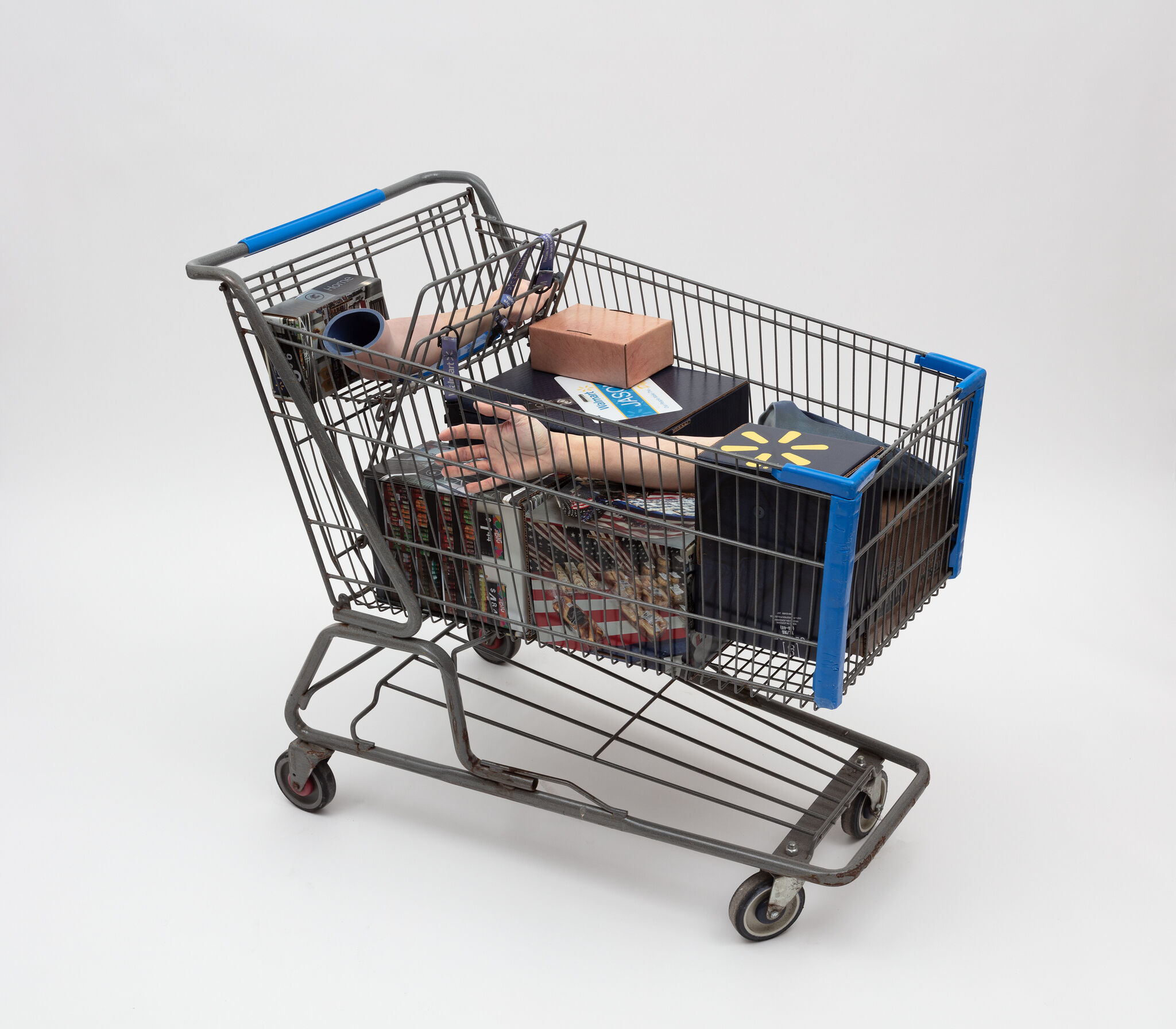
Josh Kline, In Stock (Walmart Worker’s Arms), 2018 (detail). 3D-printed sculpture in acrylic-based photopolymer resin, Walmart shopping cart, and cardboard boxes customized with inkjet prints on self-adhesive vinyl, 39 × 26 × 44 in. (99.1 × 66 × 111.8 in). Collection of the artist; courtesy 47 Canal, New York. © Josh Kline. Photograph by Joerg Lohse
Narrator: When you step off of the elevators, you will be confronted by two walls offset from the center. To the left is a soft white wall with a large painting by Jaune Quick-to-See Smith, as well as the introductory information for that exhibition and to the right is a darker painted wall with the Josh Kline exhibition information. This survey exhibition Project for a New American Century, uses immersive installations of video, sculpture, photography, and design to explore contemporary politics of labor, class, automation, disease and democracy. To the right of the entrance way is a sign that reads Please watch your step. Several galleries include floor coverings that may be slippery or uneven. While the carpet throughout the exhibition is medium-low pile, there are other flooring installations including tarp and cardboard. There is low lighting and projected video throughout the space. The artist intends for viewers to weave around sculptures so there are many objects dispersed throughout the space of the exhibition. Each object has approximately five feet distance in between to navigate around the artworks.
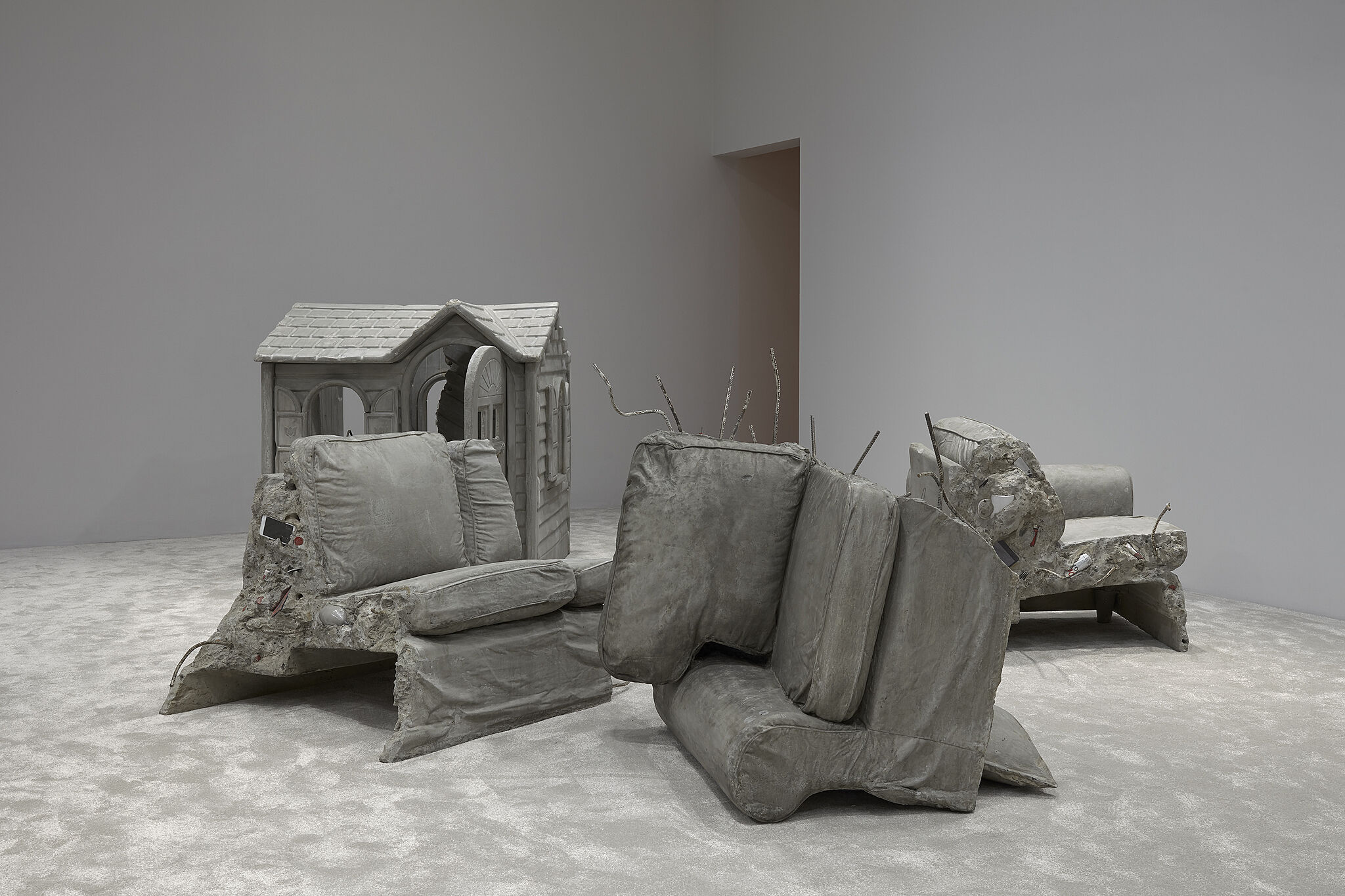
Upon entering the exhibition, the first room consists of sculptures from Kline’s “Civil War” series with rubble piles immediately inside the front room measuring about three feet tall. On the south side of the gallery to the far back, there are appliance sculptures with ticking sound components on vintage wooden tables. There are two raceways on the floor connecting the artworks to the South floor.
Continuing to the doorway, the gallery to the left contains plastic lamp sculptures hanging from the ceiling at varying heights that resemble large spherical virus molecules. This gallery is very dimly lit with light emitting from the sculptures and the flooring consists of medium-low pile carpet.
The following gallery explores the theme of “Unemployment” with realistic three dimensional sculptures made using 3-D scanning and printing. These sculptures consist of people in fetal positions inside plastic bags spread out across the gallery alongside various to-scale shopping carts.
The next gallery combines artworks from “Unemployment” and “Climate Change”. There is first an area with a video projected onto the east wall and there is very low lighting throughout the space. Viewers are invited to sit on the floor which is composed of a tapestry made of middle class clothing and pieces of cardboard from both generic and Amazon brand boxes. In this gallery there are also three heated tables with wax models that slowly melt over time.
In the subsequent galleries under the section “Another America is Possible” there is a three channel video projection containing slow tempo ambient music. In this gallery there is a dark blue carpet and dark blue painted walls with three wooden picnic bench tables for seating.
Exiting to the right is a gallery titled “Creative Labor” in which the lighting changes drastically to a garishly bright, white fluorescent light and linoleum flooring with many objects on both shelves and pedestals, as well as video works and photographs. To the left, there are four shelves consisting of various sculptures on them, some containing liquid. There are also two mannequins nearby with small video monitors embedded in their abdomens. Further into the space, there are three floor to ceiling monolith walls with video works, in addition to four floor to ceiling columns with an IV bag hanging from each. Additionally there is a large three channel silent video taking up much of the east wall. There are also two series of photographs, one related to the videos embedded in the mannequins, and the second in which portraits of two different celebrities are digitally merged to form one figure.
In the final gallery, the west-facing windows of the Whitney are exposed, allowing for natural lighting over couch seating and artwork on the walls. The couches are an artwork that can be sat on and are made of transparent plastic and stuffed with shredded bills. The east wall is covered in black Patagonia nano puff material. There are also hand sanitizer dispensers with bacteria growing inside of them on the south wall towards the entry/exit.
Josh Kline, Normalization, 2017. Casts in polymerized gypsum mixed with sand and gravel, urethane foam, rebar, acrylic, and mixed media, three parts: 46 x 38 x 39 in. (116.8 x 96.5 x 99.1 cm), 49 x 34 x 31 in. (124.5 x 86.4 x 78.8 cm), 51 x 37 x 31 in. (129.5 x 93.9 x 78.4 cm). Rubell Museum, Miami. © Josh Kline. Photograph by Robert Glowacki; image courtesy the artist and Modern Art, London
0:00
0:00