Whitney Biennial 2022: Quiet As It's Kept
2022
-
000
Billboard: Raven Chacon, Silent Choir
Audio, Verbal description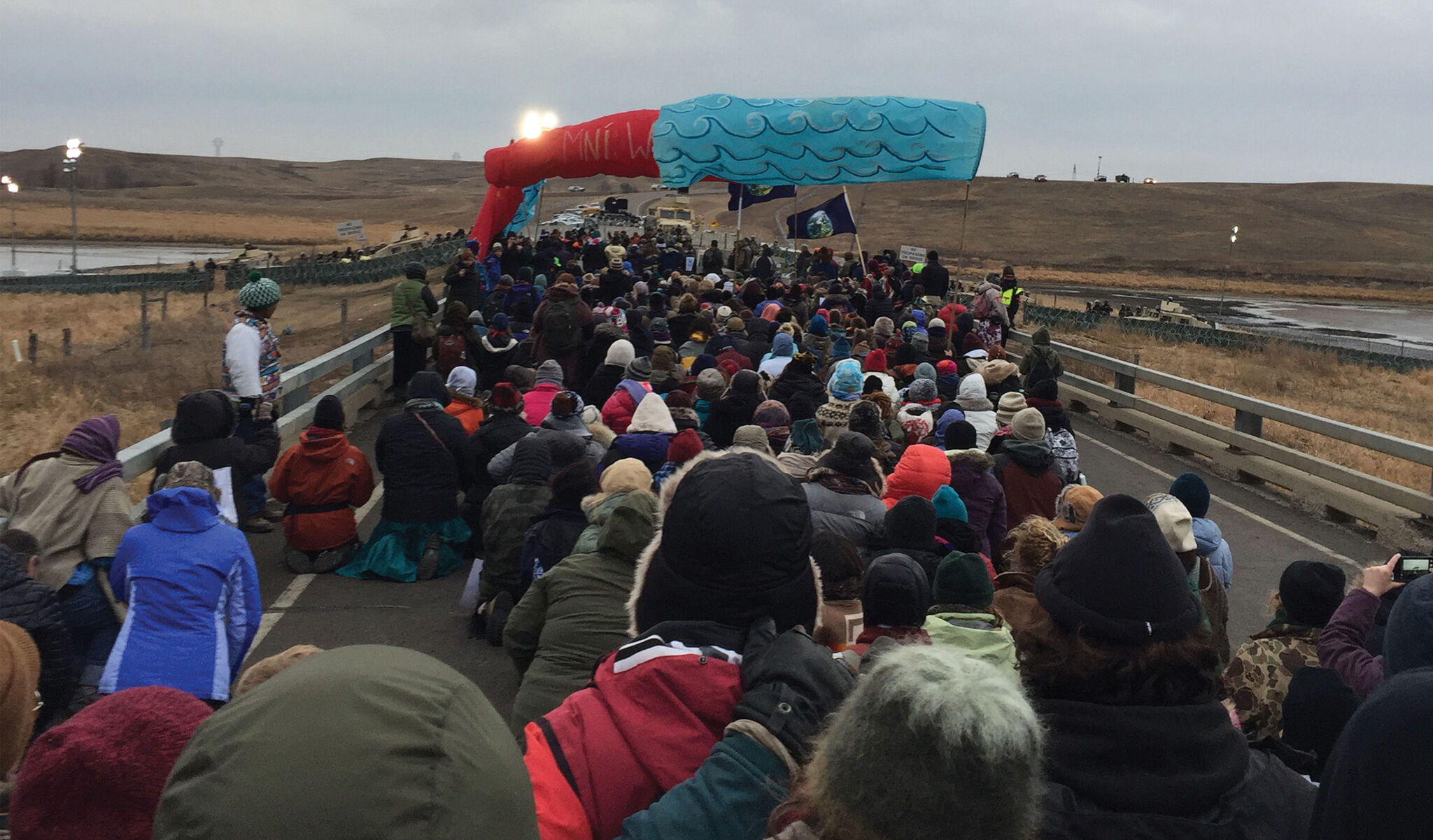
-
000
Introduction
Audio -
000
Verbal Description: Floor 1
Verbal description -
000
Verbal Description: Floor 5
Verbal description -
000
Verbal Description: Floor 6
Verbal description -
101
Transcription: Tony Cokes, Evil.80.Empathy?, 2020
Transcription -
100
Jason Rhoades, Caprice
Audio, Verbal description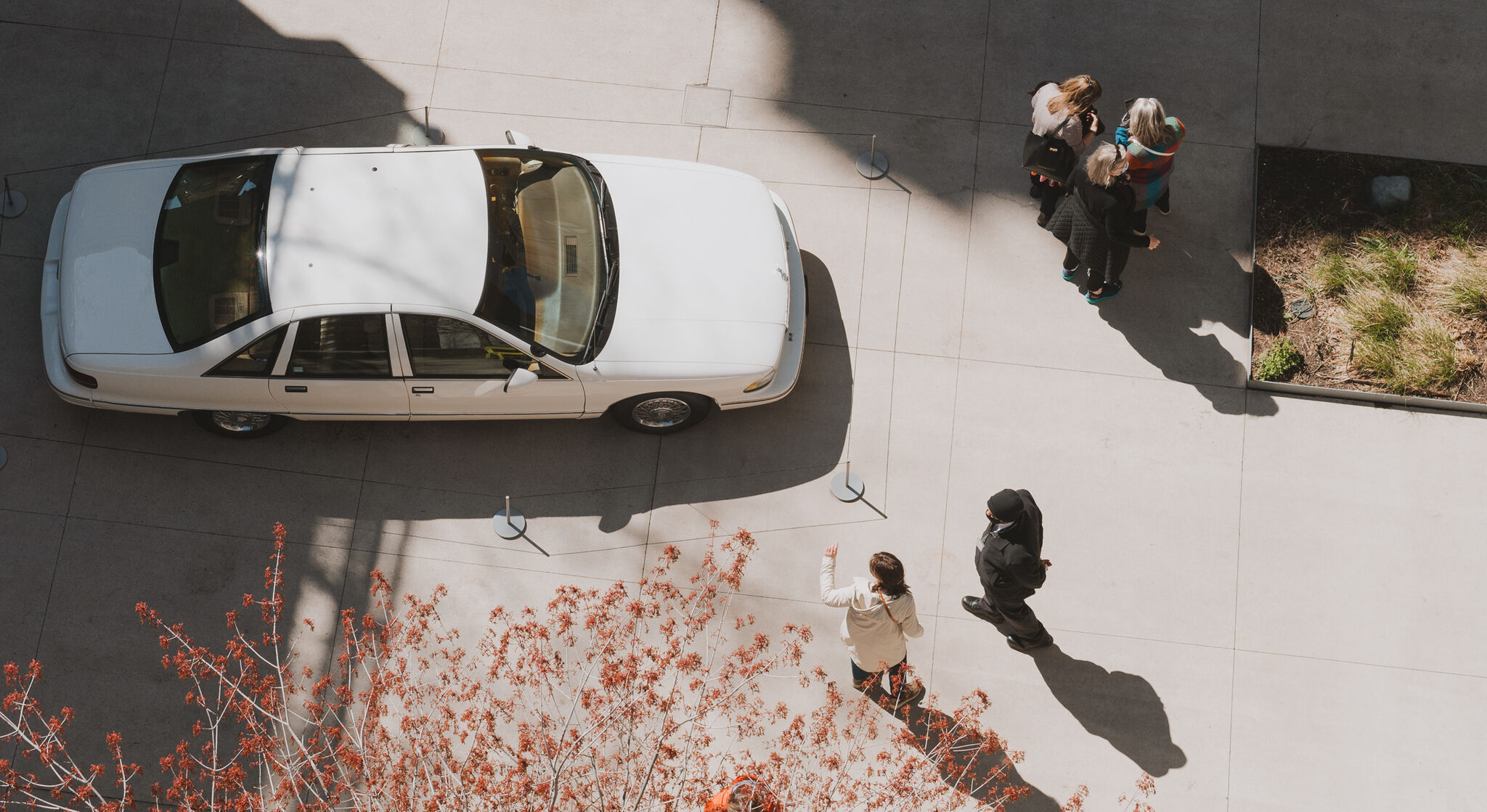
-
101
Rayyane Tabet, Becoming American
Audio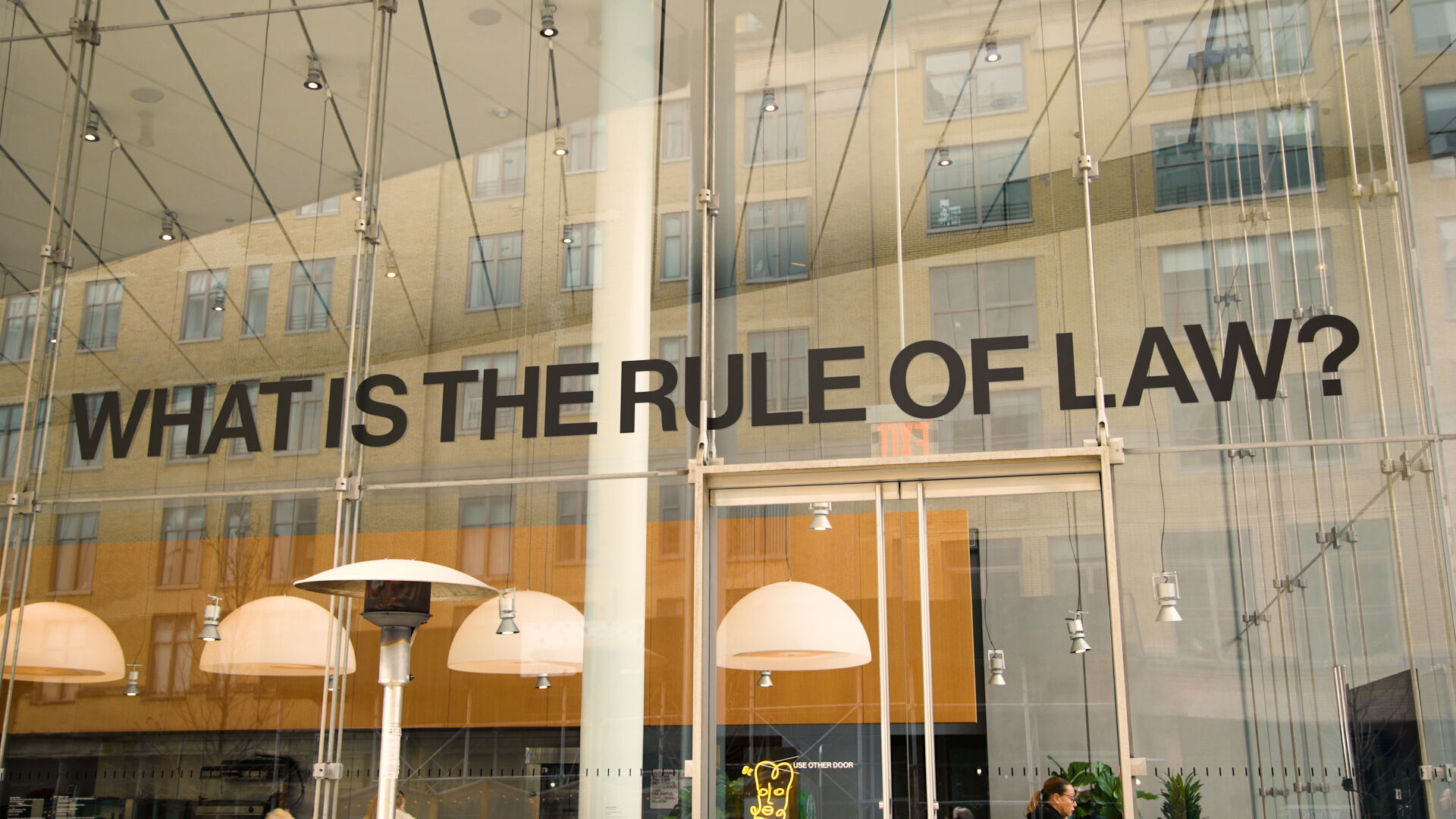
-
101
Transcription: Tony Cokes
Transcription -
102
Renée Green, Space Poem #7 (Color Without Objects: Intra-Active May-Words)
Audio, Verbal description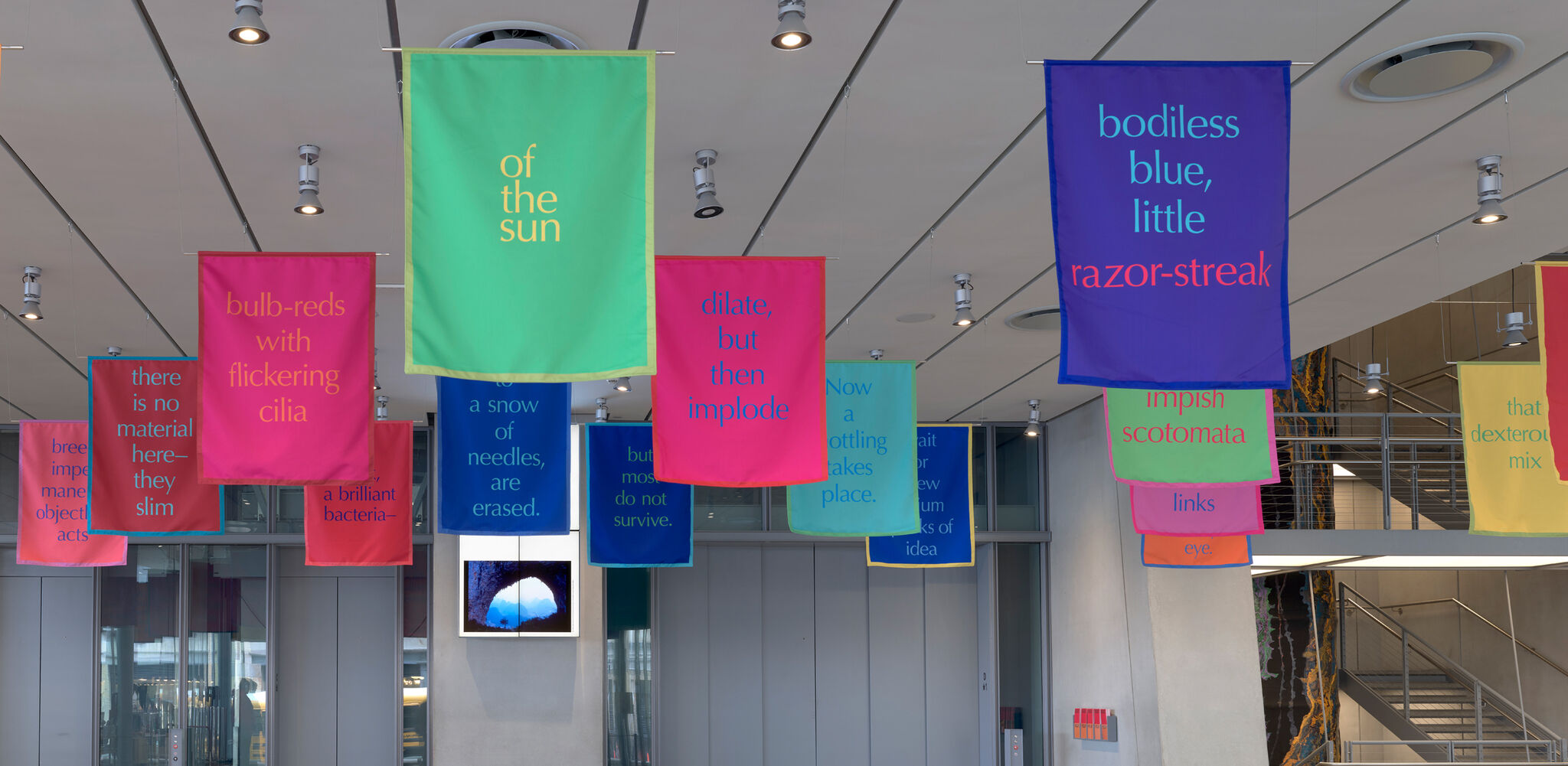
-
300
Rodney McMillian, shaft
Audio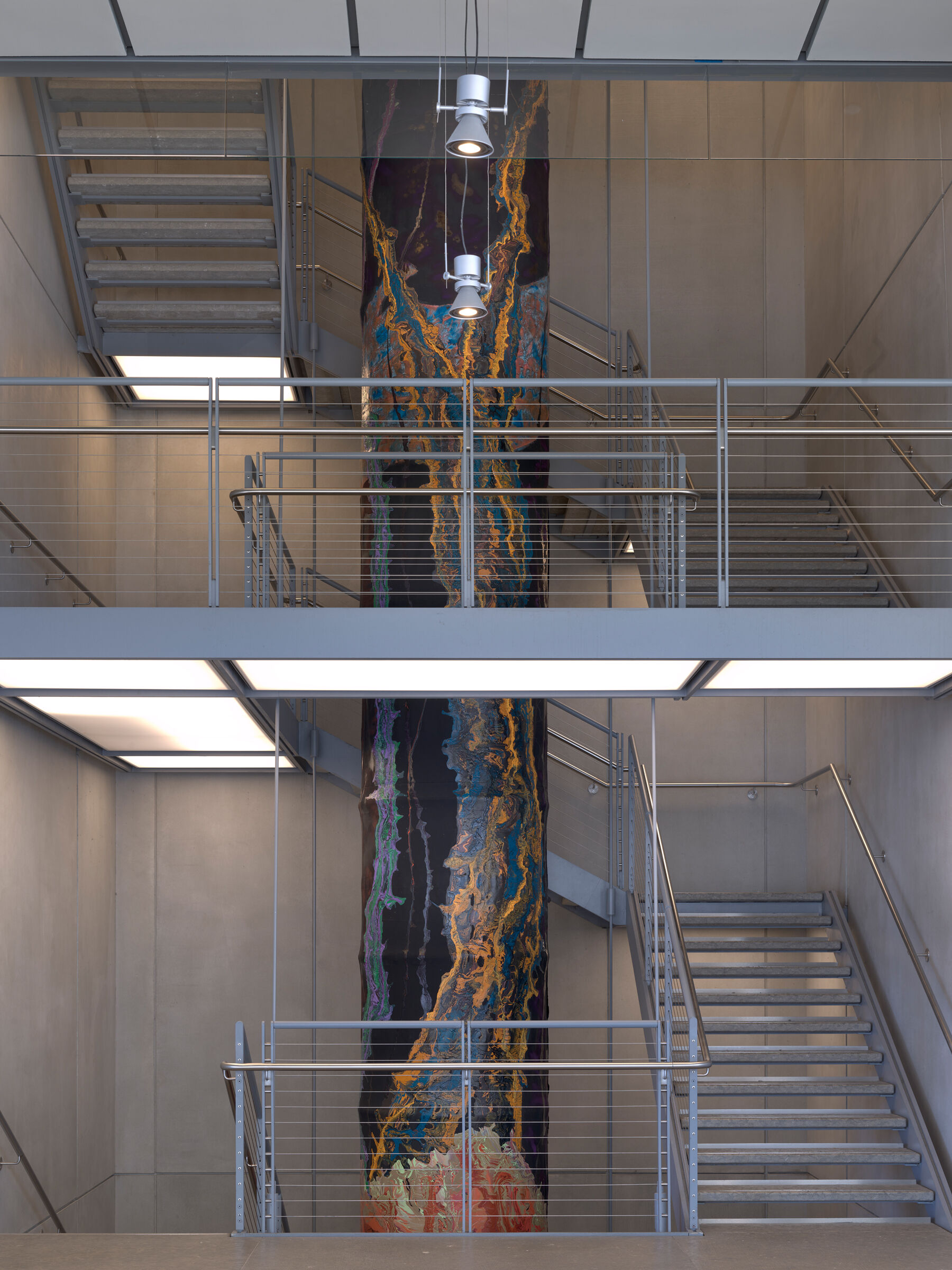
-
502
Rayyane Tabet, Becoming American
Audio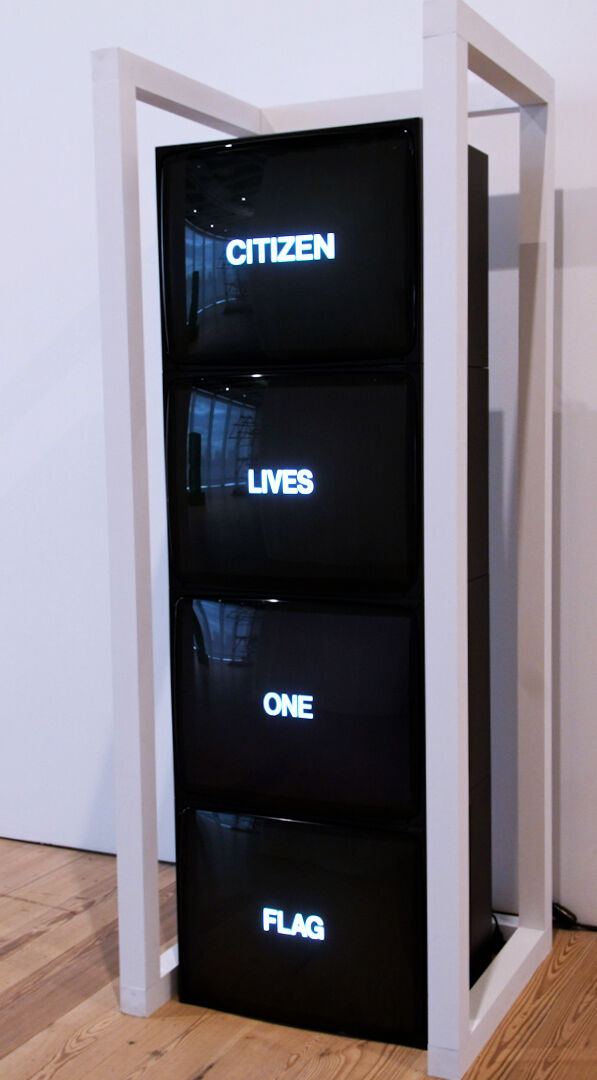
-
503
Rose Salane, 64,000 Attempts at Circulation
Audio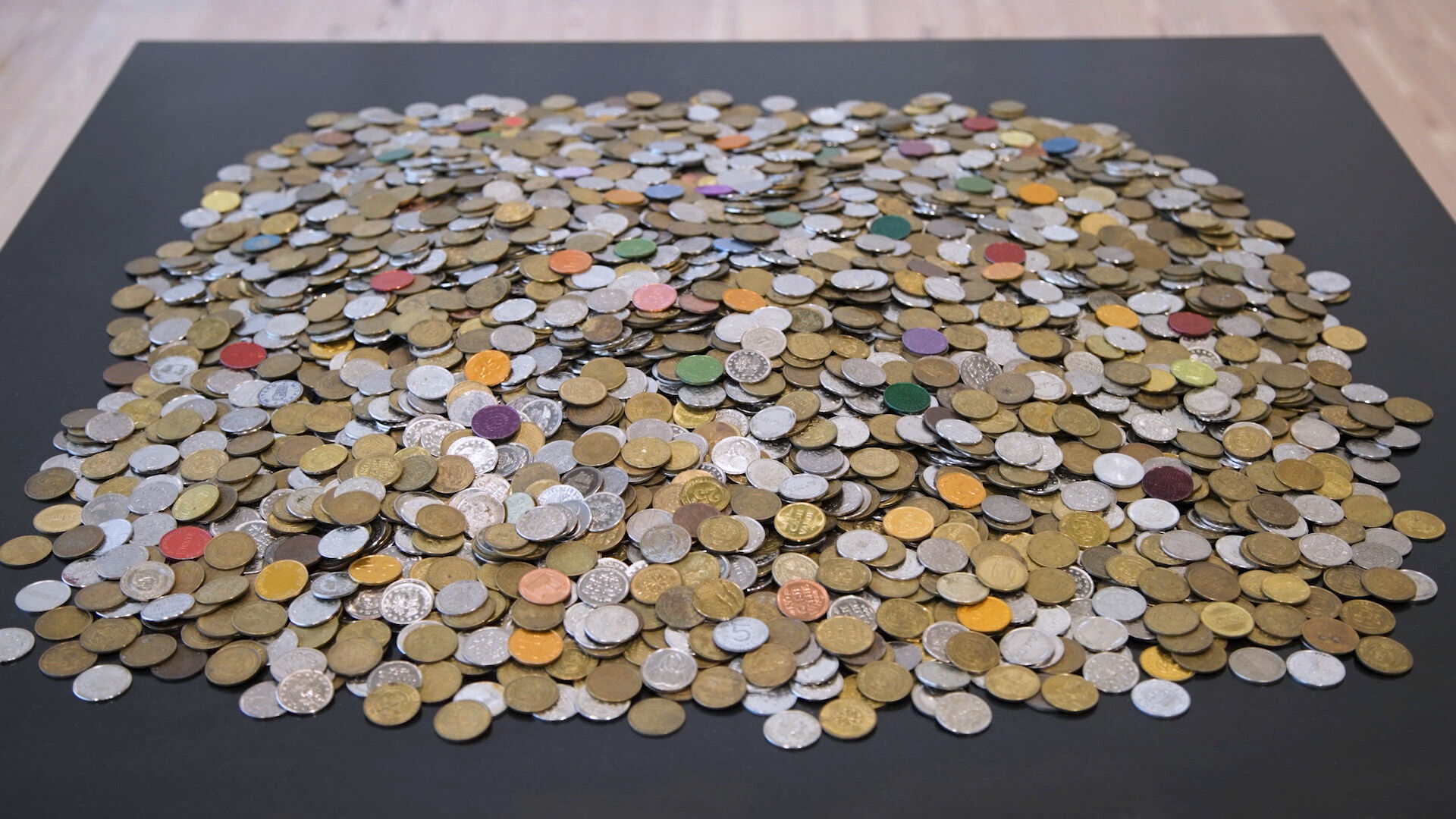
-
504
Pao Houa Her
Audio, Verbal description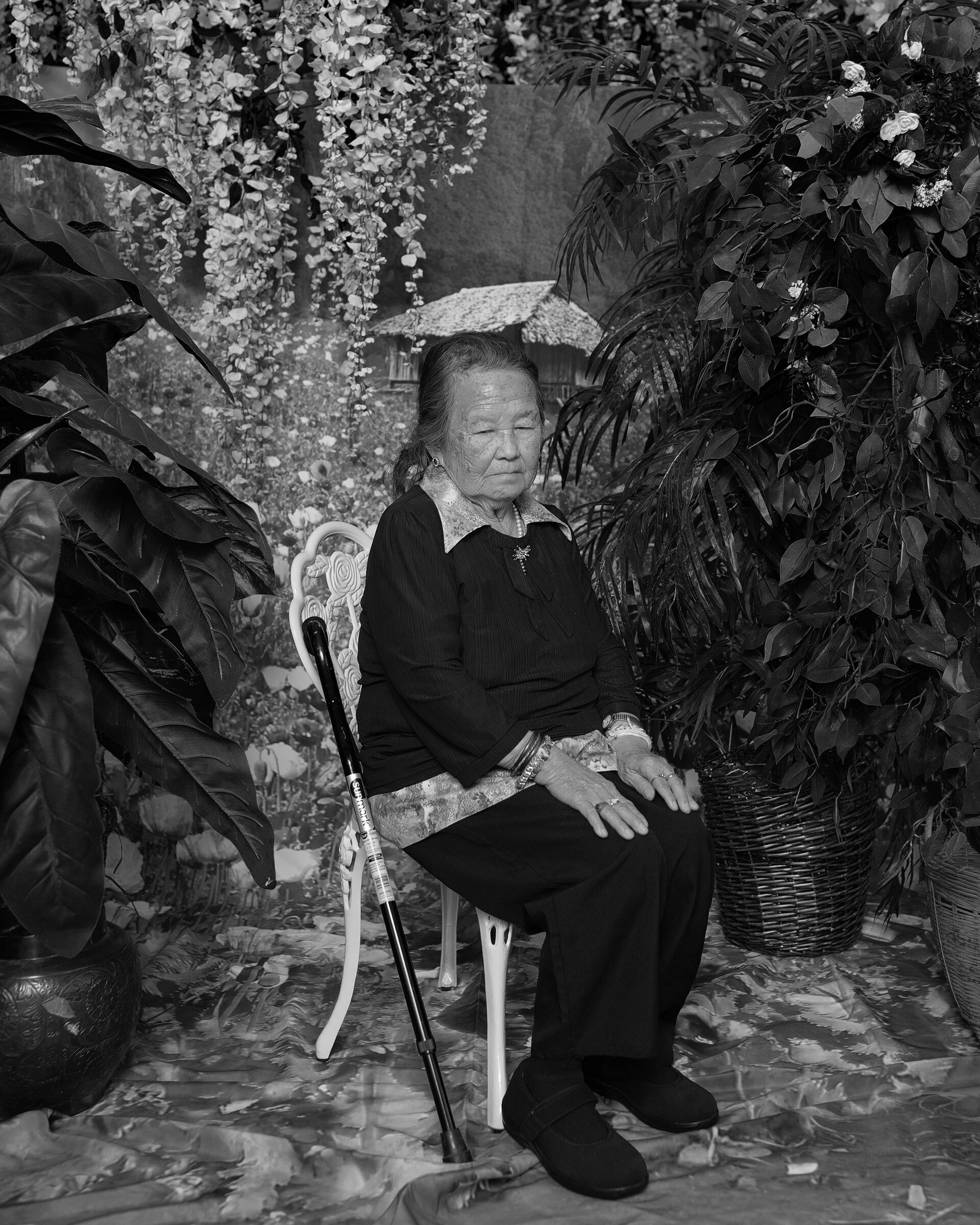
-
505
Renée Green, Lesson
Audio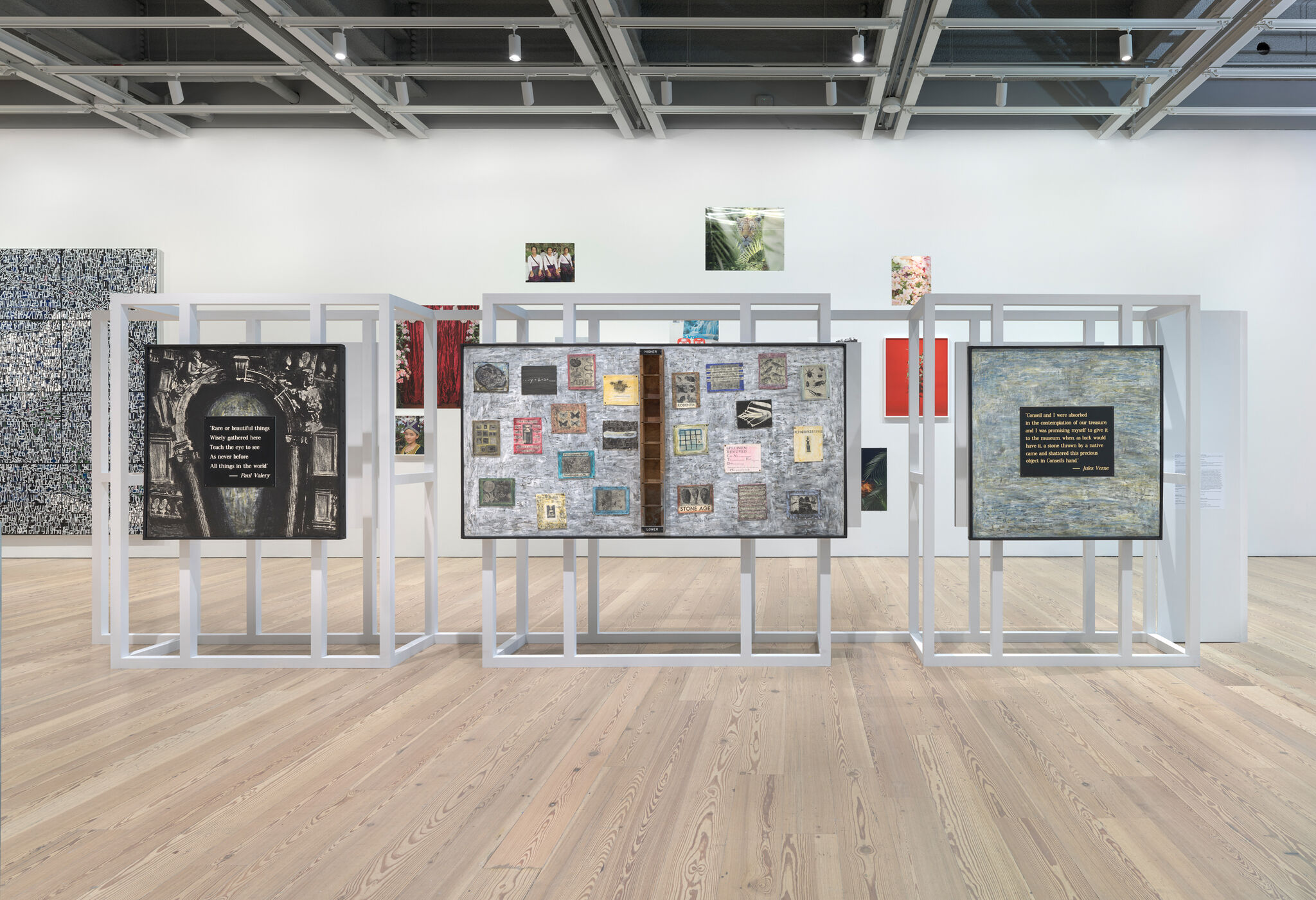
-
506
Rayyane Tabet, 100 Civics Questions
Audio
-
507
Duane Linklater, Wintercount
Audio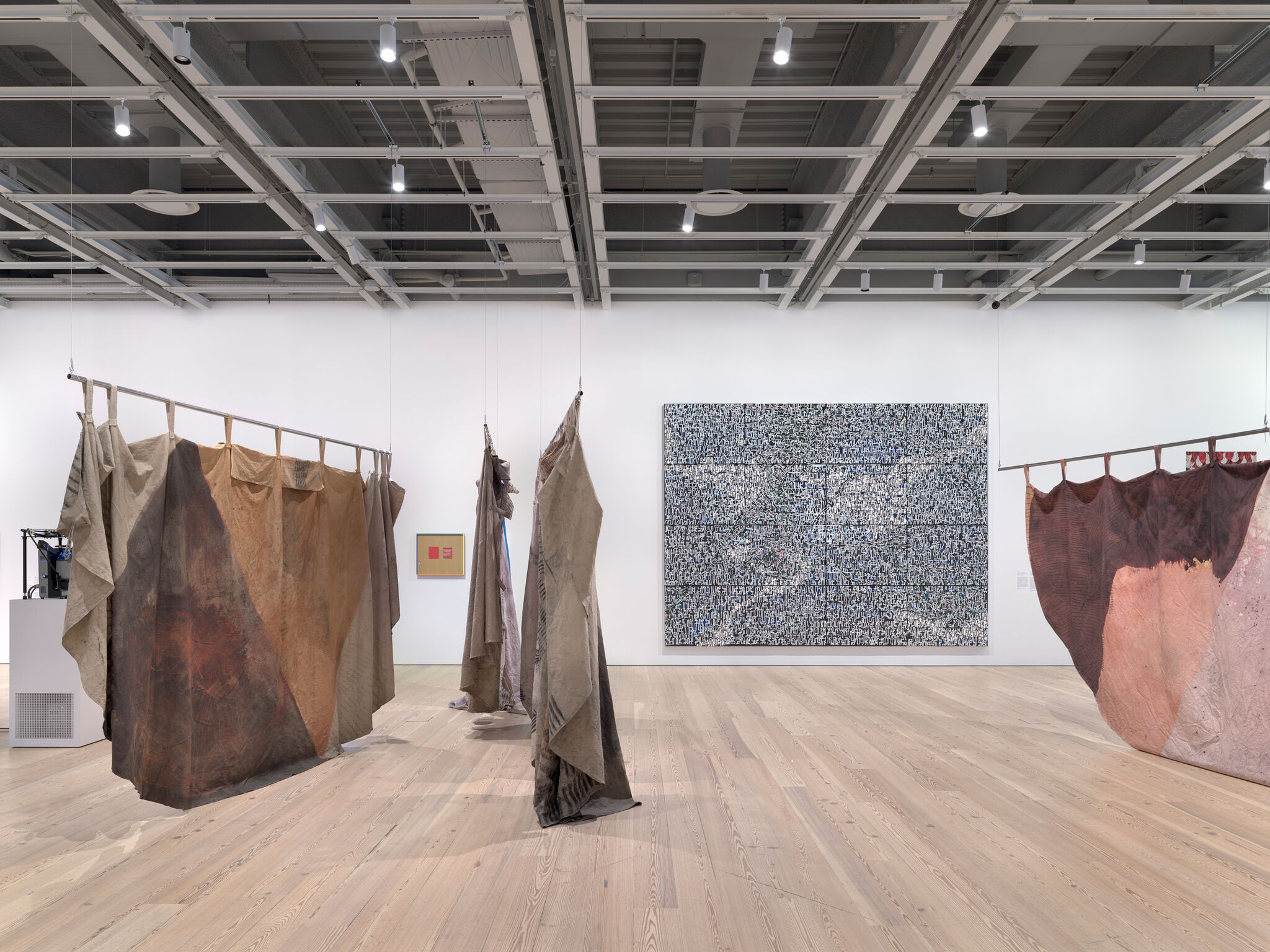
-
508
Veronica Ryan, Between a Rock and a Hard Place
Audio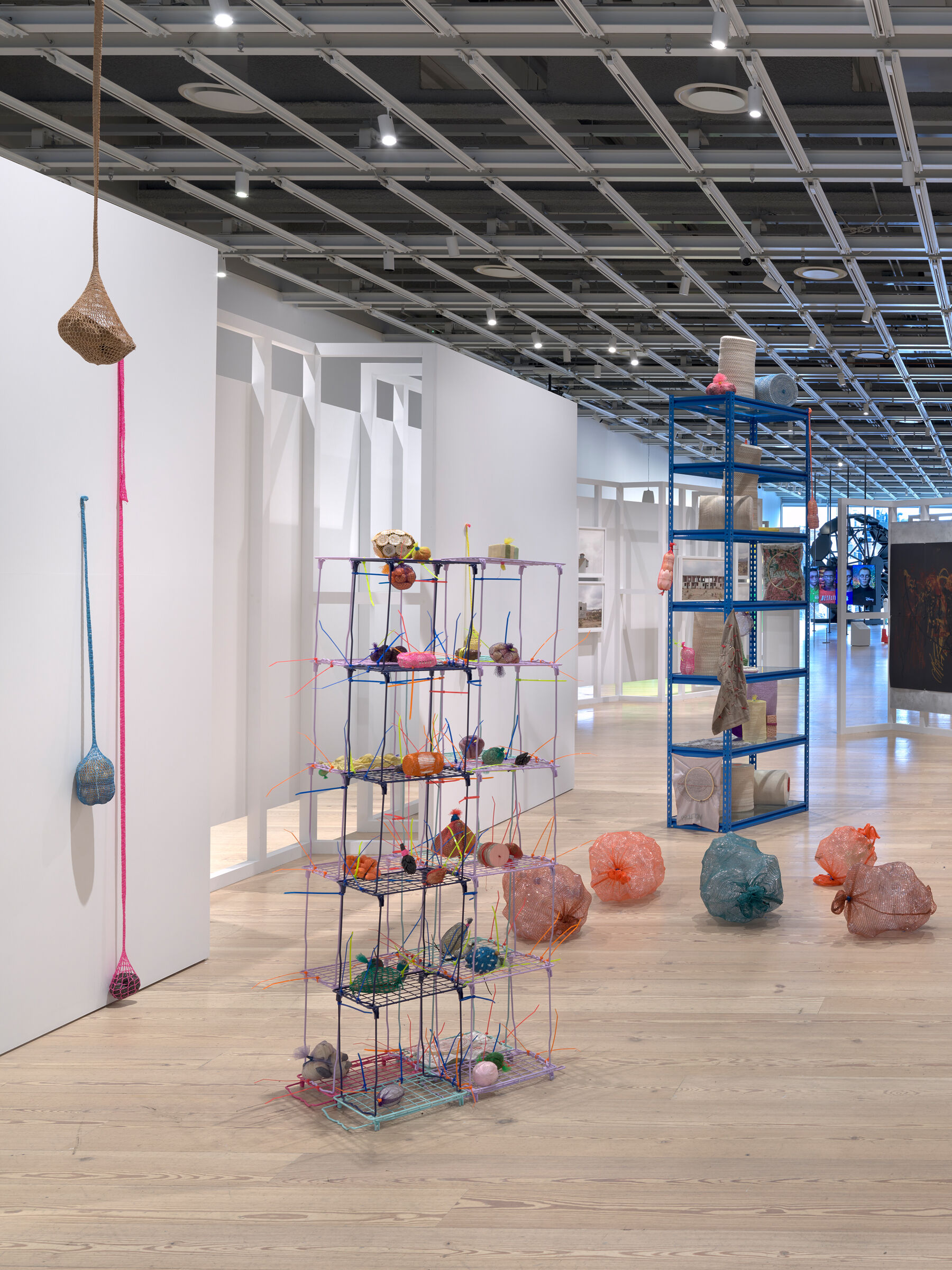
-
509
Rick Lowe, Project Row Houses: If Artists Are Creative Why Can’t They Create Solutions
Audio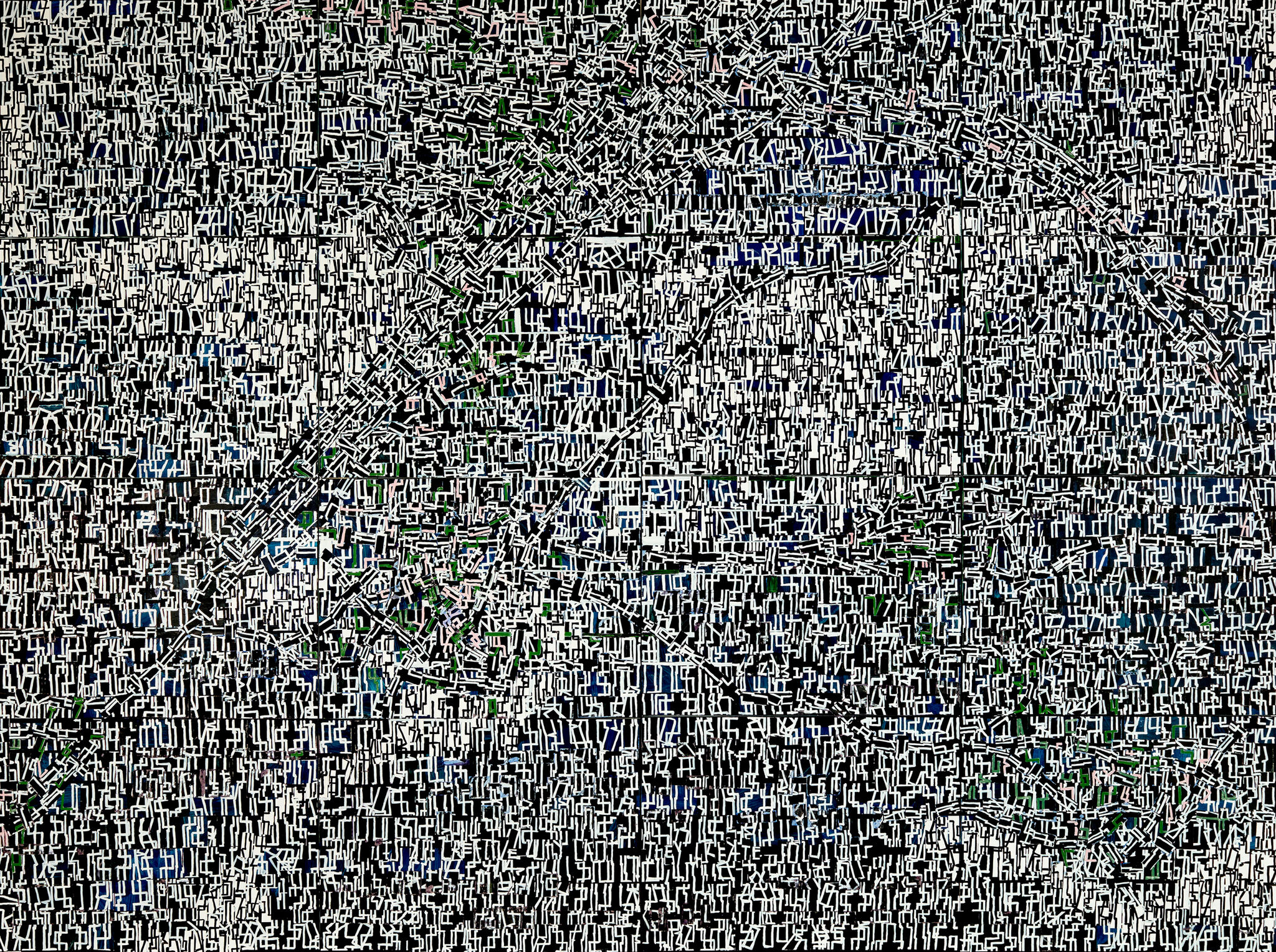
-
510
Awilda Sterling-Duprey, …blindfolded
Audio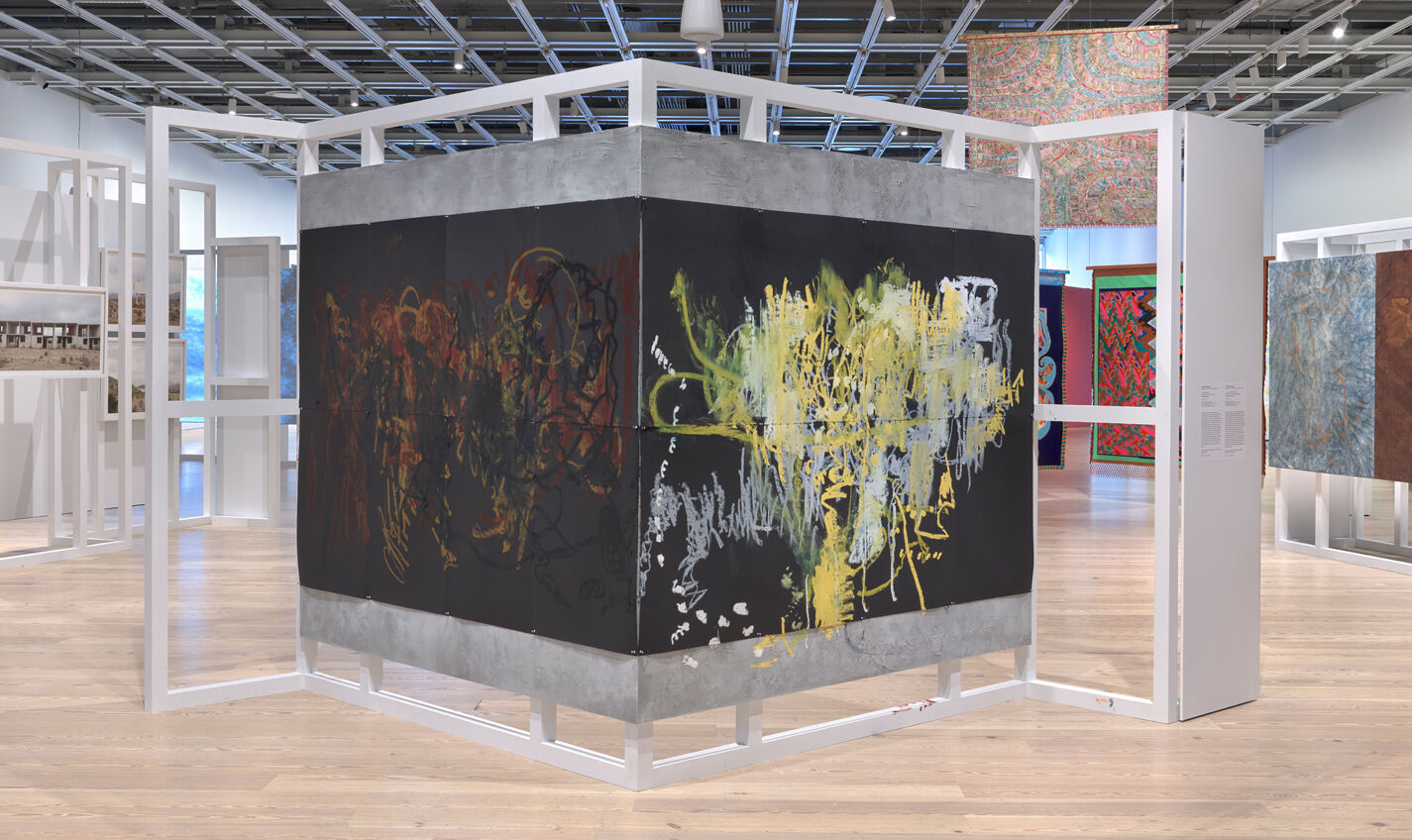
-
511
Rindon Johnson, An island is all surrounded by water In the morning foreboding. . .
Audio, Transcription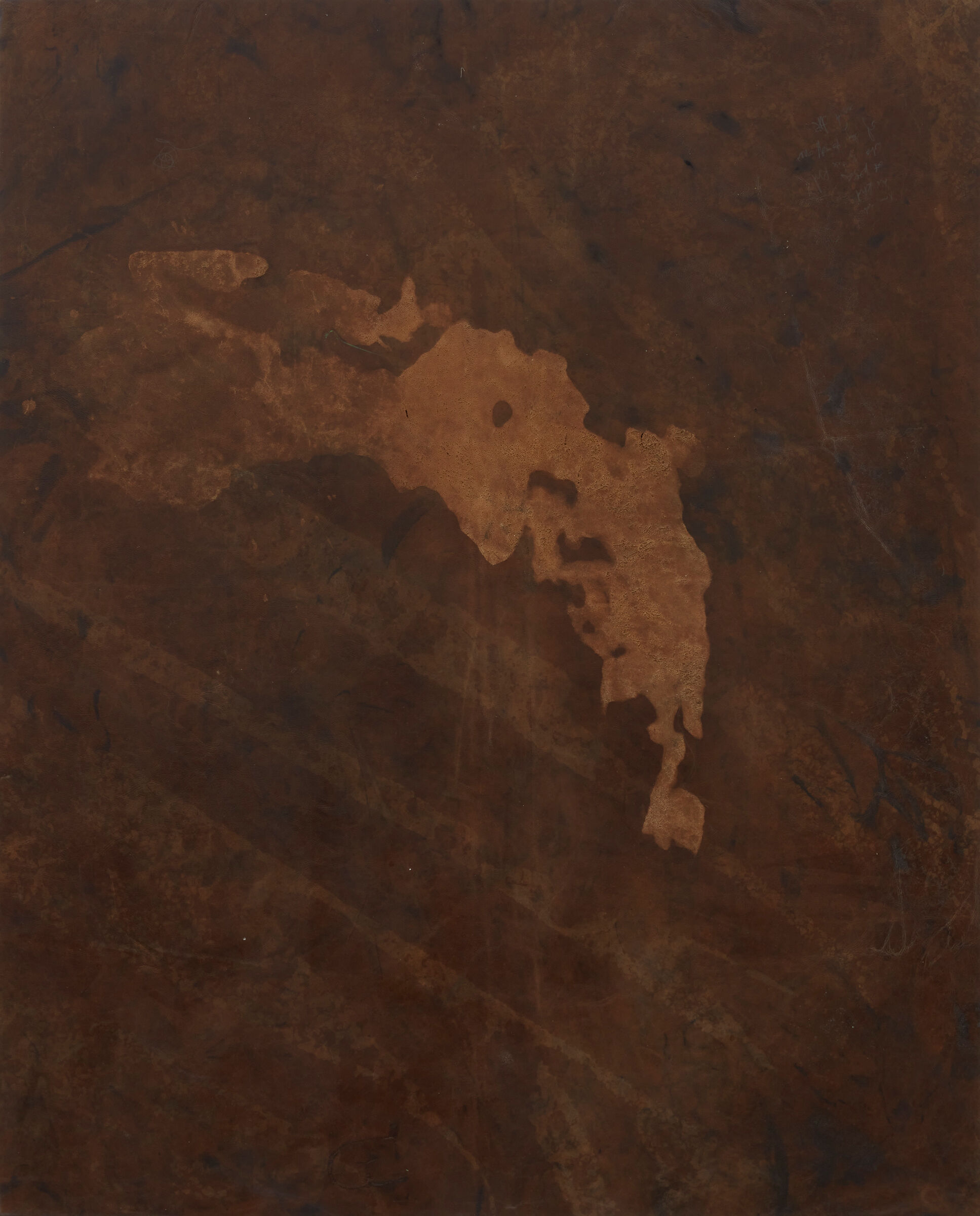
-
512
Mónica Arreola, Valle San Pedro
Audio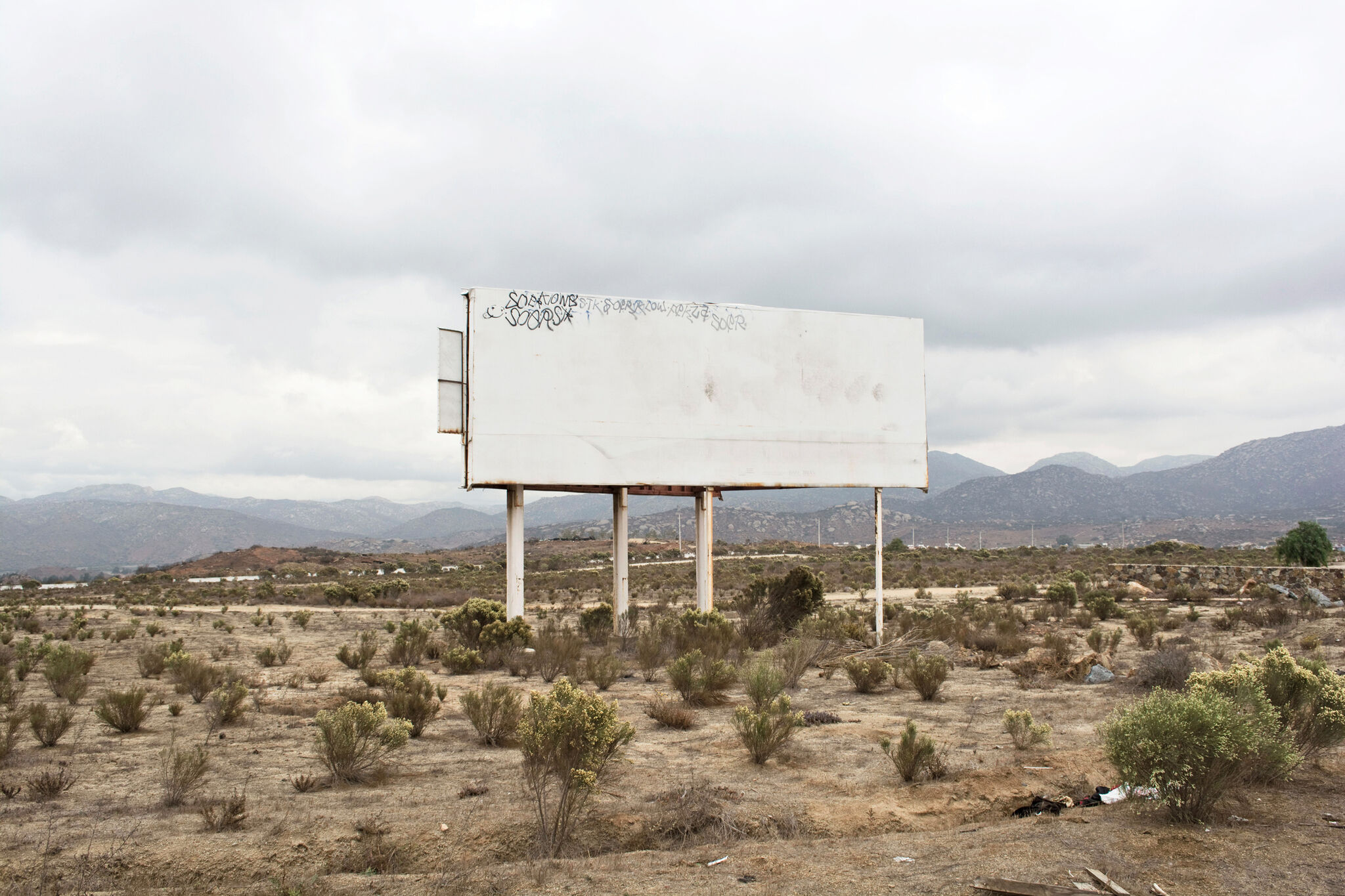
-
513
Dyani White Hawk, Wopila | Lineage
Audio
-
514
James Little, Joyful Austerity
Audio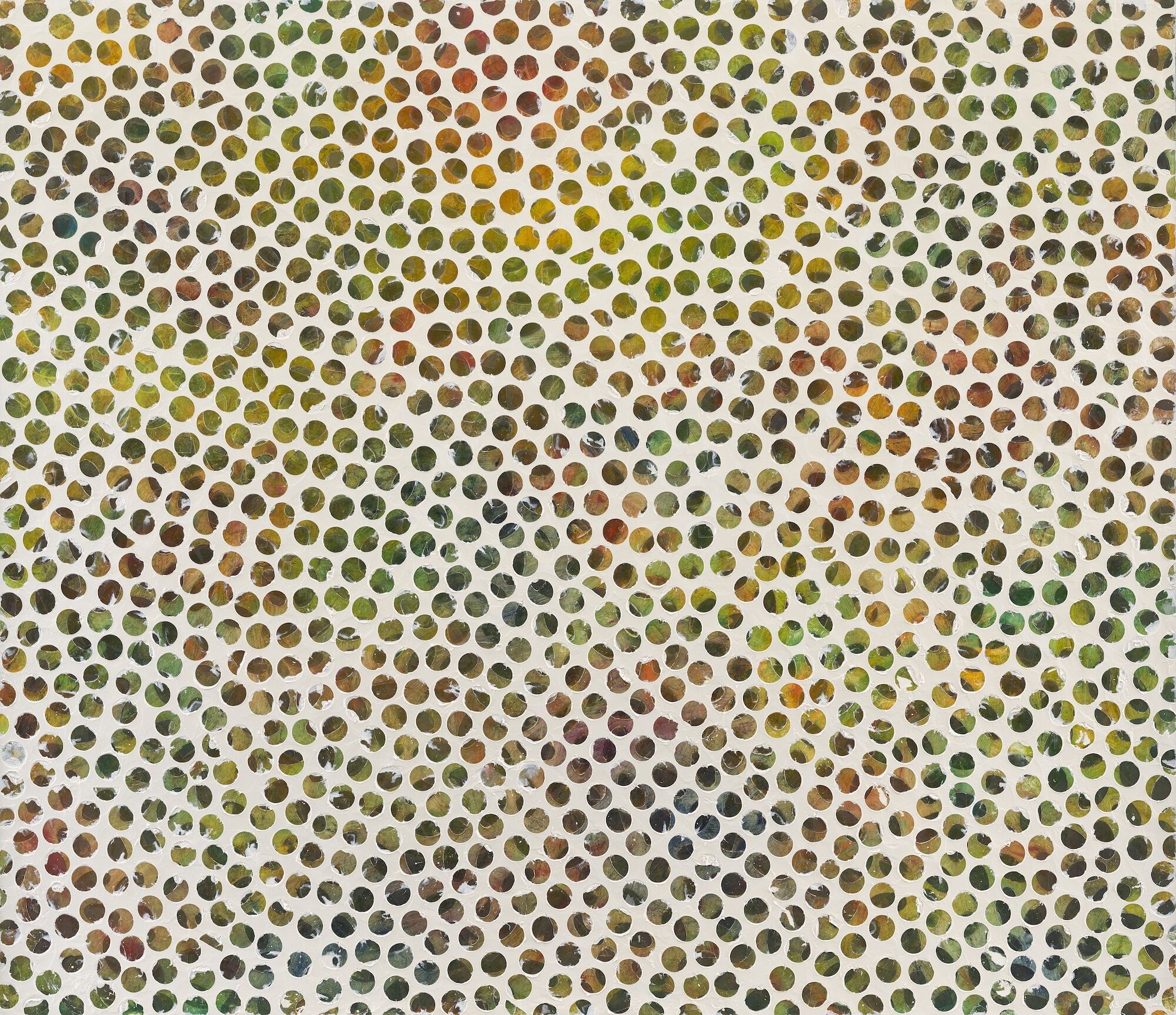
-
515
Leidy Churchman, Mountains Walking
Audio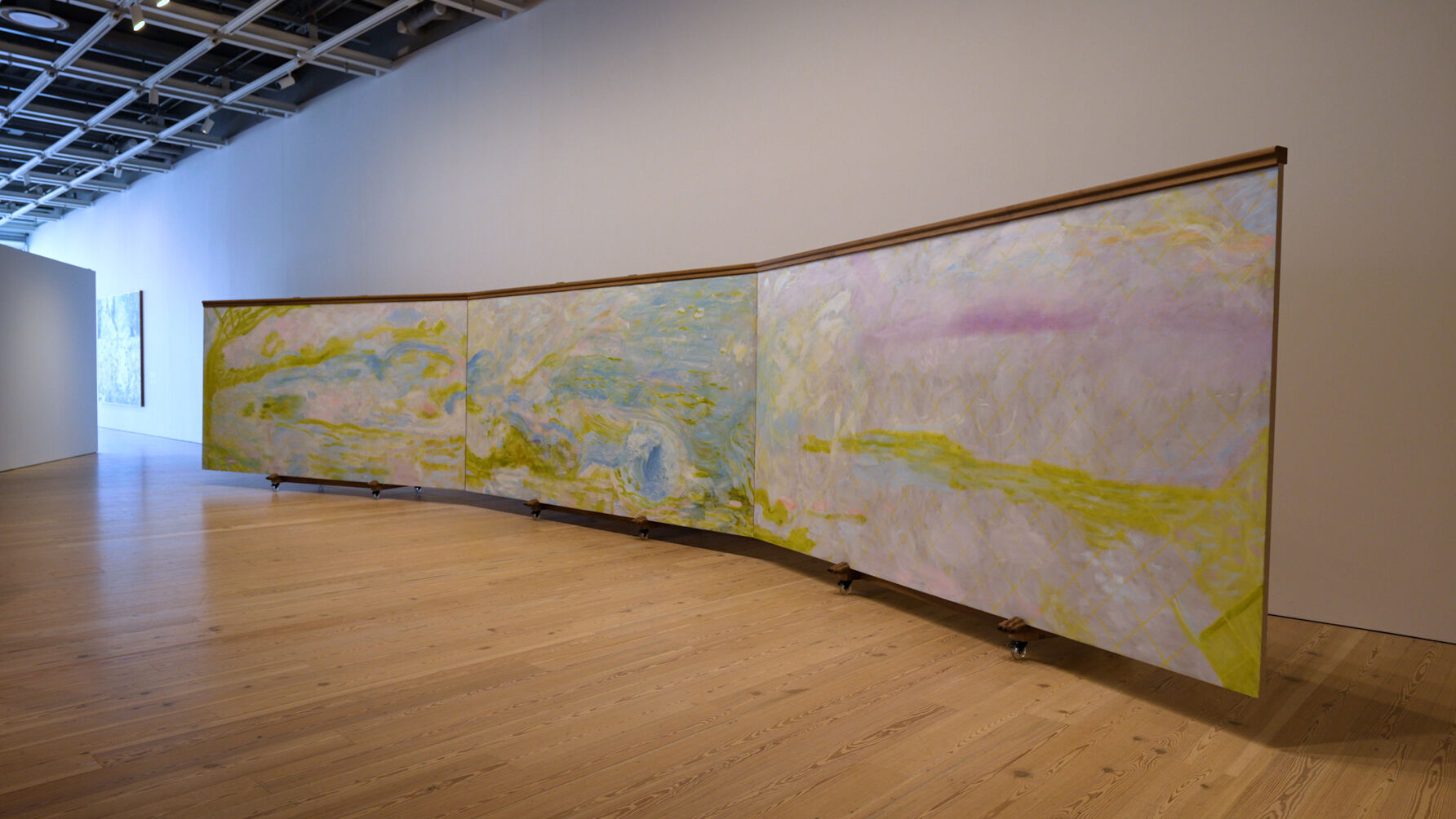
-
516
Eric Wesley, North American Buff Tit
Audio, Verbal description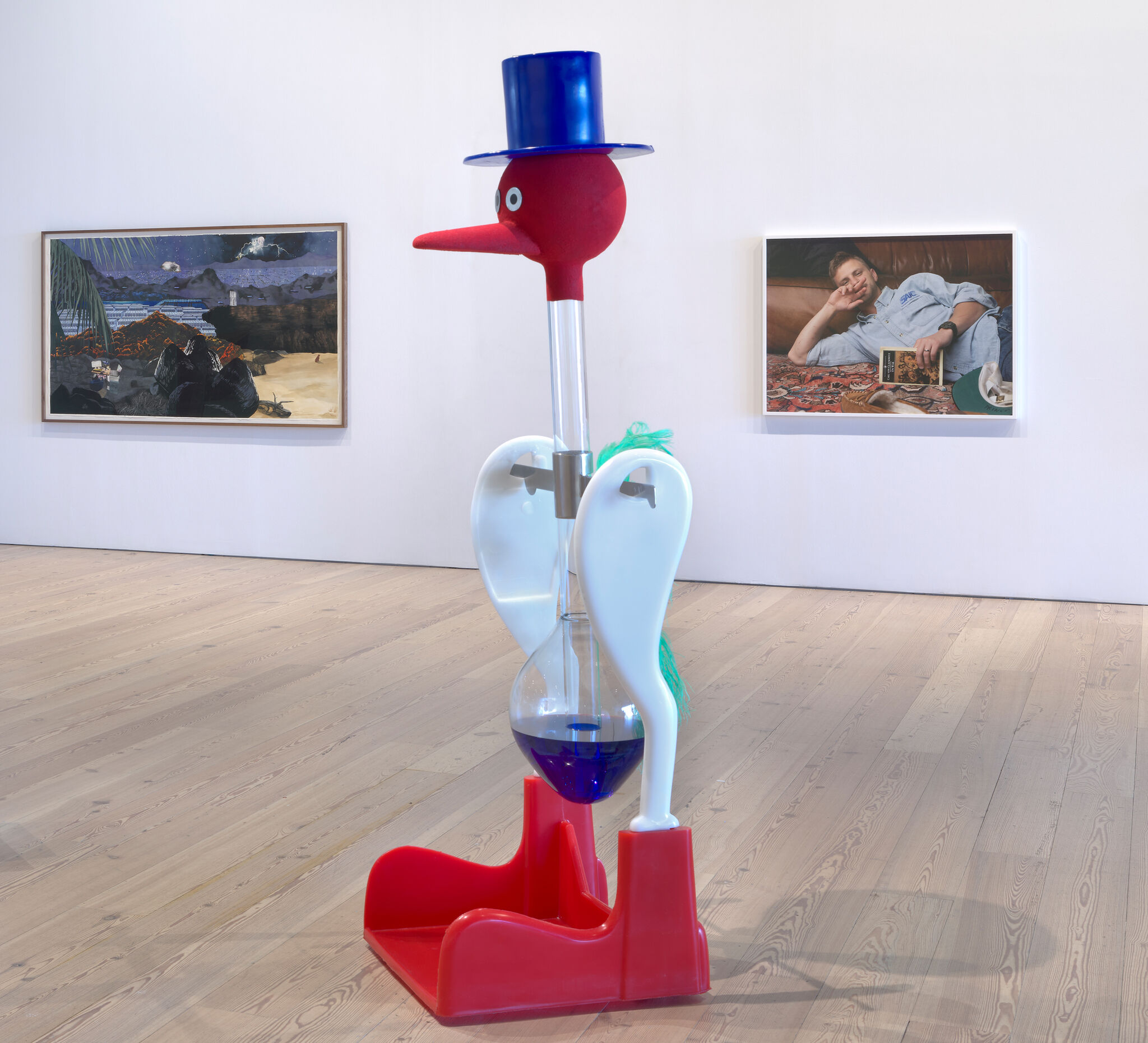
-
517
Danielle Dean, Long Low Line (Fordland)
Audio, Verbal description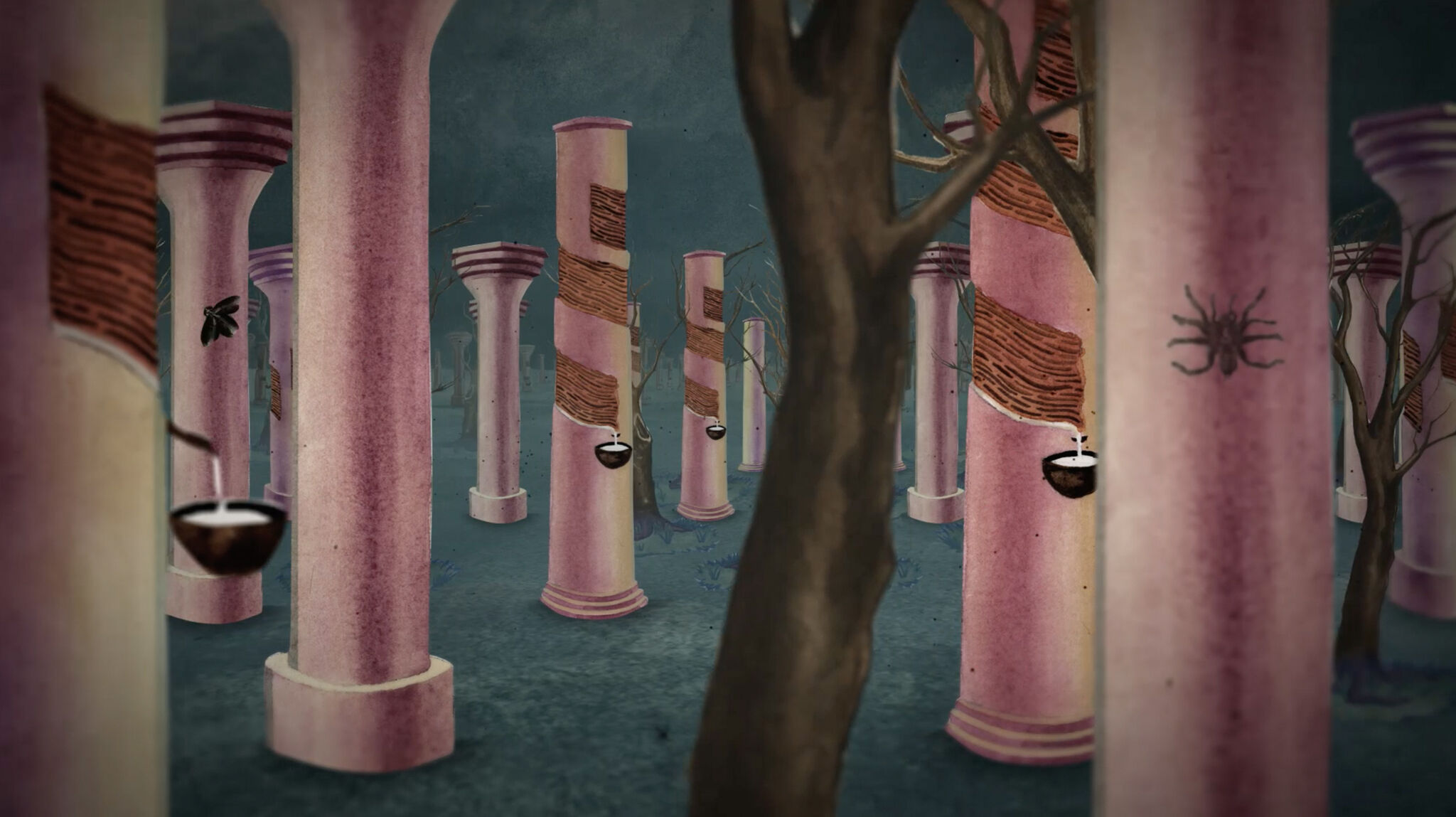
-
518
Transcription: Alex Da Corte, ROY G BIV, 2022
Transcription -
518
Buck Ellison, Rain in Rifle Season, Distributions from Split-Interest Trusts, Price Includes Uniform, Never Hit Soft
Audio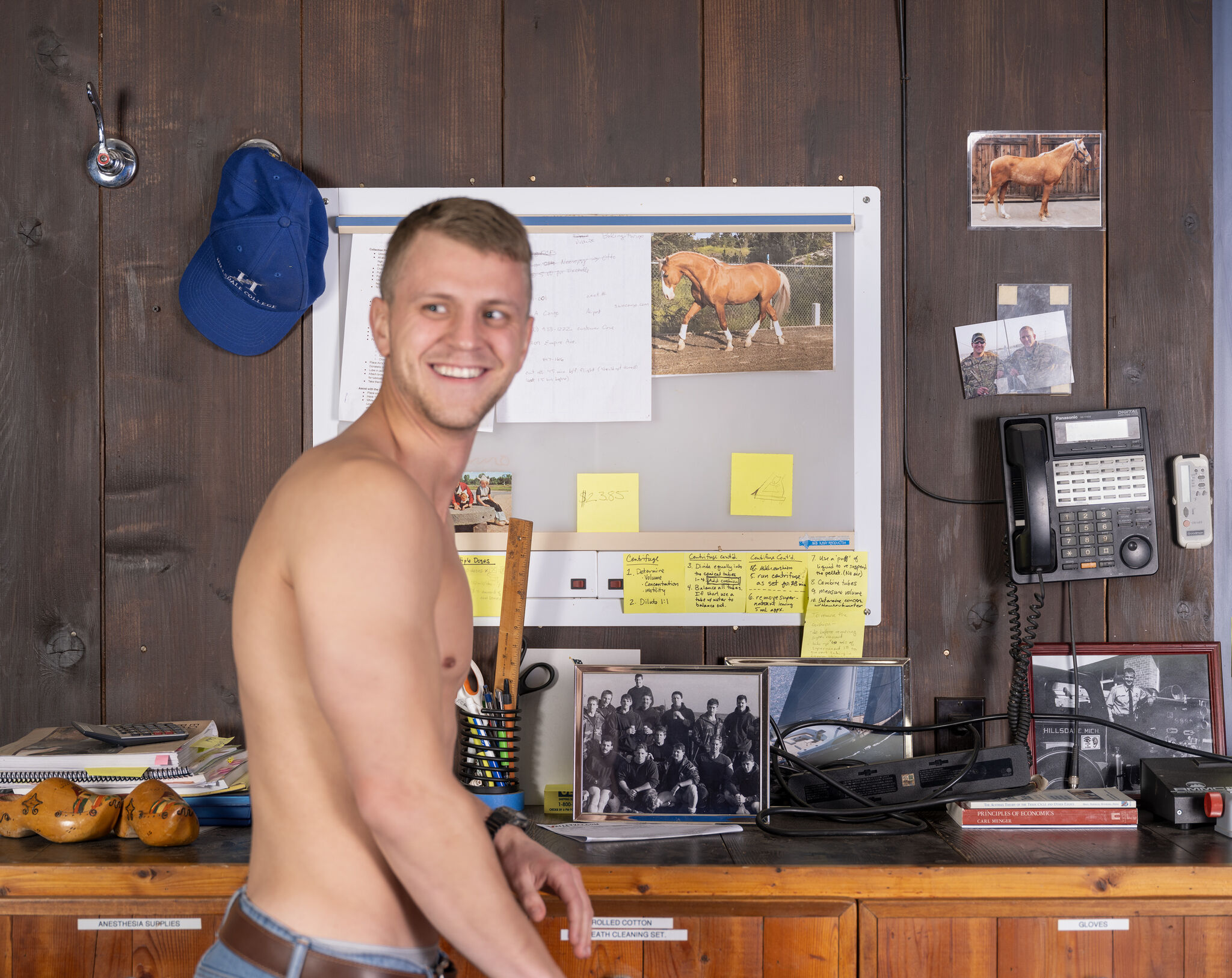
-
519
Jane Dickson, 99¢ Dreams
Audio, Verbal description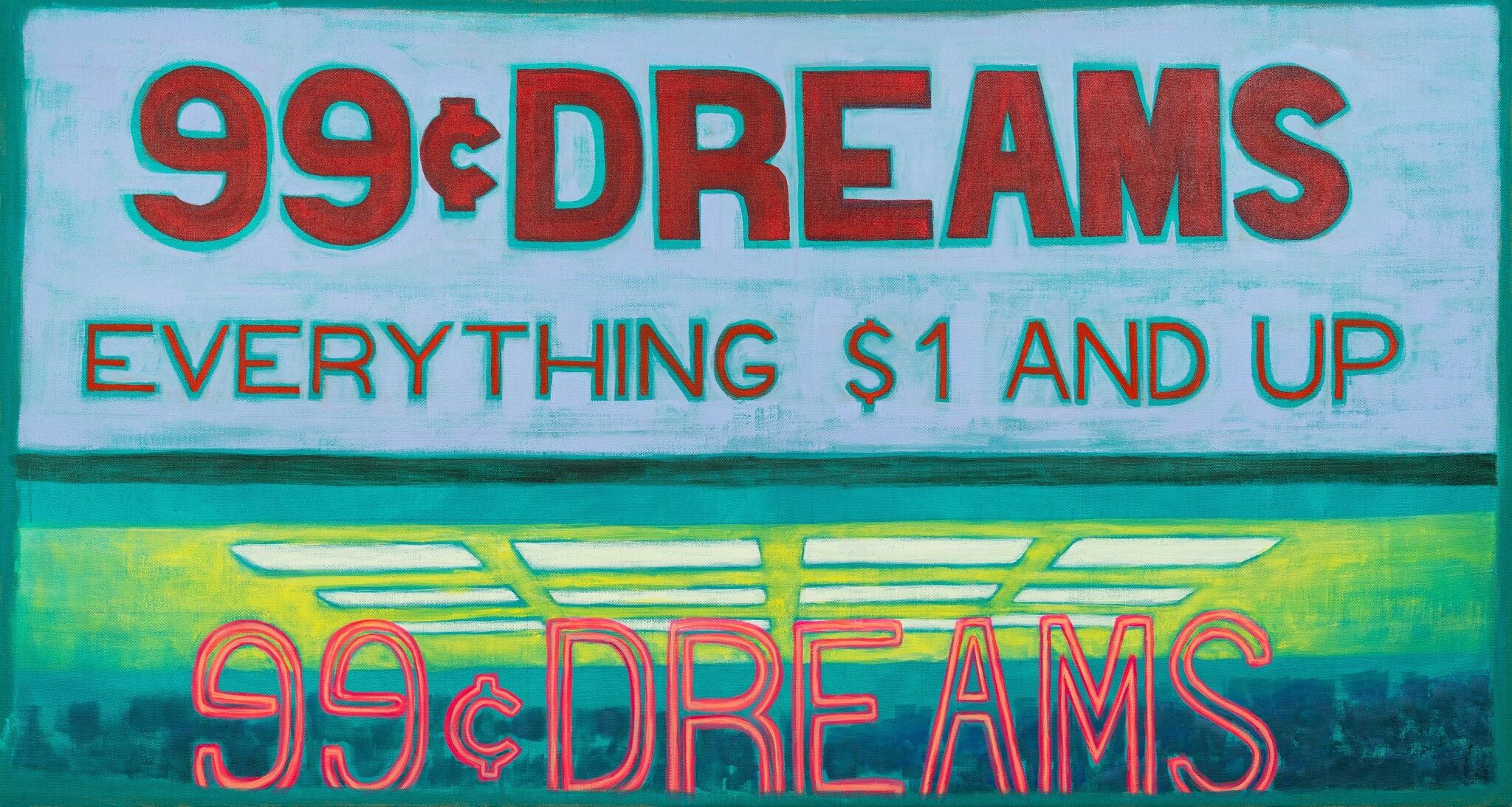
-
520
Sable Elyse Smith, A Clockwork
Audio, Verbal description, Transcription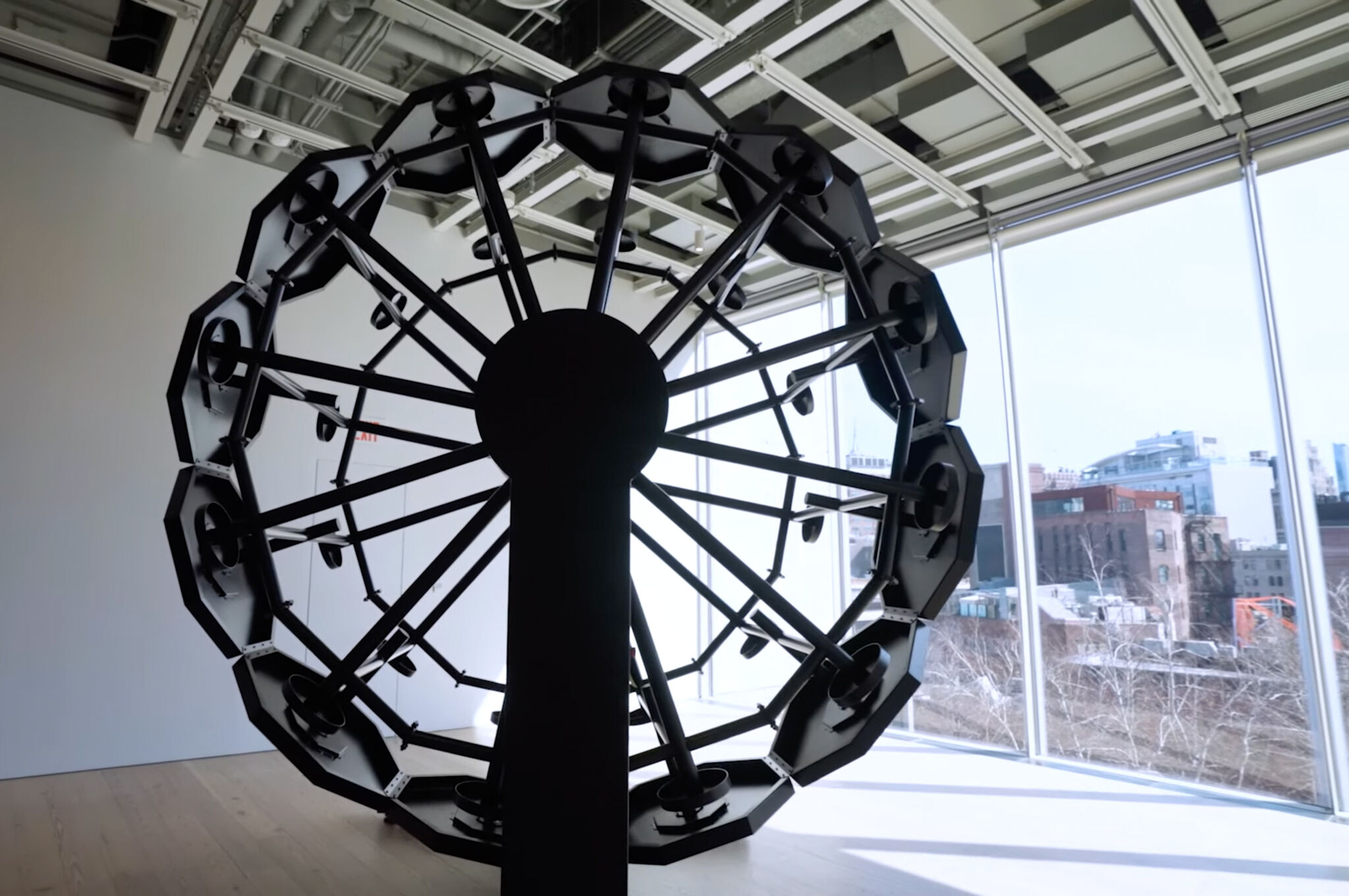
-
521
Emily Barker, Death by 7865 Paper Cuts and Kitchen
Audio, Verbal description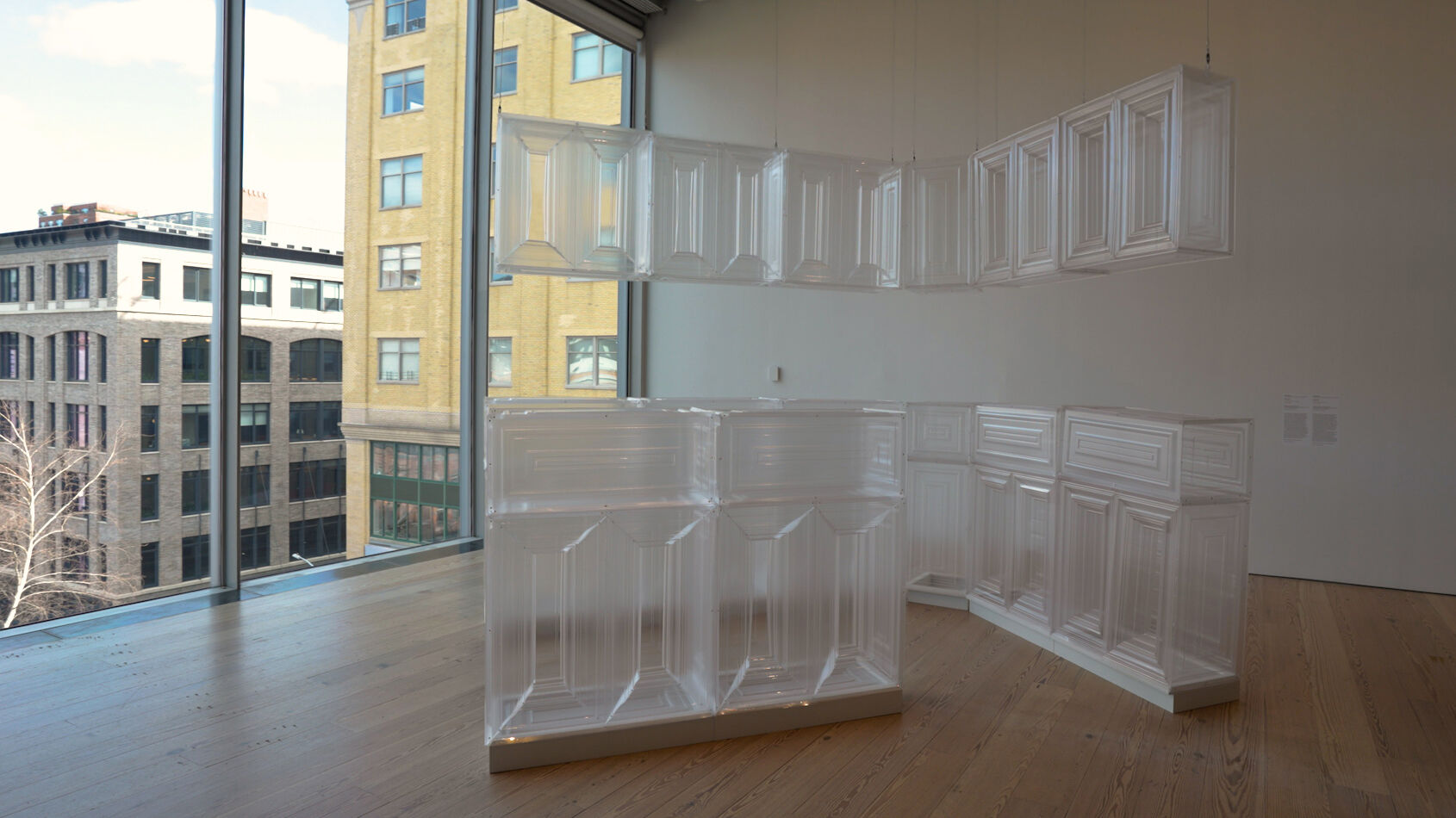
-
522
Guadalupe Rosales, Fire in the sky
Audio
-
523
Alejandro Morales, Juárez Archive
Audio
-
524
Adam Gordon, She throws children into the world
Audio
-
525
Transcription: Monitor A: Andrew Roberts, La horda (The horde), 2020
Transcription -
526
Transcription: South Screen A: Jacky Connolly, Descent Into Hell, 2021
Transcription -
527
Transcription: East Screen B: Jacky Connolly, Descent Into Hell, 2021
Audio -
550
Charles Ray, Burger
Audio, Verbal description
-
601
Denyse Thomasos, Displaced Burial / Burial at Gorée
Audio, Verbal description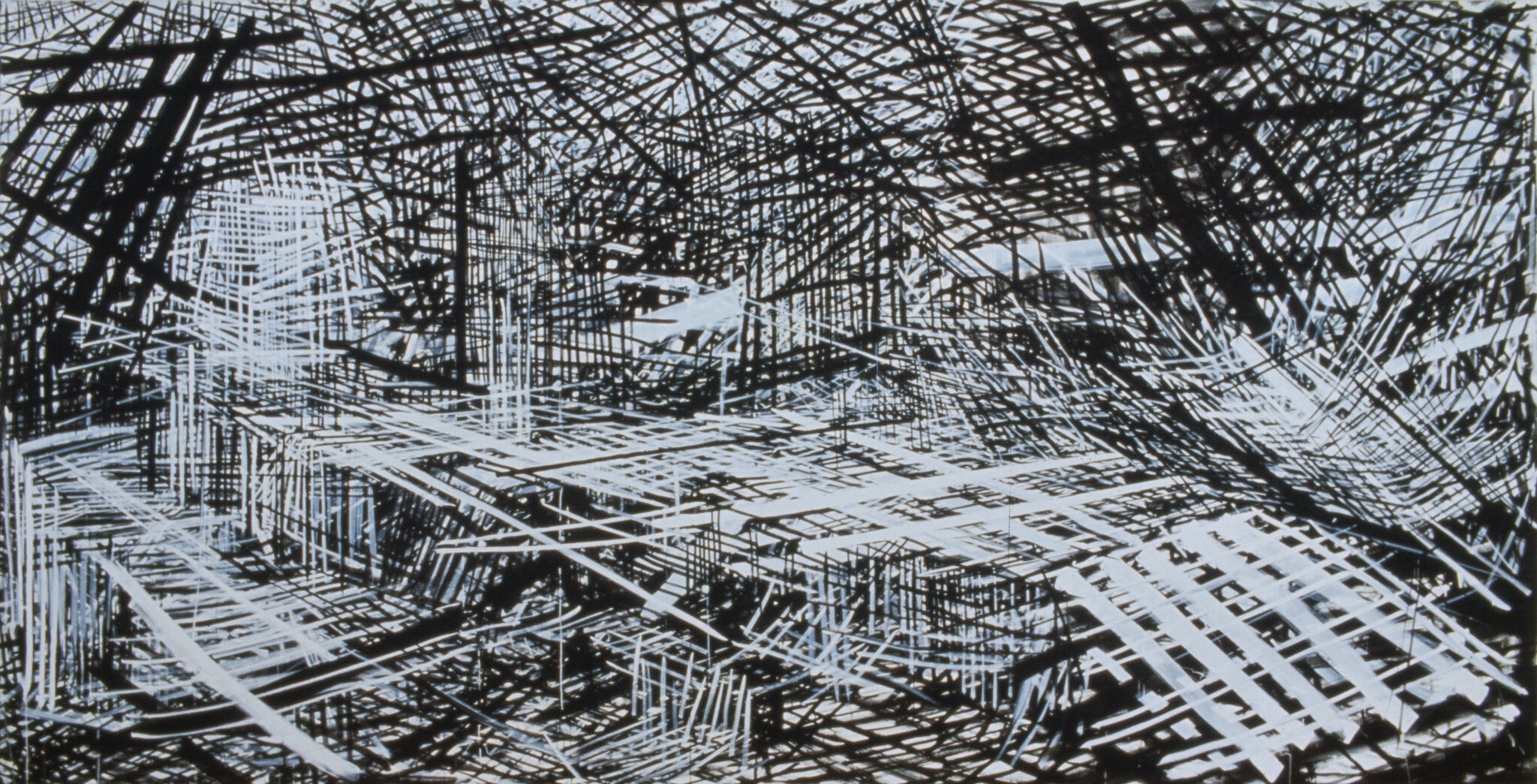
-
602
Raven Chacon, For Zitkála-Šá series
Audio, Verbal description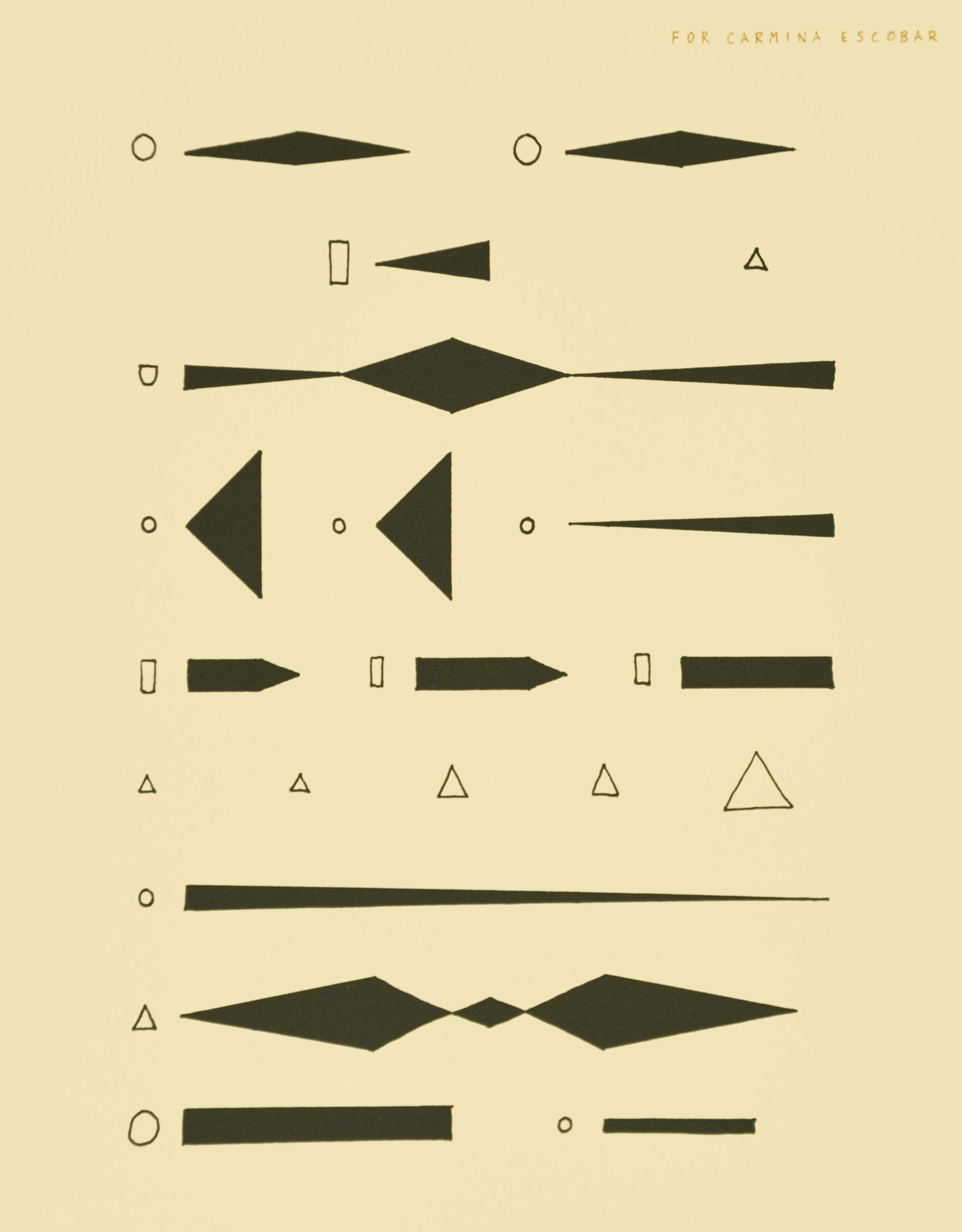
-
603
Daniel Joseph Martinez, Three Critiques...
Audio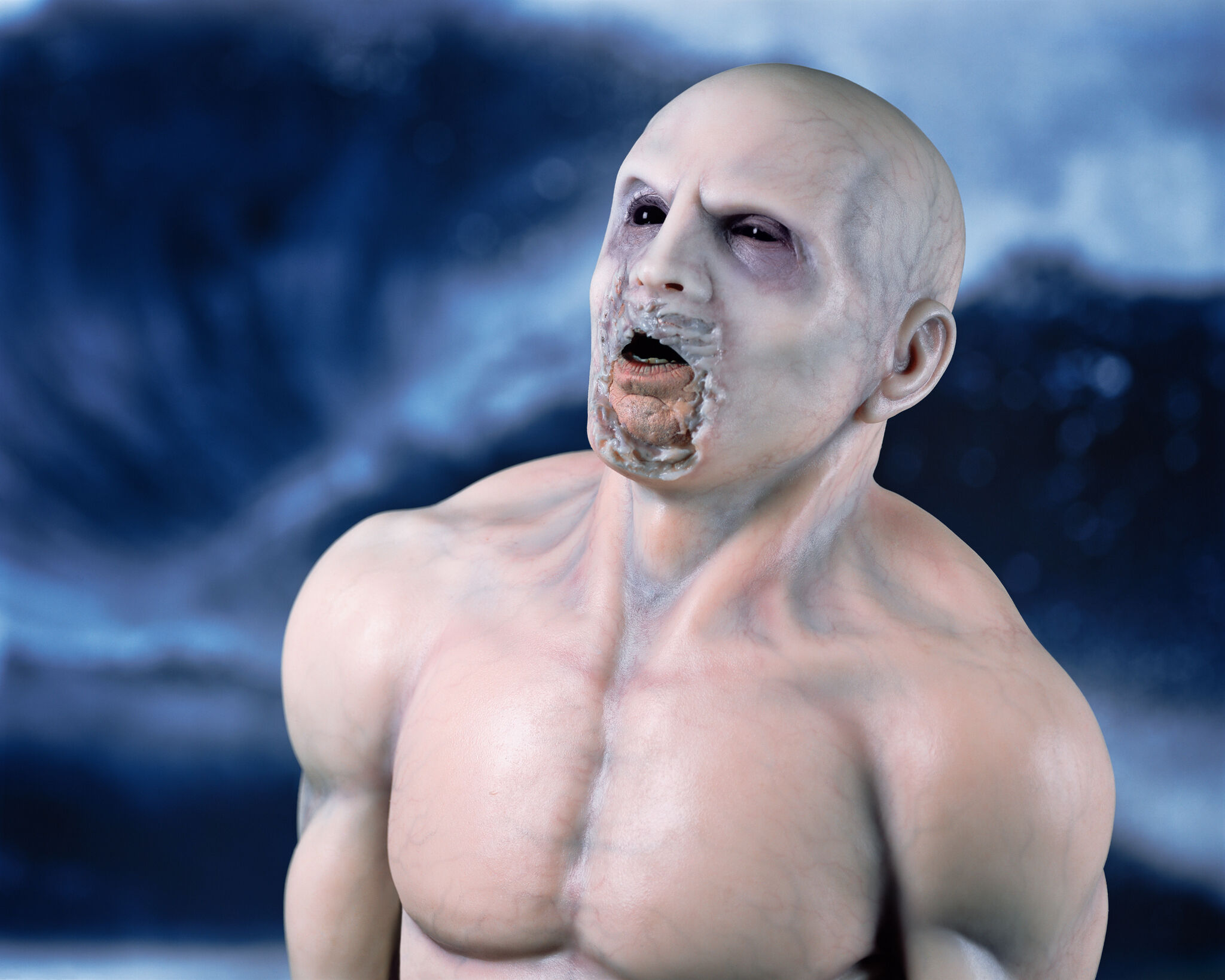
-
604
James Little, Exceptional Blacks
Audio
-
606
Guadalupe Rosales, Winter Solstice/Hazards
Audio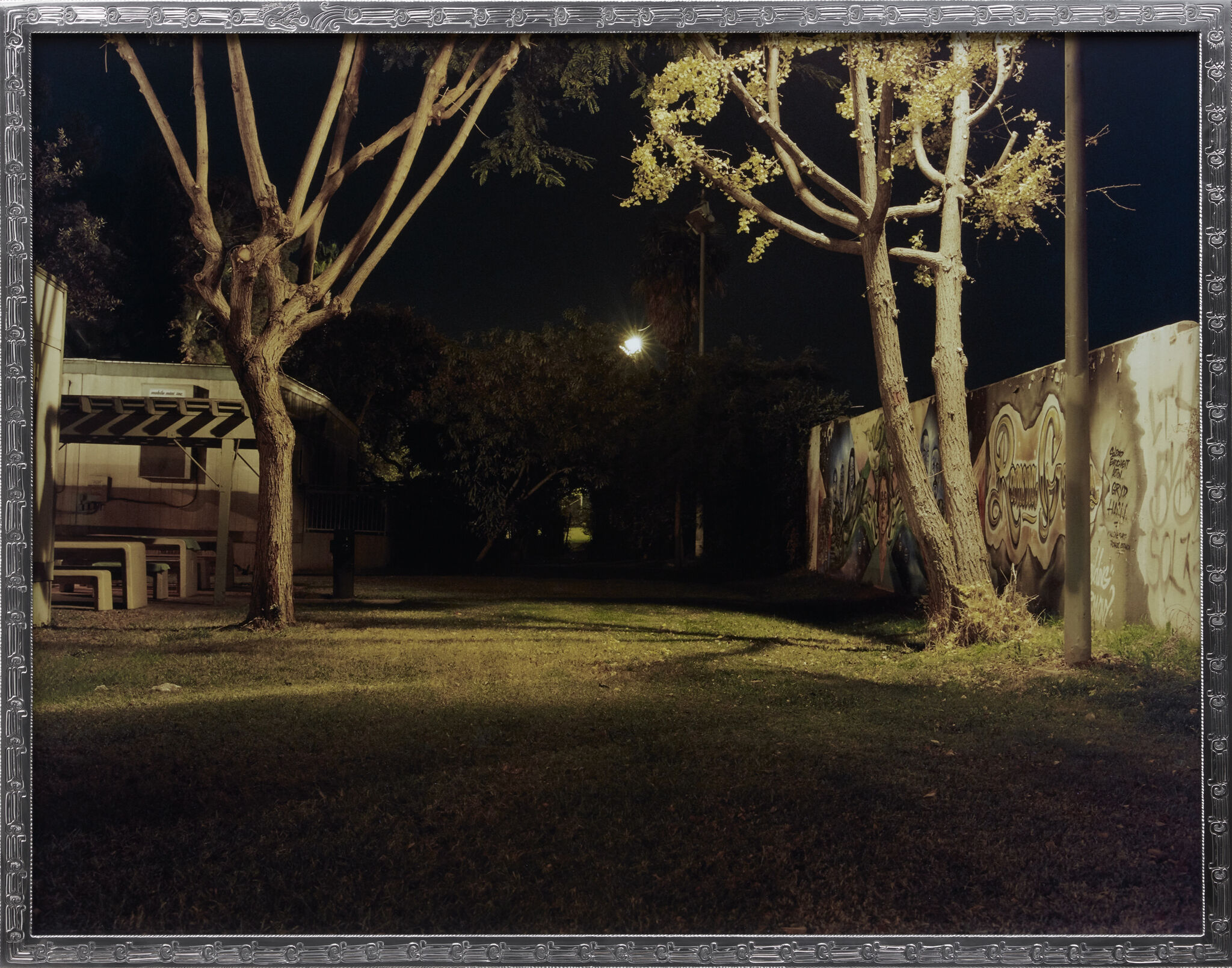
-
605
Jonathan Berger, An Introduction to Nameless Love
Audio, Verbal description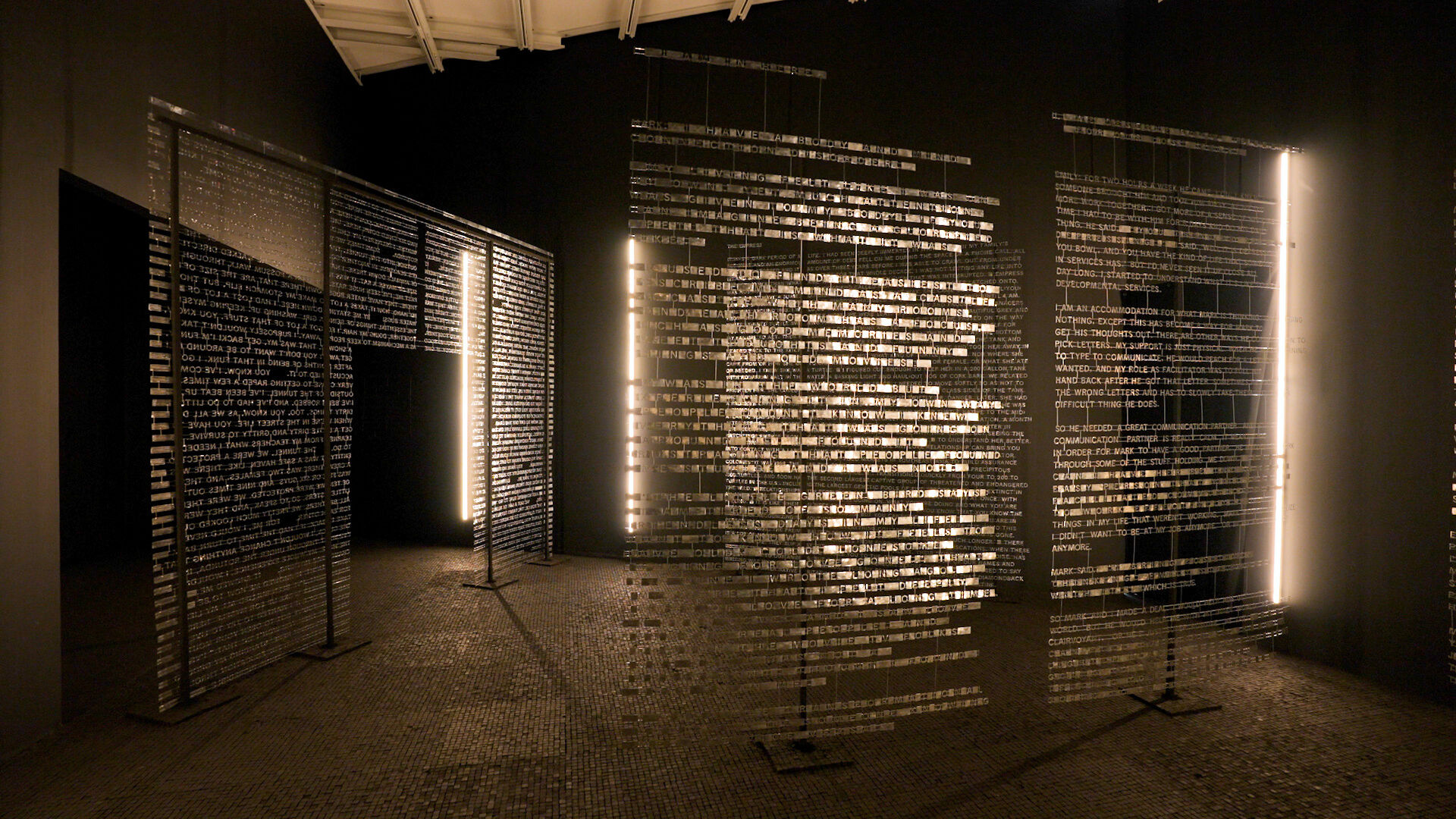
-
607
A Gathering of the Tribes, selection of archival material
Audio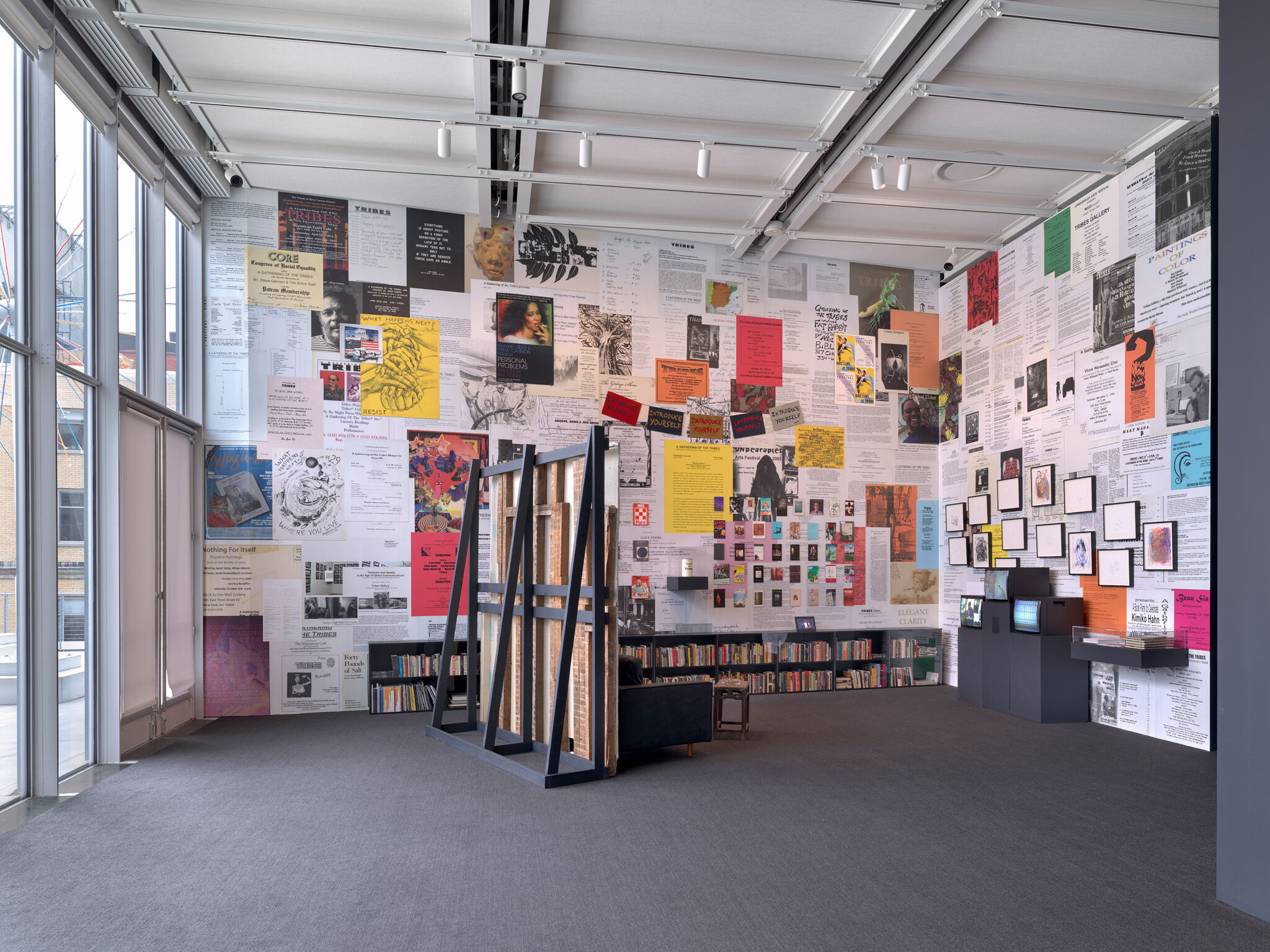
-
608
Ivy Kwan Arce, ECHO POSITION
Audio, Transcription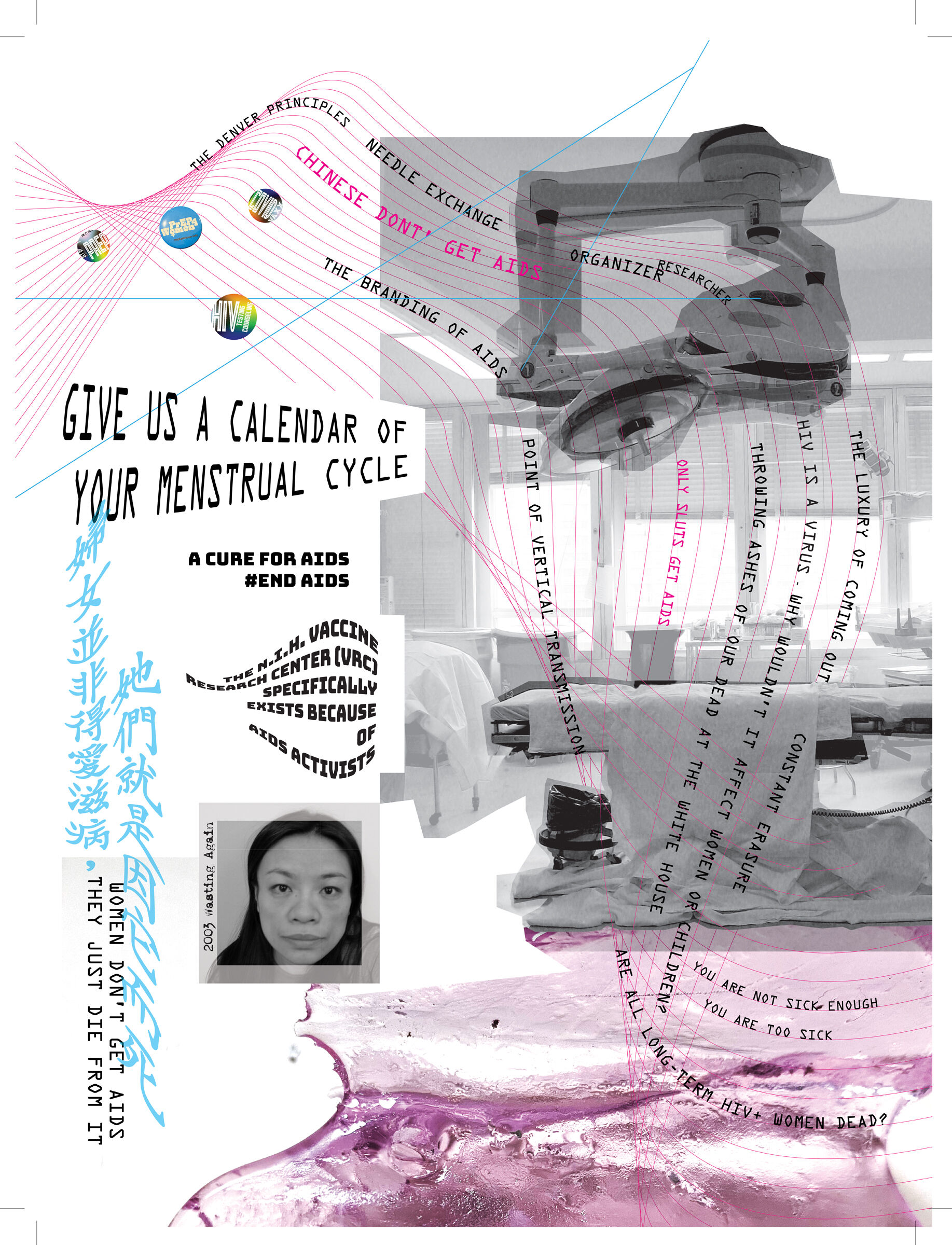
-
609
Transcription: Raven Chacon, Jehnean, 2021
Transcription -
610
Transcription: Alfredo Jaar, 06.01.2020 18.39, 2022
Transcription -
611
Transcription: Dave Mckenzie, Listed under Accessories, 2022
Transcription -
612
Transcription: Coco Fusco, Your Eyes Will Be an Empty Word, 2021
Transcription -
650
Alia Farid, Palm Orchard
Audio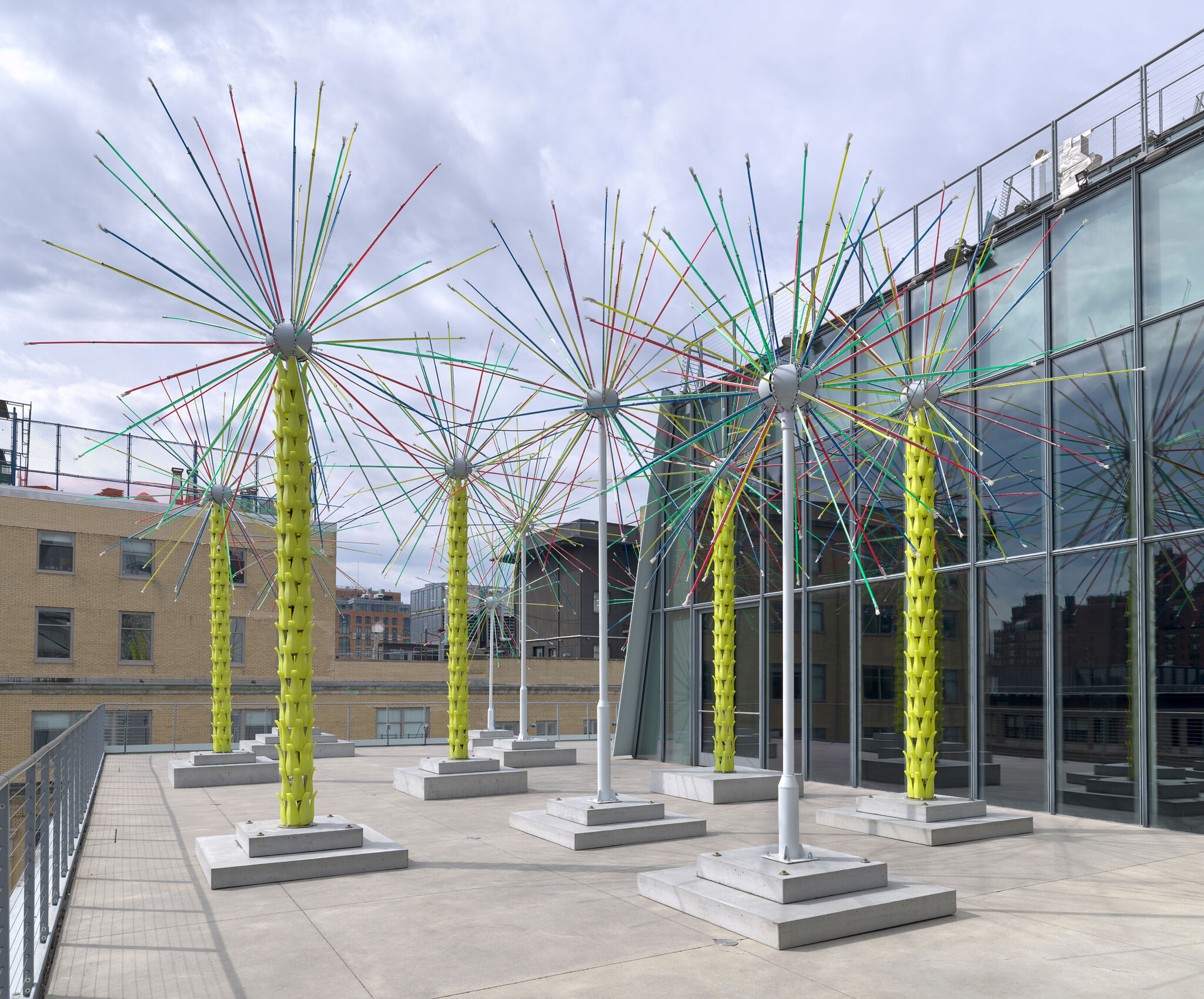
Raven Chacon: Silent Choir, both in the audio form and the photograph form, were never intended to be an artwork. I went to the Standing Rock Reservation during the #NoDAPL water protection that was happening in 2016. And I came as a guest, as another American Indian trapped in this country who wanted to understand what was happening in this place. At the same time, be another presence, another witness to this as well, but mostly watching and listening.
You would hear noises, you would hear helicopters in the sky. You would hear people singing through the night and then you would hear big instances of silence as well.
Narrator: The recorded sounds from this moment are on the sixth floor of the Biennial inside the Whitney Museum.
On the Sunday after Thanksgiving, the elder women of the encampment led a silent resistance on the bridge that connects the reservation to Bismarck, North Dakota. They faced state police and DAPL—or, Dakota Access Pipeline—security.
Raven Chacon: Led by these women, this group of people came onto the bridge and just stared at the police. And didn’t say a word. No yelling, no pleading, nothing. Just staring. And so, what I was able to capture was the sound of five or six hundred people just being absolutely silent and staring at the police. In retrospect, when I went home and listened to the recording, I could feel the power of those bodies, of those people, American Indian people and allies confronting and having to not say a word.
Narrator: Installed at second-story height across from the southern tip of the High Line, the image appears to recreate this scene here in New York City.
Raven Chacon: Even though I had not intended this image to become an artwork, let’s say, I’m grateful that the curators had seen that this was a transposable image, as if police would barricade off the Highline. One might find themselves on that side of such a situation.
So, to be able to see that these images or these point of view photos could be transposed in your own home, I think can be a very powerful experience.
Narrator: Raven Chacon’s Silent Choir (Standing Rock), 2017–22, is a billboard measuring 17 × 29 feet. (5.2 × 8.8 m).
Raven Chacon: This is an image of a couple hundred water protectors on the Backwater Bridge.
Narrator: This is a photograph by artist Raven Chacon showing water protectors just outside of Standing Rock Reservation in North Dakota. This bridge connects the reservation to Bismarck North Dakota which is off the reservation. Using some very large vehicles, state police and the Dakota Pipeline—or DAPL—security have barricaded this bridge.
Raven Chacon: In the foreground, you see a couple hundred water protectors confronting the DAPL security further on the bridge. You also see a few other objects: particularly a giant wind sock that an artist has made that says “mni wiconi,” which means “water is life.” And this photo was taken, I believe, at about 4 o’ clock in the afternoon in November on Thanksgiving weekend, the last hours of daylight.
Raven Chacon, Silent Choir (Standing Rock), 2017–22. Inkjet on vinyl, 204 × 348 in. (518.16 × 883.92 cm). Collection of the artist; courtesy the artist
Narrator: Welcome to the Whitney Bienniel 2022: Quiet as It’s Kept. This exhibition was curated by two Whitney curators: Adrienne Edwards, whose title is the Engell Speyer Family Curator and Director of Curatorial Affairs at the Whitney, and David Breslin, the DeMartini Family Curator and Director of Curatorial Initiatives. In this audio tour, listen to artists speak about their work and find other materials like transcripts and verbal descriptions. The tour is also available in Spanish. Sound quality may vary, as some of the interviews were conducted during the pandemic over Zoom.
Melanie Taylor: I'm Melanie Taylor, the Director of Exhibition Design here at the Whitney Museum of American Art.
The Whitney Biennial begins outside the museum and proceeds through the main level up through to the third, fifth, and sixth floor galleries.
As you approach the glass-walled entry to the Museum, large flat-screen monitors punctuate the façade, showing bright color and text based videos by artist Tony Cokes. Passing through the glass revolving doors into the Museum's light-bathed lobby, you'll see the gift shop and admission desks to the left and colorful text-based fabric banners overhead by Renée Green. To the right is the Museum café and the Eckel Gallery, where Biennial artists Moved by the Motion have staged a video installation on the theme of Moby Dick.
In contrast to the bright Lobby with its views to the Hudson River, the Eckel Gallery is darkened and mysterious. As you enter, only the curving back of a freestanding wall is visible, strangely intersected by a pitched stage clad in distressed wood like a ship's deck. As you follow this wall around to the other side, you begin to glimpse the video projected on the curved wall and see that you can ascend the roughly 25 foot square stage filling the small gallery like a ship in a bottle.
In the Whitney's main staircase, spanning from the coat check up through to the fifth floor, is a cylindrical canvas painting by the artist Rodney McMillian.
Melanie Taylor: The fifth floor is the largest exhibition space in the Museum. At 67 feet wide and 270 feet long, it's nearly the size of a football field. Capped by 17 foot high windows on both the east and west sides of the gallery, the curators hoped to take advantage of its vast scale and natural light to create what they're calling a “clearing.” The goal was to create a non-hierarchical space, where the visitor determines their own itinerary through the artwork.
Taking the unusual approach of an open gallery with no traditional walls, we had to devise a more transparent way of supporting the two-dimensional works in space. This took the form of frame like armatures made of poplar wood, painted matte white. They range from 8 feet tall to 9 1/2 feet tall and are scattered across the floor.
We conceived of the armatures to function similar to folding screens that you might have at home, where a single artist might occupy both sides or perhaps two artists occupy the front and then the back leaving lots of room on the floor for you to move in amongst them.
They're open shapes, offering porous views through to other artworks and creating a kaleidoscope of relationships amongst works. Looking to the west with its views of the river, you will experience a layering of artwork on armatures with sculptural works, like Duane Linklater's 20 foot wide naturally dyed textiles hanging from the ceiling or a mini retrospective of archival and video work by Theresa Cha enclosed by an ethereal gauze scrim. To the east, with its softer light, you'll see a vibrant 12 foot wide video of animated watercolors by Danielle Dean and Sable Elyse Smith's slowly rotating 14 foot high ferris wheel assemblage of prison furniture. Throughout the sounds of audio, visual works shift and mix to contribute to a dynamic flux of ideas.
Melanie Taylor: The sixth floor is designed to be the spatial and material counterpoint to the fifth floor. Whereas the fifth floor is open and bright, the sixth is dark and moody. With a similar ceiling height but slightly smaller footprint, the sixth floor undergoes an inversion. Here, the walls are painted black, the pine floors are completely obscured by black carpet and you are greeted by the monumental black and white hatch like paintings by Denyse Thomasos on either side of a small doorway.
Entering through this doorway, one encounters a small dark room, only big enough for a few people. A silent protest plays and this antichamber is punctuated by two small dimly lit objects. Passing through another low doorway, one sees a white scrim veiling a shallow space beyond with five large emphatically colorful and metaphysical portraits by Daniel Joseph Martinez, lit in a cold even wash of futuristic light, the only white space in the gallery. To the right is a labyrinthian circuit of spaces, gently spotlit where there are paintings or shimmering where large scale video occupies corners and even ceilings. Circling back to the east, one passes a series of small idiosyncratic black box spaces with wide, low doorways framing their contents like viewfinders or dioramas. Here on the sixth floor, a visual cacophony is replaced with a sonic one.
As a view to the east terrace begins to emerge from the shifting and overlapping pathway, the riotous form of an artificial oasis takes shape. On the terrace are over one dozen 9 and 12 foot tall palm trees with multicolored, LED fronds inviting you to sit beneath them and enjoy the surrounding city.
Transcription: Tony Cokes, Evil.80.Empathy?, 2020.
Running Time: 00:02:43
[Music Track: percussive high-tempo music plays, interjected by deep rhythmic moments of bass.]
Speaker 1: (echo-y, with a British accent, layered over the music) Please, I swear, sometimes we're living on different planets because there is no fuckin' way of communicating with you all. Who the fuck are you people anyway? Hey? Who the fuck are ya?
[Music Track: the music crescendos into a bass drop, reminiscent of dubstep music. The electronic bass tones pulse among various other percussive beats.]
Speaker 1: (in the same voice, but layered under the music) Please, I swear, sometimes we're living on different planets because there is no fuckin' way of communicating with you all. Who the fuck are you people anyway? Hey? Who the fuck are ya?
(echoes, same as before) Please, I swear, sometimes we're living on different planets because there is no fucking way of communicating with you all. Who the fuck are you people? Hey? Who the fuck are ya?
[Music Track: the pulsating music continues to reverberate, growing smaller only in the last couple of seconds before it ends]
Narrator: Jason Rhoades died in 2006. Adrienne Edwards is the Engell Speyer Family Curator and Director of Curatorial Affairs at the Whitney. She says she selected his work for inclusion in the exhibition because it speaks to the current cultural moment.
Adrienne Edwards: The Caprice is a car that Jason was immediately drawn to, the fact that it had served as the car for so many federal and state employees, particularly the police, that it also was a car that was converted from a police car into taxis. And we think about how the gig economy has, in a city like New York, impacted the taxi industry. There have been real calamities around that, so here's a work that he created in the nineties that actually was quite prescient and relevant to today.
But also that it was about an almost romantic idea about the engine and mobility and expansion and the way it’s all bound up in our ideas of freedom and also individuality. And I think for Rhoades it’s not about a kind of emotional attachment to cars or any one car, but it’s about them as machines and as tools. Making the work, the car becomes this liminal space for him, between his studio and then all the places he would go visit to source materials all over Los Angeles for his installations.
It could be very easy to ask: why put Jason Rhodes in the Biennial at this moment? There was an article in The New Yorker in 2017 and the title of this piece is “An L.A. Artist Who Anticipated Our Trumpian Moment.” And I remember seeing that and thinking that that was precisely right.
Narrator: Rhoades described the project to the curator Hans Ulrich-Obrist, while driving in one of the cars.
Jason Rhoades: They are based in tools, the idea of a tool for perception or a vehicle for thinking. You know like a vehicle as a, not a motorized vehicle necessarily, but like a medium. You know like in paint is powder right and you use a medium which is either an oil or linseed, you know the vehicle which the color is transported in. So I use it, my interest is in how and what and why it transports things and how it can be used as a tool for certain perceptions. The tool for hauling physical things, a tool for hauling mental things and also a tool to be used to propel yourself through space. I mean I look at objects, I mean I’m incredibly interested in Duchamp in that way, I mean he put the readymade into an art context but then I believe we can put it back to work, to where objects can have simultaneous meanings, simultaneous levels, at all points in time, you know the object that you buy at the store, the gesture of buying it is an incredibly sculptural gesture, and the gesture of consuming it, putting it in your car, the gesture of opening the box, the gesture of putting it in the work of art, you know is all very, very important part of sculptural process.
Jason Rhoades’ Caprice (1996) is a Chevrolet Caprice Classic 4 Door Sedan. It measures 55 x 77 x 214 inches (139.7 x 195.6 x 543.6 cm)
Rhoades’ Caprice is a real 1996 white Chevrolet Caprice, 4 door sedan that now sits parked on Gansevoort Street like it once sat parked outside the artist’s studio. The Caprice has rounded lines, a roomy interior and a stand-up hood ornament. A good cruising car, both durable and tough, it’s a car that has been used both for NYC taxis and police vehicles.
There are more visual descriptions of artworks in the Biennial on floors five and six. These are also found at whitney.org/guide.
Jason Rhoades, Caprice, 1996 (installation view, Whitney Museum of American Art, New York). Chevrolet Caprice Classic Sedan. Estate of Jason Rhoades; courtesy the Estate of Jason Rhoades; Hauser & Wirth, and David Zwirner Gallery. Photograph by Ryan Lowry
Rayyane Tabet: The project is called Becoming American.
The project as a whole looks at the naturalization exam, which is one of the last components of your path to gain U.S. citizenship, which is a path that I'm on right now, which is called a change of status.
One component is called 100 Civics Questions, which is kind of this intervention in multi-sites and the second one is called Learning English.
Narrator: You can find the video Learning English on the Museum’s fifth floor. 100 Civics Questions is distributed throughout the Museum. Here artist Rayyane Tabet is discussing the work 100 Civics Questions.
Rayyane Tabet: The United States citizenship and immigration services provides study guides for these exams. So in a way you go to the exam. Knowing all the questions and knowing all the answers.
The project as a whole kind of takes this exam as a site of inquiry and kind of takes these questions and these elements out of their context of the exam and distributes them around the Museum, in the gallery, and online for them to become kind of probing.
For me, it became really interesting to follow the process of the change of status as a philosophical one, a poetic one, an artistic one.
Those 100 questions, what is the imagination of a U.S. citizen seen through the lens of the naturalization exam, especially when, if you go on the street and ask those same questions to people that are de facto citizens by being born in the U.S., most people will not be able to answer those questions. And that is the result of many things. One of which is that there's no standardized civics curriculum across the U.S.. And the idea that people in different states, in different counties, in a way learn possibly a different kind of history and even geography of the country.
And what becomes very apparent when you look at these questions is of course it tells you one specific part of the history. It focuses more on civic duties and less on civil rights. Let's say it opens up the potential for a really interesting kind of conversation around those issues.
Rayyane Tabet, 100 Civics Questions from Becoming American, 2022 (installation view, Whitney Museum of American Art, New York). Text-based installation at the Whitney Museum of American Art, New York, 2022. Courtesy the artist. Photography by Sandenwolff
Transcription: Tony Cokes
Running Time: 00:10:29
["Casino" by The Notwist playing].
[Background noise: rhythmic beat]
Speaker 1: I think [inaudible] would be very proud to see young, African-American, young white American, young Latinos and Asian-American and Native American coming together. Who say, "No," to racism, "No," to hate. That we must disarm hate and [inaudible] and redeem the soul of America. And in doing so, maybe we can help redeem the soul of the world. And save this whole planet, we studied, we prepared ourselves. We spent our life teaching [inaudible]. [inaudible]. We study about what was happening in South Africa. We heard about the [inaudible] and others, and we accepted the way of non-violence as a way of life, as a way of living. [inaudible] I was arrested 40 times. And since I've been in Congress another five times. And I'm probably going to get arrested again for something else. You may be beat me, you may arrest me and throw me in jail.
[Background noise: rhythmic beat speeds up]
Speaker 1: Almost died on that bridge for the right to vote. I gave a little blood but other people gave their lives. We must not be afraid, we must be hopeful, we must be optimistic. We must never hate. As Dr. King would say, "Hate is too heavy a burden to bear." You know, we cannot create a society [inaudible] because we're hating each other, putting each other down. I remember so well the first time I got arrested and went to jail. That's an unborn struggle. Our struggle is not a struggle that lasts for a few days, a few weeks, a few months, or a few years. It is a struggle of a lifetime, maybe many lifetimes, but you must give it all. And that's why we must continue to move our feet. Continue to push and pull, not just to make America better, but to make our planet a little better. But we still have problems. They want to take us back, but we've come too far, made too much progress to go back.
[Background noise: rhythmic beat continues]
Speaker 1: I've said over and over again, the vote is precious. It is almost sacred. It's the most powerful, non-violent instrument or tool that we have in a democratic society. We should make it easy and simple for everybody to participate.
["Between the Clock and the Bed" by Manic Street Preachers featuring Green Gartside playing]
["Exercise One" by Joy Division playing].
Narrator: Adrienne Edwards is one of the curators of the Whitney Biennial 2022: Quiet as It’s Kept. She discusses one of Renée Green’s Space Poems, which are the banners hanging from the ceiling.
Adrienne Edwards: Renée uses very poetic, abstract, sometimes oblique language that sort of functions to open our mind as to how we understand what we think we understand, how we encounter information, because it has almost an advertising kind of sensibility. It’s interesting: that kind of slippage between expecting to be told something as opposed to being presented with the opportunity to think magically in a way about something.
Narrator: Renée Green talked about the series.
Renée Green: Space Poems are open-ended wavelengths very often in serial forms. I chose it as a way of working because it is so capacious. I’m looking for different kinds of resonances. Each one is different and I’m always collecting ideas for the Space Poems. I would say my work over time is try to find distillations throughout. I’m always trying to do that. And so it would be refining it in a way, almost like a poem.
Narrator: Renée Green’s Space Poem #7 (Color Without Objects: Intra-Active May-Words) 2020, is composed of 28 double sided banners made out of polyester nylon and thread. Each banner measures 42 x 32 inches (106.7 x 81.3 04 cm).
Green’s Space Poem #7 (Color Without Objects: Intra-Active May-Words) is a work of 28 colorful banners that hang from rods installed on the gallery’s ceiling. All banners are the same size. The banners are evenly spaced apart from each other and inhabit a large area of the gallery. Each banner is double sided with text on each side. The texts reference May Swenson’s 1965 poem “Color without Objects.” The banners’ colors are bright, glowing and playful.
Let me offer you an example of one banner. I am only describing one side of the banner. Rectangular in shape with the long sides hanging vertically (all banners hang in this manner) the background is a rich, vibrating orange surrounded by a thin border that is a light orange color. Since the banner is made out of nylon, there is a slight puckering where the border is sewn to meet the larger area. Centered in the rich, orange background is text that uses lower case letters in a sans-serif font. All the letters are the same size and are a sour yellowish, green color. The phrase reads as follows: “incubated under the great flat lamp.” There is no punctuation and the words are stacked upon each other. The word “incubated” is at the top above the word “under” which is above the words “the great” that is above the words “flat lamp.” The text is large enough to read at a distance. Different phrases in different color combinations form the remaining twenty-seven banners. This is a poem that shifts in meaning as one’s body navigates the space allowing connections to emerge through movement.
Renée Green, Space Poem #7 (Color Without Objects: Intra-Active May-Words), 2020 (installation view, Whitney Museum of American Art, New York). Polyester nylon and thread, 28 double-sided banners, 42 × 32 in. (106.7 × 81.3 cm) each. Collection of the artist; courtesy the artist; Free Agent Media; and Bortolami, New York. Photograph by Ron Amstutz
Narrator: Rodney McMillian created this piece for the stairwell.
Rodney McMillian: I don’t think of it as a painting so much as I think of it as an object that incorporates painting because it’s about the space. It’s about how the body moves through that space and how the body is engaged with the object, which in my head, I keep wanting to call an event just because it’s the act of ascending and descending. And the idea of like engaging with the work is not about the eyes as much as it’s about the whole bodily experience, because you can’t absorb the whole thing with one’s eyes anyway.
Narrator: McMillan is known for very large-scale landscape paintings made with industrial materials like house paint. Born in South Carolina, McMillan traces his interest in landscape to his political awareness. “I’ve always seen the landscape as a space of oppression because of the toil and the rape and the blood and the murder that’s existed in the land,” he says. “These conditions persist to this day. These are conditions we’ve inherited, and they can be undone. I’m interested in the undoing.”
Rodney McMillian, shaft, 2021–22 (installation view, Whitney Museum of American Art, New York). Latex, acrylic, vinyl paint, ink, and paper on canvas, six panels. Collection of the artist; courtesy the artist; Vielmetter, Los Angeles; and Petzel, New York. Photograph by Ron Amstutz
Rayyane Tabet: The project is called Becoming American.
The project as a whole looks at the naturalization exam, which is one of the last components of your path to gain U.S. citizenship, which is a path that I'm on right now, which is called a change of status.
The United States citizenship and immigration services provide study guides for these exams. So in a way you go to the exam. Knowing all the questions and knowing all the answers.
The project as a whole kind of takes this exam as a site of inquiry and kind of takes these questions and these elements out of their context of the exam and distributes them around the museum, in the gallery, online for them to become kind of probing.
For me, it became really interesting to follow the process of the change of status as a philosophical one, a poetic one, an artistic one.
Rayyane Tabet, Learning English from Becoming American, 2022. Four-channel video, silent, black-and-white, 60 min., looped. Courtesy the artist. Photography by Sandenwolff
Rose Salane: All of these coins that had been sorted through the system that are not money at all, but they were used at one point to pay for bus fare.
Narrator: Artist Rose Salane purchased a collection of fake money used by riders on the MTA at an auction, and thus began the idea behind this installation. Salane has an art degree, but she also earned a master’s in urban planning. Her work combines her interest in making art with her curiosity about the city and how it functions.
Rose Salane: It was almost this sampling of a two-year period of people dropping whatever resembled money into this machine or into a transportation system that they would get somewhere, physically get somewhere.
The attempts at kind of cheating the system, but also like needing it as well to just live one’s life through the city. So I do find that objects are really revealing of these moments that, I don’t know, kind of fighting and also getting away with something.
I use the city as a very powerful lens. And I try to see: what are the changes that have significantly reshaped people’s way of moving through an environment, this one. And sometimes I think New York can reveal very unfortunate truths. So I’m interested, as a New Yorker, in knowing the vibe or rhythm of the city.
I was just really invested in letting the objects speak and having objects hold the truths that it does and in that form it retains a psychology of the object itself.
I’m also really interested in the bureaucracy in how this currency that passed through, but it couldn’t pass through to the main level of the agency cashing it in for something that they can report on, like their taxes or like their earnings, so it gets stopped at a specific level. But the individual is able to pass through up until that level until the institution prevents it.
Rose Salane, 64,000 Attempts at Circulation, 2022. Slugs (counterfeit currency used to trick coin-operated devices) acquired from a New York City MTA asset recovery auction installed on patinaed steel tables with screen prints on archival paper. Collection of the artist; courtesy the artist and Carlos/Ishikawa, London. Photograph by Sandenwolff
Narrator: Photographer Pao Houa Her now lives in Minnesota. She captures the lived experience of the Hmong people.
Pao Houa Her: I’m Hmong and the Hmong people are historically from China during the Han dynasty, they were sort of forced out and made their way south into Southeast Asia, so I am a group of Hmong people that are from Laos.
Narrator: The photographs here rotate. At any given time, you’ll see a selection of work, all of which references the Hmong diaspora in one way or another. The artist has spoken about the complex nature of her Hmong-American identity:
Pao Houa Her: Hmong people helped the Americans fight during the Vietnam War, specifically in Laos.
Narrator: One body of work that will be on view for part of the Biennial represented over the course of the Biennial is comprised of portraits of Hmong soldiers who assisted the US government in Southeast Asia during the Vietnam War. Denied official acknowledgement and veteran status, these soldiers have long sought to achieve recognition. Her’s portraits convey the dignity denied to these men, though they had to assemble their uniforms from the army surplus store.
Pao Houa Her: I’m really interested in the legacy of the Vietnam War and how the trauma continues to get played out in sort of the everyday lives of what it means to be a Hmong person. I’m interested in ideas of desire within like the Hmong consciousness. I’m also very much interested in ideas of what an imaginative Laos or a homeland would look like.
Narrator: Another selection of pictures that will be on view for a portion of the Biennial comes from a body of work called After the Fall of Hmong Tebchaw.
Pao Houa Her: And basically that body of work came from a story essentially. There’s a Hmong man in mid-2015, he was able to swindle Hmong elders into paying him a set amount of money, because he said that he was establishing a Hmong country. And that if you can pay into this new establishment, you can be a founding member, and he was able to swindle over a million dollars from Hmong people in the community.
And for me, I’m really interested in like, What is it about this desire? What is it about wanting to go back? To go back into a country that you feared so much that you had to leave. There’s something about that psychology that I’m like really interested in.
Narrator: Some of the work was photographed at the Como Park Conservatory in Minnesota.
Pao Houa Her: When we came to America, for a long time my parents would go to a conservatory in St. Paul every weekend because it was the only place that was hot and humid, the atmosphere resembled Laos. But then also conservatory, for me, was very symbolic and metaphorical in a way too right. Here are these plants that are not native to Minnesota, that have been transplanted to Minnesota that are kept in these beautiful glass houses. And so I just think about that metaphor.
Pao Houa Her’s Untitled (Portrait), 2017 is an inkjet print. It measures 52.5 × 42 inches (133.4 × 106.7 cm). It is from the series After the Fall of Hmong Teb Chaw
In this black and white print by Pao Houa Her, an older Hmong woman sits surrounded by large leafy plants as if she is in a jungle. She gazes to our left. Her expression is thoughtful. Her hair is pulled back and an earring dangles from her left ear. Leaves from the surrounding plants cover the top of her head. Garlands from white flowers dangle from the top of the image but they do not reach her head. Her right elbow rests on something that we cannot see but for one very big leaf emerging from under her arm. Her left hand clasps her right wrist. The elegant fingers of her right hand hang down. She is dressed in a brocaded jacket from which a white collar of a shirt appears at the neck. Her jacket spreads slightly open upon her lap. The bottom part of her outfit is black, and the image is cropped below her lap.
After the Fall is a body of work that has two types of images. One group are portraits that are set up in a way that resemble traditional Hmong portraiture. In traditional Hmong portraiture the individual is placed in the center and they are surrounded by fake florals or greenery. In Her’s portraits, the artist photographed Hmong women from a senior day care center at the site and surrounded them by plants found in the center. The artist volunteers at the senior center and knows the woman in this work.
Pao Houa Her, Untitled (Tais Kai) from The Imaginative Landscape, 2017. Inkjet print, 52.5 × 42 in. (134 × 107 cm). Collection of the artist; image courtesy the artist and Bockley Gallery, Minneapolis
Renée Green: I’ve had a very long relationship with painting. I'm 61, I grew up in Cleveland and I was taken to the Cleveland Museum of Art. I had a lot of opportunities to look at the collection.
Narrator: Renée Green made Lesson when she was a resident at the Studio Museum in 1989, just before she participated at the Whitney's Independent Study Program.
Renée Green: I went to the Whitney program in 1989. It was fall of ‘89 to spring 1990. This was a time of transitioning forms. And that's part of why I mention this work. It's called Lesson. It’s trying to combine almost like a critique of museums and collection, because it has this collection that's included in it itself. It's not representative of anything else really. But it also has these elements that are quotations from novels. So from Jules Verne, there’s a quotation that has to do with something being destroyed when it was in the process of being collected.
Something I've been thinking about a lot has to do with language and how language is brought into my work, and how it's always been there. I don't think of the painting in isolation, that's the thing. I see it more as a prompt in relation to new works and other works that I've made or that I make that I'm in the process of making.
Narrator: In that sense, Green’s Space Poem, text on colored banners hanging in the Lobby, is conceptually related in her mind to this painting and to her overall trajectory as an artist.
Renée Green, Lesson, 1989. Photocopies, mixed media, and plastic signs on masonite and wood, three panels: 48 × 48, 48 × 96, 48 × 48 in. (122 × 122, 122 × 243.8, 122 × 122 cm). Collection of the artist. Photograph by Ron Amstutz
Narrator: You can find the video Learning English on the Museum’s fifth floor. 100 Civics Questions is distributed throughout the Museum. Here artist Rayyane Tabet is discussing the work 100 Civics Questions.
Rayyane Tabet: The United States citizenship and immigration services provides study guides for these exams. So in a way you go to the exam. Knowing all the questions and knowing all the answers.
The project as a whole kind of takes this exam as a site of inquiry and kind of takes these questions and these elements out of their context of the exam and distributes them around the Museum, in the gallery, and online for them to become kind of probing.
For me, it became really interesting to follow the process of the change of status as a philosophical one, a poetic one, an artistic one.
Those 100 questions, what is the imagination of a U.S. citizen seen through the lens of the naturalization exam, especially when, if you go on the street and ask those same questions to people that are de facto citizens by being born in the U.S., most people will not be able to answer those questions. And that is the result of many things. One of which is that there's no standardized civics curriculum across the U.S.. And the idea that people in different states, in different counties, in a way learn possibly a different kind of history and even geography of the country.
And what becomes very apparent when you look at these questions is of course it tells you one specific part of the history. It focuses more on civic duties and less on civil rights. Let's say it opens up the potential for a really interesting kind of conversation around those issues.
Rayyane Tabet, 100 Civics Questions from Becoming American, 2022 (installation view, Whitney Museum of American Art, New York). Text-based installation at the Whitney Museum of American Art, New York, 2022. Courtesy the artist. Photography by Sandenwolff
Duane Linklater: My name is Duane Linklater, and I’m originally from Moose Creek First Nations, which is located in Treaty 9 Territory in Northeastern Ontario situated along the southern coast of James Bay.
Narrator: Linklater uses pigments that have been important to Indigenous artists, including sumac, charcoal, and cochineal. He’s painted them onto linen canvas that will be shifted and rearranged over the course of the Biennial.
Duane Linklater: These are teepee covers. They’re not functional teepee covers, but I think that the idea is there. There’s something important about these works and their ability to articulate a change, or their ability to articulate a fluctuation of time and space. And that’s sort of originating from their original uses, as teepee covers, as this sort of very, very flexible mode of architecture, this flexible mode of being able to move from one place to another, according to the situation of the environment.
The series is called Wintercount. And so in my own culture, my Omaskeko Cree culture that when we ask each other this question of how old are you? And when we ask each other that question in Cree, if we were to translate, that would literally be saying, how many winters are you? If we are looking at a lifetime of a person, that person is half winter, the sort of way I look at it, right? And so this really beautiful way to think about the presence of winter. In this case, there were certain things that I’ve been thinking about over the past three or four years, five years, and that have made their way into the work. For example, I think one of the important ones this past summer in Kamloops, they uncovered a number of unmarked graves of children who went to residential school.
Narrator: The Canadian Truth and Reconciliation Commission has described the residential schools as a central element in Canadian policy on Indigenous people for over a century. Children were taken away from their families in an effort to force assimilation and erase Indigenous cultures. Thousands of unmarked graves have been uncovered around Canada, and the search for more continues. In November of 2021, the Department of the Interior announced plans to begin identifying the unmarked graves that exist at similar schools in the United States.
Duane Linklater: Myself, I didn’t attend residential school, but many of my family members were forced to attend residential schools. And it had a profound impact on my family, and part of what it is that’s happening in here, and part of making this work, being able to articulate myself, and being able to speak and make work, make choices, free, open choices with the work seems important in light of this historical context.
Duane Linklater, a selection from the series mistranslate_wolftreeriver_ininîmowinîhk and wintercount_215_kisepîsim, 2022. Canvas, cochineal, orange pekoe tea, charcoal, sumac, cotton thread, blueberry dye, felt tip marker, linen, 220 × 100 in. (558 × 254 cm) each. Collection of the artist; courtesy the artist and Catriona Jeffries, Vancouver. Photograph by Ron Amstutz
Narrator: In these sculptures, Veronica Ryan combines found and fabricated materials, using metaphor and personal association to create a sense of place.
Veronica Ryan: So when I’m talking about environments and looking at the state of the global warming situation and this disjuncture in terms of the natural order, the internal order and chaos and trauma, different states. Those are all parts of the conversation that's going on in the work and by trying to work things out, materially, trying to deconstruct and make meaning, understand the wider cultural manifestation.
Narrator: Ryan was born in the British overseas territory of Montserrat in the Caribbean, and grew up in London. Her work is deeply rooted in a sense of place, history, and global migration—all issues that she approaches very metaphorically, through materials and poetic connections.
Veronica Ryan: About migration and place. I’m always curious what people mean. I just read a really interesting article this morning about the Pacific, and about the garbage patch in the middle of the ocean, and about the way that it’s creating an interesting phenomena for scientists where, according to this swirling ocean, some of the garbage is now creating itself as an attachment for some sea creatures. My work really is global. It does move around different connecting parts, and it is interconnected.
I don’t see any one aspect not related to the wider culture. For instance, the article was talking about gooseneck barnacles that are attaching to either tangles of fishing line or water bottles. I’m quite interested in metaphorical references, and how the movement of people across different parts of the globe, then people take their original culture with them, and then embrace the culture that they’ve moved to, and then, some people are never able to embrace different paradigms. So, that sort of interspace, that gray space of dislocation and so on, and that’s generally the way that I work.
Veronica Ryan, Between a Rock and a Hard Place, 2022 (installation view, Whitney Museum of American Art, New York). Collection of the artist; courtesy the artist and Paula Cooper Gallery, New York. Photograph by Ron Amstutz
Narrator: Artist Rick Lowe trained as a landscape painter.
Rick Lowe: But very quickly I started to rebel against formal aspects of painting the way that it was taught to me, and I was interested much more in the political context of things that I was dealing with. And I wasn’t comfortable with how painting functioned in the art world, the art world as I saw it.
Narrator: In the 1990s, Lowe was one of the founders of Project Row Houses in Houston, a collective that transformed twenty-two homes in the city’s Third Ward into a community space for art and empowerment. This public, collaborative project influenced his painting. Lowe says that, in recent years, his process has become more intellectual, less physical, out of necessity. He started playing dominoes, and, eventually, making new work inspired by the game.
Rick Lowe: I really found myself at the domino table a lot more, you know, and just kind of learning and talking and sharing with people, playing dominoes and it's an incredibly spiritual and educational experience when you’re doing that on a regular basis with people you get to know. One of the things that I’m thinking about though is actually these patterns that would happen as the game plays out. Especially when people play with different colored dominoes. The shapes were really interesting, you know, and after people would play a hand and I was like, say, hold on, hold on, wait, hold it. And I would take a photograph of it, you know, with my camera, these bird’s-eye-view photographs. Then I started kind of getting into it and start layering them. And then it just starts to speak to me as something that’s separate from the game.
Narrator: After so many years as the public face of Project Row Houses, Lowe says the domino drawings gave him a new, more introspective opportunity.
Rick Lowe: I could kind of pull myself back and buy time for myself. I mean, I love that stuff where every decision should be a collaborative decision with many voices in that kind of stuff. I love that stuff. You know, in the studio making something, it’s my choice. It’s my decision. I get to make these things, you know? And that’s something that I kind of left behind, which is kind of a joy to reconnect with that. There’s a part of me that really loves this collaborative and social part, but there’s another part of me that has a deep appreciation for the private and personal, which I just kind of let go for you know, nearly thirty years.
Rick Lowe, Project Row Houses: If Artists Are Creative Why Can’t They Create Solutions, 2021. Acrylic and paper collage on canvas, sixteen panels, 36 × 48 in. each, 144 × 192 in. overall (91.4 × 121.9 cm each, 370 × 490 cm overall). Collection of the artist; courtesy the artist and Gagosian, New York, Los Angeles, Paris, London, and Hong Kong
Narrator: Artist Awilda Sterling-Duprey:
Awilda Sterling-Duprey: I have always been very curious and very into impulsive, something attracts me and I don’t ask for permission or whatever. I just go there to see what is happening or to see is it true what I felt or what I heard.
Narrator: Sterling-Duprey performs her paintings and drawings into being. She blindfolds herself, then allows music to guide her in improvisational movements that lead to mark-making on paper, and the walls.
Awilda Sterling-Duprey: I am using sound, I am following sounds, the energy of improvisation, jazz improvisation to produce those images or those traces on the paper that my body has to follow. I don’t have a sense of what I am doing at the moment, but I do know that I am enjoying what I am doing. Yes. I have to feel that I am enjoying grasping the idea and the concept.
My impression is that I have so much information in my brain, what I have been doing before, always using my body to do things, to create things, usually in large spaces, large format, that I think I don’t have to see what I am doing, because it is already there. It’s just a way of feeling where I am feeling the surfaces, listening to the sound and the noise, and the music.
I think that’s probably also very much connected to jazz. You cannot just memorize the song. You memorize the song, but you have to imbue it with your own feelings. Even when following the rules for jazz interpretation, you have to feel it first and you make it your own. And then you can improvise.
Awilda Sterling-Duprey, . . . blindfolded, 2020–. Installation with oil stick on paper and performance. Courtesy the artist. Photograph by Ron Amstutz
Rindon Johnson: My name is Rindon Johnson.
I work with leather because it’s a byproduct of the meat industry. A lot of my original thesis with this work was thinking about how American Blackness is a byproduct of the transatlantic slave trade and I wondered what other byproducts I could work with. I began to realize, when I started trying to find a material that was as Black as I was, that, because of the way that capitalism functions in our society—especially in American society—every material is touched by the violence of it. And so what became clear to me was that I could choose any material and it would be filled with the charge and the pain of capital accumulation.
Narrator: Other products—like indigo, coffee, wax, and wood stain—also interested Johnson because they share histories inflected by exploitation. These materials trace colonial trading routes and exhaust natural resources. Though he uses these materials to alter the cow hide, he purposefully adds little fixatives and in doing so acknowledges the impermanence of these marks.
Rindon Johnson: I’m using a series of indigo baths and indigo washes across the cows to try and arrive at a very deep blue. It’s not going to work, and so much of my work is about things not working.
Narrator: Johnson marries a set of material reactions in this work: the mercurial nature of the colors he uses and the leather’s subsequent changing over time. The artist describes this relationship as a “line of recognition” between one medium and another.
Rindon Johnson: I have a lot of questions about neglect and I have a lot of questions about what it means to leave something alone. Do you leave something alone because you want to give it the agency to be itself or do you leave something alone because you don’t care about it?
Transcription: Awilda Sterling, …blindfolded, 2020
Running Time: 00:25:22
00:10
[Background: a frenzied, jazzy tune plays; most prominently heard is an accordion, a number of horns, and a drumline which hurries the song along]
4:23
[A new song begins, led by a quick piano and a higher pitched horn, punctuated by a percussive line that includes a heavy bass drum and a triangle. The piece is heavily syncopated, and incorporates a jazzy horn, piano, and upright bass riff about midway through]
11:11
[A new song begins with syncopated horns and piano. The overall feeling of this song transitions from contemplative and melancholy to smooth and uptempo, united with the other songs through the use of a jazzy horn and persistent percussive line]
18:59
[A new song begins, characterized at first by a mellow string line and a smooth saxophone melody. The overall feeling of the song is almost parisian and wistful at moments. It transitions into a more jazzy tune with a forward-moving percussion line and string sound, resolving gracefully with a sort of dissonant hum]
Rindon Johnson, An island is all surrounded by water In the morning foreboding Quickly solved by dripping A shower, you know A slow crawl to the park Wait first meat A coffee A hill A roundabout A breeze on the lake A larking body of water, once screaming once babbling, once running A sleeping family A white child with A water gun A tall tree A tunneling A horn Another A too small blanket, you in my mind and next to me A wind in my ears, my basement look what I found, leave the lights on A sigh A tie on a rooftop A still flooding Another horn All in the flight path An immovable object A clapping of leaves A certainty, it is seven feet deep One boy watches the other A horn, 2022. Crayon, indigo, Vaseline, stone, ebonizing dye (coffee), gouache, and leather, four of six panels. Collection of the artist; courtesy the artist and François Ghebaly Gallery, Los Angeles and New York. Photo by Paul Salveson
Narrator: Mónica Arreola’s series “Valle San Pedro” captures a group of Tijuana housing projects. They were constructed, yet left unfinished, when the 2008 economic recession hit.
Mónica Arreola: Mi nombre es Mónica Arreola…
Narrator: In my work, I always try to speak very particularly about the city of Tijuana, about how the city is being built or how it’s being deconstructed.
I found a place, a subdivision called Valle San Pedro. Valle San Pedro is located in the southeast area of the city of Tijuana, between Tijuana and Tecate. During Felipe Calderon’s six-year term, part of his agenda was to develop sustainable subdivisions. But in 2008–due to the recession in the United States, Mexico was also hit. And in 2011, everything that had to do with housing in the country, and also obviously in Tijuana, collapsed. Valle de San Pedro is a subdivision that is semi-abandoned, and with my images I want to trigger a series of critical dialogues about failed architecture, or these silent or violent imaginaries that are generated in these abandoned areas.
I start with the landscape in the sense that I have to coordinate with everything around it to be able to create a photograph. It’s like this dance between the landscape and me and photography. When I take the photos, I have very little time. I’m always accompanied by my sister. She stays in the car, and the car is on. And another person, who is always usually a man, watches my back. While I’m photographing, he makes sure no one approaches me. So yes, it’s about taking the photos quickly–get in the car and move. So that’s like another conditioning factor that dictates my photographs a lot. And the skies are cloudy. I looked for the characteristic of cloudy skies, because it allowed me to generate greater intensity in the image, and also a greater volume in the image.
Mónica Arreola, Untitled from Valle San Pedro, 2018. Digital photograph, 25 1/4 × 36 in. (64.1 × 91.4 cm). Collection of the artist
Dyani White Hawk: My name is Dyani White Hawk. I am Sičangu Lakota through my mom, German and Welsh through my dad. I live in Shakopee Minnesota and I have a studio in Minneapolis.
I’m a painter and multimedia artist, so I do a lot of painting and beadwork, porcupine quillwork. And my practice pulls from the histories of Lakota abstraction and easel painting abstraction.
Beadwork is an important part of the artistic history of my tribe and has become an important part of my own artistic journey. The glass seed beads that have become synonymous with plains artwork were trade items that came through a relationship with non-native people. A lot of that work before the beads were available through trade was done in porcupine quillwork. You can see how exciting it must have been to all of a sudden have this beautiful new material to start incorporating into your artistic practices. And now, that has become so strongly integrated into the artistic history of native people that these European glass seed beads are now fairly synonymous with Native American artwork.
A lot of non-native people, and non-native painters were looking to the history of Native art. In beadwork, in porcupine quillwork, weaving, basketry you know and a lot of the most famous white male painters, who are lifted up as the founders of abstraction, were looking to Indigenous art. They were collecting that art because they recognized the strength and the agency and the beauty and the expertise of that work.
There’s a reason why they’re attracted to it, right, and a reason why they’re looking at it. And often even the tribes that the work is coming from is not spoken to, is not given the same kind of relevancy, importance, or honor as their non-native counterparts. So, my work really is meant to pull out and honor those intersections, to create opportunities for conversations where we can speak to the realities of our shared histories, and hopefully start creating narratives that are more honest and more truthful about our shared artistic history on this land base, so that hopefully our artistic narratives going forward reflect a greater truth.
Dyani White Hawk, Wopila|Lineage, 2021. Acrylic, glass bugle beads, and synthetic sinew on aluminum panel, 8 × 14 ft. (2.4 × 4.3 m). Collection of the artist; courtesy the artist and Bockley Gallery, Minneapolis, MN. Photograph by Ron Amstutz
Narrator: Artist James Little.
James Little: I don’t find self-expression, and freedom of expression, self-determination in any other form other than abstraction. You want to know why I did this, how did I do it, and what does it take to arrive at a point like this and, it takes a lot of pain . . . takes a lot of discrimination it’s a big struggle, it takes a lot of hope and determination, and those are the things that I try to bring to my painting.
Modernism to me is like democracy. You know it’s these fragile experiments, these fragile structures that have held up and they have to keep being supported one way or another aesthetically or politically. But they are structures and so that’s one of the things that I try to pursue in my art. I always go for structure.
It has to have a feeling. But the thing that makes it work in the end, is whether or not it has synthesis.
An artist, to me, is just a conduit. I mean information is here . . . it travels through him so that we can get this art.
James Little, Borrowed Times, 2021. Oil on linen, 64 × 74 in. (162.6 × 188 cm). Collection of the artist; courtesy the artist and Kavi Gupta Gallery, Chicago. Photograph by Ron Amstutz
David Breslin: Hi, I’m David Breslin. I’m the DeMartini Family Curator and Director of Curatorial Initiatives at the Whitney, and the co-curator with Adrienne Edwards of this Whitney Biennial 2022: Quiet as It’s Kept.
Leidy Churchman is a maker and painter of worlds. And perhaps bringing together worlds that I, you, we might not think to bring together.
This is a painting that Leidy has made for the Biennial; Leidy has brought together Monet, the grid, and space. The easel becomes a sculptural element of the entire painting. I don’t usually think of Monet, and outer space, and a grid together, but when Leidy does it, it makes sense. Or, how it doesn’t make sense makes me want to understand each element better, or maybe insist that not everything has to make sense, or there are other and new ways to make meaning.
And I know for Adrienne and me, that possibility that painting can do that, that an artist who’s using oil paint on a stretched canvas, even though Leidy doesn’t ever just have a stretched canvas. I mean, look at the feet on this sculpture/painting. That these forms that we think we know can take new resonance, depend on who’s making them, what we’re seeing, and when we’re seeing it.
Leidy Churchman, Mountains Walking, 2022. Oil on linen, hand-crafted wood easel, three canvases, 6 1/2 × 13 ft. (2 × 4 m) each. Collection of the artist; courtesy the artist; Rodeo, London and Piraeus, Greece; and Matthew Marks Gallery, New York and Los Angeles. Photograph by Sandenwolff
Eric Wesley: My name is Eric Wesley. I am an artist from Los Angeles. I’ve always had an interest in kinetic sculpture.
Narrator: The drinking bird debuted as a toy in the mid-1940s. It works by heat transfer to create the motion that mimics a bird drinking water.
Eric Wesley: What it is the “dippy bird” or “lucky bird,” or it’s got various names, is a dressed up heat engine.
It’s said that Albert Einstein studied the dippy bird for four months on his desk, and couldn’t figure it out and refused to take it apart.
The movement is predicated on, basically two factors, heat, light, and humidity. The Whitney Museum space which I think is 70–72 degrees Fahrenheit, and 50–55% relative humidity. And so she feels the same as you feel.
It’s very Sisyphean. It’s very Pop in its design. I would even go so far as to say Disney or, more accurately, with what I’m trying to do, Pop art, or a kind of Koonsian dynamic, or Paul McCarthy or so. In terms of human condition, we are all always working simply by breathing, let’s say. When you sleep your heart doesn’t stop. You’re working. And so I think that there’s something about that in there, and this kind of cyclical nature of life in general, I suppose.
And I stopped at the human-size for a reason, you know if it’s just a little taller than you and looking at you as if you’re prey, if it’s twenty feet tall, it becomes about something else.
Eric Wesley’s North American Buff Tit (2022) is made out of plastic, glass, stainless steel, and dichloromethane and measures 84 × 26 × 26 inches. (213.4 × 66 × 66 cm).
Similar to those small dippy bird toys that mimic a bird drinking water - rocking back and forth - the beak pecking at water, Eric Wesley’s North American Buff Tit resembles the toy but on a larger scale. It is slightly bigger than average human height, with a clear transparent body topped by a transparent rounded bird head. It has an orange beak and silver disk eyes surrounding black circle pupils and its body moves back and forth. The movement is dependent on the heat, light, and humidity within the gallery. A pressure device rises from the top of its head.
Eric Wesley, North American Buff Tit, 2022. Plastic, glass, stainless steel, and dichloromethane. Collection of the artist; courtesy the artist and Bortolami, New York. Photograph by Ron Amstutz
Danielle Dean: I lived in Detroit for a few years, and the whole thing started because of the fact that I kind of got obsessed with Ford and Ford cars because of being there.
Narrator: Some of the nearby animation and the watercolors you see here draw on an archive of Ford advertisements. And on some level, all of the works draw on Ford’s larger idea of the assembly line.
Danielle Dean: The idea that a division of labor is split along an assembly line so that a worker only does one part of a whole, is so specific and simple, but I feel like it’s so weighted on how we live now. How we work and how we live are intertwined.
And I’m just so interested in that: how that way of life has come about through the influence of something like the production of cars. It used to be rubber, for example, was a big money maker. It was a massively big deal, globally, because so much is made from rubber. And it still is a big deal, but now what’s more of a big deal is data. What they call big data. So getting information for development of A.I. is the new raw material. And so I just personally have this obsession for comparing history to the present and how history has influenced or has a kind of intertwining.
I really was interested in how there’s a lot of labor that people do or a lot of ways of life that have come about that are an extension of this Fordist process and that now affects how people just live their everyday. For example, Amazon Mechanical Turk workers, which is one example of a lot of online crowdsourcing to develop data for A.I. A lot of people get all of their wages from logging in to these sites and filling in questionnaires and information about themselves to contribute to mass data.
That type of history is about: well, what kind of present or what kind of future? Because also, this type of automatization is leading to robots taking over all of the work, right? Which is the speculative sci-fi part, but it’s true that it probably will happen. So then again, what happens to humans? What life are we going to lead in the future?
Danielle Dean’s 2.00. a.m. (2021) is a watercolor on paper measuring 48 × 84 inches (121.92 × 213.36 cm).
Narrator: This painting by Danielle Dean is a large-scale imaginary landscape bathed in moonlight. The viewer is placed in the position of looking over large rocks placed in the center foreground of the painting. From the upper left corner green palm leaves drift in the night sky. Beyond the rocks enframed by the palm leaves lies a valley of rough terrain in which an office workspace is located.
Danielle Dean: In this first layer of rocky terrain, you can see a sort of workspace that has three computers, two computer screens and one laptop and an open chair. There's no one there, but the screens are on. And, actually, the first screen is a depiction of Amazon Mechanical Turk website, so the work that the person may be doing, and then there is an image of the whole landscape that you see, but reduced in size on the screen.
Narrator: In the foreground is a sandy area that is the top of a cliff with a small dog sitting on top of it. A stick lies near the animal. The dog is turned away from the viewer and gazes into the distance.
Moving into the center area of the painting beyond the valley of the desolate office space is an area of trees, the colors of autumn leaves. To the right of the foliage is a large, jagged boulder. Beyond the trees and the boulder are rows and rows of data servers. Silvery and geometrically organized they recede into the distance meeting a river overlooked by midnight blue cliffs. Boats drift on the water - a bridge spans the river.
Danielle Dean: And hovering above a cliffs and is an alien spaceship. Beyond the alien spaceship is a flat city with lights. And then beyond that is more mountains, and you can see the night sky, the stars, and a kind of dramatic lightning-like moon.
Narrator: This work is from a series based on elements of Ford car ads from different time periods. The artist removes most people and cars from the ads in order to empahsize the fantasy created by the landscape.
Danielle Dean: In all of the ads, there's people and cars, but I always take the people out and I always take the cars out, but I like to leave the animals. So that's why there's a little dog there.
Danielle Dean, still from Long Low Line (Fordland), 2019. HD video, color, sound; 18:01 min. Collection of the artist. Image courtesy the artist; 47 Canal, New York; and Commonwealth and Council, Los Angeles
Transcription: Alex Da Corte, ROY G BIV, 2022
Running Time: 01:00:00
ACT 1
Marcel Duchamp:
We have come a long way from what we actually felt
The Christian monk, John of the Ladder, once said
Take a hard stone with sharp corners.
Knock it and rub it against other stones until its sharpness and hardness are crushed by the knocking and rubbing
and, at last, it is made round.
I long to be round.
Gertrude Stein once wrote
Once upon a time the world was round
The moon was round
The lake was round
And I,
I almost drowned.
I long to not drown.
In a year of 13 moons, four seasons in hell
This I pray
Dear God, if you are a season let it be the one I passed through to get here
We have found ourselves almost drowned in sorrow and grime, but I ask
Are we yet round?
Are our edges softer?
Are we ready to be born, out of the house, up in smoke, to pursue the next you?
Well,
Happy birthday baby
So I propose
A bird in space
to stand the test of time
Plumage is of all colors yet, on the whole, yellow deepening to red is more common than blue.
This light that does not touch us does not travel the whole distance,
the light that gets lost,
the light that does not light on one side,
gives us the beauty of the world,
so much of which is in the color blue.
This process of transformation consists mostly of decay and then this crisis when emergence from what came before must be total and abrupt.
And I think of how the hours passed in this house
And I assure you
they passed
But you did not take my heart alive.
I leaf through a book of reproductions of paintings I love
I can only do so distractedly.
I admire this work, but the images are frozen, and this bores me.
So I cut them with a kitchen knife and knock them until they become round.
ACT 2
Rose Sélavy:
Why do birds suddenly appear
(applause)
Every time that you’re near? Oohwee baby
Just like me, they long to be
Close to you ooh oooh
On the day that you were born the angels got together
And decided to create a dream come true
So they sprinkled moon dust in your hair of gold and starlight in your eyes so true
And that is why
My brain hurts a lot
My brain hurts
The Joker:
[No words]
The Kiss:
Five Years
Oh, Hmmm Five...
Five Years [repeats 9 times] *Scream*
Five Years OHHH! Five Years AHH! Five Years Ahh
Five Years [repeats] Ohhhh!
Five Years Oh, OH!
Five Years [repeats] *Blue Melts*
Five Years [repeats 4 times]
Ooo, Fiiii-, *Exhale* Five
Five Years *Exhale*
ACT 5
Blue:
Look out! Awwww hah
Somethin’ tooooold me It was ooooover babe
When I saw youuu
And that girl talkin’ babe Aaaw ah!
Somethin deep doooooown in my soul Said go’on and cry girl
When I saw youuu
And that same girl walking byyy
Aww yea!
And I would rathah I would ratherah be a blind girl babe
Then to see you walk awaaay Walk away from me babe
Aw yea!
Cuz ya see
I love you so much
I don’t wanna watcha leave me babe
And another thing is ah
I just don’t wanna be free no babe
Aw no!
Now listen I was just I was just
Sittin here thinkin’ ya
About your sweet kiss
Woah
and your warm embrace babe
Aw yea!
When the reflection in the glass That I held to my lips babe yayaya
Revealed the tears
That was on
Woah my face yea babe Aw yea!
Baby baby baby baby baby baby baby
I’d rather be a blind girl
Woaaah I’d rather be a blind girl
than to watch you walk away from me boy
Look out
Ooooowaaaah
Ooooowaaaaah
Eh
Oooooooaaa I’d rather be a blind girl than to watch you walk away from me babe don’t leave me
Woah
Now listen
I'm gonna tell y’all one more time
I was just sittin’ here a minute ago thinkin’ babe I was thinkin’ about your sweet kiss
and your
I was thinking about your sweet kiss And your
Oooooooh la la la la la la la la la la la
When I looked down at the glass that I held to my lips
I was lookin’ in the glass and I saw the reflection of the tears rollin’ down my face
Oh babe
Oh babe
Aawwo ha ha ha
Oooooh baby I’d rathah I’d rathah be a blind girl
Oh lord
Baby baby
Baby don’t leave me boy
Look out
The light is always changing The black and white horizon
I leave this red stone building Cuz I rose
I rose
I rose out of ya garden
And I walk across the rooftops hah
I am vines
I am vinnnneess
I am vinnnnnnnnnneesssss
Narrator: These photographs by Buck Ellison take as their subject the real-life figure Erik Prince, reimagined as he might have been around the start of the war in Afghanistan.
Buck Ellison: The project’s focuses on Erik Prince at exactly my age, thirty-four years old, on his ranch near Cody, Wyoming. And it’s set in 2003.
Erik Prince co-founded the security and mercenary firm Blackwater. The company received widespread notoriety in 2007 when a group of its employees killed seventeen Iraqi civilians in the Nisour square in Baghdad.
Erik Prince is often touted in the media as a war criminal, as a shadow figure in politics, as a monster. And yet, I think with all my work about these real figures, I’m sort of interested in like if a camera allows us to even desire, or be curious, or feel empathy towards a figure like that.
When Erik was thirty-four, he had just gotten his first contract from the Bush administration. It started out with just sort of covert CIA stuff, and then, it really ballooned into, towards the end of the war, he had received billions and dollars of contracts to send men to Iraq, to fight on behalf of our government.
His business was exploding. And then, also, his wife had passed away of cancer the year before. So, he had three young children, and I thought, oh, on a really basic human level, that is difficult for anyone. People, they’re complicated, but I thought this would be an interesting time to come in and look at Erik.
My work on Erik Prince is based a lot on research. This In particular I drew from his book, Civilian Warriors and autobiography of sorts that he wrote to sort of clear his name—that I’ve read a punishing amount of times.
It was all filmed in California using actors, and yet, California, as it often does, is playing Wyoming. So, we shot on two separate ranches.
I’ve done research, but I just wanted to make sure, always, that these things are really authentic. That, for me, is always the goal is less to critique something and more to recreate something with so much precision that it has to be taken seriously.
Buck Ellison, Fog, In His Light We Shall See The Light, Raintree 23 Ltd Ptnr, Excess Distribution Carryover, If Any, 2003, 2021. Archival pigment print, 48 × 60 in. (121.9 × 152.4 cm). Collection of the artist
Narrator: Jane Dickson based some of these paintings on photographs she had taken of Times Square during the 1980s.
Jane Dickson: I found bags and bags of negatives that I had not really looked at since I shot them. And once I started looking at them, I would remember that experience and go, I meant to do more with this. And actually, even though it’s forty years ago, you know, we don’t have amnesia. History is important. And these were done in the eighties. This was a different pandemic, but it was a pandemic. And it has things to say to this moment.
I decided I wanted to be a witness of my time and a witness not of the heroic moments. I feel like I’m more able to offer some fresh insights into the small moments and the overlooked, very everyday things that are such background that nobody thinks about it, you know, as you’re living it.
Narrator: In other paintings on view here, Dickson focused on the suburbs.
Jane Dickson: God knows they’re lonely in a different way, but profoundly lonely. One of my subjects is: how do spaces make you feel?
You don’t maybe think about it, but this is what you’re dealing with every day, are these non-places that are strictly designed for someone’s economic advantage. And we’re all trying to figure out how to wend our way through these worlds.
Jane Dickson’s 99¢ Dreams (2020) is made of acrylic paint on linen and measures 39 x 73 inches (99 x 185.4 cm).
On the top of Jane Dickson’s painting is the phrase ”99 CENTS DREAMS.” The symbol for “cents” follows the number 99. The word “dreams” is in capital letters. The phrase is painted in red in a blocky, chunky style and appears handwritten as it lacks the sleek, clean look of machine design. There is a thin greenish line around each element in the phrase (numbers, symbol and letters) causing the phrase to visually pop. Below ”99 CENTS DREAMS” is the phrase: EVERYTHING 1 DOLLAR AND UP.” The symbol for money is placed before the number 1 and all text is in capital letters. The font is a very thin handwritten line. The phrase is in red, outlined by a thin line of green. This area takes up slightly more than half of the painting. Its background is a milky greenish white. A dark greenish line separates the top area from the bottom area of the painting.
The bottom part of the painting contains the phrase “99 CENTS DREAMS.” Again, the symbol for “cents” follows the number and “dreams” is in capital letters–but now they resemble neon signage in glowing red hanging on a storefront window allowing us to see the yellowish, green glow of the store’s lighting (you can almost hear the florescent lights’ buzz) and the murky green aisles of a 99 cents store. There is a thin green border around the entire painting and that border slightly crops the signage of “99 CENTS DREAMS” at the bottom of the painting.
Jane Dickson, 99¢ Dreams, 2020. Acrylic on linen, 39 × 73 in. (99 × 185.4 cm). Collection of the artist
Narrator: Sable Elyse Smith.
Sable Elyse Smith: I’ve always been interested in invisibility, things that are just barely legible or sort of perceptible and trying to point at objects that have a kind of ambiguity in them potentially like upon first encounter, but are inherently violent and a part of perpetuating these sort of oppressive or violent systems.
This one is configured to look like a Ferris wheel. There is this really extreme and intense relationship between entertainment and violence.
Narrator: By referencing a Ferris wheel, the artist evokes places where, beneath the sheen of carefree fun, there are unacknowledged systems of protocols, rules, and rituals. Smith is interested in locations where, in her words, “we agree to suspend our sense of morality . . . hopscotching from harm to pleasure.”
Sable Elyse Smith: We can go to a traveling carnival and consume and witness human beings that we deem different or that we other, participating or fighting or doing anything to each other. And that could be a source of entertainment, whereas if we’re outside of the framework of the carnival or a show or whatever it is, then that behavior or consuming that wouldn’t be permissible.
Narrator: This slowly-rotating sculpture brings to the fore other social environments as well, ones with similarly concealed social contracts. Making up the wheel-like shape are tables and chairs designed for a range of municipal spaces, and particularly prison visiting rooms.
Sable Elyse Smith: All of the decisions about the design of the furniture are about power and surveillance. So the height of the tables is just at your knee so that it distracts from and also it’s difficult to pass things under the table for example. So that’s one way where there’s a specific mechanism of power embedded into the object that it is like upon first glance or if you don’t have experience with, it seems neutral. It seems like it’s just a piece of furniture, how bad could it be? Or how could this object just be considered violent or have a kind of action and impact in a space?
Narrator: Sable Elyse Smith’s A Clockwork (2021) is made of aluminum, steel and a motor. It measures 14 ft. 7 1⁄2 in. × 13 ft. 9 1/8 in.× (4.5 × 4.2 × 2.5 m).
A Clockwork is a large-scale sculpture that resembles a Ferris wheel one might find at a traveling carnival. The work is extremely large, rising to a few feet below the gallery’s ceiling. A Clockwork is a continuation of a series of sculptures that Sable Elyse Smith has made referencing furniture design used in prison visiting rooms. The center wheel is framed by hexagon shapes that connect edge to edge and encircle the wheel’s entire perimeter. The hexagon is a replica on a one-to-one scale of the tables found in prison waiting rooms. The circumferences of smaller wheels to the left and the right of the main wheel incorporate replicas of the round seats that accompany the hexagon tables.
Sable Elyse Smith: The entirety of the piece is powder coated in matte black. And it sort of slowly rotates, which also, I guess when you sort of first encounter it, I think the movement takes maybe a moment to be able to register. There is this uncanny sensibility or this questioning of, "Is it moving or is it not moving?" that happens.
Transcription: Sable Elyse Smith, Laugh Track, or Who's That Peeking in My Window, 2021
Running Time: 00:07:56
Please note this transcript includes a racialized epithet included in the song "GATTI" by JACKBOYS, Pop Smoke, and Travis Scott.
[Background noise: distorted trumpeting music reminiscent of a mariachi band plays, layered by birds tweeting rapidly. The music continues fading in and out before becoming a low buzzing sound.]
Newscaster: In Sarasota, Florida, today a 29-year-old talk show host has shot herself in the head live on television. You are going to see another first.
[Background noise: distorted melodic high and tinny voices, interrupted by a gasp then total silence. One second blip of a police siren wailing, followed by a longer snippet of the same sound a few seconds after.]
Officer 1: You don't know anything?
Driver 1: (sobs) No.
Officer 1: You don't know anybody that they might be enemies with?
Driver 1: (sniffles) They were ar... I thought they were arguing for a short second, but I thought they got over it.
[Background noise: police siren approaching. Fuzzy orchestral music–most prominently, a group of violins play up and down a scale, becoming more and more echo-y before abruptly stopping. A singer sings a soulful tune against a background of diffuse hymn-like harmonies; a few bells sporadically tinker in as the singer's riff ends. The bells accompany a few airy notes from another singer, and some chords play from perhaps an electric keyboard.]
Speaker: (inaudible voices from perhaps an emergency responder's radio) Rescue one, when you arrive, stop sh..
[Background noise: a few more musical notes sound before complete silence. The silence is interrupted by the discordant, echoing violin group.]
[silence]
[Background noise: the sound of a tape rewinding plays loudly and sporadically, then silence. The silence is interrupted by a resonating tune from mellow bells. The bells play a quick rhythm against a humming backing chord.]
Officer 2: When y'all came to the stop, uh... at 1-75 and 13-25 there,
Driver 2: Uh-huh (affirmative).
Officer 2: ... you just kind of rolled through that real slow, when you gotta come to a complete stop, like where you kind of feel that lurch.
Driver 2: Okay.
Officer 2: Uh, no big deal.
[Background noise: the same bells play the same quick rhythm against the same humming backing chord.]
Officer 2: When y'all came to the stop at, uh, 175 and 13 25 there-
Driver 2: Uh-huh (affirmative).
Officer 2: ...you just kind of rolled through that real slow, when you gotta come to a complete stop, like where you kind of feel that lurch.
Driver 2: Okay.
Officer 2: Uh, no big deal.
[Background noise: the same bells play the same quick rhythm against the same humming backing chord.]
Driver 2: Don't be telling me nothing-
Officer 2: Okay.
Driver 2: ...about that lurch (laughs).
Officer 2: Okay, so, [chuckles] no big deal, but that's why I stopped you, okay?
Driver 2: Okay.
Officer 2: Do you have your driver's license, proof of insurance?
Driver 2: Yeah.
Officer 2: Okay. Hey bud, do you got your ID or anything on you, man?
Passenger: Yeah, I got my ID.
Officer 2: I appreciate you. Who- who- who are you kicking with?
Passenger: Who do I kick it with?
Officer 2: Yeah.
Passenger: What are you talking about?
Officer 2: Come on, dog. No big deal.
Passenger: (laughs).
Driver 2: (chuckle)
Officer 2: Uh, no big deal. Okay. All right, what I'm gonna do, I'm gonna make sure you don't have any weapons.
[Background noise: the same bells play the same quick rhythm against the same humming backing chord]
Officer 2: What you been to prison for? Step out real quick for me.
Passenger: Uh, I was in there for assault with a deadly weapon and-
Officer 2: [voices overlapping] You riding dirty tonight?
Officer 2: I appreciate you being honest with us about your affiliation.
Passenger: Nah, man. I don't do drugs.
Officer 2: I won't disrespect you. Put your hands here for me.
Passenger: (silently) For a while.
[Background noise: the same bells play the same quick rhythm against the same humming backing chord before stopping abruptly. Then silence.]
Unidentified Driver 3: [voice speaking backwards over the humming of the car on the road. The bells restart in the same rhythm, briefly glitching as the officer driving is flipped right-side up in the video.]
Officer 2: Okay, so they didn't have any, uh, uh, narcotics or anything like that. Um, mainly what I wanted to do with this stop is, uh, I want to write a report. Um, send it up to our intel guys and get 'em documented as a gang member.
Officer 2: Okay, I appreciate you, man.
Man: (inaudible).
Officer 2: All right.
[silence]
Officer 3: Step over.
Woman in handcuffs: What the (beep) is going on? (sobs)
Officer 3: We're figuring it out right now, but in... not in the-
Woman in handcuffs: Why the (beep) was I--?
[Music Track: "GATTI" by JACKBOYS, Pop Smoke, and Travis Scott starts playing. Pop Smoke raps over heavy bass and an electric drum track. Man down. All you see is helicopters. Paramedics pick him up. They gon' send him to the doctor. (engine revs faintly) I'm in the hood like an engine, revvin'. Trey, get that n-gga.]
Officer 3: So you didn't hear anything going on in there?
Woman in handcuffs: (sniffles, sobs) No.
Officer 3: Until we get things figured out, I'm just gonna have you sitting in the car. It's safer there, okay?
Officer 2: No–no big deal.
Officer 3: –over.
Woman: (distraught) Is he okay, please?
Officer 3: Step–step over.
Unidentified speaker: Step outside, ma'am.
[silence]
[Background noise: a low-toned, diffuse melody plays, layered over by futuristic laser-like noises and echoing, hymnal, inaudible voices. The music shifts abruptly to the trumpeting music reminiscent of a mariachi band from before, before it distorts and slows to fade into GATTI's thundering bass line
Music Track: Travis Scott’s “Got it jumpin' out the zoo. Seein' red, seein' blue.”]
Officer 4: I was trying' to work with 'em. They didn't want to work with me. I tried to have 'em step away from the area, 'cause he's kinda agitated. So the best situation was just to get 'em away from the scene. He was unwilling to do that, so the, uh, next course o' action was just take him to jail.
[A snippet of Pop Smoke's song "Welcome to the Party" plays. Baby, welcome to the party.]
[silence]
[Music Track: Travis Scott, from "GATTI" Young La Flame, how it moves. Pop Flare how it, woo. [music diffuses and stops suddenly]
Older Woman: This is a Bob Ross painting.
Man in handcuffs: (inaudible). Every time that, uh, they stop you th–there's always something wrong.
[Background noise: the same bells play the same rhythm from earlier, over the same backing chord before stopping, restarting, and stopping again just as abruptly.]
Unidentified speaker 1: If you're gonna play this role, you need to have, like, a simmering undercurrent of some kind of resentment or personal turmoil.
[Background noise: unidentified person breathing heavily for multiple seconds. Five firm knocks sounds, as if against a door, as the person continues to breathe heavily. Four quick, heavy thuds sound against the red door, then silence. The unidentified person continues to breathe heavily. light footsteps on a creaky floor can be heard; rustling.]
Unidentified Speaker 2: (the heavy breathing continues in the background) No, he got arrested.
Unidentified Speaker 3: You didn't hear anything?
Woman: (gasp]) Oh!
Unidentified Speaker 3: Walk this way.
Woman: Is he okay?
Unidentified Speaker 3: He's just on the ground right now. We're gonna check him out. Hm. Except-
Woman 2: I feel like (beep) because I told him to come over here to chill with me and now he's getting arrested.
Unidentified Speaker 2: No, he got arrested.
Officer 4: (yelling) Hey! (woman yelps) Sheriff's department, show me your hands!
Woman behind desk: American history. Ameri–(laughs). You're so scared.
Unidentified Speaker 3: You didn't hear anything?
[silence]
Sable Elyse Smith, A Clockwork, 2021. Aluminum, steel, and motor. Collection of the artist; courtesy the artist; JTT, New York; Carlos/Ishikawa, London; and Regen Projects, Los Angeles. © Sable Elyse Smith
Narrator: This installation represents six month’s worth of medical records and hospital bills in the life of artist Emily Barker, who experienced a spinal cord injury and uses a wheelchair.
Emily Barker: It’s the printout of the files that I got from the hospital. It shows the medical industrial system and the healthcare industrial system and the pharmaceutical industrial system and how those all operate together when something tragic happens or an accident happens. You’re then faced with millions of dollars of medical bills and debt.
And so the first six months of being hospitalized, I racked up hundreds of thousands of dollars, or I think I hit a million in the first year. I was nineteen years old, there's a date of the start of the paperwork, and It’s almost like an oral history of what my body experienced in those first six months being hospitalized and having surgeries.
Emily Barker: As far as the kitchen piece is concerned, I was examining a blind spot in our culture and in our society and in the world in general of which we have these dimensional standards.
Narrator: The disorienting height of this kitchen replicates the feeling the artist has navigating the built environment in a wheelchair.
Emily Barker: You have a standard or a norm for something that will exclude people that exist outside of this conceived norm or standard. And so the piece itself is questioning the repercussions of building a world for a very limited amount of people in a very specific point in their lives that doesn't consider aging or disability or motherhood or living outside of a very specific body type in the world.
So the height of the kitchen countertop goes to just above the chest level for the average height of a U.S. male. So not a very tall person but a medium-height person in the U.S. And so it’s forcing a perspective that exist in every single space that we encounter, because in every single building and restaurants everywhere are these design standards and norms that really infantilize and leave out and patronize people who do not fit within these preconceived notions of normalcy that are absurd really, that shouldn't exist.
Narrator: Barker talked about their decision to use a transparent material to create the kitchen.
Emily Barker: These are invisible ideas, concepts and scales that we're working with. And so it was more of a metaphorical choice for it to be transparent. And I'm trying to be transparent with the work as much as possible. I’m trying to be transparent and vulnerable without being too intimidating because of the scale, because I don't want these ideas or concepts to cause people to feel guilty or intimidated or defensive. I want them to take this experience with them in a way where the first impression is one of beauty.
What if this happened to you, which it could at any moment? And how do we create systems and a world in which it makes sense for all of us and it doesn't further traumatize and harm us after something bad has already happened? My experience has been one that there are not systems of care in place for anything out of the ordinary happening or outside of the status quo that your Being different and becoming different is severely punished and very expensive. I don't even mean to make work that is so charged, politically. This is just my experience and I couldn't make work about anything else at this point.
Emily Barker’s Kitchen (2019) is made of PET plastic and measures 15 x 15 x 15 ft. (4.6 x 4.6 x 4.6 m).
Emily Barker creates elements of a typical kitchen but on a massive scale using translucent plastic. Placed on the floor, is a kitchen island flanked by two cabinets. Though translucent, these objects replicate the real elements of a typical kitchen including the molding found on much kitchen cabinetry. These kitchen elements are intentionally oversized, in order to communicate the experience of a wheelchair user in a standard kitchen. The height of the countertop is 5 feet 9 inches, the average height of an adult male in the US. Imagine moving between the island and the cabinets and how your body might feel. All the floor pieces have a white wooden base. Suspended from the ceiling are a group of kitchen cabinets made in the same translucent plastic and on the same massive scale. These cabinets hover over the floor pieces providing the upper kitchen storage and reflect the same cabinet design. Their outrageous height renders them useless because of our inability to reach them.
Emily Barker, Kitchen, 2019 (installation view, Whitney Museum of American Art, New York). PET plastic, 15 × 15 × 15 ft. (4.6 × 4.6 × 4.6 m). Collection of the artist. Photograph by Sandenwolff
Guadalupe Rosales: My name is Guadalupe Rosales.
Los Angeles became a dark place for me towards the late nineties, early 2000s, and I left. I moved back to L.A. and the first thing I did was go back to these siteswhere I was raised. Sites that were considered safe spaces for me. And the energy was still there, at night especially.
The times when I hung out with my friends and my lovers, being a teenager, being out on the streets, we were confronted by violence and the police, but there's also this essence of home with that. And that is what I'm capturing, ghostly remnants or markings.
For me, I have a different relationship to these sites, but there are multiple stories similar to mine. And in some ways that's what I'm trying, or I guess I'm capturing with these photographs. They could be very specific to a location, but I'm also really interested in what is being activated for other people.
I’ve shared other photos that I've taken in the past of other locations and I'm surprised by how people respond and just this familiarity in them, even though they don't know exactly where these photos are from.
Guadalupe Rosales, Fire in the sky, 2022. Archival pigment print, 18 × 24 in. (45.7 × 61 cm). Collection of the artist; courtesy the artist and Commonwealth and Council, Los Angeles
Narrator: Artist Alejandro Morales has offered something for free: a pocket-size viewfinder filled with images of Juárez, Mexico, the border city where he was born.
Alejandro Morales: This is a project I started last year during the pandemic. It’s an archive project. And most of my projects are like that. I work with images and photographs that I take from newspapers, from websites. And this time I use Google Maps.
And what I wanted to do was to see how the city was changing in the two years that I haven’t been able to go there. I was missing a lot, my home and my family, and the nostalgic idea of the printed photographs and 35 millimeter cameras. So I wanted to try to do something where you can translate this digital image of Google Maps, like a screenshot into a 35 millimeter photograph, which is unique. You can not share it. And it’s something really personal and intimate.
Narrator: Morales says that the media publicized the violence in Juárez in ways that exploit images of bodies and bloodshed.
Alejandro Morales: So if I want to talk about my city to someone else that doesn’t know it, it is not a good idea to use these kinds of images. You have to use something else, so they can be drawn to it like these photos. If I show you the things that I see in the newspapers, you’re not gonna want to talk to me anymore. I think it’s a good experience if you see something else, something that makes you think about what's going on there.
Alejandro “Luperca” Morales, Juárez Archive, 2020–. Novelty magnifying keychains containing 35mm slides, 2 5/16 × 1 1/2 × 1 3/8 in. (5.9 × 3.8 × 3.5 cm) each. Image courtesy the artist. Photograph by Michelle Lartigue
Narrator: Gordon creates much of his subject matter by constructing spaces, depicting mundane scenes that we might not think are deserving of the hours of observation he devotes to them. Though painting is only one portion of his practice, for his Biennial contribution he meticulously painted hyperrealistic surfaces in multiple layers. This fascinated the Biennial curators, David Breslin and Adrienne Edwards. Here’s David Breslin.
David Breslin: We were really drawn to Adam Gordon’s paintings because of the way that he makes places that seem deeply uncanny, really weird. He’s pointing to the fact that so much of what we’ve inherited, and see, and live with every day is weird enough as it is. And to take the time to make a painting, to lavish this much attention on something found that he sees, that he finds on the internet, that he slightly changes in his own environment, to pay attention to the oddity of what already is, feels like a very profound gesture about how odd our time is, and how surreal it is, and how we don't necessarily need to skew it too much to acknowledge that.
Adam Gordon, She throws children into the world, 2022. Oil and acrylic on canvas. Collection of the artist; courtesy the artist; Chapter NY, New York; and ZERO. . ., Milan. Photograph by Ron Amstutz
Transcription: Monitor A: Andrew Roberts, La horda (The horde), 2020
Running Time: 00:03:00-04:00
Speaker: Contemplaré el fin del mundo, tranquilo.
Desde mi silla Acapulco.
Lo pienso bello, con explosivos colores en el cielo
Armónicos, en una sinfonía instrumental que calle gritos
Llantos y balazos
¿Qué género cinematográfico será el apocalipsis a la mexicana?
Sexi comedia, o comedia romántica.
Ojalá sea producida por un gringo.
Un fin del mundo certificado primer mundo.
Es lo último que pido.
No quiero zombi, ni indígenas.
Alienígenas, ni migrantes.
Vampiros, ni provincianos.
Quiero a mi Diego Luna.
Luchando contra el Mictlān, bajo la cobija de Nétflix.
Grabado sí se puede en el mero centro de Bellas Artes.
Precioso mesías mexicano.
No quiero monstruos, ni mancos.
Ni mucho menos demonios o maricones como héroes.
Mi fin del mundo será hermoso.
Digno de la época de oro.
Pedro Infante salvará la noche.
Y Diego Rivera le pintará laureles.
Verdadera identidad post apocalíptica, neo mexicana.
Contemplaré el fin del mundo, tranquilo.
Desde mi silla Acapulco.
No quedará lugar en la sangre, ni para la mugre.
Un final desinfectado.
Donde las calles, los edificios, las ropas, las pieles, y la bandera se teñirán de blanco.
¿Qué banda sonora musicalizará los últimos días en territorio mexicano?
No quiero Reggaetón ni Rock en español.
Y ni se bandas sureñas o norteña.
Aquí sonará Spotify en versión de prueba. Con anuncios comerciales en inglés.
Un fin del mundo a la antigua. Con valores familiares. Con papá y mamá.
En ese orden.
Sin androides. Ni mendigos.
Sin fantasmas, ni ansianos.
Sin duendes o niños enfermizos.
Con mis hijos, y sus hijos arrullados por Nintendo.
Recluidos de toda desgracia humana.
El fin de los tiempos moldeado tras los héroes de Marvel y las princesas de Disney.
Sin pantanos de petróleo.
Sin campos infértiles.
Sin mares muertos.
Sin pestes del tercer mundo.
Con el agua y la carne heredada para nosotros.
Por nosotros.
Los fieles a su imagen de silicio.
Contemplaré el fin del mundo.
Tranquilo, desde mi silla Acapulco.
Y con un celular en mi mano, transmitiré en vivo el último impacto.
Pues la extinción de la vida sobre la tierra,
Habrá sido obra mía.
¿Qué es el zombi sino el temor a nuestra propia carne?
El temor a vernos desposeídos de cuerpo y voluntad.
Como asesinos, sin raciocinio, autómatas, drones.
De una mente raptada que busca propagar su infecciosa.
O como las víctimas.
Una pila de órganos y huesos,
Molidos e irreconocibles sobre el caliente pavimento.
El horror frente a lo desconocido.
A desconocernos en el otro.
Aquel que mata o que muere.
Que pierde su rostro en la masa.
Uniforme de torsos, brazos, manos, piernas, pies y cabezas.
Miembros separados el uno del otro.
Desmembrados entes flotantes.
Extraídos de una película gore.
Materializados realidad por el pánico.
A que la sangre secuestre lo último de nuestra purulenta humanidad.
Los muertos levantados de la tumba no desean.
Necesitan, sobreviven
Como por instinto, sin erotismo hacia la carne.
La devoran, sin más.
Nosotros contra ellos.
Los salvajes, sin murallas morales que separen su apetito voraz de las necesidades más básicas.
Rampantes frente a todo.
¿Por qué nos tememos salvajes?
¿Por qué nos horrorizamos en el otro?
Nuestro hogar, un refugio en ruinas.
Con barrotes de madera amurallante.
Las ventanas que mantienen la distancia, entre aquellos monstruos de afuera.
Y la posibilidad de vernos consumidos hasta la nada por una horda de resucitados.
No más propiedad privada.
Nuestro terreno, cuerpo,
E incluso miedo será insumo público.
Esconder a tus padres,
Pareja, y mascota, porque las tierras ahora pertenecen a los muertos.
El pavor frente a la locura inhóspita de la última lata de embutido.
Caduca, disponible, y que tendrás que arrebatarle de las manos a un viejo moribundo apara tu supervivencia.
El asco a la peste y a la hambruna que sortearás en las calles que con familiaridad habitaste.
Y que ahora son testigo de tu propia crueldad.
La nueva economía, donde los metales pesan y los billetes se incineran, porque ver el siguiente amanecer es la divisa de mayor valor.
La cobardía cuando la enfermedad comience a recorrer tus venas y se haga de tu cabeza.
parásito, bicho migrante se alimentará de tu cerebro y hará de tu cuerpo un caparazón.
Entre convulsiones y espasmos tomarán el asiento de copiloto.
Y con tus ojos como pantallas contemplarás la secuela de tu no vida.
Matarás y comerás sin importar tu decisión.
¿Qué es el zombi, sino el temor a perder el control sobre nuestro propio cuerpo?
Transcription: South Screen A: Jacky Connolly, Descent Into Hell, 2021
Running Time: 00:33:57
[Background: a low atmospheric tone swells and fades, reminiscent of the sound of wind while fire crackles. These noises cede suddenly to the distant sound of birds cawing and screeching, and a watery sound. This soundscape is overtaken by metallic clanking and creaking as the train travels on the track. The train sounds suddenly stop, and the cars on the road swoosh by while crickets chirp. The creaking and clanging train noises return, and the train horn sounds intermittently. The figure's boots crunch on gravel as they walk. The train mechanically pops, hisses, and clanks as it travels down the track, the turning of its wheels creating a low reliable rhythm.].
[Background: the ambient noise of water warbling and dripping is overwhelming; it fades to the sounds of birds chirping, and then a soft white noise punctuated by the occasional sound of small waves lapping upon a beach. A repeated tune from a small drum fades in and grows in volume and intensity. A greeting bell can be heard as the figure enters the convenience store. Then, a loud and vibrating sound pulses while the drumming becomes more frantic. This erratic soundscape only lasts for a few seconds before the pulsating sound disappears, and the drumming returns to a predictable, although fast, scale]
Speaker 1: (layered over the background noise; the voice is higher pitched and fuzzy, as if the person was standing too close to a microphone) It feels like the objects around you are a part of a set.
Speaker 1: The sharp details of the color of the cereal box seems more important than how you interact with it. Objects seem out of place and kind of staged.
[Background: the original rhythm of the bongos fades back in, before being overtaken by the low white noise, like cars whooshing by on the roadway. A dog barks faintly every once in a while while birds chirp occasionally. These noises suddenly stop.]
[Background: the warbling sound of water reappears in the background as the light crackles and fizzes. With the introduction of the red sphere, the warbling and fizzing gives way to an atmospheric music characterized by echoing high pitched notes as if played on a xylophone and dissonant tones which occur at unpredictable intervals. The overall feeling of the music is generally mysterious and discomforting. A mellow and melancholic horn instrument, perhaps an alto saxophone, begins to play a low, blues-y melody against a backing track of atmospheric noise. The music fades away to fuzzy white noise.]
Speaker 1: Spill a beer on the jukebox and the music gets all messed up. The radio got staticky after the flood.
[Background: an electric guitar plays a brief contemplative, echoing melody against a low white noise. Birds chirp in the background. The pictured dog whines, its nails tapping on the floor as it walks. It whines again, and the persistent white noise fades out. Birds are chirping, and then the sound of water running is interrupted by a doorbell.]
Speaker 2: (an older, lower voice) All right. Let's see who this is. So let's see who's here today. [footsteps] Hello.
Emma Watson: (higher pitched and younger) Hi.
Speaker 2: Whoa. [the door creaks] And who are you?
Emma Watson: I'm Emma Watson.
Speaker 2: Hey, nice to meet you.
Emma Watson: Hey. You too.
Speaker 2: And what are you doing here today?
Emma Watson: I heard there's a fiesta party?
Speaker 2: You heard there was a fiesta party?
Emma Watson: Yeah.
Speaker 2: Who told you about the fiesta party?
Emma Watson: A friend at school.
Speaker 2: A friend at school told you about the fiesta party. What did they say about the fiesta party?
Emma Watson: Said it was fun, very wild. I'd have a great time.
Speaker 2: And that's what you're looking for, is a great time?
Emma Watson: Yes.
Speaker 2: Something wild, huh?
Emma Watson: Uh-huh (affirmative).
Speaker 2: Oh my God. You look like a little wild girl. You look naughty. Um, these friends at your school, did they happen to tell you that there's a password involved?
Emma Watson: Yes, they did.
Speaker 2: They did. And you're okay with, uh, showing me the password to get into the fiesta party?
Emma Watson: Right here?
Speaker 2: Right here, right now, girl. I got to see it.
Speaker 2: Oh my God. Wow. Those are some passwords, I gotta tell ya. [Emma giggles] Oh my God. You mind if I check em out real quick?
Emma Watson: Oh, go ahead.
Speaker 2: Oh my goodness.
Emma Watson: Mm.
Speaker 2: Wow. That is nice.
Emma Watson: Mm.
Speaker 2: Damn, girl. You've got the right passwords, so I guess I'm gonna have to let you into the fiesta party.
Emma Watson: Well, thank you.
Speaker 2: I'll let you come on in.
Emma Watson: All right.
Speaker 2: All right. Make yourself, uh, comfortable. Yes. Please close the door. And, uh, just, uh, come on in this way, right over here. Sit down on the couch. If only I... You know, I, I got my room upstairs, but it's being renovated. So is this cool?
Emma Watson: Yeah. This is fine.
Speaker 2: This is fine?
Emma Watson: Mm-hmm (affirmative).
Speaker 2: So tell me a little bit more about yourself. You like to have a crazy, wild time?
Emma Watson: I really do.
Speaker 2: You really do. Oh my God.
[Background: a higher pitched wailing noise overcomes the soundscape, accompanied by the sound of heavy wind. It sounds like the wailing of an emergency vehicle or alarm. Different pitches of the same tone are layered over each other. The wailing slowly fades away, but the sound of the wind remains, gradually becoming quieter but not fading away entirely]
[Background: The cars can be heard whooshing along the road; the wind still blows in the background]
Speaker 1: There was a girl that grew up in a nervous house full of giants and monsters. Raised by monsters, she became a monster herself.
[Background: the sound of the wind disappears while the figure smokes a cigarette inside. There is a quiet mechanical whir as the bus begins to move. A siren can be heard faintly in the background. These noises disappear with the image of the casino.].
[Background: inside the casino, a loud indistinct song plays. The sound of wind has also returned. The instrumentals of the song begin to morph and distort into high pitched dissonant sounds growing in volume]
Speaker 1: She knew what to say.
Speaker 3: (a higher pitched voice, in a pleasant and clear tone which indicates an advertisement; it is fuzzy, as if through a radio) Time to party or kick back and pitch for fashion currently on 360. Watch the game on our massive 16' by 28' HDTV. Sip cocktails. Indulge in great deals and [inaudible].
Speaker 4: (an older, higher pitched voice, faintly) Would you like to play midnight poker?
[Background: the dissonant music and white noise both fade away to the warbling watery sound. Birds can be heard in the distance. A piano begins to play a slow melody of four notes over and over again, its tune distorted by a mid-tone buzzing like that of a radio in between stations. All of the voices following come from different people; they sound like snippets of radio or television shows which have been spliced and layered together, united through the dissonant buzzing and white noise.]
Speaker 5: (fuzzy and faint, angrily) Hit her.
Speaker 6: (distorted and faint) Where? Hop on.
Speaker 7: [inaudible] …clearly we're seeing some incentives to tax winners.
Speaker 8: We're going to pay off our bills and party.
Speaker 9: I called you three times today with a life-threatening situation.
Speaker 10: Oh really?
Speaker 11: [crosstalk] for you. Euphoria is for losers.
Speaker 12: You think the girls are all fake?
Speaker 13: I'm literally the top [inaudible].
Speaker 14: I'm the only one who [inaudible].
Speaker 15: The next thing I know, I'm in [inaudible] and he was wearing [inaudible].
Speaker 16: Leda, please. I need a place to stay, in the [inaudible], in an apartment. [inaudible].
Speaker 17: Trying to get in line ahead of you.
Speaker 18: Yes. Slide him in and then we'll carry it.
Speaker 19: You can't use the [inaudible] those instruments. It's unnecessary to me.
Speaker 20: Warm up.
[Background: the piano continues to play while a low buzzing noise grows in pitch and volume. The buzzing overtakes the soundscape and then fades away quickly.]
Transcription: East Screen B: Jacky Connolly, Descent Into Hell, 2021
Running Time: 00:33:57
[Background: an ambient noise like wind blowing can be heard quietly in the background. It is eventually accompanied by the sound of crackling flames.]
Speaker 1: (in a young, high-pitched voice, mildly distorted by audible fuzziness) Her house burned down, so she hit the road. She had a series of premonitions about the end of everything, but she had learned to keep these thoughts to herself.
[Background: the sound of fire crackling is accompanied by what sounds like the running engine of a big car; these sounds fade out to a fuzzy white noise and the echoing calls of birds].
[Background: a low rumbling sound overtakes the bird calls and white noise. The rumbling cedes quickly to the sound of tires on the road, the gravel crunching under the tires. Then a myriad of mechanical sounds -- most prominently heard are chains clinking and metal clacking against metal].
[Background: waves crash on a beach loudly, then suddenly all can be heard are footsteps and birds calling. The flag can be heard flapping in the wind. Metal clangs and rumbles as the train rolls over the track. The high pitched screeching, hissing, and clanging noises of the train permeate a soft white noise in the background.]
Speaker 1: (layered over the sounds of the train) It isn't that I've been here before, but I might have died here before.
[Background: birds call amidst an overwhelming warbling sound, like being underwater. The sounds of water trickling into itself and gently sloshing overwhelm the soundscape. The ambient sound of the water fades out, but sloshing can still be heard]
Speaker 1: She, lightning came across the water and electrocuted the mother and daughter.
[Background: sloshing and splashing in the water suddenly stops. Birds call and cars can be heard speeding along the road in the distance, growing louder as they get nearer and fading away quickly. An unobtrusive white noise grows, and is permeated by an upbeat rhythm played on a high pitched drum. Eventually the sounds of the drum disappear and all that can be heard is the ambient white noise and birds. As the same image of the person playing the drums return, so too does the sound]
Speaker 1: The girl walked out of the freezing cold gas station into the parking lot and fainted. When you faint, you see purple, black glitter, and then everyone's face above you looks like The Brady Bunch or something.
[Background: a dog barks in the background. Birds chirp among a subtle white noise. The solid sound of rubber on metal, a hollow clang, can be heard as the figure climbs up the ladder.]
Speaker 1: She did not speak of these things. Years in hospitals had taught her.
[Background: a high pitched buzzing is interrupted by heavy footsteps and random mechanical beeping. As the red sphere moves, a clicking sound like heeled shoes on a linoleum floor can be heard. Then an ethereal tune is played by a synthesizer and percussive bells. The atmospheric music pulses and grows more dissonant. The bells punctuate the ambient noise somewhat unpredictably.]
[Background: the music is the only thing that can be heard as the car travels along the road. The atmospheric music is transformed by the addition of a horn, maybe a saxophone, which plays a mellow and contemplative melody. This melody fades out again into low ambient noise as the figure walks along the street. The gate creaks and slams; an electric guitar plays a few echoing and unpredictable riffs, then fades out as quickly as it appeared. The dog whines while birds caw loudly; the dog's nails tap audibly against the ground. Suddenly a doorbell rings]
Speaker 2: (in a lower, older voice) All right. Let's see who this is. Let's see who's here. Hello?
Emma Watson: (higher pitched and younger) Hi.
Speaker 2: Whoa. And who are you?
Emma Watson: I'm Emma Watson.
Speaker 2: Hey, nice to meet you.
Emma Watson: Meet you too.
Speaker 2: And what are you doing here today?
Emma Watson: I heard there's a fiesta party?
Speaker 2: You heard there was a fiesta party?
Emma Watson: Yeah.
Speaker 2: Who told you about the fiesta party?
Emma Watson: A friend at school.
Speaker 2: A friend at school told you about the fiesta party. What did they say about the fiesta party?
Emma Watson: Said it was fun, very wild. I'd have a great time.
Speaker 2: And that's what you're looking for, is a great time?
Emma Watson: Yes.
Speaker 2: Something wild, huh?
Emma Watson: Uh-huh (affirmative).
Speaker 2: Oh my God. You look like a little wild girl.
Emma Watson: (giggles)
Speaker 2: You look naughty. Um, these friends at your school, did they happen to tell you that there's a password involved?
Emma Watson: Yes, they did.
Speaker 2: They did. And you're okay with, uh, showing me the password to get into the fiesta party?
Emma Watson: Right here?
Speaker 2: Right here, right now, girl. I gotta see it. (pauses) Oh my God. Wow.
Emma Watson: (laughs)
Speaker 2: Those are some passwords, I gotta tell you.
Emma Watson: (laughs)
Speaker 2: Oh my God. Do you mind if I, uh, check 'em out real quick?
Emma Watson: Yeah, go ahead.
Speaker 2: Oh my goodness. Wow. That is nice. Damn, girl, you got the right passwords, so I guess I'm gonna have to let you into the fiesta party.
Emma Watson: Well, thank you.
Speaker 2: I'll let you come on in.
Emma Watson: Right?
Speaker 2: All right. Make yourself, uh, comfortable. [Emma Watson's heels clack against the hard floor] Yes, please close the door. And, uh, just, uh, come on in this way, right over here. Sit down on the couch. Only, you know, I, I got my room upstairs, but it's, it's being renovated. So, is this cool?
Emma Watson: Yeah, this is fine.
Speaker 2: This is fine.
Emma Watson: Mm-hmm (affirmative).
Speaker 2: So, tell me a little bit more about yourself. You like to have a, a crazy wild time?
Emma Watson: I really do.
Speaker 2: You really do. Oh my God.
[Background: a low pitched wailing noise can be heard, but it doesn't sound entirely human. It sounds almost like an emergency siren. Different pitches of the same persistent noise are layered over each other. The sound grows in intensity before fading away to the sounds of strong wind, which grow in intensity before fading into the background.]
[Background: the dog pictured barks with a medium tone consistently and unpredictably, then suddenly stops. Wind chimes clang and clink, growing in volume and speed as the sound of the wind in the background grows. They suddenly disappear.]
Speaker 1: (layered over the distant sound of wind) The flies slept on the walls and sitting at the counter, having my last cup of coffee before I go to hell.
Speaker 1: Suddenly she felt the distinct sensation that she was being captured somewhere behind the back of her head.
[Background: a piano begins to play four notes of a song, which grow in volume and intensity. The four notes repeat over and over. Random snippets of different human voices, phrases, and sounds from the TV can also be heard. A low buzzing pervades the entire soundscape, along with what could be the sound of wind.]
Narrator: Charles Ray’s process is painstaking and slow. For the three sculptures here on the terrace, Ray discussed a range of references from a 1950s psychiatric experiment involving people with schizophrenia to the people he saw at the crack of dawn at the Burger King in his neighborhood.
Charles Ray: I sent my casting director, who helps me find models for sculptures and whatnot. And he went and volunteered for a year in a needle exchange program downtown Los Angeles and just got to know the local people.
Narrator: That interaction eventually led to Ray concentrating on the piece here titled Jeff, of a figure staring into space. He increased the scale, in an effort to raise Jeff to something more profound.
Charles Ray: I kind of see him, in a certain sense, as a modern mocking of Christ. He’s just sitting on a box very down and out, very dejected, but I think the scale, in a certain sense, brings an abstraction to it where the equation can move. And in a certain sense, the soul of the sculpture, I wouldn’t even say push, but move back to you rather than you constantly moving into it with empathy. And I guess if there’s any divinity in it, it lies in that equation somewhere. So, that was always going on. It just was finished recently.
Narrator: Now turn to the seated figure eating a burger. Ray found inspiration for this piece on his early morning walks, when he would stop in to a local Burger King.
Charles Ray: I was in there every morning around 7:00 am, between seven and eight, I’d spend ten minutes then. I’d go in the front door, then out the side door. And I realized that people were really interested in their hamburgers, in their Burger King, in their food, in their fries. And it was a moment of really great importance and pleasure to them. And some would wear the crowns, and it brought me to the question of, it was a meta question, who is the king? It was something I started thinking about.
And I found a model, it was a UPS driver, and I made a sculpture of him concentrating on his burger, so he was sitting on a stool, eating his hamburger and concentrating on it. There is like an almost Eastern contemplation going on. It’s almost like a Buddha.
Narrator: The third sculpture in the trio depicts a drunk student.
Charles Ray: Then I was at the Getty and the Getty had just recently acquired a drawing of a drunk peasant. And he was just so drunk, and the drawing was about his drunkenness. He was so drunk, and this was conveyed in the drawing.
I was looking at this drawing, and I was thinking, our kind of contemporary equivalent to this peasant is a student, a university student because they leave university and they’re indentured. They have such horrible student loans that they’re indentured and it can be an economic hardship for some people their whole life or half their life with these debts. And then a college student, you see them in Ann Arbor on a Friday night just puking at a bus stop in a group, hardly being able to move. You don’t think anything of it. Students, Jesus, they’re kind of allowed to be drunk like this peasant is allowed to be drunk, in a way.
So I looked around with my casting agent and found some students and got them super drunk, and picked one in the end and this is the last sculpture in the exhibition, and it’s called 99 Bottles of Beer on the Wall. And it’s this super drunk student sitting on kegs or six packs or twelve packs of beer and it’s scaled up.
And then I started thinking, well, I have Christ in the figure of Jeff. I have the Eucharist in the burger eater and I have the wine and the beer drinker, the blood. And that’s kind of where I am.
Charles Ray’s Ninety-Nine Bottles of Beer on the Wall (2021) is made out of aluminum and measures 76 × 79 × 62 in. (193 × 200.6 × 157.5 cm).
Charles Ray’s sculpture shows a young man (a drunk student) sitting on 3 blocks stacked on top of 3 blocks - all measuring the same size. The stacked blocks are approximately the height of a bench. The sculpture is life size and the entire surface is a silvery white color. The young man leans back. His head tilts to our right. His eyes are closed. His nose tilts up and his full lips are at rest - neither frowning nor smiling. His youth is reflected in his smooth unlined face. His hair is short with a few stray curls visible behind his right ear.
He wears a buttoned-down shirt open at the neck. The shirt is not tucked into his pants. His left arm hangs down with a closed fist resting on the surface of his seat. His long-sleeved shirt is closed at the wrist. His right-hand rests in his lap. His left leg is crossed over his right and the edge of his straight legged pants rides up revealing the weave of the sock covering his left ankle. He wears flat laced walking shoes and his left shoe extends out. His right leg is bent and his right foot comes to rest near the floor. Upon close examination, one becomes aware that there is a gap of air between the edge of his right pant leg and the mouth of his right shoe. His shoe rests upon a piece of wood that is placed between the sole of the shoe and the gallery floor. The right shoe angles outward.
Installation view of Whitney Biennial 2022: Quiet as It’s Kept (Whitney Museum of American Art, New York, April 6-September 5, 2022). Charles Ray, Ninety-Nine Bottles of Beer on the Wall, 2021. Mild steel. Collection of the artist; courtesy the artist and Matthew Marks Gallery, New York and Los Angeles. Photograph by Ron Amstutz
Adrienne Edwards: I’m Adrienne Edwards. One of the curators of the 2022 Whitney Biennial.
Jail is one in a triptych of paintings made during the artist’s formative years in 1993, alongside Displaced Burial/Burial at Gorée, which was the first of her large scale works and Dos Amigos Slave Boat. The first two are here in the Biennial. These works encapsulate the range of Thomasos’s social, political, and historical concerns and research-driven methods, which traversed the middle passage of the Atlantic slave trade, architectures of incarceration and immigration while acknowledging the impossibility of ever being able to represent these histories in their aftermaths, by testing the capacity of abstraction to hold and convey them.
Narrator: Curator Adrienne Edwards wrote about these paintings by Trinidadian-Canadian artist Denyse Thomasos in The New York Times. Edwards quotes Thomasos saying:
Adrienne Edwards: “I used lines in deep space to recreate these claustrophobic conditions, leaving no room to breathe, to capture the feeling of confinement. I created three large scale black and white paintings of the structures that were used to contain slaves and left such catastrophic effects on the black psyche, the slave ship, the prison and the burial site. These became archetypal for me. I began to reconstruct and recycle their forms in all my works.”
For Thomasos, enslavement and imprisonment are inextricably connected to systems of capture.
Thomasos explained: “Overall, I’m not trying to give the audience a happy experience or dark experience. I’m trying to give a complex experience. I really get the complexity of humanness.”
Denyse Thomasos’ Displaced Burial / Burial at Gorée (1993) is an acrylic on canvas and measures 108 × 216 in. (274.3 × 548.6 cm).
This mural-sized painting by Denyse Thomasos is composed of black and white paint strokes, linear and slash-like that range across the entirety of the canvas’ surface. Varying in length and width, moving in different directions, these lines form a monumental abstract painting. Crisscrossing black lines loom in the top half of the painting, suggesting the binding web of netting. Thick black lines are scattered throughout the canvas as if they are the remains of a shattered structure. Angling slightly below the horizon line towards the right corner of the painting are white lines that reference multiple platforms. Throughout the painting, black and white lines weave in and out of each other referencing architectural fragments. Box-like structures, broken and ghostly, conjure images of prisons. The scale of this work and the kinetic motion of the mark making contribute to the experiential nature of the work. The island of Gorée lies off the coast of Senegal, and from the 15th to the 19th century, was instrumental in the trans-Atlantic slave trade. Over twenty million enslaved Africans passed through the island after they were captured on the continent. Thomasos explained: “I used lines in deep space to re-create these claustrophobic conditions, leaving no room to breathe.”
Denyse Thomasos, Displaced Burial / Burial at Gorée, 1993. Acrylic on canvas, 108 × 216 in. (274.3 × 548.6 cm). Image courtesy the Estate of Denyse Thomasos and Olga Korper Gallery, Toronto
Raven Chacon: I’m Raven Chacon. I’m a composer and artist based in Albuquerque, New Mexico.
The project is thirteen scores dedicated to contemporary Indigenous women musicians and sound artists and composers.
The scores then took on a bit of a portraiture form in thinking about the work that each of these women make. And so, some of them might use Western notation: clefs, and note heads, and staff lines. Others might incorporate more of the tribal geometries that these women are from. And others are other kinds of symbology, other kinds of maybe mathematical or numerological symbols. Other kinds of maybe ambiguous designs that can take on both sonic meanings, but also meanings of world view. Maybe of landscape, maybe the cardinal directions of the earth.
One of my favorite ones of the series is the one I wrote for a violinist who’s an Alaska native. Iñupiat musician named Heidi Senungetuk. And Heidi is one of the women that I wrote for that does have a classical music background and has that kind of training. And so, that score uses the staff lines and five line staff and system to make a kind of subversion of that notation. And the way that score works is one has an opportunity to compose a melody onto a traditional staff line, but you see the subsequent lines are misshapen. In fact, some of them look like birds or look like slopes of a hillside, or of a mountain. And one is to then transpose that melody back onto those new staff lines.
They’re all different and they all have meaning, all of these symbols, but at the same time, they’re not totally open to interpretation or expression. In fact, a lot of them are very specific in their instructions. I think they are welcoming.
Raven Chacon’s For Zitkála-Šá series (2017–20) is composed of 13 lithographs that measure 11 × 8 ½ in. (27.9 × 21.6 cm) each. For Zitkála-Šá is a series of thirteen graphic scores for a solo performer. Each composition is dedicated to an American Indian or First Nations woman working in the field of contemporary music performance, composition, or sound art. This visual description is for the work in the series: For Buffy Sainte-Marie.
The paper of this print by Raven Chacon is a cream color. A little off center and surrounded by the cream-colored space of the paper are 6 zig zag lines. The lines are black, thin and delicate. They are arranged on a diagonal that angles down to the left. There is space above and below the lines. The first 3 zig zag lines are equally spaced above each other and the zig zags resemble 3 steps. There is a gap and the 3 lines continue though they are longer in length - one can count 5 steps made by the zig zags. The lines appear to float within the emptiness of the paper.
In the upper right corner, there is text that looks handwritten. The text reads as follows: For Buffy Sainte-Marie. The letters are small, all are capitalized and their color is a transparent reddish brown that fades into the cream-colored paper. The words hug the top right corner of the paper.
Raven Chacon, For Carmina Escobar from For Zitkála-Šá, 2018. Lithograph, 11 × 8 1/2 in. (27.9 × 21.6 cm). Whitney Museum of American Art, New York; purchase with funds from the O’Grady Foundation. Image courtesy the artist and Crow’s Shadow Institute of the Arts, Pendleton, OR. Photograph by Nika Blasser
Daniel Joseph Martinez: Science fiction has the ability to imagine things that other forms of creativity cannot do.
Daniel Joseph Martinez, Three Critiques* #3 The Post-Human Manifesto for the Future; On the Origin of Species or E=hνÓ (+) We are here to hold humans accountable for crimes agains humanity OR In the twilight of the empire, in the spider hole where the masters of the earth have gone to ground with their simulacral weapons, reality gives way to a violent Technological Phantasmagoria Celestial Event or Homo Sapiens are the Ultimate Invasive Species on the Earth or MODERNISM has failed us, the EMPIRE is collapsing, humans are MORALLY indefensible or A world between what we know and what we fear or Doubt is not a pleasant condition, but certainty is an absurd one Or Homines corruptissimi Condememant quod non intellegunt. Five photographs, 59 1/8 × 73 3/16 × 3 5/8 in. (150 × 185.9 × 9.1 cm) each. Collection of the artist
Narrator: James Little grew up in Memphis, Tennessee, in the 1950s. He and his siblings were prohibited from attending the school right across the street from their house; it was restricted to white students only. His parents taught him lessons about survival in the segregated south.
James Little: I mean the way I grew up you’re not encouraged to become a visual artist. You know that’s off the charts—that’s not even an argument. You try to learn something practical. Because your whole thing is to try to get financial security.
Narrator: After earning an MFA at Syracuse University, Little moved to New York and delved into modernism and his career as an abstract painter. He’s been painting for nearly fifty years since then. Recently, Whitney curator Adrienne Edwards visited him in his studio and talked to him about how he makes his white paintings like this one:
Adrienne Edwards: So, Mr. Little. Will you about how you make those white paintings?
James Little: Okay I’m gonna give you, step-by-step technique. So if you took a piece of paper and you want to draw some circles and you cut them out okay so, then you have a stencil. What’s left is a reversal. So I take what you cut out, put it on the canvas after I worked the surface, put it on the canvas, I may paint over it then I’ll take it up. So what I take up is what you see.
Adrienne Edwards: Do you paint, sort of all over? The variation in color?
James Little: Not the same color.
Adrienne Edwards: No, no, I know, but is it the total surface of the canvas?
James Little: I only want the shape of what was there. It could be a square or circle or triangle or or whatever.
Adrienne Edwards: And then you paint it white.
James Little: No, I paint over it take it up.
Adrienne Edwards: I see.
James Little: And then I allow it to dry and I go back over. I go over the white surface with something else or color or mark making or whatever and I’ll use another shape. Over that, and I’ll paint over that shape and put it up, so I get another effect, so I have two layers. So then I’ll decide on a combination of colors. And textures and surfaces, and I will find another shape to put down. Now paint over it. But I don’t stop there, I have to mix the liquid paint make the paint into a liquid form and I pour it. And I have to leave it there for a couple of days to set. So, then, I came back and I removed the last shape from the canvas and then everything I did before that is what you look at when you look through those shapes.
Adrienne Edwards: Amazing.
James Little: I have to think about the colors all the way through from the first layer to the last one. So I gotta try to figure out how to organize it, so the painting has to move and you look at each painting it’s almost like a symphony.
James Little, Exceptional Blacks, 2021. Oil and wax on linen, 72 × 72 in. (182.9 × 182.9 cm). Collection of the artist; courtesy the artist and Kavi Gupta Gallery, Chicago. Photograph by Ron Amstutz
Guadalupe Rosales: My name is Guadalupe Rosales, and I am an artist based in Los Angeles.
Los Angeles became a dark place for me towards the late nineties, early 2000s. Things started to almost accumulate or build up. My cousin dying in ‘96 and then just seeing friends go to prison, dying even. And I left. I disconnected myself from family and community here in East L.A. And I started seeing the ways in which L.A. or my communities were being described, like gangs, people dying and all this stuff, which part of it is true. But at the same time, like you know there’s actually something more real, more authentic.
One of the photographs that I have in the show is called Winter Solstice. That is a photo of where my cousin was killed, and I've been going back every year on the winter solstice because that's when he was murdered. Is this something that I'm going to keep repeating over and over and over and over? I don't have an answer to that question.
And something more, I would say, for myself in a deeper way is every time that I go to where my cousin was killed, even through the land that is there, the soil that is there, I still think about his blood, his existence is still living there.
Guadalupe Rosales, Winter Solstice / Hazards, 2022. Archival pigment print, frame, 48 × 62 in. (121.9 × 157.5 cm). Collection of the artist; courtesy the artist and Commonwealth and Council, Los Angeles
Narrator: Jonathan Berger was inspired to make Introduction to Nameless Love by his friendship with the artist Ellen Cantor. They became close friends in 2008, and she passed away in 2013. Reflecting on their relationship, he came to be very compelled by his feeling that it had had the depth and intensity of true love, which is typically reserved for romantic relationships.
Jonathan Berger: I got interested in making a show that really sort of tried to crack that open in some way, and make a platform for relationships that are remarkable in some way, but also that really validate people, like viewers, and allow people to sort of celebrate the relationships in their own lives that are profound, and life changing, and transformative, but that don’t fit into like a sort of conventionally romantic, societally hierarchical thing.
Plenty of people are like, “I love my dog more than I’ll ever love my husband.” People get that. People have that phenomena or that transformative, ecstatic, depth thing, with relationships that aren’t romantic all the time.
Narrator: Over the course of six years, Berger had ongoing dialogues with those engaged in six different profound non-romantic relationships, and distilled the transcripts into short form narrative, each of which takes the final form of a text-based sculpture. The three sections of the larger project on view here center the photographer Margaret Morton and Maria A. Prado, former resident of the New York City underground houseless community known as The Tunnel; turtle conservationist Richard Ogust; and Autistic writer/philosopher Mark Utter with his communication supporter and collaborator Emily Anderson.
Jonathan Berger’s An Introduction to Nameless Love (2019) is an installation of tin, nickel, and charcoal. Its dimensions are variable.
In its entirety, Jonathan Berger’s An Introduction to Nameless Love is a large-scale sculptural installation consisting of 6 text-based sculptures of different shapes and sizes that are based on 6 complex love stories. Three of those stories are on view in the Biennial. Each sculpture is comprised of one narrative that tells a tale about love. The letters that form the text are cut from tin and are 1 inch in height. After it is cut, each letter is hammered and prepared by hand before it is soldered into structures made out of nickel wire. Letter by letter forms sentence after sentence until the complete narrative unfolds. Some of the sculptures are architectural in nature. One work frames a doorway. Their large size makes movement integral to our reading of the story. The tin letters are affected by light and the texts appear to sometimes float in space. The floor is made of cubes of compressed charcoal. The soft black material slowly changes under the visitors’ body weight and leaves grey afterimages from the soles of our feet or the tread of our tires.
The Tunnel
I would go through that window, hop over the ledge. There was another ledge on the other side that was about four feet wide, not very much. And then right over there was a huge drop, say about seven feet. There was a small ladder. You couldn’t see it because it looks like it’s a part of the wall. But if you look carefully you can see there’s an old skinny ladder. Really rusted. You can go right down to the tracks from there.
It was quite a few years I stayed down here. We stayed between the tunnel and under the rotunda, back and forth. We’d go inside the tunnel for safety.
Everybody had their own little division. Like, we were here at 103rd, that was our little division. We did everything for us there. They had another area that was up on 108th Street. They had their own little division. There was another one down further. There was about, I’d say, between 72nd and 108th, five divisions in total.
It was my home, my other home. We were really a community. We worked together. We got food together. We all went up on top and found food and brought it down, not for one but for everybody. If one didn’t have a blanket, another one would help. When I first came down there, a gentleman reached out to me, he says, listen, being that you’re going to be living down here with us, let us show you how to live. And that’s what they did. They showed me how to dumpster dive. You know, smell this before you eat it because they have a tendency of pouring bleach. They showed me how to eat off the land.
There is nothing like living life on the lam, like, being free. Actually having to live from day to day, not knowing where your next meal may come from or if you’re going to get one. Not knowing when your next dollar is going to come from to get high, or to do whatever.
You have no responsibilities but the responsibility to just do your part, whatever it may be.
Everybody was down here for their own reason. Some were running from the law. Some really had nowhere else to go. We were just living.
We got a lot of resistance from the police, the parks department. You’re not supposed to be here! We’re going to have you arrested! So in order to keep our stuff and stay out of their way, we decided to go inside the walls. This was a secret thing we had going on. We’d come down here, we’d come home, nobody knew nothing.
I was brought down here by a gentleman. He brought me here and we got high. He said, I will be back, and he left. I’ve [column break; begin top right] never seen him again.
He brought me right to this spot, under the rotunda. So I waited and I waited, and a couple of guys said, well, while you’re here, you can help us out. And before I knew it I was staying down here and it became my second home.
I had my child down here, under that rotunda. It was the dead of winter. I delivered my child, on my own, right there under that rotunda.
Sometimes we would see the lights shining from the outside into the tunnel. That’s how we would know it’s daytime. It’s beautiful in another gory sense. We have seen an array of animals down there. I have seen a ant that was all of the size of maybe a rat. It was humongous! And he walked directly past me. I’ve seen huge rats. I’ve seen a possum walk through there. They have water bugs down there that are the size of my hand. Now it takes a lot to make my stomach flip, but those water bugs!
By me staying down here, I had lost a lot of the essential things of being a girl. Washing up, keeping myself together. Doing my hair. I forgot a lot of that stuff. You know, as a mechanism to keep people away, I purposefully wouldn’t take a shower. That was my, get back! I’m funky, get away! You don’t want to be around me! After months of being in that funk, I got accustomed to it.
You know, I’ve come very close to getting raped a few times. Outside of the tunnel. I’ve been beat up, I’ve been robbed. And I’ve had to do little dirty things, too, you know, as we all did when we’re in the street life. You have to get a little dirty and gritty to survive. I learned from my teachers what I needed to do.
The tunnel, we were a protected entity. It was a safe haven. Like, there was a crew. There was two females, and there was five or six guys. And nine times out of ten, we were protected. We were their little sisters, so to speak. And they were all brothers. We pretty much looked out for each other.
For me, I would never take it back. If I had the time to turn back the clock, I wouldn’t change anything that I’ve went through under the rotunda, in the hole. My whole experience, I wouldn’t change for nothing.
It showed me hot to fight. It showed me how to be independent. I’ve been bullied all my life. I never really spoke up for myself. Here, I had no choice if I wanted to try to live. It was, “Ria, you’ve got to open your mouth, talk, tell them you won’t do that.” I’ve had fights down here, standing my ground. The experience and the education through those years is something incredible. [end bottom right]
My doppelganger died
My Aunt Rhoda died at the age of thirty-seven when I was fifteen years old.
Her death remained something of a family mystery for decades. My grandmother, Rhoda’s mother, thought Rhoda’s ex-husband poisoned her in Mexico when they went down there to get a divorce. Other speculations included undiagnosed parasite, bad IUD, encephalitis, and mad cow disease. I have no idea where such notions came from, but to this day, should you ask a relative what she died of, you’d get only theories and shrugs.
At age sixteen, I inherit all of Aunt Rhoda’s clothing, jewelry, and a large selection of her art work. I crawl into her life, her smell, her style, I wear her big-buttoned dresses that look like the Chrysler Building, her unpolished stone earrings as light as ancient fossils. I am her living archive and I carry her death into my future, casting exquisite crooked shadows across every step. I hang up her glue and ink paintings, her charcoal sketches, and place her bronze sculptures like sentries at my bedroom door. The small shiny gold-plated sculpture of a Georgian-style lion lives inside a silk-lined pouch embroidered in aqua and turquoise. I take it with me everywhere. Decades later, I notice an inscription beneath the lion’s left rear paw: for Mady.
One day, not long after her death, I sit sprawled on the floor with a pen in my maladroit left hand and wrote crooked and angular words on unlined paper. I write from right to left and the words are illegible. I produce pages and pages of hieroglyphic musings and sign each entry with a different name in honor of the mysterious presence who seemed to author them.
By the time I am thirty-seven, I have four journals of left-handed writing that can only be deciphered if held up to a mirror.
[left]
Fernando Pessoa
The writer Fernando Pessoa experienced himself as having no personality, a man without recognizable qualities, a chaos of moods simply implausible to unify into a singular identity. For Pessoa, madness was not the failure to make sense, but the attempt itself. Instead of seeking his voice, he sought his voices; he wrote as if he were a medium. According to Adam Philips, Pessoa was always at the point of disappearing from himself, and that’s the way he liked it.
I would like to be like Pessoa. To elude the consistency I hear in all I say, in all I write. Pessoa didn’t need to imitate himself in order to keep writing. Rather, he exploded himself, wrote in seventy-eight different names, what can be called heteronyms: Alvaro de Campos, Alberto Caeiro, Ricardo Reis, Bernardo Soares, Fernando Pessoa, and seventy-three others! Pessoa became his own pandemonium, a cacophony of tongues, flirting and cajoling himself into a state of perpetual emergence.
I love Fernando Pessoa. He would never mistake me for myself.
[right]
“If I only had a heart” the Tin Man, from the Wizard of Oz, 1939
I met Markey Doodles ay a gathering of ventriloquist dummies that I hosted in Los Angeles in March 2018. We all sat around in a circle and talked. I asked the dummies – four of them in total – a number of questions about love, relationships, partnering, friends (imaginary and otherwise), fears, everyday preoccupations, and the current political climate. “What are your pastimes?” “Are you in a relationship right now?” “What makes you sad?” “Do you have any advice for me about love?” Before parting ways, I posed one final question: “Where do you see yourself five years from now?” Markey Doodles, the youngest of the group, did not hesitate to answer: “I’d really like to be a person by then.”
I find it fascinating that Markey Doodles, like the Tin Man nearly eighty years earlier, longs for what humanity has to offer while we humans are every day converting ourselves into automata at furious rates. It’s your time, Markey! We humans want to be you! We literally love you to death.
[left]
Dummies: in the carpool lane
Mady: What can I ask you that nobody seems to ever ask you?
Roscoe: “Does that guy [points to his ventriloquist] talk to you when you’re not performing?” And the answer is, yes, he does.
M: Does he talk to you when no one else is around?R: He tries to, but I ignore him,
M: He doesn’t listen to you?
R: I don’t listen to him!
Darlene: Christine and I talk to each other when no one’s around. That’s what friends do!
R: We’re not that kind of friends/
D: Sometimes Christine leaves me in the case. One time she was trying to move over into the carpool lane and I was in the case and I was yelling, “Let me out! They’re not going to know I’m here! You’re going to get a ticket.” That really happened.
[right]
Colin and Elaine
I had known Elaine Meaney for over three decades. She was a painter and weaver, fiercely independent, long since divorced and somewhat regretful about having children. She was deeply involved in eastern philosophy and ruthlessly disparaging og the New-Age practices that pervaded her everyday life in southern California. We really got along.
When I learned of her death in 2005, I made the trip to Colorado to attend an intimate memorial service being held at her daughter Caryn’s house.
As I drove up, Elaine’s grandson Colin, about eleven years old at the time, was out in the street feverishly and doggedly directing traffic, telling us where to park, directing us to the house and listing our names in order of arrival on a large yellow legal pad. Once everyone was inside and seated, his aunts and uncles began the service. Colin interrupted several times to announce that we were not going in the proper order, that testimonials were to be delivered according to the names on his list. After several such interruptions the adults conceded to his demands and that’s exactly what we did. After an exhausting (and comically poignant) two hours, Colin’s mom Lise asked Colin if he had anything to say. Without hesitation, he said that he did not want to speak, but Ralph, Elaine’s dog, had something to say. Colin took his place facing the assembled crowd and called for Ralph who came immediately and sat by his side. “Thank you, Elaine, for taking care of me. Thank you for brushing me, and taking me on walks, and for feeding me slices of turkey off your plate at lunchtime. I love turkey.”
[top left]
I. I am in here
Mark: I have a body and mind connection disorder.
My living felt like I was on my own. Yet much attention was given to my body. If you can imagine being a glorified pet, that is what it was like.
I used to find it easiest to describe my mind as a castle. A castle with many rooms. And each room has a focus, such as good memories and sweet thoughts and funny things and old movies.
I was in the world but experiencing it in my own way. People didn’t know I knew everything that was going on around me. I found it frustrating that people found me stupid, and I was not.
‘The little green bird says: I am tired of so many friendless days in my life. I want to know how it feels to have old, cold, lonesome longing for love gone.’ That is a line I wrote long ago. I am aware that I felt deeply aware of love for a long time. I felt love, and saw love between real people and between the movie TV folks too. But I was not a participant, though I found I felt it in me.
I want the transformational soothing of someone knowing me, and vice versa.
[top right]
II. We deserve royal treatment for our lost souls
Emily: For two hours a week he came. I only knew his mind. Someone brought him and took him away. As we did more work together, I got more of a sense of his life. One time I had to be with him for 5 days and do his daily thing. He said, ‘You think my life’s depressing.’ I said, ‘Well it is depressing. You bowl, and you have the kind of life that someone in services has.’ But I’d never seen it up close all day long. I started to understand what it’s like to be in developmental services.
I am an accommodation for what Mark is thinking. I’m bringing nothing, except this has become a way for Mark to get his thoughts out. There are other ways he could learn to pick letters. My support is just physical. When he was learning to type to communicate, he would reach for a letter he wanted, and my role as facilitator was to pull his hand back after he got that letter. Sometimes he picks the wrong letters and has to slowly take them out. It’s a difficult thing he does.
So he needed a great communication partner, and a great communication partner is really calm. It meant that in order for Mark to have a good partner, he needed to work through some of the stuff holding me down. ‘How can I have her be the quiet, easy person that will allow facilitated communication to work effectively?’ There were things in my life that weren’t working. Mark helped me realize I didn’t want to be at my job anymore. Or in my relationship anymore.
Mark said, ‘I bring positive thinking. Emily struggles with it.’ Which is true.
So Mark and I made a deal. I would help him get out in the world, but he would help me with my inner world. He’s either clairvoyant, or he’s just super positive. He said, ‘You can pull yourself up into a lighter place. Everything’s going to be better. I’m telling you, everything’s going to be fine.”
[top left]
III. I'm tired of being the only one. She is tired of being the only one.
E: Mark, do you want to sit a little back in the chair? You look a little uncomfortable. Put both your feet on the floor.
Mark will clap so loud that the person is drowned out. It’s inappropriate. Me personally? I get upset because it hurts my ears. But he doesn’t want to be asleep in the corner. He wants to be very alive.
M: I am making a concerted effort to be engaged in my life, so I am noisy. I often clap really loud at too many things and for too long. Emily thinks I am going nuts, but I’m just trying not to sink . I have a lot of fear that I am stuck here in the valley between ‘I am in here’ and the life I want as a voice of our time.
E: There haven’t been people who ask us questions in this way. We feel like we’re on an island. Why don’t other people understand?
M: I can see Emily in my mind… in her castle, which is sometimes near and clear and sometimes foggy and far.
E: I pulled back my support for Mark with the hope that other people would start to show up. But nothing changed. I think I’ve done my part. But then I think I want to be a part of Mark’s life. But not the only part. We exist in a world where systems don’t work. It’s a world that Mark is very much a part of. People think, ‘What do you expect us to do? This is how developmental services works.’
M: I am totally so tired and yet this is the only avenue joy has given me. I have got to make it work. I hope for the best.
[top right]
IV. Long game
M: I am thinking of the long game always. Can you see the finish line? Oh, yes, I can.
E: ‘Oh, yes, I can?’
M: Oh, yes, I can. And it is good.
E: So can you see the finish line?
Maybe that’s my life’s work – to figure out if Mark can really tell the future, or if he is just saying he can because it’s positive. It’s such a beautiful, fun, amazing thought to think, ‘Oh, my friend can see it, and now we’re moving towards it.’
M: Fun.
E: Yeah. Like, the ‘Church of Mark Utter’.
M: Yes.
E: ‘Cause also you don’t have to pay taxes if it’s a church.
M: I think we should be daring and write some dialogue for a tragedy that ends with Emily leaving and the epilogue is totally positive and true…
[top left]
V. Doll's House Movements Out in the World by Mark Utter
Scene I
M: I long to make this way of being last forever.
E: This is not possible. I need to not be a person held for so long in this role of communication support.
M: Will you sometimes support my thoughts coming out?
E: On the table is the book I have assisted you in creating. In it are lots of things I have learned about you and your larger way of looking at the world. This is going to assist you amazingly.
M: Hallelujah. I know it easily will fill the space you are leaving. Alright, this is painful. Do not go.
E: I will always think of you and our work together and what an impact we have had on each other’s lives.
M: May I email you?
E: Yes. It will be such [top right] a pleasure to hear from you.
M: I will send you all the support you will be missing. You might get confused and lost without me.
E: No. No.
M: I must help you if you need it.
E: I am needing your friendship but not all the life advice you have been feeding me for years. Now the miracle is going to have to happen.
M: What is the miracle?
E: It is something with both have to believe in and get others to believe in it too.
M: Oh, I will!
E: For this to happen I must leave. Goodbye. (She goes out)
M: She is gone. I thought she would never really go. (he picks up book) And now for the miracle of miracles.
Living together alone
The relationship with God has to really be like a lover. You have to feel that connection.
To be a shaker you have to feel something that’s called a calling. You have to feel a sensing from God that this is a place and a way of life that you need to be a part of. It can’t be something that’s coming from you because it looks romantic and it’s nice. Community life is very difficult. The concept of community is that ‘the strong will help the weak along’. None of us have perfect personalities; we all have faults and failures. When you have a collection of people who are together, you get to tap into those resources that help you to make a collective whole and make life better.
In the first days of the shakers in America, they had no converts. They lived very apart and very alone. Mother Ann kept telling people to get ready, get ready. They would plant more crops every year, they would build buildings they didn’t need, and nobody was getting it. And she said, they’re going to come like doves. And they did. Because she had such a faith in it. Mother Ann, she raised work up to be so important. We have to see beyond work to see it’s the spiritual work that we’re doing at the same time. So the hands to work, hearts to God is a living reality – we’re not talking about ideals, we’re talking about reality.
We’re doing this to help each other and to help build it up, and so no matter how meaningless it seems that task is, it’s not meaningless at all. No matter what job you’re doing, no matter how hard, disgusting, repulsive it is, if you’re in the mindset of not saying, I hate this, and say to yourself, alright, we’re going to get through this and god give me the strength to make it happen, and just recognize that it’s not you.
It definitely becomes something of an act of devotion.
Brother John Anderson made, like, 2000 spectacle cases. If you asked him what is your greatest accomplishment in life, he wouldn’t have said 2000 spectacle cases. He would have said, ‘I’ve been a believer for 40 years,’ he’s using his hands and he’s using his talents to help – that is a prayer.
Even my every breath is a prayer to God. That’s the ideal. So anything we’re doing is potentially an act of prayer, of devotion to God.
We produce goods because we need to produce goods to live/ and we had to have something to sell so that we could afford to live. And we are detached from it and always have been detached from it. To see these pieces and the way they were used and then not used, and to understand that there has to be a forward progression. Both of faith and of living. We don’t cling to the past. It’s this whole cosmic struggle that’s going on around us and inside of us, it’s all of these things about our yearning not to be here anymore. This is not our home. This is our home but our heavenly home is where we’re aiming for.
The shakers have a very good understanding of perfection, I think, and that is to say, perfection is progressive. I couldn’t cook the best tarragon chicken I’ve ever cooked today. Five years from now I should be cooking it better than I did because I practice it. I’ve done it. I’ve refined it. You can do it literally on the physical plane as well as the spiritual plane. So that’s what we’re aiming for. It is a progression. And to think you’ve obtained the perfect moment, there is no such thing. It’s a perfect moment for the moment, and then we’re moving on. But you’ve also got to look back every now and again. That’s spiritual too. Doubt can be a healthy thing, because you have to examine yourself to think, am I living up to my expectations and God’s expectations for me and the community’s expectations for me, and if I’m not why am I not doing it? Am I unhappy? We don’t know when we’re strong and we don’t know when we’re weak, and when we think we’re the weakest is sometimes when we’re actually the strongest. The challenge – every day to give and forgive and to be forgiven, and to just move on and progress forward as much as possible.
We as individuals have to be motivated to want to change. When that happens then good things start to happen and better things start to happen the more we practice it, and we feel a genuine love, which is free from the body. It’s fully of the soul, and it’s fully for humanity. And it’s, I think you can use the word compassion, and that, that’s what it’s really all about.
I think a lot of people misunderstand the word love, and I think a lot of people misunderstand love. Where we seem to fall so short is when we take an ideal and we want to make it a reality and when it’s not a reality we don’t know how to cope with it. Love is always and take and a genuine love is something that, is something that continues to grow and is deep and abiding.
The reality is love takes a lot of work to and it takes a willingness to compromise constantly. It takes a willingness to be open, a willingness to admit when you’re wrong, a willingness to pick yourself up and to go on and to love without bounds, because God has loved you without bounds. And that means we are called as the instruments of God every single day of our lives to constantly be breaking down those boundaries that separate people from us and us from them. And we need to open it up and have to recognize the oneness of man that is so broken and so distorted, and God’s constant calling us back to this oneness within God himself.
The thing is you also have to be prepared to recognize that there are times when you’re going to have a feeling of being very alone, very apart, and very deserted.
The work goes on. The hands fall off, the feet fall off, the work goes on.
I do fervently believe and it has been given to me to understand that that is going to be the case. People will still be shakers long after me, because, well, I think that this is the truth and the truth can’t die.
When you can feel the love of God. Oh how precious, filling all immensity. And a million other ones.
[left circle, from outermost ring to innermost]
I love a challenge. I love a man. I love his mind mind mind. I love the corners of his mouth when we find find find.
This life is grand. This life is fine fine fine. He knows me real. Real real. We are a kind kind kind. This life is good.
My name is Ray. Ray Ray. It’s a man’s name. My name is Ray. Ray Ray. I play a man’s game. Dancing corners of the room. It’s more than line line line.
Our time. This is our time. This is our time. This is our time. This is our time. This is our time. This is
Spectacular things! A rush of creation. Of brass and gold rings. A carnival flutter. And shudder and dreams.
Petunia, horsetail, the hallway between. These things we gather and weigh ourselves by and with.
[right circle, from innermost ring to outermost]
Petunia, horsetail, the hallway between. These things we gather and weigh ourselves by and with.
Spectacular things! A rush of creation. Of brass and gold rings. A carnival flutter. And shudder and dreams.
Our time. This is our time. This is our time. This is our time. This is our time. This is our time. This is
My name is Ray. Ray Ray. It’s a man’s name. My name is Ray. Ray Ray. I play a man’s game. Dancing corners of the room. It’s more than line line line.
This life is grand. This life is fine fine fine. He knows me real. Real real. We are a kind kind kind. This life is good.
I love a challenge. I love a man. I love his mind mind mind. I love the corners of his mouth when we find find find.
But it was unbelievably, intensely complicated.
He talked of this very structured place.
But walls came and went all the time.
That really is Charles and Ray together –
Putting on the perfect show.
We’re the final act.
It wasn’t like one imagines a couple.
I think in many ways they were their own client.
Everything was the product of their love.
Who you are as an individual was pretty secondary to being there.
There was always a lot of controversy around credit.
She composed in three dimensions and he composed in two.
He was the politician.
She was the eyes of the office.
She never came to any of the meetings.
He’s with IBM and his name is on the letterhead.
She remembered everything visually. She was a synesthete.
She made the house look the way it did.
Je liked the process. Snapping Polaroids.
Custom made suits. All these groupies.
I think the words he used are love and discipline.
It moves away from furniture and into exhibits,
Intellectual excursions.
The aquarium that never got built
He was tough on her, and in ways that…
Later they would come to work separately and
Perhaps leave work separately.
Each in their own car.
But when they were there, they were,
You know…
He knew.
And she knew.
She tried for a while after he died,
But she really couldn’t do it.
She couldn’t keep things moving.
Charles kept projects moving.
And Ray started living, sleeping in the studio.
He talked about the circus as a city plan.
The Empress
It was a dark period of my life. I had been deeply immersed in writing when my family’s business and an enormous amount of debt fell on me during the space of a phone call. All activities stopped and it was over three years before I was able to crawl out from under it. And basically during my thirties for that whole decade, I was not letting any life into my life, other than what came through writing. Then even that was interrupted.
Empress was not her name, it was what my friend called her which the press later latched onto. She did not have a name and I did not relate to her that way. She came out of an all-you-can-eat spot in Chinatown called Bingo’s that used to be on Mott St and open until 4 A.M. This was around 1993. I would go there with the factory owners and production managers from the Garment District after work. We were leaving and there was a beautiful grey and white skinned turtle swimming frantically in the tank with the eels we passed on the way out. She riveted my attention, but I did nothing and left.
All night I kicked myself for my failure to act, then ran back in the morning. She was still there, down at the bottom of the tank, looking exhausted. I bought her for $20. They fished her out of the tank and headed back to the kitchen to chop her up. I managed to prevent that and took her away in a bag.
I knew nothing about this animal, not what kind of turtle she was nor where she came from or how she got to Chinatown, whether she was male or female, or what she ate or needed. I knew she was a turtle.
I figured out enough to keep her in a 200 gallon tank with aquarium salt in the water, a basking light and haul-out log of cork bark. We related largely through the relation of our bodies in space. I needed to move softly so as not to frighten her. She could fly off the log at speed and slam into the glass sides of the tank. She saw me primarily as something dark moving overhead swiftly or, danger. Later, she had a provider category for me. She did respond to music and my friend sang to her.
She was a diamondback terrapin, malaclemys t. terrapin, a brackish water turtle native to the mid-Atlantic seaboard salt-marshes and had been illegally harvested from hibernation. A month after arrival, she dropped five eggs in the water. I put them on the kitchen counter in vermiculite. 57 days later, 3 hatched. I was already in love with this turtle, but seeing the hatchlings emerge from their eggs I was completely overtaken.
To understand her better, I began talking to a wider circle of people, much like any love relationship can bring you into contact with a larger community. I became a New York State Wildlife Rehabilitator, and I began to acquire turtles out of food markets in southeast Asia to build assurance colonies. It was 1998, the year the conservation community understood the precipitous crash of turtle populations was worldwide.
I transitioned quickly from four to 200 to 1500 turtles, and soon had the second largest captive group of threatened and endangered turtles in the U.S., including the largest genetic pools of five species presumed extinct in the wild.
Relationships with people are about a hundred different things at once. With an animal, you know much better what is going on, what you are doing and what you are feeling.
It is like when you meet someone on the street and you know that you know the person and how you feel about the person, but you cannot place the person – you are in a space of recognizing-without-identifying. Then the compulsion to figure out “who this person is” sets in. As soon as you do, everything collapses and the open feeling is gone. With an animal, the pre-verbalized feeling of recognition can remain much longer.
There is a lot of mortality dealing with animals from food markets and confiscations. When these creatures die, they slip away with no trace. Death is silent. Their dying makes no noise, has no mark in history. The sadness shakes you to the core. We make much of our names and we give them to our animals. But animals were persons before their names.
I used to say writing was my public life, and animals were my private life.
I released that diamondback terrapin into her native habitat along the Atlantic coast after a long quarantine.
Jonathan Berger, An Introduction to Nameless Love including selected elements Untitled (Emily Anderson and Mark Utter, with Erica Heilman); Untitled (Richard Ogust); and Untitled (Margaret Morton and Maria A. Prado, with Esther Kaplan), 2019 (installation view, Whitney Museum of American Art, New York). Tin, nickel, and charcoal. Collection of the artist; courtesy Carpenter Center for the Visual Arts, Cambridge, MA; Participant Inc., New York; VEDA, Florence; and Luhring Augustine, New York. Photograph by Sandenwolff
Chavisa Woods: My name is Chavisa Woods, and I am currently the Executive Director of A Gathering of the Tribes.
Narrator: The poet and thinker Steve Cannon founded A Gathering of the Tribes in 1991.
Chavisa Woods: The mission of A Gathering of the Tribes, Steve always said, Tribes meant to him people from different groups coming together for a greater purpose. So it was a place where all different types of marginalized artists and authors came together in order to strengthen our standing, and to make sure that we did get represented. I think it’s a place for LGBTQ artists, artists of color, immigrant artists, Native American artists, Indigenous artists, and artists from poor and working class backgrounds.
Narrator: Tribes was housed in Cannon’s apartment in the East Village. It operated as a magazine, a salon, and a gallery—flyers hanging around this space show the vast range of artists whose work appeared there. One of its most striking features was a wall painted by the artist David Hammons, which framed the couch where Cannon could usually be found directing the action in the space.
Chavisa Woods: The wall to me looks like David Hammons has created wallpaper, but it’s painted on. So it’s these beautiful sort of golden waves that go vertically up and down the full length of the wall. And they look like they’re made with gold leaf.
And at the top it looks like chicken wire, and the part that would be spikes is made of human hair. So then the wall becomes something else. It becomes a security fence, but of course it’s not, because it’s also . . . there’s a conflict there because it’s so beautiful. Because it’s red and gold, and then the human hair gives it this sort of really gritty feel because the hair, of course, has been cut off and is old and dry.
Narrator: A Gathering of the Tribes has operated out of two different apartments in New York. In 2013, Cannon was evicted from the organization’s first home.
Chavisa Woods: Steve, when he was evicted, decided to take the wall with him, which is a pretty brassy move, to tell the landlord, okay, I’ll move out but I’m taking a wall with me. [laughs]
David Hammons, A Gathering of the Tribes series, n.d. (installation view, Whitney Museum of American Art, New York). Photograph by Ron Amstutz
Ivy Kwan Arce: I am Ivy Kwan Arce, mother of Atom, born in the year 2000, and Ahimsa, born in 2004.
My husband, Alex Arce, and I searched for a name that would honor our struggle to conceive and carry a pregnancy, as I have lived with HIV/AIDS for over three decades. The atom is the basic building block of chemistry. Ahimsa, in the Hindu, Buddhist, and Jain traditions, denotes the active practice of non-injury to all living beings and is a central principle of Gandhi’s activist practice.
In 1999, at a time when doctors actively counseled HIV-positive women against becoming pregnant, I insisted on my right to give birth and to prevent neonatal transmission of the HIV virus. AIDS activism prioritizes refusing the status quo and insists that researchers and care providers partner with the person with HIV/AIDS, the PWA, and acknowledge our needs and desires.
As a Cantonese and American woman of color, my survival always depends on modes of activist collaboration that account for my individualism. Julie Tolentino is my partner here, for her practice explores how we are sustained by the efforts and legacies of others and how the dead and living exist in a constellation. Julie and I are mutually connected to performance studies scholar and veteran AIDS activist Debra Levine, and we invited her to develop this audio narrative with me.
From the time of my diagnosis, a few constant presences have sustained me.
One is Sandra Vreeland, a poet who died of AIDS in 1996. Sandra and I were close friends, but we never spoke about our shared circumstances. Sandra’s two-year-old granddaughter, Maia, carries one of the four orbs and, in doing so, extends my bonds with Sandra over generations.
Elena López de Lamadrid introduced me to a man with whom I had a brief and complicated relationship. I love Elena and know she struggles with feeling responsible in part for my seroconversion. I asked her to hold an orb to communicate that I recognize her deep investment in my survival.
Rebecca Jordan-Young possesses a third orb as a proxy for Sally Cooper. Sally led the PWA Health Group from 1993 to 1999 and organized a peer-education group to improve the health of positive women. I learned about my disease and treatment options at the Health Group and Sally became my steadfast advocate until her death in 2018.
The last orb is held by Eduardo Wong, my best friend, my cousin, an out gay man, the first person I called when I received my diagnosis. We grew up in Bolivia together, and haven’t seen each other in over two years because I am immunocompromised and COVID has limited my travel. But our geographic distance does not lessen his constant presence.
The constellations of these relationships allow me to live the full measure of my life.
Transcription: Na Mira, Night Vision (Red As Never Been), 2022
Running Time: 00:24:44
[Background sounds include: A multitude of birds chirp faintly amidst a fuzzy white noise and light footsteps. Someone unseen breathes deeply and sighs, as if they were sleeping peacefully. A fuzzy noise as if shifting through radio stations grows in volume. Snippets of singing are interspersed with snippets of commercials, or perhaps a radio show in a foreign language. The voices fade in and out, punctuated by faint popping sounds typical of fireworks. Then, an opening bit of a cheerful pop song can be heard; other instrumentals and songs are layered on top of it until there is no discernible song at all. The noise fades together into a fuzzy buzzing, like wasps swarming. Indiscernible talking permeates the buzzing noise, as if phrases have been recorded and are playing on loop.]
[The buzzing shifts in pitch to have an almost harmonic quality to it before merging and fading again to a wall of sound, which could be the sound of the ocean waves crashing on the beach. The voices on loop fade in and out of the noise, which slowly becomes quieter]
Speaker 1: (fuzzy, as if on the phone) There's somebody singing. There's a si–singers, last night. Las.. What'd she say, something like, uh, "Still want to love right now? No, still want, uh, no love, uh, now." (laughs).
Speaker 1: Something, she, way she say it, it was kind of interesting.
Speaker 2: [clearly] When do you think she's gonna love?
[Radio: (singing a jingle in a high pitched voice amidst cheerful music) Radio Korea. (A few beeps sound, as if counting down until the speaker is on air) In English: since 1989, you're listening to Radio Korea, AM 1540, KMPC Los Angeles. (upbeat and rhythmic electric guitar plays a jingle). The electric guitar plays the riff in the background) Go Dodgers! (crowd cheering).]
[silence]
Speaker 3: (fuzzy) Hunter is alternative. He is Black.
[Background sounds include: silence, then the buzzing and indiscernible speaking on loop return suddenly. A quick, repeated rhythm of bells or chimes can be heard faintly among the voices and buzzing; eventually, the musical noise grows in volume to overpower the voices and the buzzing, then fades away again behind a few snippets of pop songs on repeat. The ambient chime noises and the pop songs fade in and out of each other before the original fuzzy buzzing with talking takes over.]
[the high pitched buzzing and talking is intercepted by a pop song which grows in volume and clarity. Moments of the song are layered on top of each other on repeat, which makes the lyrics indiscernible. Eventually the song fades into the buzzing once again. A multitude of birds chirp, and the buzzing fades into the fuzzy white noise from earlier.]
Ivy Kwan Arce and Julie Tolentino, ECHO POSITION: Poster, poster accompanying performance and installation by Ivy Kwan Arce and Julie Tolentino, 2021. Digital C-print, wood, and glass. Collection of the artists. Image courtesy the artists
Transcription: Raven Chacon, Jehnean, 2021
Running Time: 00:06:50
[a single drumbeat]
[silence]
01:58
[A bird caws, punctuating the low sound of wind. The person pictured begins playing a beat on the drum. They begin to sing in their Native language]
On screen lyrics:
Help us, help us
Watch over us
Help us, help us
Watch over us
Lift us up from
Deep water death
Medicine spring
Open to us
Fire cloud
Goes before us
Help us, help us
Watch over us
Help us, help us
Watch over us
When I step on the banks of the river
Stop my worrying
Help us, help us
IN peace help us cross
Always, always
I’ll make music to you
[silence]
Transcription: Alfredo Jaar, 06.01.2020 18.39, 2022
Running Time: 00:05:20
[Background noise: silence for one minute and thirteen seconds.]
Multiple Speakers: (chanting) Black lives matter. Black lives matter. Black lives matter. Black lives matter.
[various other voices yelling and chanting inaudibly]
Speaker 2: (yelling) Take a knee. Take a knee. [inaudible 00:01:46] people. Who are you defending? What are you standing for right now? What are you standing up for right now? What are you standing up for right now?
Multiple Speakers: (chanting) Black lives matter. Black lives matter. Black lives matter.
Speaker 4: Enough, no more. Now listen. I am with you. I'm with you.
Multiple Speakers: (chanting, voices layered over and among a cacophony of other voices)
Hands up, don't shoot. Hands up, don't shoot. Hands up, don't shoot.
[silence from 02:28 to 00:02:55]
Speaker 5: Be peaceful.
Speaker 6: Talking shit.
Speaker 5: Don't give no reason, don't give no reason. Be peaceful. You can voice your opinion, don't get up in their faces. Be peaceful. Let's show the world that Black people are peaceful.
Speaker 6: (yelling simultaneously) We will never be peaceful.
Multiple Speakers: (chanting something inaudibly).
[Background noise: a loud boom is heard, then shrieking, yelling, and the sounds of people running. Another loud boom is heard.]
Speaker 7: (screaming) Are you going to get this on cam?!
Multiple Speakers: [people in the crowd are yelling, screaming, as popping noises are heard]
Speaker 8: (yelling) Get out of the way. Get out of the way.
[Background noise: two more booms, cracking and popping noises accompany the sparks. Then two more booms. The crowd is yelling and screaming as booms continue to sound.]
Multiple Speakers: (chanting) No justice, no peace. No justice, no peace. No justice, no peace. No justice, no peace.
[Background noise: the helicopter overhead whirs, the sound of it drowning out the chanting protestors.]
[Background noise: the whirring of the helicopter's blades grows in volume and intensity, becoming the only discernible noise. Glimpses of protesters yelling and chanting can be heard underneath, but very faintly and indiscernibly. The whirring fades out to silence.]
Transcription: Dave Mckenzie, Listed under Accessories, 2022
Running Time: 00:34:12
Speaker 1: (clearly and resonantly) In a bar somewhere, they're playing a familiar song. (footfall, clack) I feel movement, but I sense that I'm also the only one.
Person with white shoes: (deep breaths)
Speaker 1: If I step out onto the floor now, I'll be too early, too soon, alone.
Person with white shoes: (deep breaths)
Speaker 1: And then I remember we don't dance to this music anymore.
Person with white shoes: (footsteps and huffing, as if they were doing something laborious. Grunts.)
Person in white fabric: (rustling with movement)
(rustling with movement)
(rustling and thudding against the floor with movement)
(clack)
(rustling and thudding against the floor continues)
(rustling and footfalls)
(rustling and thudding against the floor)
(rustling)
(rustling)
(footfalls, hollow timbre)
(feet landing heavily and sliding across a hard floor)
(footfalls)
(hollow, loud clang and swoosh of feet along the floor)
(footfalls loud and soft, breathing, twinkling sound of glass)
(footfalls loud and soft, breathing, twinkling sound of glass)
(ping)
(ping)
(footfalls)
(gliding flootfalls)
(percussive footfalls)
(scrape)
(exhale)
(breathing, soft clanging)
(footfalls, labored breathing)
(footfalls)
(light thud)
(footfalls and hollow timbre)
(smack)
(footfalls)
(light squeak)
(footfalls, sliding, slamming, scraping)
(tinkering of glass)
(footfalls, growing loud and percussive)
(hollow clang)
(footfalls)
(breathing)
(feet slide against floor, light footfalls)
(light thunk, then slide)
(jostling, footfalls)
(loud steps, thud agaisnt wall)
(klang)
(footfalls, breathing)
(klang, step, step)
(heavy step, breathing)
(thud, thud thud)
(footfalls, heaving breathing)
(heaving breathing, footfalls)
(hollow clang, clang, clang)
(clang, clang, clang,)
(clang, clang, clang, clang)
(clang, clang, clang)
(clang, slide)
(footfalls, stepping and sliding)
(hollow knocks)
(hit hit knock)
(smack, smack, smack, smack)
(smacks grow faster)
(footfalls, breathing)
(thud)
(footfalls)
(exhale)
(footfalls)
(footfalls, hollow slapping)
(slapping grows harder and louder)
(knock, knock, knock, knock)
(footfalls)
(footfalls)
(thunk)
(footfalls)
(body thunks against floor)
(body thunks against floor)
(ping)
(ping)
(ping, ping, muffled)
(body thunks against floor)
(pinging, hitting)
(smack)
(slap)
(body thunks against floor)
(hollow impact, pinging)
(breathing)
(smack)
(thunk)
(thunking, body thudding against floor)
(smack)
(body thudding agaisnt floor)
(exhales)
(smack)
(knock, hit hit hit)
(body thudding agisnt floor, smack)
(footfalls, breathing, hollow thudding of glass)
(heavy breathing)
(thud)
(footfalls)
(footfalls)
(hollow smacking)
(footfalls)
(clang)
(foot sweeps against floor)
(thunk, thunk, thunk)
(thunk, thunk, thunk, thunk)
(footfalls)
(footfalls)
(footfalls)
(smack)
(footfalls)
(jolt of loud steps)
(exhale)
(clang)
(thunk)
(footfalls)
(footfalls)
(thunk, thunk)
(hollow soft hits)
(quick exhale)
(footfalls)
(slap)
(labored breathing, slight whimper)
(smack, smack, thud)
(footfalls, hollow plink)
(footfalls)
(foot chugs along floor)
(foot chugs along floor)
(footfalls, intermittent smacks and jostles)
(percussive footfalls)
(hollow impact)
(hollow slide)
(clank)
(footfalls)
(smack)
(hollow clinks, footfalls)
(feet hitting ground in quck succession)
(heavy footfalls)
(feet hitting ground in quick succession)
(feet sliding across floor)
(heavy footfalls)
(quiet squeak)
(heavy footfalls, heavy breathing)
(hollow slide)
(heavy breathing)
(footfalls)
(light thud)
Transcription: Coco Fusco, Your Eyes Will Be an Empty Word, 2021
Running Time: 00:12:00
[In the background, a mid-tone buzzing from a long note drawn from a violin persists among occasional touches of harmonic tones; the notes continue quietly beneath the narrator's voice.]
Pamela Sneed: "When death comes, it will have your eyes," he said. The fear of touching the dead has never left me. I was a child when I watched my mother pick my brother up and raise him over the edge of a coffin to kiss our father's forehead. Before she could ask me to do the same, I walked away. I thought my escape would be hidden by the rush of farewells before the closing of the casket. Buried inside me was the belief that death was contagious. So if I touched in anyone that had stopped breathing, I would stop too. I walked out into the cold and let the wind stop my tears. I walked away from the sounds of prayer. I walked away to breathe. Breathing meant I was alive.
[The mid-tone note fades away as lighter, higher tones come to the forefront before becoming quieter beneath the narrator's voice once again.]
Pamela Sneed: Breathing means something different now. Death is in the air. It invades our lungs and clouds our minds. It dictates our moves and our moods. We cannot walk away from the air. Instead, we walk back. We walk back in time. We return to our caves and stare at the shadows on our walls. We converse with specters. We rejoined the people who once knelt before an angry God. We call it a wave or a surge as if a natural disaster had ripped the roofs off our homes and tossed us out into the open sea.
We ride the waves. We steer our course with ancient safeguards. We make our shields out of cloth. We hide behind walls and flee from crowds. We isolate the damned. We find new ways to pray. Clanging pots take the place of tolling bells. We pretend to raise the dead. We learn the names of those we never knew. We watch them walk through our minds. We do not touch them.
We build memorials to fallen heroes in our heads while death does its dance. The waves break through the levies. The waves carry us away. The waves scatter their victim. The waves leave more bodies than we can name. The waves leave more bodies than we can carry. There are too many bodies to hide. There are no more beds for them to lie in. There are no more plots to bury them. There are bodies waiting on roads. There are bodies waiting in lots. There are bodies waiting in trucks. There are bodies that are unclaimed. There are bodies that are unknown.
[The instruments become more chaotic, with tremolos and vibrato destabilizing the ambient notes.]
Pamela Sneed: Two days is too little to be found for those that came from far away. Two days is too little to be found for those that have been lost for so long. The bodies lie together, alone. What our minds cannot fathom, the city will immure. The task of tending to concentrations of the living turns people into populations. Concentrations of the dead turn bodies into numbers. They were penniless. They were foreign. They were banished. They were outcast. They were miscreant. They were afflicted. They were unwanted, or they were simply un-befriended. They were herded through life as numbers, case numbers, file numbers, chart numbers, registration numbers, convict numbers, patient numbers. They are interred by men who also became numbers. They end on a small island where the numbers rise, but the counting stops. A mountain of unclaimed souls, perhaps a million, perhaps more or perhaps less. No one actually knows.
[The mid tones return as short staccato notes among the buzzing in the background.]
Pamela Sneed: "When death comes, it will have your eyes," he said. Our minds recoil from death tolls, but not from death rates. On average, there are 158 deaths per day in this city. On average, only three quarters of our 23,000 hospital beds are occupied. On average, 30% of those occupations end in death. On average, a cemetery will perform 60 cremations per week. On average, a funeral will cost $10,000. On average, a family will have 35% less than that amount saved when death comes.
When we reached 100,000 deaths last spring, we yearned for a day when less than 1000 would pass. When 4,000 deaths occurred in one day, we were reminded that 2,403 lives were lost at Pearl Harbor and 3,000 perished in 2001 on 9/11. We were told that the current death toll is higher than the losses suffered in several foreign wars. We were consoled with the thought that this is less than the 850,000 casualties from the Civil War. It is less than the six written 675,000 deaths from the Spanish Flu, but more than the number of deaths from cholera or typhoid or polio. The loss of life becomes a manageable sum. We may treat it as a debt that could be forgiven one day. Forgiven and forgotten, we will walk away.
[Ambient scattered harmonic notes play among the low buzzing in the background.]
Pamela Sneed: When death comes, it will have your eyes. This death that is always with us from morning till evening, sleepless, death like an old remorse or some senseless bad habit. Your eyes will be an empty word, a stifled cry, a silence. The way they appear to you each morning, when you lean into yourself alone in the mirror, sweet hope, that day we too shall know that you are life and you are nothingness. For each of us, death has a face. When death comes, it will have your eyes. It will be like quitting some bad habit, like seeing a dead face resurface out of the mirror, like listening to shut lips. We'll go down into the vortex in silence.
(Silence)
[The mid-tone buzzing of the violin crescendos, accompanied by the same harmonic and sliding tones layered on top of each other before fading out into silence.]
Narrator: Alia Farid lives and works in Kuwait and Puerto Rico. The work she made for the Biennial addresses the destruction of the ecology of south Iraq, the displacement of people, and the struggle for sovereignty. The daughter of two architects, Farid has an interest in the built environment and works in many different media, including film, sculpture, and installations.
Alia Farid: I’m interested in this idea of how nature or the things that had been sort of desecrated in the landscape reappear now in this kind of tokenistic form. The palm groves in Southern Iraq that were destroyed, how they reappear in the landscape, through these artificial trees. I’m also interested in how nature is seen as an accomplice to resistance in Southern Iraq. During Saddam Hussein’s regime, a lot of the Shiite rebels or people who were against Saddam Hussein’s rule, hid in the marshes. And that’s precisely why he sent orders to drain the marshlands.
Alia Farid, Palm Orchard, 2022 (installation view, Whitney Museum of American Art, New York). Installation. Collection of the artist. Photograph by Ron Amstutz
0:00
0:00