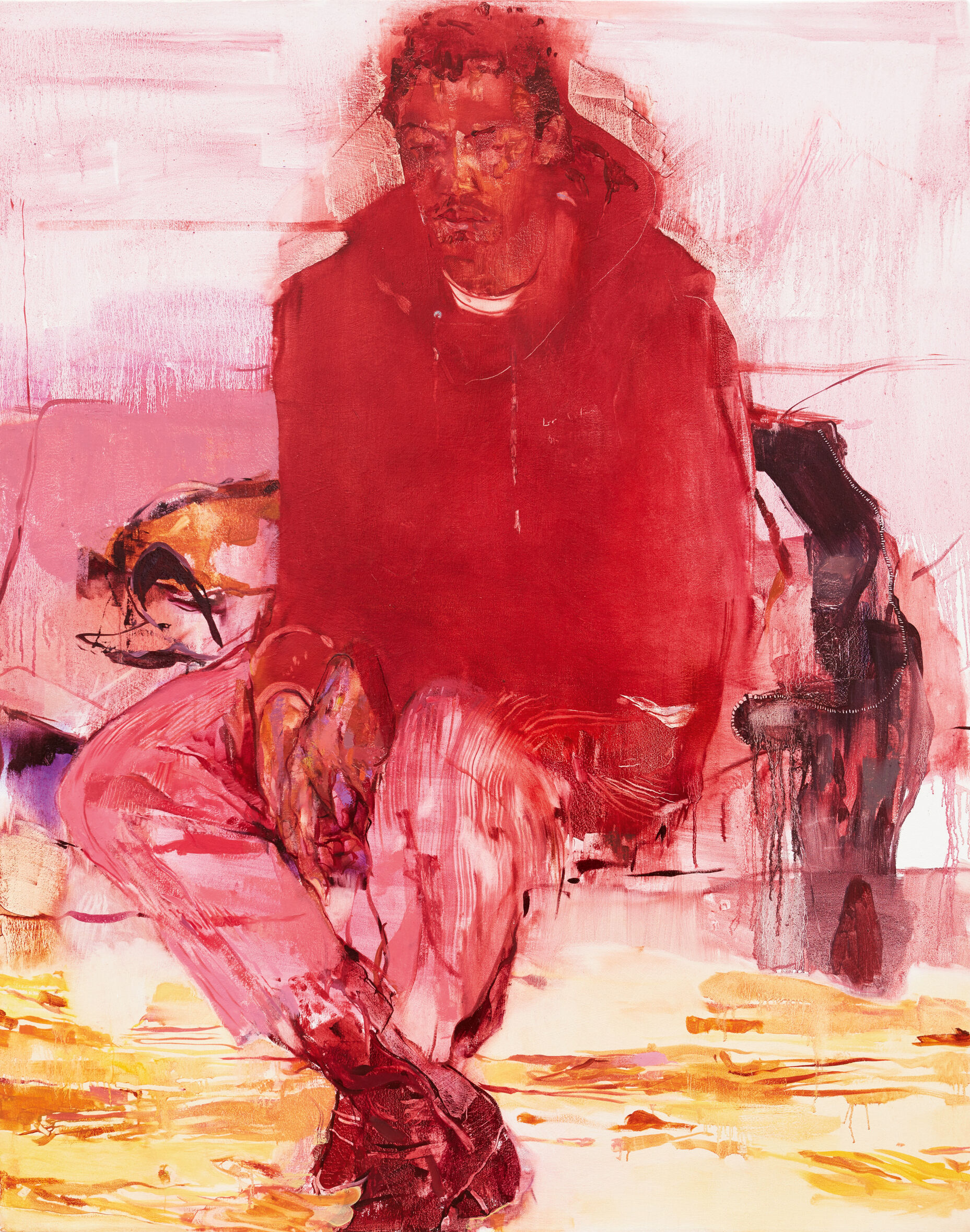
Jennifer Packer: The Eye Is Not Satisfied With Seeing
2021
Hear from artists, curators, and scholars on selected works from the exhibition.
Rujeko Hockley: This is a show that shares over thirty works by Jennifer Packer, a New York–based artist born in 1984, and one of the preeminent painters of her generation.
Narrator: Rujeko Hockley is one of the curators of this exhibition.
Rujeko Hockley: She works primarily in portraiture and still life, which are genres of painting that go back to the earliest days of Western painting. So her use of them connects her to a very deep history, but also places her in a very contemporary context, thinking about current events, her peers, her friends, and the personal relationships that she has.
Jane Panetta: I think a lot about the way she uses portraiture to do something political.
Narrator: Jane Panetta co-curated this exhibition.
Jane Panetta: So while the predominance of paintings in the show are portraits or still lifes, so many of them are really using the work, and this type of work, not in a didactic way, but in a way that raises issues around Black invisibility, violence against Black life, that these are really recurring motifs, but consistently she’s using the portrait, the still life, in part as a mechanism to convey these ideas.
Narrator: We conducted some of these interviews over Zoom, so sound quality may vary.
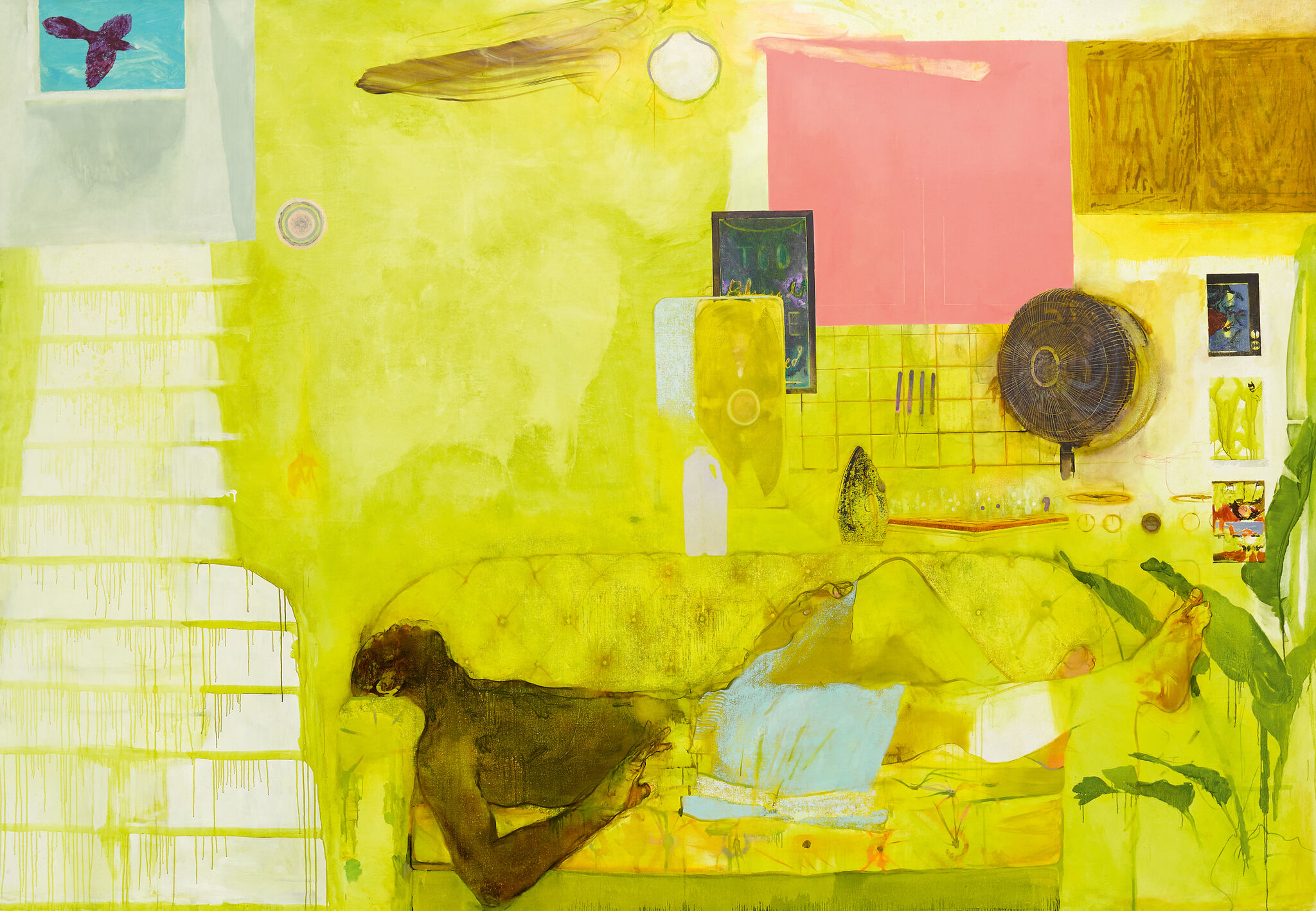
Jennifer Packer: I was looking at photographs of Breonna Taylor’s home that were documented like the gunshots, the measurements.
Narrator: Jennifer Packer.
Jennifer Packer: And as I was scrolling through these images, I saw things that I recognized, things that I would have seen in my own apartment. I could almost conflate a time in my life materially to what I was seeing in hers. I felt this sense of connection.
I’m not interested in the hierarchy that portraiture suggests. I’m interested in the codependency of humans, existing in spaces, along with other really important information, or materials that humans subject to wear and tear. So it’s like I’m interested in environment as much as the figures that sit within it.
I think a feeling of power in the medium fluctuates. When I’m making images, I can force myself to see things I don’t want to see or don’t feel like I can deal with. I can create confrontation that is psychological and intensely personal, even as I think about these larger social or structural issues.
Narrator: This audio is courtesy of Serpentine Gallery, London.
Jennifer Packer, Blessed Are Those Who Mourn (Breonna! Breonna!), 2020. Oil on canvas, 118 × 172 1/2 in. (300 × 438 cm). Private collection. © Jennifer Packer. Photograph by George Darrel. Image courtesy Sikkema Jenkins & Co., New York, and Corvi-Mora, London
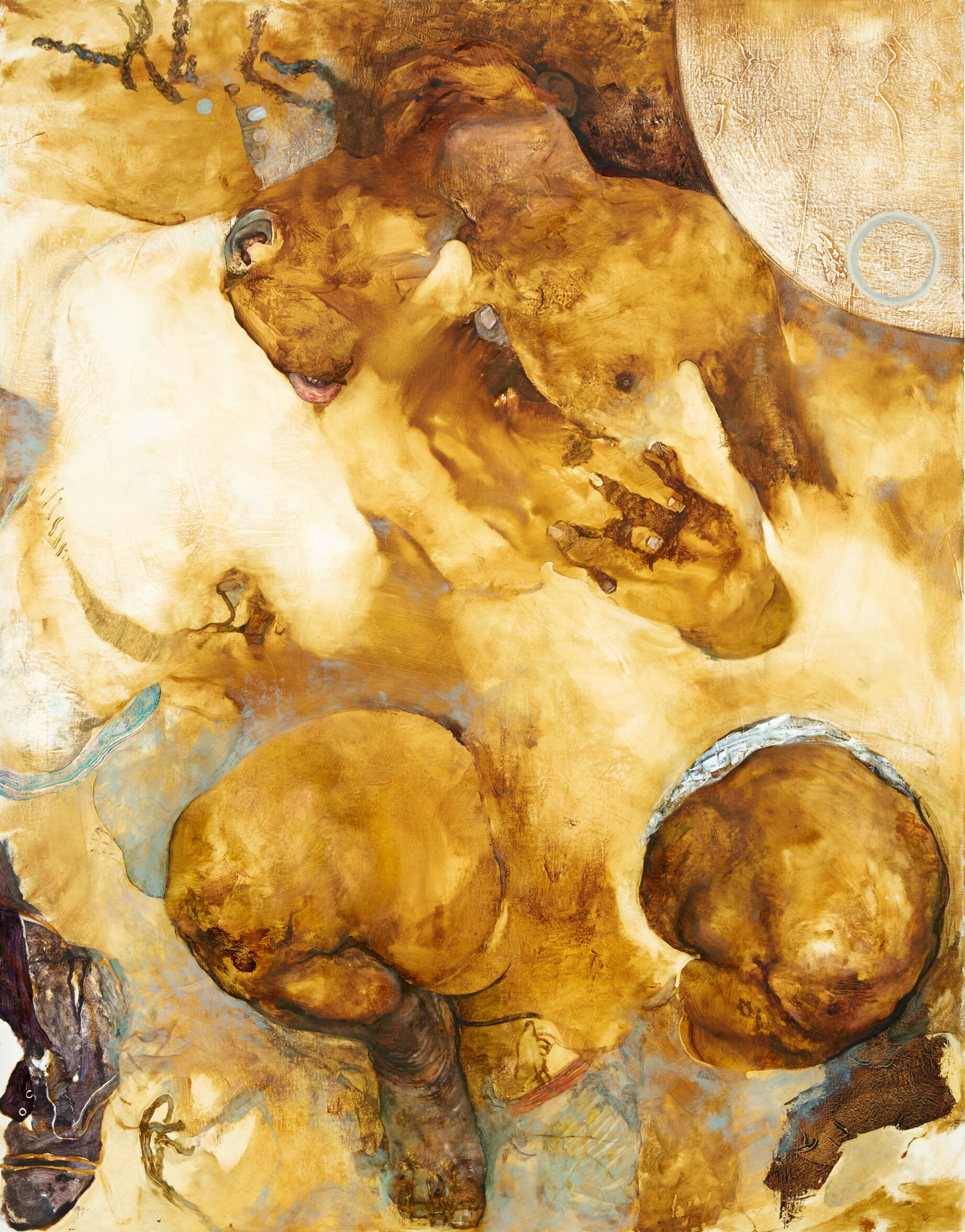
Narrator: In Lost in Translation, Packer takes up the question of how much information a viewer needs to make sense of a painting.
Jordan Casteel: The beginnings of the finger endings intertwining, just the beginnings, give us enough information to understand that they are hands and they’re intertwined. Whose hands they are isn’t exactly clear.
Narrator: Jordan Casteel.
Jordan Casteel: It’s the enmeshment that we can get lost in translation. I think the title very much speaks to what this painting is. That sometimes we try to translate. We try to tell our story. We try to explain to the best of our capacities and people still can not grasp the truth of what we are trying to tell. And the truth for this painting might not be for us to fully see.
I mean, I have no idea what exactly is going on, but that's exactly why I love it because I know that wherever it is, these people feel safety. They feel connected, potentially feel loss or love. The yellow tones don’t allow an exact feeling to present itself to me in an explicit way. What it feels like to me is warmth.
Jennifer Packer, Lost in Translation, 2013. Oil on canvas, 54 1/2 × 42 1/2 in. (138.4 × 108 cm). Private collection. © Jennifer Packer. Photograph by Jason Wyche. Image courtesy Sikkema Jenkins & Co., New York, and Corvi-Mora, London
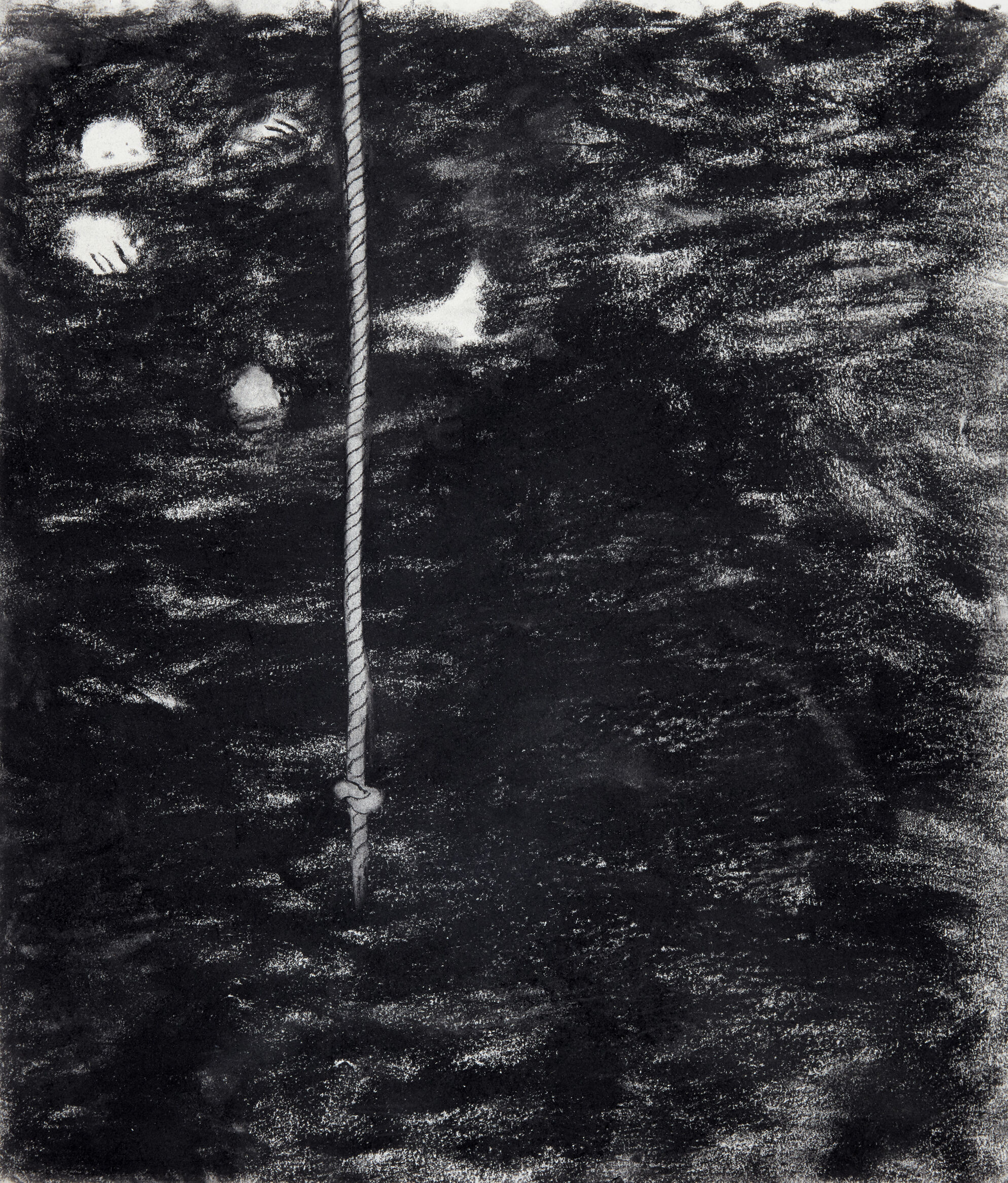
Rujeko Hockley: She has said that she wanted to challenge herself to approach drawing in such a way that it could argue with a painting. And I think that this is a drawing that really exemplifies that.
Narrator: Curator Rujeko Hockley.
Rujeko Hockley: The image shows a figure in the top left register in negative space. The water is in charcoal. The person is in the negative space, the white of the page with just their head, their hands and their feet visible with a rope hanging, perhaps a rope swing, something along those lines. But these are the only details that we really get along with the title, Swim.
Narrator: As you look around the gallery, you’ll see that Packer treats drawing as something independent—not just as a step on the way to painting.
Rujeko Hockley: Even if there’s the same image, the drawing is its own work, the painting is its own work. And there’s a relationship or a counter relationship, but it’s not a one-to-one necessarily. I think drawing is a really important part of her practice because in the way that you scribble before you put sentences together, or you have a sentence before you have a paragraph, drawing can be seen as this building block towards this larger practice of painting, even if they’re not a one-to-one, as I mentioned.
Jennifer Packer, Swim, 2011. Charcoal on paper, 16 1/2 × 14 in. (41.9 × 35.6 cm). Private collection. © Jennifer Packer. Photograph by Jason Wyche. Image courtesy Sikkema Jenkins & Co., New York, and Corvi-Mora, London
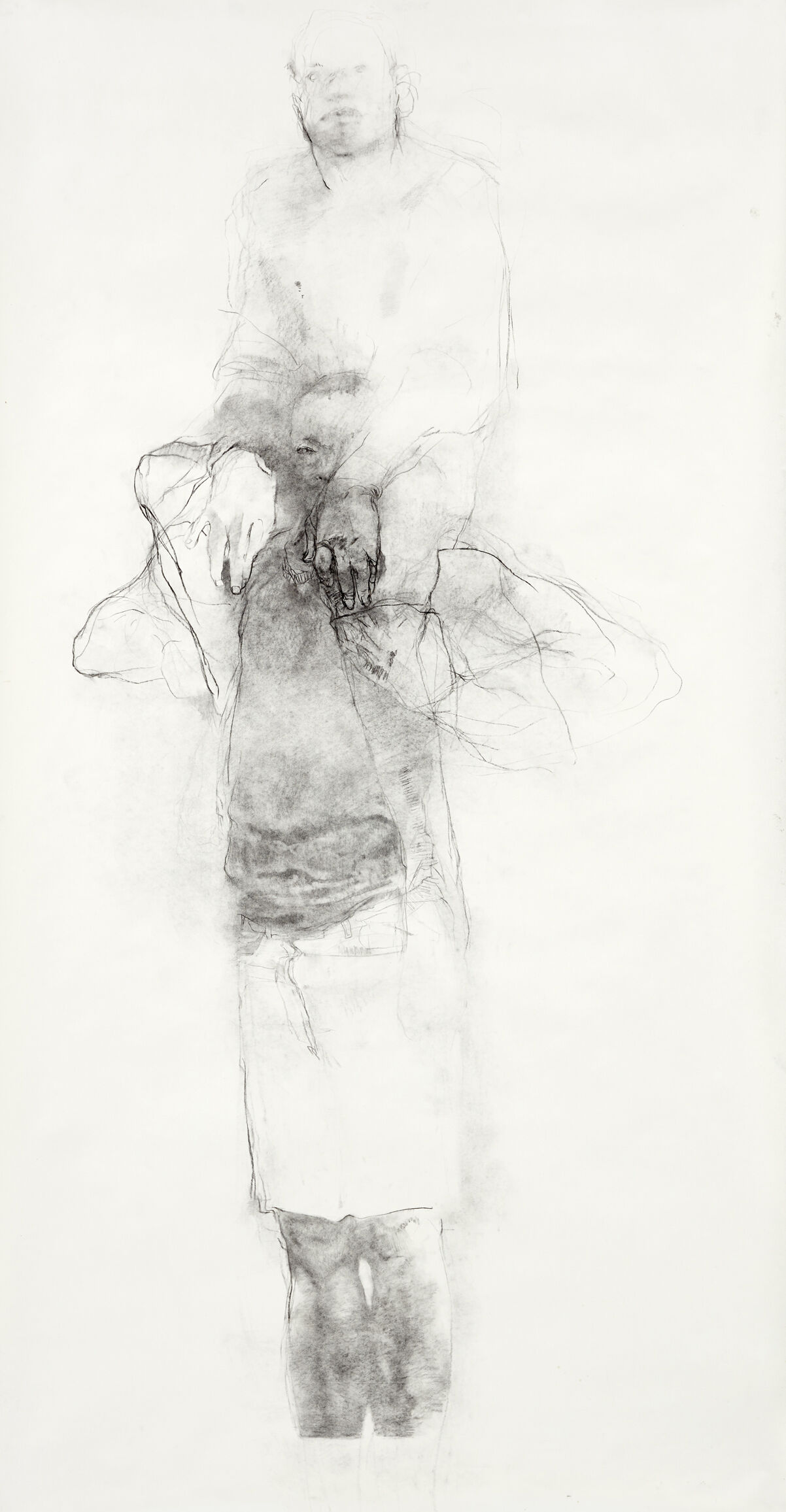
Jordan Casteel: The thing that I saw first above all else was the way that the arm seemed to flutter as the person or the body is carrying another.
Narrator: Artist Jordan Casteel describes her first encounter with this drawing.
Jordan Casteel: And at the moment of connection between the two, there’s real conflation of bodies, you can’t really tell what’s what. And, at the same time, you can see it all and understand what’s happening.
It’s almost life-size. And that in of itself, I think is also a very telling and poignant capacity that Jennifer has in her ability to draw you into very minute moments. I want to understand what that kind of more opaque hand is doing. There’s a finger that is bent, that is really holding the weight of this drawing. Everything starts and ends with that hand. And then it distills out from it. I feel like it holds the entire truth and then behind that, you begin to try to understand what the relationship is, the sense of play and complexity. If we think about vulnerability in the work, which comes up a lot, this is another moment for me, where I began to understand with more clarity, her capacity, of making us understand something without giving us everything.
Jennifer Packer, Untitled, 2014. Charcoal on paper, 94 × 48 in. (238.8 × 12.9 cm). Private collection. © Jennifer Packer. Photograph by Jason Wyche. Image courtesy Sikkema Jenkins & Co., New York, and Corvi-Mora, London
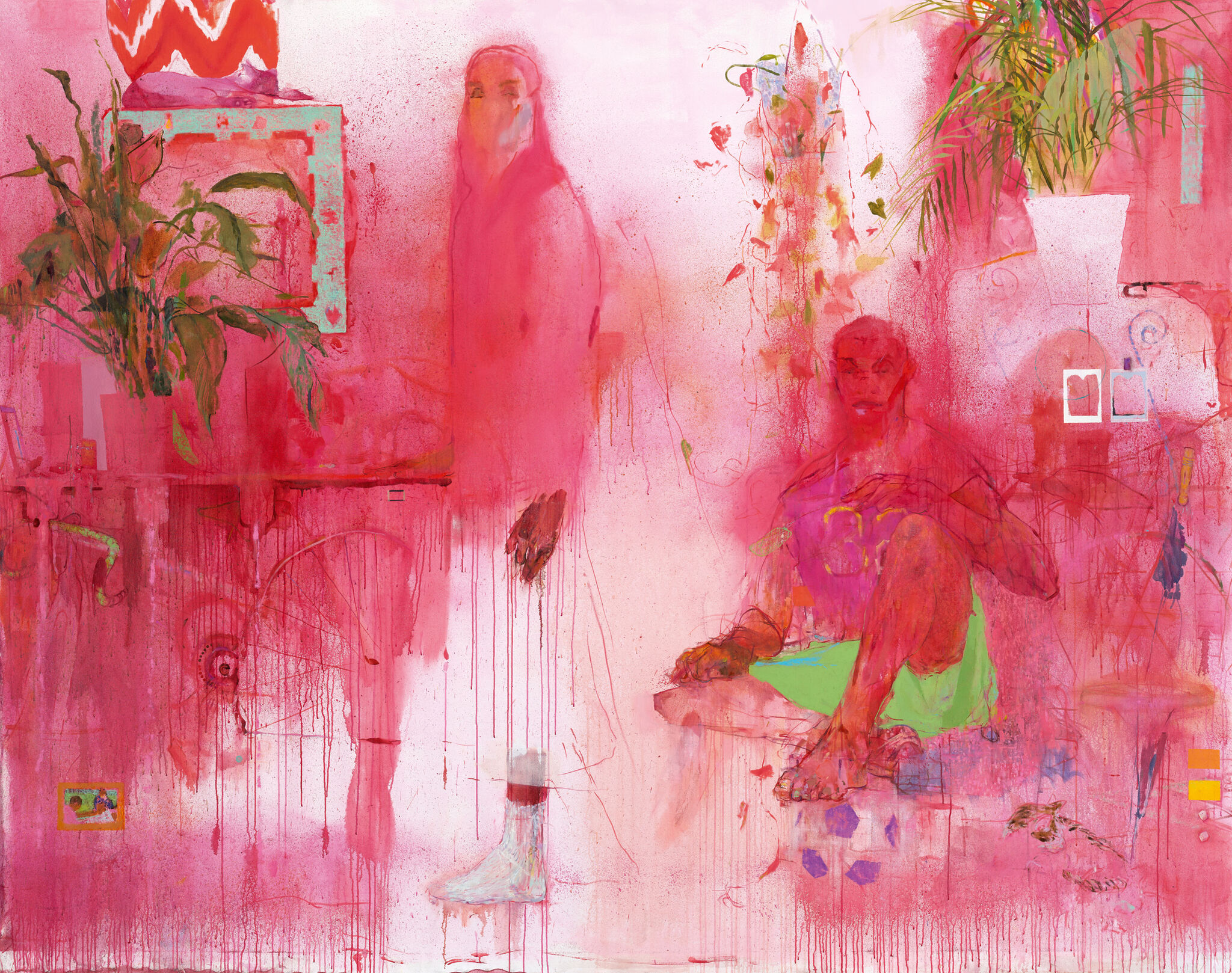
Narrator: Packer titled this monumental canvas A Lesson in Longing.
Jane Panetta: For me, one of the most striking things about it is the places in which she leaves portions of the canvas really incomplete. That she doesn’t give you all the information, that you kind of visually have to fill it in for yourself. And I think for her, she’s talked a lot about, in painting Black individuals and people in her community and her family, a desire not to give over the full information about the sitters. That there’s a desire to protect her intimacy with them and just as a means to protect them, to not fully put them out into the world.
I’m also really struck by the use of this pinkish-red color throughout the painting and I think for Jennifer, she’s also always interested and almost challenging herself to think about how one can construct a painting. And so has been interested often in making these monochromatic works that are dominated by a single color.
This painting is also one that I think feels almost drawing-like. Both in the way she’s rendered aspects of it very finely and in a very detailed way. And she’s, of course, an artist that’s also very interested in drawing and that’s a big piece of her practice. But I also think the way that she’s left the painting to drip and the way that the painting has kind of slid down the canvas in many places often completes the composition. And I think it also is a way that she’s really reminding you that this is a painting that she’s made that’s experimenting with how you fill out a composition.
Jennifer Packer, A Lesson in Longing, 2019. Oil on canvas, 108 1/2 × 137 in. (275.6 × 348 cm). Whitney Museum of American Art, New York; promised gift of Dawn and David Lenhardt. © Jennifer Packer. Photograph by Ron Amstutz. Image courtesy Sikkema Jenkins & Co., New York, and Corvi-Mora, London
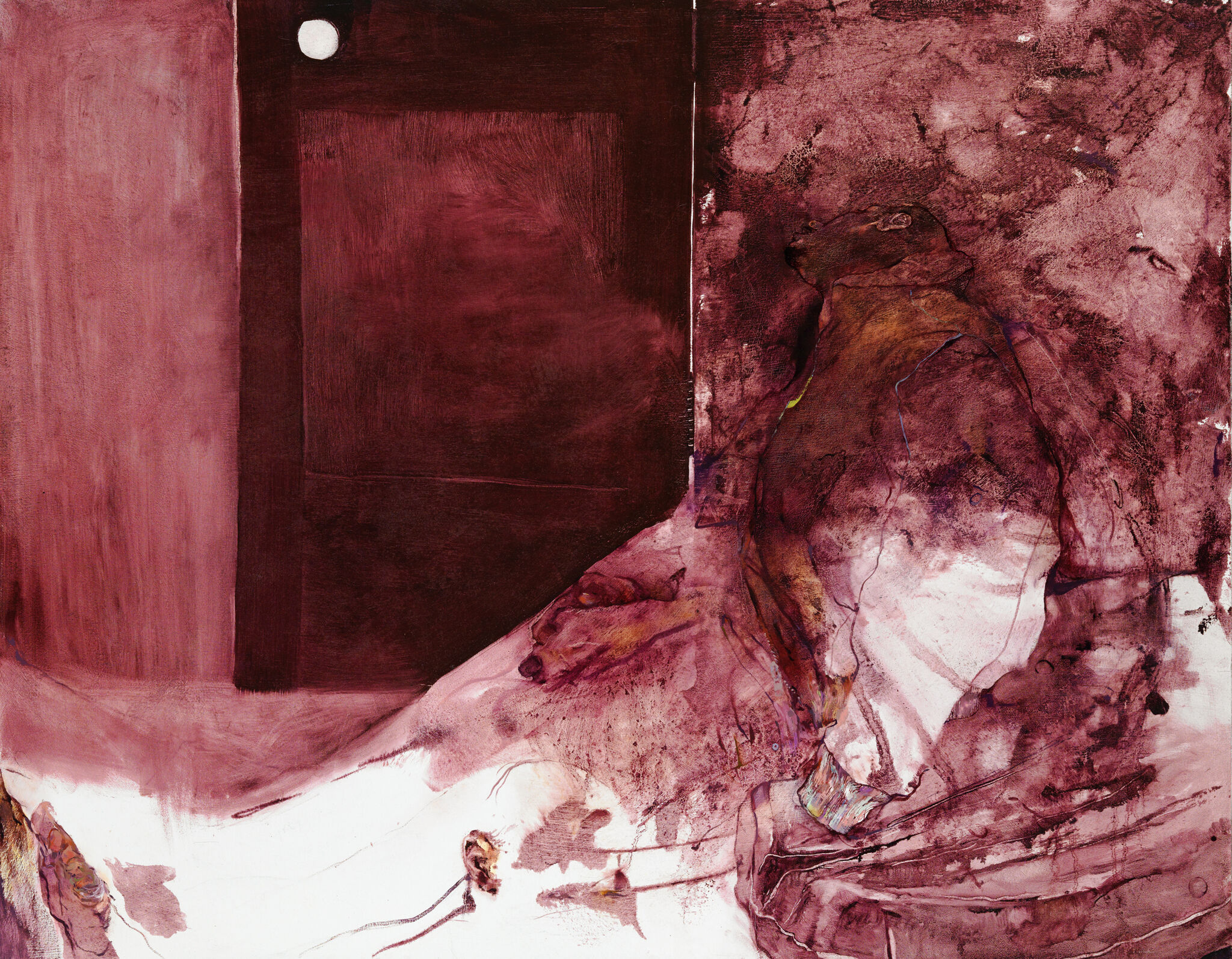
Narrator: In Vision Impaired, Packer experiments with monochromatic painting—that is, working primarily in one color.
Rujeko Hockley: Packer’s use of monochrome is very specific, and she has talked about, at this point, that she was really interested in giving equal importance to negative space and the adornment of the environment.
Narrator: Rujeko Hockley.
Rujeko Hockley: And so she’s thinking about what do you need to create details, how much information do you need to give to the viewer, whether that be in terms of line, shade, tone of color, et cetera.
And so here, you see there’s a figure that emerges on the right side of the canvas, their upper body and arm. The arm is maybe the most visible. They’re sitting on a cushion or a couch of some sort. And then their legs extend out in front of them towards the left side of the canvas. And as we’ve seen in other works, her use of negative space is really important here, because most of the figure, at least the portions of the figure that you’re able to use to discern where their body is in the space are actually visible through the use of negative space. So the white of the canvas is what delineates this person’s arm, their leg, their foot on the left side has a little bit more detail, but fundamentally you're really using negative space, which is a really interesting way of approaching image making.
Color I think is what we think of as being how we distill details and share information, especially in two dimensions. But here she’s really pushing back against that idea and really paring things down to their essentials.
Jennifer Packer, Vision Impaired, 2015. Oil on canvas, 42 3/10 × 53 9/10 in. (107.5 × 137 cm). Private collection. © Jennifer Packer. Photograph by Marcus Leith. Image courtesy Sikkema Jenkins & Co., New York, and Corvi-Mora, London
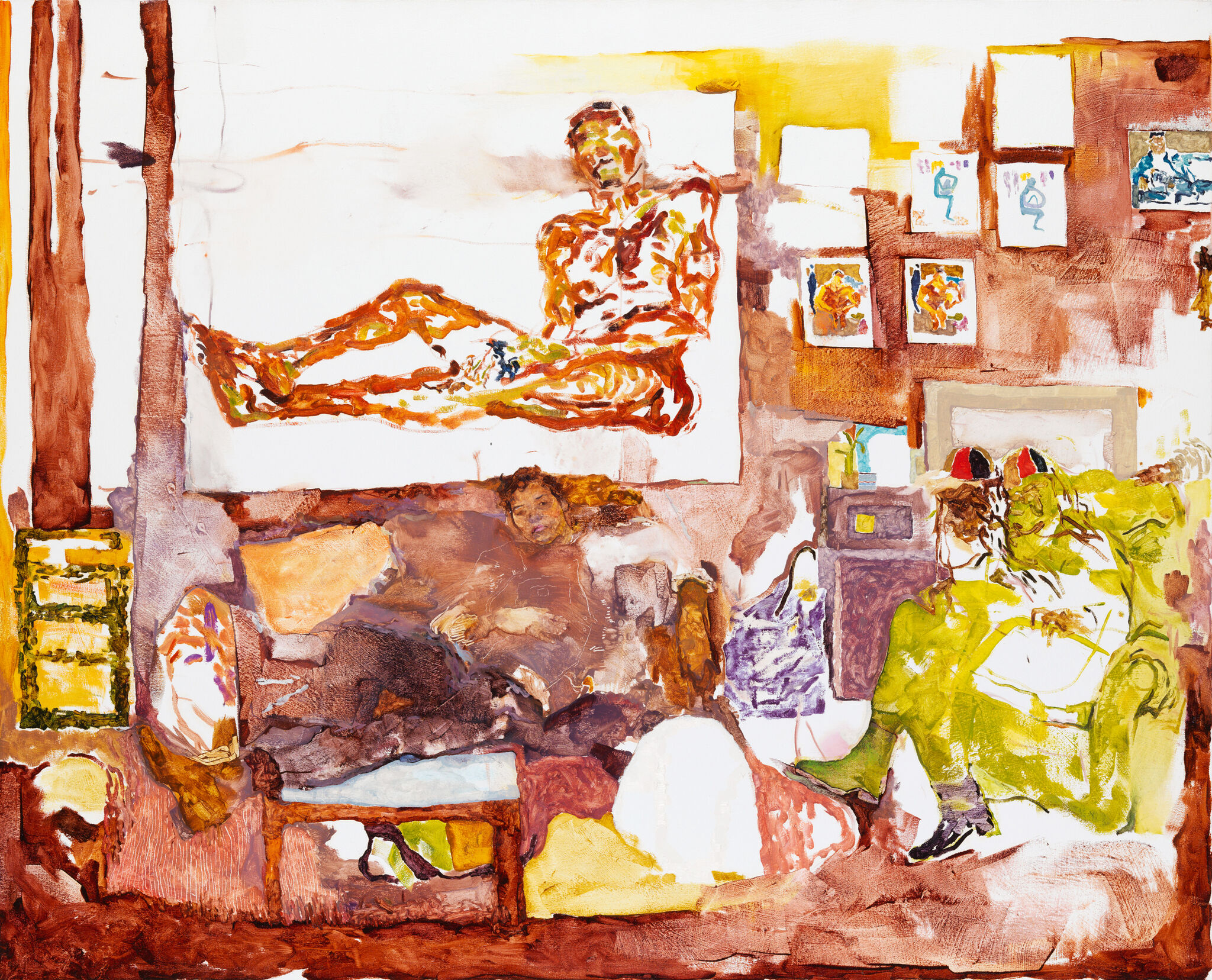
Jordan Casteel: The first thing that happens when I see this painting that Jennifer did of me in my studio at Yale, my second year, I was getting ready for graduation. I was preparing my thesis show.
Narrator: Jordan Casteel is a painter.
Jordan Casteel: She was somebody who came in . . . all the memories come flooding back, first and foremost of where I was in my life and what was happening, and then where she entered my life and how I felt safe with her. And you feel that, I think in this painting, based off the colors that she chose, there are these ambers and rose hues kind of enveloping me as I sprawl across the couch. And I remember feeling like I was merging with the environment over the period of time that she was painting me. She was doing it all from life, and I just sat there for two days. So one of the things it’s absolutely true is that I mimic the surroundings, in the way that I felt that I was becoming quite enmeshed with that space at that time.
It feels very explicit to me that she is present within the work, that her marks hold a certain care. They happen over a long period of time and watching her paint I felt that: that there was a pause before every mark. There was real intentionality and that intentionality is part of what I think makes it vulnerable is that she’s taking the time to see her environment, to relate to her environment and then to depict it as such.
Jennifer Packer, Jordan, 2014. Oil on canvas, 38 3/5 × 47 4/5 in. (98 × 121.5 cm). Private collection. © Jennifer Packer. Photograph by Marcus Leith. Image courtesy Sikkema Jenkins & Co., New York, and Corvi-Mora, London
Narrator: Jennifer Packer.
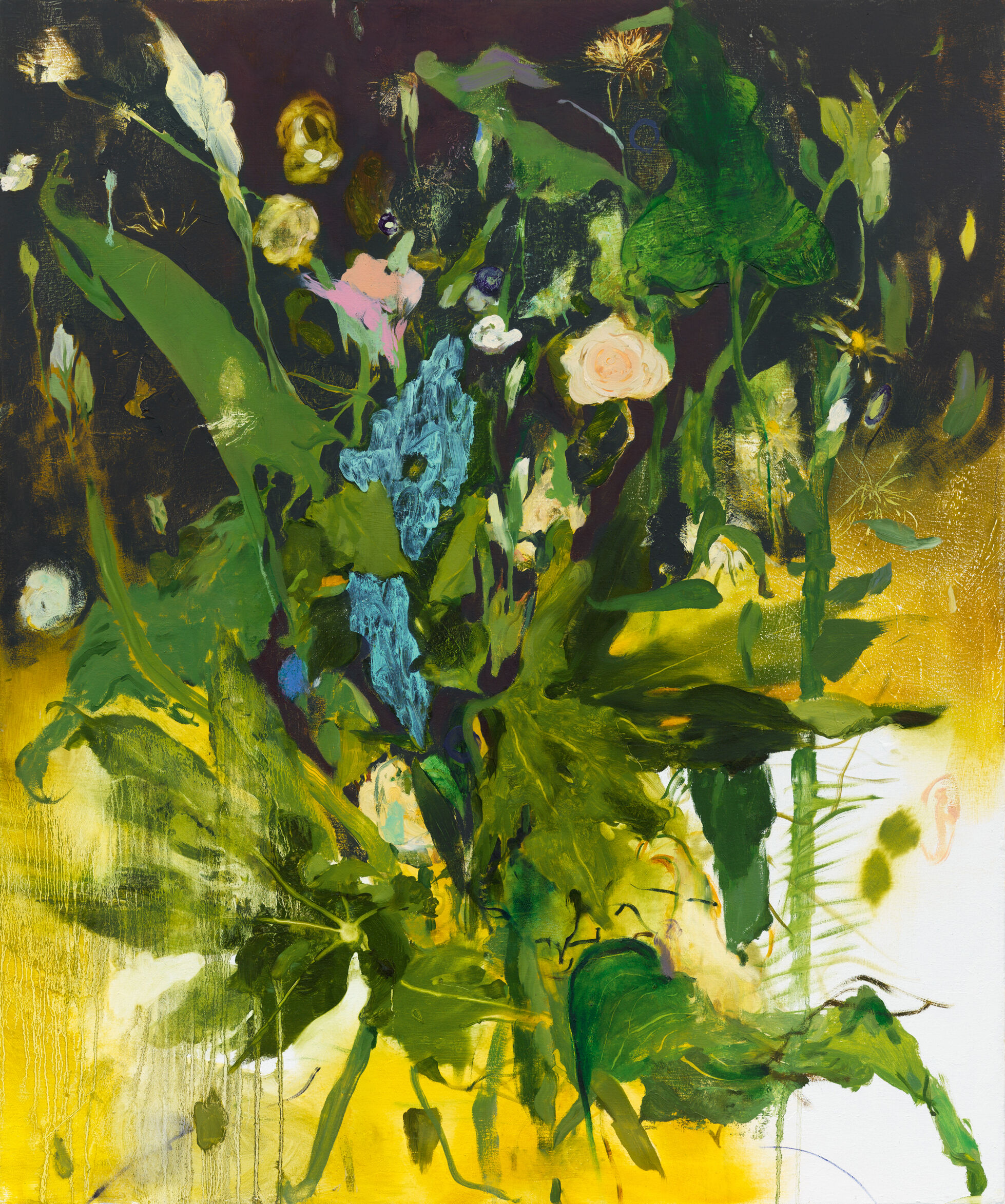
Jennifer Packer: The painting Say Her Name was kind of a turning point in terms of the way that I started to think about the decorative nature of the funerary bouquet and the decorative nature of painting. I was trying to reconcile this feeling of loss that I felt when Sandra Bland died. I wanted to come to terms with that loss through seeing a celebration of her life, like a sort of a final celebration, but I couldn’t. What I’ve been really interested in is withholding. That I don’t have access to interiority. I just have information and feeling and the ability to interpret.
Narrator: The exhibition’s title, The Eye Is Not Satisfied With Seeing, explores a similar idea.
Jennifer Packer: The Eye is Not Satisfied with Seeing articulates this relationship to belief. I think we have all watched plenty of footage that has been arbitrated over. People argue that the visual evidence isn’t enough, that there’s context and detail that somehow we’re missing in the visual. And I’m interested in that kind of leap of faith that we take when we look at pictures or paintings, or video, or listen to sound.
Narrator: This audio is courtesy of Serpentine Gallery, London.
Jennifer Packer, Say Her Name, 2017. Oil on canvas, 48 × 40 in. (121.9 × 101.6 cm). Private collection. © Jennifer Packer. Photograph by Matt Grubb. Image courtesy Sikkema Jenkins & Co., New York, and Corvi-Mora, London
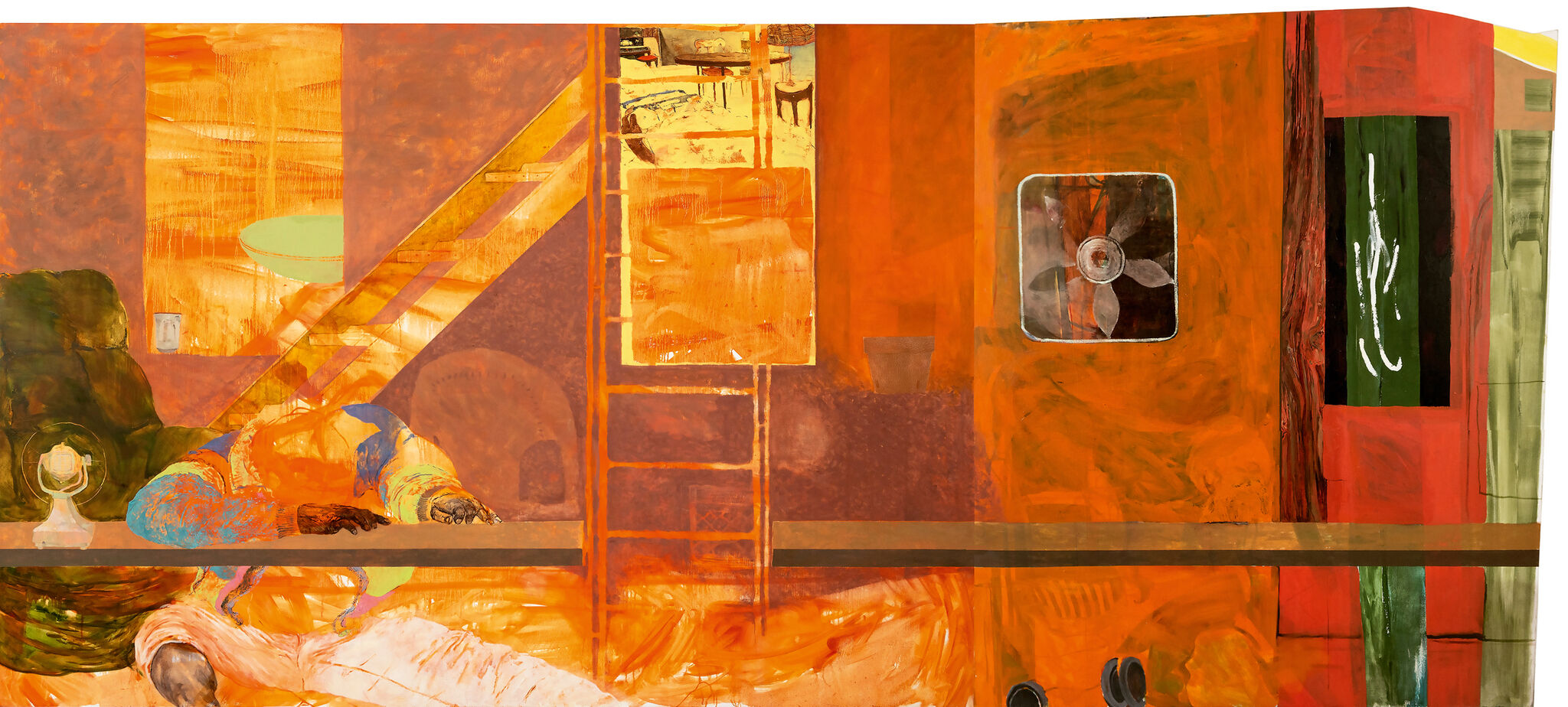
Jane Panetta: This painting, called Fire Next Time, which Packer made in 2012, is an early work of hers in the show.
Narrator: Curator Jane Panetta.
Jane Panetta: It feels very deliberately cinematic to me. It’s like she wants you to feel immersed in the space. And I think as much as it’s a portrait painting, in some ways, it’s also a painting that really privileges the depiction of the environment that the sitter is in. It’s really about the environment, I would say. And she’s really pulled out certain details within the painting. You see the fan on the wall, the fan on the table, the ladder, the stairs, you see those things very specifically.
And I’m also struck by her use of this orange palette in the painting. It gives the work a kind of high intensity. It’s a color that I would associate with fire. And the fans being in the painting as well, it feels like in part it’s about heat. It’s about the heat of the space.
The title of this painting, Fire Next Time, relates to a book by James Baldwin, that contains two essays in it. And one of the essays is written as a letter to Baldwin’s fourteen-year-old nephew. I think the intimacy of the essay, this idea of him corresponding directly to his young nephew and kind of about his own experiences, that that sensibility, that intimate sharing, really is akin to what she’s getting at in this painting: that you’re in a kind of interior and intimate and private space.
Jennifer Packer, Fire Next Time, 2012. Oil on canvas, 72 × 156 in. (182.8 × 396.2 cm) diptych. Private Collection. © Jennifer Packer. Photograph by John Betancourt. Image courtesy Sikkema Jenkins & Co., New York, and Corvi-Mora, London
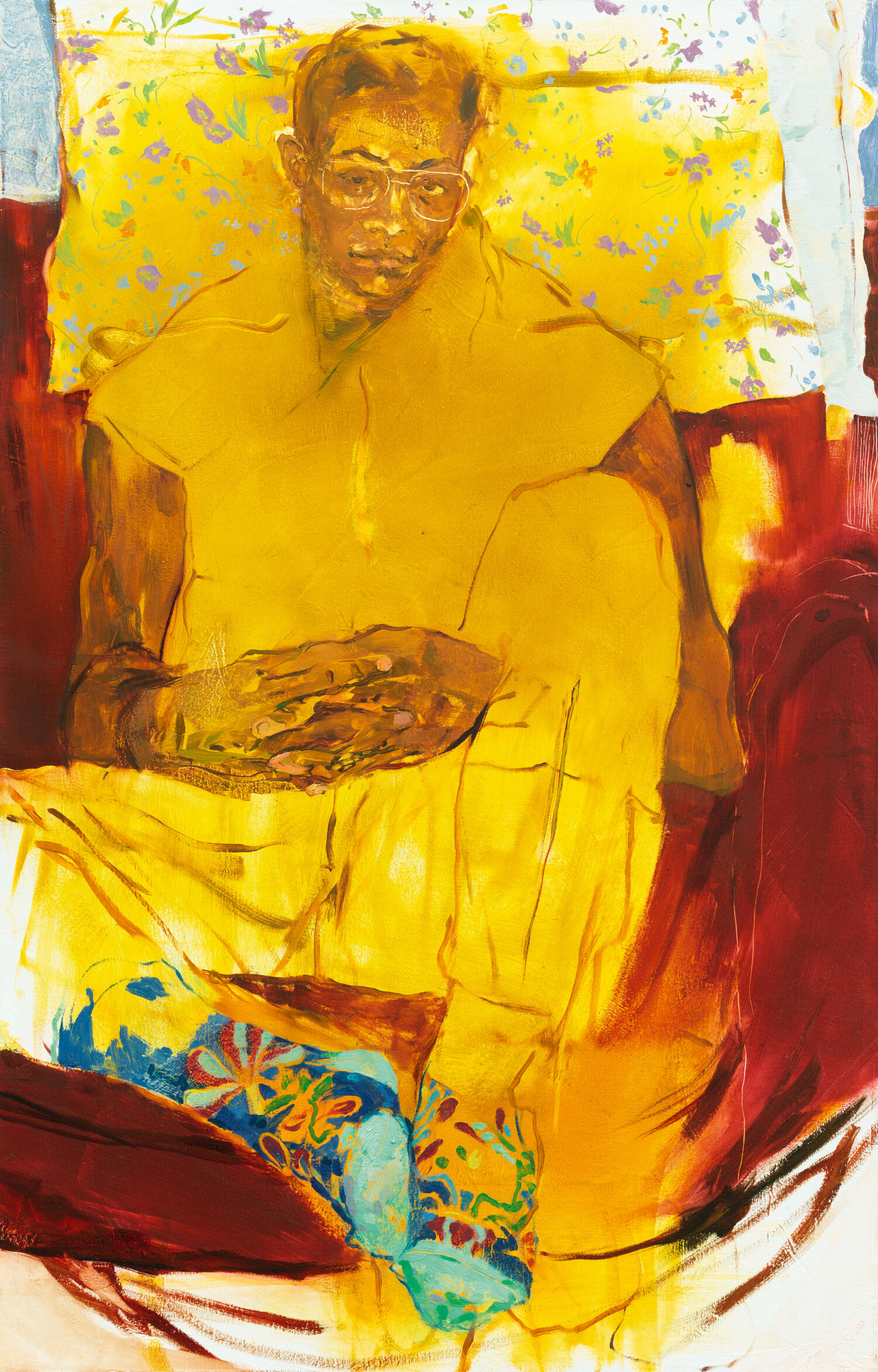
Narrator: The artist Jordan Casteel describes this painting, Tia.
Jordan Casteel: What I love is the way that the figure is sandwiched between these two very patterned fields, that the pattern behind creates the form of a pillow. Even though the pillow form is actually quite absent. There are no lines defining the pillow.
The red is another moment for me, it feels like a real encasement of the figure itself. The red is all-encompassing and holds the figure with a certain clarity and comfort and belonging. There’s no escaping the red, the relationship between the red and yellow is bold as all get out. I look at this and I’m like, we are unapologetic today. I love that she’s making those decisions consciously, unconsciously, seeing what this picture needed, seeing who this person was. It seems like there’s a richness there, a softness, even within the strength.
And the socks. That turquoise in the socks is, like, so great. It is so bold! And it’s because it is meant to exist with the immense and intense amount of clarity that it does that I just accept it. It would be so easy to be taught that you shouldn’t do that. In terms of color theory, that turquoise is not meant to just exist there. And yet it does. And Jennifer has made us accept it as a sense of weight and truth or something.
Jennifer Packer, Tia, 2017. Oil on canvas, 39 × 25 in. (99 × 63.5 cm). Collection of Joel Wachs. © Jennifer Packer. Photograph by Matt Grubb. Image courtesy Sikkema Jenkins & Co., New York, and Corvi-Mora, London
0:00
0:00