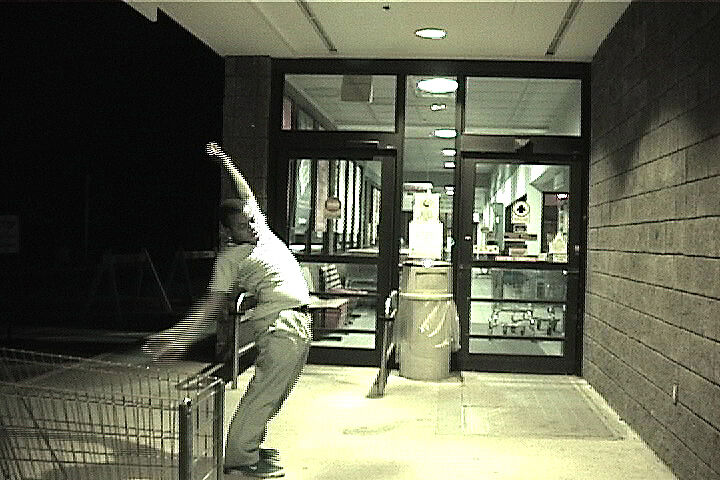
Dave McKenzie: The Story I Tell Myself
2021
Hear directly from the artist on selected works from the exhibition.
-
300
Introduction
Audio, Transcription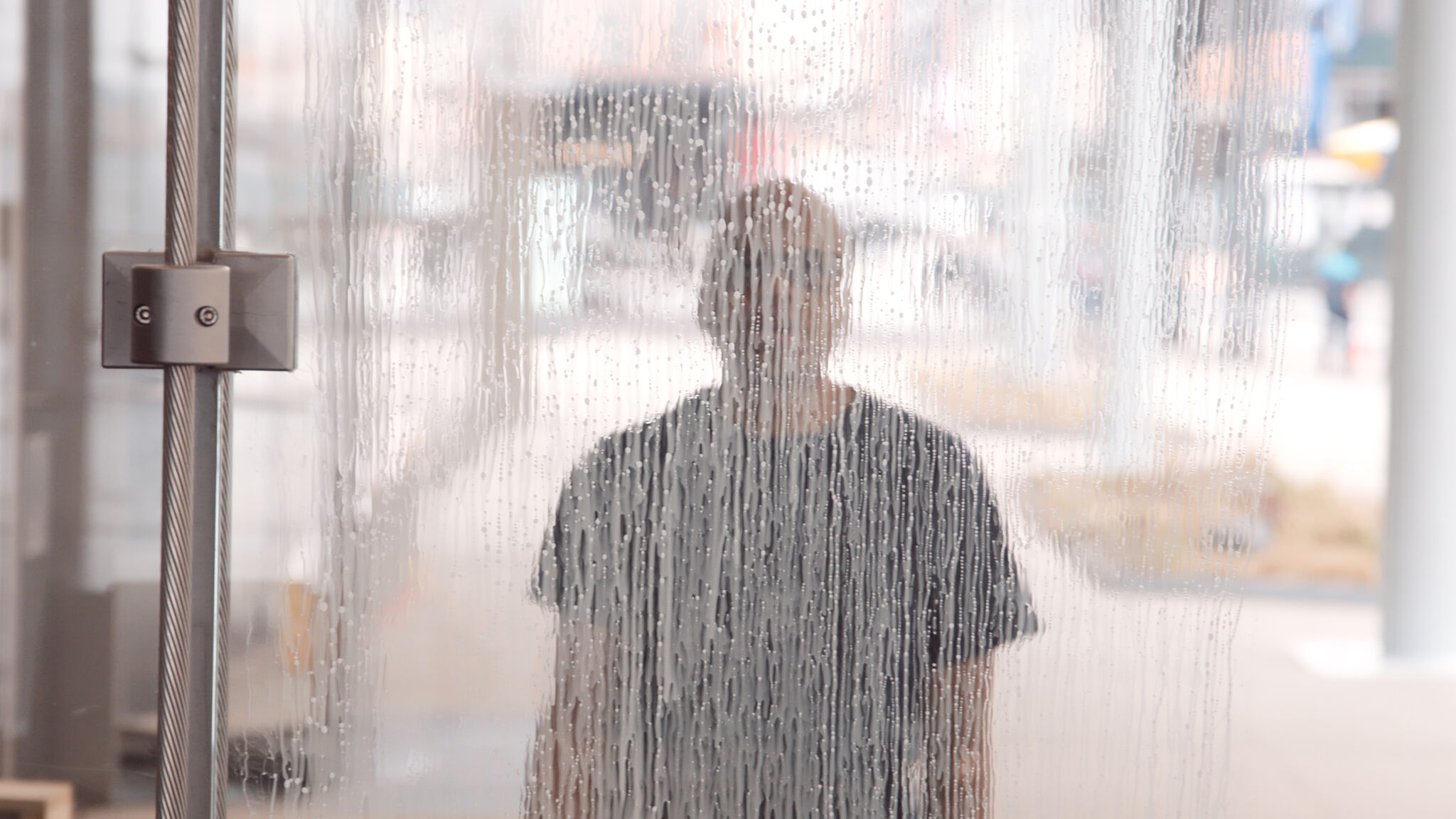
-
301
Bruce Nauman, Self Portrait as a Fountain
Audio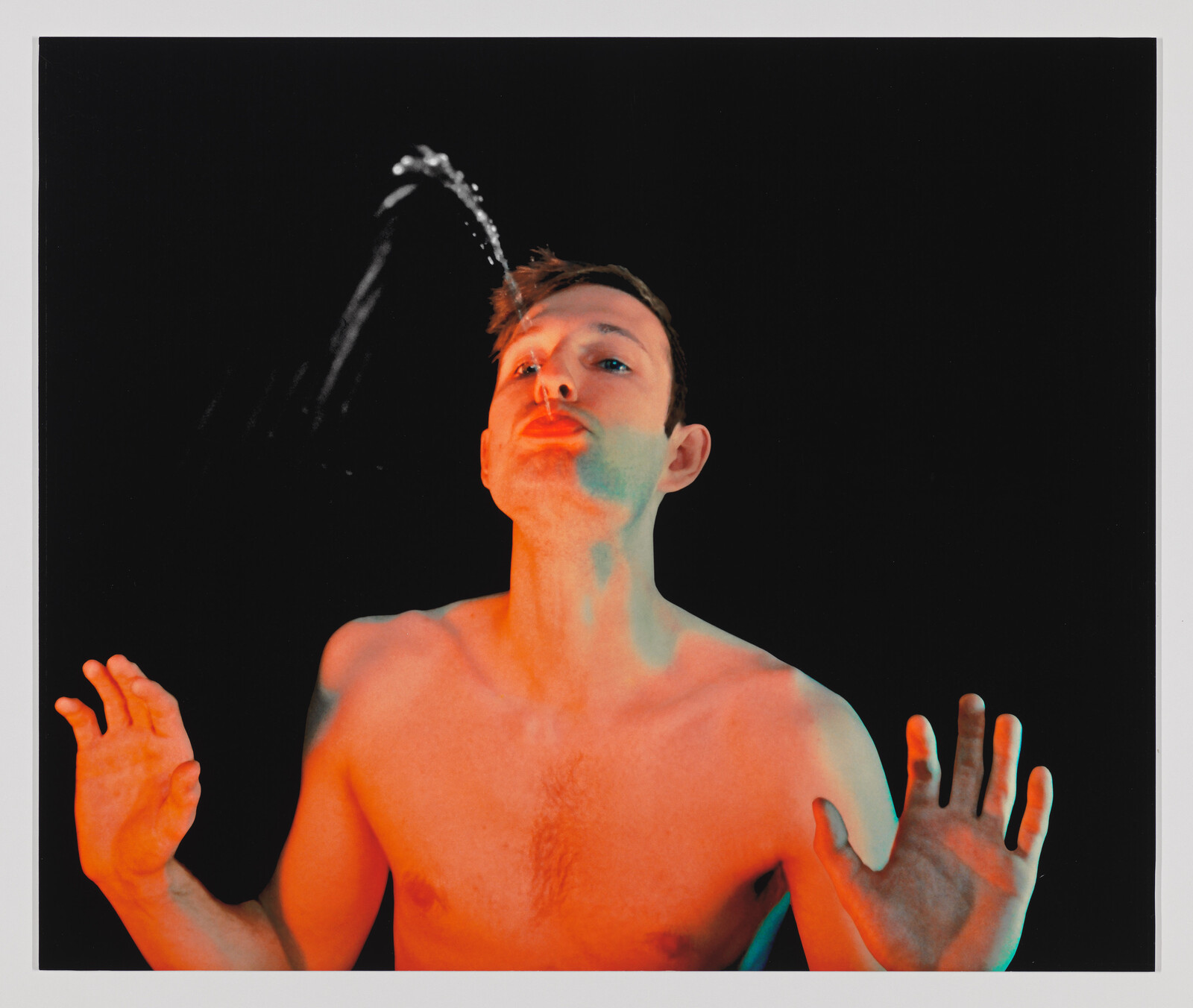
-
302
Pope.L, Black People Are The Silence They Cannot Understand
Audio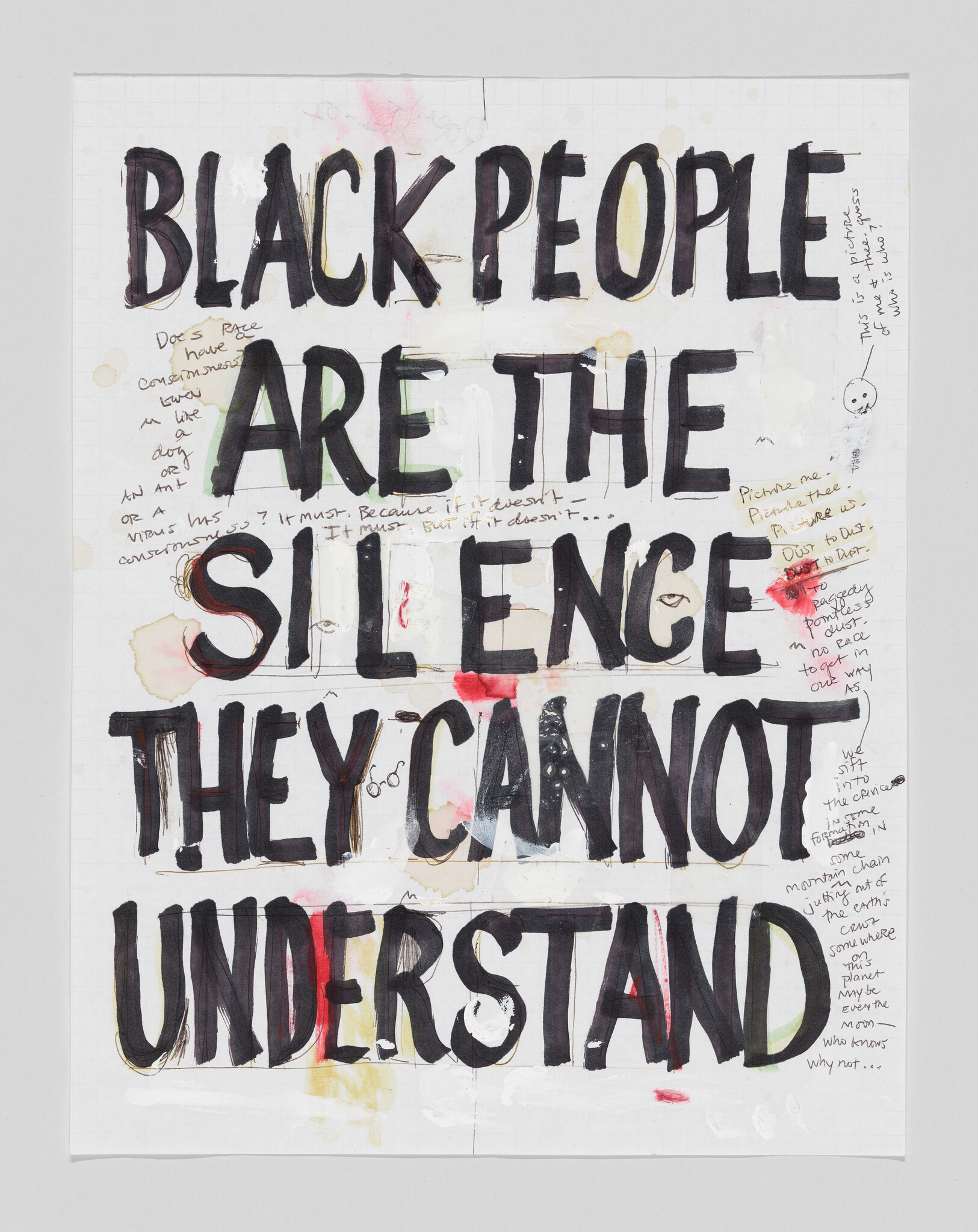
-
303
Transcription: Dave Mckenzie, Edward and Me, 2000
Transcription -
304
Transcription: Dave Mckenzie, Old Man/ Sarcophagus, 2013
Transcription -
305
Transcription: Chris Burden, Documentation of Selected Works 1971-75, 1971-1975.
Transcription -
306
Transcription: Dave Mckenzie, We Shall Overcome, 2004
Transcription -
307
Sound Description: Dave Mckenzie, Kevin and Me, 2000
Sound description -
308
Transcription: Dave Mckenzie, Wilfred and Me, 2012
Transcription
Narrator: This exhibition has been organized in conjunction with a performance by the artist Dave McKenzie.
Dave McKenzie: I will be doing a performance called Disturbing the View which will take place over the course of several weeks, where I will be interacting with the facade of the Museum.
Narrator: Dave McKenzie.
Dave McKenzie: In particular, I will be covering and maybe uncovering the windows. The performance will essentially be me... I want to say something between cleaning and dirtying the windows and removing the view, or in my case, I would say disturbing the view. I'm trying to put my body in relationship to what happens when a Museum goer looks out and maybe is expecting to see a beautiful vista. I want to interrupt that.
Narrator: The works on view in this gallery have been selected because they relate in different ways to McKenzie’s performance. Some of these works were made by McKenzie himself, others by artists he admires.
Dave McKenzie: A lot of the works that I'm showing and that are also being placed in relationship to the work, are ones that I think have a beautiful mix of architecture, body, and maybe the fragility of that sense of being in between something, or maybe negotiating something.
Narrator: More information about McKenzie’s performance can be found on the Museum’s website.
Transcription and Sound Description: Dave Mckenzie, Self-portrait Pinata, 2002
Running Time: 00:05:55
Sounds include: applause, murmur of crowd in a large room, thwacking of bat increasing in frequency, intermittent cheering, then a roar of cheer that descends back into murmur.
Folks I’d like to introduce you to Dave McKenzie. Dave McKenzie!
Alright, now!
Swing!
We need to clean up the space. Please exit the theater.
Dave McKenzie, rehearsal of Disturbing the View, Whitney Museum of American Art, 2020. Image by Alex Munro
Narrator: These photographs by Bruce Nauman are intentionally playful. In our conversation, McKenzie focused especially on one called Self Portrait as a Fountain.
Dave McKenzie: I think on one hand it's a really classic kind of sculpture. I think about it as a kind of role play. But it's the image in particular of the series that is unbelievably active, meaning you can see the action of its making. And I think that's really helpful for an artist. I think you can imagine one sort of having that idea and you can imagine the playfulness of pretending to be a fountain. It's also something that I notice that I do, like in the shower I do that a lot, this kind of fountain thing.
So... it's like an every person sculpture, right? Whether we're kids or adults, we've all sort of done this gesture.
For me, it feels really generous as an idea.
Bruce Nauman, Self Portrait as a Fountain, 1966–1967, printed 1970. Chromogenic print, sheet (sight): 20 1/16 × 23 15/16 in. (51 × 60.8 cm) Image (sight): 19 1/2 × 23 1/4 in. (49.5 × 59.1 cm). Whitney Museum of American Art, New York; purchase 70.50.9. © Bruce Nauman/Artists Rights Society (ARS), New York
Narrator: Artist Dave McKenzie reacts to Pope.L’s Skin Set drawings.
Dave McKenzie: If I look at one of them, Black People Are The Silence They Cannot Understand, instantly it makes me have associations. And so for me, that kind of framing or trying to even deal with all the complexities of race, which are fictional, which are historical, and all sorts of other things, is such a provocative kind of challenge. And at the same time, I feel like maybe this sentence is as right and wrong as anything could be. At their best, they just make me laugh. And sometimes I find that I agree with them even though, again, if I were to try and explain why "black people are the silence they cannot understand," it would be impossible.
Narrator: The drawings also make intentionally absurd claims about orange people, green people, and others.
Dave McKenzie: If we think about the spectrum of color and its relationship to the way we define people, maybe they're two absurdities playing against one another. And at the same time, I think it's fraught with all sorts of simplistic notions of race.
I think about the fact that there's a sports team called the Redskins, and what does that mean? How can that still be in 2020? So the "purple people" is a really absurd kind of text. But then it's also really imaginative, like who are the purple people, and what are they doing?
Pope.L, Black People Are The Silence They Cannot Understand, 2001–2002. Fiber-tipped pen, ballpoint pen, acrylic and tape on graph paper, sheet: 11 × 8 1/2 in. (27.9 × 21.6 cm) Image: 11 × 8 1/2 in. (27.9 × 21.6 cm). Whitney Museum of American Art, New York; purchase, with funds from the Drawing Committee and the Director's Discretionary Fund 2018.193. © Pope.L
Transcription: Dave Mckenzie, Edward and Me, 2000
Running Time: 00:04:29
Sounds include: Mckenzie's feet and body against the pavement, ambient street noise.
Transcription: Dave Mckenzie, Old Man/ Sarcophagus, 2013
Running Time: 00:03:54
Sounds include: Ambient murmur of people in the museum; splashing and clanking of Mckenzie washing dishes in the sink.
Transcription: Chris Burden, Documentation of Selected Works 1971-75, 1971-1975.
Running Time: 00:34:38
Chris Burden: “I’d like to introduce myself. My name is Chris Burden, and today on this tape I’m going to show you excerpts or visual records from eleven different pieces that I’ve done starting in 1971 into 1974. The pieces have either been filmed on Super-8, which is the most common, or 16 millimeter, or half-inch video. And there’s one that’s actually a television ad that was taken off the air.
“As you watch this tape and listen to my explanation of some of the pieces, I want you to remember that it doesn’t cover or encompass the whole body of my work. That you’re only seeing sort of a very arbitrary selection. You’re not seeing the pieces that don’t lend themselves to being taped or filmed because of purely technical reasons, such as it’s too dark or it’s too far away or something like that. You’re not seeing the pieces that don’t lend themselves to being filmed because it’s not right. I didn’t want them filmed. I didn’t... it didn’t make any sense.
“There’s an exception to that. There’s a bed piece, which is... which you’re going to see in this tape. Some excerpts from it— it’s a piece that involves staying in bed for 22 days without getting up. We’ll see how successful that is. Whether it can convey some of the energy and the feelings that were going on during that piece. And another reason is that... that I haven’t attempted to film some of the pieces, is that some of the pieces involved a one-to-one relationship where... with me and one person in the audience. And having a camera, or just even another person there, would disturb the whole... whole setup, and so it’s not... not possible.
“Other than that, there are some pieces that... that I’ve tried to film and haven’t... haven’t been able to because there’s been a technical error. Either my part or somebody else’s. Somebody forgot to push a... push the button. I... I couldn’t... I couldn’t concentrate or give enough of my attention to filming it because I was really involved with the... the performance. So you’re really seeing a very... What you’re going to see today is a very arbitrary selection. Sort of, almost... Well, a haphazard selection of works, but I... Well, another thing is that I’ve been hesitant to... to release these, because of the... of the sort of arbitrary nature of how they’ve come about. But more than that, it’s because film and tape are taken as reality, while they’re being... while you the viewer or anybody is watching them. So for the most part I recorded most of my pieces with still photographs, because they’re so old fashioned that they’re very... they’re taken very abstractly and they’re taken symbolically.
“But I guess at this time I feel that there’s maybe enough, enough, sort of, enough energy in the pieces or in the films that, that it’s important to show them, and that some of that will filter through but I want you to try to... although I know a lot of people forget it, but remain aware that you’re not seeing the actual experience. And I guess with that we can go right into the first piece which I’ve recorded on film, which is ‘220’.”
“220”
Chris Burden: “This film that you’re watching was shot by one of the participants from one of the ladders that you’ve just seen. The piece consisted of lining the gallery with black plastic and then flooding it with about 12 inches of water. Three other people and myself waded through the water and climbed onto these wooden, 14 foot step ladders. After everybody was in position, I dropped a 220 volt electric line into the water, thereby sealing us in, because if we came down off the ladders and stepped in the water we’d be electrocuted. I think you can probably see the 220 line coming out of the wall here on the right.
“The piece is already in progress, as you’re watching this. It began at midnight and it was to run until 6 o’clock in the morning. This is one of the participants who didn’t make it. She’s peeking through the mail slot. There’s supposed to be five people in the piece. All the black that you see is black plastic, and the piece became very ominous, partly because of all this black, but –– and the situation itself ––but the, also because of the dampness. The air became very heavy, the walls were sweating, the ceiling was dripping. The whole, the whole situation was very spooky.
“What’s happening now is that we’re at the bottom of our ladders and we’re looking at a problem which has developed. The ladders are wooden, they’re bone-dry, and they’re absorbing the water. We had these visions of being on, being on top of our ladders at 5:30 in the morning and being electrocuted. We’re just looking at bubbles now, that are coming up. You can’t actually see them but we’re speculating as to what’s going on.
“There’s gonna be a jump. As soon as you see us step into the water, there’s a six hour jump. The piece will be over. And Barbara Burden will have cut the electricity on the outside of the building. And so now we’re coming down off the ladders. The piece is finished. There’s, the water level has dropped considerably and there’s some speculation as to what was going on. There’s some of those bubbles I was talking about. What happened is that it leaked out of the plastic into the units beside me, but luckily I didn’t damage anybody’s shops or equipment.”
“Shoot”
Chris Burden: “In “Shoot”, I’m shot in the upper left hand arm by a friend of mine… with a .22 rifle. The only visuals I have of this piece is a very short film clip about 8 seconds long, so I’m going to begin the piece with an audio tape that was made during the actual performance. In the audio tape, some of the things to listen for are: ‘Do you know where you’re going to stand, Bruce?’ Then later, right before the film clip happens, you’ll hear me say ‘Are you ready?’ Then you’ll hear the clicking of the Super-8 camera. Later, after the clip is over, another thing to listen for is the sound of the empty shell dropping on the concrete floor. Okay, so I think we can go right into the audio tape.”
Voice: “...know where you’re gonna do this Bruce?”
(Inaudible voices.)
Bruce: “I’m gonna stand here.”
(Inaudible voices.)
Chris Burden: “Are you ready?”
(Inaudible voices.)
(Super-8 camera starting.)
(Rifle firing.)
(Inaudible voice.)
(Empty bullet shell dropping on floor.)
Chris Burden: “Josh Young asked me to do a piece with the Market Street program, from February 18th to March 10th. I told him I would need a single bed in the gallery. At noon on February 18th, I took off my clothes, and got into bed. I hadn’t given any other instructions, and I did not speak to anyone during the piece. On his own initiative, Josh Young had to provide food, water, and toilet facilities. I think that was a part of the piece, the fact that they had to deal with me simultaneously as an object and a person. I remained in bed for 22 days.
“I’m including this piece because, first, it’s an example of the kind of piece that I talked about in the introduction. I hadn’t planned to film it. The film exists as a pure accident, which I managed to get ahold of. I’m also including it to offset the more dramatic pieces in this tape. I don’t know whether the energies of this piece can be successfully transmitted on tape, but to me, this piece remains in my mind as one of the strangest and most interesting piece that I’ve ever done.
“At first it was very hard. The first two days were very boring, very painful. And I realized I wasn’t anywhere near the end, and I didn’t see how... how I could go on. But by the end or middle of the second week I had begun to establish a routine. And I began to sort of enjoy it there. My days were very full, very rich. And I had a very peaceful feeling. And as the piece neared ending, neared closing, I started feeling regret about leaving. I started feeling like I wanted to stay. And I actually considered staying, but I knew that if I stayed, that… that I would be forced to leave anyway and that people would have... would consider me crazy. I mean I knew that... that they were gonna end it for me. But the fact that I was tempted and that… that I was very seduced into it, to me, that is the strangest part about this piece.
“Some of the energy, I think, of what was going on in my head, was sort of conveyed to the other people. I had a strange power around me, sort of like a… a bubble or a repulsive magnet. Most people wouldn’t come close to me. In fact, most people seemed... seemed frightened.”
“Deadman”
Chris Burden: “Because the film is unclear, or the filmed image you’re about to see is unclear, I’m going to show you the still first. In the still you can see me lying under the tarp and there’s two flares around my head. I’m actually lying in the street on La Seneca Boulevard, outside the Riko Mizuno gallery in Los Angeles. The flares were 15 minutes each and I planned to lay there until the flares extinguished themselves. Then I planned to get up and go home, leaving the spectators sort of wondering exactly what it was about. Unfortunately, someone summoned the police, and I was arrested and booked on causing a false emergency to be reported. This charge comes out of the 1968 campus upheavals, and it’s a fairly heavy charge. It carries a penalty, or a maximum penalty of $1000 and a year in jail. Some of this film, by the way, is being shot from across the street and you can see the flares right through there.
“At the time, I was very angry… at the time of my arrest. I thought that the police had wrecked my piece, that they had destroyed it. The police, on their part, felt that I was doing some sort of publicity stunt. You can see the police, they’ve just arrived now. The whole process of the arraignment, the pretrial and the trial, was very frightening to me. It took a long time, and I was sure that the judge was gonna sort of teach this young man a lesson. It was a jury trial and it lasted 3 days before the case was finally dismissed.
“Now if you look, I’m being escorted to the police cars. I’m handcuffed and I’m being placed in the back of the police cars. The police took a long time before they lifted up the tarp, and when they did, they saw that my eyes were open. They asked me if I was okay, and I said ‘Yes.’ They asked me if I could walk, and I said ‘Yes.’ They asked me what I was doing and I told them I was making a piece of sculpture. That made them sort of angry, and they said ‘You’d better come with us.’ And this is a shot of them driving away, with me in the police car.”
“Fire Roll”
Chris Burden: “I began the piece by placing an easy chair in front of a window sill. Facing the window sill, and a television, a small portable television, facing the easy chair. Barbara sat down in the chair, and started watching television. Quickly, we traded places, and I started watching television, smoking dope and drinking beer. Other people were preparing their pieces. People were filling the museum. My activity went unnoticed. Or not necessarily unnoticed, but it was unimportant, and it wasn’t considered art. And occasionally people would stoop down and talk to me and I’d talk to them. After about 15 minutes I had to establish a distance, and I did this by having Barbara and Charles Hill take still photos of me. This began to say that I was… what I was doing was important and that probably I was one of the artists. After about five minutes I got up, turned off the television, and started walking around the room, turning off lights, until I finally ended up over a steel plate which was part of the permanent structure of the museum. And it was here where I was to perform the actual fire roll.
“The pants, which I used in the fire roll, have an interesting story in themselves. They were stolen from The Museum of Conceptual Art in San Francisco, when I did the ‘Secret Hippy’ piece in 1971. They were taken back to Los Angeles and passed around to… amongst several friends of mine. The last person who wore them, ended up drunk and beaten up in a ditch.
“And now I’m going to show you the… the actual fire roll.”
(Music and voices in museum)
(Flames.)
(Clatter, extinguishing fire.)
“Icarus”
Chris Burden: “At 6pm, three invited spectators came to my studio in Venice, which is very small, and it’s well lit by natural light. This piece was specifically designed for a small audience. You can’t see them, but they’re standing or squatting at the end of my legs, about 3 feet from me. I started the piece by exiting from the back room and lying down, as you saw, and my assistants put a 6 foot glass shelf near my shoulders. Now they’re pouring gasoline down... down the glass shelving, and as soon as they’re done with that they’re... they step back and you’ll see that in an instant. And they... they step back and they... simultaneously they try to light the fire. One of them can’t do it because his match keeps breaking. And there’s the match.
“The nice part about this piece is that right… right after I jumped out, the sun went behind a cloud, and then the gasoline made a lot of black smoke so my studio became instantly sort of dark, and this forced the viewers out, almost immediately. So the piece had a natural sort of end to it, which was very nice.
“We’re gonna look at this again, of the jumping up part in slow motion. I thought it would be interesting. You can see the match... the first match that fails again. And... watch again for the match that works, and you’ll see a blue... a blue sort of flame that passes down by my body. That’s the vapors.”
“B.C. Mexico”
Chris Burden: “The ‘B.C. Mexico’ piece grew out of utopian fantasy, which was to be dropped off in a very remote section of Baja, California on the Sea of Cortez. I planned to sort of live there, surviving off the ocean. To live in an isolated purity. Perhaps doing small pieces, just for myself. The piece was actually a show at the New Space gallery, and a large notice was put up in the gallery saying that I would be dropped off in Mexico and I would live there for eleven days in isolation. Visitors to the gallery were to participate in the piece vicariously.
These are some shots of me loading my kayak. I didn’t take very many supplies because I thought I was going to be able to live off the ocean and... survive, kind of. In an… in an instant you’re gonna see me in the water and Charles Hill is loading in the five-gallon bottle of Sparkletts water, which was very essential to surviving there. And then I start to paddle. Well, I paddled south until I just can’t do it anymore, and that’s where I land. And I stay there. The… the piece turned out to be sort of an opposite from my fantasies. It was extremely hot, about 120 degrees. I spent most of my time under a piece of plywood, just trying to stay out of the sun and conserve my water. The ocean was full of life. It was just like a jungle. There were sharks and crabs and everything. Around my tent at night there were animal tracks. It was very windy. During my whole stay there I was petrified and I sort of felt like I was at the edge of the known world.”
“Through the Night Softly”
Chris Burden: “Holding my hands behind my back, I crawled through about 50 feet of glass. Very few spectators saw this piece, most of them just passers by. I saw the pieces of glass as stars, that’s why I filmed it in black and white. Yes, I did get cut up, but that’s another reason I didn’t film it in color. I guess we can just go right into the piece now.
(Panting)
“TV Ad”
(Music)
Television Voice: “Radco presents ‘Good Vibrations’! Twenty-two original hits, with The Hollies…”
Chris Burden: “The ‘TV Ad’ piece came out of a longstanding desire to be on television. The more I thought about it, the simplest way seemed to be to purchase a commercial advertising slot. Acting on that, I pulled out The Yellow Pages and started calling up TV stations to get their rates. I could only afford to purchase a 10 second spot ID. My biggest problem was convincing the station that I was worth bothering with. That I was legitimate... a legitimate artist. They knew I was a small client, and I knew it too. What you’ve been watching is the advertisement that actually precedes mine.”
(Chris Burden panting)
(Television commercial voices)
Chris Burden: “Well, that was it. You saw how short it was. But to me, the content wasn’t so important. It was the idea of being on real TV, which to me means anything you can flip to on a dial. Anything else, cable, educational, video, but it’s not real TV. I didn’t have any illusions that people understood this. That people said, ‘Oh, there’s Chris Burden and he’s doing a performance.’ But I know it stuck out like a sore thumb, and that I had the satisfaction of knowing that 250,000 people saw it every night, and that it was disturbing to them, that they knew something was amiss. And the ad came on, my ad came on five times a week for four weeks, right after the 11 o’clock news.”
“Back to You”
Chris Burden: “‘Back to You’ is a piece that attempted to deal with my own myth, the myth of me as the aggressive artist, threatening audiences. The Evel Knieval of the art world. The tape begins with the voice of Liza Béar, and the piece actually takes place inside a moving elevator and around the elevator shaft there were several monitors placed. So what you see is exactly what the audience saw at the performance.”
Liza Béar: “Chris Burden has requested a volunteer. Would a volunteer please step up? Any volunteers? Would a volunteer please step up? A volunteer has been selected to participate. The volunteer is being escorted to the elevator.”
(Elevator doors opening and closing)
Liza Béar: “A sign in the elevator is instructing the volunteer to stick push pins into Chris Burden.”
(Elevator moving)
Volunteer: “Any particular place?”
(Pins rattling.)
(Audience exclaiming.)
(Elevator moving.)
(Elevator door opening and closing.)
“Velvet Water”
Chris Burden: "‘Velvet Water’ was actually a video performance, but before I show you the tapes from it, I want to show you the still photograph of the installation. The actual performance took place on the left hand side of this photograph... actually outside of it. You can see one of the persons on the left, in the front row peeking… peeking at it. It was a live performance, but because of the clutter of the cameras and the lights around me, the audience could only get their real information from the monitors. The large monitor in the center showed an extreme close up of my face, while the four smaller monitors that flank it on either side showed a sort of a wider angle shot... an establishing shot. And during the tape, I’m going to… because I can’t duplicate the setup you see here at the top of the still photograph, I’m going to shift back and forth from close up to the wider angle.”
Chris Burden: “Today I’m going to breathe water, which is the exact opposite from drowning, because when you breathe water, you believe the water to be a thicker, richer oxygen, capable of sustaining life.”
(Water splashing. Gasps. Gulps. Bubbling.)
Transcription: Dave Mckenzie, We Shall Overcome, 2004
Running Time: 00:05:46
We shall overcome
We shall overcome
We shall overcome someday
Oh, deep in my heart
I do believe
Oh, we shall overcome someday
We are not afraid
We are not afraid
We are not afraid someday
Oh, deep in my heart
I do believe
We shall overcome someday
We’ll walk hand in hand
We’ll walk hand in hand
We’ll walk hand in hand someday
Oh, deep in my heart
I do believe
Oh my, my what a beautiful song
Our song
I want every sister, brother up there
To sing like they’ve never sang before
Old Satchmo
Let’s go!
We shall overcome
We shall overcome (yeah!)
We shall overcome someday
Oh, deep in my heart
I do believe
We shall overcome someday
Can you repeat that phrase? Repeat that!
We are not afraid
We are not afraid (yeah!)
We are not afraid
Oh, deep in my heart
I do believe
We shall overcome someday
We shall overcome
We shall overcome… (fade out)
Sounds include: street noise, cars passing, sirens, creaking emission of bus exhaust, occasional indiscernible comments from people along 125th street.
Sound Description: Dave Mckenzie, Kevin and Me, 2000
Running Time: 00:03:08
Sounds include: Mckenzie's feet against the bridge, ambient street noise.
Transcription: Dave Mckenzie, Wilfred and Me, 2012
Running Time: 00:07:30
Magic Johnson has AIDS
Magic Johnson has AIDS
Magic Johnson has AIDS
Magic Johnson has AIDS
Magic Johnson has AIDS
Magic Johnson has AIDS
Magic Johnson has AIDS
Magic Johnson has AIDS
Magic Johnson has AIDS
Magic Johnson has AIDS
Magic Johnson has AIDS
Magic Johnson has AIDS
Magic Johnson has AIDS
Magic Johnson has AIDS
Magic Johnson has AIDS
Magic Johnson has AIDS
Magic Johnson has AIDS
Magic Johnson has AIDS
Magic Johnson has AIDS
Magic Johnson has AIDS
Magic Johnson has AIDS
Magic Johnson has AIDS
Magic Johnson has AIDS
Magic Johnson has AIDS
Magic Johnson has AIDS
Magic Johnson has AIDS
Magic Johnson has AIDS
Magic Johnson has AIDS
Magic Johnson has AIDS
Magic Johnson has AIDS
Magic Johnson has AIDS
Magic Johnson has AIDS
Magic Johnson has AIDS
Magic Johnson has AIDS
Magic Johnson has AIDS
Magic Johnson has AIDS
Magic Johnson has AIDS
Magic Johnson has AIDS
(coughs)
Magic Johnson has AIDS
Magic Johnson has AIDS
Magic Johnson has AIDS
(coughs)
Magic Johnson has AIDS
Magic Johnson has AIDS
Magic Johnson has AIDS
Magic Johnson has AIDS
Magic Johnson has AIDS
Magic Johnson has AIDS
Magic Johnson has AIDS
Magic Johnson has AIDS
Magic Johnson has AIDS
Magic Johnson has AIDS
Magic Johnson has AIDS
Magic Johnson has AIDS
Magic Johnson has AIDS
Magic Johnson has AIDS
Magic Johnson has AIDS
Magic Johnson has AIDS
Magic Johnson has AIDS
Magic Johnson has AIDS
Magic Johnson has AIDS
Magic Johnson has AIDS
Magic Johnson has AIDS
Magic Johnson has AIDS
Magic Johnson has AIDS
Magic Johnson has AIDS
Magic Johnson has AIDS
Magic Johnson has AIDS
Magic Johnson has AIDS
Magic Johnson has AIDS
Magic Johnson has AIDS
Magic Johnson has AIDS
Magic Johnson has AIDS
Magic Johnson has AIDS
Magic Johnson has AIDS
Magic Johnson has AIDS
Magic Johnson has AIDS
Magic Johnson has AIDS
Magic Johnson has AIDS
Magic Johnson has AIDS
Magic Johnson has AIDS
Magic Johnson has AIDS
Magic Johnson has AIDS
Magic Johnson has AIDS
Magic Johnson has AIDS
Magic Johnson has AIDS
Magic Johnson has AIDS
Magic Johnson has AIDS
Magic Johnson has AIDS
Magic Johnson has AIDS
Magic Johnson has AIDS
Magic Johnson has AIDS
Magic Johnson has AIDS
Magic Johnson has AIDS
Magic Johnson has AIDS
Magic Johnson has AIDS
Magic Johnson has AIDS
Magic Johnson has AIDS
Magic Johnson has AIDS
Magic Johnson has AIDS
Magic Johnson has AIDS
Magic Johnson has AIDS
Magic Johnson has AIDS
Magic Johnson has AIDS
Magic Johnson has AIDS
Magic Johnson has AIDS
Magic Johnson has AIDS
Magic Johnson has AIDS
Magic Johnson has AIDS
Magic Johnson has AIDS
Magic Johnson has AIDS
Magic Johnson has AIDS
Magic Johnson has AIDS
Magic Johnson has AIDS
Magic Johnson has AIDS
Magic Johnson has AIDS
Magic Johnson has AIDS
Magic Johnson has AIDS
Magic Johnson has AIDS
Magic Johnson has AIDS
Magic Johnson has AIDS
Magic Johnson has AIDS
Magic Johnson has AIDS
Magic Johnson has AIDS
Magic Johnson has AIDS
Magic Johnson has AIDS
Magic Johnson has AIDS
Magic Johnson has AIDS
Magic Johnson has AIDS
Magic Johnson has AIDS
Magic Johnson has AIDS
Magic Johnson has AIDS
Magic Johnson has AIDS
Magic Johnson has AIDS
Magic Johnson has AIDS
Magic Johnson has AIDS
Magic Johnson has AIDS
Magic Johnson has AIDS
Magic Johnson has AIDS
Magic Johnson has AIDS
Magic Johnson has AIDS
Magic Johnson has AIDS
0:00
0:00