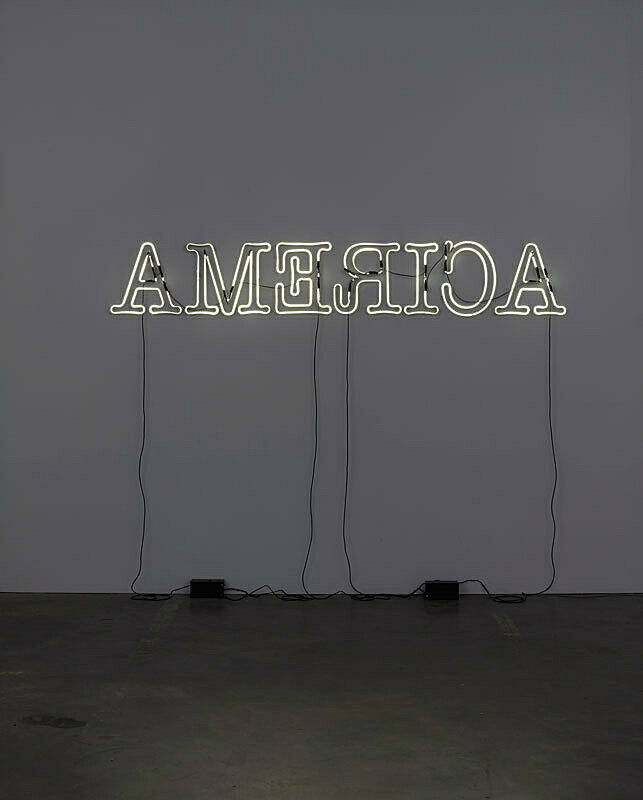
Glenn Ligon: AMERICA
2011
This audio guide, introduced by Alice Pratt Brown Director Adam D. Weinberg, highlights a diverse range of works from the exhibition Glenn Ligon: AMERICA. Artist Glenn Ligon, exhibition curator Scott Rothkopf, and Thelma Golden, director and chief curator of the Studio Museum in Harlem, provide additional commentary.
-
300
Introduction to Glenn Ligon: AMERICA
Audio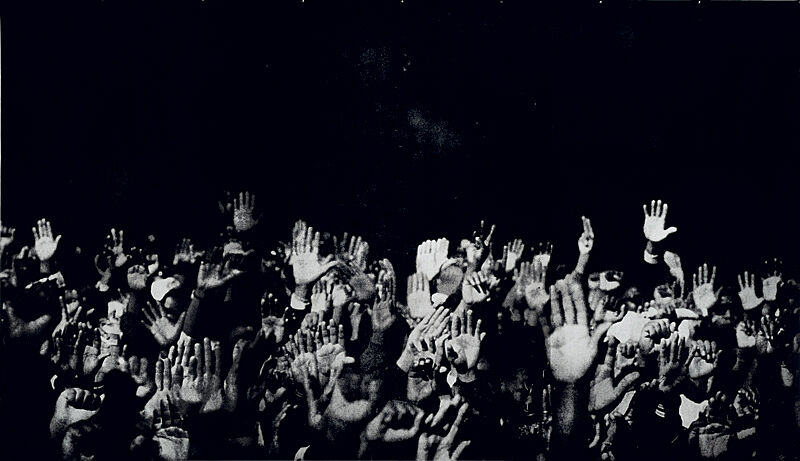
-
301
Glenn Ligon, Untitled (I Am a Man), 1988
Audio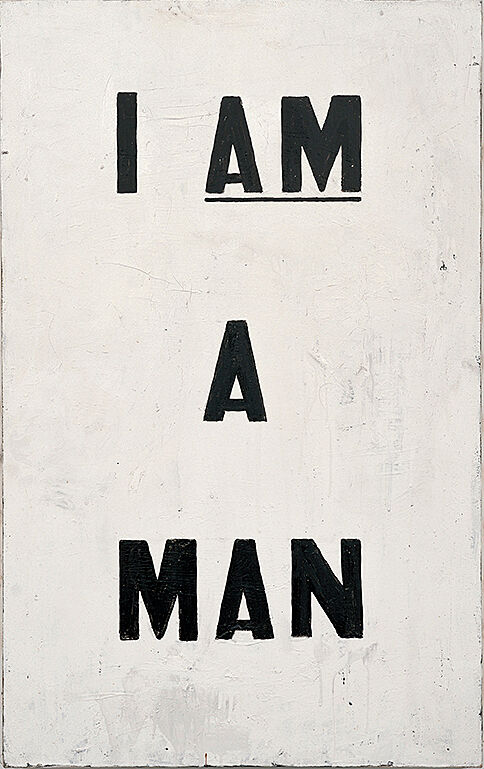
-
302
Glenn Ligon, No 291 (Language), 1988
Audio
-
303
Glenn Ligon, Untitled (I Feel Most Colored When I Am Thrown Against a Sharp White Background), 1990
Audio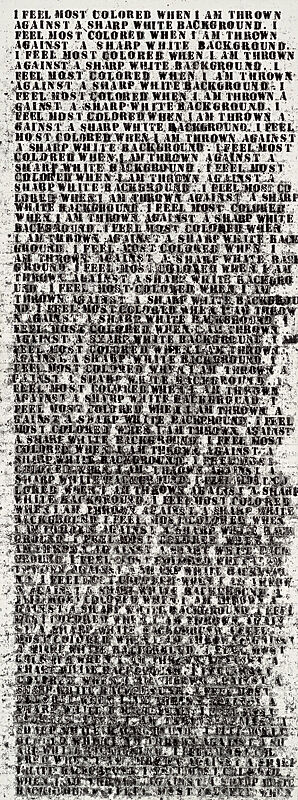
-
304
Glenn Ligon, Untitled (I Remember the Very Day That I Became Colored), 1990
Audio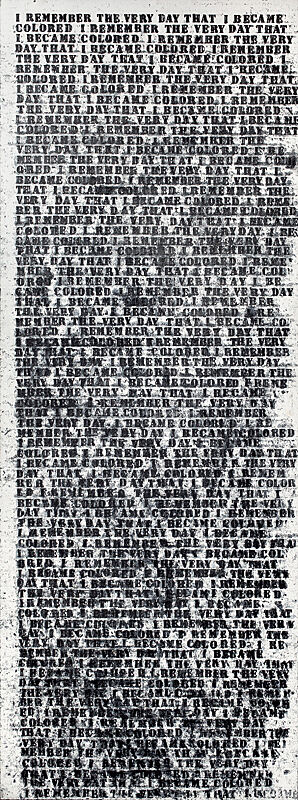
-
305
Glenn Ligon, Untitled (I Was Somebody), 1991
Audio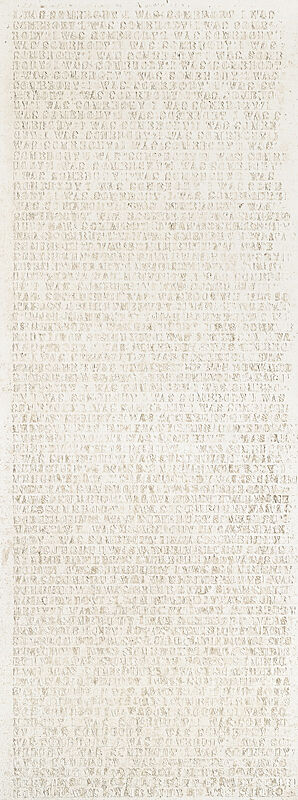
-
306
Glenn Ligon, Runaways, 1993
Audio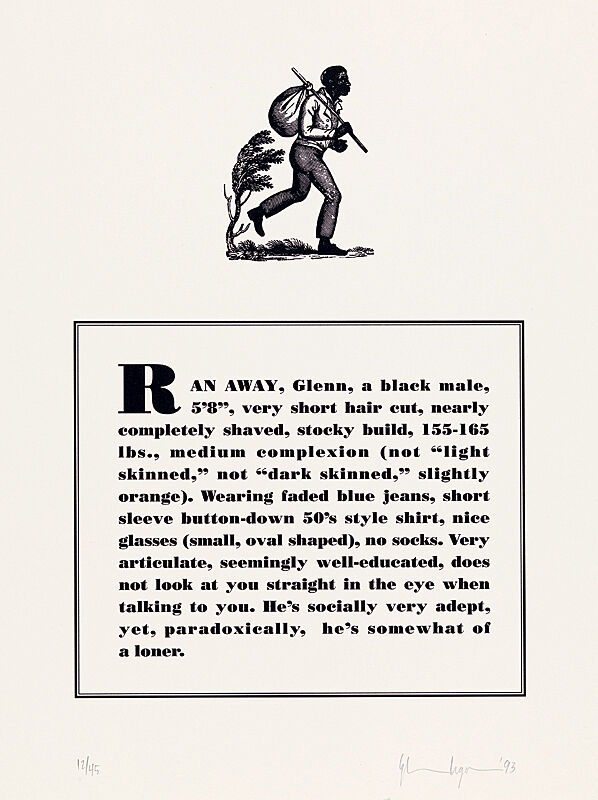
-
307
Glenn Ligon, Notes on the Margin of the Black Book, 1991–1993
Audio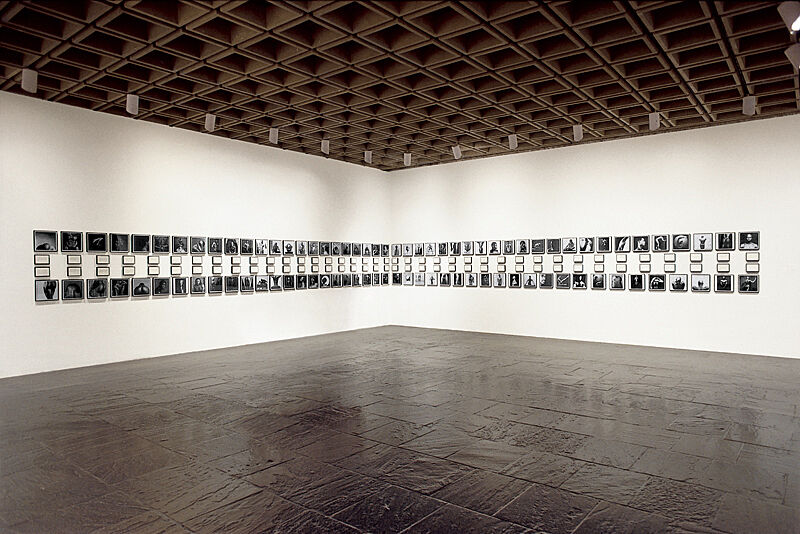
-
307b
Glenn Ligon, Notes on the Margin of the Black Book, 1991–1993
Audio
-
308
Glenn Ligon, We’re Black and Strong I, 1996
Audio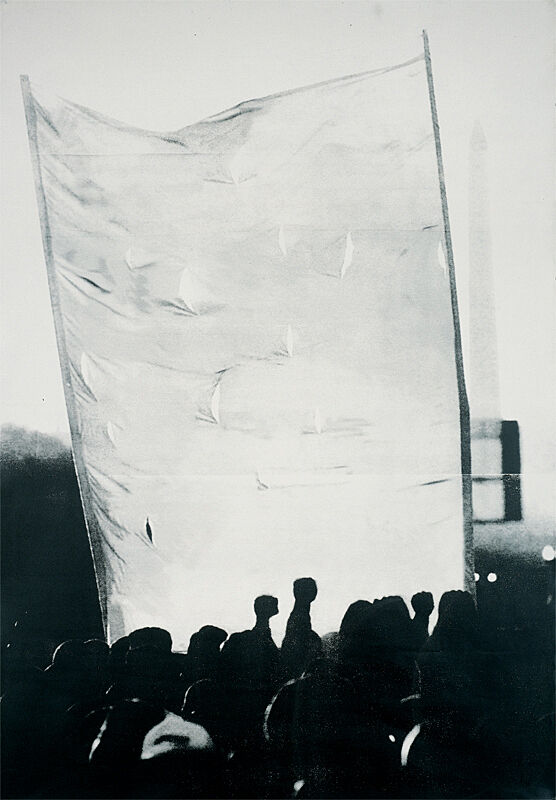
-
309
Glenn Ligon, Self-Portraits, 1996
Audio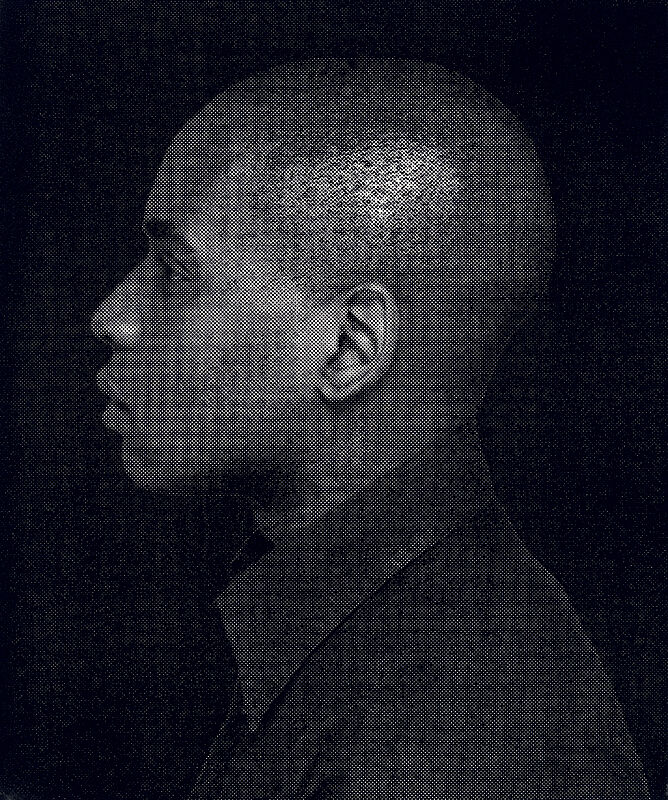
-
310
Glenn Ligon, Malcolm X (Version 1) #1, 2000
Audio
-
311
Glenn Ligon, When Black Wasn’t Beautiful #1, 2004
Audio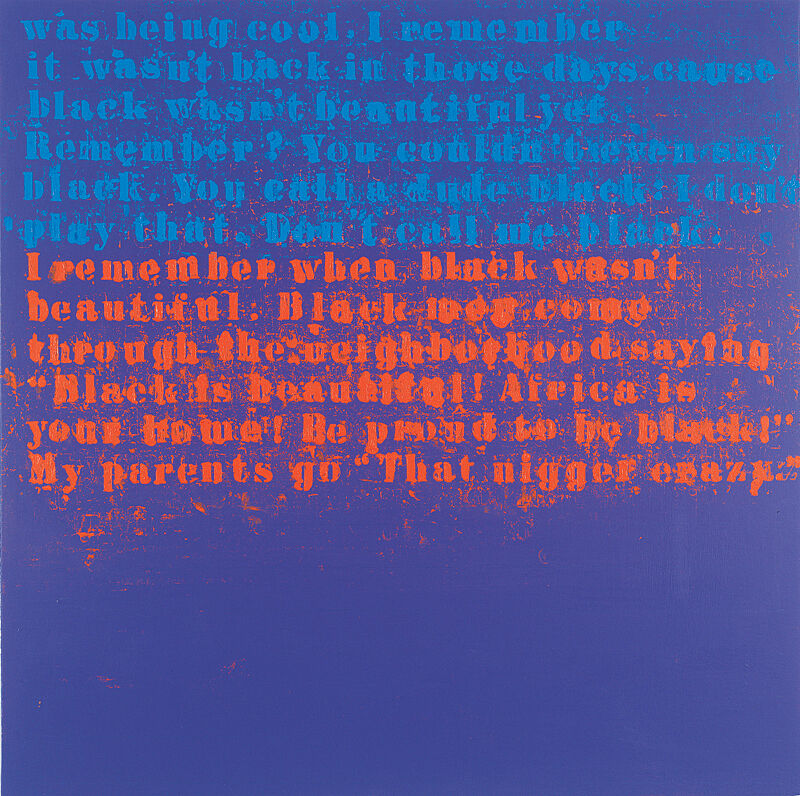
-
312
Glenn Ligon, Untitled (Conclusion), 2004
Audio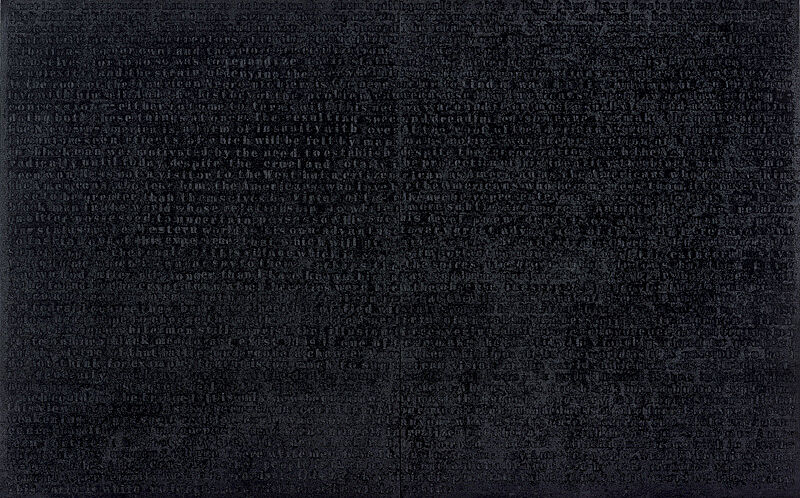
-
313
Glenn Ligon, Self-Portrait, 2002
Audio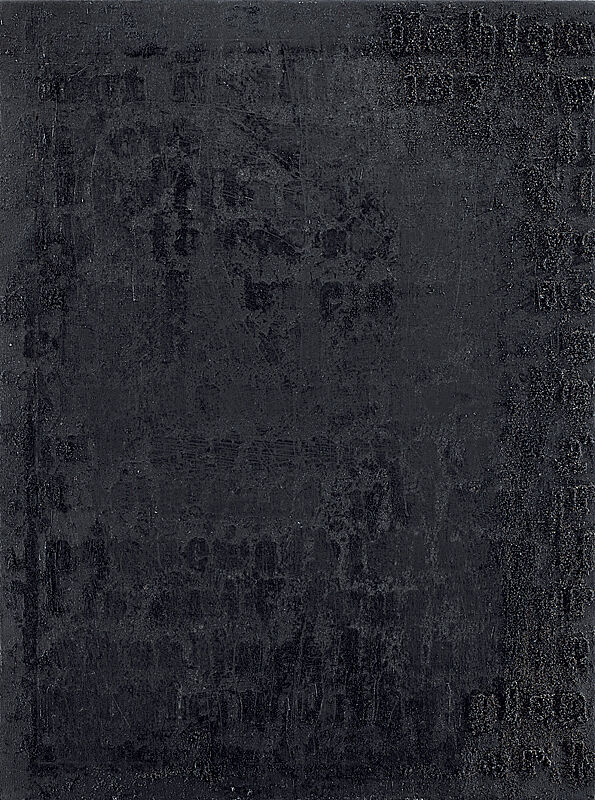
Adam Weinberg: Welcome to Glenn Ligon: America. I’m Adam Weinberg, Alice Pratt Brown Director of the Whitney Museum of American Art.
Glenn Ligon was born in 1960 and raised in the Bronx. He excelled at art as a child, studied painting in college, and began his career as an abstract painter. Then, in 1985, his work underwent a dramatic change. Ligon entered the Whitney Museum’s Independent Study Program, which emphasized more conceptual approaches to art making. Growing increasingly frustrated with what he saw as the limitations of abstract painting, he began to incorporate text in his paintings as a way of introducing new subject matter and a broad range of references into the work. He then developed what would become his signature style through the use of stencils that leant a physicality to his text-based painting. Since that time, text has became a vital part of Ligon’s work, and as you will see today, he has used it in an astonishing variety of ways.
Ligon has also used found images in his work. The 1996 screen print, called Hands, on view nearby is drawn from news photographs. A sea of hands raised against a dark sky suggests a moment of solidarity or, perhaps, affirmation. But who are these men and what are they pledging? Through this simple, powerful statement, Ligon explores what it means to be an individual, and what it means to be part of a group. He has returned to these questions again and again over the course of his career, often exploring the thorny issues of identity in relation to race, sexuality, and gender.
Few artists in the Whitney’s history have had as close a relationship with the Museum as Glenn Ligon has, dating back to his time in the Independent Study Program. We hold the largest institutional collection of his work, and Ligon has appeared in landmark exhibitions including as the 1993 Whitney Biennial and Black Male in 1994. This retrospective honors Ligon’s remarkable artistic achievement and celebrates our long relationship with him.
Glenn Ligon, Hands, 1996. Silkscreen ink and gesso on unstretched canvas. 82 × 144 in. (208.3 × 365.8 cm). Collection of Eileen Harris Norton © Glenn Ligon; photograph by Fredrik Nilsen
Narrator: In 1968, at the height of the Civil Rights Movement, hundreds of black sanitation workers in Memphis went on strike. Famously, they carried signs reading, “I AM A MAN.” Working twenty years later, Ligon almost exactly replicated those signs in this painting.
We see here a young artist at once working through the legacy of the civil rights movement and boldly declaring that he has found his artistic voice: this was one of Ligon’s earliest paintings to include appropriated text, an exploration that continues to this day.
To hear Glenn Ligon discuss the painting’s cracked surface, press play.
Glenn Ligon, Untitled (I Am a Man), 1988. Oil and enamel on canvas. 40 × 25 in. (101.6 × 63.5 cm). Collection of the artist © Glenn Ligon; photograph by Ronald Amstutz
Narrator: This painting, featuring the word “language” in orange stenciled letters on black, is part of a series based on “dream books”—pamphlets that offered ways to interpret one’s dreams. These pamphlets were common in the African American community in which Ligon grew up. The empty whorl of paint in the center of each work, quiet in some images and feverish in others, visually evokes the state of dreaming. We can see one of Ligon’s early attempts to merge language and abstract painting. Glenn Ligon.
Glenn Ligon: My early painting heroes were all the abstract expressionists, de Kooning, Kline, Jackson Pollock. It didn't make sense for me to try to be a fourth or fifth generation abstract expressionist, but my, my first love was those paintings, and I'm constantly going back to them.
Narrator: The dream books suggest interpretations about various subjects—sailors, sweethearts—or here, speaking a foreign language. They also offered lucky numbers to play in an underground lottery known as the “numbers.”
Glenn Ligon: I was very interested in those dream interpretations because they were clever, they used language in interesting ways. Also, there's a bit of family history, because my father, after his long shifts at the General Motors plant in upstate New York, worked at a numbers parlor.
Glenn Ligon, No. 291 (Language), 1988. Oil, synthetic polymer, oil stick, and graphite on paper. 30 × 22 1/4 in. (76.2 × 56.5 cm). Whitney Museum of American Art, New York; promised gift of Emily Fisher Landau © Glenn Ligon; photograph by Tim Nighswander/Imaging4art.com
Narrator: I feel most colored when I am thrown against a sharp white background. Ligon has stenciled the sentence over and over until the words smear and dissolve into abstract patterns. Glenn Ligon:
Glenn Ligon: Oil paint wants to spread out and smudge and smear. And after about six months of trying to make perfect letters, I realized that the smudging and smearing and disappearance of the letters was way more interesting than trying to make a perfect letter form. And so the paintings became about that disappearance of language.
Narrator: The text comes from writer Zora Neale Hurston’s 1928 essay “How It Feels to Be Colored Me.” Hurston describes leaving the protective black community of her childhood at age thirteen and suddenly confronting the issue of race. The painting’s illegible words embody her confusion, something Ligon builds on:
Glenn Ligon: I became really fascinated by those sentences that had the word “I” in them—"I feel most colored when I'm thrown against a sharp white background.” The use of the word “I” creates a kind of confusion. Is it the “I” of the text that I'm quoting, or is it “I,” Glenn Ligon, feel most colored? And so, the confusion between those two things was something I was interested in.
Narrator: Ligon’s surface here is actually a door. Its human scale is ideal for a text that speaks in the first person, its hard surface suggests Hurston’s “sharp white background.”
Glenn Ligon, Untitled (I Feel Most Colored When I Am Thrown Against a Sharp White Background), 1990. Oil stick, gesso, and graphite on wood. 80 × 30 in. (203.2 × 76.2 cm). Collection of Eileen Harris Norton © Glenn Ligon; photograph courtesy of Glenn Ligon; photograph by Dennis Cowley
Narrator: The phrase, “I Remember the Very Day that I Became Colored,” comes from writer Zora Neale Hurston’s essay, “How it Feels to be Colored Me.” As curator Scott Rothkopf explains, the meaning of these words is amplified through the work’s formal properties and Ligon’s meticulous process.
Scott Rothkopf: Glenn begins by painting the surface of the door with white gesso ground, and then has to put down thin pencil rules that he'll use to basically mark where the text falls. But there aren't any rules that show the separation of one letter from another . . . so, he is sort of guessing as he puts each letter down, and the space between them starts to vary.
If he gets to the end of the line, he has to think about whether he's going to start another word. . . . And in this painting, you see places where there are big white gaps on the right where he might have been able to fit the next word.
And sometimes he makes mistakes. About fifteen lines into this painting you see he has the letters c-o-l-o—which is the first part of "colored"—and when he goes to finish that word on the next line he actually repeats the "o."
But, I don’t think any of these errors are things that detract from the painting. In fact, they’re what make it interesting. The way that words blur into one another, the way that they become more or less easy to read, and the way that those characteristics on the surface actually relate to some of the sense that the text communicates, this feeling of Zora Neale Hurston, the author, becoming colored, and how this painting itself becomes colored as it gets covered with oil stick.
Glenn Ligon, Untitled (I Remember the Very Day That I Became Colored), 1990. Oil stick, gesso, and graphite on wood. 80 × 30 in. (203.2 × 76.2 cm). Collection of George C. Wolfe © Glenn Ligon; photograph by Sheldan C. Collins
Narrator: This white painting features the phrase “I was somebody.” The words are Ligon’s variation on the rallying cry of black political leader Jesse Jackson’s “I Am Somebody”—a mantra that itself appears in a black and white painting nearby. Scott Rothkopf and Glenn Ligon.
Scott Rothkopf: The painting I Was Somebody, where he changes this into the past tense, you start to think, well, if you were somebody, then today you're not. And that's a kind potentially sad or troubling thought. And this painting, being in white text on a white ground, has a sense of dissolution or ghostliness to it that I think communicates the feeling of absence maybe that that text suggests.
Glenn Ligon: Also, I guess, when I made the painting that said “I was somebody,” I was thinking of historical processes, and how our notions of identity and selfhood change over time and become more complicated, that our very fixed and certain notions of who we are have to change over time. I think that pair of paintings is about that, that loosening of the sense of self.
Scott Rothkopf: A lot of Glenn's work deals specifically with subject matter from black history, African American literature, and for that reason, it's often been discussed in terms of its engagement with questions of identity as they relate to race. But one of the things that it's worth emphasizing is the extent to which this work actually speaks to all of us.
Glenn Ligon, Untitled (I Was Somebody), 1990 and 2003. Oil stick, gesso, and graphite on wood. 80 × 30 in. (203.2 × 76.2 cm). Collection of John and Mary Pappajohn © Glenn Ligon; photograph courtesy of Glenn Ligon
Narrator: This series of lithographs, Runaways, began with Ligon’s study of nineteenth-century advertisements for runaway slaves, written by slave owners.
Glenn Ligon: The descriptions were quite detailed: "He laughs a lot when he talks," or, "He can play the French horn," which seem to me unnecessary if you're just describing the return of a person who is your property. And the elaborateness of those descriptions seemed to speak to a complicated relationship between master and slaveholder.
Narrator: Ligon asked ten friends to describe him as if they were filing a “missing persons” report. He presented their descriptions in prints seeking a run-away named Glenn. Like the slave owners, Ligon’s friends paint a picture that is both generic—he is five feet eight inches tall—and oddly idiosyncratic. When Glenn walks, for example, “his feet cross each other a little bit.”
The works are funny and disturbing. With a light touch, Ligon confronts the issue of slavery and brings it into our own time. He suggests that it remains a powerful undercurrent in American society.
Glenn Ligon, Runaways, 1993 (detail). Suite of ten lithographs. 16 × 12 in. (40.6 × 30.5 cm each). Whitney Museum of American Art, New York; gift of the Peter Norton Family Foundation © Glenn Ligon; Digital Image © Whitney Museum of American Art
Narrator: In this monumental work, Ligon captures the scope and passion of the polarizing public debates surrounding the photographer Robert Mapplethorpe’s Black Book. The Black Book is a series of black and white photographs depicting nude black men in eroticized, classical poses. Upon its publication, the book became a lightning rod for controversy in the culture wars of the 1980s. Glenn Ligon.
Glenn Ligon: I probably saw Mapplethorpe's Black Book the year it was published, which was 1986, and I remember having very ambivalent feelings about it, partially because the representations of the men were very de-contextualized. You had no sense of their social lives or histories, you just have a sense of them as objects for Mapplethorpe's camera. But at the same time, I thought the photographs, as a way of seeing black men, were important on some level.
Narrator: For Ligon, the photographs became a starting point for investigating ideas about black masculinity and sexuality. After struggling with his own thoughts, he decided to research the public debate.
Glenn Ligon: I started reading hundreds and hundreds of articles about Mapplethorpe, about the issues around censorship and homophobia that his work generated, scholarly commentary. I did interviews with people in bars that I met and showed them copies of The Black Book and asked them what they thought.
Narrator: Ligon presents the responses in panels positioned between the actual pages of Mapplethorpe’s book. Filled with charged language, the texts reveal the staggering array of meanings associated with these images.
This work appeared at the provocative 1993 Whitney Biennial. To hear more about its reception, press play.
Glenn Ligon, Notes on the Margin of the Black Book, 1991–1993. Ninety-one offset prints, 11 1/2 × 11 1/2 in. (29.2 × 29.2 cm) each (framed); seventy-eight text pages, 5 1/4 × 7 1/2 in. (13.3 × 18.4 cm) each (framed). Solomon R. Guggenheim Museum, New York; gift of The Bohen Foundation © Glenn Ligon
Narrator: The 1993 Whitney Biennial was both praised and vilified for its focus on political art. Glenn Ligon and Thelma Golden, one of the Biennial curators and now the Director of the Studio Museum in Harlem, recall the response to Notes on the Margin of the Black Book.
Glenn Ligon: My experience of the piece at the time was through the guards of the Whitney Museum. I'm friends with all the guards, and so whenever I went to see the 1993 biennial, and asked the guards how people were responding to the show, they would tell me that visitors to the show would read every single quotation in the piece. . . .The fact that people were reading every single quote spoke to me about a sort of hunger to think about, to be immersed in, the kinds of debates around the images.
Thelma Golden: I think one of the most important things that Glenn did is that he opened up this work in a away that pushed away from that kind of yes/no, right/wrong, black/white reading that had been attached to it . . . He sort of creates the space to allow you to understand that images are complicated. And that’s the space, perhaps, in which they are most powerful.
Narrator: Notes on the Margin of the Black Book remains a landmark of the art of the 1990s.
Glenn Ligon, Notes on the Margin of the Black Book, 1991–1993. Ninety-one offset prints, 11 1/2 × 11 1/2 in. (29.2 × 29.2 cm) each (framed); seventy-eight text pages, 5 1/4 × 7 1/2 in. (13.3 × 18.4 cm) each (framed). Solomon R. Guggenheim Museum, New York; gift of The Bohen Foundation © Glenn Ligon
Narrator: A crowd of men, with fists raised, salute an empty banner. This image is from a body of Ligon’s work reflecting on the Million Man March, which took place in 1995 in Washington DC. Its organizers, Louis Farrakhan and the Nation of Islam, promoted it as a day for black men to pledge solidarity and responsibility. Women were banned and asked instead to observe a “Day of Absence”—which became Ligon’s title for this series as a whole. The ghostly white banner powerfully conveys the sense that something is missing.
Ligon chose not to attend the event. Like many, he experienced it through the media. He made this work by enlarging a photograph and printing it on unstretched canvas to evoke the banners the marchers carried. He removed the text from the banner, which had read “We’re Black and We’re Strong.” Like his stenciled text paintings, the process of making the work distorted the information Ligon presented.
Glenn Ligon: Imagine making a Xerox one hundred times. Eventually, it gets darker and more indistinct, and that's what happened to these images of the march. They became more mysterious, and in some ways, by becoming more mysterious, they became more accurate . . . more able to portray the feelings that I had about the march.
Narrator: It is nearly impossible to distinguish individual faces and bodies—they are subsumed by the group.
The Million Man March was controversial from its inception. Who was included and who was excluded? What image of masculinity did it put forward? And in the end, was it effective? Ligon doesn’t try to answer these questions, but the series serves as a complex meditation on them. As pictures of protest, these images are eerily silent.
Glenn Ligon, We’re Black and Strong (I), 1996. Silkscreen ink and gesso on unstretched canvas, 120 × 84 in. (304.8 × 213.36 cm). San Francisco Museum of Modern Art; Accessions Committee Fund: gift of Frances and John Bowes, Emily L. Carroll and Thomas W. Weisel, Collectors Forum, Susan and Robert Green, Danielle and Brooks Walker Jr., and Phyllis Wattis © Glenn Ligon; photograph courtesy of Glenn Ligon
Narrator: In these self-portraits, Ligon refuses to look directly out at us. The images, silk-screened onto canvas with thick enamel ink, are dark and grainy. Curator Scott Rothkopf.
Scott Rothkopf: He's both inhabiting the mug shot but then sort of undoing it by turning his head away from us and showing us only the back. It wouldn't be very useful in a police lineup or a criminal suspect picture. And I think that that tension, and that kind of resistance, is a real part of the work and its political interest.
And, you know, this is part of systems for law enforcement in this country, which black men are certainly more obviously made the target of than any other population. And I think Glenn is, in a way, responding to and resisting that.
Glenn Ligon, Self–Portrait, 1996. Silkscreen ink and gesso on canvas, 48 × 40 in. (121.9 × 101.6 cm). Whitney Museum of American Art, New York; promised gift of Beth Rudin DeWoody P.2013.5. © Glenn Ligon
Narrator: This painting of Malcolm X comes from Ligon’s Coloring series, which grew out of a group of workshops he conducted with children at the Walker Art Center in Minneapolis. Ligon asked the children to color pictures from 1970s-era coloring books. Glenn Ligon.
Glenn Ligon: I decided to make a body of work using these images because they had such a specific political agenda behind them. They were kids' coloring books meant to normalize images of black Americans, to make them part of history. But for a three year old, none of that matters. And what was interesting about making the work was the irreverence with which the kids approached these images. So a little kid can take an image of Malcolm X, and put lipstick and blush and eye shadow on him. For an adult, this is a transgression. For a kid, this is just normal.
I took the images from the coloring books and silkscreened them onto large canvases, and then I hand-colored in the images using the kids' drawings as the basis for my images.
Narrator: Director of the Studio Museum, Thelma Golden.
Thelma Golden: He committed to himself to use these drawings made by the children and then reproduce them, faithfully, as paintings. So in some cases, what you get, are these images that now have huge historic import but are treated in a way that seems to belie that importance. What’s at heart here was Glenn’s idea of trying, as he does in all his work, to make sense of these images. So these works remain complicated, interesting, engaging and perhaps, to some, enraging.
Glenn Ligon, Malcolm X (Version 1) #1, 2000. Vinyl-based paint, silkscreen ink, and gesso on canvas. 96 x 72 in. (243.8 x 182.9 cm). Collection of Michael and Lise Evans © Glenn Ligon; photograph courtesy of Glenn Ligon (framed). Solomon R. Guggenheim Museum, New York; gift of The Bohen Foundation © Glenn Ligon
Narrator: Richard Pryor shouts in neon colors and profane language. Pryor was one of America’s greatest comedians, famous for his unsparing observations about race. Glenn Ligon.
Glenn Ligon: His jokes are very pointed political commentary. They're funny, but they're also cringe-worthy and that sort of tension between very sharp, biting satire of American culture and their jokiness was something I was interested in.
Narrator: As curator Scott Rothkopf explains, the paintings capture—and even re-create—that tension.
Scott Rothkopf: Often, the colors are so bright that they kind of are actually hard to look at. The paintings feel like they have a vibrating, optical effect, and you can't even sometimes see the text against this colorful ground, they're hard to read. I think another thing that he captures is certainly the difficulty of reading this kind of language which you're used to encountering, let's say, in a comedy club . . . and now you're being forced to look at it in an art gallery. And you are, in a way, implicated in this language, because you're reading this word nigger in your mind, and someone's watching you do that, and you're watching them do that. So, it becomes a kind of public act. Something fascinating happens when you change contexts.
Narrator: To hear Thelma Golden’s take on these paintings, press play.
Glenn Ligon, When Black Wasn't Beautiful #1, 2004. Oil stick, synthetic polymer, and graphite on canvas. 30 x 30 in. (76.2 x 76.2 cm). Collection of Susan Hancock © Glenn Ligon; photograph courtesy of Glenn Ligon
Narrator: This large, almost entirely black diptych is one of nearly two hundred works by Ligon that grapple with James Baldwin’s 1953 essay “Stranger in the Village.” Glenn Ligon.
Glenn Ligon: The essay starts out with a description by Baldwin of the Swiss town that he's living in, in the early 1950s. He's gone there at the invitation of his lover, Lucien, . . . and he's working on a novel. But he says that for many of the villagers, he is the first black person they have ever seen. And so, the essay becomes about this fear and fascination, which is the response to his presence.
Narrator: The painting features the essay’s final three paragraphs, but the words are almost impossible to see, let alone read. Ligon layered the surface with paint, glue, and glittering coal dust, a toxic and highly combustible by-product of the coal mining process. Coal dust also came to have a deeper association for Ligon.
Glenn Ligon: The fact that it's a leftover thing seemed parallel to some things that Baldwin was talking about. Baldwin often said that it's from the margins of society that you get the truth, that the people who most accurately can talk about what a society means are the people at its margins. And so, I was really interested in using this material that's the leftover stuff, but in the space of the painting becomes very beautiful, becomes very alluring, becomes very poignant.
Narrator: The dark image reflects Baldwin’s feelings of loneliness and estrangement. But he concludes on a note of optimism. In Europe, in the 1950s, he is regarded as an exotic rarity. But the close and intertwined history between black and white Americans, may, in Baldwin’s words, be “something of an achievement.” Baldwin writes, “It is precisely this black-white experience which may prove of indispensable value to us in the world we face today. This world is white no longer, and it will never be white again.”
Glenn Ligon (b. 1960), Untitled (Conclusion), 2004. Oil stick, synthetic polymer, oil, coal dust, glue, and graphite on canvas in two parts. 90 × 144 in. (228.6 × 365.8 cm). Collection of Jill and Peter Kraus © Glenn Ligon; image courtesy the artist and Regen Projects, Los Angeles
Narrator: This black painting, which has been slashed repeatedly in the center, is a self-portrait from Ligon’s series of works about James Baldwin’s "Stranger in the Village" essay. As Curator Scott Rothkopf explains, it was made from a failed painting:
Scott Rothkopf: It was something that he was struggling with, wasn't happy with, and so he scraped the language off this picture. And it's very violent, in a way. You see the scratches. You see the traces of letters. You have a sense of something that has been effaced, something that has been violated.
The fact that he chose to call this painting Self-Portrait then becomes a very interesting thing to think about. Why is this surface that has been rubbed off something that he chooses to think of as a representation of himself? And I think that this gets at his very deep and intense relationship to the writing of James Baldwin. Certainly Baldwin was a black, gay man who, like Glenn, grew up in New York City. . . .But the idea that this is a self-portrait, I think, relates . . . to his . . . also needing to maybe push beyond that. . . .
Maybe he's effacing himself or he's effacing this author with which he's had extreme identification. Or maybe he's doing both at the same time. And that kind of blankness that overwhelms this painting is a very beautiful and I think moving idea of a self-portrait, but one that’s also kind of haunting.
Glenn Ligon, Self-Portrait, 1996. Silkscreen ink and gesso on canvas. 48 x 40 in. (121.9 x 101.6 cm). Collection of the artist © Glenn Ligon; photograph courtesy of Ronald Amstutz
0:00
0:00