
Julie Mehretu
2021
Hear directly from the artist and curator on selected works from the exhibition.
-
500
Introduction
Audio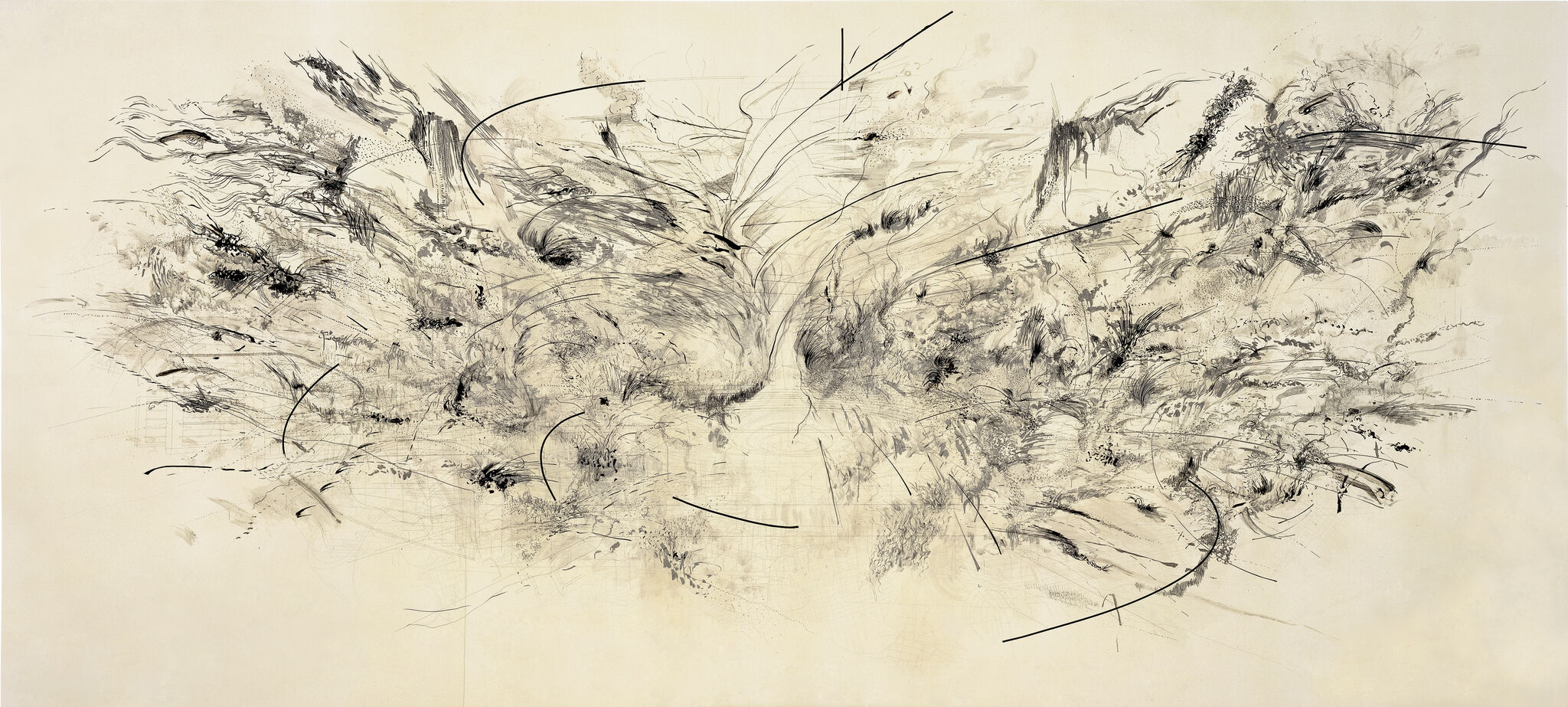
-
501
Untitled (yellow with ellipses)
Audio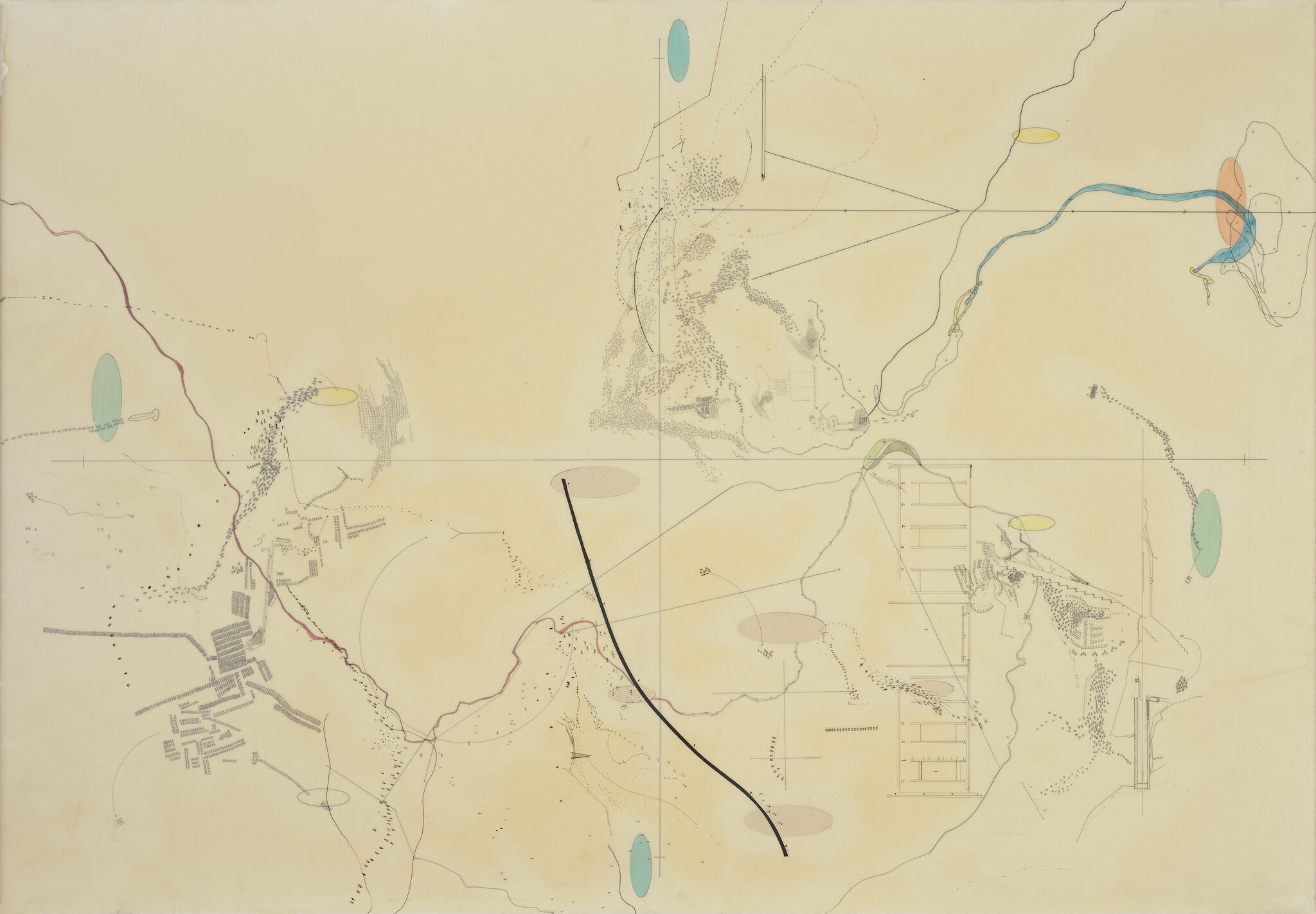
-
502
Retopistics: A Renegade Excavation
Audio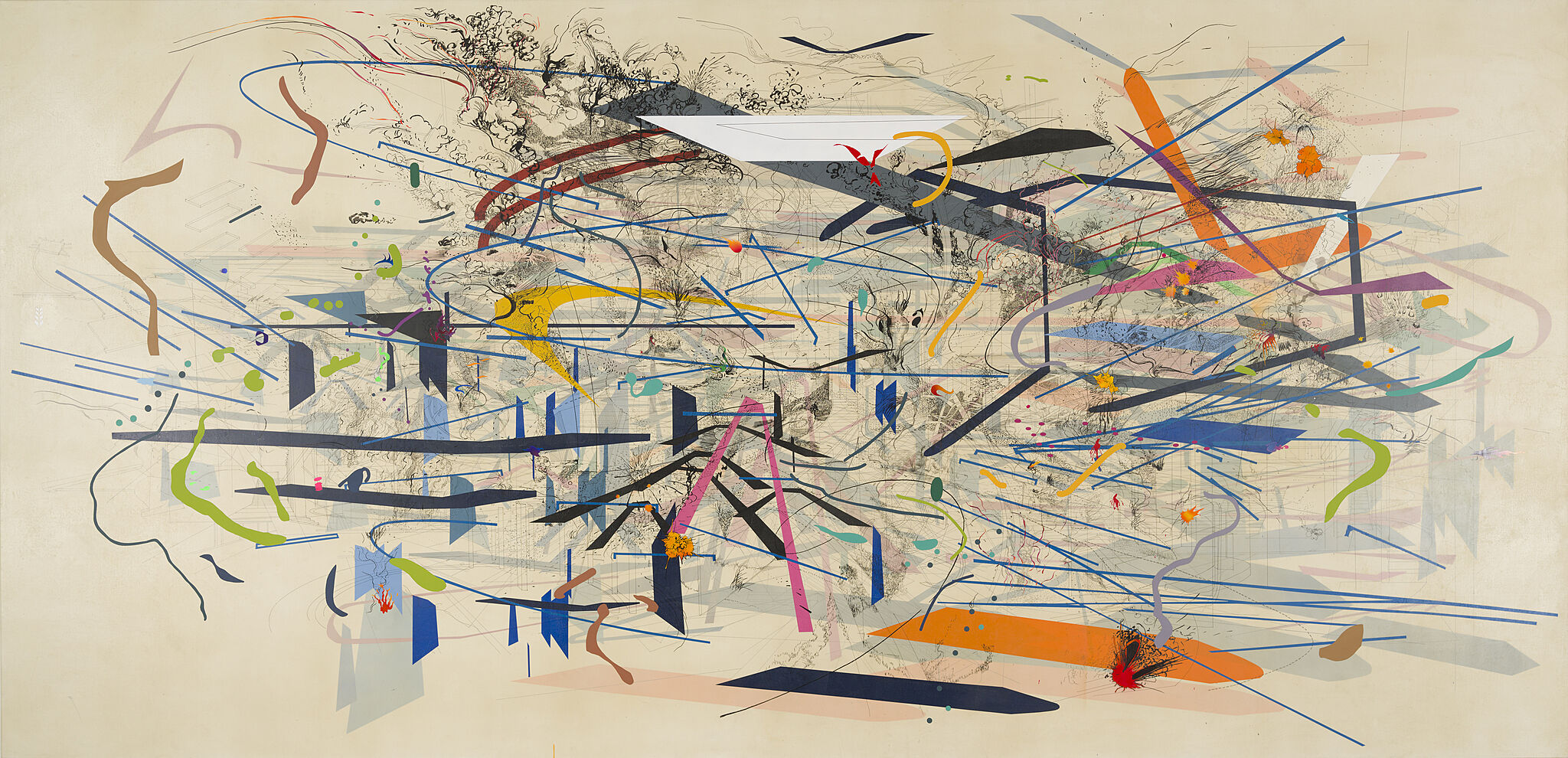
-
503
Stadia II
Audio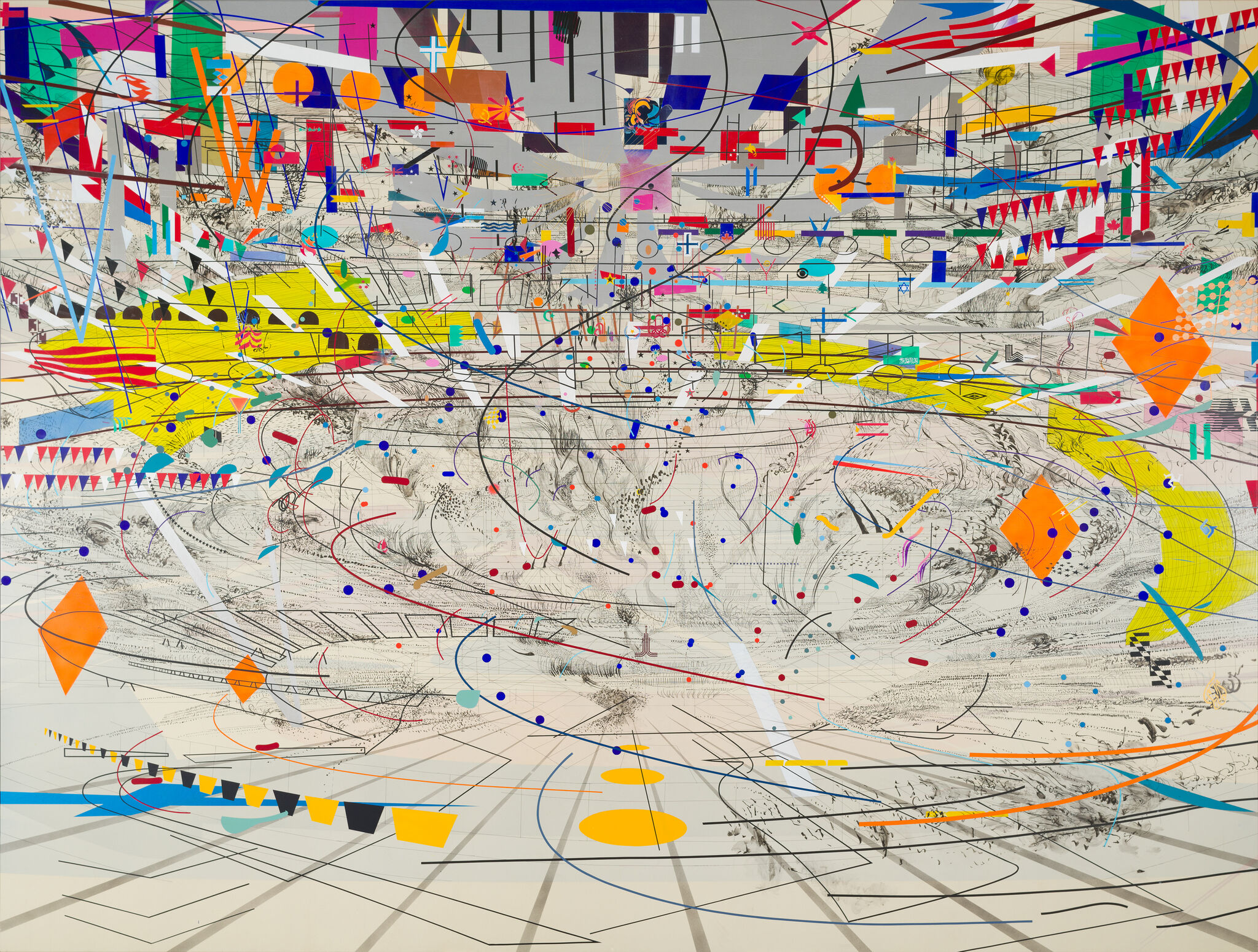
-
504
Black City
Audio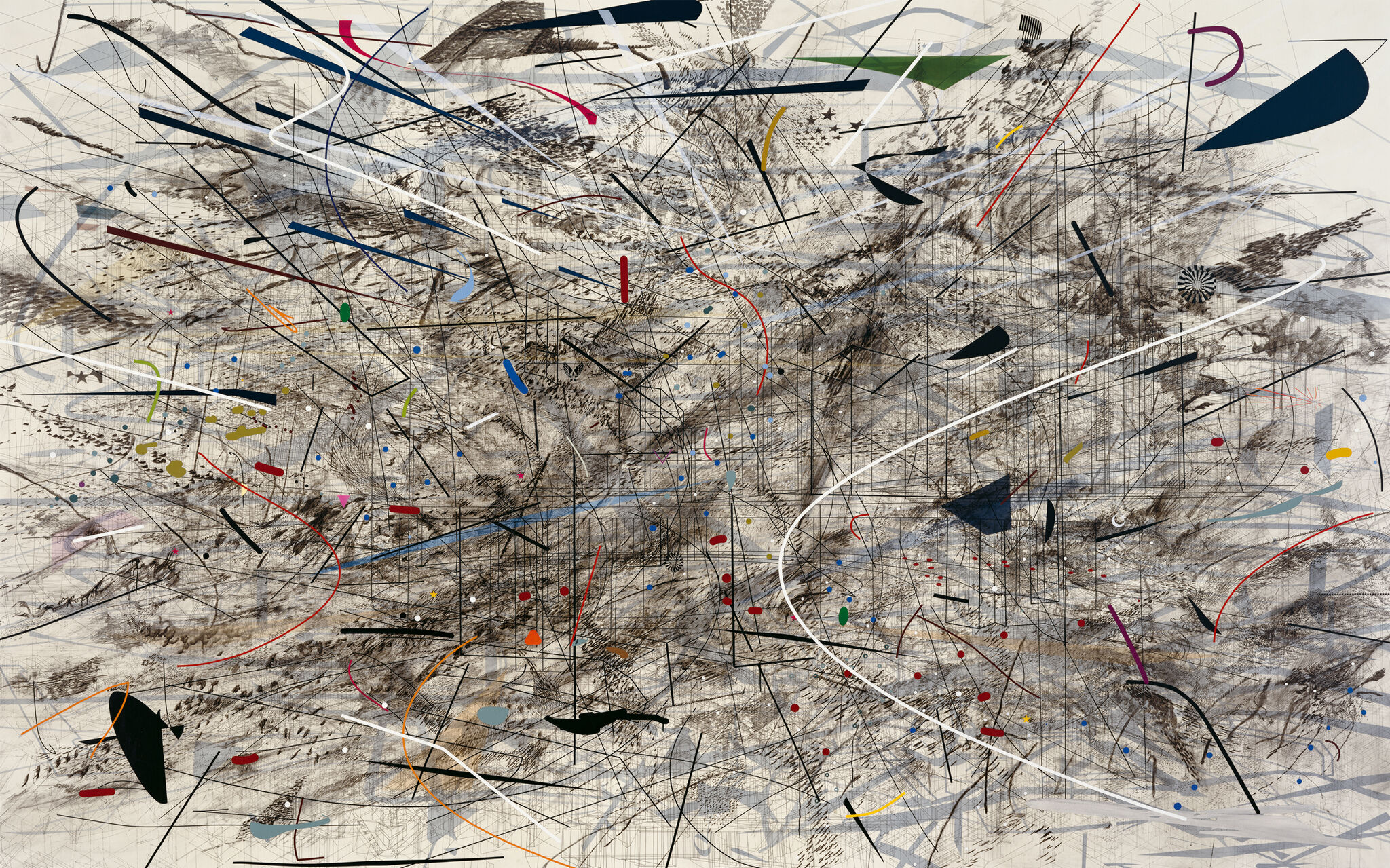
-
505
Berliner Plätze
Audio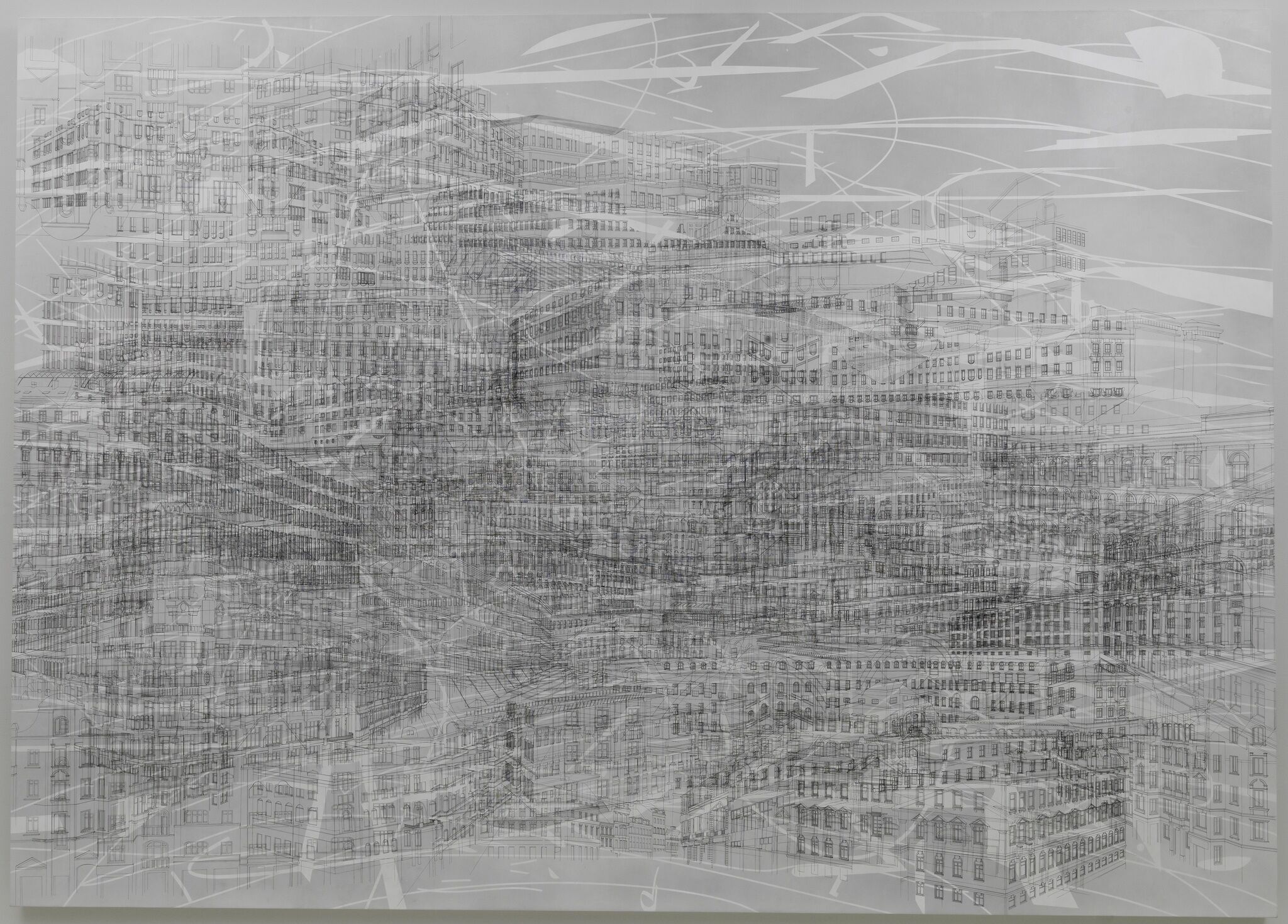
-
506
Mogamma (A Painting in Four Parts) Part 1
Audio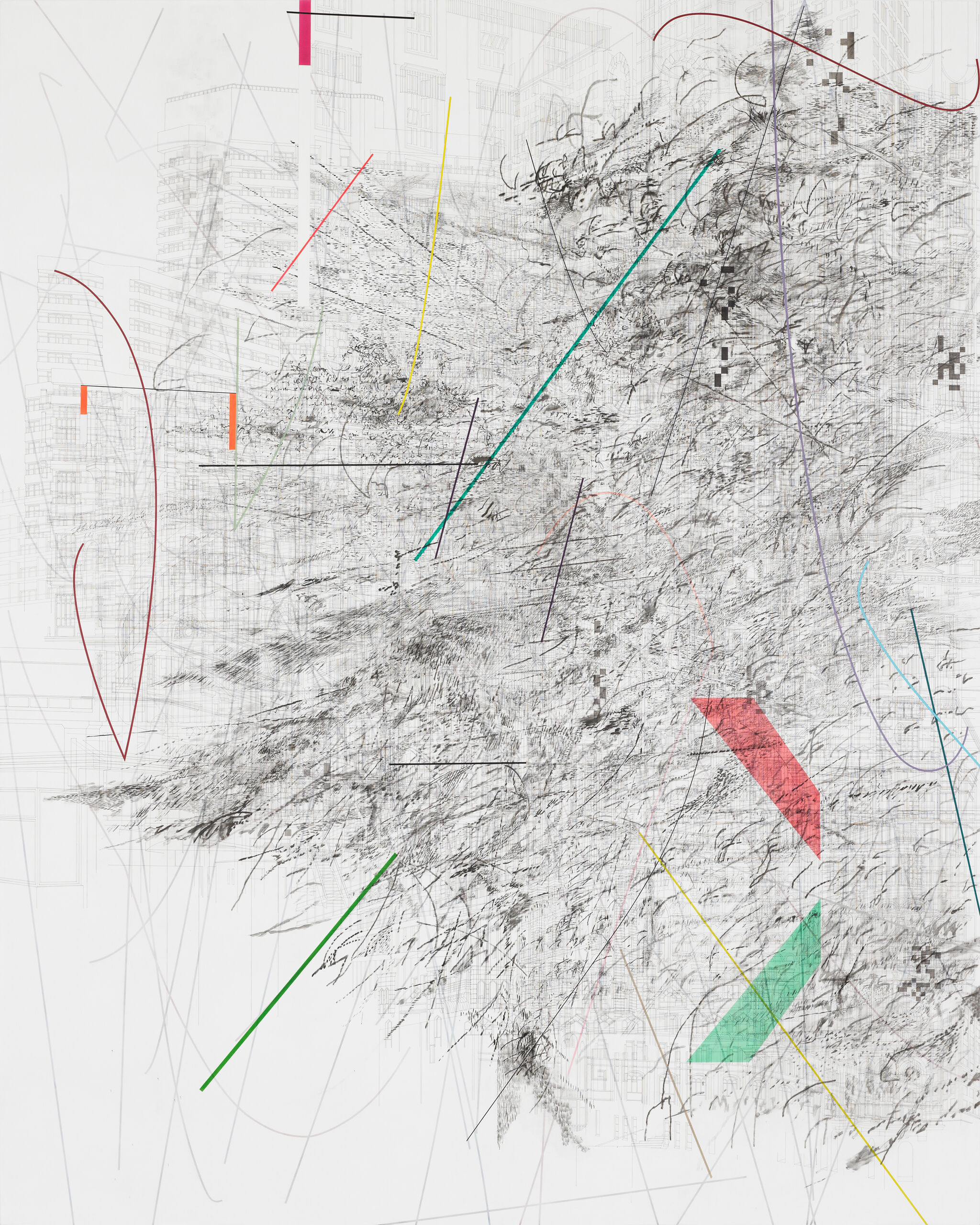
-
507
Mogamma (A Painting in Four Parts) Part 2
Audio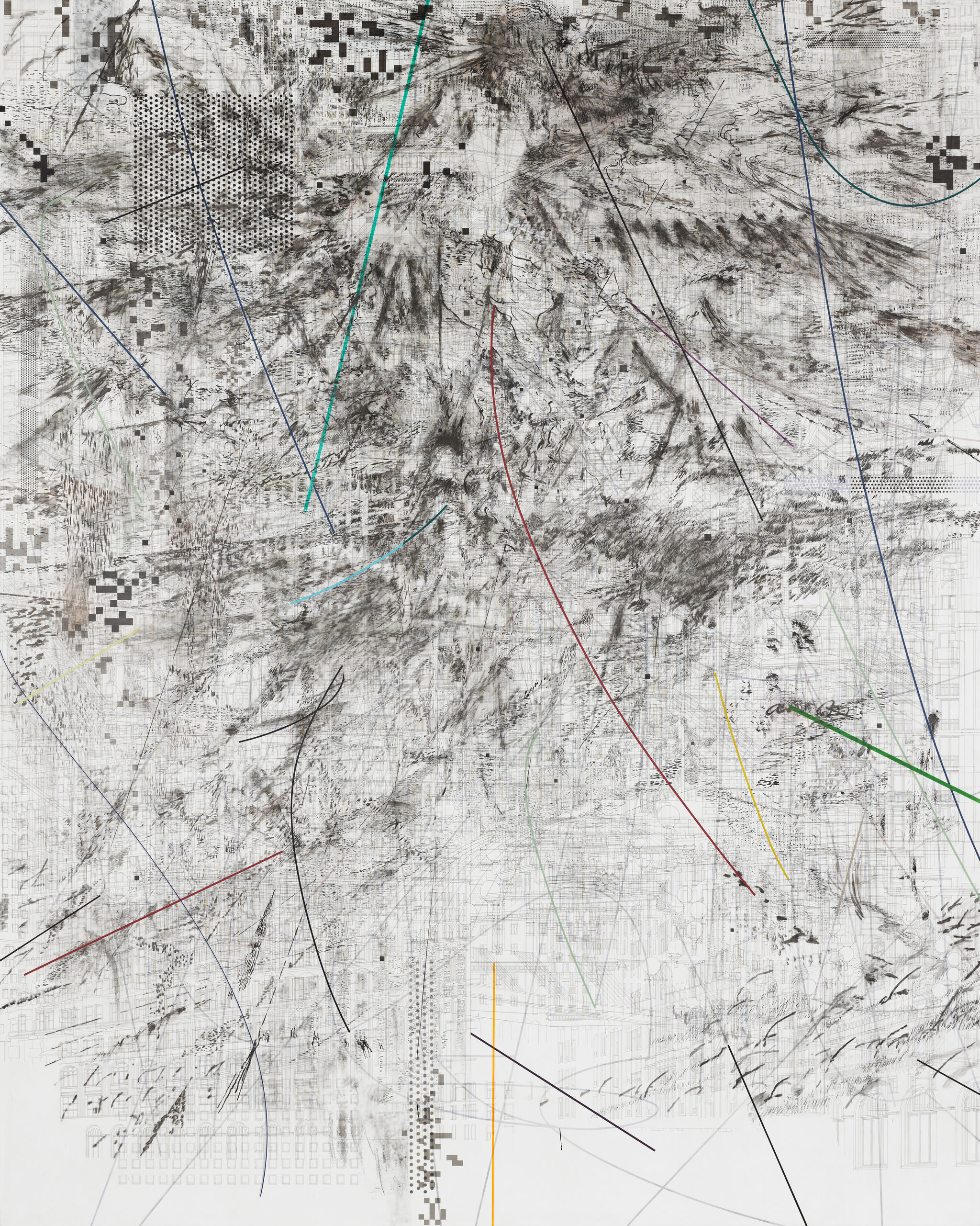
-
508
Being Higher I, 2013, and Being Higher II, 2013
Audio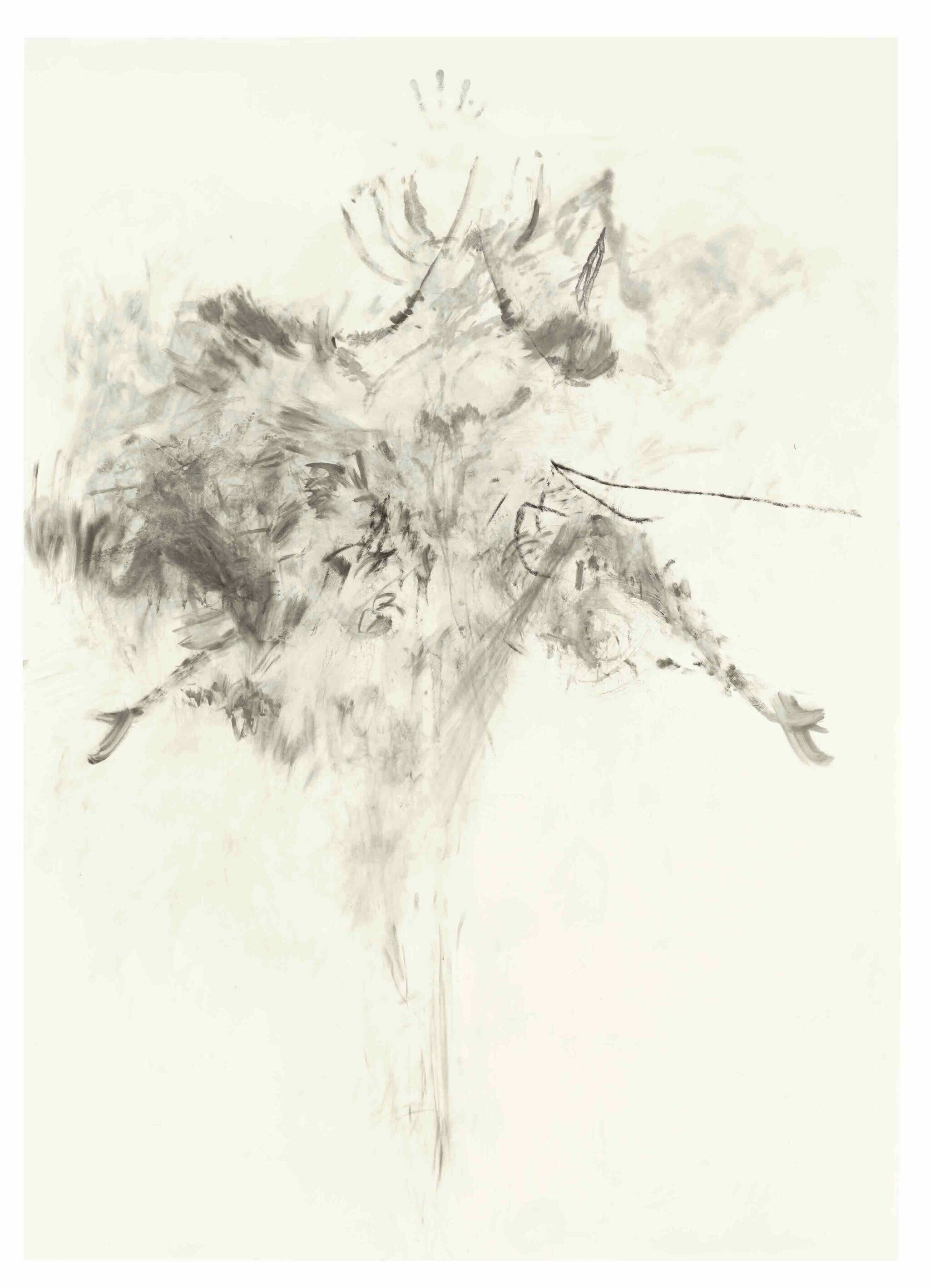
-
509
Invisible Line (collective)
Audio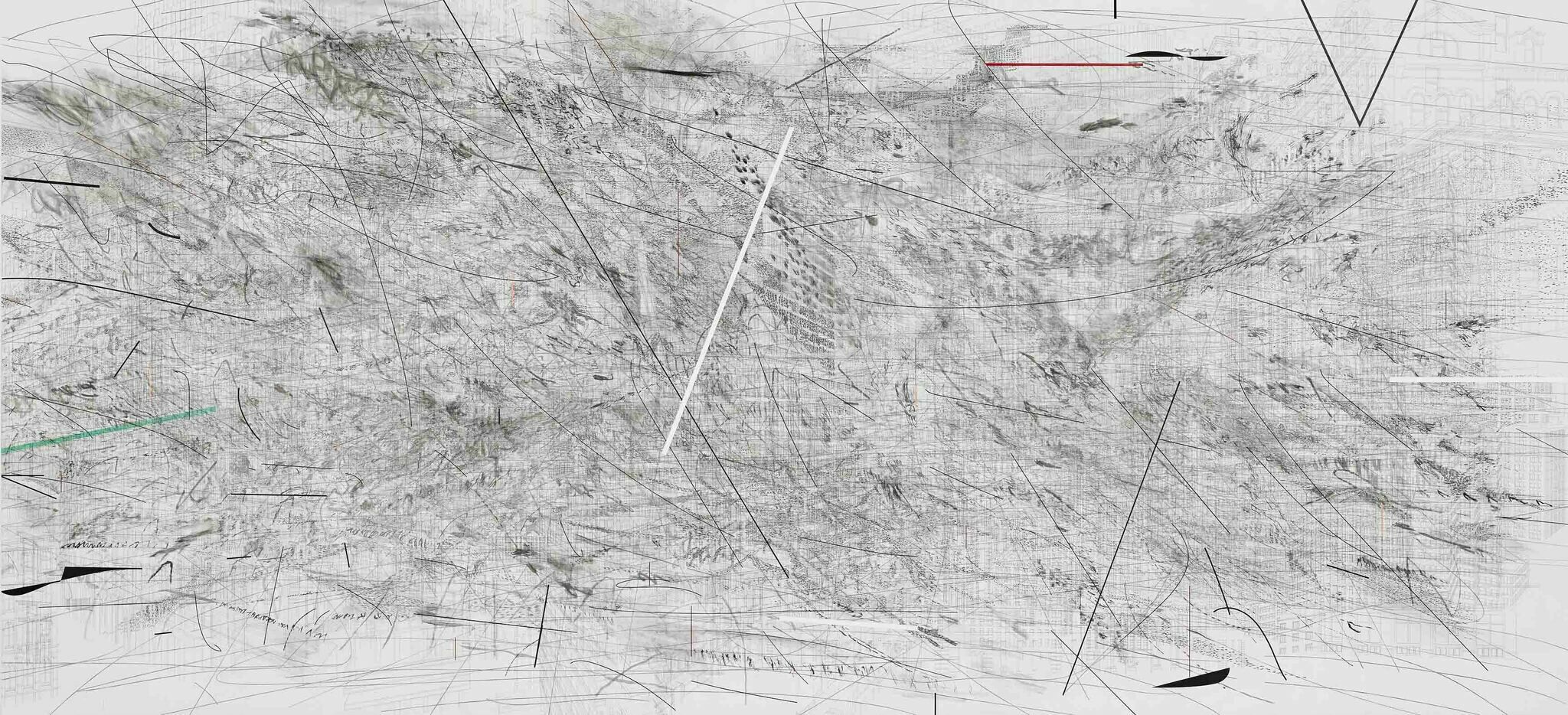
-
510
Conjured Parts (Eye), Ferguson
Audio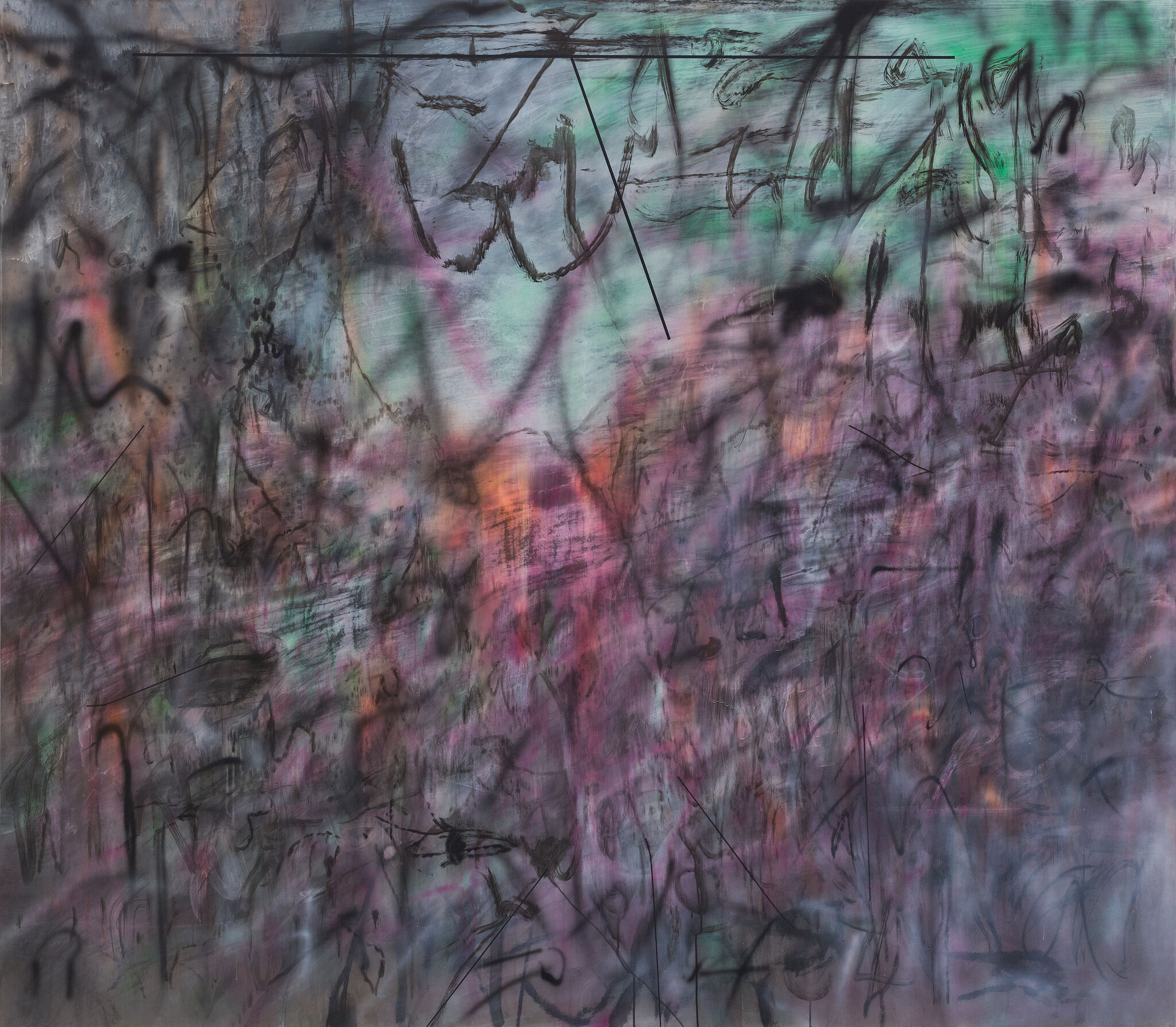
-
511
Of Other Planes of There
Audio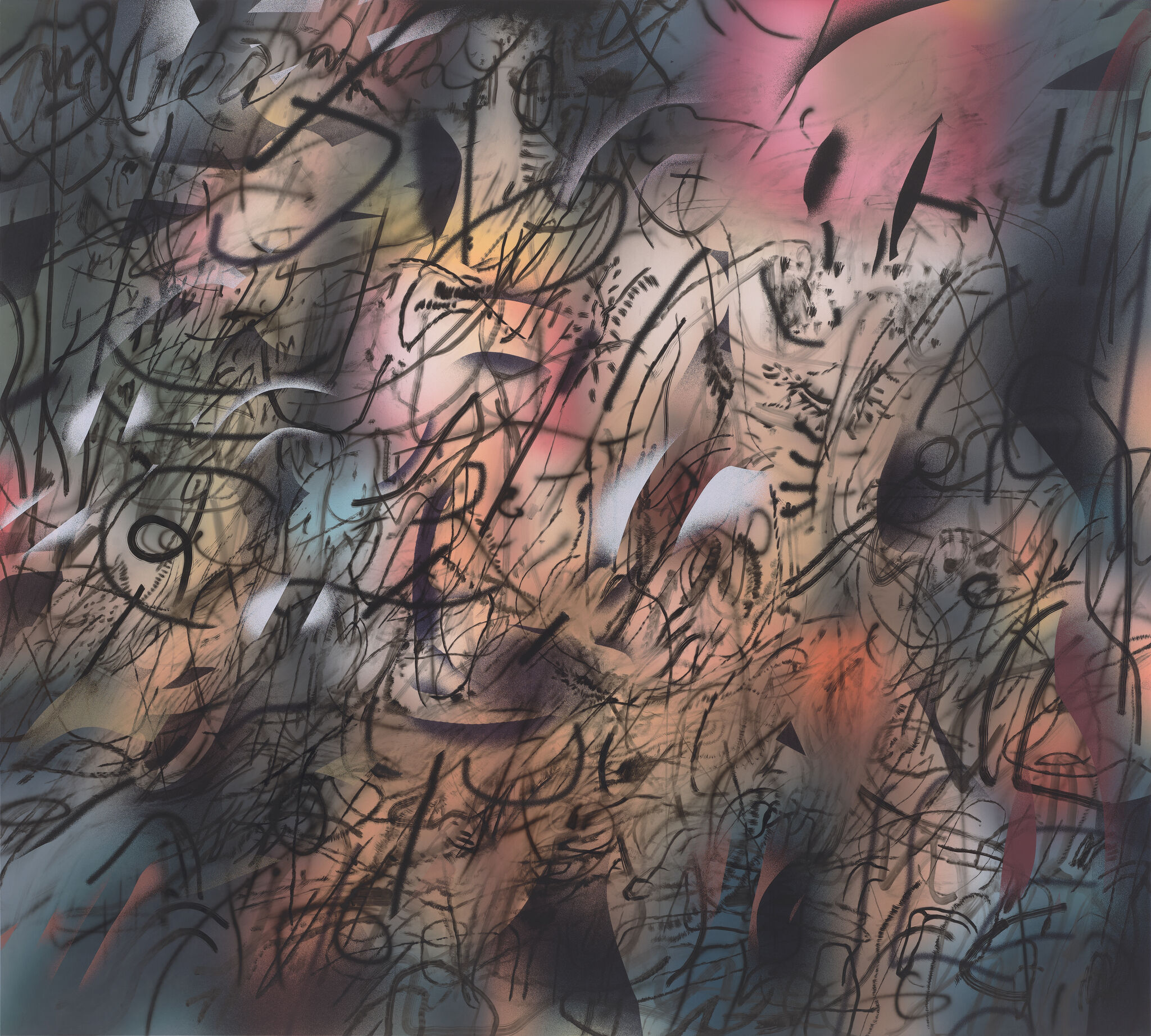
-
512
Ghosthymn (after the Raft)
Audio
Narrator: Welcome to Julie Mehretu, the first retrospective of the artist’s work in New York. The exhibition opens with one of her early works, Transcending: The New International. It’s the large painting opposite the elevators.
Rujeko Hockley: As a viewer, when you stand in front of one of her paintings, you are really kind of enveloped by all that she has done. And that is true, whether they're 20 feet wide—or if they're really intimate drawings.
Narrator: Rujeko Hockley is a curator at the Whitney.
Rujeko Hockley: They are really seductive in a certain way: the intricacy of the details, the kind of embedded nature of the different layers. That layering is really emblematic of her practice, but also of her approach and the way that we might think about what it means to be an artist at this time.
She is an artist who has really pushed the boundaries of painting, of contemporary art in general, of destabilizing categories around who an American artist is, what is American art? What does it mean to be of the global African Diaspora?
Narrator: In this painting, Mehretu layers maps and architectural drawings from African capitals, focusing especially on sites and building styles that emerged from independence movements. One important element is a map of Addis Ababa, the capital of Ethiopia. The artist was born there in 1970 and lived in the city until 1977, when her family came to the United States to escape political turmoil. As you look closely, you’ll also see many marks that don’t seem to represent anything specific. These smaller abstract forms and flows move across the surface. They seem to suggest migration through a complex, abstracted political landscape. Mehretu called these dynamic marks “characters.” She’d been working with them for a while by the time she had made this painting. We’ll look more closely at some of them in the next stop on our tour, which continues into the gallery to the left.
Music by Blue Dot Sessions, out of Creative Commons.
Julie Mehretu, Transcending: The New International, 2003. Ink and acrylic on canvas, 107 × 237 inches (271.78 × 601.98 cm). Collection Walker Art Center, Minneapolis T.B. Walker Acquisition Fund, 2003. Photograph courtesy Walker Art Center. © Julie Mehretu
Narrator: Mehretu structured this painting around an X-Y axis—an Enlightenment era measuring tool. But rather than plotting rational data points onto its grid, Mehretu contrasts it with the fluid movement of the abstract marks she calls “characters.”
Julie Mehretu: Each mark in its gesture and its making suggests a certain type of behavior.
Narrator: Julie Mehretu.
Julie Mehretu: The different marks and the different kinds of glyphs and “characters”—as I call them—behave and interact differently.
I started to really think of each mark in this very abstract way as having social agency. Agency comes from not just an agent on its own, but the way that it's recognized or understood, or connected is by a context and by some type of social context that it's put in. That construct is invented in that space.
And then I started to think about the paintings as being this kind of terrain space and I would map the actual terrain space. And this is the first painting where I tried to collapse the map and the drawing into one space.
And so I was playing with that type of information, just to experiment and feel out how these types of visual... I mean, this is really early, just after grad school when I was really just playing around and trying to understand what I was even interested in trying to do with this language.
Narrator: As you explore the works in this room, you’ll see Mehretu exploring the relationship of the individual to real and imagined space in other ways, too. The largest painting in the room is called Apropos.
Julie Mehretu: This was a scale that was kind of like my body, a little bit bigger than my body, so that you were somewhat immersed in this map and in this aerial space. And then, the underpainting—I was playing with the suggestions and the colors of the charts—I started to think of as a reflection of the room that the painting was going to be shown in.
Julie Mehretu, Untitled (yellow with ellipses), 1998. Ink and acrylic on canvas, 42 × 60 in. (106.7 × 152.4 cm). Private collection. Photograph by Tom Powel Imaging. © Julie Mehretu
Julie Mehretu: The more geometric abstract shapes you see are comprised of tracings and copies of different airport diagrams and airport plans and airport maps, transit stations, subway platforms, things that are conduits to move you through these kinds of spaces of mobility.
Narrator: Mehretu made this painting while living in Bushwick, Brooklyn, and doing an artist in residency program at the Studio Museum in Harlem. In addition to commuting around the city, she also began traveling more frequently to participate in group exhibitions.
Julie Mehretu: I started to be really interested in ways of transit and ways of mobility and ways of migration and movement patterns, social movement patterns, in differently interconnected reality.
You have parts of ancient ruins in there, and there's almost this kind of exploratory collapse of historical built space—especially in terms of thinking about urban space as a general phenomenon, not trying to locate it in one city or one space, particularly, or even one period of time.
Narrator: The painting’s large scale also contributes to the meditation on movement through space.
Julie Mehretu: It has this breadth [and] you have to kind of travel through it. So you have a perspective of the entire painting from a distance, but as you get closer to it, that painting fragments into these various parts.
Julie Mehretu, Retopistics: A Renegade Excavation, 2001. Ink and acrylic on canvas, 101 1/2 × 208 1/2 in. (257.81 × 529.59 cm). Crystal Bridges Museum of American Art, Bentonville, AR; 2013.28. © Julie Mehretu
Narrator: In 2003, Mehretu began making a series of paintings that explored the form of the stadium—or stadia, in the plural.
Julie Mehretu: I really wanted to look at particular forms of architectural phenomenon and structure, and the stadia being this really interesting, kind of iconic, historic, fundamental part, of any urban space and any collective urban space, in any type of social society.
Narrator: Exploring the form of the stadium felt especially right to Mehretu in 2003, when the United States government was leaning heavily on propaganda and spectacle to ramp up the war in Iraq. She began thinking about stadia as forms dedicated to spectacle, and to the production of historical meaning.
Julie Mehretu: From early Olympic Games to the Roman Colosseum to the use of prisons as execution sites, to major concerts and different types of sports projects.
That, to me, was really interesting. But also it's the formation of it, this gathering space, the public arena or the kind of public square-ness of it, that it became this site of that. And in that sense, even the structure of this form was mimicked as a structure for oration and a structure for governance.
Narrator: The composition incorporates flags from around the world.
Julie Mehretu: They participate in this kind of language of spectacle, but almost like ephemera, almost like bubbles. The meaning of them are pretty violent and pretty challenged if you think about ideas of global citizenship. It's part of this other neoliberal spectacular game in a way, and thinking of this as a stage for that.
Julie Mehretu, Stadia II, 2004. Ink and acrylic on canvas, 107 3/8 × 140 1/8 in. (272.73 × 355.92 cm). Carnegie Museum of Art, Pittsburg; gift of Jeanne Greenberg Rohatyn and Nicolas Rohatyn and A.W. Mellon Acquisition Endowment Fund 2004.50. Photograph courtesy the Carnegie Museum. © Julie Mehretu
Narrator: Just as Mehretu worked with the form of the stadium in Stadia II—which is on view nearby—here she used abstraction to explore the history of security infrastructure.
Julie Mehretu: I looked at early fortified cities, [and the] ways that these walls were built. There are aspects of Hitler's Atlantic Wall and bunkers that were built on the Normandy Coast [that are] in certain ways similar to bunkers you have here in the U.S. in Long Island, and also in California. Most of these structures are concrete and they're very solid, not ephemeral structures, and the way that they're all drawn here is in 3-D elevation where you can actually see through these and they become this much more ephemeral, kind of suggested structure.
The marks really become a lot more riotous, they become a lot more loose and gestural in the way that they're made. They're less glyphs and characters, and they're much more these ink marks and pen marks that are really in a more aggressive stance in a way, and have this suggestion of conflict in terms of how they're moving or migration or battle formation.
It's almost like the architectural language and the space that is provided by that is in conflict with the marks, and the marks are working to be the contagion in that space, and be the devourer and digest that space and transform it somehow, to disrupt it in a way; [they] are disobedient to the space.
Julie Mehretu, Black City, 2007. Ink and acrylic on canvas, 120 × 192 in. (304.8 × 487.7 cm). François Pinault Collection. Photograph courtesy the François Pinault Collection. © Julie Mehretu
Narrator: Mehretu made this painting while living in the German city of Berlin.
Julie Mehretu: When you're walking around there are blocks and blocks where you see these kind of quick contemporary buildings that have been constructed, and you can tell, because as you look down the rest of the street, you see this early nineteenth century, late nineteenth century, twentieth century buildings, but all of a sudden, you get to the corner and in the corner it's all these new buildings, and clearly that's where a bomb had been dropped.
Narrator: Mehretu based the images here on a book of postcards depicting these former domestic architectures. They became the foundation of a meditation on the present, which reflected her opposition to U.S. warfare in Iraq and around the world.
Julie Mehretu: Berlin specifically brought up a different context for thinking around not just urban space, but how the trauma of history is embedded in space and how visceral that is in Berlin.
In the middle of this, in 2008, we were still deep in the Iraq War.
I thought a lot about social responsibility, agency, and how fundamentally as a citizen, thinking around those ideas of nation-states or global citizenship, how do you negotiate, and how do you come to terms with taking that form of responsibility? And it really shifted how I could think around the history of Germany and being there.
What I think is the most interesting is as you walk across the painting it becomes a vertiginous experience because of optically what happens within the wire frame drawings and the way that it's drawn. The painting actually fluctuates while you walk around it. It can be somewhat disorienting.
Julie Mehretu, Berliner Plätze, 2009. Ink and acrylic on canvas, 119 7/16 × 167 1/4 in. (305.2 × 425.9 cm). Deutsche Bank Collection, Berlin. © Julie Mehretu
Narrator: Mehretu named this painting cycle Mogamma, after an Egyptian government building on Cairo’s Tahrir Square. She began the paintings in the wake of the uprising there, which ousted Hosni Mubarak—one of Africa’s longest-serving dictators. Their form was inspired by an article she had read by the architectural historian Nasser Rabat, which looked at Tahrir Square itself.
Julie Mehretu: What I thought was really interesting about this was this study of each of these buildings around Tahrir Square that respond to a very specific part of the history that made those people. So it is this kind of amalgam of time, from Mamluk all the way through Islamic to a modernist, brutalist kind of structure that is the Mogamma building, which talks about a very particular type of socialist moment. So all of these are embedded as witnesses to this space, but they're also the markers of that history.
If we could look at every major square that was a site of action, from the Zócalo in Mexico City, to Tiananmen Square in Beijing, to Place de la Concorde in Paris, and Zuccotti Park here in New York City, and how these spaces become these... What are these containers, and what is the history that created these forms of containers of this type of gesture? And so the four Mogamma paintings are the symphonic exploration of that. The paintings surround you, but if you look at them closely, the architectural drawing in the top half of the painting is all drawn upside-down, almost as a reflection—but not really—of the painting below. And so you're embedded in this kind of psychological space. And it resists the idea of being an arena or a stage, in that way. It becomes a different kind of space.
Narrator: Mehretu spent more than a year working on these paintings. If you’d like to hear about her process, please listen to the next message on this series.
Julie Mehretu, Mogamma (A Painting in Four Parts) Part 1, 2012. Ink and acrylic on canvas, 180 × 144 in. (457.2 × 365.76 cm). Guggenheim Abu Dhabi. © Julie Mehretu. Photograph © White Cube, Ben Westoby.
Julie Mehretu: For the four paintings, I rented a space in Harlem where I could make the paintings at this height.
The underpainting is this just loose drawing of lines that I drew in the computer and stretched through these. And that was more just to create an under-dynamic through these paintings, some kind of coherent form.
And the colors from those come really from...they're basic colors that you put into flags, these kind of suggestions of those types of identities.
There's about sixty cities. We researched all these squares and plätzes. Parts of these buildings are projected on and drawn into the paintings. And it took about a year to do that across the four paintings.
And then I had the studio to myself, without anyone else working with me, where I drew into the paintings with ink and acrylic, ink marks and brush marks and pens at times, but usually just the brush. It consumed the space, if you will, with the drawing, and reoriented what could happen in there. So the drawing really starts to become a different kind of contagion in the machine here, and it's really disruptive in a very different way, kind of becomes its own dynamic. When you see the four paintings together that sense becomes stronger in a way—that gesture becomes stronger than the architectural drawing.
You'll also see these small silkscreen elements, where I started to silkscreen eight-bit character things into the paintings, and throughout all of them. And some are very transparent and some are not. And somehow it was about this kind of digital noise that happens through the layering of all the architectural drawing.
Julie Mehretu, Mogamma (A Painting in Four Parts) Part 2, 2012. Ink and acrylic on canvas, 180 × 144 in. (457.2 × 365.8 cm). High Museum of Art, Atlanta, purchase with funds from Alfred Austell Thornton in memory of Leila Austell Thornton and Albert Edward Thornton, Sr., and Sarah Miller Venable and William Hoyt Venable, David C. Driskell African American Art Acquisition Fund, Dr. Lurton Massee Jr. Endowment for Contemporary Art, the Blonder Family Acquisition Endowment Fund, Robert O. Breitling, Jr. Acquisition Endowment Fund, WISH Foundation Fund of the Community Foundation for Greater Atlanta and through prior acquisition from Mr. and Mrs. Alexander Liberman, Anne and William J. Hokin through the 20th Century Art Acquisition Fund, Henry B. Scott Fund, Jean Cloupsy, Mrs. Elizabeth Fisher, Charles Green Shaw, Jean Gorin Estate, David Kenney, 20th Century Art Acquisition Fund, Judith Alexander, Dr. Milton Mazo to mark the retirement of Gudmund Vigtel, Sidney Singer, Mr. and Mrs. L. Slann, Southeastern Annual Exhibition Purchase Award, Patricia N. Whitlow, Doris Caesar, Mrs. Edith Flynn, Mr. and Mrs. Gerald D. Kohs, J. J. Haverty Memorial Fund for the J. J. Haverty Collection, Scientific-Atlanta, Inc., through the 20th Century Art Acquisition Fund, William Quinn, Mr. and Mrs. Richard A. Allison, Mr. and Mrs. Joseph Amisano, Mr. and Mrs. Overton A. Currie, Mr. & Mrs. Robert L. Steed, and Mr. and Mrs. G. Kimbrough Taylor, Jr., Dr. and Mrs. Gilbert J. Rose, Mr. and Mrs. Maurice Hahn, Friends of Jon Carsman, Mr. Andrew J. Crispo, Dean Gardens, Wellington Management/ Thorndike Doran, Paine and Lewis Collection, Friends of Con- temporary Art, Bruce and Lisa Stein, Rich’s, Andres J. Escoruela, Lawrence Fox for the Ralph K. Uhry Collection, Friends of W. Dean Gillette, Benjamin Elsas, Glenys and Kermit Birchfield, Friends of Henry Toombs, Atlanta Watercolor Club Annual Purchase Award, Jose Pinal, Estate of Theresa B. Oppenheimer, Chester and Claudia Carter, Shirley and Victor Kramer through the 20th Century Art Acquisition Fund, James Twitty, through prior acquisition from Lewis Beck, funds from Kidder, Peabody & Co., Inc./GE Capital Corporate Finance Group through the Kidder, Peabody & Co., Inc. Regional Purchase Program, Dr. Lawrence Rivkin, Jova/Daniels/Busby in celebration of their 20th anniversary, and Joseph Felice Brivio 2013.31. Photograph © White Cube, Ben Westoby. © Julie Mehretu
Julie Mehretu: These are two paintings that I made during Hurricane Sandy, when my studio was shut down in the building that I'm in. It was flooded and the elevators weren't working. They had to close the building down for a while. I took these two paintings home. I was able to work on them at home, in my studio at the house.
And I didn't have anything on them. They were just prepared surfaces of this very papery surface where you can't fully erase a mark. It kind of stains the surface [because] it's a porous surface that has a lot of silica and pumice in it, so it works much more like paper. So when you put ink down, it absorbs it.
Narrator: Working at home through the hurricane meant that the paintings’ scale inevitably related to the body. Mehretu’s friend, the artist Glenn Ligon, described this new intimacy in the work. He wrote: “Her move away from marks that represent a collection of individuals to ones that reference the sweep of an individual’s hand or the scale of her body signals a new focus on the role each of us play in helping imagine a new world.”
Julie Mehretu, Being Higher I, 2013. Ink and acrylic on canvas, 84 × 60 in. (213.36 × 152.4 × 7.62 cm). Collection of Susan and Larry Marx; courtesy Neal Meltzer Fine Art, New York. © Julie Mehretu
Narrator: Mehretu painted Invisible Line soon after returning to New York from Berlin. She wanted to use painting to think about what it meant to be back in the United States—and the painting began as a meditation on racial division. Like Berlin, New York is a city with many layers and histories that bump up against each other in ways that are both complex and sometimes upsetting. But as she began working on Invisible Line—digging into her experience and understanding of New York—more global events also demanded her attention.
Julie Mehretu: As I continued to work on it, Tahrir Square exploded, and I had that on the television in my studio the whole time that I was working. The hand drawing in this was drawn during those eighteen days of occupation in the square by that social movement. In a way, it was very reflective of that time.
Narrator: Mehretu was especially attuned to events in Egypt because of its proximity to the country where she was born, Ethiopia.
Julie Mehretu: The revolution in Ethiopia and what happened in the aftermath of the revolution is the reason my family left Ethiopia, and the co-option of that revolution, and the co-option of what was happening during that revolutionary time.
But what happened in Tahrir Square, that immense kind of a social revolution by peaceful means, really by this massive form of a new sense of collective action in the city in that context was momentous, especially having grown up through, having been... not in exile but having had to leave Ethiopia because of this reality. And then having been witness to the evolution of the authoritarianism that really ran Egypt for so long. It was really profound for me to experience that at the same time as being here. And so in this way, it's this painting that's looking at almost three places of myself. It's a very dear painting to me in that sense.
Julie Mehretu, Invisible Line (collective), 2010–11. Ink and acrylic on canvas, 136 3/4 × 298 3/4 × 2 in. (347.3 × 758.8 cm). Pinault Collection. © Julie Mehretu
Narrator: Mehretu made this painting in response to press images of uprisings in Ferguson, Missouri, in 2014. These protests began shortly after police officer Darren Wilson murdered a young, unarmed Black man named Michael Brown.
Julie Mehretu: There was something very haunting about the images from Ferguson, the images of the militarized police force engaged with this community of Black folks that were trying to insist on their right to exist. So I was looking at these photographs, but a lot of the photographs I would blur, and then I would paint the blurred image into the painting and then would respond to that in some way.
For this painting, the photograph was a black and white blurred photograph. It was of this scene of protestors against police with riot gear. What happens when you blur a photo, the specters inside of the photo kind of become primal, and you only have the dynamic of the light and the shadows and what is created within that. And then there's all these other levels of gray area where there's almost this haunting-ness, the haunting trace of the photo is there.
Julie Mehretu, Conjured Parts (eye), Ferguson, 2016. Ink and acrylic on canvas, 84 × 96 in. (213.4 × 243.8 cm). The Broad Art Foundation, Los Angeles. Photograph by Cathy Carver. © Julie Mehretu
Narrator: Mehretu was inspired to make this painting by the protests that emerged against former President Donald Trump’s policies. The painting also draws on photographs of U.S. detention centers for migrant children.
Julie Mehretu: I was working with many different blurred photographs of these events throughout this time, but what stands out for me in this painting, what emerges from the blurs that are formed by the signs and the people in the crowd in D.C. at the time is the almost emergence of these two colossal figures that are about to fight. They're like emerging out of a boxing ring or something, like there's almost this ceremonial gesture to that emergence of this action.
I was looking at some photos of these detention centers that were for children, and I couldn't work with any of the images that had children in them. And I worked with images of just the facilities; of either payphones, the cots, the kind of bunk beds that were in certain parts of the facility and others that were just more open, caged areas where children were kept.
And in these images, they become the vessels of the haunting of what kind of abuse takes place in those spaces. But when you blur those images and tie them together, the blurred photo of both of those became this very haunted landscape.
Julie Mehretu, Of Other Planes of There (S.R.), 2018–19. Ink and acrylic on canvas, 108 × 120 in. (274.32 × 304.8 cm). Whitney Museum of American Art, New York; purchase with funds from Anna and Matt Freedman and an anonymous donor. Photograph by Tom Powel Imaging. © Julie Mehretu
Narrator: Mehretu made this painting specifically for this site, facing the Hudson River. It was in progress in January 2020, when we interviewed her for this audio guide.
Julie Mehretu: The underpainting is made from blurred images of anti-immigration rallies, from here, Germany, and the U.K., and they're very riotous images of enormous crowds protesting against Merkel's acceptance of many immigrants and migrants from the Mediterranean that came into Europe, and also from Eastern Asia and North Africa.
One of my fascinations, and thinking around this and thinking about the river and thinking about the point of entry to this country being the city still, in this case. The airports in this country are a big point of entry for many people seeking asylum, and for many immigrants coming to this country, but also the history of Ellis Island. That's something you can't ignore when you look out at the Hudson River.
Everyone looks at the Statue of Liberty. And that's this marker of this history of this country and what kind of created that. So I was thinking about that water, that behavior, that history, the evolution of this place. In the making of that painting I've been really studying [Théodore] Géricault's Raft of the Medusa.
Narrator: The Raft of the Medusa is an early nineteenth century painting. It depicts a cannibalistic disaster on a life raft used in the wake of a shipwreck near Mauritania. The painting is based on a real event—a scandal of exploitation and incompetence. It’s famous both for its dynamic composition and its unflinching portrayal of death. Here, Mehretu imagines turning the history depicted in the painting upside down.
Julie Mehretu: Instead of the destitute of Europe trying to go to the colonies to further their lives in a colonial project, you have the reversal of that. So something about that haunting, that kind of recalling of time, that inheritance in a way that is immersed in those gestures is something that I'm thinking about in the making of this painting. But it will be this visceral experience [in which] something else will emerge and I'm still in the midst of working on that.
0:00
0:00