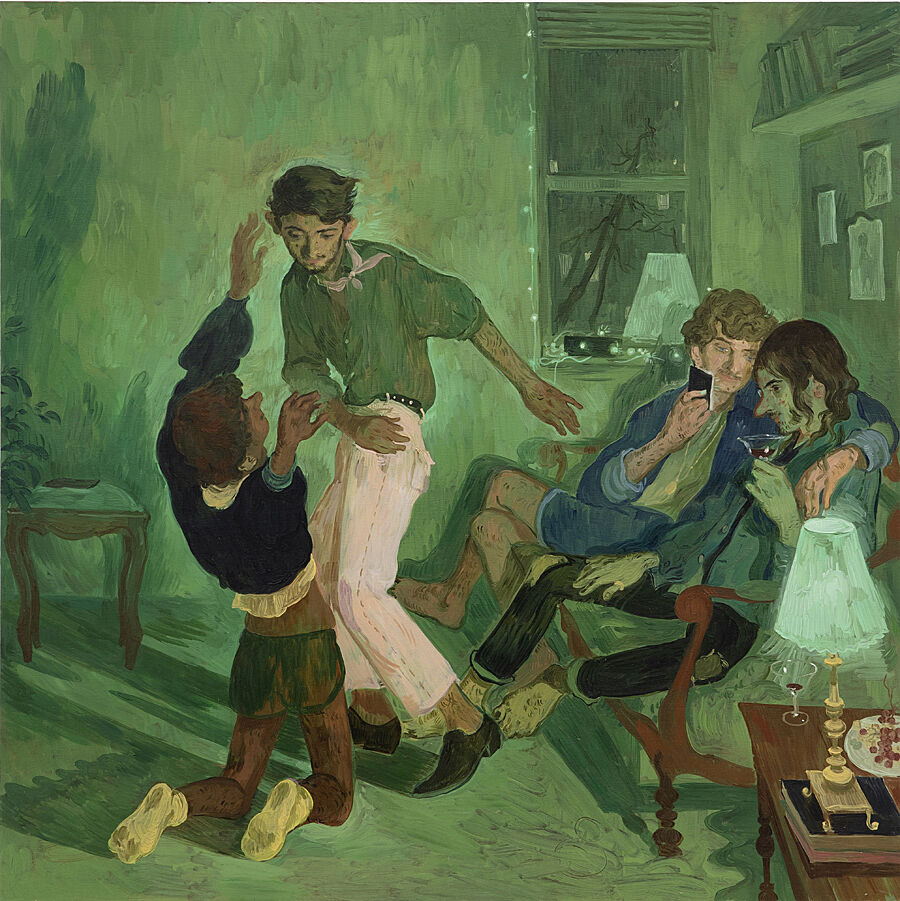
Salman Toor: How Will I Know
2020
“We took this title because, not only was it a song that I really like dancing to, but it also had a deeper resonance, thinking about the future.” —Salman Toor
Hear from Salman Toor about the work in the exhibition.
Salman Toor: My name is Salman Toor and I'm from Pakistan. I am a figurative painter. I had done a painting called Dancing to Whitney about two years ago. I was imagining that the characters in the painting were dancing to this song, "How Will I Know?" When we decided to do this show, we took this title because, not only was it a song that I really like dancing to, but it also had a deeper resonance, thinking about the future.
Narrator: Toor lives and works in New York City, but many of his paintings depict in-between settings.
Salman Toor: There's a lot of dancing in a lot of my paintings. I moved from a conservative place into this ultra-free, urban culture here. So the paintings also move between being fantasies of free space and more constricted, inner spaces that people inhabit when maybe they're crossing national borders and they’re forced to reckon with a reduction of what their identity might mean to a gatekeeper who might have to decide whether these individuals should be allowed to cross or not. And I think they're also ultimately linked to my idea of myself.
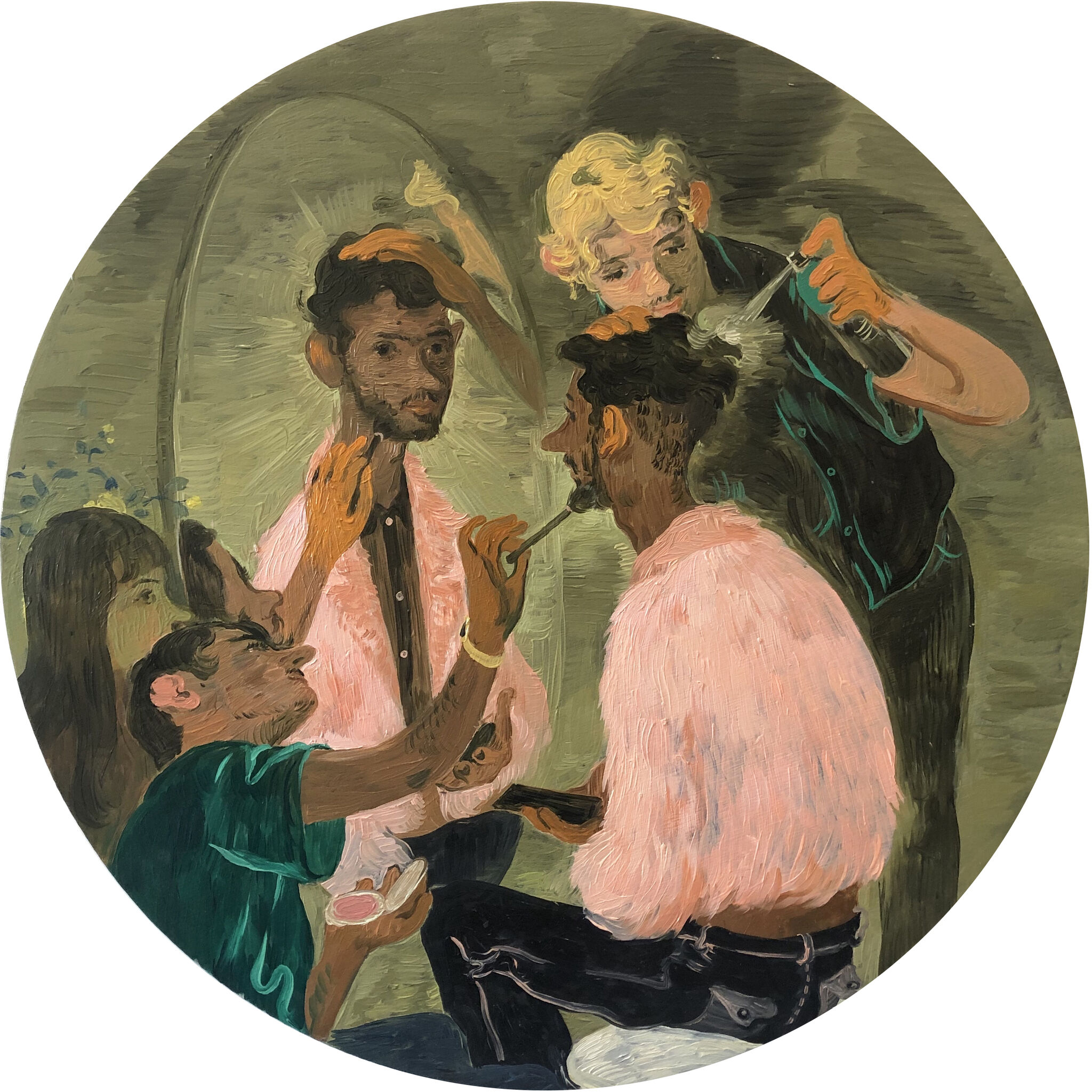
Salman Toor: This one's called The Star, and it’s a comedy picture about vanity.
I want to play with the idea of feminine men, what is traditionally considered to be feminine in this culture, and kind of accentuating and celebrating that, but also having a sense of humor about it.
This person is just getting ready, I imagine, to get out on stage on a late night show or some fashion show or whatever. And there’s a person in power admiring themselves or maybe not so sure of themselves, and they have makeup artists who are sort of like ladies in waiting helping them to prepare themselves. And it's a kind of backstage scene.
I wanted to kind of play with the idea that this hairy guy, skinny, with a unibrow is having a conversation with the current ideas of beauty in this culture and to be prepared, to be made empowered by these collaborators who are multi-ethnic people. And, you know, they're helping him to be his best self.
Salman Toor, The Star, 2019. Oil on plywood, 24 × 24 in. (61 × 61 cm). Whitney Museum of American Art, New York; purchase, with funds from Graham Steele and Ulysses de Santi 2020.120. ©️ Salman Toor. Image courtesy the artist and Luhring Augustine
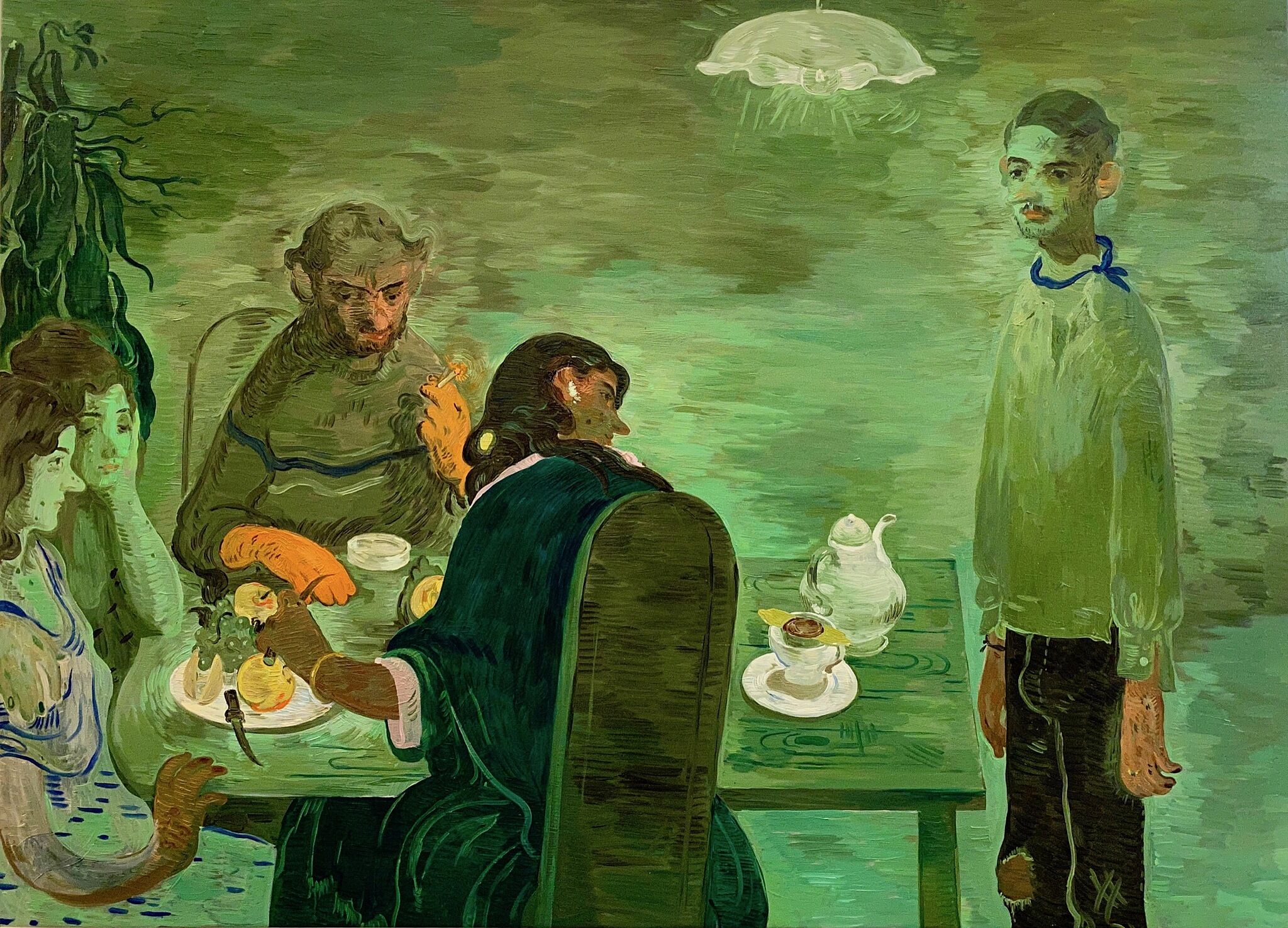
Narrator: Salman Toor draws inspiration from his own life, as well as from art history. Here, he uses still life painting and portraiture to play out an imagined family dinner. Salman Toor.
Salman Toor: It is an encounter and a negotiation—that's what I thought of it at least—between what I imagined was a conservative environment in conversation with an emancipated self.
Often in the paintings there is a very dramatic gesture, and in that instance I try to use the still life to be more expressive than the figures because there's so much communication that needs to happen sometimes between the figures, that I really give up on that idea and I use other things to speak more. The fruit, for me, was the most dramatic bit and I had a great time doing it because the rest of it was pretty straightforward. The fruit is inviting, and voluptuous, and the knife is threatening. I like to use that traditional language of painting to express these ideas.
Green is a completely aesthetic choice for me. I stumbled on it and what I liked about the idea of the color was that it was inviting and poisonous and glamorous. And it had a sense of ambience without being over-emotional.
Salman Toor, Tea, 2020. Oil on canvas, 42 × 57 in. (106.7 × 144.8 cm). Collection of the artist. Courtesy the artist
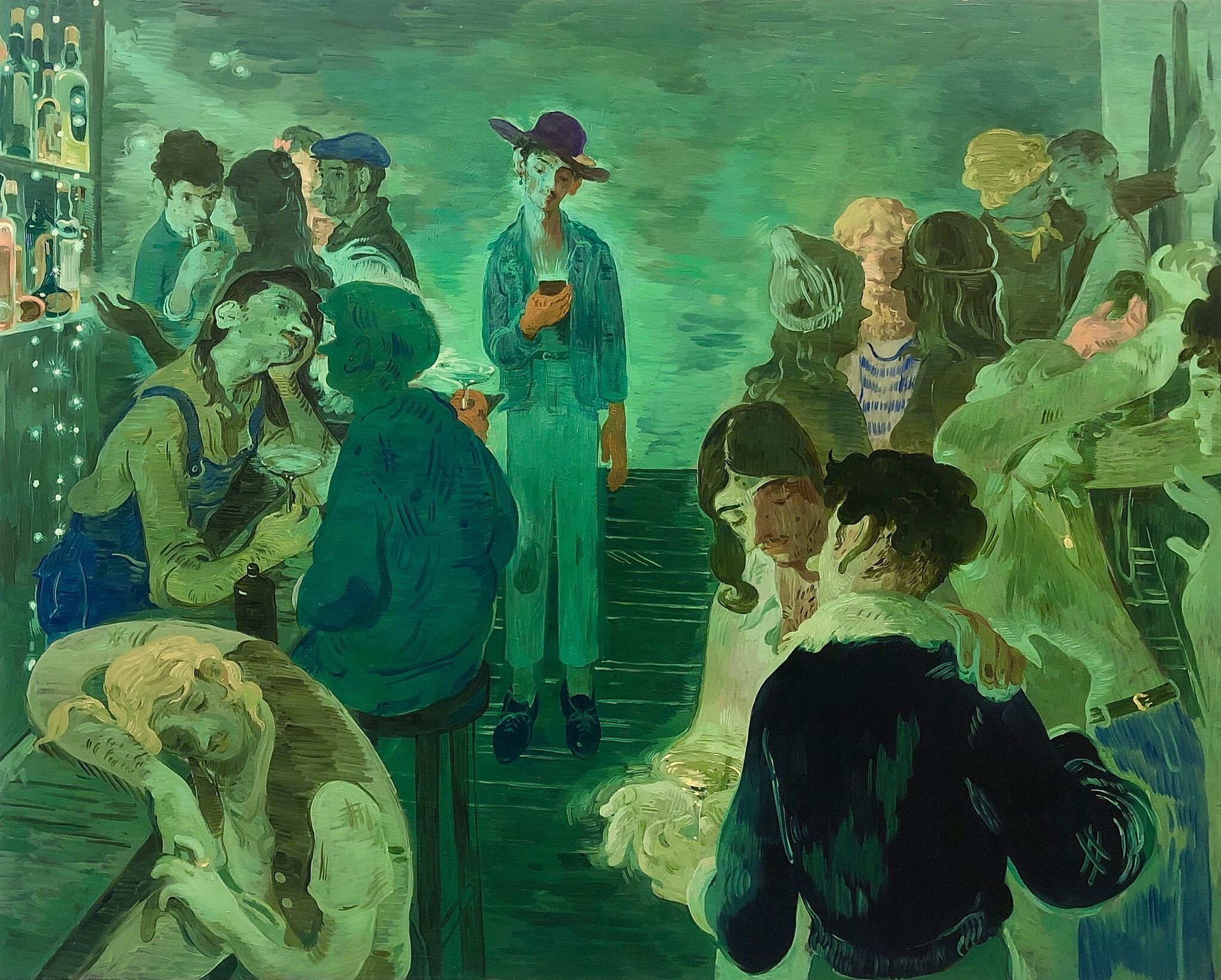
Salman Toor: The green bar paintings are like fantasies about, and also based on autobiography of my life living in the East Village.
I like using devices that light up dramatically and the phone does that for me. The idea of the portrait is so linked now to our gadgets, to our smartphones, we're constantly taking portraits of ourselves. But most importantly, I think, is the idea of the light.
Narrator: Toor emphasizes the fantastical quality of the scene by giving his characters gangly limbs and sloping posture. He describes these figures as marionettes.
Salman Toor: I really liked the idea of a marionette, the idea of a fairy tale-like language in which the nose and the hands are kind of cobbled together. It's the language of fairy tales, maybe Pinocchio, sort of characters that have complexity, but they're also a little bit wooden because they are made up of real lives, a lived life, and also tropes about ethnicity and community or place of origin. And the protagonist in the paintings kind of moves between being very free and empowered and also passive and maybe a little bit humiliated. And the marionette figure encapsulates those things for me.
Salman Toor, Bar Boy, 2019. Oil on plywood, 48 × 60 in. (121.9 × 152.4 cm). Whitney Museum of American Art, New York; purchase, with funds from John Auerbach and Ed Tang 2020.119. © Salman Toor. Image courtesy the artist and Luhring Augustine, New York
0:00
0:00