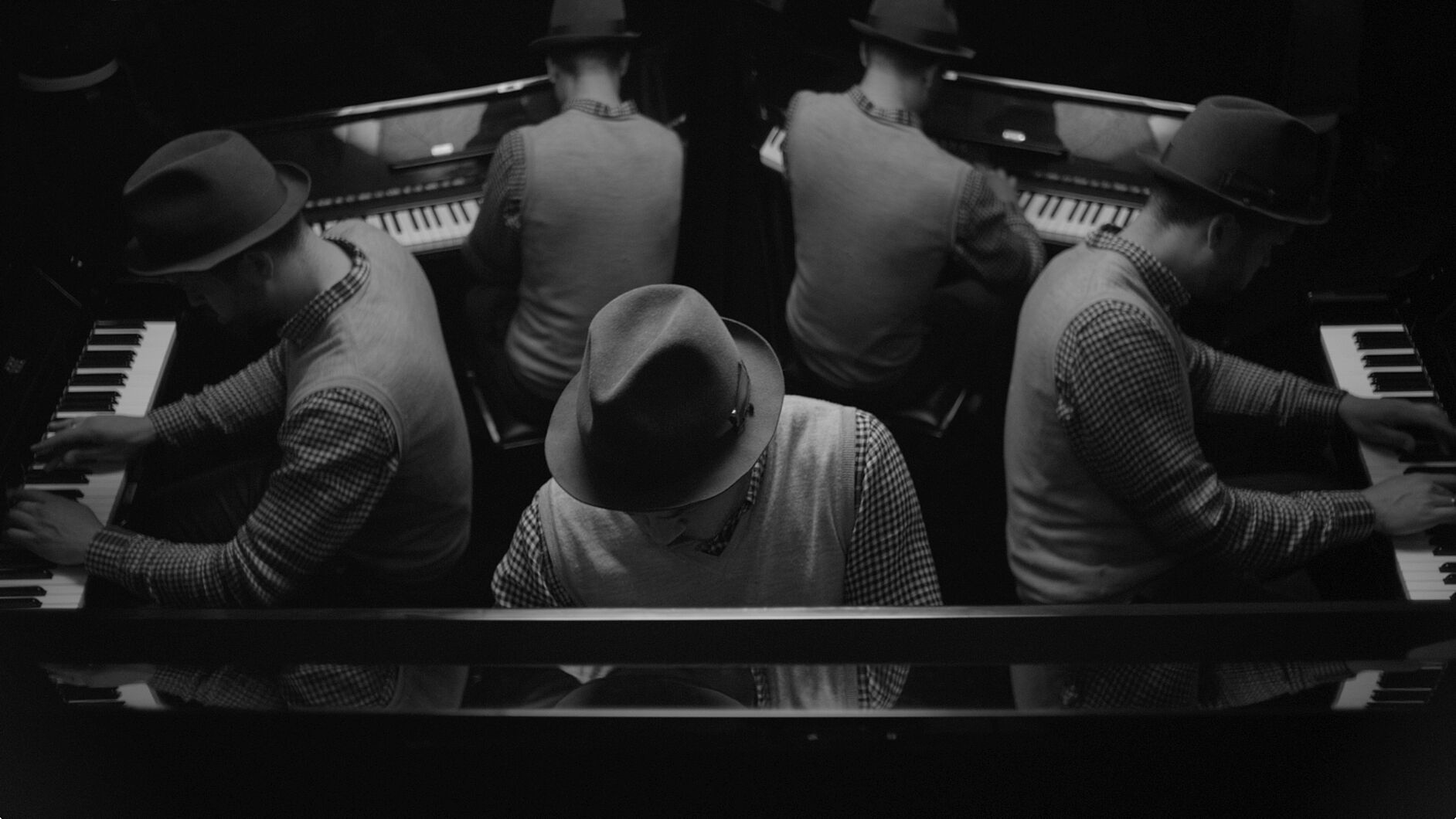
Jason Moran
2019
Find sound descriptions and transcripts of works with sound in this exhibition.
-
800
Transcription: Jason Moran and The Bandwagon, Excerpt from Milestone, 2005 and 2007
Transcription -
801
Transcription: Jason Moran and Joan Jonas, Antiphony, 2013
Transcription -
802
Sound Description: Ryan Trecartin and Lizzie Fitch, Excerpts from The Last Jazz Fest, 2018
Sound description -
803
Sound Description: Jason Moran and Lorna Simpson, Chess, 2013
Sound description -
804
Transcription: Adam Pendleton, Excerpts from The Revival, 2007
Transcription -
805
Transcription: Theaster Gates, Excerpts from Looks of a Lot, 2014
Transcription -
806
Sound Description: Kara Walker, National Archives Microfilm M999 Roll 34: Beaureau of Refugees, Freedmen and Abandoned Lands: Six Miles from Springfield on the Franklin Road, 2009
Sound description -
807
Transcription: Carrie Mae Weems, Lincoln Lonnie and Me—A Story in 5 Parts, 2012
Transcription -
808
Transcription: Joan Jonas and Jason Moran, Excerpts from They Come to Us Without A Word II, 2015
Transcription -
809
Sound Description: Theaster Gates, Looks of a Lot, 2014
Sound description -
810
Sound Description: Julie Mehretu, Excerpts from MASS (HOWL, eon), 2017
Sound description -
811
Transcription: Jason Moran and the Bandwagon with Ryan Trecartin, Lizzie Fitch, and Ashland Mines, The Last Jazz Fest, 2018
Transcription -
812
Sound Description: Jason Moran, STAGED: Three Deuces, 2015
Sound description -
813
Sound Description: Jason Moran, STAGED: Slugs’ Saloon, 2018
Sound description -
814
Sound Description: Jason Moran, STAGED: Savoy Ballroom 1, 2, and 3, 2015
Sound description -
815
Sound Description: Stan Douglas, Luanda-Kinshasa, 2013
Sound description -
816
Sound Description: Glenn Ligon, The Death of Tom, 2008
Sound description
Transcription: Jason Moran and The Bandwagon, Excerpt from Milestone, 2005 and 2007
Running Time: 4:27
Adrian Piper: It is only because of the defects in my personality that I can finally say this to you. I am protected and strengthened by my inadequacy. I am secure, smugly secure, for my personal flaws will constitute a more than adequate defense against whatever your response might be to what I have to say to you.
For my imperfection maintains an unbridgeable chasm between us. It protects us both from each other but, most importantly, me from you. The defect I have in mind is that I cannot love you, will never be able to love you. Where there might have been feeling there is only impersonal interest.
You hurt me and betrayed my trust and for that I will never forgive you. In fact, I would like nothing better than that you see yourself as I do, with the contempt that I do.
Because of you. There is a coldness in me, a suspiciousness towards you in all your guises, all your appearances. Because of you, I withhold my feelings for I could never trust you not to tread all over them.
I want you to realize what you've done and be really ashamed, ashamed of your conceit, your selfishness, your meanness, your insensitivity, understand the extent of your carelessness and hate yourself for it, regret even more than I do the real friend you might have had.
I might reason with you, share with you, even extend an offer of help or support. I might indulge with pleasure in lovemaking fantasies about you, but you will never elicit an emotional commitment from me. Take care that you ask of me no more than that we laugh together for you will be disappointed if you do.
After you, I found solace and friendships with men. After that I healed myself in solitude. Whatever regrets I feel about this are small to me now and readily transformed into anger and resentment towards you. As you well know, our enmity is ultimately your doing and your choice. Now I have learned to thrive on it. I must in order to protect myself and thus I alienate you in turn.
Our femininity itself can never again be a point of contact between us. I perceive that now you are no more capable of trusting me than I am of trusting you, and I cry for our mutual impoverishment. That at least we can share. But I insist again that this is your choice, your fault, not mine. I insist that, from the fact of my appearance, you jump to the wrong conclusion as you always do. You instinctively perceived me as the enemy and nothing I say or do is sufficient to change that. You punish me for how I look when that is both irrelevant and out of my control. You automatically assume that I neither need nor want your friendship nor would be willing to work for it even though you have no reason to think this, no reason to assume anything at all.
For if you had only given me the chance, I would have shown you where my loyalties lay, but you took me off guard once and it was very painful. I will never give you the opportunity to do that again. My defenses have solidified. There's nothing I can do. It sickens me to realize that I've grown incapable of overcoming the distance between us. I hate you for doing this to me and myself for allowing it to happen.
Transcription: Jason Moran and Joan Jonas, Antiphony, 2013
Running Time: 4:56
Jason Moran: I met Joan in 2005. She finds my name in the phone book and calls me on the phone. I pick up the phone and she says, "This is Joan Jonas and I'm working on a performance for Dia: up in Beacon." She was like, "would you want to work with me?" I was like, "yes." So we worked on this piece called The Shape, the Scent, the Feel of Things. It was an entree into a different world through her and through Adam Pendleton. They brought me to this other space, contemporary performance culture, contemporary aesthetics, all things I had never thought about as a jazz musician.
When we first started working, it was very hard because I didn't know what she wanted and also I didn't go see a lot of performance art, so I also didn't know what the sonic aesthetic of it should be. I don't want to be—you have to check me out at the places that I play, too.
Joan Jonas: What do you mean?
Jason Moran: I don't want to be overly sentimental.
Joan Jonas: No, no, no, that's the point.
Jason Moran: Yeah, my tendency is to go there.
Joan Jonas: You know that concert, the one I liked that you did on the Lower East Side, [unintelligible] if you play like that more.
Jason Moran: Right.
Joan Jonas: You know what I mean? Don't feel romantic about the landscape.
Jason Moran: Okay.
Joan Jonas: I'd like it to be tougher.
Jason Moran: All right, thank you.
Very clearly, the first time we improvised together, she kind of I say danced but moved and I played and I was like, "Oh, this is like working with the greatest jazz musician I know."
From working with Joan, really what happens is it may come across as so loose but it's highly choreographed and it's—how do you achieve that? How do you blend those lines between showing exactly what every outline of the space is or phrase and knowing how to make things really come together as one thing? One big idea that you could focus on rather than the individual parts.
Did you hear it?
Jason Moran: Did you hear it? It's very subtle.
Speaker 1: Can you just decide when you're done?
Joan Jonas: Make sure to do a sound signal. I think Jason should time it.
Jason Moran: That, too.
Speaker 1: Yeah.
Joan Jonas: Because I'm no judge of how interesting it is for how long.
Jason Moran: Coming from this sound, it goes down and goes up many times and then I also play here. I feel like next time we do it then I'll be conscious of the time.
Joan Jonas: It's better if we don't try to exact because then it'll look wrong. Just think of the idea like this, we're totally involved in this and we don't know where we are and all of a sudden it changes and we're still doing it.
Jason Moran: Right.
Joan Jonas: And that's okay.
Jason Moran: Right.
Joan Jonas: Because in the next sequence there's so much time.
Jason Moran: And I trust Joan in these spaces. I trust Joan to also allow me to play what she thinks I need to play. She would many times say, "Oh Jason, you have to play, too." Like she only says that [unintelligible] because she wants to hear me play and she always says, "I get way more inspiration from listening to your music than ever looking at my [unintelligible]." So she's like, "I need you to play. Don't feel like you have to end or start. Just be in it." You know, those reminders are good to hear.
Joan Jonas: And the thing is that you don't have to reflect what you think [unintelligible].
Jason Moran: Right.
Joan Jonas: I mean people are coming to hear you and to see the whole thing but they're going to listen to you. So what you should do is—I'm going to also respond to you.
[Interlude: Running Time: 4:26]
Sounds include: moments of music interspersed with silence.
Sound Description: Ryan Trecartin and Lizzie Fitch, Excerpts from The Last Jazz Fest, 2018
Running Time: 5:27 and 4:46
Sounds include: multiple distorted voices echo. Syncopated beats grow in volume and reverberation. Digital reverberation gives way to melodic piano playing.
Sound Description: Jason Moran and Lorna Simpson, Chess, 2013
Running Time: 10:05
Sounds include: piano music.
[Interlude: Running Time: 7:55]
Transcription: Adam Pendleton, Excerpts from The Revival, 2007
Running Time: 4:38
Speaker 1: First, there was the bailiff, and we broke the bailiff. And then there was God, and we broke God. And lastly, there was cock, and we broke that too, freed the ground, freed religion, freed the body, and went up this hill, standing together, naked like the old female pack, growing to eat but not to market. The three days' labor that we gave to the priests, we gave instead to the hungry, turned the tithe barn into a hospital, and we found cunt beautiful. What they had hidden and suffered shame for, its lovely shapelessness, its color, all miraculous. What they had done, made dirty, or worshiped out of ignorance, do we now.
I said first, there was the bailiff, and we broke the bailiff. And then there was God. I said and then there was God, and we broke God. And lastly, lastly, lastly, there was cock, and we broke that, too. I said there was cock, and we broke that, too. We freed the ground. We freed religion. We freed the body. The three days' labor that we gave to priests, we gave—I said we gave instead to the hungry. The tithe barn into a hospital, and we found cunt beautiful. That, we had hidden and suffered shame for, its lovely, its lovely shapelessness, its color, its color, all miraculous. What they had made dirty, or worshiped out of ignorance, do we now.
Transcription: Theaster Gates, Excerpts from Looks of a Lot, 2014
Running Time: 5:52
Jason Moran: For me, the real tense moment is when the students walk by the music stand playing Faith's Fade. So, from seeing the stands, how do we place the stands in a way that gives them enough?
Theaster Gates: And they're on casters.
Jason Moran: Right. Oh, so they move easily?
Theaster Gates: Yeah.
Jason Moran: The students, could be right here, or they could be like this.
Theaster Gates: Yep.
Jason Moran: I'm saying this as I don't know.
Theaster Gates: There's nothing about our collaboration that has to scream, "He did this," or, "He did that," or she, right?
Jason Moran: Yeah, yeah.
Theaster Gates: You know.
Jason Moran: I'm making my things.
Theaster Gates: [unintelligible]
Jason Moran: This is a real simple part of the melody. The students will play this song too. I'm making a long…like a long...
Theaster Gates: Do you imagine winding this yourself? I'm asking because it's another way of playing music, you know? But the function is different. Your function is different.
Jason Moran: Yeah. When you showed me the long stands, this is a long sheet of music that goes on it.
Theaster Gates: Yes.
Jason Moran: But that first pass, it's a viewing?
Theaster Gates: Yeah.
Jason Moran: Like a viewing.
Theaster Gates: Yeah, like a burial. Like a—
Jason Moran: Yes. Yeah.
Theaster Gates: Like a funeral pass.
Jason Moran: So the next time we pass it, and they read the piece that's on the stand as they walk by.
Theaster Gates: Come on. Come on.
Jason Moran: Because I'm going to have the kids walk by. [unintelligible] kids want to go see other kids' funeral and shit, you know?
Theaster Gates: Yeah.
Speaker 1: Chicago.
Theaster Gates: And, you know, so much of this, our sense of what a blues is, so much of it has to do with like mourning, redeeming, mourning, redeeming, mourning, redeeming the mourning moment. And if there's a way that redemption is built into the mourning moment, like at the repass, new emotion is being born in that moment. Like, some of the best wailing I've ever heard was at funerals, because it's only death that can get you to a certain place. Stick it between [unintelligible]
Jason Moran: Yeah. Then I've gotten up. Then I walk.
Theaster Gates: And then you can say some names.
Jason Moran: Yeah.
Theaster Gates: Yeah.
Jason Moran: [unintelligible]
Theaster Gates: Sing some names. [singing]
Jason Moran: Yeah.
Theaster Gates: [singing]
Jason Moran: Yeah.
[piano]
Theaster Gates: [singing] [unintelligible] ...over and over again. Then there was Oscar, and Kelly, and [unintelligible] and there was...there was...[unintelligible]...children...[unintelligible]...many, many, many...there was [unintelligible] and [unintelligible] and lil’ John and there was Kiki and Kiki had a smile, it was so Kiki and Kiki was smiling, she was—she could make us [unintelligible]...Kiki...Kiki...
[Interlude: Running Time: 6:01]
Sound Description: Kara Walker, National Archives Microfilm M999 Roll 34: Beaureau of Refugees, Freedmen and Abandoned Lands: Six Miles from Springfield on the Franklin Road, 2009
Running Time: 13:21
Sounds include: piano music, cricket sounds.
[Interlude: Running Time: 8:36]
Transcription: Carrie Mae Weems, Lincoln Lonnie and Me—A Story in 5 Parts, 2012
Running Time: 18:08
[singing] [unintelligible]
Speaker 1: Four score and seven years ago our fathers brought forth on this continent a new nation, conceived in Liberty, and dedicated to the proposition that all men are created equal. Now, we are engaged in a great civil war, testing whether that nation, or any nation so conceived, so dedicated, can long endure.
We are met on a great battlefield of that war. We have come to dedicate a portion of that field, as a final resting place for those who gave their lives, that the nation might live.
In a larger sense, we cannot dedicate, we cannot consecrate, we cannot hallow this ground. The brave men, living and dead, who struggled here, have consecrated it, far beyond our poor power to add or to detract.
The world will not [unintelligible], nor long remember what we say here, what we say here, what we say here. But it will never forget, it will never forget, it will never forget, what they did here. It is for us, the living rather, to dedicate here to the unfinished work which they who fought here have thus far, thus far, thus far so nobly advanced.
It is rather for us to be here, dedicated to the task remaining before us, the task before us. That from, that from these honored dead, we take increased devotion to that cause for which they gave the last full measure of devotion. That we here, highly resolve that these dead should not have died in vain. That this nation, under God, shall have a new birth of freedom and that government of the people, by the people, for the people, should not perish from this earth.
[singing]
Speaker 2: If you're speaking is only certain situations…When, I understand…I generally go into a situation knowing there's no change that'll happen.
At this particular point in my life I…And that's why that particular story about the book was so pivotal, because I knew at that particular point that there was no way that I was going to be able to engage any individual if they had these preconceived notions in their mind.
So, at that point it became like you said, it was really an issue of management. So, because I really understand that there's no change, it's really an issue of management.
The curtains won't pull apart. A lightning bolt could come from the sky. The light bulb won't illuminate above that person's head.
It's really an issue of management.
Nothing necessarily is going to happen to make a person have any kind of radical change because what they know and what they understand is so deeply rooted.
It's really an issue of management.
In their person and their society.
I may contribute to some level of another kind of understanding they might have but I've given up serious hopes of making any sort of sweeping change or augmenting any particular person's perception of one particular group or another.
[singing]
Speaker 3: Stay nice and loose.
Speaker 4: He's hurting on [unintelligible]. You've got to avoid that hand.
Speaker 5: I'm all right. Yeah. Yeah, I can continue. I can get hit by that again. All right. You should come out hard, block.
Speaker 4: That's it. Cover up, cover up. He's coming in. Just count on the rocks [unintelligible]. That's it, right there. Now you slip and slide, now you slip and slide. That's it.
And when he throws a hard right, slip a—That's it, now he's off you, now he's off you. Keep them jabs on him, keep them jabs on him. I'm scared, he's scared. Keep that popping, keep that popping, keep that popping. Keep on thinking of something to do. That's it. He don't want to throw no punches now. Now who's scared? Now who's scared?
[silence]
[singing]
Speaker 6: I was with you. I have seen you for a long time and I know you. I know you. And I'm going to get you. I'm going to take you. I'm going to take these hands and I'm going to [unintelligible]. I'm going to kill you. Then I'm going to [unintelligible] you because I know you. [unintelligible].
You don't believe me? Huh? No, you don't believe me, do you? But I'm going to take you and I'm going to break you. I'm going to destroy you because I want you to feel the suffering that I know. It's not going to be pretty.
Revenge is a motherfucker.
[singing}
[Interlude: Running Time: 4:26]
Transcription: Joan Jonas and Jason Moran, Excerpts from They Come to Us Without A Word II, 2015
Running Time: 3:55
[piano music]
Joan Jonas: It asks of man, is your harvest in? The oats, the hay, the feed for the herd? The potatoes, the cabbage, the turnips and all? Are they dug and stored in your cellar, warm and dry? Is your house patched up against the winter? With the sills bagged round, where the cold seeps in? Have you harnessed the horses and gathered the maple, the long white oak and the occasional ash, cut in the hot months of summer? Against the time when the woods will be waist deep with snow, and bows bent down and saddened by their heavy load. Is your barn mended against the dampness of the winter, when the cold will try the best it can to seep in and blacken the hay?
Sound Description: Theaster Gates, Looks of a Lot, 2014
Running Time: 9:15
Sounds include: Jason Moran playing a music box. Theaster Gates sings. Band plays. Applause.
[Interlude: Running Time: 5:59]
Sound Description: Julie Mehretu, Excerpts from MASS (HOWL, eon), 2017
Running Time: 7:54
Sounds include: A horn, drums, and keyboard move melodically through a scale with embellishments. Cut to a percussive and feverish trio. Cut to a trio that favors trance-like repetitive progressions and sustained sounds. Cut to an indistinguishable yet sentimental melody.
Transcription: Jason Moran and the Bandwagon with Ryan Trecartin, Lizzie Fitch, and Ashland Mines, The Last Jazz Fest, 2018
Running Time: 4:59
[piano music]
Speaker 1: [singing]
Speaker 2: Come on, now. [singing]
Speaker 3: The last solo, the last ballad, the last applause, the last chorus, the last fee, the last rhythm changes, the last blues, the last intro, the last trading, the last jazz brunch, the last dollar, the last tour, the last fest, the last brochure, the last flyer, the last meet-and-greet, the last catfish, the last spring, the last acts, the last sub, the last promoter, the last rehearsal, the last cool, the last swing, the last fusion, the last big band, the last combo, the last road trip, the last shitty gig, the last train wreck, the last lesson, the last dues, the last double bill, the last line check, the last sound check, the last load-in, the last coda, the last driver, the last house.
The last CD signing, the last back line, the last drink, the last drink ticket, the last plus-one, the last subtitle, the last time, the last background, the last cast, the last chart, the last arrangement, the last formal, the last tuxedo gig, the last livestream, the last gank, the last pay, the last stretch, the last lesson, the last sub, the last piano solo, the last head, the last tab, the last brain, the last brunch, the last flute solo, the last [unintelligible], the last road trip, the last stop time, the last time, the last jazz fest. [singing]
Sound Description: Jason Moran, STAGED: Three Deuces, 2015
Running Time: continuous
Sounds include: Piano music ranging from upbeat to melancholy at various tempos.
Sound Description: Jason Moran, STAGED: Slugs’ Saloon, 2018
Running Time: continuous
Sounds include: Piano music ranging from upbeat to melancholy at various tempos.
Sound Description: Jason Moran, STAGED: Savoy Ballroom 1, 2, and 3, 2015
Running Time: continuous
STAGED: Savoy Ballroom 1, 2015
Running Time: 00:51:52
Sounds include: a chorus of singing voices and tools hammering in unison. The sounds echo, cutting in and out in intervals.
Savoy Ballroom 2, 2015
Running Time: 00:07:45
Sounds include: a chorus of voices swirl together, singing a wavering, melancholy melody.
Savoy Ballroom 3, 2015
Running Time: 01:06:58
Sounds include: a chorus of singing voices and tools hammering in unison. The sounds echo, cutting in and out in intervals. At one point, the chorus and tools interweave with a high-pitched, singing voice.
Sound Description: Stan Douglas, Luanda-Kinshasa, 2013
Running Time: 58:35
Sounds include: Jason Moran and other musicians play music.
Sound Description: Glenn Ligon, The Death of Tom, 2008
Running Time: 23:00
Sounds include: piano music
0:00
0:00