The Face in the Moon: Drawings and Prints by Louise Nevelson
2018
Hear from curatorial assistant Clémence White with recordings from Louise Nevelson about select works from the exhibition.
Clémence White: Hello, I am Clémence White and I'm a Curatorial Assistant at the Whitney Museum and I curated this exhibition of works on paper by Louise Nevelson.
Narrator: Louise Nevelson is best known for large sculptures made of wood—often foraged from her everyday surroundings—that she would paint all black or all white. Throughout her career, Nevelson aimed to give her artworks lifelike qualities.
Louise Nevelson: My figures would move as if they were real people. Even if they were abstract, they would move.
Narrator: Nevelson was born in 1899 to a Jewish immigrant family that settled in Maine. She insisted that she wanted to be an artist from a young age. Nevelson’s gallerist, Arne Glimcher, recorded this interview with her in 1972.
Louise Nevelson: I went to the library with another little girl in my class. And I recall the librarian, said to the little girl "What are you going to do when you grow up?" as they always ask and I think the little girl said that she was going to be a stenographer or a bookkeeper. The she asked me what I was going to do I said, "I'm going to be an artist."
Narrator: This show is organized chronologically, and shows how the artist rendered volume and depth across an array of two-dimensional media. The earliest drawings are to your left, across from the staircase.
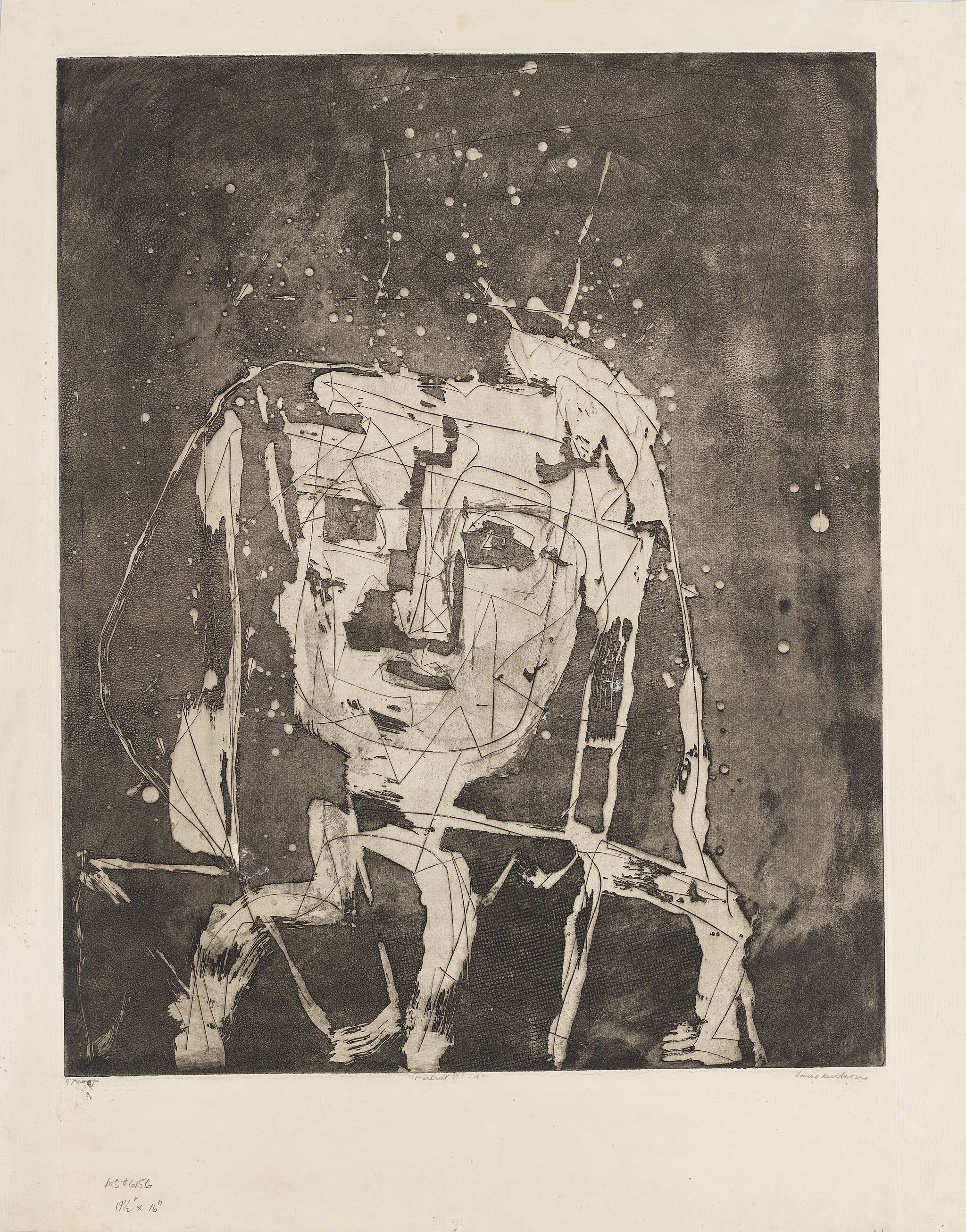
Louise Nevelson, Portrait, 1953-55. Aquatint and etching: sheet, 24 1/8 × 19 1/4 in. (61.3 × 48.9 cm); plate, 19 5/8 × 15 7/8 in. (49.9 × 40.3 cm). Whitney Museum of American Art, New York; gift of the artist 69.242. © 2018 Estate of Louise Nevelson/Artists Rights Society (ARS), New York
Narrator: Nevelson moved to New York in 1920, and began studying at the Art Students League soon after. Clémence White describes the context in which the artist made her early drawings.
Clémence White: She was taking formal art classes at the Art Students League and, teaching art herself, employed by the Works Progress Administration, and was part of a broader community of artists.
These works are really important to understand Nevelson's practice because her mastery of drawing would prove essential to how she built composition in her later works on view in this exhibition and in her sculptures.
Narrator: Nevelson would later move on to explore volume and form with geometric sculptural shapes, but these early works show her portraying depth through using the human body instead.
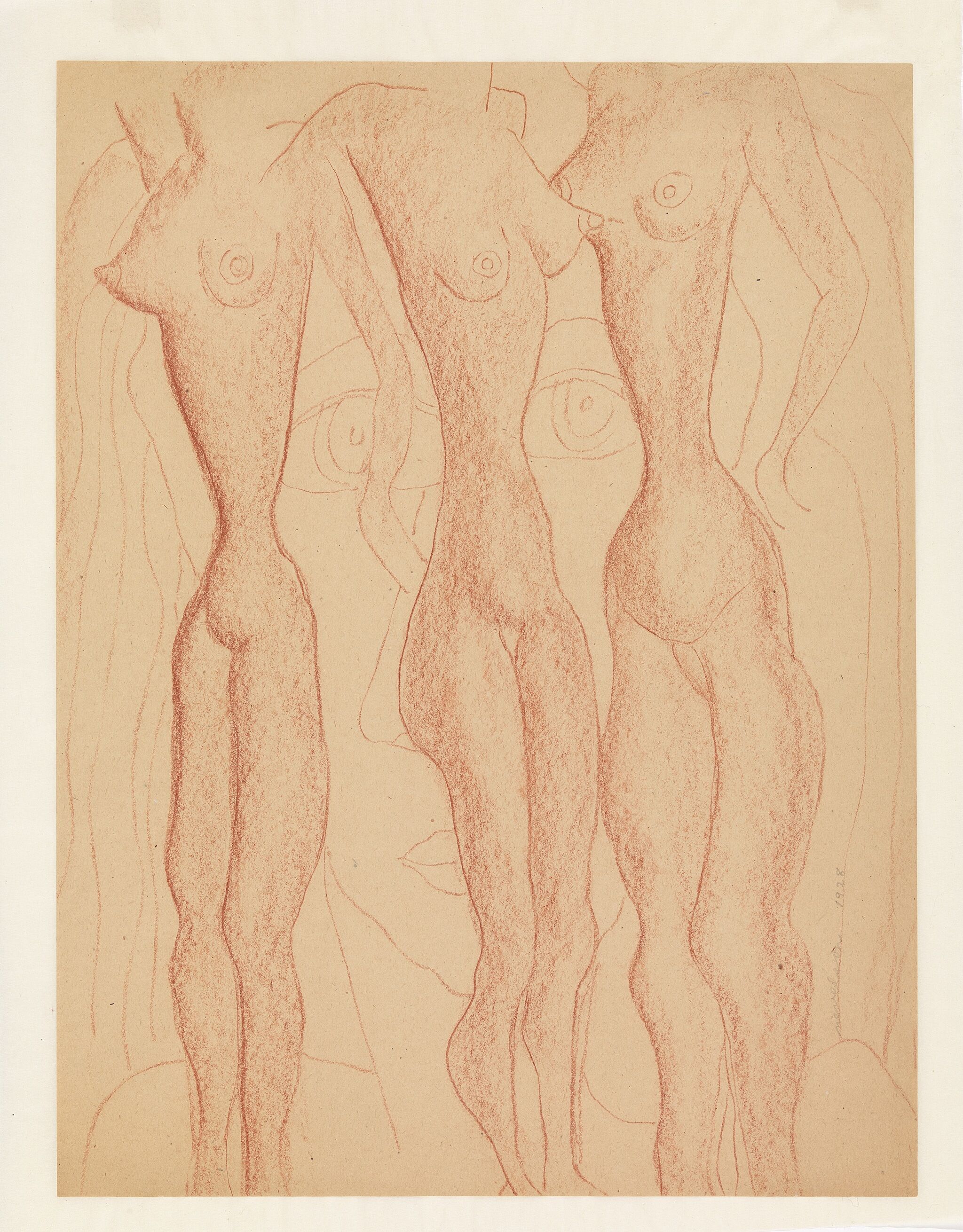
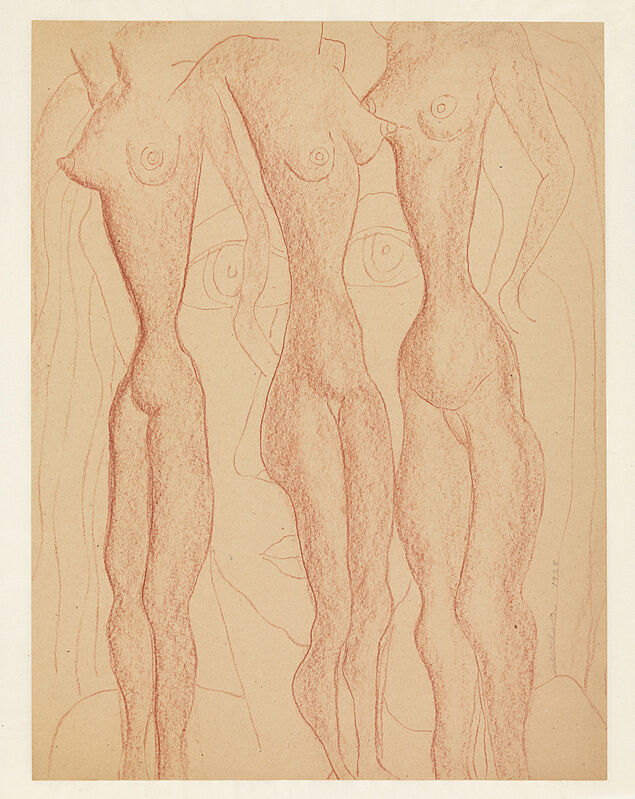
Clémence White: She is working in these drawings depicting mostly figurative imagery and, using the line to different effect, was interested in the way that a single line could contain and create many forms.
Louise Nevelson, Untitled, 1928. Fabricated red chalk on paper: sheet, 17 5/8 × 13 3/8 in. (44.8 × 34 cm); mount: 19 9/16 × 15 1/2 in. (49.7 × 39.4 cm). Whitney Museum of American Art, New York; gift of the artist 69.220. © 2018 Estate of Louise Nevelson/Artists Rights Society (ARS), New York
Narrator: This group of works was made at Atelier 17, a European avant-garde printmaking studio that relocated from Paris to New York in 1940. There, Nevelson began using increasingly experimental techniques.
Clémence White: She's making these in a distinctly spontaneous and gestural manner. A lot of the works she was printing herself. She was noted for the lack of precision in her approach and is working in a kind of freer manner in how she's making these works.
Narrator: Clémence White.
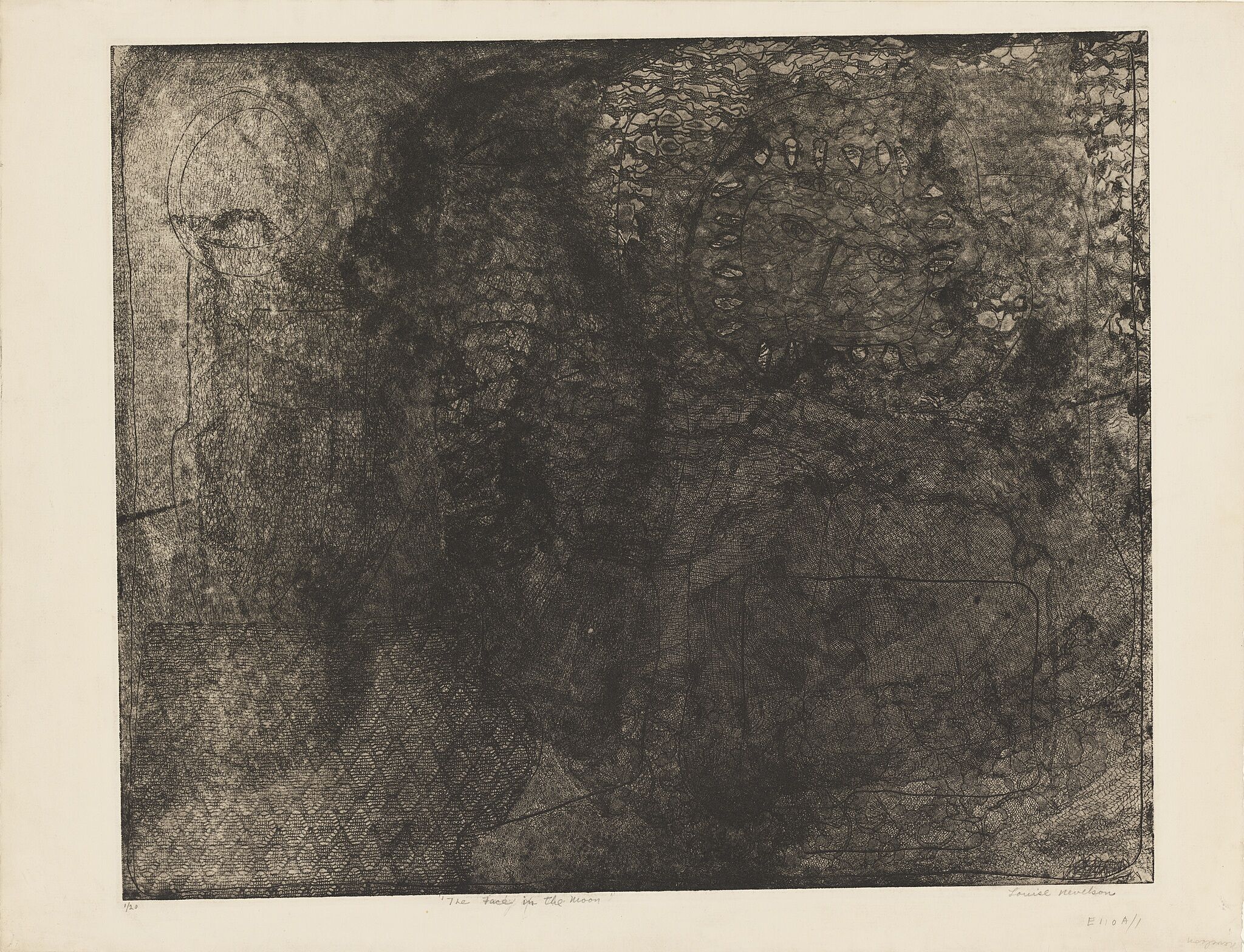
Clémence White: In this work, The Face in the Moon, after which the exhibition is named, a face appears in the top right corner, peering through this very densely textured fabric. Nevelson was largely uninterested in the precision demanded of printmaking.
Narrator: The printmaking process of etching can be exacting. Marks made cannot be easily undone. Nevelson’s refusal to treat this process preciously, as well as her inclusion of found materials, makes these prints stand out. Using an intentionally fluid process allowed her to freely explore new ideas—in a voice all her own.
Louise Nevelson, The Face in the Moon, 1953-55. Etching: sheet, 20 × 26 1/16 in. (50.8 × 66.2 cm); plate, 17 7/8 × 21 5/8 in. (45.4 × 54.9 cm). Edition 1/20. Whitney Museum of American Art, New York; gift of the artist 69.247. © 2018 Estate of Louise Nevelson/Artists Rights Society (ARS), New York
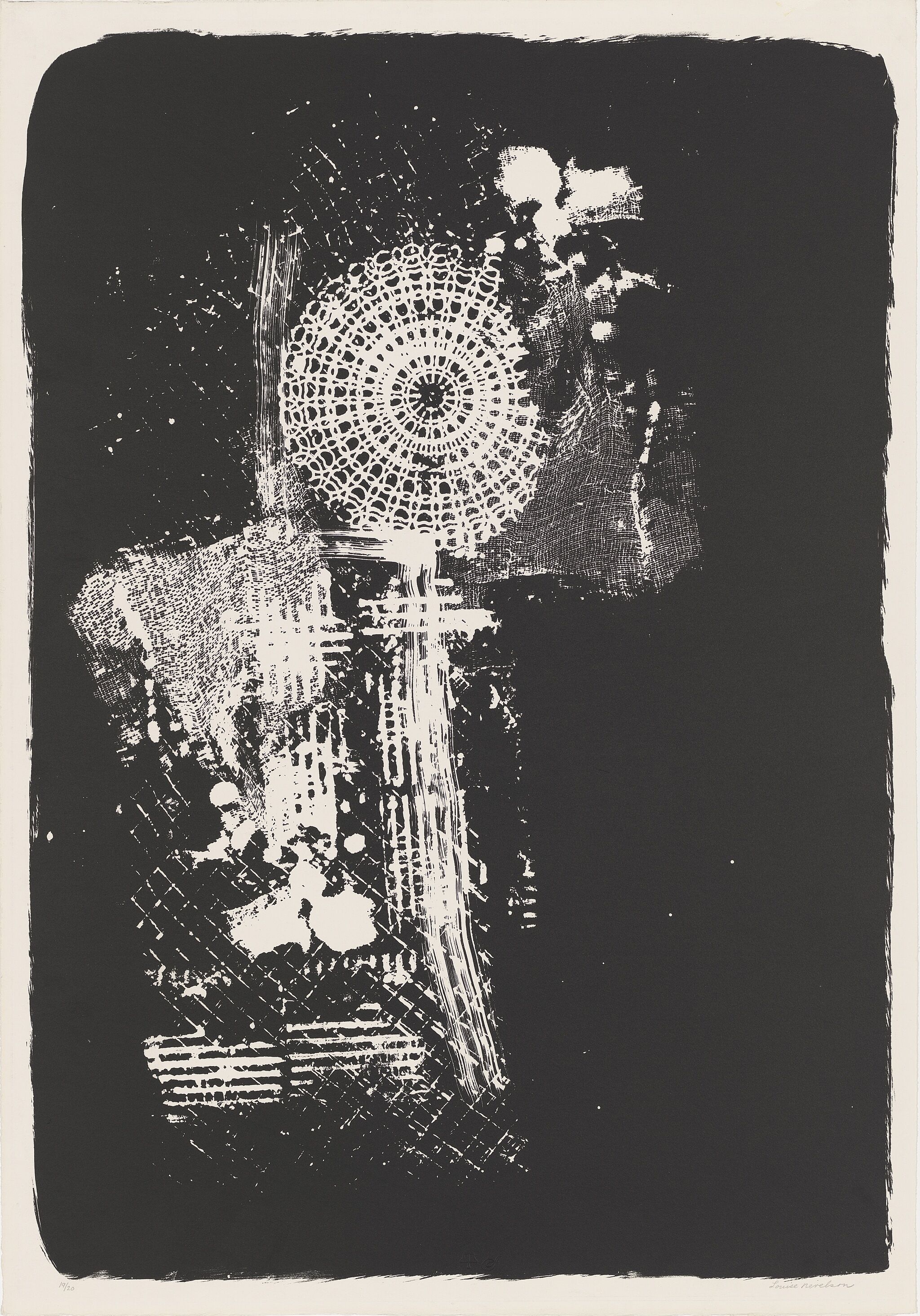
Narrator: In 1963, Nevelson was invited to the Tamarind Lithography Workshop, a printmaking studio in Los Angeles.
Clémence White: Her imagery is entirely abstract at this point. She's really interested in the relationship between light and shadow and in depicting light. I think these look almost like a flash photograph. Her sculptures are entirely black, white, and then later in her career, gold.
Narrator: Throughout her career, Nevelson chose to restrict herself to working in these extreme tones. Louise Nevelson.
Louise Nevelson: I don't want color to help me. And I think that is the key to my life. That has been the key. Why I chose the hard way I don't know.
Louise Nevelson, Untitled, 1963. Lithograph: sheet, 34 × 23 9/16 in. (86.4 × 59.8 cm); image, 32 1/8 × 22 1/4 in. (81.6 × 56.5 cm). Edition 19/20. Whitney Museum of American Art, New York; gift of the artist 69.253. © 2018 Estate of Louise Nevelson/Artists Rights Society (ARS), New York
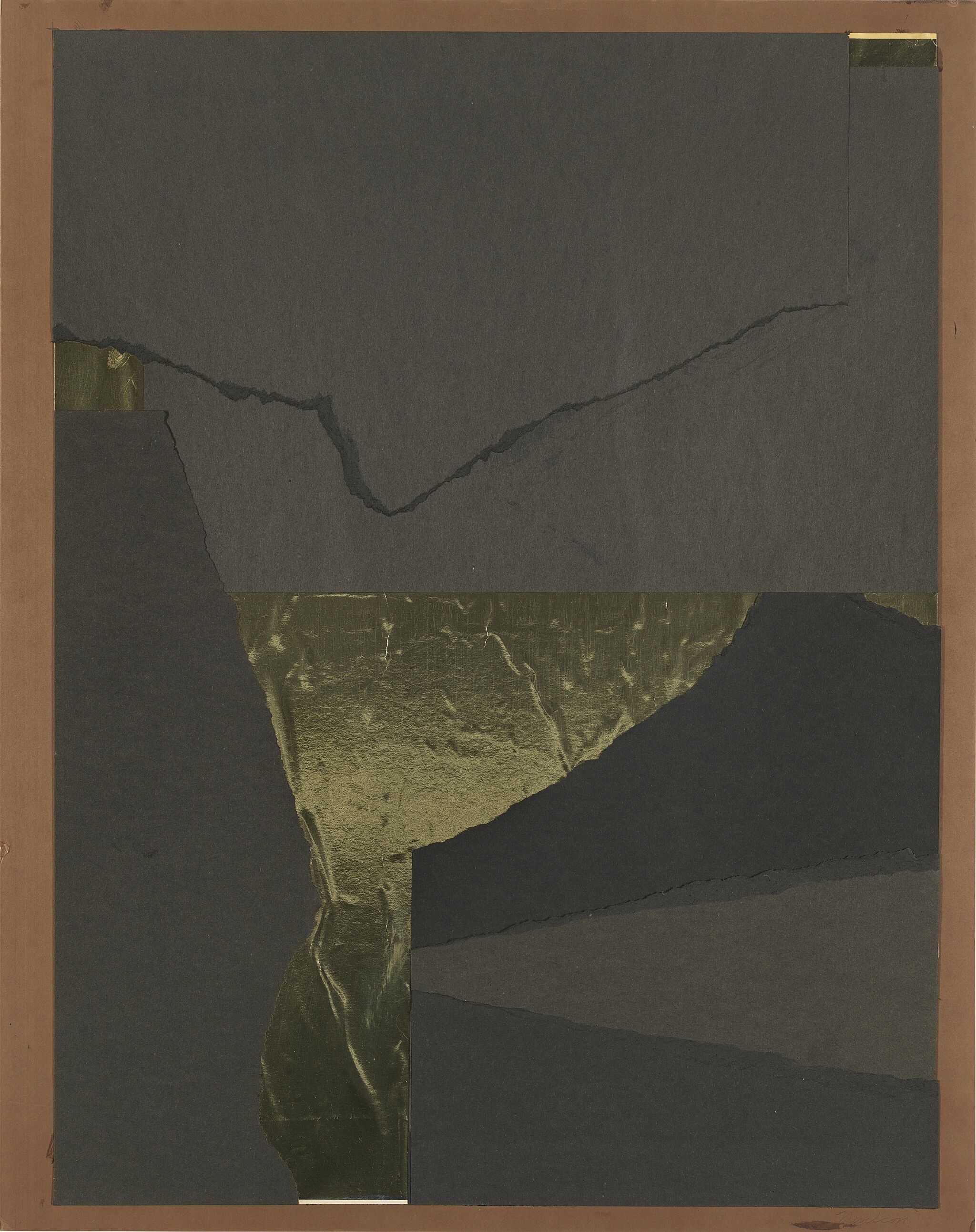
Narrator: Look closely at this collage. In the center, there is small piece of silver visible. Clémence White talks about the materials Nevelson included in these works, which were made later in the artist’s career.
Clémence White: The collage has a square of silver foil on it. She's using a stamp from a film company to create texture, but also is imprinting the logo of this film company onto the foil. She's really thinking about all of her materials as divorced from the context in which they exist. No material was too lowly for her. And she was really interested in giving this other life to discarded objects.
Narrator: In these collages, Nevelson put old works of her own side by side found materials. In doing so, she asks us to consider the power that everyday objects have to transport us. Nevelson describes how she felt upon returning to New York after a trip abroad.
Louise Nevelson: I returned to America and New York and I'd got into the subways. The columns in the subways are black iron. And for me, personally, they certainly had as much meaning, and in form as well as many of the things that are in museums. I didn't make that distinction, for me. And they still have that power and they still are grand and glorious.
Louise Nevelson, Untitled, 1974. Paper and metal foil collage on board, 27 13/16 × 22 1/8 in. (70.6 × 56.2 cm). Whitney Museum of American Art, New York; gift of Jean and Howard Lipman 97.113.6. © 2018 Estate of Louise Nevelson/Artists Rights Society (ARS), New York
0:00
0:00