
Jimmie Durham: At the Center of the World
2017
-
500
Introduction
Audio -
501
On Loan from the Museum of the American Indian, 1985
Audio
-
502
Pocahontas’ Underwear, 1985
Audio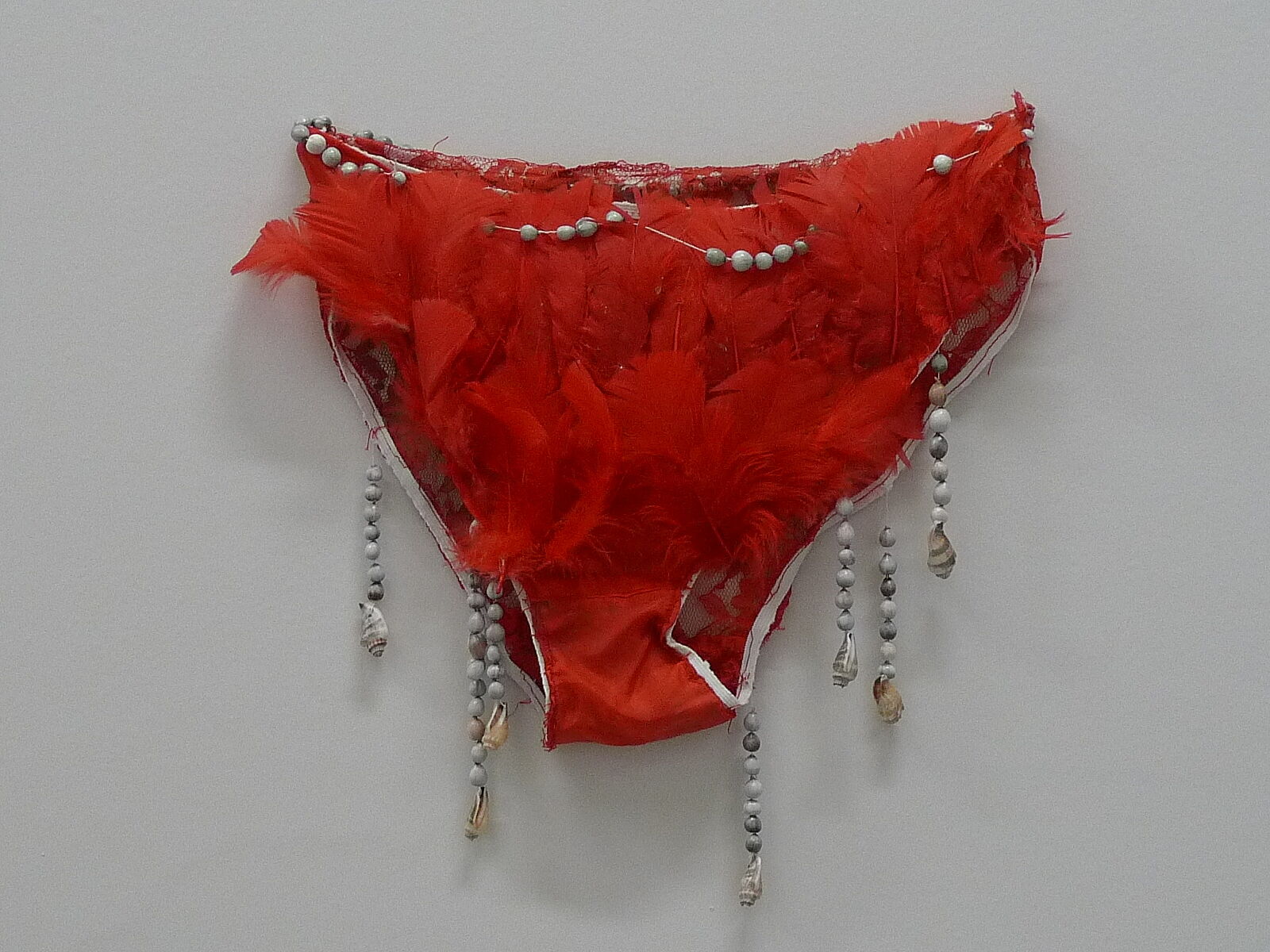
-
503
Types of Arrows, 1985/86
Audio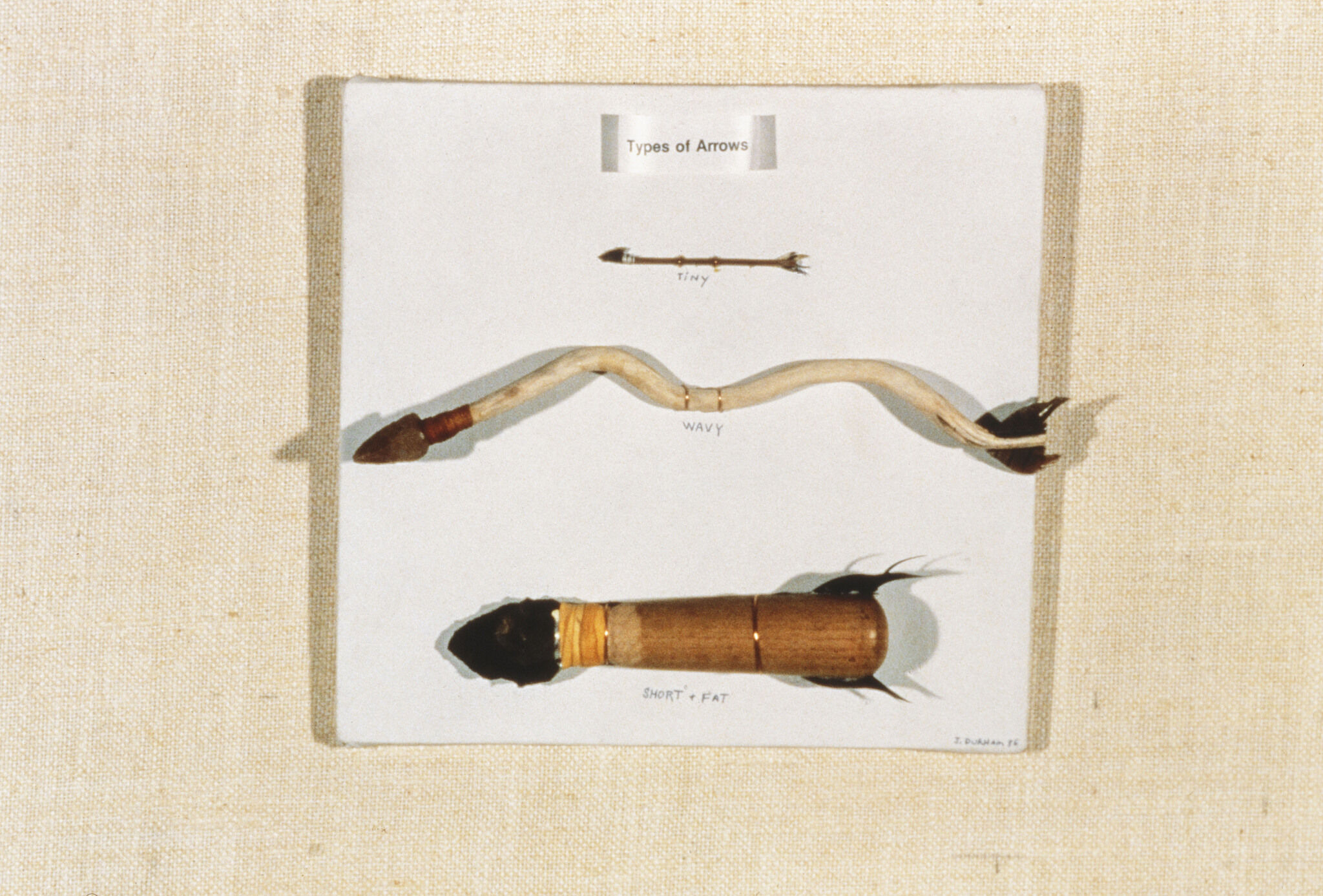
-
504
Tlunh Datsi, 1984
Audio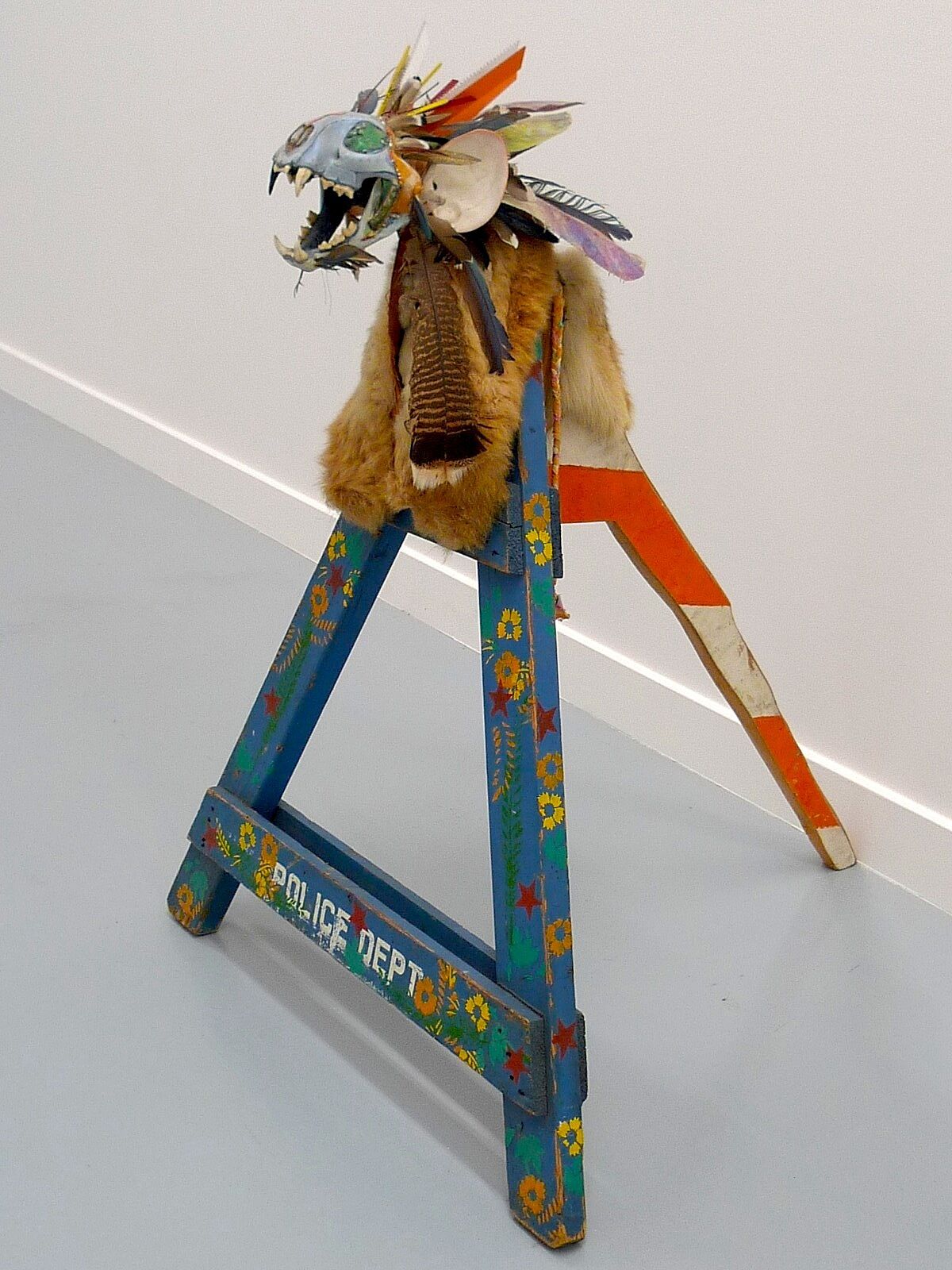
-
505
Bedia’s Stirring Wheel, 1985
Audio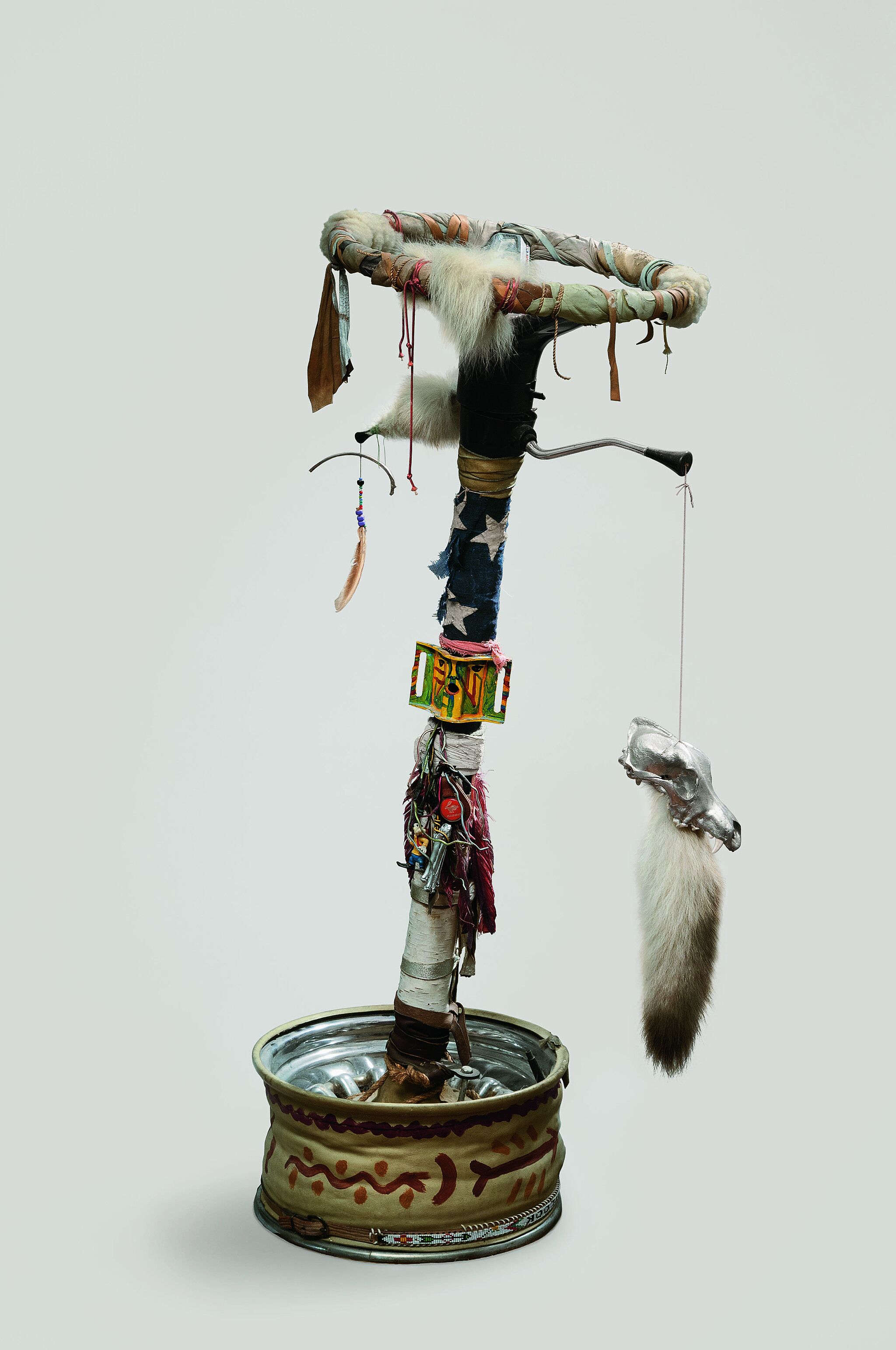
-
506
Self-Portrait, 1986
Audio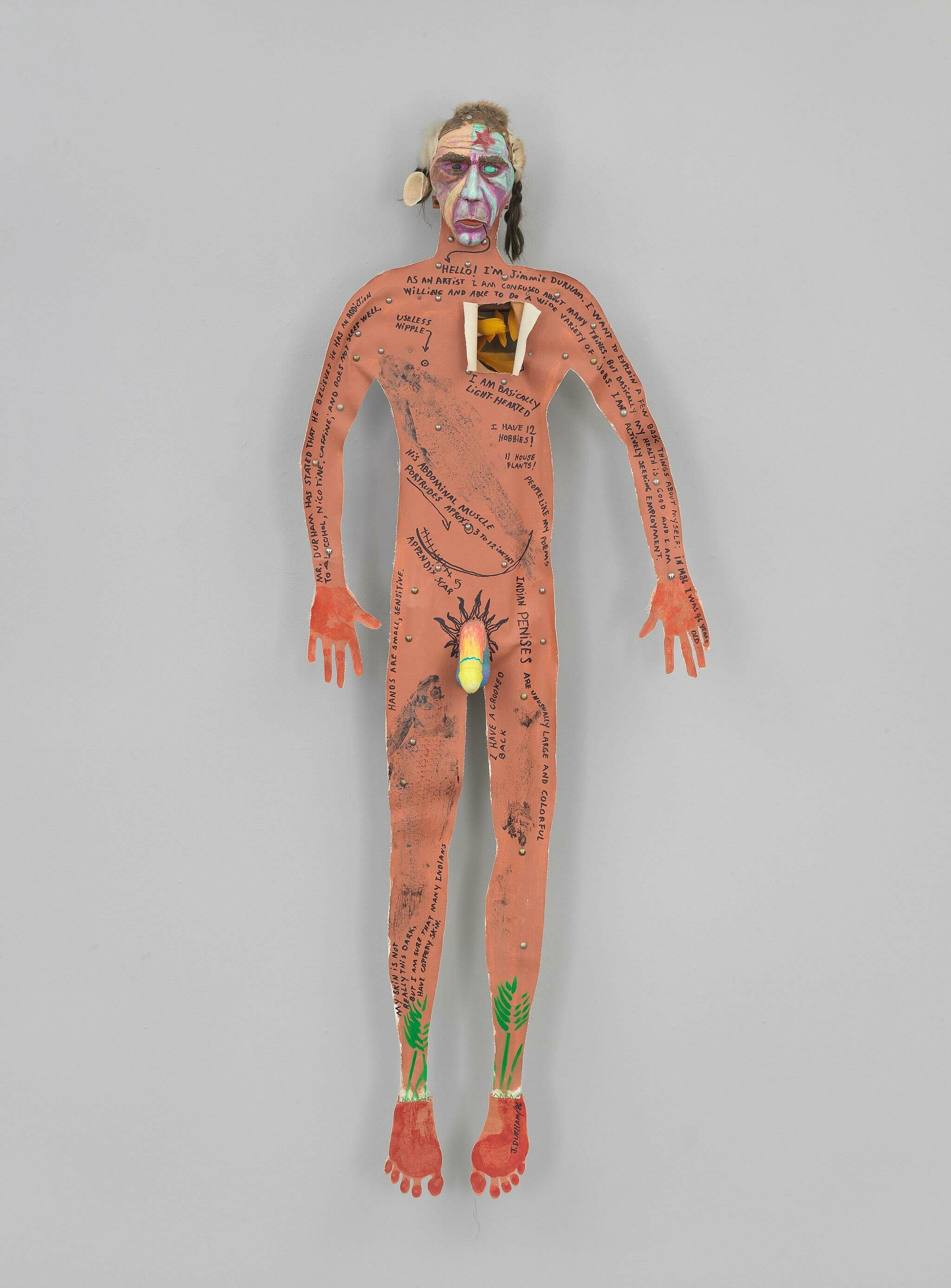
-
507
Choose Any Three, 1989
Audio
-
508
I Forgot What I Was Going to Say, 1992
Audio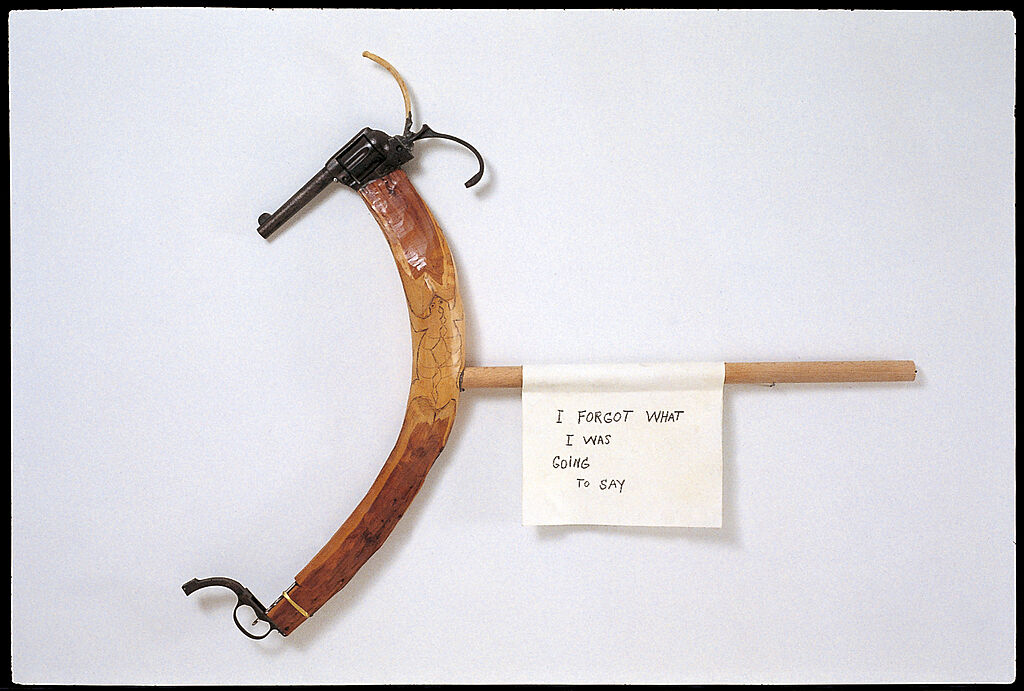
-
509
Malinche and Cortez, 1988-1992
Audio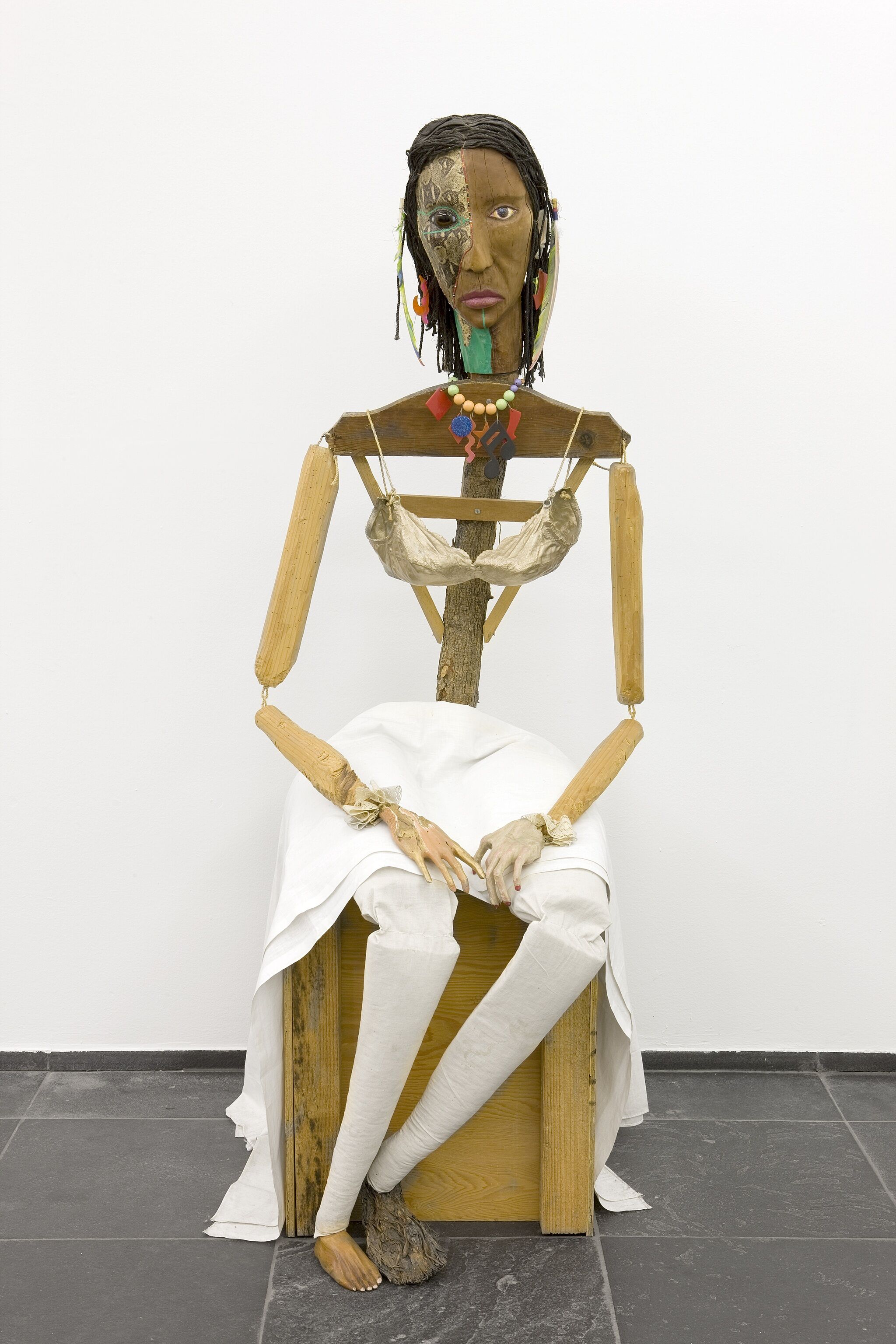
-
510
Caliban Codex, 1992
Audio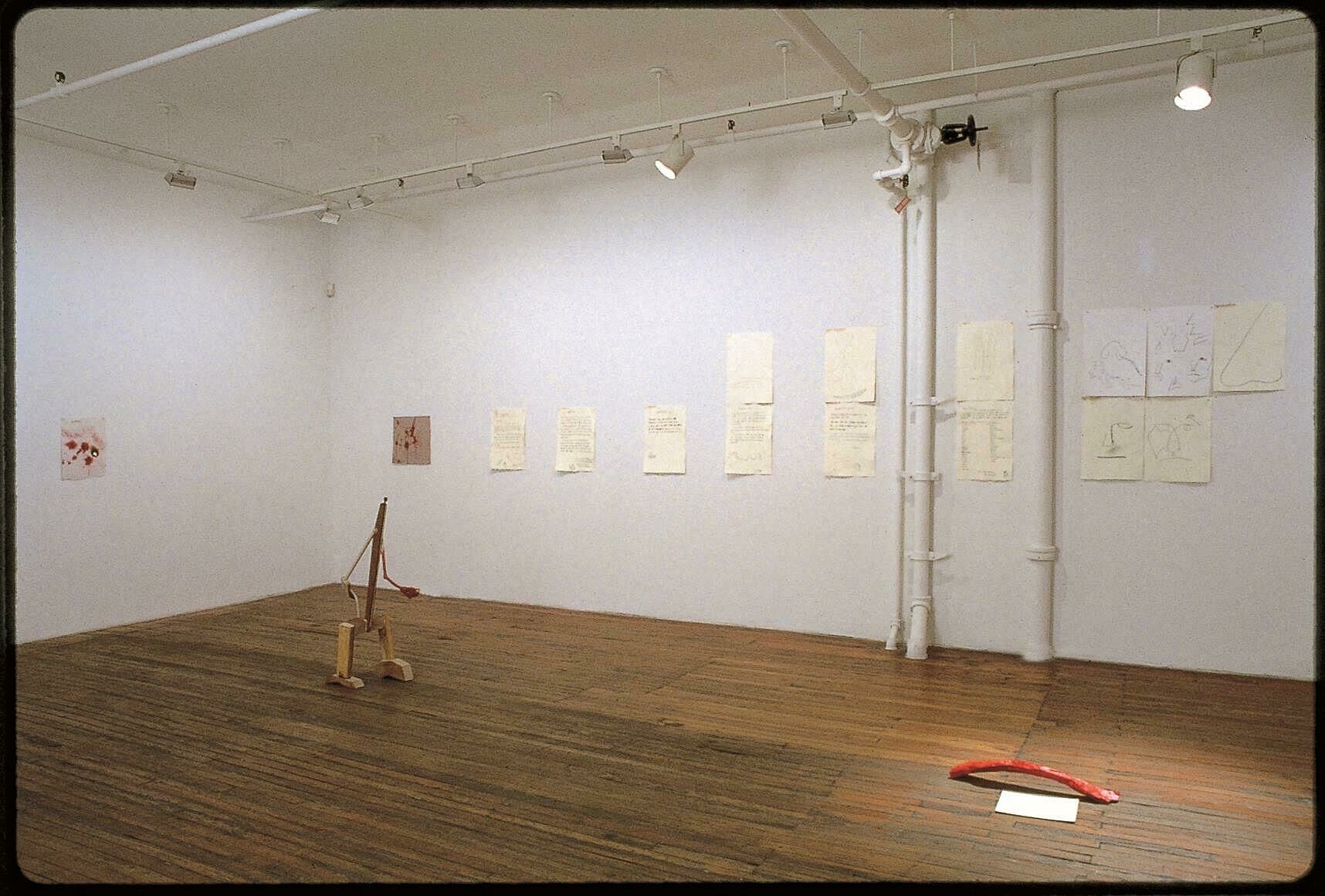
-
511
St. Frigo, 1996
Audio
-
512
Something...Perhaps a Fugue or an Elegy, 2005
Audio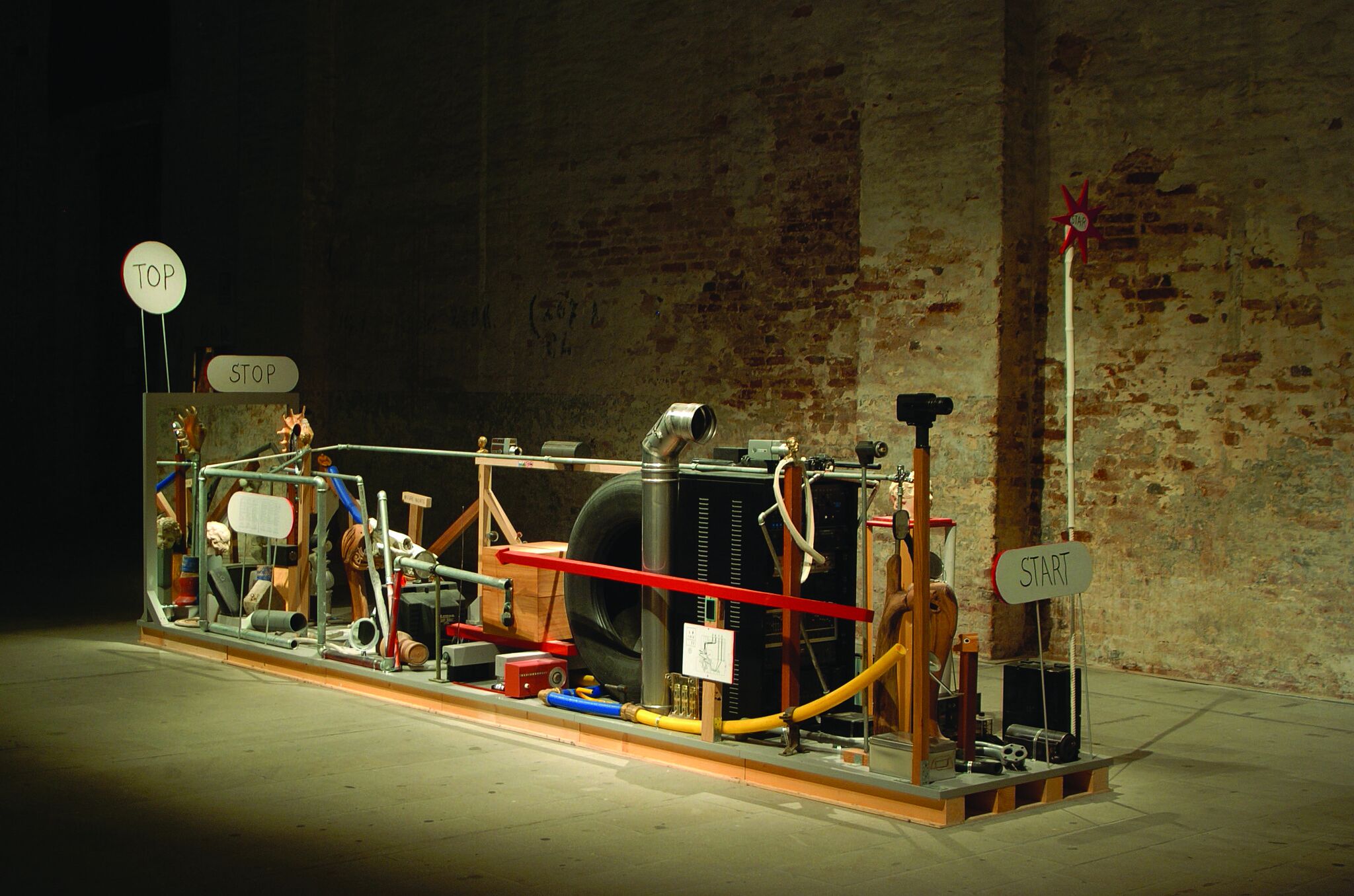
-
513
Self Portrait Pretending to be a Stone Statue of Myself, 2006
Audio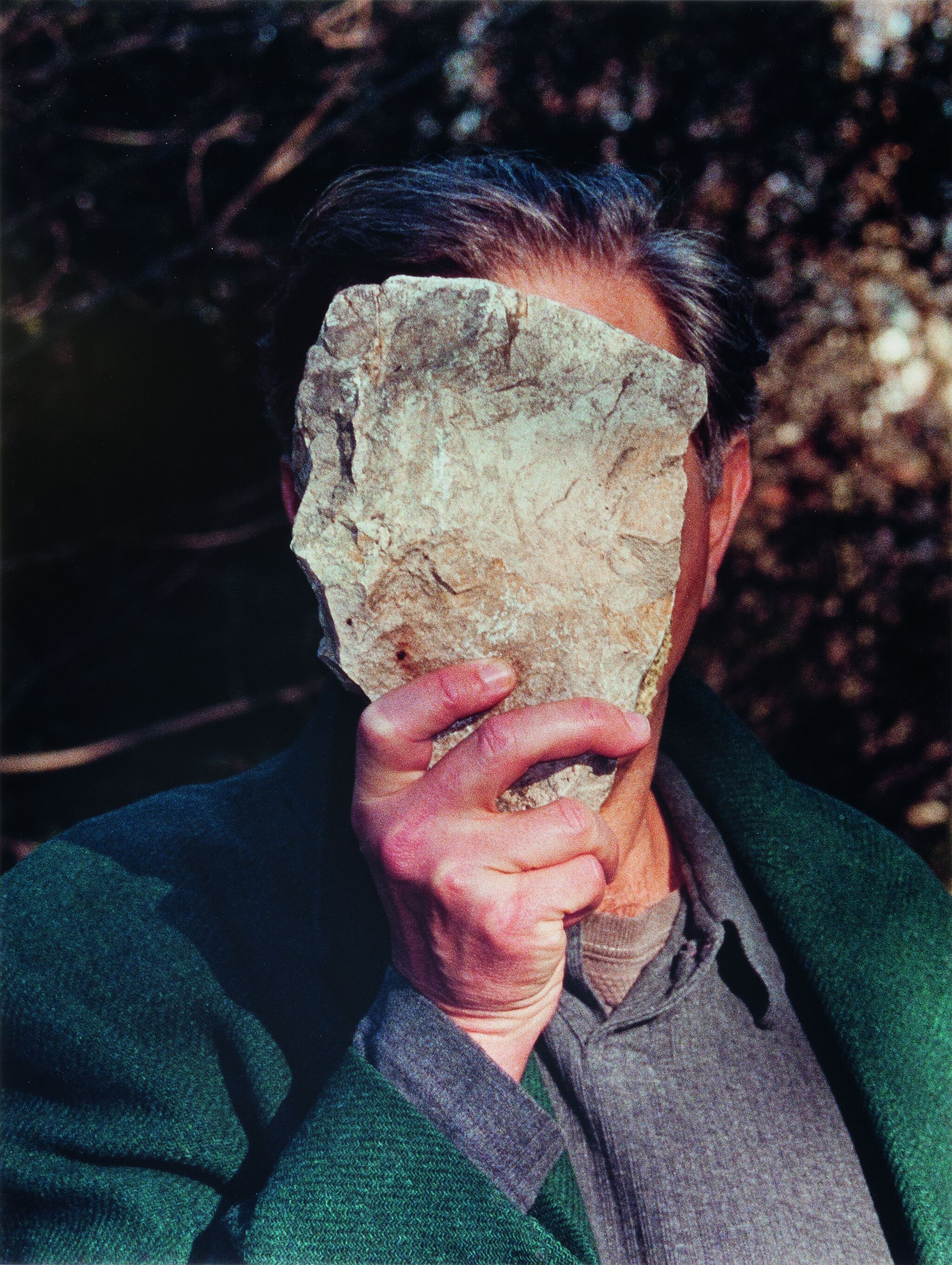
-
514
Works from Wood, Stone and Friends, 2012
Audio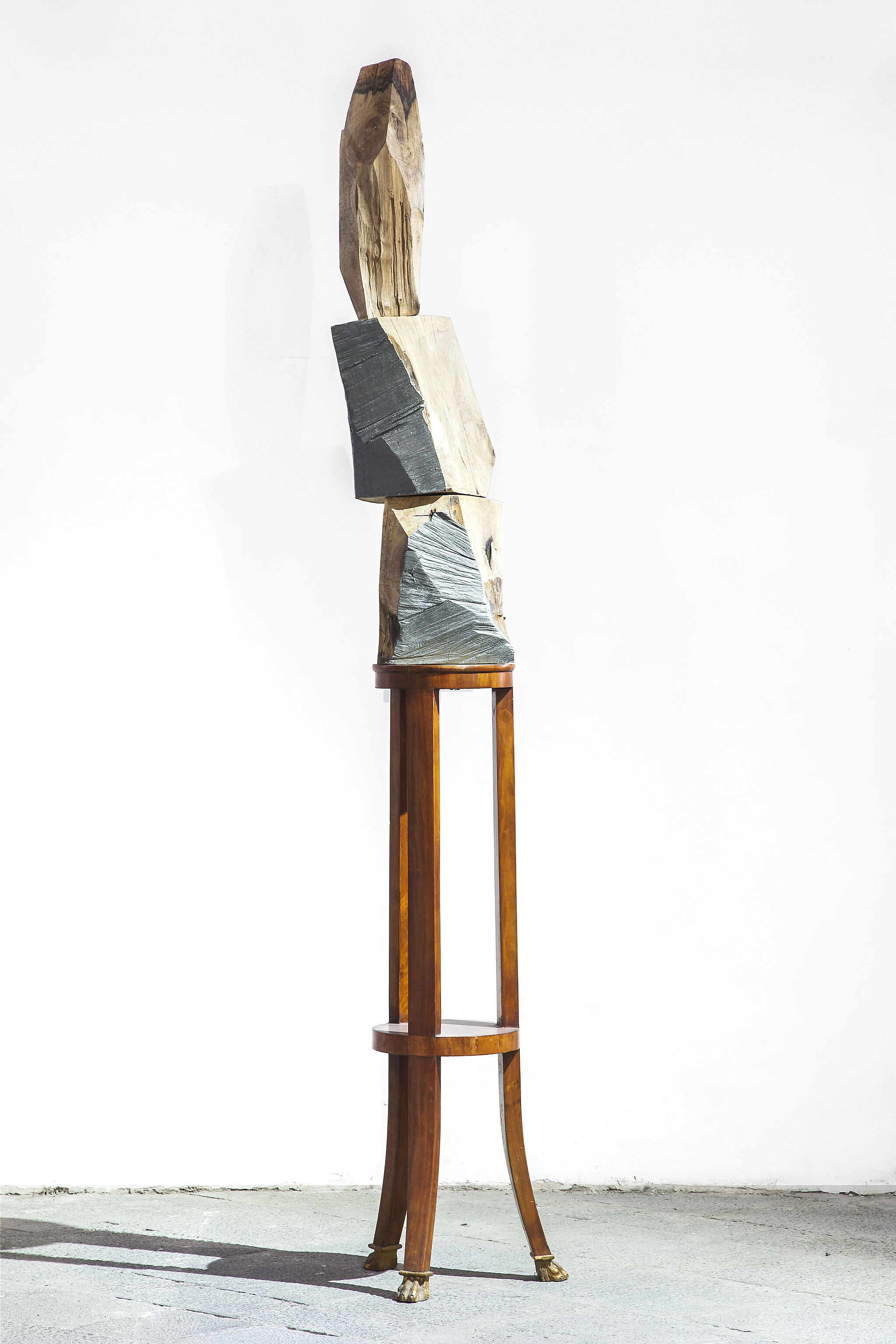
-
515
Arc de Triomphe for Personal Use, 1996
Audio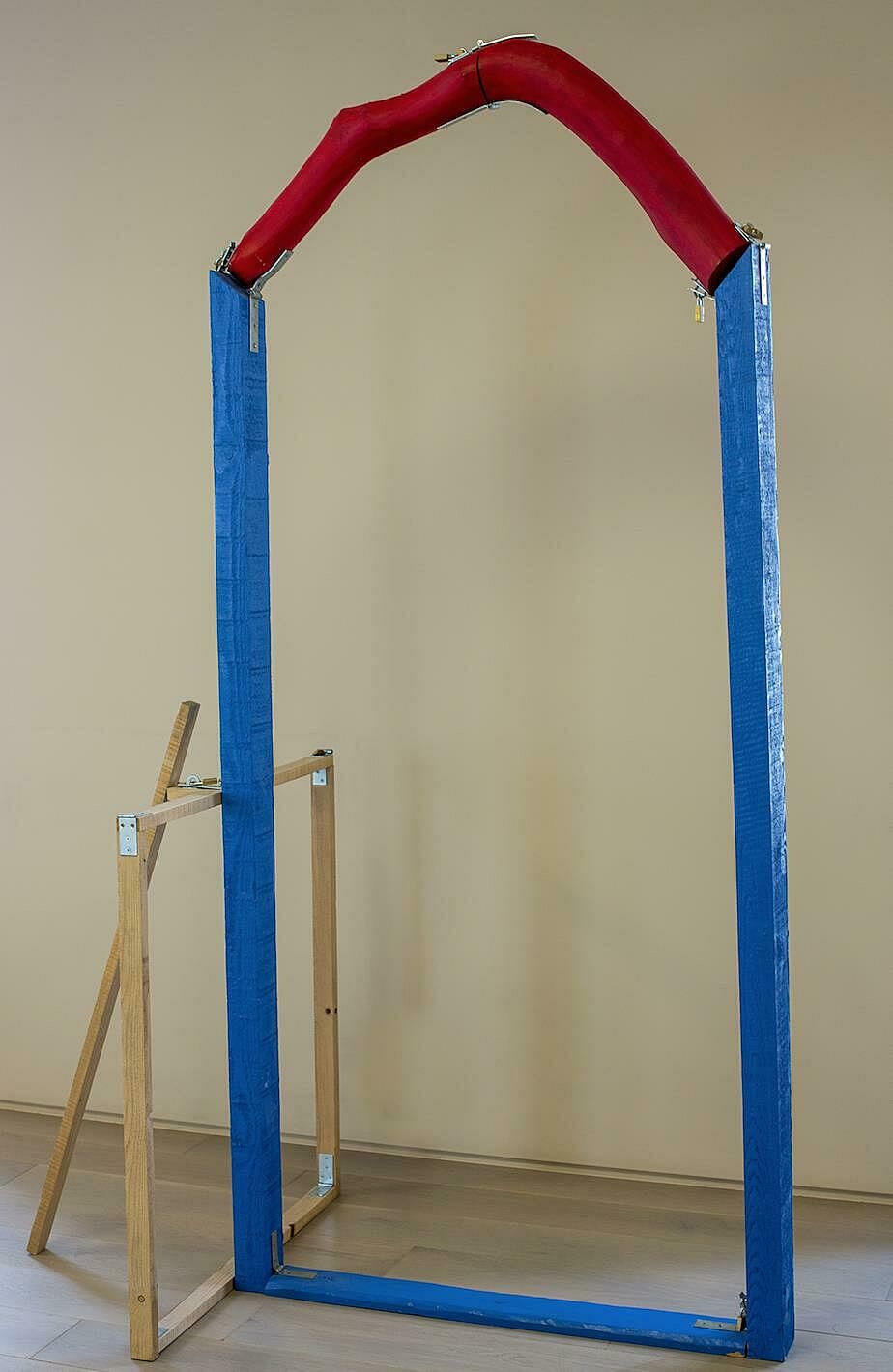
Jimmie Durham: I've always loved comedy as a way of fighting, and comedy as a way of disrupting. I like it very much. The transition from politics to art and art to politics never stops, and it is a constant in my life.
Narrator: That’s artist Jimmie Durham. As we explore this retrospective exhibition, we’ll encounter all of these things: art, politics, and a good deal of humor. Feel free to begin looking at the works nearby as you listen to this introduction.
Durham attended art school in Geneva in the late 1960s and early 1970s. But for most of the 1970s, he focused his energies on politics. He worked for the American Indian Movement, an organization that fights for Native American Civil Rights. When he returned to making art in the 1980s, a lot of his work exposed, and mocked, stereotypes that White settlers have imposed on Native Americans for centuries. He left the United States in 1987; living in Cuernavaca, Mexico, and then moving to Europe in 1994. Today, his studios are in Berlin, Germany. As he travels the world, he works with materials that evoke his local context. He pays close attention both to their physical properties, and to their political implications.
Narrator: Durham titled this group of works On Loan from the Museum of the American Indian. It was the artist’s response to a plan to open a new Smithsonian Museum that would exhibit Native American artifacts and cultural traditions.
Jimmie Durham: I was struck by the idea, Museum of THE American Indian. It’s such a clumsy term. You wouldn’t say, Museum of the Italian. Museum of the Jew. Museum of the Black. It’s not nice to do that, is it? Then I said, that’s something to poke at. That’s something to play with.
Narrator: Durham attended a conference about the museum at the American Indian Community House. The other members of the community consulted on the genocidal history implied by the museum’s collection.
Jimmie Durham: What should they do with almost a million pair of beaded moccasins that they have?
Obviously, what they can do is start a Holocaust Museum, but they're not going to start a Holocaust Museum on us even though they killed millions of us and still think it's funny, still celebrate it.
I couldn't do anything with that. I certainly couldn't try to make any art about almost a million pair of beaded moccasins. It's too sad, too tragic, too dirty. So, I said I can make my own Museum of the American Indian.
Jimmie Durham, On Loan from the Museum of the American Indian, Installation view, Hammer Museum
Anne Ellegood: Pocahontas's Underwear grew out of Durham finding some costumes that had been used by a performer that lived in his neighborhood.
Narrator: Anne Ellegood is Senior Curator at the Hammer, and organized this exhibition.
Anne Ellegood: Durham has always been incredibly critical of the way that American Indians have been portrayed in mainstream media, particularly Hollywood and the film industry. His concern here is that Pocahontas has been portrayed through these various mythologies, almost as a fetish object. Thinking about how objects get incorporated into museums, into their collections, and displayed in museums that can become fetishized in some sense, removed from their original context and the way that they're intended to be used. In this case, I think what he's doing is talking about the reduction of a complex figure like Pocahontas to essentially a sexualized figure, one who is most characterized by her supposedly voluntary marriage to a British man.
Jimmie Durham, Pocahontas’ Underwear, 1985. Dyed chicken feathers, shells, beads, 13 1/4 x 13 1/4 in. (33.6 x 33.6 cm). Exhibition copy, courtesy the artist
Jimmie Durham: In thousands of cowboy and Indian films, a cowboy takes an arrow out of another cowboy and looks at it and said, "It's not Apache. It's Cheyenne." or "It's not Navajo. It's Apache." I'm charmed by the ideas that everybody has signature arrows [laughs] that you can tell, maybe you can even tell the name of the mother and the guy who made the arrow. It's so specific!
I thought I will make some things and I will show some things that could just as well be something, or not. I made a little wavy arrow and a tiny, tiny arrow. They all have real arrow points on them. They all have real flint points.
I just wanted to make something ridiculous to show how ridiculous it already is. And do it in way that doesn’t accuse anybody of being racist, because it doesn’t help to accuse people of being racist; it just makes them angry. But if you say, "Here are three types of arrows," then so ridiculous, then people laugh. Suddenly, they're removed from it for a little while and can see it, maybe can see it.
I don't want them to laugh at the genocide, but I want them to laugh at three ridiculous arrows.
Jimmie Durham, Types of Arrows, 1985/86. Oak, flint arrowheads, cow leather, turkey feathers, canvas over board, ink on paper, 11 1/4 x 11 1/4 x 2 1/8 in. (28.8 x 28.8 x 5.4 cm). Collection of Coleen Fitzgibbon and Tom Otterness
Narrator: Durham found the materials for this sculpture on the streets of New York, where he lived for most of the 1980s. He thought of the work as a kind of collaboration with the animal itself, a process of discovering how it felt to be dead, and interpreting those feelings through sculpture. Durham’s art often involves this kind of imaginative effort, almost a form of empathy with his materials.
Jimmie Durham: I know it sounds romantic and silly, but that was my idea.
I don't remember where I got it, but in one of these crazy ways, I was just getting a skull and there was every kind of garbage. There was a fur district down in the 20’s. They put out every kind of fur scraps: mink, chinchilla, wolf, everything.
His eyes, one is turquoise and the other must be this kind of stone called pyrite stone from Peru, from the Andes. I had been in Lima when I was in the American Indian Movement and several other places in Peru.
Jimmie Durham (b. 1940), Tlunh Datsi, 1984. Puma skull, shells, turquoise, turkey feathers, metal, sheep and deer fur, pine, acrylic paint. 40 ½ × 35 ¾ × 31 ¾ in. (103 × 91 × 81 cm). Private collection, Belgium
Narrator: Here, Durham has combined car parts, feathers, and scraps of fur, leather, and fabric in a deliberately mysterious sculpture. He called it Bedia’s Stirring Wheel, and presented it—along with Bedia’s Muffler, which you’ll see nearby—as part of a loose fictional narrative. He presented the objects as artifacts, left behind by the first inhabitants of an island called Manahattas. Durham explained that they’d been discovered by a fictional Cuban archeologist and explorer named José Bedia. Durham gave very little additional information, leaving viewers to imagine Manahattas on the basis of the objects alone. What, one might wonder, would modern Manhattan have been like if the encounter between Europeans and the island’s original inhabitants had gone differently?
This project was inspired by a real person, named José Bedia—a Cuban artist whose work Durham had seen and admired. They hadn’t met when Durham made these works, but Bedia came to the gallery opening where they debuted, and the two artists became friends.
Jimmie Durham, Bedia's Stirring Wheel, 1985. Car steering wheel with shifter, metal car wheel, cotton flag scraps, cow leather, fur, sheepskin, pigeon feather, dog skull, beads, plastic doll, acrylic paint, 42 1/4 x 18 in. (107.3 x 45.7 cm). Collection of Karen and Andy Stillpass
Narrator: This was the first self-portrait Durham ever made. But in some ways, it’s more of an anti self-portrait. He started the work with help from his partner, artist Maria Thereza Alves.
Jimmie Durham: We had some canvas, I laid it on the floor and asked Maria Thereza to trace my body. I cut that out and then I had a beginning. Then I took some calipers that sculptors used to use to measure things, and I measured every part of my face and then carved it out of wood.
I started writing things on my body in the early '80s. Everybody who wrote everything in the art world were talking about something was inscribed on something, and ‘inscription’ and ‘inscribed’ was everywhere, so I thought, "Hey, I'm going to inscribe on this body." [laughs] I wanted to say things that were not true, but that were absolutely not lies. Nothing is true, nothing is a lie. I don’t tell any lies.
I don't like self-portraits. I've done hundreds of them by now because I got into it. But when you look at painters—to me, it's in my mind, it's always men, but it's not true, is it? But the men stare in the mirror, and they're always painting themselves staring in the mirror as though it's a proof of something.
It's not, in any sense, real because this European idea of painting is a pretty silly construction. It’s not a portrait that looks like a person, because they're flat, they're little, and they're dead. [laughs] The world is living, three-dimensional, and completely different.
Jimmie Durham (b. 1940), Self-portrait, 1986. Canvas, cedar, acrylic paint, metal, synthetic hair, scrap fur, dyed chicken feathers, human rib bones, sheep bones, seashell, thread. 78 × 30 × 9 in. (198.1 × 76.2 × 22.9 cm). Whitney Museum of American Art, New York; purchase, with funds from the Contemporary Painting and Sculpture Committee. Digital image ©Whitney Museum, N.Y.
Jimmie Durham: We were living in Mexico when I did this. We had a lot of free wood around where we lived in Cuernavaca. I had this fresh piece of, I think it's ash, some sort of white wood like ash.
I saw something in our local market, I think, where there were heads springing out of another head. Probably a mask, carnival mask or something. I took the idea without taking the way it was happening, and made two different carved-wood heads and put them on in a way that could not make any sense.
So then I said, "I will put some names on it." I started just writing names. Wrote one name, stuck it on. That name reminds me of another name, not any logic, only free association, I guess you'd call it.
I don't like art that means something other than itself. Of course, it means something, but it doesn't mean language something. I don't like for people to look for it to mean something.
I know why they do it. They do it because it's the European tradition to make paintings that illustrate Biblical stories. That's what paintings in churches are, illustrations of Biblical stories, so it's not art. It's painting. It's the craft of painting and illustrating a story.
But I want art to be like music, its meaning is in itself.
Jimmie Durham, Choose Any Three, 1989. Carved and painted wood, metal, and glass, 99 3/16 × 49 3/16 × 48 in. (251.9 × 124.9 × 121.9 cm), kurimanzutto, Mexico City. Courtesy the artist and kurimanzutto, Mexico City. © Jimmie Durham. Photograph by Jean Christophe Lett
Narrator: Durham first showed these works at the Whitney, in the 1993 Biennial.
Jimmie Durham: I had a funny studio in Mexico with a bunch of things. So many things looked like either guns or cameras. I saw the two as the same in the sense of they're pointed at you to control you.
Narrator: Durham combined the materials into an allegory of police-state violence and surveillance.
Elisabeth Sussman: Each object has a label, a text.
Narrator: Elisabeth Sussman is Sondra Gilman Curator of Photography.
Elisabeth Sussman: The labels are a range of languages. They're never translated for you, the ones that you can't read the language of, but they’re, as you can see with these objects, they’re appended to the object. They're attached to the objects as if they're supposed to tell you something about the objects, right?
It's the kind of thing that you would see in a museum that would be a remnant of another civilization that the label is going to try to explain to you. You would get a very specific read of the materials, and he's put kinda put these things together so he's defamiliarized the whole system.
Jimmie Durham, I Forgot What I Was Going to Say, 1992. Metal gun parts, yew tree from Ireland, wood dowel, bone, acrylic on canvas, 24 1/2 x 26 1/2 x 2 1/2 in. (62.4 x 67.2 x 6 cm). Collection of Dieter and Birgit Broska
Narrator: This sculpture is Durham’s interpretation of a historical figure, Malinche.
Anne Ellegood: Within the Spanish conquest, she was sold as a slave to [Hernán] Cortés and functioned as his interpreter and traveled around Mexico with him.
Narrator: Anne Ellegood.
Anne Ellegood: She, in current Mexican history, is often held up as a traitor, but like Durham's interest in thinking through the complexities of Pocahontas as a historical figure, in this work he's also arguing for a reexamination of Malinche not as a traitor, but rather as a woman who was sold into slavery and oppressed by the colonizer.
Jimmie Durham: I did want to show the unreality of the myth, of the idea. The unreality of what they call reality. I carved a more realistic looking foot and I had a piece of yucca cactus that just happened to look like a foot, so I stuck it on.
Then, I made Cortez, but for a long time, he was just a face. I made many different layers that were all tinted differently, so then when I sand it down, it looks disgustingly like flesh, if flesh were dead and petrified. I wanted him to look monstrously bad and greedy, like he wanted Mexico.
Jimmie Durham (b. 1940), Malinche, 1988–1992. Guava, pine branches, oak, snakeskin, , polyester bra soaked in acrylic resin and painted gold, watercolor, cactus leaf, canvas, cotton cloth, metal, rope, feathers, plastic jewelry, glass eye. 70 × 23 ⅝ × 35 in. (177 × 60 × 89 cm). Stedelijk Museum voor Actuele Kunst (SMAK), Ghent, Belgium. Image ©S.M.A.K. / Dirk Pauwels
Narrator: 1992 was the five-hundred-year anniversary of Columbus’s encounter with the Americas. The Caliban Codex is one of several works in which Durham responded to that event, looking at colonialism in a global context. Some of its pages contain drawings.
Mario Caro: There's this very crudely made face.
Narrator: Mario Caro specializes in contemporary Indigenous art. He teaches at the Massachusetts Institute of Technology.
Mario Caro: You want to read it as a mask, but it could be a portrait of Shakespeare's Caliban, The Tempest, right? Where you have this figure, Prospero, a duke that gets exiled and stranded on an island. There he meets the kind of prototypical Native, Caliban.
Narrator: Prospero makes Caliban his servant, and teaches him language.
Mario Caro: In Shakespeare's play, Caliban talks about how grateful he is that he's been able to learn this language from Prospero, because it allows him to curse him. Learning the enemy's language in order to resist or combat the enemy. This is definitely what Durham is enacting here. He's really captured the resistance, the anti-colonial stance that is there in the original Caliban.
Durham is very aware of the role of language and the history of language. There have been laws that have been passed to prevent Native folks from maintaining their language. Language is an extreme marker of someone's cultural identity. It's a whole worldview.
If you're going to talk about language and Native languages, which I think this piece is doing, you can't help but invoke that violent history of forcibly taking away a language and imposing another language.
Jimmie Durham, Caliban Codex, 1992. Pencil on paper, Twelve sheets, 21 x 15 in. (53.3 x 38 cm.); two sheets, 22 1/4 x 15 in. (56.5 x 38 cm). Daled Collection, Belgium
Anne Ellegood: St. Frigo is a sculpture Durham made in 1996 that consists simply of a small refrigerator.
Narrator: Anne Ellegood.
Anne Ellegood: What for me is so important about this work is it marks a vital turning point in Durham's practice in which he moves from incorporating stone into the sculpture, as he had done with other natural materials, such as wood, animal skulls, feathers, fur, to using stone itself as a sculpting tool. So in this case, he was doing a residency in France. For ten mornings, he essentially stoned this refrigerator in a courtyard that was adjacent to the studio building where he had been working. He went outside every morning and threw stones at the refrigerator, essentially turning it into a kind of martyred figure.
The experience of stoning the white, clean refrigerator really for him turned into this process in which he felt that he was stoning a body. He began to feel sad and somewhat guilty about stoning this refrigerator, and later titled her St. Frigo.
Jimmie Durham, St. Frigo, 1996. Metal refrigerator, 52 x 23 1/2 x 23 1/2 in. (132 x 60 x 60 cm). Collection of Ministry of Culture, Lisbon, Portugal
Narrator: Durham made this enormous sculpture for the 2005 Venice Biennale.
Jimmie Durham: We went out to used things places, and we went to flea markets and we went to highway roadside stands, which Northern Italy is full of, and just started buying whatever junk we could find and it all fit.
Jimmie Durham: I had some horse bones, a cow skull, a rattlesnake skin, a half an armadillo shell. I had a bunch of junk in my studio as usual. So then I said, "I always like boxes that don't open." I like the mysteriousness of the always-closed box.
Everything is connected, and everything is connected almost in a Rube Goldberg machine-type way.
Narrator: Durham called this work Something...Perhaps a Fugue or an Elegy. A fugue is a musical form where two or more themes weave together over and over again. An elegy is a type of poem, a lament for the dead. The title hints that the sculpture, with its mysterious interior and complex mechanisms, may be a meditation on the cycle of life and death.
Jimmie Durham (b. 1940), Something…Perhaps a Fugue or an Elegy, 2005. Cameras, television, VHS player, amplifier, tripod, steel pipes, hardware, PVC pipes, plastic, rope, acrylic paint, pine, seashell, brass heads, cast marble-dust head, oak box, glass bottle, wood furniture parts, tree branches, tire, mirrors, metal lock, metal chains, lights, wires, plywood pallets, armadillo shell, cow skull and bones, ink on paper. 71 × 275 ½ x 63 in. (180 × 700 × 160 cm). Fondazione Morra Greco, Naples, Italy. Image courtesy of kurimanzutto, Mexico City
Narrator: Durham called this photograph Self-Portrait Pretending to Be a Stone Statue of Myself.
Jimmie Durham: But of course, I'm not pretending to be. I'm pretending to be pretending to be.
This idea comes from an old Japanese idea that I love very much. The Middle Ages Japanese court had a special language that you pretended to be pretending to be sorrowful if a friend died. You pretended to be pretending to be happy if something happy happened.
I just like the idea of a double pretense, that you're not really living your life. You're not really there at all. I don't know how ‘here’ I am, but I know the self-portrait is already a double pretense.
Jimmie Durham, Self-Portrait Pretending to Be a Stone Statue of Myself, 2006. Color photograph. Edition of 1 + 1 AP. 31 ¾ × 24 in. (80.7 × 60.9 cm). Collection of fluid archives, Karlsruhe. Courtesy of ZKM Center for Art and Media, Karlsruhe
Narrator: In this sculpture and those nearby, Durham responded to Naples, Italy. One material he used in them was wood that he found in the region.
Laura Phipps: As far as I gather, it was all already downed wood.
Narrator: Laura Phipps is an Assistant Curator at the Whitney.
Laura Phipps: Which I think is important. That it's not about going out and chopping down trees and staking your claim on nature in that way.
Narrator: Durham also used abandoned leather-working machines that he found when he moved into his new studio.
Jimmie Durham: So, I had many, many crazy old machines. I put two or three of them, as just a way to get rid of them, put some wood on them, put some stone on them, call it art. Sell them. That was the idea. I'm being facetious, but they also acted like they would like to have a new job. That they wouldn't like to be old machines the rest of their existence.
So, they're all quite happy, and joined in very quickly, as things do. That's part of the joy of working directly with material and with no idea first. The material starts talking at least as much as I talk.
Jimmie Durham (b. 1940), The Forest and Brancusi, 2012. Three pieces of walnut, acrylic paint wood table. 110 ¼ × 19 ¾ × 15 ¾ in. (280 × 50 × 40 cm). Private collection, Nottingham. Image courtesy of kurimanzutto, Mexico City
Laura Phipps: This is a work that Durham did well into his time living in Europe. And one of the things that spending time, and making work, and living in Europe brought to his attention was the use of architecture as sort of a way of describing culture, and the fact that there's this monumentality to a lot of European architecture.
He created this Arc de Triomphe for Personal Use to play with that idea. The work itself can fold up into sort of a small portable piece of art. It's almost like carrying around this monumentality with you, allowing an individual to carry around a history or their own personal successes or triumphs as a work of art.
Narrator: This sculpture’s portability reflects the artist’s refusal to tie himself definitively to any single place or group.
Jimmie Durham: I don't want to be of any group of people. I think now, in Europe, there is hardly another moral stance. If that's true in Europe, it's certainly true in much of the world.
I want something broader, something deeper than a fight of these people against these people.
At this point in my life, the recent illegal immigrant in Italy is my best friend and my brother or sister. That has to be the case. It has to be the case for everyone in Italy. It has to be.
Narrator: This is the last stop on our tour. You can keep exploring Durham’s work in the outdoor gallery on Floor 5, and in the Museum’s central stairwell.
Jimmie Durham, Arc de Triomphe for Personal Use, 1996. Pine, acrylic
paint, metal hardware, padlocks, keys, 78 3/4 x 31 1/2 x 31 1/2 in. (200
x 80 x 80 cm). Collection of Maria and Alexandre Bosoni, Paris
0:00
0:00