
Willa Nasatir
2017
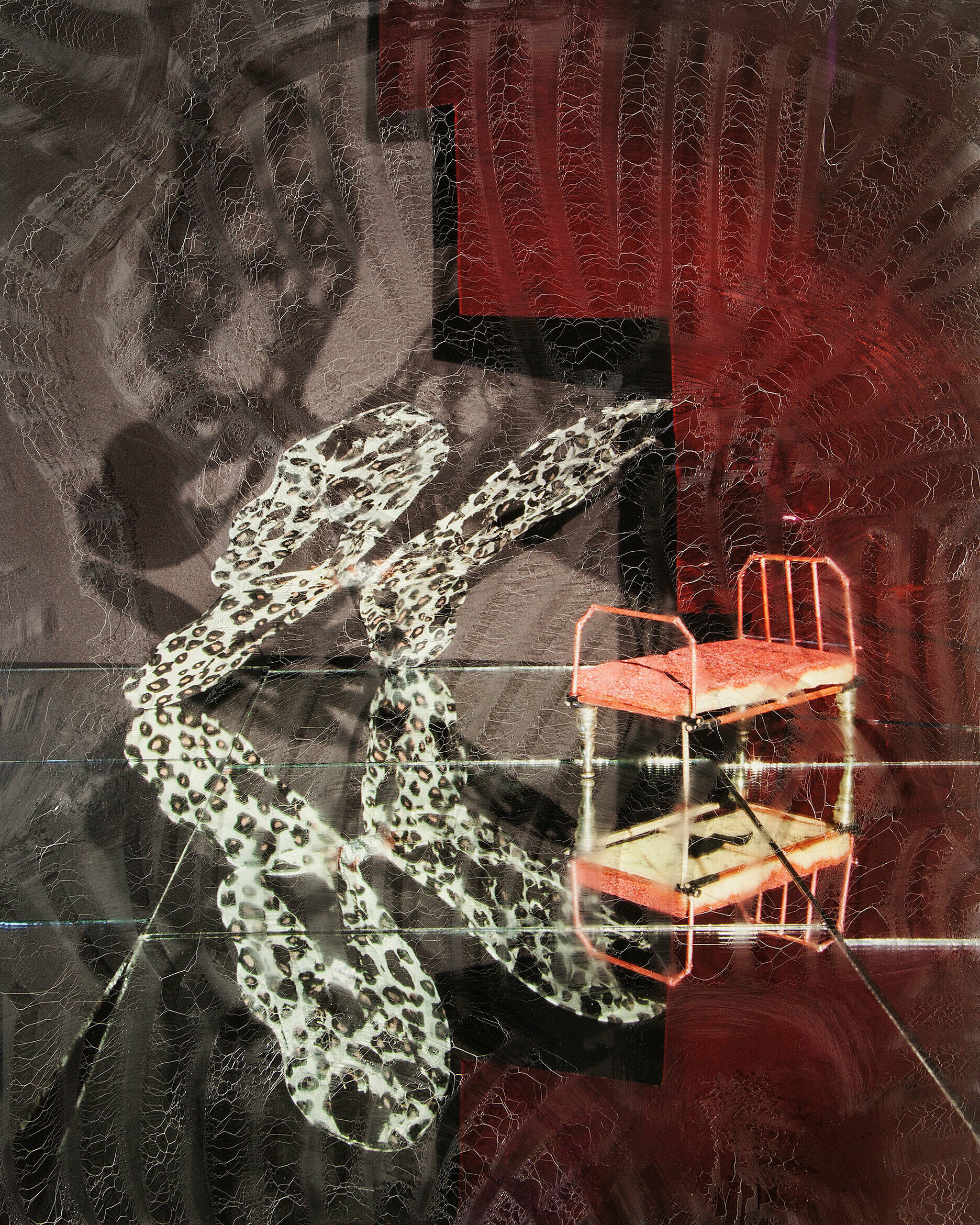
Narrator: Hi! In these galleries, we’ll look at some photographs taken by Willa Nasatir. To make these images, she began by making found objects into improvised sculptures. She’d photograph these, then use a variety of techniques to cast light and shadow on those images. Then she would photograph them again.
Willa Nasatir: I'm interested more in these sort of invented and absurd material choices than I am doing it on a computer.
I think that there's endless possibility to digital manipulation, but I think there's also endless possibility to taking a picture of something, and getting an effect that you haven't seen before or you can't quite place. I think our eye is trained to recognize things as digital, but to me it's actually easier to make something using more of my hand than it is using Photoshop, just because I am less proficient in it. I don't have strong conviction to that dark room photography at all, but I do feel best about the work that I make that most involves my own hand.
I also like the element of chance that happens when you're experimenting with these processes.
Willa Nasatir (b. 1990), Butterfly, 2017. Chromogenic print mounted on wood, 73 1/2 x 60 in. (186.7 x 152.4 cm). Collection of the artist; courtesy Chapter NY, New York
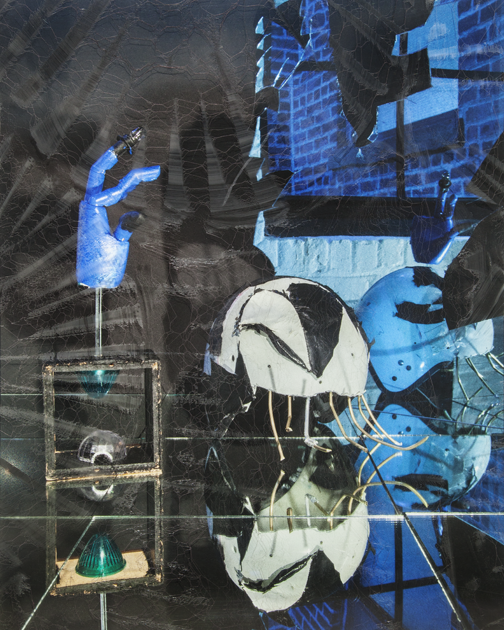
Narrator: The center of Nasatir’s exhibition is an installation of six large photographs.
Willa Nasatir: They are scenes that I see as connecting to one another in some ways. For instance, there's a gridded floor of mirrors on all of those pieces, but the grid doesn't really line up. I think there's kind of a collapse of space when you look at them altogether that, to me is, reminiscent of the way that your spatial reality when you're dreaming shifts so abruptly.
I like the way that in these photographs, I can make something appear as if it's descending into infinity, or when you use mirrors, I think that you show a space that doesn't exist in our living world, and so, to me it feels sort of like you're accessing a different world, space.
They go from green to blue.
There's a certain type of green that I wanted that I hadn't used in a photograph, it reminds me of the ways that the future was depicted in films in the 80s, kind of this neon, spooky green. Then it goes into a turquoise blue that feels very jazz-like to me. Those two pieces have a depiction of music in them, and that blue reminds me of that.
Willa Nasatir, Conductor, 2017. Chromogenic print mounted on wood, 79 1/2 x 61 in. (201.9 x 154.9 cm). Courtesy the artist and Chapter NY.
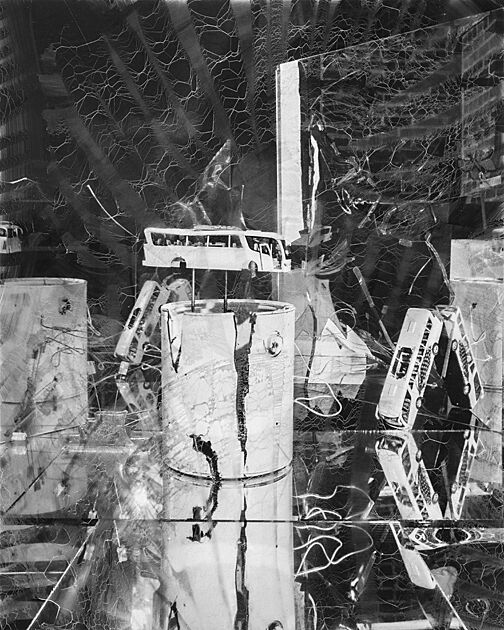
Willa Nasatir: All of my work has somewhat of a surreal element. I think the idea of bending reality within a photograph is something that I am always interested in. Less Surrealism as in an art movement, and more the difference between how something can appear figurative and abstract at once, and that there's a blurry line between what you can understand and define, and what you don't have language for.
I get a lot of joy out of making artwork. It's a way of processing the world to me that is funny and doesn't have a purpose, or an explicit purpose, and so you're allowed to have a sense of absurdism and feel like it’s okay to do something that isn't necessarily logical or effective.
Film noir, I like, because there's such an elevated sense of drama and these kind of filmic tropes of suspense or fear or something is "up," is always something that I like to see how you can convey within a still photograph, like what is it to just pose something and light it and to be able to convey that feeling?
Narrator: The works in this series are silver gelatin prints—a black-and-white chemical printing process largely associated with twentieth-century modernism.
Willa Nasatir: I'm not super attached to the technique, although it's beautiful. I think it's helpful for me to be working simultaneously very large and very small, and with a super deep color palette and something is more restrained, it's like a balancing challenge.
Willa Nasatir, Bus Depot, 2017. Gelatin silver print, 21 x 17 in. (53.3 x 43.2 cm). Courtesy the artist and Chapter NY.
0:00
0:00