
Mirror Cells
2016
This audio guide features commentary by four of the exhibiting artists and Jane Panetta, associate curator and co-curator of Mirror Cells.
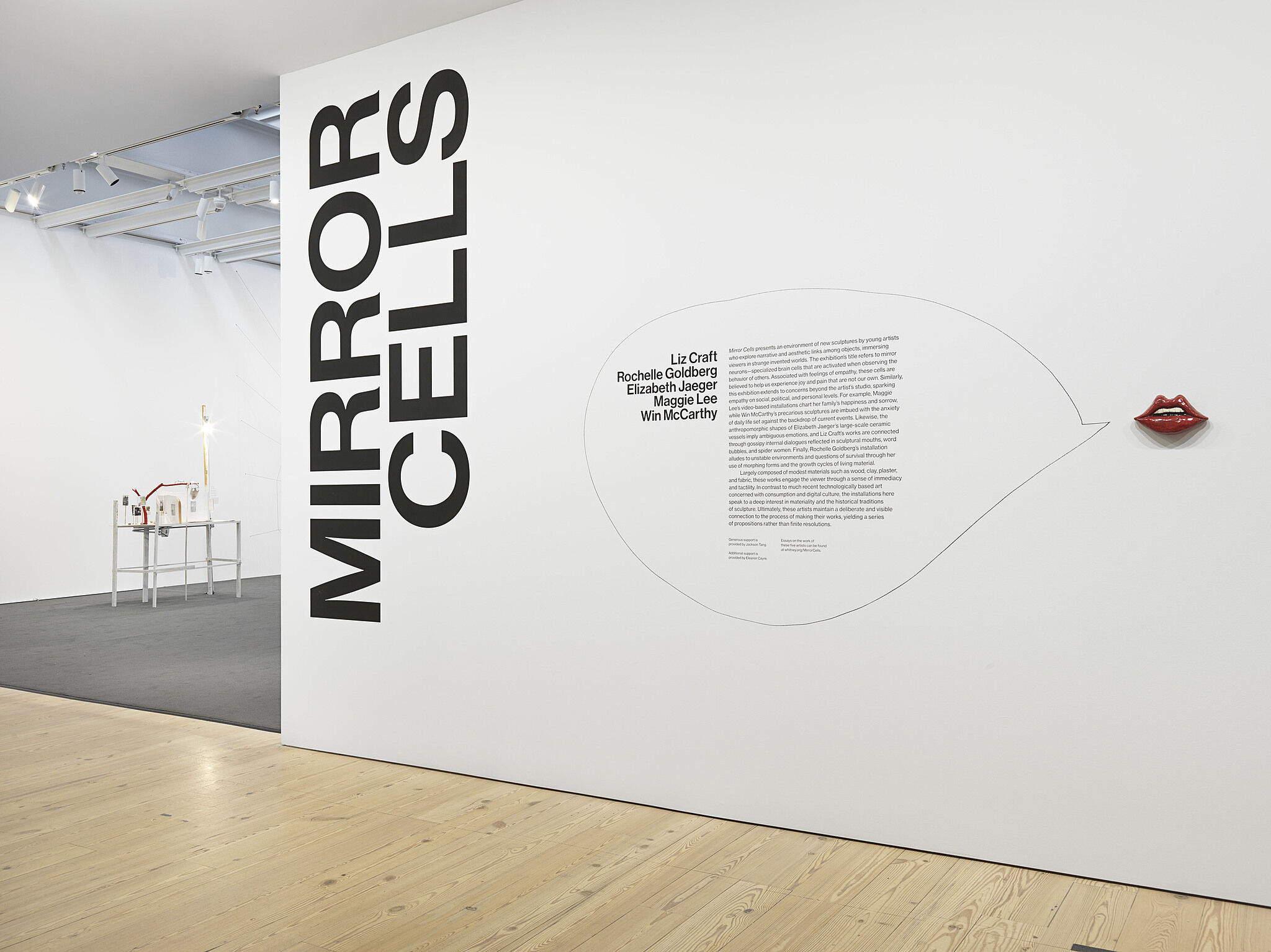
Jane Panetta: My name is Jane Panetta and I’m an Associate Curator here at the Whitney.
Narrator: Panetta and Associate Curator Christopher Y. Lew organized this exhibition.
Jane Panetta: This exhibition is titled Mirror Cells. It’s a group exhibition of five emerging artists, primarily sculptors.
We’ve titled the show Mirror Cells, which refers back to mirror neurons, which are neurons that we have, that allow us to feel empathy or to experience the pain of others that we might see or witness. And I think we liked the way that reflected a sensibility we saw in a lot of this sculpture. These are works that kind of reflect things both personal and about the outside world in a kind of sensitive, almost vulnerable way, I would say.
And I think that beyond that, beyond the kind of scientific relationship between mirror cells and mirror neurons, we even liked the way the phrase mirror cells somehow seemed to get the idea of these works being kind of individual microcosms that reflect the world or reflect the artist’s own experiences.
Narrator: A few works are installed near the elevators, and in the café nearby. But most of the exhibition is one open, continuous space. Take a look around. If you’d like to hear more of the thinking behind the show, please tap the button on your screen.
nstallation view of Mirror Cells (Whitney Museum of American Art, New York, May 13–August 21, 2016). Photograph by Genevieve Hanson
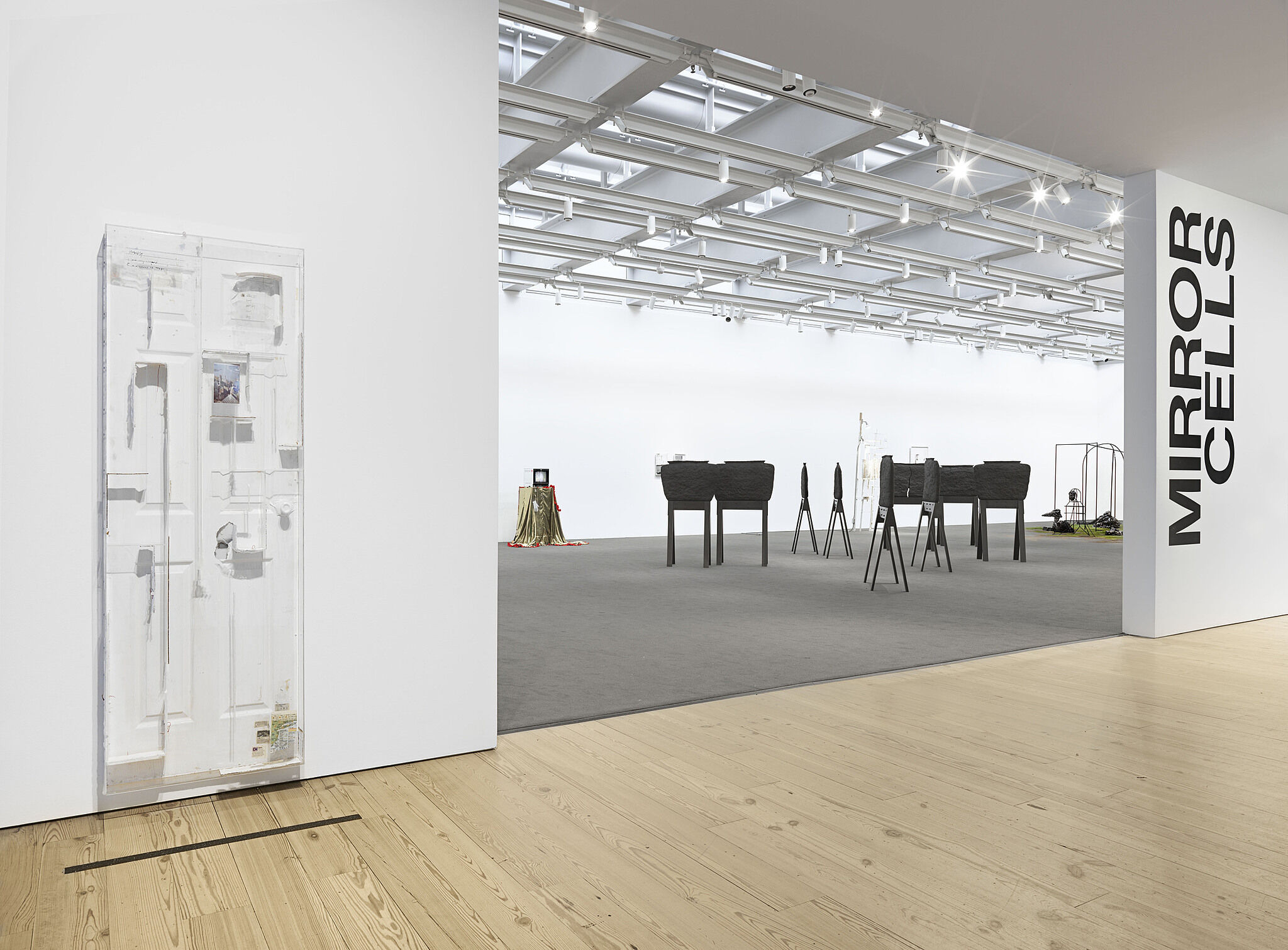
Jane Panetta: The artists in this show all seem to have a similar interest in materiality, in using certain materials, like ceramic, wood, fabric, maybe what might be considered more modest materials. I think we saw this narrative thread in the work—or this willingness to engage in figurative forms, in figurative objects—particularly interesting right now. In a lot of ways we’ve been in a moment that’s been very partial to conceptual work, or more abstract work, or work that feels maybe high-production. And I think in contrast here, there is this—as I said—openness to engage with narrative, to engage with figurative form in a kind of unapologetic way.
Installation view of Mirror Cells (Whitney Museum of American Art, New York, May 13–August 21, 2016). Photograph by Genevieve Hanson

Maggie Lee: Hi, I'm Maggie Lee. I made this film called Mommy, and it's based off of my family.
Narrator: Lee began the film after her mother, a Taiwanese immigrant, died unexpectedly. Parts of the film, which is divided into chapters, are playing in the two sculptural installations nearby. One monitor screens the chapters of the film that center on the artist. The other focuses on her mother. Lee says that each installation offers a kind of window into a character’s life.
Maggie Lee: I try not to have it look directly like the video, because the video is there for someone to watch, and I'm just creating a scene that is another layer of the chapter that relates, but is not present in the film.
My mother's viewing installation is basically a display case, mixing ideas of the old world, coming from Taiwan, and the new world, coming to the U.S. The display case is also a Buddhist altar where you can find small objects. Things that my mother would like, but also personalized collages of family photos.
My mom worked so hard her whole life, and always wanted the best, and gave me the best, and was also really worried that I wanted to be an artist. So this is a way where museum visitors can come to see my mom's altar, but also see my life as an artist now.
Narrator: To hear about the installation that Lee made to represent herself, please tap the button on your screen.
Maggie Lee (b. 1987), still from Mommy, 2015. Digital video. 56 mins, 23 secs. Image courtesy the artist.
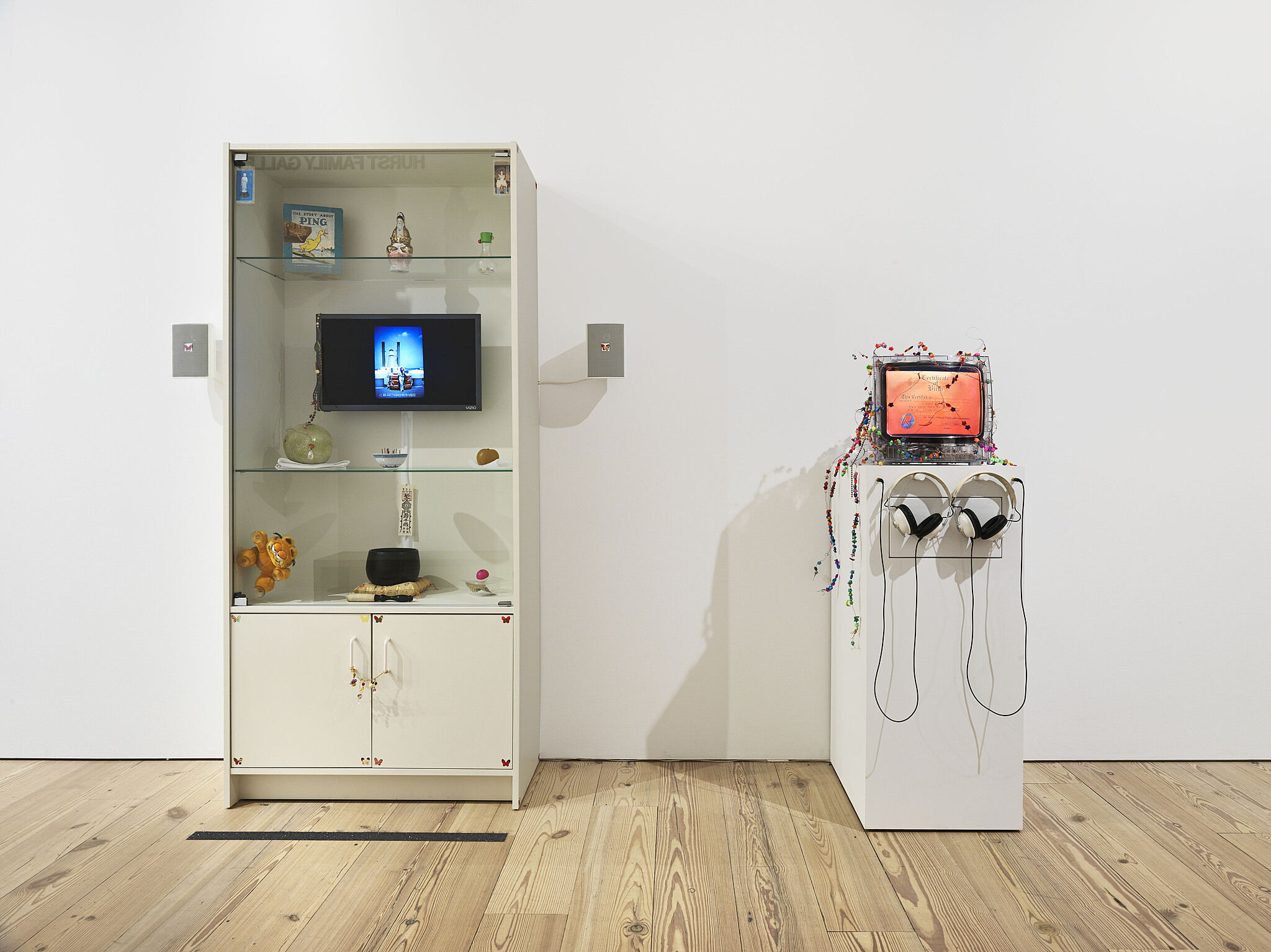
Maggie Lee: My TV viewing installation is a clear TV with little origami folding stars that I used to play with as a child, but they're forming inside the membrane of the clear TV.
There's also marks on the TV that give the indication of birth, in a way. It seems as if this TV is being born, and it's representative of my own character. Tiny origami folding stars are bursting inside the TV, as well as outside, and overflowing with ideas from since I was born, since I was a baby, up until what is relevant now.
Installation view of Mirror Cells (Whitney Museum of American Art, New York, May 13–August 21, 2016). Photograph by Genevieve Hanson
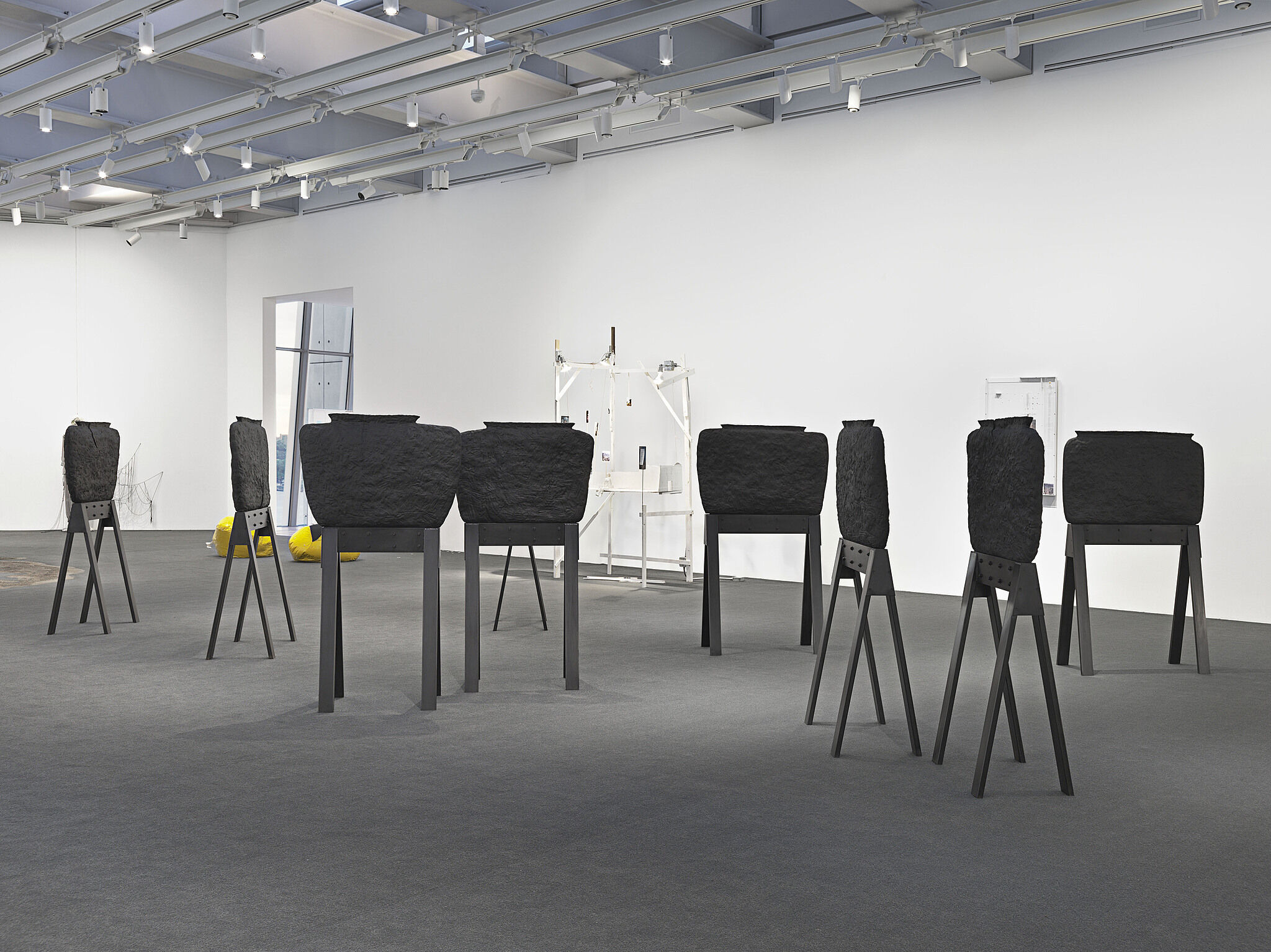
Elizabeth Jaeger: My name is Elizabeth Jaeger.
I guess something that could be interesting to know is the amount of failure involved in these specific vases. I think I've made twenty to twenty-five of them, and less than ten have survived. They're kind of this design that makes no sense. I feel like I'm shooting myself in the foot. It was intentional for them to look like they're about to fall over, but the consequence is that most of them fall over.
My initial intention was to make something deceitful, where from the side it appears much different than from the front. Through this process of having so many of them fail or be rebuilt—if they fall, I have to cut off half of them and start over—it became about salvaging or saving something.
I had this moment with a friend where we were talking about what they were about, and he was talking about how you can't really get inside of them. I had this moment where I realized they're very much about my grandfather, in the sense of, he has dementia. I grew up with him, and when I was old enough to get to know him, he was already losing his mind. Having this conversation with this friend I realize it all at once, that I was making this thing that was really physically challenging, but at the end was completely useless, or inaccessible, or difficult to parse out. That was related to trying to get to know someone who's losing their mind, in a way.
Installation view of Mirror Cells (Whitney Museum of American Art, New York, May 13–August 21, 2016). Photograph by Genevieve Hanson
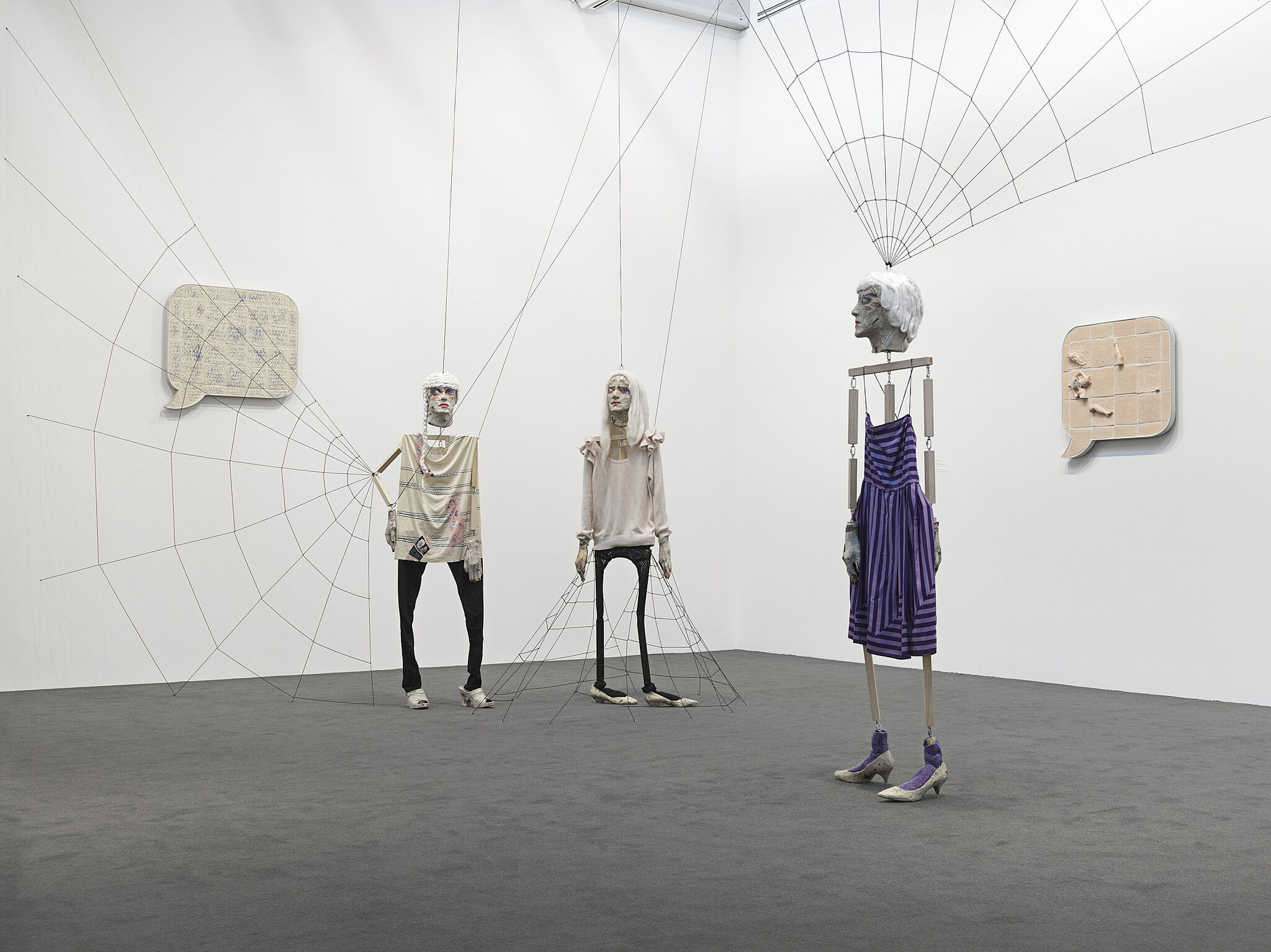
Narrator: A few years ago, Liz Craft was looking for a way to sculpt a human figure inexpensively, and in a way that would be easy to ship. She realized that she could focus entirely on the head, hands, and feet, using clothes to cover up the rest. She had been interested in marionettes for a while, and decided to use strings to control the figures' poses and gestures. She attached these strings to the wall.
Liz Craft: It became like a spider in the web. The web is installed in the space. It's a figure, but really it's this piece that has to be incorporated into the space of the room. I like thinking about that in a more abstract way. I feel people are really integrated into landscape. And usually you think of yourself floating along in this body, but really I think you’re more integrated into the space.
Narrator: Craft has also installed ceramic pieces on the walls, both in the exhibition and in the café nearby. They look like cartoon word bubbles. If you’d like to hear about them, please tap the button on your screen.
Installation view of Mirror Cells (Whitney Museum of American Art, New York, May 13–August 21, 2016). Photograph by Genevieve Hanson
Liz Craft: I had a show of these before, and I thought the bubbles were some internal thoughts that these women were having that normally you can't read what people are thinking. I thought of them that way. Also, I thought that was the mind, and the women were these bodies.
In this case, I don't know if it's going to be that way, because the bubbles that I had before that went with the marionettes, it was more of this internal dialogue, whereas these ones, it's different. Some are like jokes, some are referencing back to the café—like what people saw in the café tables then they're going to see again in the bubble.
It's more abstracted. They're in the shape of a word bubble, but it's not really. I don't think the marionettes are saying something. It's more like some invisible idea of who would be saying that.
Installation view of Mirror Cells (Whitney Museum of American Art, New York, May 13–August 21, 2016). Photograph by Genevieve Hanson
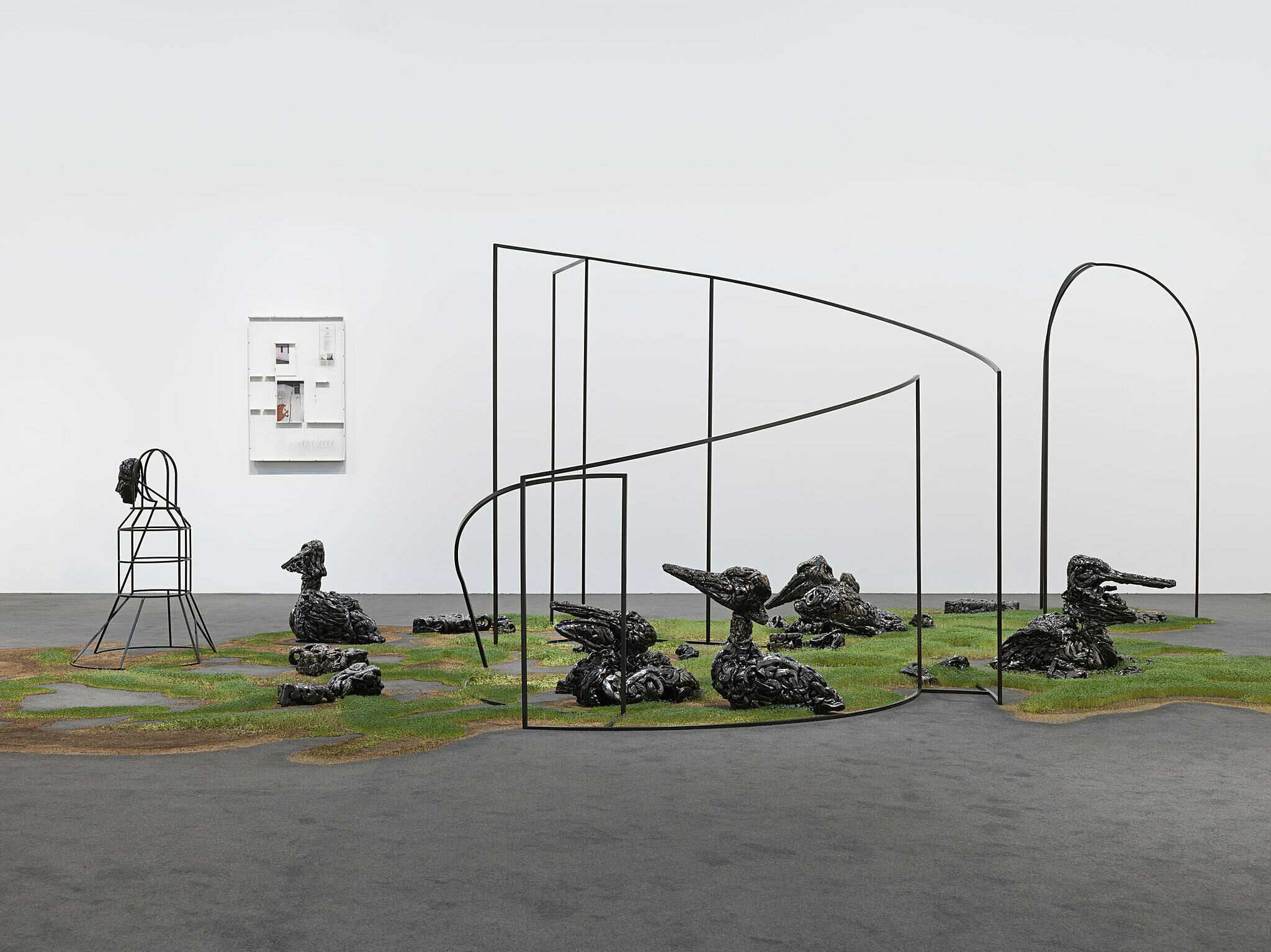
Narrator: Chia plants growing on a carpet spread across the room is part of Rochelle Goldberg’s Nowhere, Now Here. Some of the plants have just recently sprouted; others are already on the way to decay.
Rochelle Goldberg: I wanted a material that would speak to an idea of emergent growth and life cycle. Often, when I do the piece, a common question is, "Is this real?" Of course, what do you mean when you're asking if a living plant is real? The chia readily engages with that kind of attitude because it has this almost virtual green aesthetic to it. It's almost somewhere between grass, and moss, and an unknown future plant.
The ceramic forms within the composition of the carpet are these wreathing entanglements of serpent segments that are coiling into shapes of pelicans and swans, and the determination of the species is never fully reached. It's always in a process of emerging or unbecoming.
There is a kind of social engagement between these diverse entities. Between the seed, the ceramic, and the steel, they're all talking to each other. That conversation then opens up, through the chia leaking out and swarming, and infecting various zones and areas, in and around the other sculptures by my peers.
Installation view of Mirror Cells (Whitney Museum of American Art, New York, May 13–August 21, 2016). Photograph by Genevieve Hanson, N.Y.
0:00
0:00