Human Interest
2016
This audio guide highlights selected works in Human Interest: Portraits from the Whitney’s Collection, with commentary by students from PS 33 Chelsea Prep and Whitney Museum educator Melanie Adsit.
-
601
Kerry James Marshall, Souvenir IV, 1998
Audio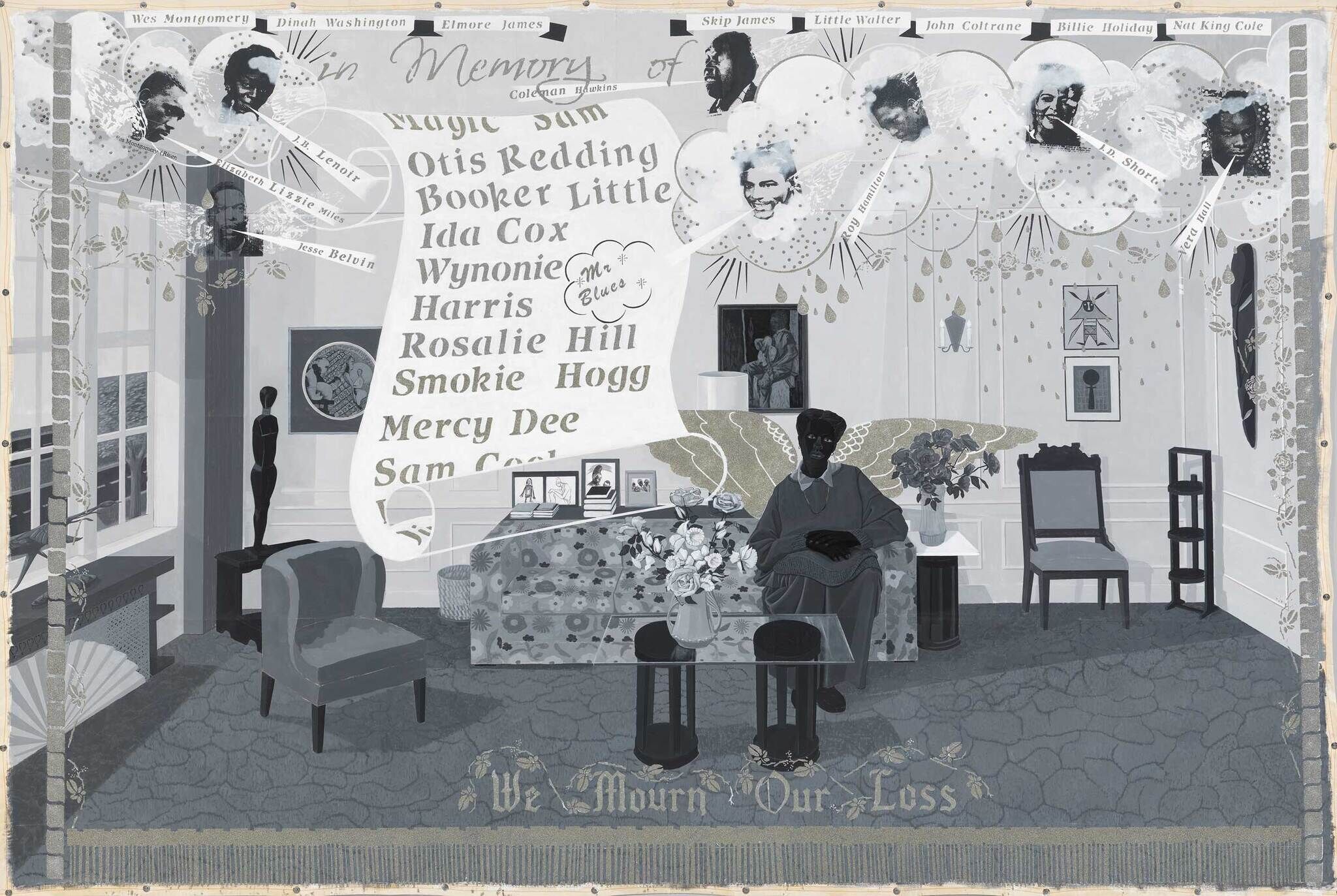
-
602
Alison Saar, Skin/Deep, 1993
Audio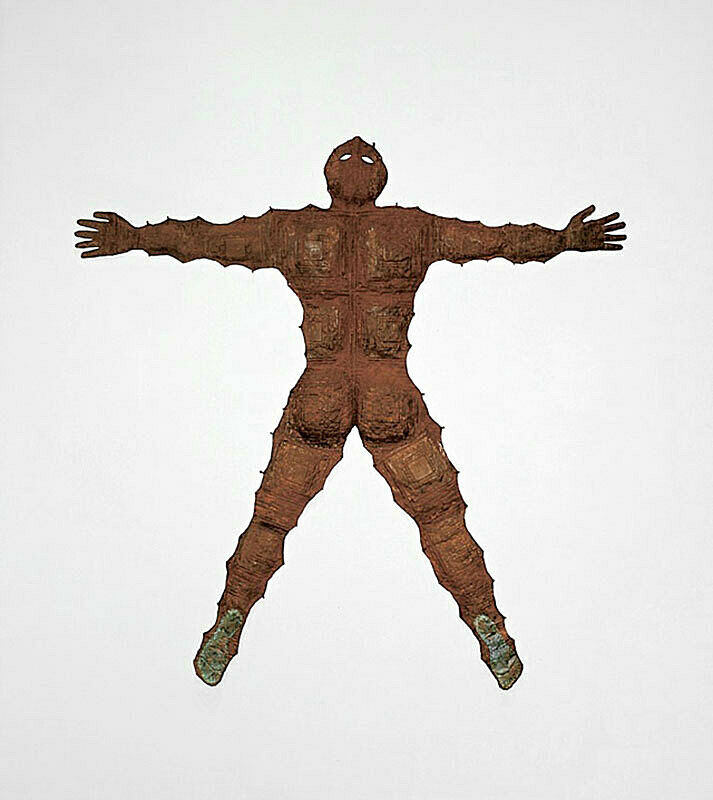
-
611
Joan Semmel, Touch, 1975
Audio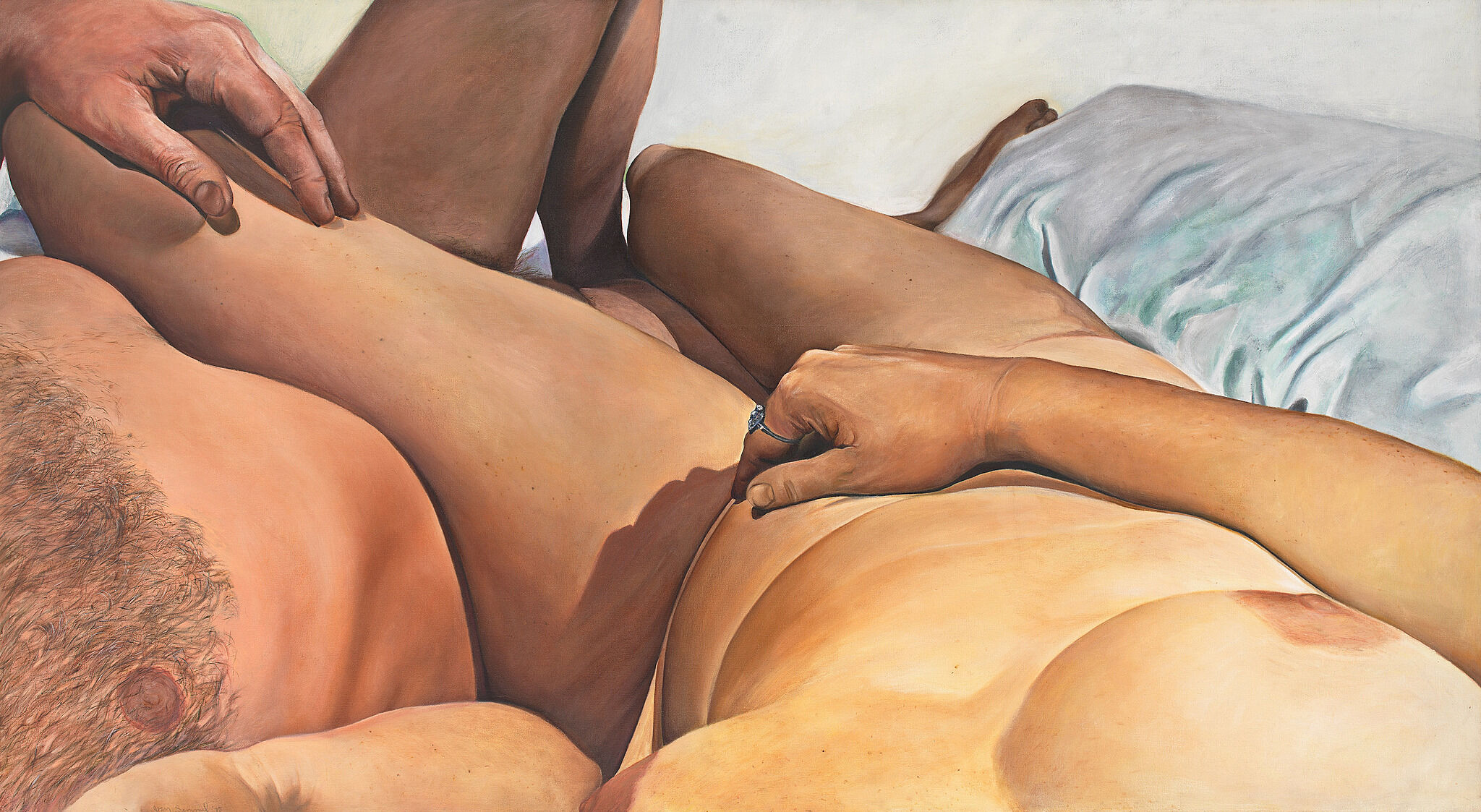
-
611-2
Joan Semmel, Touch, 1975
Audio
-
612
Deana Lawson, The Garden, Gemena, DR Congo, 2015
Audio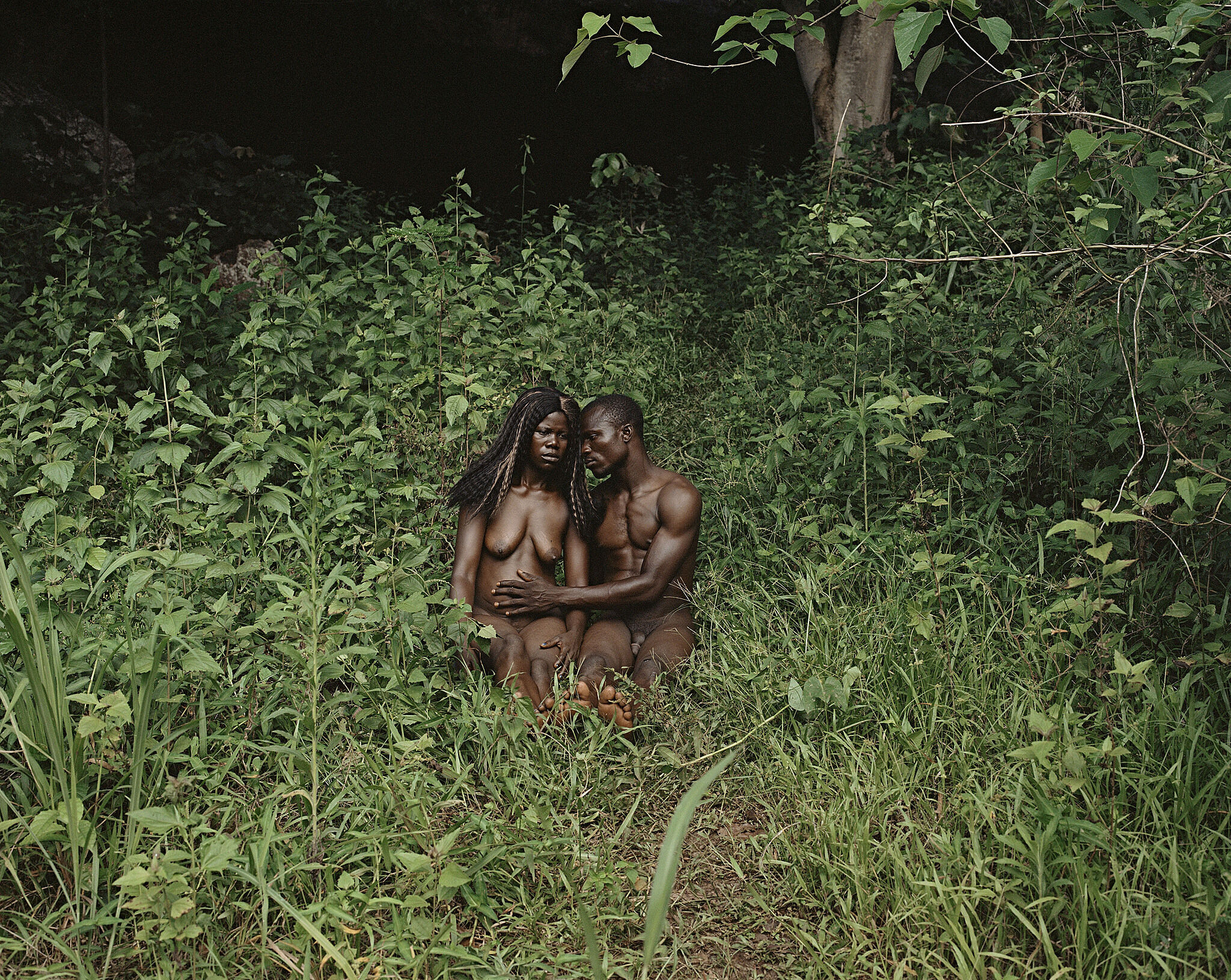
-
613
Alice Neel, Andy Warhol, 1970
Audio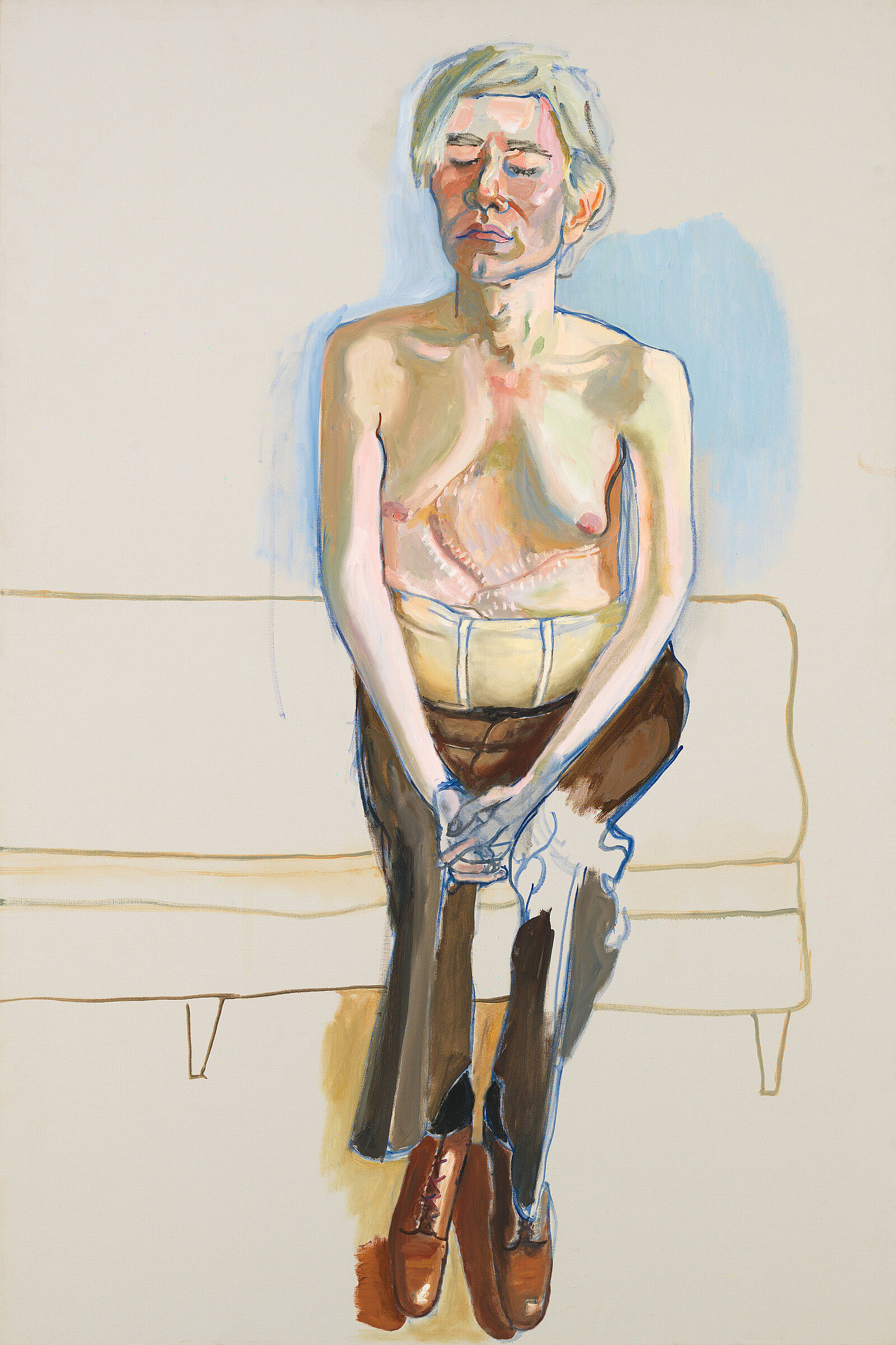
-
615
R.H. Quaytman, Distracting Distance, Chapter 16, 2010
Audio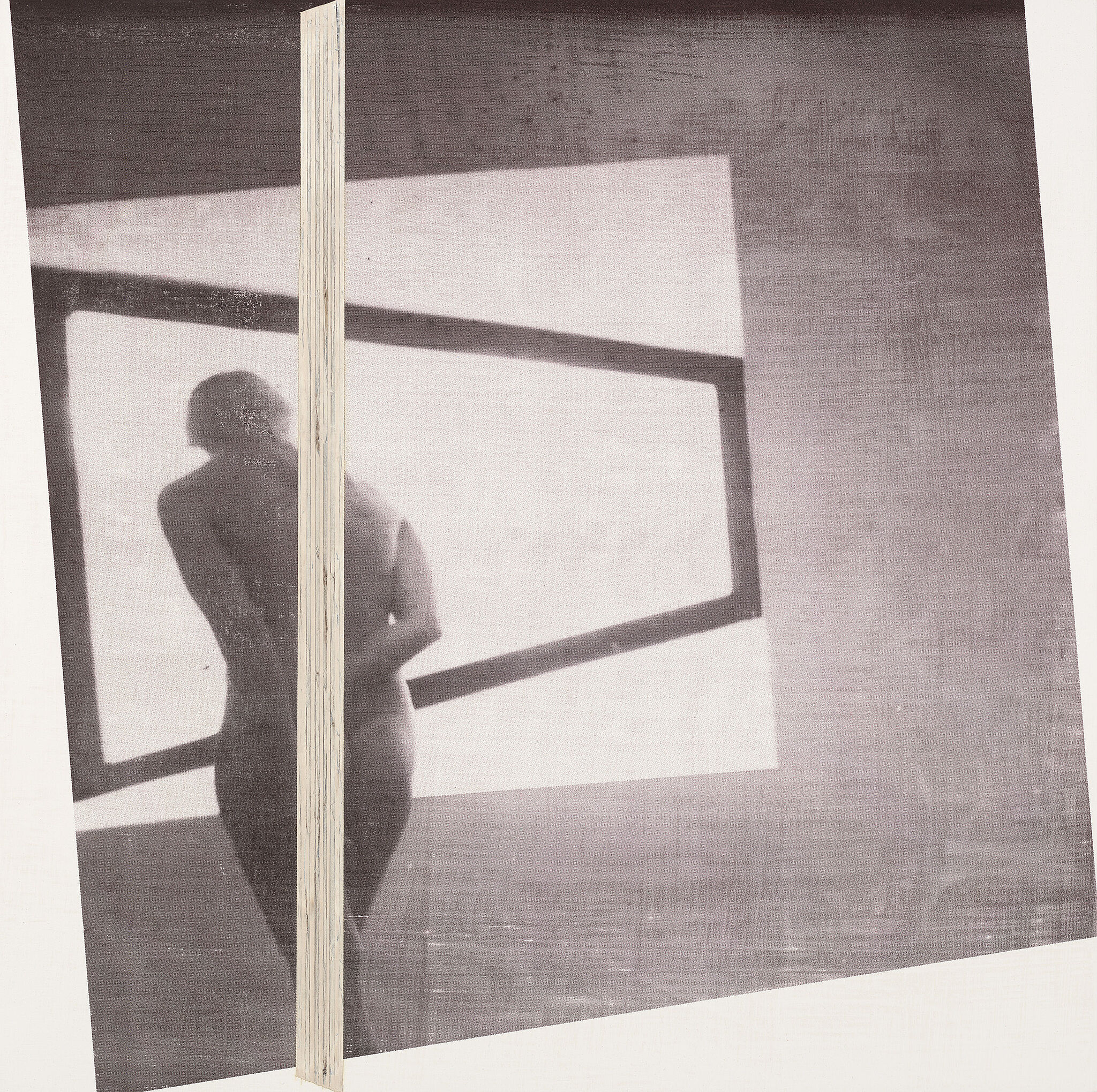
-
616
Catherine Opie, Ron Athey, 1994
Audio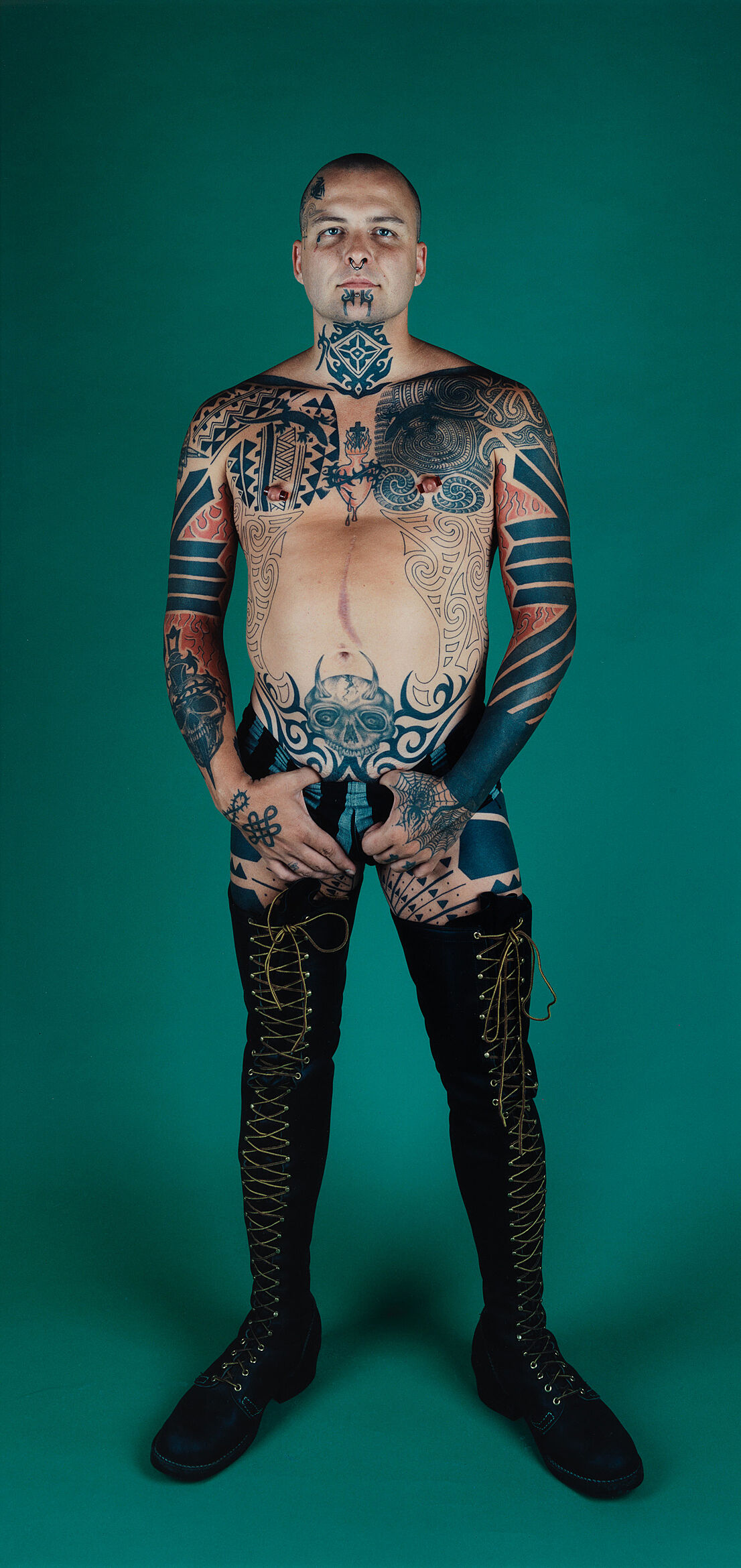
-
617
John Coplans, Frieze, No. 2, Four Panels, 1994
Audio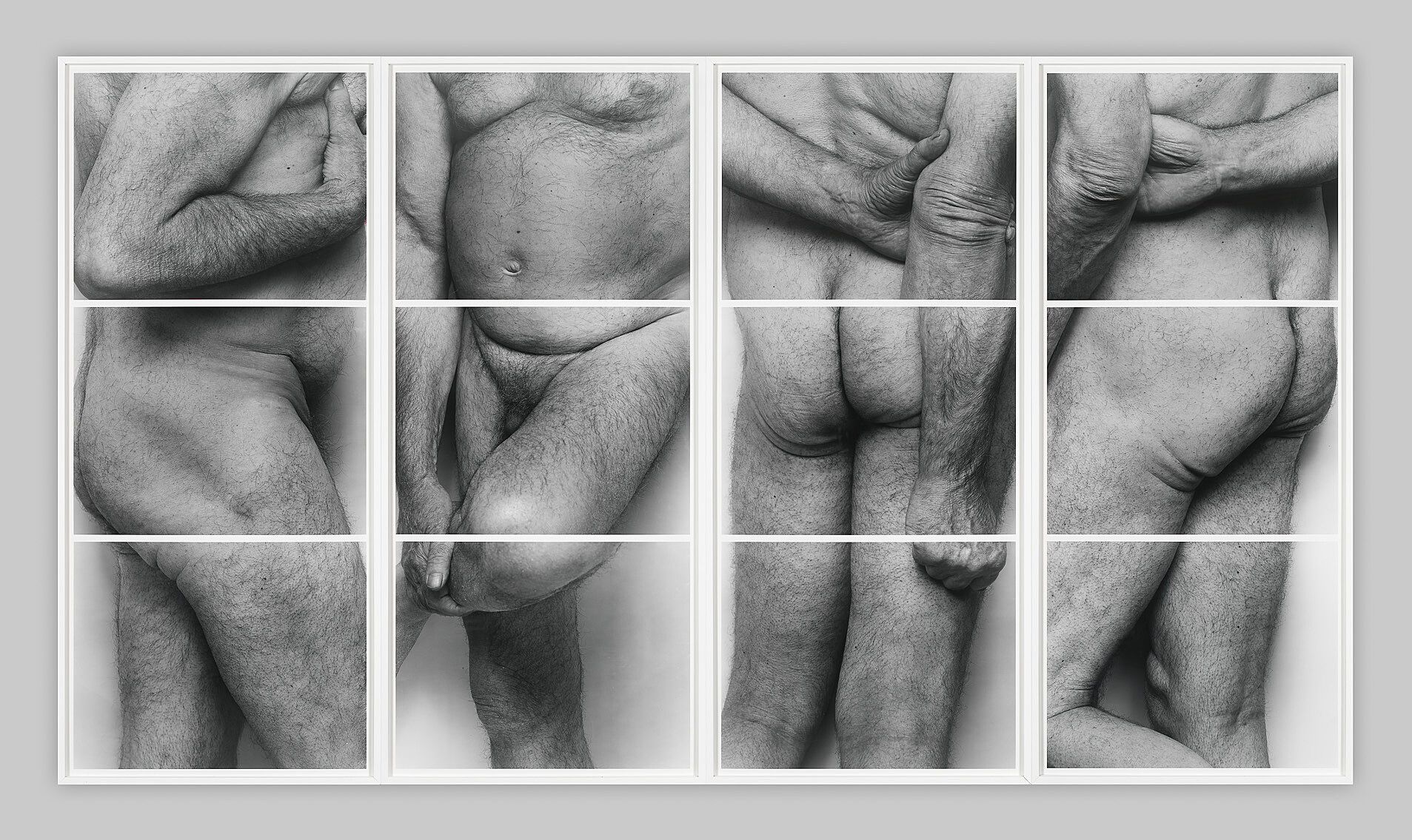
-
618
Mary Kelly, Antepartum, 1973
Audio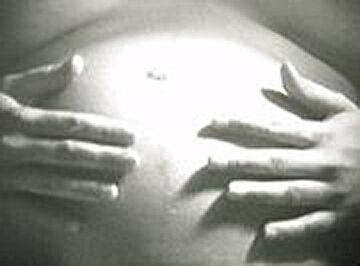
-
619
Alvin Baltrop, Untitled, 1977
Audio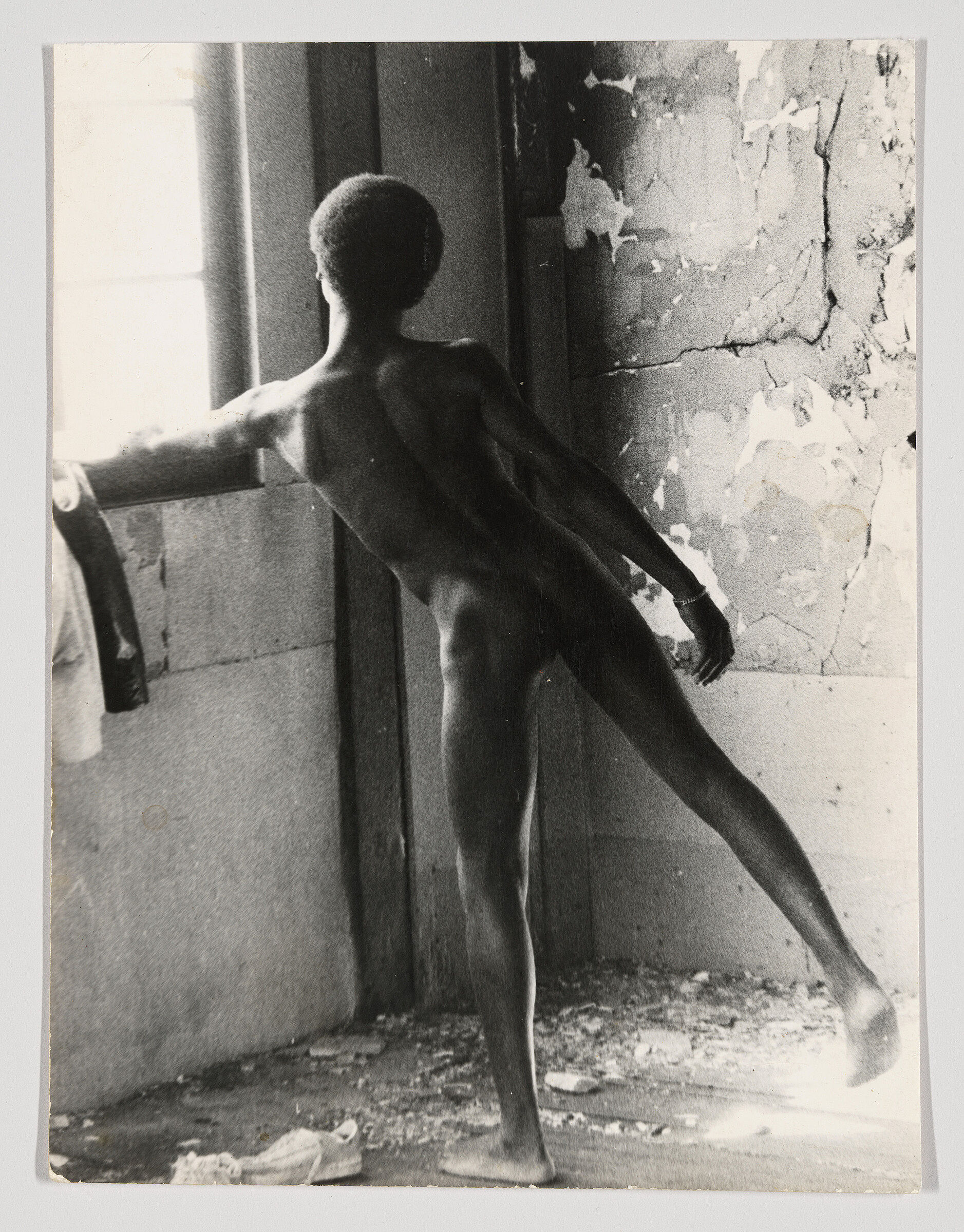
-
631
Bruce Nauman, Six inches of my knee extended to six feet, 1967
Audio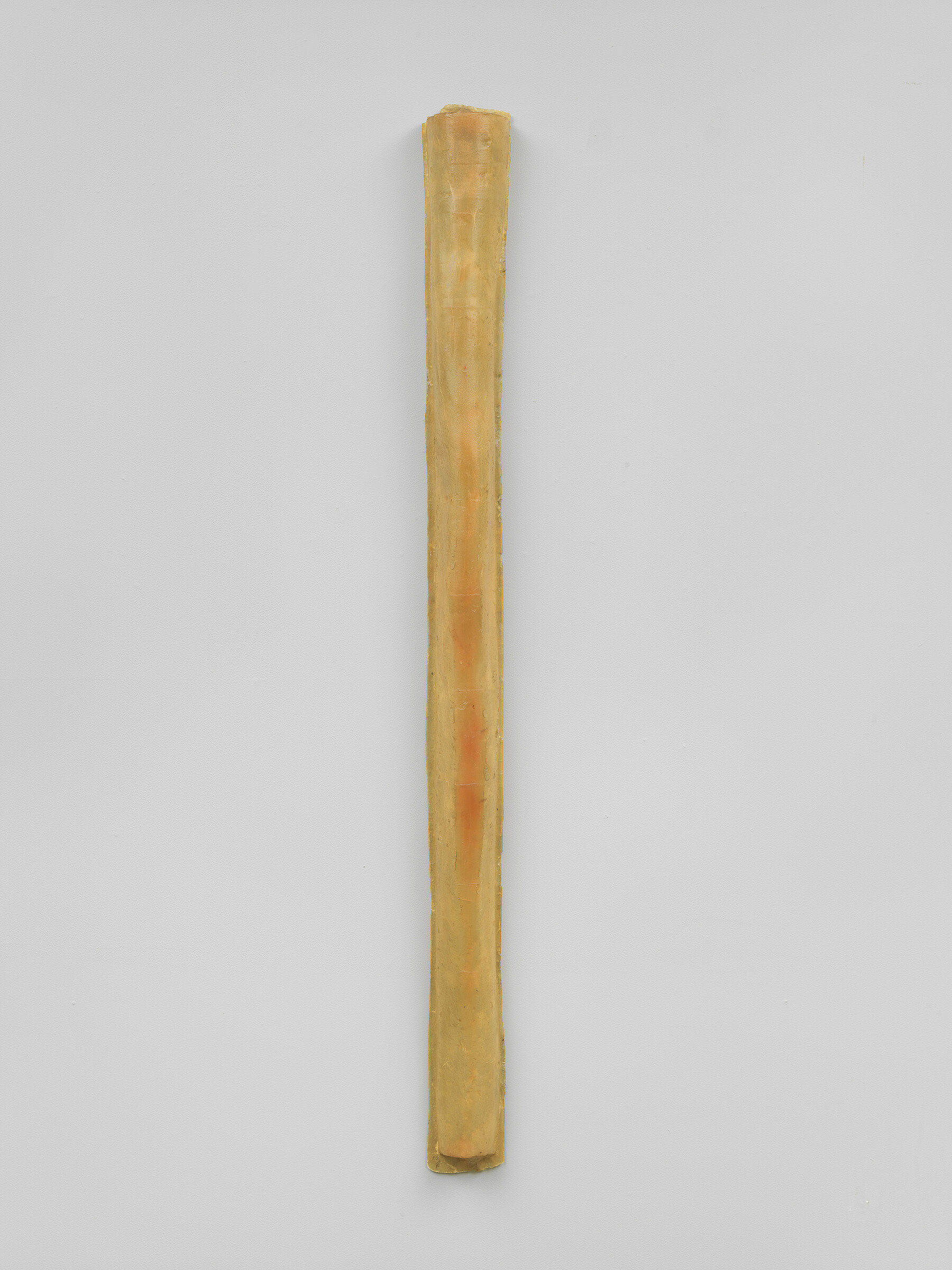
-
641
Andy Warhol, Nine Jackies, 1964
Audio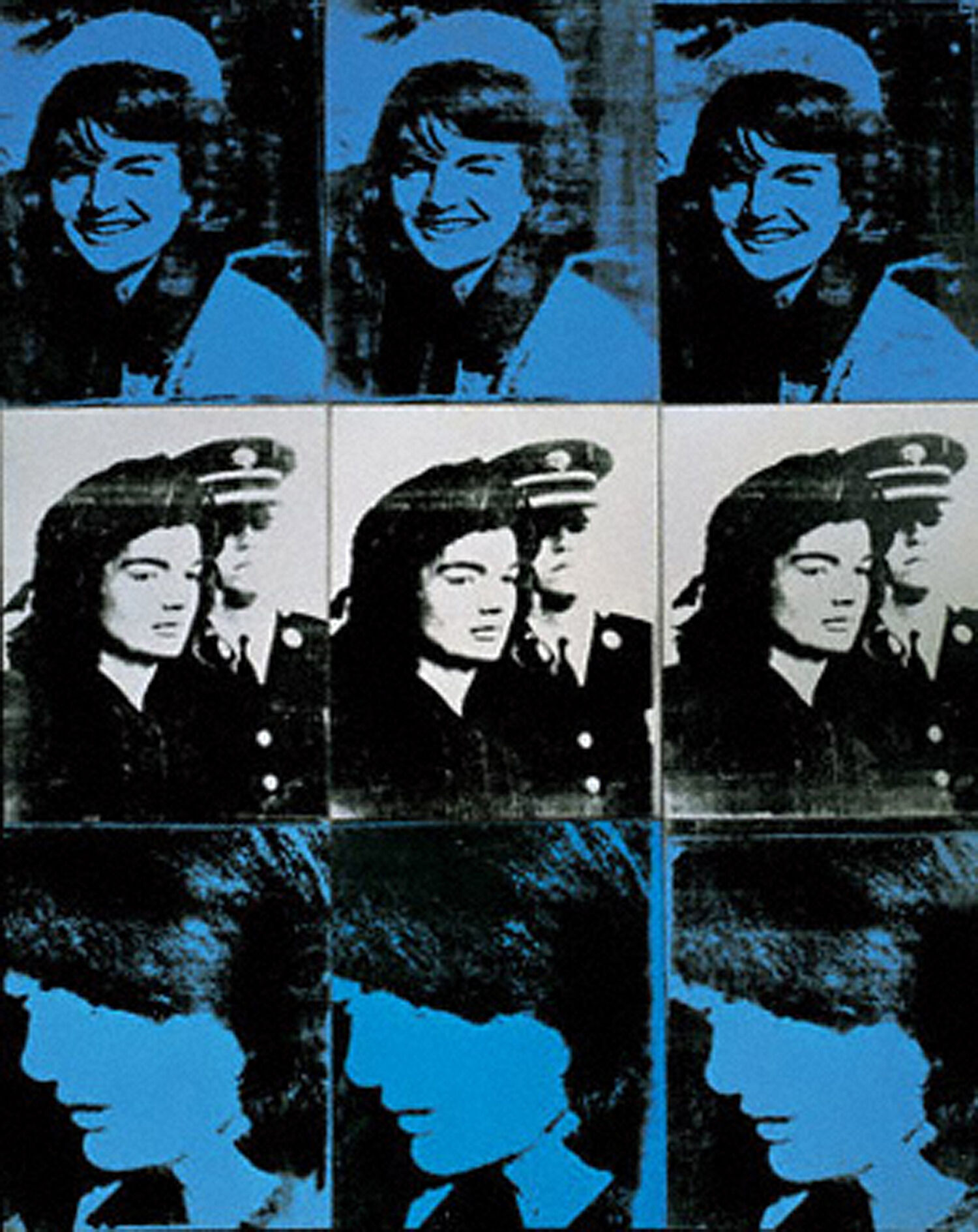
-
641-2
Andy Warhol, Nine Jackies, 1964
Audio
-
651
Jean-Michel Basquiat, Hollywood Africans, 1983
Audio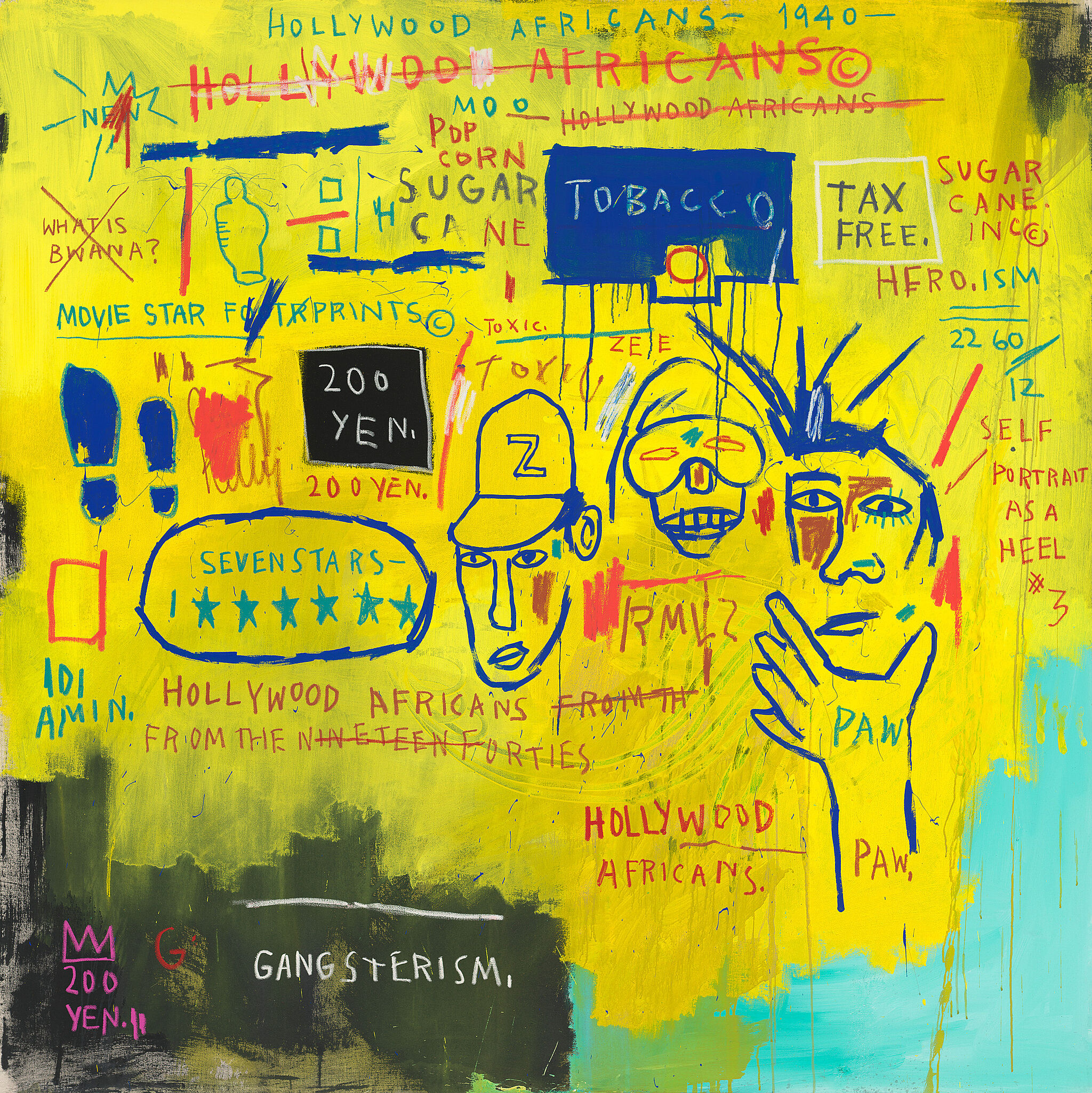
-
652
K8 Hardy, Position Series #20, 2009
Audio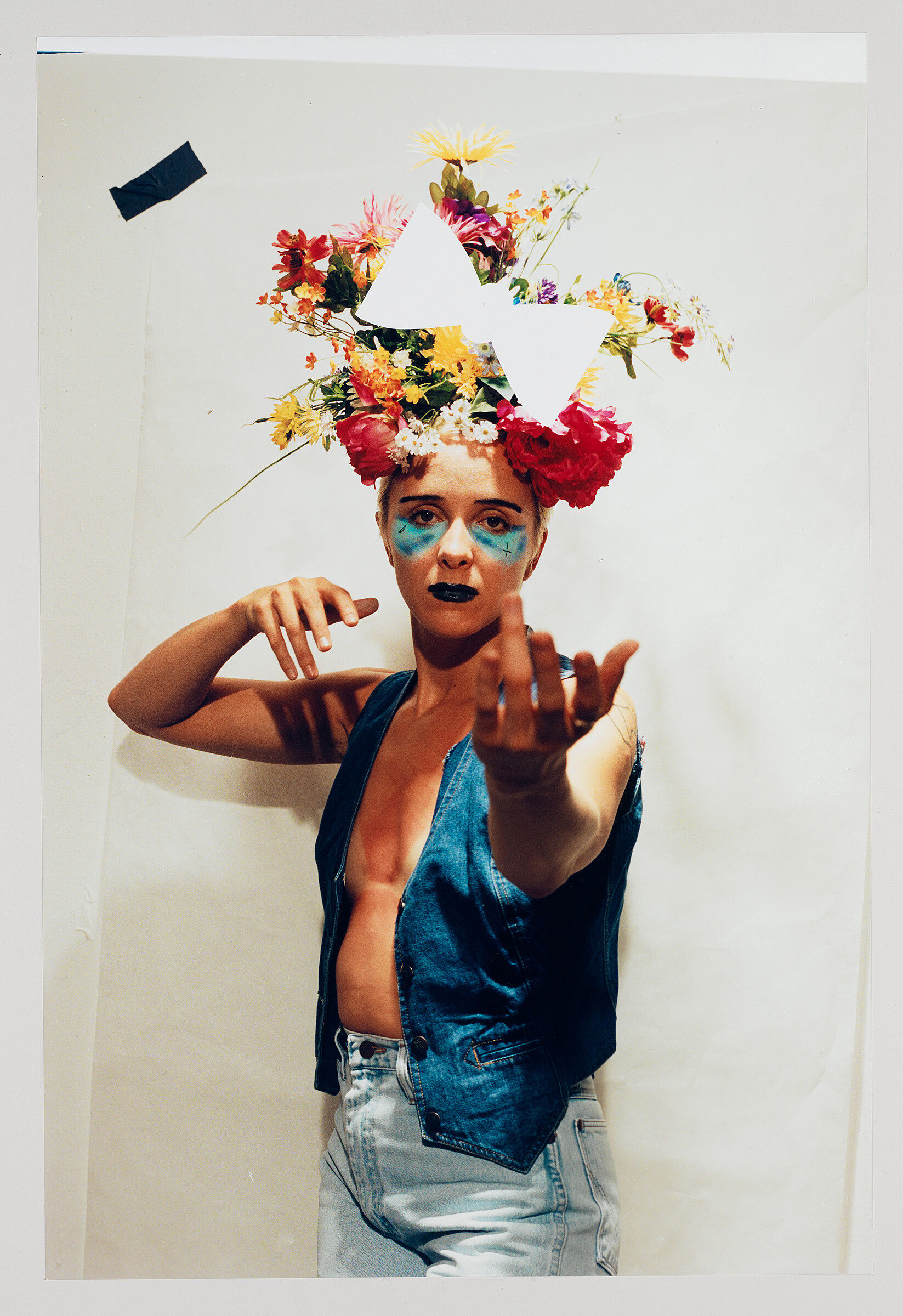
-
653
Cindy Sherman, Untitled, 2008
Audio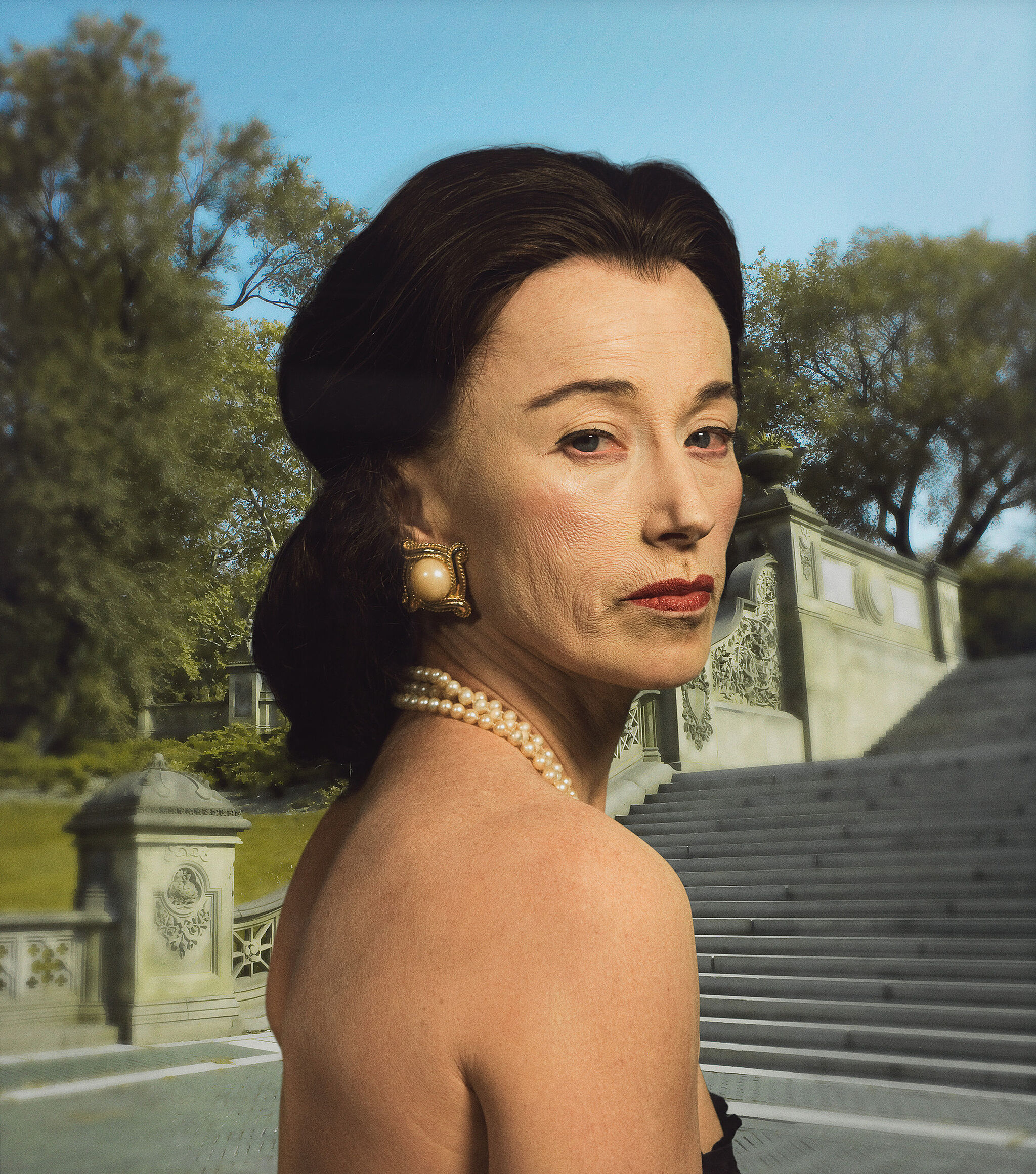
-
661
Gary Simmons, Lineup, 1993
Audio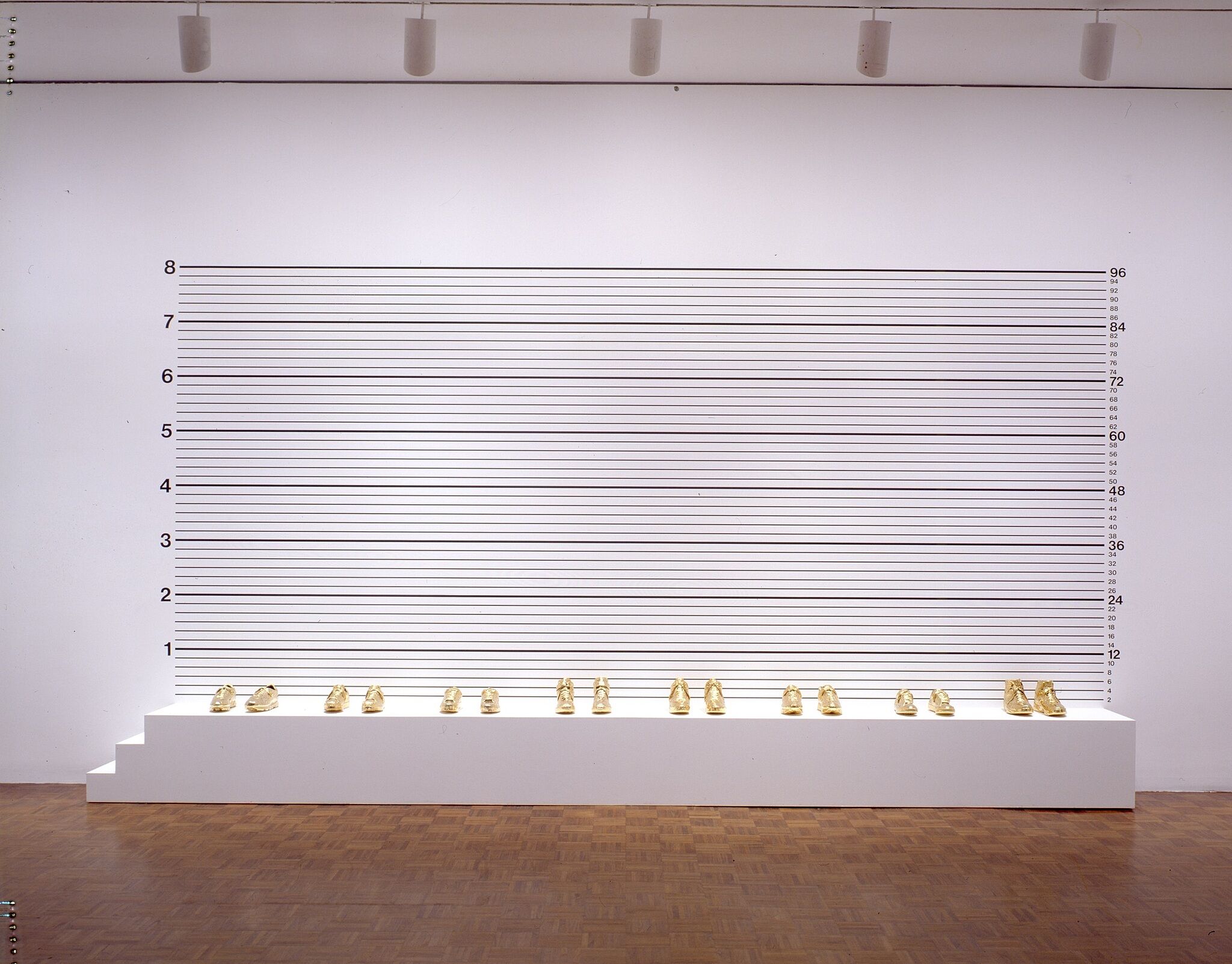
-
662
Mike Kelley, Educational Complex, 1995
Audio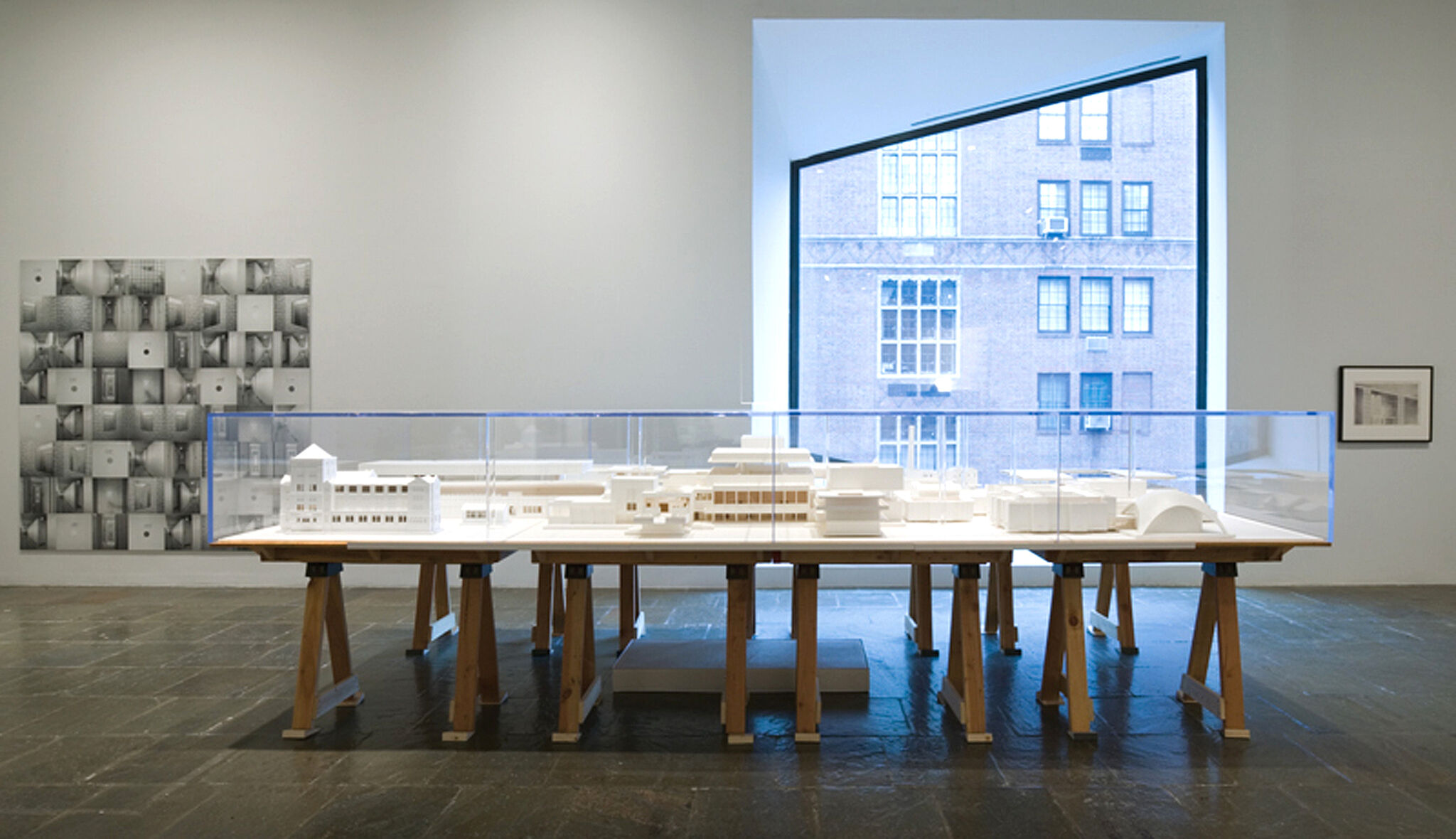
-
663
Glenn Ligon, Self-Portraits, 1996
Audio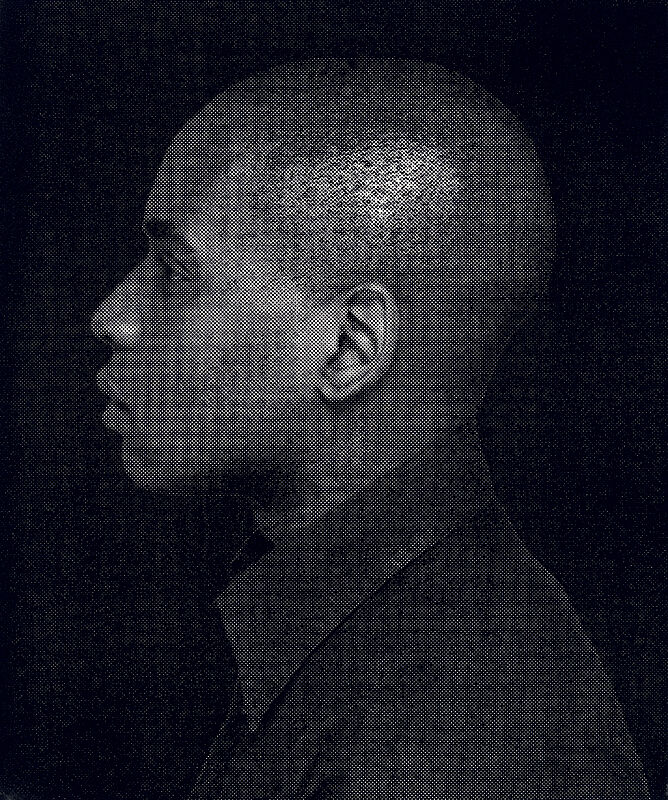
-
664
Byron Kim, Synecdoche [Whitney Artists], 1999–2001
Audio
-
664-2
Byron Kim, Synecdoche [Whitney Artists], 1999–2001
Audio
-
713
Jay DeFeo, Study for September Blackberries, c. 1972–73
Audio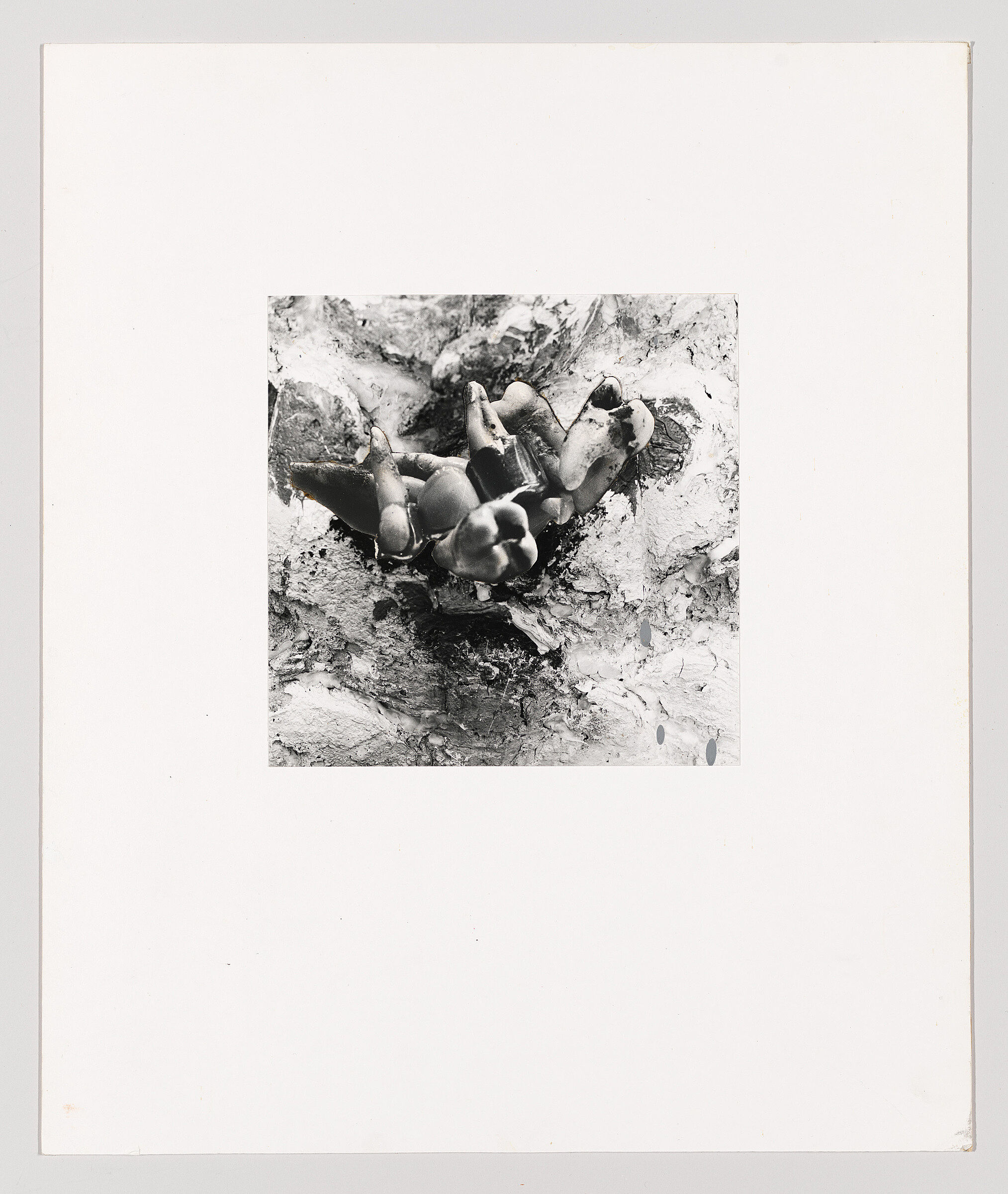
-
732
Toyo Miyatake, Michio Ito in the Pizzicato, 1929
Audio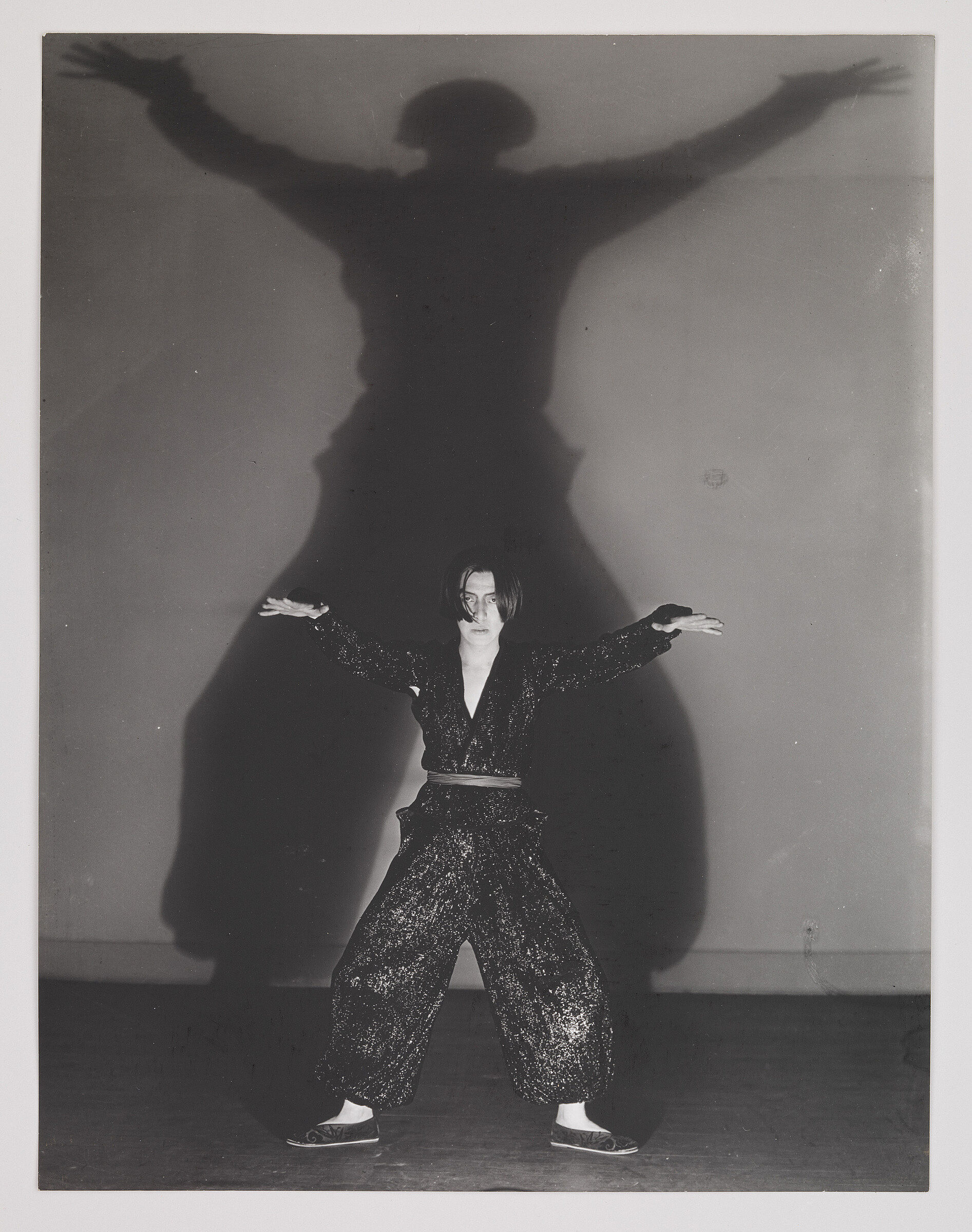
-
751
Helen Levitt, Street Drawing, c. 1940
Audio
-
752
Diane Arbus, Woman with a Veil on Fifth Avenue, N.Y.C., 1968
Audio -
771
Gaston Lachaise, Standing Woman, 1912–27
Audio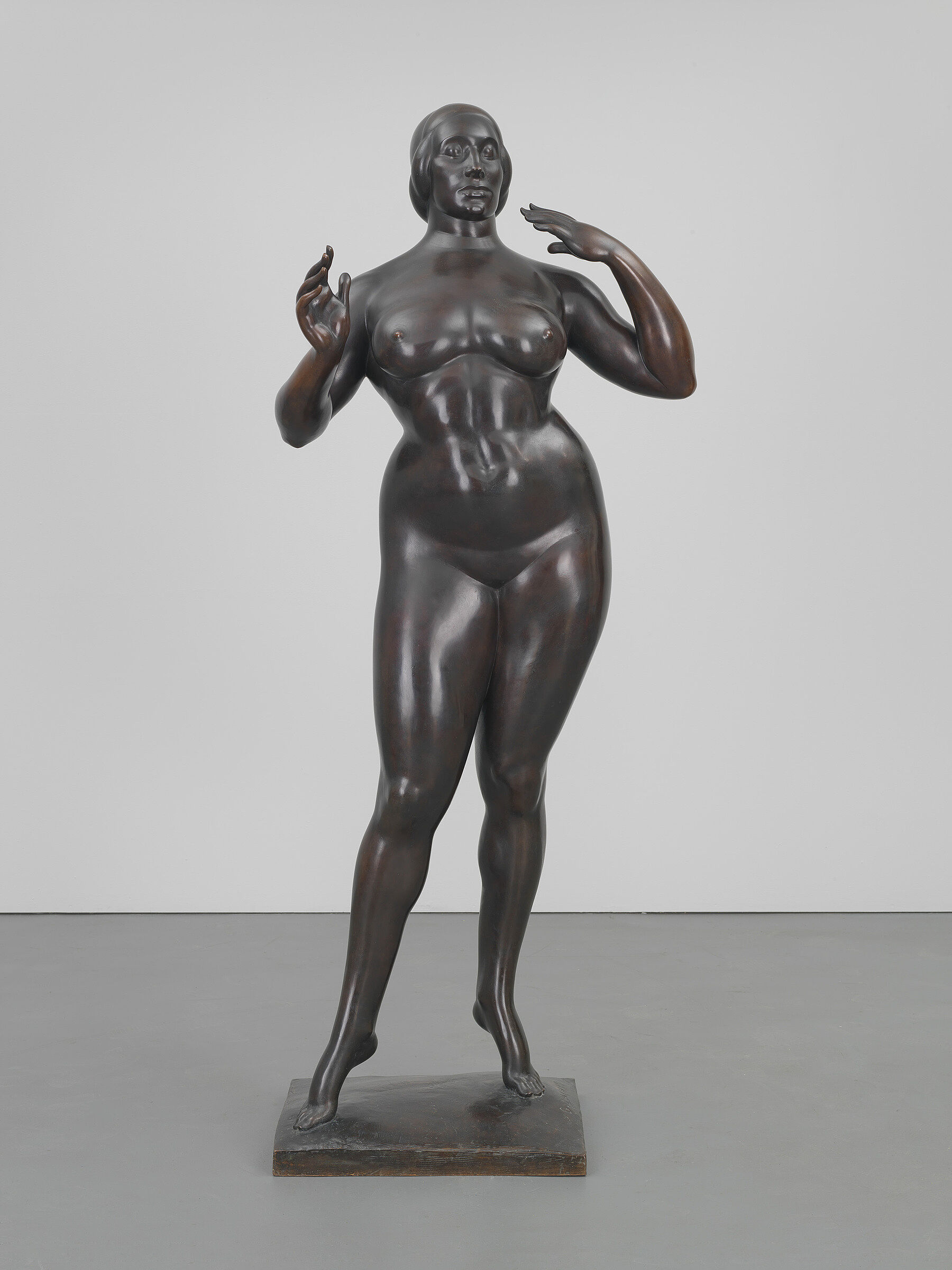
-
603
Duane Hanson, Woman with Dog, 1977
Kids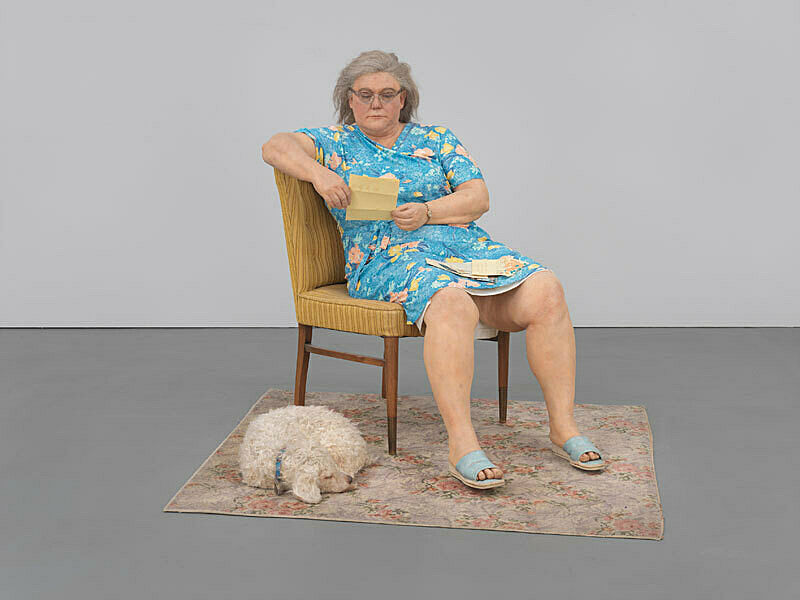
-
604
Chuck Close, Lyle, 1999
Kids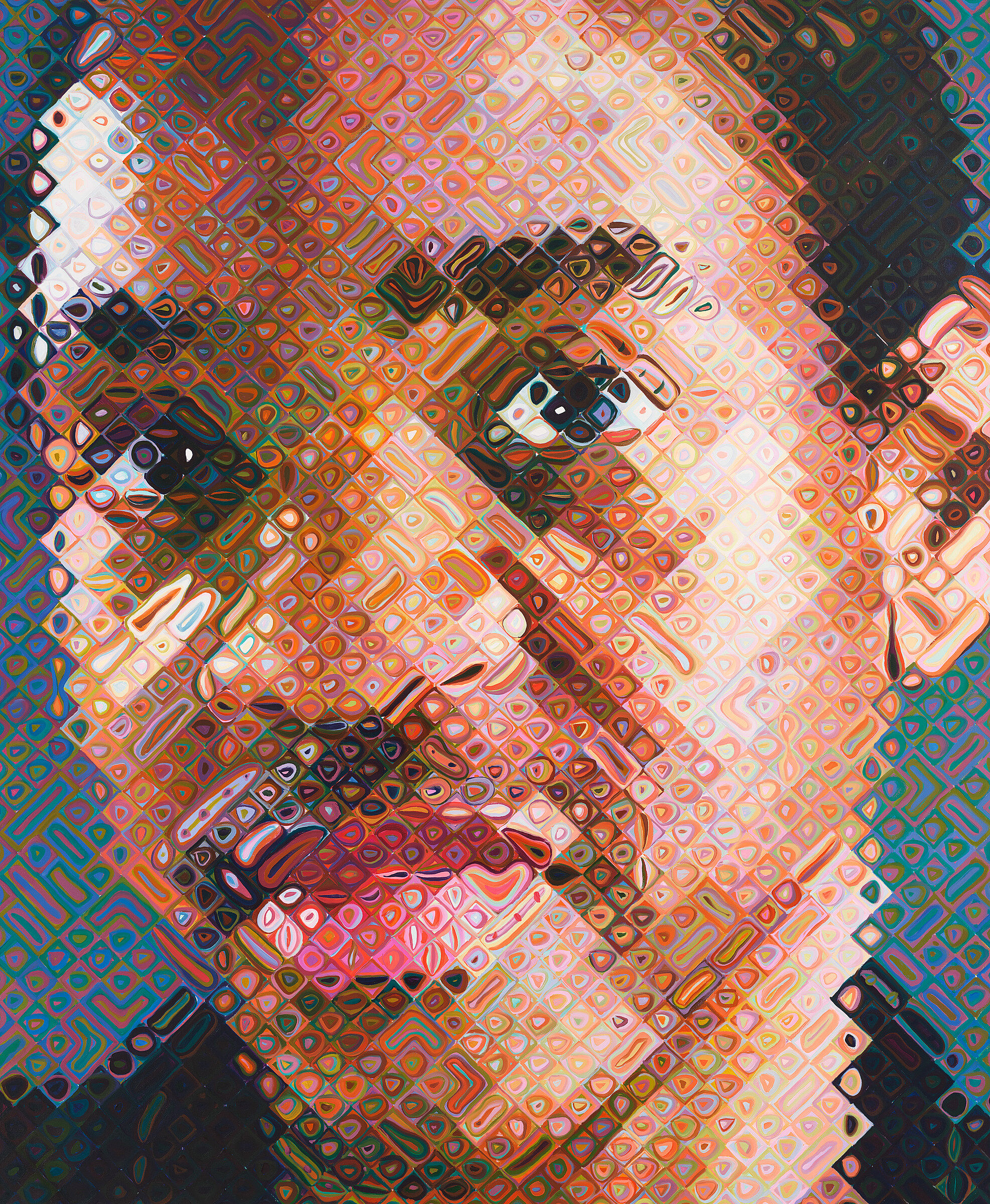
-
665
Josh Kline, Cost of Living (Aleyda), 2014
Kids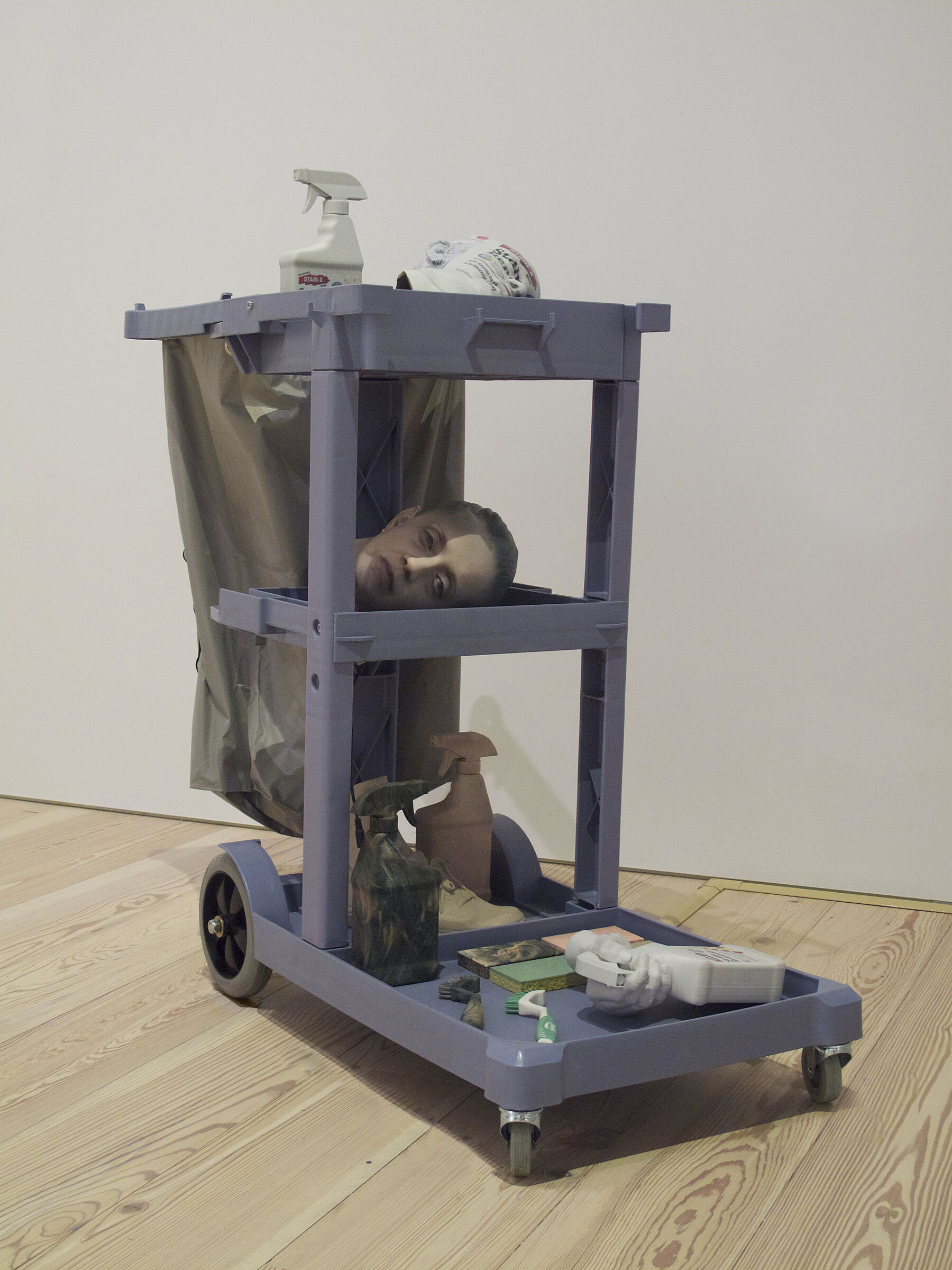
-
666
Urs Fischer, Standing Julian, 2015
Kids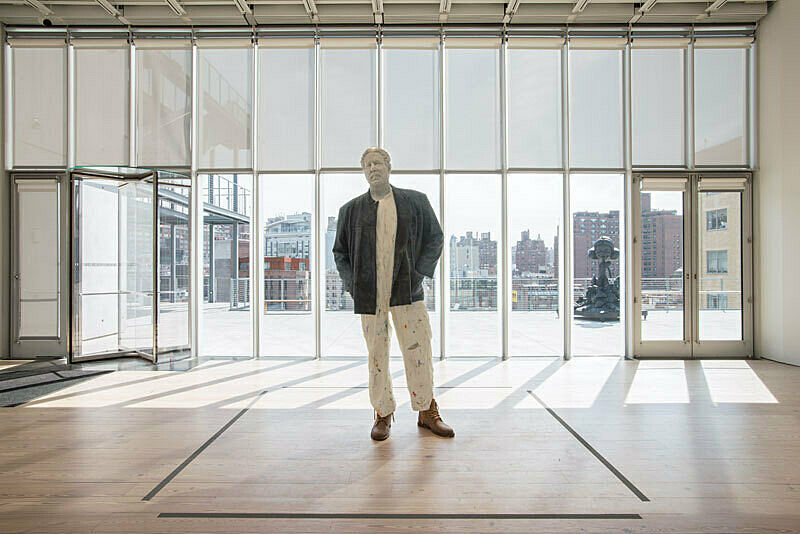
-
667
Paul McCarthy, White Snow #3, 2012
Kids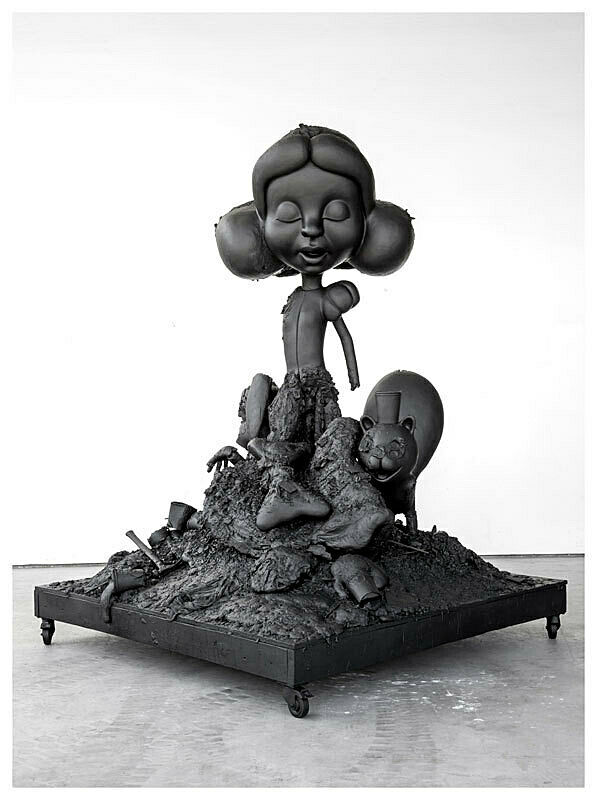
-
703
Robert Bechtle, ’61 Pontiac, 1968
Kids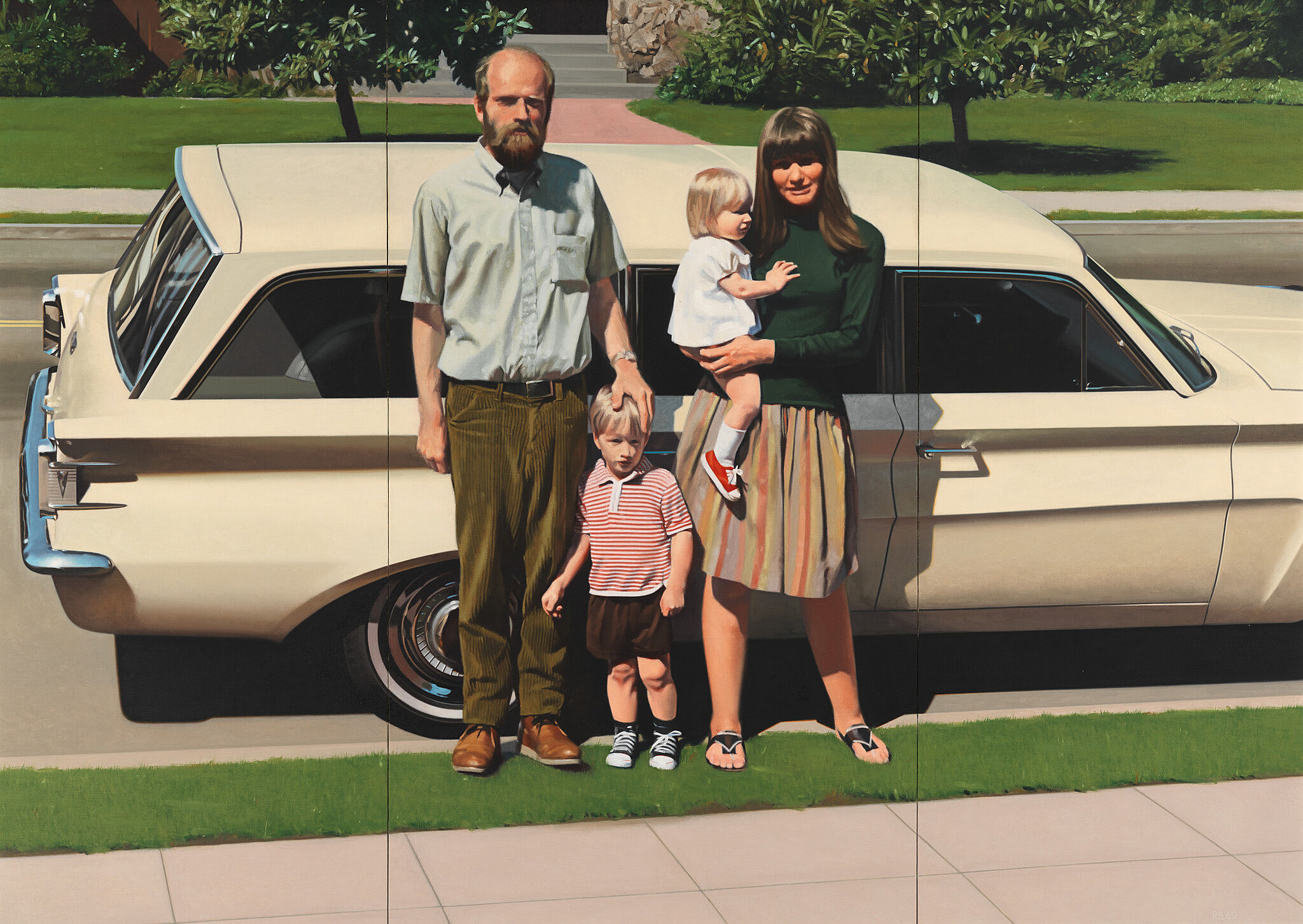
-
705
Barkley Hendricks, Steve, 1976
Kids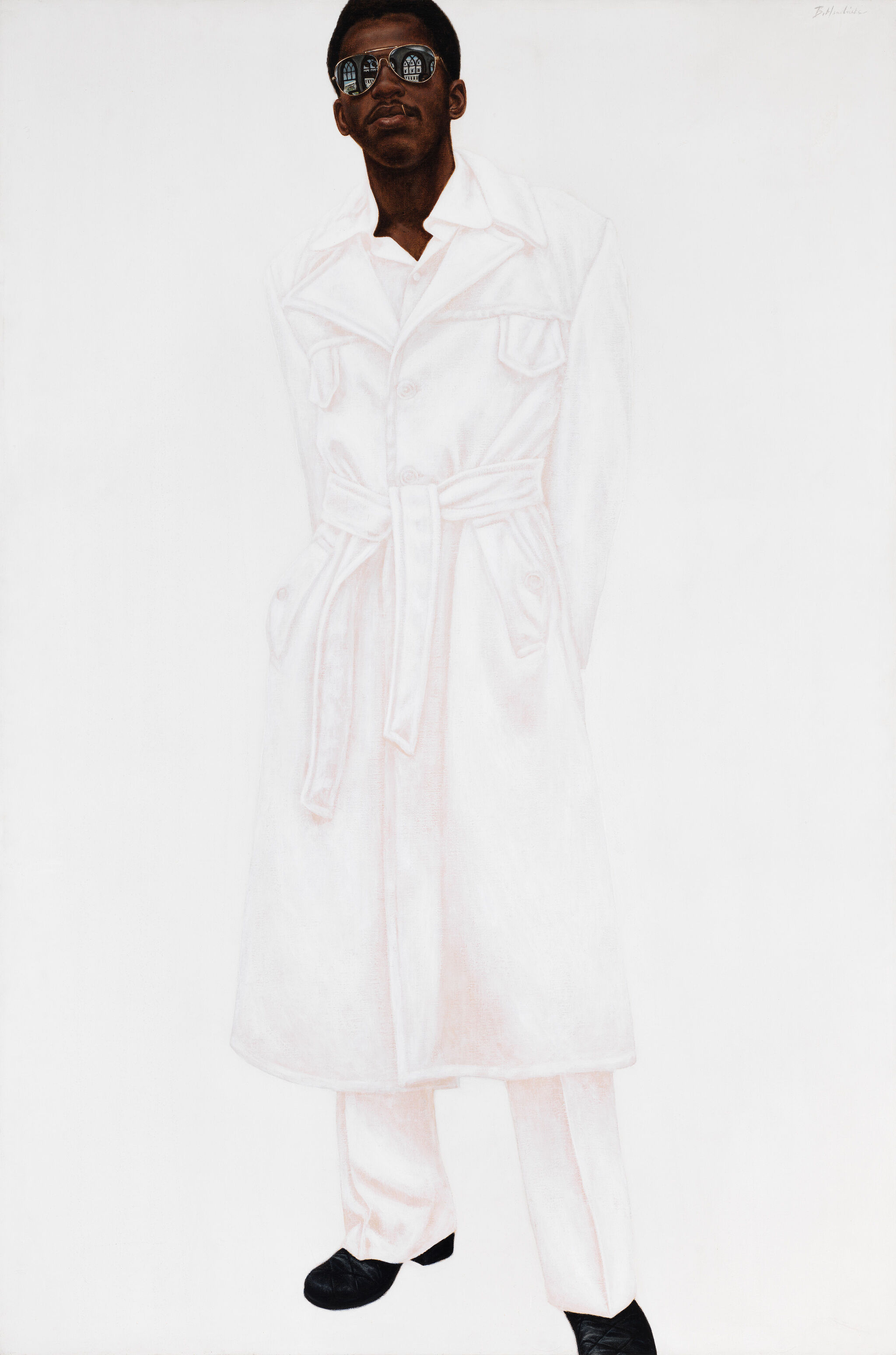
-
744
Charles Demuth, My Egypt, 1927
Kids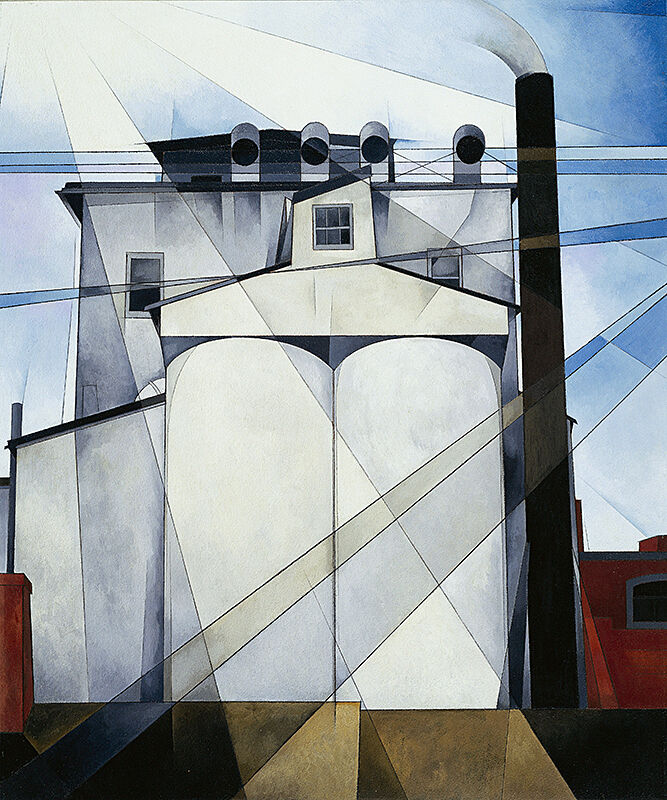
-
741
Georgia O’Keeffe, Summer Days, 1936
Kids
-
722
Robert Henri, Gertrude Vanderbilt Whitney, 1916
Kids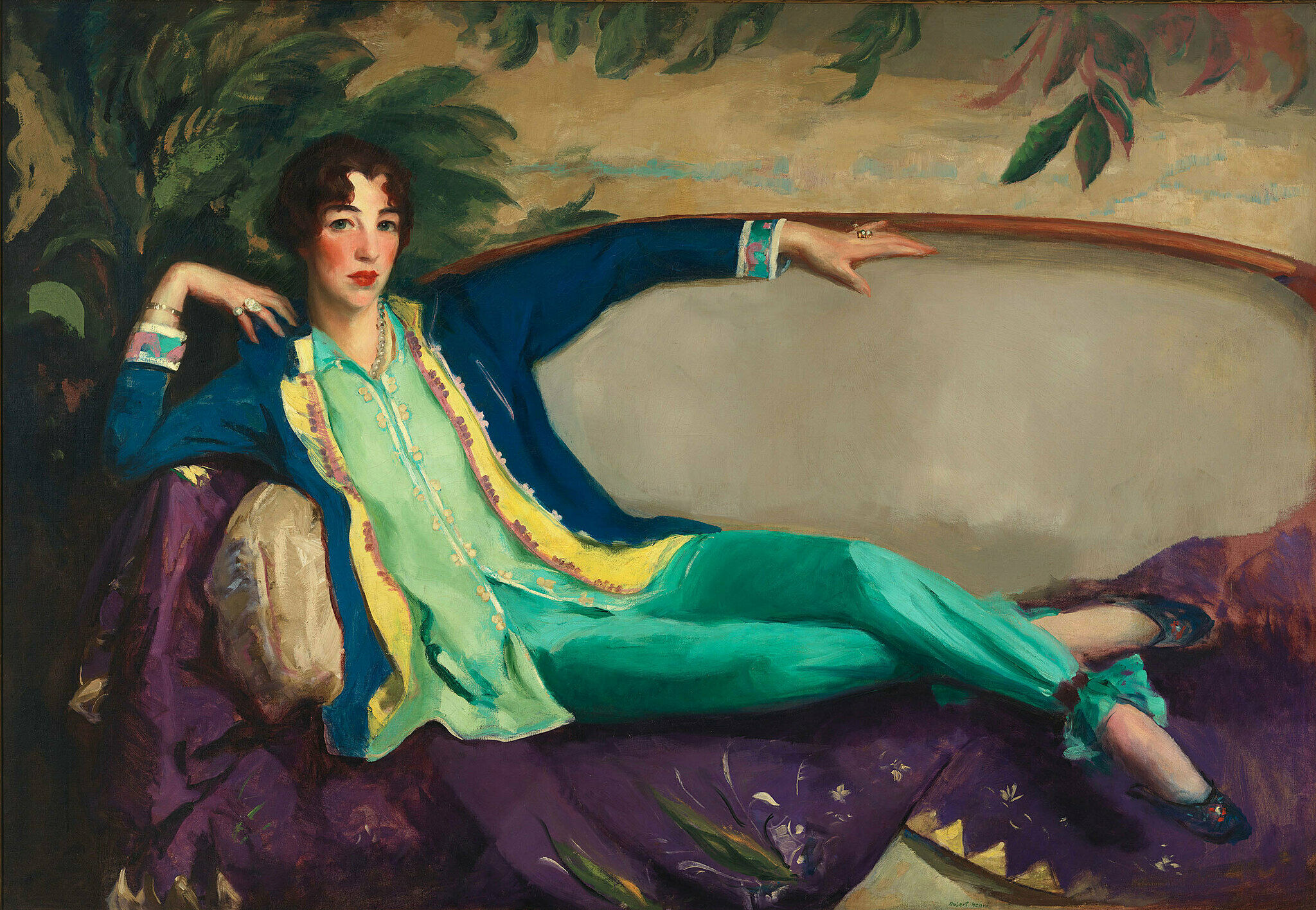
-
731
George Bellows, Dempsey and Firpo, 1924
Kids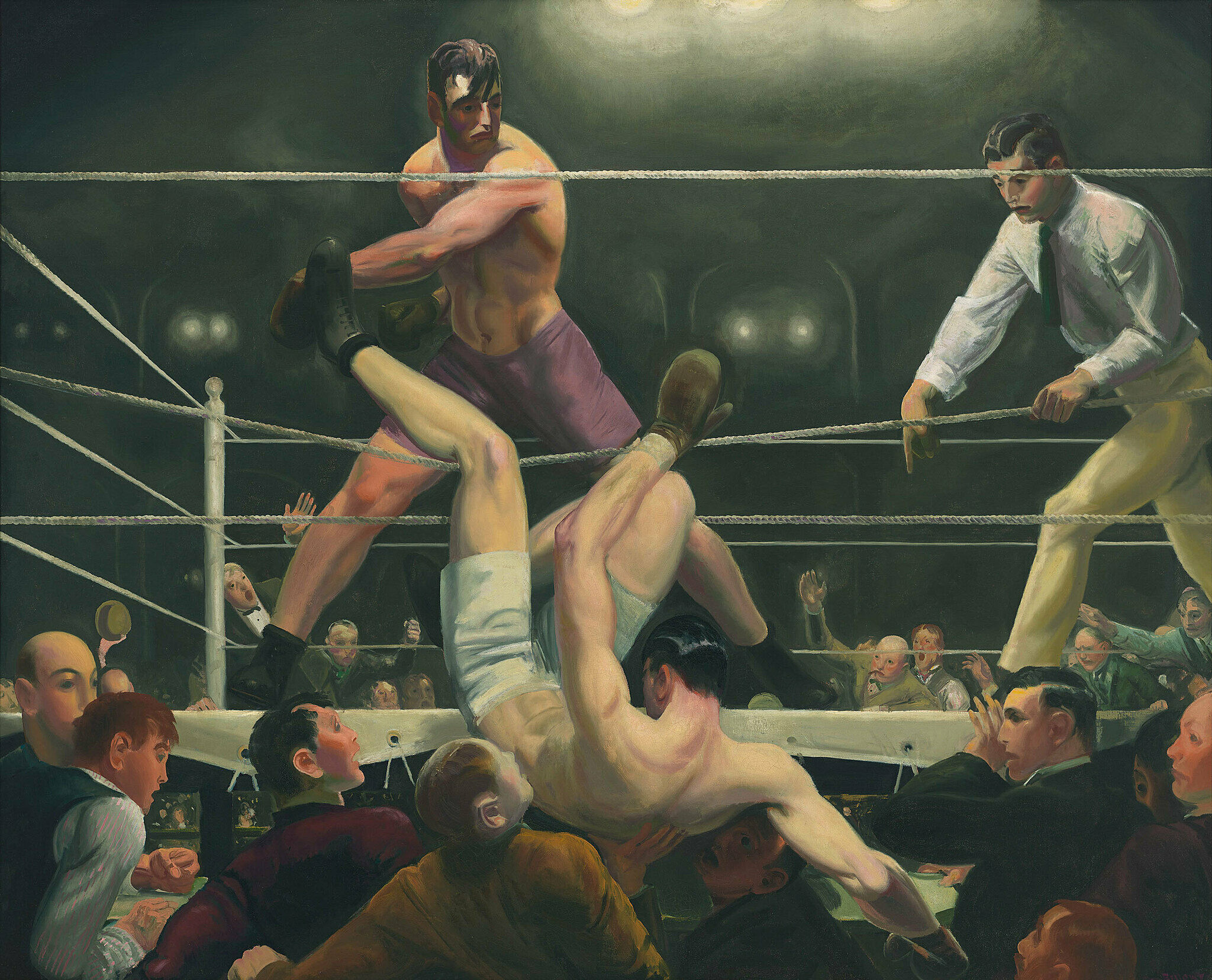
-
753
Leidy Churchman, Tallest Residential Tower in the Western Hemisphere, 2015
Kids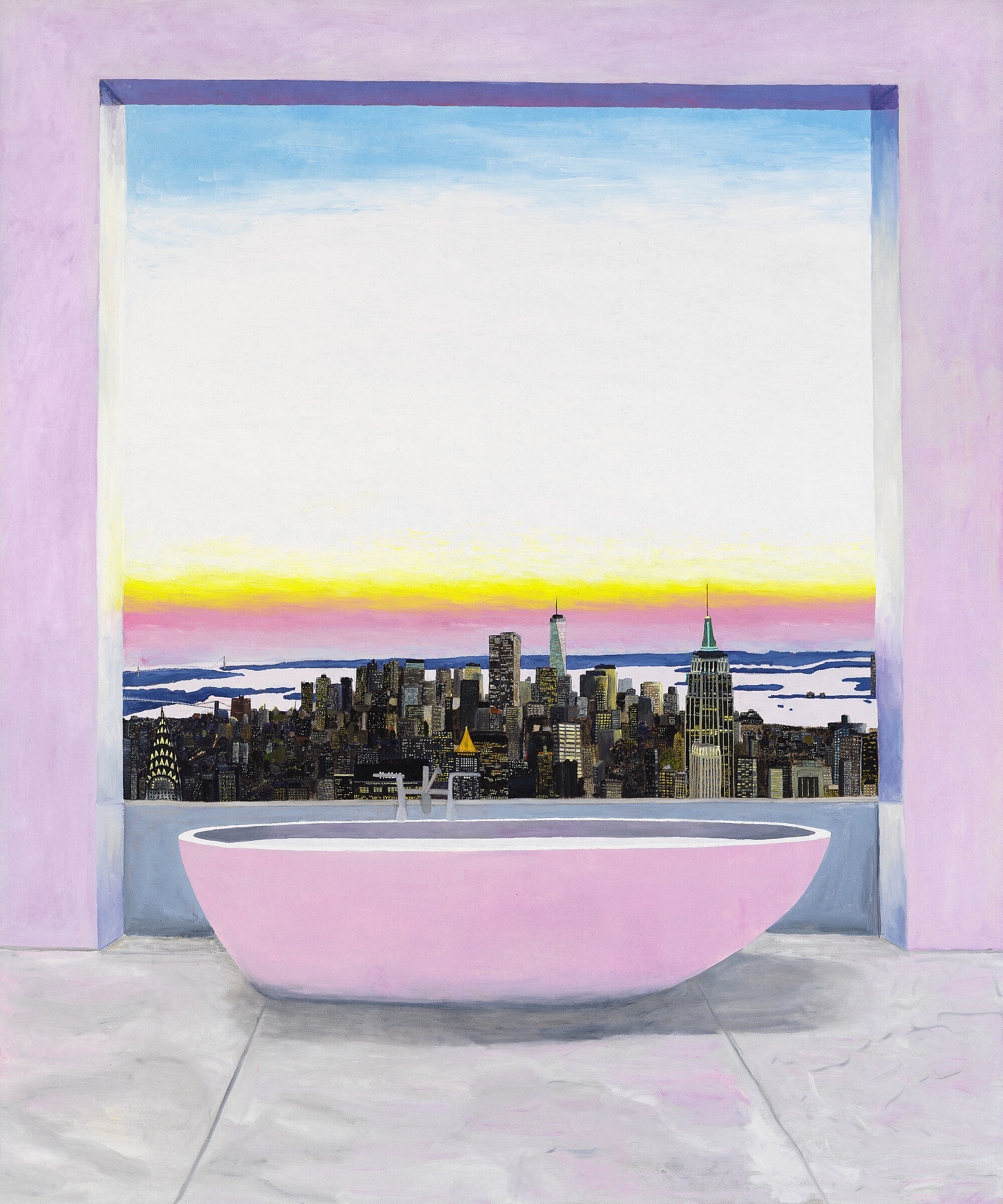
-
762
Charles Henry Alston, The Family, 1955
Kids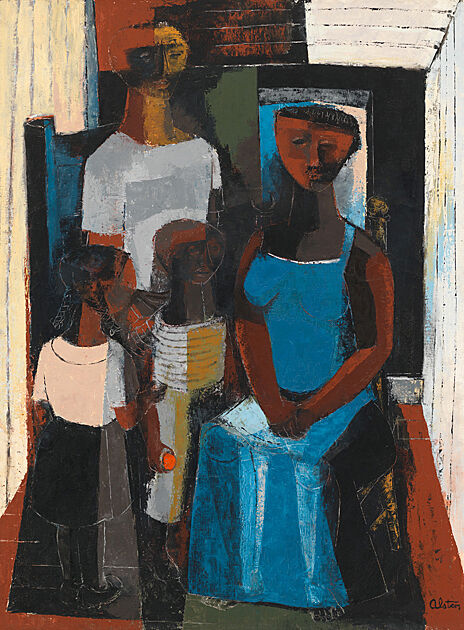
Narrator: This large banner-like painting by Kerry James Marshall is part of a series called Souvenir, intended to commemorate important African American cultural figures of the 1960s.
Kerry James Marshall: Now, one of the things you’ll see in the paintings, is there’s a list, or roll call, of individuals. And in the painting here, Souvenir IV, at the Whitney Museum, the roll call is a list of musicians, and in this case, they’re all blues, jazz and R&B musicians.
Narrator: Across the top of the painting, in the cloud-like forms, are the faces of other musicians.
Kerry James Marshall: And in that pantheon of images there, you see people like Dinah Washington, you see Billie Holiday, you see John Coltrane, you see Wes Montgomery, Little Walter, and each one of those musicians in the pantheon across the top also speaks the name of another musician, so it’s a way to try to get as large a roll call as I could.
Narrator: Marshall included musicians who died between 1959 and 1970, the years bracketing the sixties.
Kerry James Marshall: 1959 was when Billie Holiday died and 1970 is when Jimi Hendrix died. And you can see in the bottom curl of the scroll floating in the middle of the living room, that J-I-M underneath that curl begins the name of Jimi Hendrix.
One of the things I wanted to do with the naming of all of these other people, who also died during the same period that the Kennedys and Martin Luther King died, was to expand the pantheon of people who were worthy of remembrance to include people who didn’t receive the same kind of popular commemoration that the two Kennedys and Martin Luther King did.
Narrator: Marshall sets this painting in a contemporary middle class interior, except that his protagonist, an elderly woman, has a pair of wings, like an angel.
Kerry James Marshall: And I think in a way, one of the things I was trying to suggest in the painting is that this is the world we live in. It’s ordinary and magical at the same time. And the thing is, at any moment we can recreate or call up visions of these people and relive a sense of the time through the power of what they produced.
Narrator: You’ve been listening to an excerpt of Dinah Washington singing This Bitter Earth.
Kerry James Marshall, Souvenir IV, 1998. Acrylic, glitter, and screenprint on paper on tarpaulin, with metal grommets, 107 5/8 × 157 1/2 in. (273.4 × 400.1 cm). Whitney Museum of American Art, New York; purchase, with funds from the Painting and Sculpture Committee 98.56. © Kerry James Marshall; courtesy Jack Shainman Gallery, New York
Alison Saar: This is Alison Saar. I'm the artist that created Skin/Deep in 1993.
Generally, I use ceiling tin or the pressed metal tin to clad my sculptures. It's always been a material that I saw as a skin. In this case, it has been flayed off of the figures. When I usually use it on figures, it also feels like an armor. The material itself being metal has a sort of protective quality. I think this piece in particular, where it has been taken off of the figure and nailed on to the wall, it talks about the vulnerability, and the vulnerability of skin at the same time.
When I made this piece, I think I was pregnant with my second child, and it became a point where I just couldn't watch the news. We had the Rodney King beatings. Then there was a young man from Brooklyn, Christopher Wilson, who had gone down to Tampa and had been abducted and doused with gasoline and set afire. It seemed every time I turned on the news, it was open season on black males. It was a frightening time, I think, having a son, and just seeing the way the world was responding to people of color.
That's what really got me doing these pieces. I think, in general, my work really wants to not only give dignity to the figures that I create, but also strength. I think that this is the first piece I've done that really was a straight out victim and vulnerable.
I think part of that was a really angry response, and actually a really frightened response to the news that was being broadcasted nightly on our television sets. Sadly, it's still as apropos twenty years later. I think it's interesting that now with access to public media, that a lot of these things that had been going on for [laughs] centuries, basically, are more visible.
Alison Saar, _Skin/Deep_, 1993. Ceiling tin, nails and copper, 82 1/2 x 83 7/8 x 2 1/2 in. (209.6 x 213 x 6.4 cm). Whitney Museum of American Art, New York; Purchase, with funds from the Painting and Sculpture Committee 93.34a-b © Alison Saar
Joan Semmel: I’m Joan Semmel. I’m an artist, and I live in SoHo.
Narrator: Semmel painted Touch in 1974.
Joan Semmel: It’s a representation of a male and female figure in a post or precoital situation. And I was at the time interested in showing the images from a female point of view. So I took photos of the couple—of myself and a partner—from my own point of view.
I was being confrontational, and I wanted the painting to confront the audience with an image that was different than the way they normally saw this subject. Our softcore porn pictures are essentially the same of images that are in the history of art, where the women are usually placed as a kind of seductive lure to the male eye as much as possible. Which, I don’t have any problem with, except that it doesn’t turn me on [laughs]. And I was interested in finding an erotic language that would be interesting for women. So for me the whole idea of the touch is very important, and one feels the flesh as the most important part of what’s happening.
Narrator: Semmel was part of an early generation of feminist artists, who wanted their art to have a personal and political impact on their contemporaries. To hear more from Semmel, please tap your screen.
Joan Semmel, Touch, 1975. Oil on canvas, 57 x 103 in. (144.8 x 261.6 cm). Whitney Museum of American Art, New York; promised gift of Jeff and Leslie Fischer P.2016.1
Joan Semmel: We were trying to break down the whole way women were seen and perceived, and the way they thought about themselves, and it was an attempt to force the issue so to speak, and make women understand how the way they saw themselves was really important in terms of how they participated in society in every way.
Joan Semmel, Touch, 1975. Oil on canvas, 57 x 103 in. (144.8 x 261.6 cm). Whitney Museum of American Art, New York; promised gift of Jeff and Leslie Fischer P.2016.1
Deana Lawson: I’m Deana Lawson. I’m a photo-based artist. This image is taken in D.R. Congo; it’s in a small town called Gemena.
We often think of countries in Africa, especially D.R. Congo as a site of crisis or a problematic place. I was interested in switching that dynamic. Instead of seeing it in terms of a place of crisis I wanted to imagine it as a paradise or Eden. Robert Farris Thompson talks about Congo being the center of the mother continent, almost like the veins coming out of Congo. The center of humanity, in general. And my idea with The Garden was that the subjects would pose as the first human beings on earth.
Narrator: Lawson modeled their poses after the images of Adam and Eve in Hieronymous Bosch’s sixteenth-century painting, The Garden of Earthly Delights.
Deana Lawson: I found the female subject, who worked at a local restaurant in Gemena, and the male subject was my taxi driver. So they’re not a real couple, but it’s completely staged to look as though they’re a couple.
The male subject has his hand on her belly. Often people ask if she’s pregnant; she’s not pregnant, but I don’t mind that being a possibility of the imagination.
I’m really looking at these two individuals and trying to imagine or put out an image in the world that represents a divine intimacy, which I think is needed right now, particularly when so many of popular culture images and media put forth a divisiveness, a lot of times, between black men and black women. So to me this is about asserting this, somewhat of a love story.
Deanna Lawson, The Garden, Gemena, DR Congo, 2015. Inkjet print, 55 3/16 × 69 9/16 in. (140.2 × 176.7 cm). Edition 1/1. Whitney Museum of American Art, New York; purchase with funds from the Jack E. Chachkes Endowed Purchase Fund 2016.83. © Deana Lawson and Rhona Hoffman Gallery, Chicago, IL
Trevor Fairbrother: My name is Trevor Fairbrother. I’m an independent curator and writer.
Narrator: Fairbrother discusses Alice Neel’s 1970 portrait of Pop artist Andy Warhol.
Trevor Fairbrother: It’s an interesting year for both of these artists. Alice Neel was actually seventy years old when she painted it, and in a sense was just hitting her stride as an important American realist. She’d had an incredible career since the thirties, but she hadn’t really had much recognition until the wave of feminist interest in the arts in the sixties. And suddenly she was a forebear for a whole new generation of feminist artists and writers.
Narrator: The late sixties were much harder on Warhol. He’d been shot two years before Neel painted this portrait—an attempted assassination by a member of his artistic circle. In posing shirtless for Neel, he exposes the corset that he was required to wear for the rest of his life. He also bares his aging body, his chest sagging so that he almost appears to have breasts.
Trevor Fairbrother: She shows him—I think it’s this kind of essence of loneliness and vulnerability, but at the same time I think she knows that he knows that everybody is looking at him. He was very much invested in famous artists. He wanted to be a kind of brand-name Pop artist, and he certainly is that now, long after his death. He, Warhol, in a sense is rising to her challenge to sit for her, to be painted and to take his clothes off. And so in a sense he’s doing a brave thing, but he’s also―he’s getting through it by shutting his eyes and being very focused internally.
I think part of the soulfulness of this picture is the fact that it might seem unfinished. I wouldn’t say it’s unfinished. I think she decided she had what she needed, and she stopped where she was ready to stop. The picture doesn’t need more.
Alice Neel, Andy Warhol, 1970. Oil and acrylic on linen, 60 × 40 in. (152.4 × 101.6 cm). Whitney Museum of American Art, New York; gift of Timothy Collins 80.52 © The Estate of Alice Neel
Narrator: The work you see here, by R.H. Quaytman, isll part of a larger group of paintings, each of which the artist considers "a chapter." The chapters relate to the place where the work will first be shown. This one was first shown in the 2010 Whitney Biennial, which took place in the Upper East Side museum designed by Marcel Breuer. Quaytman’s work hung next to one of the building’s distinctive windows.
R. H. Quaytman: Because I really have always loved those Breuer windows. And they also refer to a concept I use a lot in my work, which is pushing the picture plane back into one point perspective.
And then I started thinking about just the history of the Whitney. And I went to the library. I did some research on Breuer, the collection. In the end, I just saw this painting of the Hopper, Woman in the Sun. And I've always just really admired this painting a lot because I felt that the woman in it was very powerful and authoritative, and you wonder what she's thinking more than you wonder how she looks. And also to me [it] is the quintessential Whitney collection painting.
Narrator: Quaytman photographed a friend and colleague next to the Breuer window, in a composition that strongly recalls the Hopper painting. Quaytman then silkscreened the image onto gessoed wood panels.
R. H. Quaytman (b. 1961), Distracting Distance, Chapter 16, 2010. Screenprint and gesso on wood, 24 5/8 x 39 7/8 in. (62.5 x 101.3 cm). Whitney Museum of American Art, New York; purchase with funds from the Painting and Sculpture Committee 2010.54. © R. H. Quaytman
Narrator: Catherine Opie took this photograph of the performance artist Ron Athey in 1994.
Catherine Opie: He's just a very incredibly amazing, giving, lovely person who has pushed the boundaries with his own body.
Narrator: This photograph came from a time when Opie had just started making studio portraits of her friends in the San Francisco leather community. She used brightly colored backdrops intended to recall the northern Renaissance painter Hans Holbein, who is known for the intense humanism of his portraits. Catherine Opie.
Catherine Opie: By using bright colored backgrounds, I was able to reference Hans Holbein as a painter and begin to create these very loving, political portraits at a time in which my community was decimated by AIDS, and really wanted to talk about the idea of identity politics in relationship to being an out queer person. I wanted to kind of redefine the notion of my own documentary practice, so that the site became the body.
Catherine Opie (b. 1961), Ron Athey, 1994. Chromogenic print, 57 × 28 3/16 in. (144.8 × 71.6 cm). Whitney Museum of American Art, New York; gift of Norman Dubrow 95.104 © Catherine Opie
John Coplans: Well, my name is John Coplans. And I’m an assistant poet. If I call myself an artist, I get in a cab, and the cab driver says, hey, what do you do? And I say, I’m an artist. He says, what do you do, do you paint? No, I make photographs. He says, that’s not art, photographs. I make photographs too.
Narrator: John Coplans passed away in 2003. We interviewed him about his work for the 2000 Biennial.
John Coplans: So I tell them I’m assistant poet, and they shut up. Some of them of course accept the idea that my photos might be artistic, and they say, what do you photograph? And I say, myself in the nude. How do you photograph yourself in the nude? Do you use a timer? No, I say, I have a young lady assistant come in and photograph me. Now, they say, this is intriguing, how do we become like this? How did you start? So then it goes on, the story. Talking it into being, I actually spout words at somebody, at my assistants. So I have to think very carefully. Because if you look at these photographs, they are parts of my body which mentally I’ve conceived of then I have to arrange.
My fingers here are all stuck; I can’t gesture. I have to in, words, describe exactly what is the framing of what I want, and how I want the lighting. I want a shadow at the top or the side, slightly. So that’s all things that are in my mind, which I convey to an assistant, who reacts and does what I say, and I get what I want. That’s why I’m not really a poet, you see. I’m only an assistant. Because I really abuse poetry.
John Coplans, Frieze, No. 2, Four Panels, 1994. Four gelatin silver prints, 76 5/8 × 136 × 1 7/8 in. (194.6 × 345.4 × 4.8 cm). Whitney Museum of American Art, New York; purchase with funds from the Photography Committee and Steven and Ann Ames 2001.5 a–d © The John Coplans Trust
Narrator: Antepartum is one of a group of works the artist Mary Kelly made that documents the experience of pregnancy and motherhood.
Mary Kelly: I was concerned with something that a lot of artists were at that time, which is the body as a site. I wanted this to be an extreme close-up, so it’s just the shot of the abdomen at a full term pregnancy, and you can see the movements, of the unborn child very subtly. And I just run my hand slowly over the surface, and there’s a kind of, I suppose, pre-linguistic, form of interaction between the mother and the child.
Narrator: Kelly looks back to 1973, the year she made Antepartum.
Mary Kelly: At that time, strangely enough, there was no work that focused on the woman, as mother. There’s plenty of painting in the past that would take that as their subject matter. But actually, very few women had approached this. And, it was, if you remember a period of, you know, the high modernist, masculine renunciation you could say, of anything that smacked of the feminine, so it seemed you know, an absolutely crucial thing to do at that time.
Mary Kelly, Antepartum, 1973. Super 8 film transferred to video, black and white, silent; 1:30 min. looped, Aspect Ratio: 4:3. Whitney Museum of American Art, New York; gift of the artist 2002.335
Narrator: Alvin Baltrop took this photograph in one of the warehouses on the Hudson Piers, during the 1970s. Until the mid-twentieth century, the piers had been the center of the largest port in the world. But by the time Baltrop took this picture, they had been largely abandoned. They became important sites for artists, and for gay men cruising for sex.
Jonathan Weinberg: In this photograph, probably taken in Pier 46, at the foot of Christopher Street, Baltrop focuses on a beautiful naked man stretching.
Narrator: Jonathan Weinberg is a painter, curator, and art historian.
Jonathan Weinberg: His lithe, muscular body and his pose on one foot suggest that he is a dancer, and therefore, like Baltrop, an artist, drawn to the dilapidated waterfront structures for their sublime beauty, but also the freedom they afford to spread out, to be brazenly naked, to escape the strictures of moral decorum.
Taken before the advent of the AIDS epidemic, such an image speaks for a time in the 1970s when expressing the homoerotic in such an uninhibited way was emblematic of the so-called sexual revolution, and the breaking down of political control and social repression. At the same time, Baltrop’s characteristic cityscape is in ruins, caused by profound economic displacements. The dancer’s freedom only exists in the midst of urban poverty and neglect, just a few blocks from some of the most real estate in the world.
As a queer man myself, who painted and sunbathed on the same pier at that time in my late teens, I look at Baltrop’s photograph with a great sense of nostalgia and wonder. Was there really such a time when we were so free?
Alvin Baltrop, _Untitled_, 1977, from the series Pier Photographs. Gelatin silver print, 9 × 6 7/8 in. (22.9 × 17.5 cm). Whitney Museum of American Art, New York; purchase with funds from the Photography Committee 2009.3. Courtesy The Alvin Baltrop Trust and Third Streaming, N.Y.
Narrator: Art historian Janet Kraynak on artist Bruce Nauman.
Janet Kraynak: What's important about this piece is that as a viewer, if you came upon it and just looked at it, it would seem to be not just an abstract sculpture, but you would have no idea what it is.
Narrator: The title, however, is highly descriptive: Six inches of My Knee Extended to Six Feet.
Janet Kraynak: What Naumann starts with is the perspective as if one is looking down from one's body at your knee, and if you imagine making an arced line from the left side across the top of your knee to the right side. And he made it into a six inch piece. Then he just attached many of these together in the drawing, elongating it to the length of six feet.
He starts by making these distorted sculptures of the body and eventually where this leads in his work is he puts the viewer in a position of perhaps not being able to understand your body's relationship to space. What would it mean, for example, if you became estranged from your body, if it didn't quite add up or fit or look like what your body is supposed to feel like or look like?
Bruce Nauman, _Six inches of my knee extended to six feet_, 1967. Fiberglass-reinforced polyester resin, 68 3/4 × 5 3/4 × 4 5/8 in. (174.6 × 14.6 × 11.7 cm). Whitney Museum of American Art, New York; partial and promised gift of Robert A. M. Stern 91.115 © 2016 Bruce Nauman/ Artists Rights Society (ARS), New York
Narrator: In this painting, Andy Warhol presents nine images of Jacqueline Kennedy in the moments leading up to and following the assassination of her husband, President John F. Kennedy. In the top row, we see Jacqueline Kennedy in Dallas, Texas, just before the assassination. Notice the faint image of John F. Kennedy ‘s face at the edge of each frame. In the middle row, we see the First Lady during her husband’s funeral procession. And in the bottom row, Warhol presents a close-up of her grief-stricken face, taken from a photograph of Mrs. Kennedy standing next to Lyndon B. Johnson as he was sworn in aboard Air Force One. In this work, Warhol points out how the media turned Kennedy into a symbol of the grief of a nation.
Warhol took these images from newspaper photographs, which he cropped and then silkscreened onto canvas. By his deliberate repetition of the poignant images, Warhol poses an important question: When the media bombards us with repeated images of tragedy, does this make us relive and reenact these horrific events or does it gradually numb us to the pain?
Jacqueline Kennedy herself recognized the importance of the media and used it brilliantly. To hear how, tap your screen.
Andy Warhol, Nine Jackies, 1964. Acrylic, oil, and screenprint on linen, 60 3/8 × 48 1/4 in. (153.4 × 122.6 cm). Whitney Museum of American Art, New York; gift of The American Contemporary Art Foundation Inc., Leonard A. Lauder, President 2002.273 © The Andy Warhol Foundation for the Visual Arts, Inc./Artists Rights Society (ARS), New York
Narrator: John Hellmann is a Professor of English at Ohio State University and the author of The Kennedy Obsession: The American Myth of J.F.K.
John Hellmann: John F. Kennedy ran for President precisely in the year where, for the first time, it was said, it was reported that virtually every American home had a television set. And he drew upon the power of film, and Jackie Kennedy I think, learned to do that as well.
Narrator: Jacqueline Kennedy carefully planned her husband’s funeral, which was broadcast into countless homes across the nation.
John Hellmann: There was a black horse in the funeral that walked along without a rider, and this was meant to symbolize the fallen hero. She also came up with the idea of the eternal flame at his grave and it still burns at his grave in Washington DC. All these were grand, theatrical elements that gave a special, kind of ceremonious meaning to her husband’s death. And it transformed its meaning from simply history and political science into the realm of art and myth. I think that’s one of the things that Andy Warhol in the painting Nine Jackies, is drawing our attention to.
Andy Warhol, Nine Jackies, 1964. Acrylic, oil, and screenprint on linen, 60 3/8 × 48 1/4 in. (153.4 × 122.6 cm). Whitney Museum of American Art, New York; gift of The American Contemporary Art Foundation Inc., Leonard A. Lauder, President 2002.273 © The Andy Warhol Foundation for the Visual Arts, Inc./Artists Rights Society (ARS), New York
Thelma Golden: Hollywood Africans is somewhat of a typical Basquiat painting, because the first thing you see is that it’s covered with words. And the words have a hierarchy: some of them are circled, some of them are crossed out, some of them are highlighted in different colors, but really the most important thing is you see the words.
Adam Weinberg: Thelma Golden is director and chief curator of the Studio Museum in Harlem.
Thelma Golden: At the core of this painting is a self-portrait of Basquiat himself and his two friends, Toxic and Ramellzee, who were also artists of that era who had traveled with him to L.A., so in many ways, the painting is a document of this trip that they made out to California, encountering out there both the art world as well as the music world, that they were hanging out in. I think it’s obvious to look at Hollywood Africans as a critique of the way in which black people have been portrayed in Hollywood film.
But I think, given when this painting was made in 1983, Basquiat was making a more complicated comment about the ideas of freedom and ownership as it related to the Hollywood arena. I often think of this painting, Hollywood Africans, as referring not just to those portrayals of Africa, the stereotypes of Africa in films like Tarzan and the way in which Africans were portrayed, but more a contemporary comment about the role of black people in the film world, right? That they are stars, but yet still, culture defines the way in which they’re understood. So it, to me, seems often like he wasn’t just making a comment about the past, but he was really making—not a comment or a critique—but a statement about the present.
Jean-Michel Basquiat, Hollywood Africans, 1983. Acrylic and oil stick on canvas, 84 1/16 x 84 in. (213.5 x 213.4 cm). Gift of Douglas S. Cramer 84.23. © 2015 The Estate of Jean-Michel Basquiat/ ADAGP, Paris/Artists Rights Society (ARS), New York
Narrator: This work comes from a series of photographs that K8 Hardy made using herself as a model. Some of the images in the series are deliberately ordinary, even banal. But here, Hardy’s makeup and costume are fantastical. She’s also used a technique developed in the early twentieth century to manipulate the print, covering part of the photo paper during the exposure to make it look like she was wearing a cartoonish bow. The resulting type of print is known as a photogram.
K8 Hardy: In the darkroom I use the photogram to take you a little bit out of the photo.
Narrator: K8 Hardy.
K8 Hardy: Sometimes the photo is too slippery and too real, so I would just do something in the darkroom to pop the viewer out of the belief in the photo and into the construction.
In the beginning I was so resistant to calling them self-portraits, because that implies that my story's in there somewhere or that I'm describing myself. But I wasn't really thinking about myself when I was taking them. It's a feminist tactic to use your own body and also to approach this subject matter of the female body and of objectification. I just wanted to keep that simple and use myself.
K8 Hardy, Position Series #20, 2009. Chromogenic print, 30 × 20 in. (76.2 × 50.8 cm). Whitney Museum of American Art, New York; purchase with funds from the Photography Committee and the Henry Nias Foundation 2010.74 ©2009 K8 Hardy
Narrator: A woman glances over her shoulder, framed by signs of luxury: elaborate jewelry, a hint of a ball gown, and a palatial formal garden. Her gaze is rather haughty, but also seems to hint at something else—perhaps dissatisfaction or bitterness. At the very least, her face betrays a struggle with her advancing age. Her mouth is pinched and wrinkled, while her forehead seems almost too smooth, and her hair unnaturally dark.
This photograph comes from a series of society portraits by Cindy Sherman. To make these images, Sherman transformed her own appearance using wigs, thick pancake makeup, and costumes. She photographed herself against a green screen, and then Photoshopped her images into opulent backgrounds. The resulting characters seem artificial, and at odds with their surroundings.
Sherman made her society portraits in 2008, when the real estate bubble had hit its peak and the economy was on the verge of collapse. The works suggest an age of excess, a status-obsessed society. This image seems, in part, to critique that society—even to mock its members, cruelly exposing their flaws. At the same time, though, there is something tragic about the work, as if the woman were caught in a trap that is largely self-imposed.
Cindy Sherman, _Untitled_, 2008. Chromogenic print, with frame, 70 1/16 × 63 3/8 × 3 7/8 in. (178 × 161 × 9.8 cm). Whitney Museum of American Art, New York; purchase with funds from the Painting and Sculpture Committee and the Photography Committee 2009.46a–b © Cindy Sherman; courtesy Metro Pictures, N.Y.
Kerry Nolan: The gold plating of the sneakers in Gary Simmons’s Lineup makes them look almost like giant bronzed baby shoes or trophies. Despite the plating, you might still be able to recognize the different brands. Nike, Adidas, Puma. The sneakers stand in a row before a police lineup, the height chart painted against the wall of the Museum itself. But where are the suspects, the people who would occupy these shoes? The artist, Gary Simmons.
Gary Simmons: That’s what the piece hinges on, is what these people might be. And, you know what our assumptions are, or what potentially our assumptions are of the identities of these people. That’s why I really wanted to remove the actual identity and place that question in the viewer’s mind, of who you would think would be in this lineup.
Kerry Nolan: Simmons refers here to law enforcement’s tendency to view young African-American men, particularly those whose style of dress might include shoes like these, as perpetrators of crime, making them potential victims themselves at the hands of the police or even of their peers.
Gary Simmons: A lot of kids were shooting each other over their sneakers. In a way, it was not so much a carjacking, but it was more of a sneaker jacking. So I was really looking at that kind of violence and how was that structured and who was supporting that, and who was driving that kind of market, that economy.
Gary Simmons, Lineup, 1993. Acrylic on wood with gold plated basketball shoes, 114 × 216 × 18 in. (289.6 × 548.6 × 45.7 cm). Whitney Museum of American Art, New York; purchase with funds from the Brown Foundation Inc. 93.65a–p © Gary Simmons
Narrator: Mike Kelley.
Mike Kelley: I decided to build a reconstruction of every school I ever went to with the all the parts I could not remember left out. And then these were combined to one super school. They were cut apart and reconfigured, uh, in a kind of very formalized way that made it look more like a kind of modernist architecture.
Narrator: Educational Complex explores how we remember spaces—and how much of them we forget.
Mike Kelley: Educational Complex was done directly in response to the rising infatuation of the public with issues of Repressed Memory Syndrome and child abuse. It led to a rash of similar kinds of cases. the popularization of this certain kind of-of therapy which was predicated on the idea that certain traumatic events, that especially sexual abuse are repressed and only removed later through therapy. The implication is that anything that can't be remembered is somehow the result of trauma.
So the parts I could not remember of these buildings was the majority of them, probably like eighty percent. So that meant eighty percent of these buildings that I had been in for most of my life were the site of some kind of repressed trauma.
No one's going to think that when they look at it. It looks completely orderly. It doesn't look dysfunctional at all. But seen through the theory of repressed memory syndrome, that's what it means. Like, why can't Mike Kelley remember like all these rooms in the schools he went to every day for, you know, most—like, half of his life. Well, nobody can.
Narrator: Mike Kelley died in 2012.
Mike Kelley, Educational Complex, 1995. Painted foam core, fiberglass, plywood, and wood, 57 3/4 × 192 3/16 × 96 1/8 in. (146.7 × 488.2 × 244.2 cm). Whitney Museum of American Art, New York; purchase with funds from the Contemporary Painting and Sculpture Committee 96.50 © The Mike Kelley Foundation for the Arts, licensed by VAGA, New York
Narrator: In these self-portraits, Ligon refuses to look directly out at us. The images, silk-screened onto canvas with thick enamel ink, are dark and grainy. Curator Scott Rothkopf.
Scott Rothkopf: He's both inhabiting the mug shot but then sort of undoing it by turning his head away from us and showing us only the back. It wouldn't be very useful in a police lineup or a criminal suspect picture. And I think that that tension, and that kind of resistance, is a real part of the work and its political interest.
And, you know, this is part of systems for law enforcement in this country, which black men are certainly more obviously made the target of than any other population. And I think Glenn is, in a way, responding to and resisting that.
Glenn Ligon, Self–Portrait, 1996. Silkscreen ink and gesso on canvas, 48 × 40 in. (121.9 × 101.6 cm). Whitney Museum of American Art, New York; promised gift of Beth Rudin DeWoody P.2013.5. © Glenn Ligon
Narrator: The canvases on view here are, in a sense, “portraits” of artists in the Whitney’s permanent collection.
Byron Kim: Each one is meant to represent an actual person's skin color.
Narrator: Byron Kim.
Byron Kim: They're arranged on the wall in alphabetical order from left to right by first name. Synecdoche, the title of the piece, the work, the painting, is a term of grammar that is a metaphor which means a part standing for the whole. Such as, in the Navy when they say, "All hands on deck." They don't literally mean just the sailor's hands, they mean the whole person. So, in this case, the skin color is standing for the person.
In my mind originally, it just was a way to make a modernist painting or a modern looking painting and give it some other kind of meaning. But it quickly came to mean something having to do with race and possibly even race relations in this country, which isn’t exactly what I meant. But it wasn’t something that I denied once it was noticed.
Narrator: To hear Kim reflect further on the reactions to his work, please tap your screen.
Byron Kim, Synecdoche [left to right, top to bottom: Annette Lemieux, Brice Marden, Byron Kim, Chuck Close, Donald Moffett, Donald Baechler, Ed Baynard, Elizabeth Murray, Fred Tomaselli, Fred Wilson, Glenn Ligon, James Casebere, Jane Hammond, Janine Antoni, Jon Kessler, Joyce Kozloff, Kiki Smith, Lesley Dill, Lois Dodd, Lorna Simpson, Lynne Yamamoto, Mel Bochner, Mel Chin, Merry Alpern, Lee Mingwei, Natvar Bhavsar, Nayland Blake, Oliver Herring, Philip Pearlstein, Polly Apfelbaum, Robert Gober, Robert Rahway Zakanitch, Sam Messer, Sandy Scolnik, Suzanne McClelland, Timothy Greenfield-Sanders, Vija Celmins, Vito Acconci, William Wegman], from the project Synecdoche, 1999–2001. Oil and wax on wood, Dimensions variable, each panel 10 x 8 in. Whitney Museum of American Art, New York; Gift of the Peter Norton Family Foundation 99.2.3a–nn © Byron Kim
Byron Kim: I remember at the Whitney during the '93 Biennial, I did a lot of things with the education department around the installation of this work. There was a group of school children. They were around kindergarten. First thing I thought to ask them was, "What do you think these are? What do you think this looks like?" It took them a long time. At first they said, "Oh, it looks like bathroom tiles." I think I had to hint around, and finally we got around to it, because these are just flat colors. They have really very little to do with a person. In a way, that was closer to what I probably wanted to say in the beginning.
Byron Kim, Synecdoche [left to right, top to bottom: Annette Lemieux, Brice Marden, Byron Kim, Chuck Close, Donald Moffett, Donald Baechler, Ed Baynard, Elizabeth Murray, Fred Tomaselli, Fred Wilson, Glenn Ligon, James Casebere, Jane Hammond, Janine Antoni, Jon Kessler, Joyce Kozloff, Kiki Smith, Lesley Dill, Lois Dodd, Lorna Simpson, Lynne Yamamoto, Mel Bochner, Mel Chin, Merry Alpern, Lee Mingwei, Natvar Bhavsar, Nayland Blake, Oliver Herring, Philip Pearlstein, Polly Apfelbaum, Robert Gober, Robert Rahway Zakanitch, Sam Messer, Sandy Scolnik, Suzanne McClelland, Timothy Greenfield-Sanders, Vija Celmins, Vito Acconci, William Wegman], from the project Synecdoche, 1999–2001. Oil and wax on wood, Dimensions variable, each panel 10 x 8 in. Whitney Museum of American Art, New York; Gift of the Peter Norton Family Foundation 99.2.3a–nn © Byron Kim
Dana Miller: This is a photocollage that involves kind of two layers of photography.
Narrator: Curator Dana Miller.
Dana Miller: Jay DeFeo is an artist who is best known for a monumental painting called The Rose. And the foundation for this image, the background image that you see, is a photographic detail of this painting, The Rose. So it looks almost like a geologic formation, but that’s because the paint was so thick that it was layered with all of these crevices and cracks.
And on top of this photograph, she has collaged cut-out photographs of her teeth. Her own teeth. And she suffered from periodontal disease, and it was her belief that the gum disease was brought on by some of the chemicals, in particular lead, that was in the paint that she was using for The Rose.
So the loss of her teeth is very much associated with the creation of The Rose. So she’s taken these images of her teeth, which look almost like pearls or berries, and she’s nestled them by layering them, collaging them, on top of The Rose. So there’s a sense of loss, she’s lost her teeth. The Rose at the time that she made this painting was at the San Francisco Art Institute buried behind a layer of plaster, so a painting that she had spent almost a decade of her life working on nearly exclusively was also lost to her at that time. So I think there’s a sense of longing and wistfulness in the work.
Jay DeFeo, _Study for September Blackberries_, c.1972-1973. Gelatin silver prints and paint mounted on paperboard, Image: 7 5/8 × 7 5/8 in. (19.4 × 19.4 cm). Whitney Museum of American Art, New York; Purchase, with funds from the Photography Committee 2004.18 © 2016 The Jay DeFeo Trust / Artists Rights Society (ARS), New York
Dana Miller: Toyo Miyatake is a Japanese-born photographer, and he opened up a very successful photography studio in Little Tokyo in Los Angeles.
Narrator: Curator Dana Miller.
Dana Miller: He became pretty involved with another Japanese-born artist, a modern dancer named Michio Ito, who was really a pioneer of modern dance in this country, despite being relatively unknown, in part I think because he was Japanese-born and so his contribution has been, I think, somewhat minimized. But he spent four years in Los Angeles and did these major performances at the Hollywood Bowl. And Toyo Miyatake was his official company photographer, and he also worked for a time as the lighting designer for the dance company.
So what you see in Michio Ito in the Pizzicati is the influence of lighting on modern dance, and the way that Miyatake’s emphasizing that. And the shadow is just as prominent if not more prominent than the actual figure itself. This is a very modern way of looking at dance photography and Toyo Miyatake was kind of in the center of all of that activity.
Toyo Miyatake, Michio Ito in the Pizzicati, 1929. Gelatin silver print, 13 15/16 × 10 11/16 in. (35.4 × 27.1 cm). Whitney Museum of American Art, New York; Purchase, with funds from the Photography Committee 2014.242 © Toyo Miyatake Studio
Narrator: Helen Levitt was a street photographer who lived and worked in New York. Her subjects were often children, frequently residents of East Harlem. Levitt used an attachment on her camera that allowed her to look one way and take the picture the other, so the people in Levitt’s photographs often appear to be unaware of her presence. As a result her images have an incredibly spontaneous feeling—they capture life as it happens, without interpretation.
The generation of documentary photographers that preceded Levitt—those that worked through the Great Depression—often intended their photographs to have a social function. They would glorify farm workers, monumentalize factories. Levitt saw the world with more of a Surrealist’s eye. She was first drawn to photography by graffiti and children’s chalk drawings—transitory, untutored images. But she soon began focusing on children—a favorite Surrealist subject, since children were presumably freer than adults, more natural and less corrupted by civilization. James Agee once described the particular kind of innocence that appears in her photograph:
"The overall preoccupation in the photographs is, it seems to me, with innocence not as the word has come to be misunderstood and debased, but in its full, original wildness, fierceness, and instinct for grace and form.”
Helen Levitt, Street Drawing, c. 1940. Gelatin silver print, sheet: 10 15/16 × 13 7/8 in. (27.8 × 35.2 cm) Image: 6 3/4 × 10 9/16 in. (17.2 × 26.8 cm). Whitney Museum of American Art, New York; gift of Lilyan S. and Toby Miller 94.166. Helen Levitt © Film Documents LLC
Elisabeth Sussman: What is wonderful about this picture is how extremely close up this look at this woman is. How in a way she, with her turban and her furs and her careful makeup seems to dwarf the skyscrapers that you see behind her. She's almost Promethean in relation to these skyscrapers.
Narrator: The photograph is also remarkable for the quality of the printing. Curator Elisabeth Sussman.
Elisabeth Sussman: Arbus was a very concerned and involved black-and-white printer. She almost never worked in color.
An assistant worked with Arbus to get the kind of prints that she wanted. She was extremely sensitive to the grayscale going into the black scale.
That's a wonderful feature of this photograph where the fur and the light of the background and the stone of the skyscraper is just really in wonderful textural contrast. She had real control over the print quality. The other thing you see in this work, which is typical of her, are the borders, the exposed borders. You see them, black lines on the top and the bottom.
Before Arbus, she became famous for this, people would crop off those borders, but she left hers on. They are part of the process of making a picture so she's giving you, yes, a very up close and interesting reality bite here, but she's always letting you know that you are looking at a photograph by the inclusion of those borders.
Diane Arbus, Woman with a Veil on Fifth Avenue, N.Y.C., 1968. Gelatin silver print, sheet: 13 15/16 × 11 in. (35.4 × 27.9 cm) Image: 10 1/2 × 10 1/4 in. (26.7 × 26 cm). Whitney Museum of American Art, New York; purchase, with funds from Ann G. Tenenbaum, Thomas H. Lee and the Photography Committee 97.15. © The Estate of Diane Arbus LLC
Adam Weinberg: The inspiration for this monumental sculpture by Gaston Lachaise was the artist’s lifelong muse, Isabel Dutaud Nagle. When they first met in Paris, Isabel was just visiting from the United States, was married to another man, and was the mother of a child. In spite of all of these obstacles, and the fact that Isabel was ten years older than he, the artist left his native France for America in the hopes of being with her. They married in 1917, five years after he made this sculpture. As was often the case, Isabel didn’t pose for this work. Lachaise created her image from memory. The result is an intensified expression of desire and devotion. Isabel was only five foot three, but here the artist has envisioned her as a larger-than-life goddess. He has given her wide hips and large breasts, features you might find in an ancient fertility goddess. And the gesture of her slender hands and curved fingertips is reminiscent of an Indian Buddha. She bears a meditative, other-worldly expression and stands on tip-toe, as if endowed with divine powers.
The artist’s extensive love letters to Isabel articulate the same passion that his sculptures exude. In 1915, three years after making this work, the artist wrote Isabel, calling her: “A beautiful goddess of heavy breasts and splendid white belly, goddess of sublime thoughts of tranquility and strength. You are the harmony of heaven and earth. I sing my hymn to you . . . You inspire my every moment.”
Gaston Lachaise, Standing Woman, 1912-1927. Bronze, 70 5/8 × 28 1/2 × 19 1/8 in. (179.4 × 72.4 × 48.6 cm). Edition 4/4. Whitney Museum of American Art, New York; Purchase 36.91
Narrator: What did you think when you first saw this sculpture? If you’re anything like me, you were wondering what some older woman in her house dress was doing in the middle of a museum. Is this really the kind of place you’d usually hang out with your dog and read a letter? For thousands of years, sculpture has pictured really important people—kings and queens, gods and goddesses. We’re so used to that, seeing a sculpture like this one kind of makes you say “wait, what??” It’s so ordinary, that it’s kind of weird! The artist, Duane Hanson, wanted us to have this experience—to make us see things in a whole new way. And no, that’s not a real stuffed dog. Its body is ceramic. But it does have real dog hair, from the artist’s cousin’s poodle!
Duane Hanson, Woman with Dog, 1977. Synthetic polymer and oil on cast polyvinyl with clothing, hair, eyeglasses, watch, shoes, upholstered wood chair, ceramic dog with collar, woven rug, postcard, letters, and envelopes, 46 1/8 × 50 1/2 × 48 in. (117.2 × 128.3 × 121.9 cm). Whitney Museum of American Art, New York; Purchase, with funds from Frances and Sydney Lewis 78.6a-f © Estate of Duane Hanson/Licensed by VAGA, New York, NY
Narrator: In this piece Chuck Close painted a portrait of the artist Lyle Ashton Harris. Look closely and examine the artist’s unusual technique. Close created a diagonal grid in which each diamond shape contains its own tiny, brushy painting. From close up the work seems abstract, as if the artist is concentrating on experiments with different colors and brushstrokes. But take a step back—just watch where you’re going as you do! From further away, all of those small individual abstract paintings join together to make a face.
The artist has purposefully chosen a technique that offers viewers two very different experiences. By giving us such a different view close up versus far away, maybe he is asking us to get to know his painting as well we would get to know a person.
Chuck Close (b. 1940). Lyle, 1999. Oil on canvas, 102 1/16 × 84 1/8 × 3 1/16 in. (259.2 × 213.7 × 7.8 cm). Whitney Museum of American Art, New York; gift of The American Contemporary Art Foundation, Inc., Leonard A. Lauder, President 2002.220 © Chuck Close, courtesy Pace Gallery
Narrator: Take a minute and look closely at all of the parts of this sculpture by Josh Kline. I wouldn’t blame you if you had a hard time taking your eyes off of the head on the middle shelf of this cleaning cart. It looks so real! What do you think of the look on her face? Did you notice the dark circles under the eyes?
This sculpture is based on a real woman. Her name is Aleyda. When Kline made this sculpture, she had a job cleaning rooms in the Rivington Hotel in Manhattan. The artist made two copies of her head using a three-dimensional scanner, and then printed it. He had one painted realistically, and one so that it matched the label of her cleaning fluid. He’s also scanned and printed a copy of her foot, and some other cleaning supplies.
Josh Kline makes a lot of art about workers. He thinks our society sometimes focuses so much on how work gets done that we forget about the real people who are doing it. What do you think this sculpture has to say about that?
Josh Kline (1979-). Cost of Living (Aleyda), 2014. 3D printed sculptures in plaster, inkjet ink and cyanoacrylate, with janitor cart and LED lights, 44 1/2 × 36 × 19 1/2in. (113 × 91.4 × 49.5 cm). Whitney Museum of American Art, New York; promised gift of Laura Rapp and Jay Smith P.2014.118a o
Melanie Adsit: What can you tell me about the person in this portrait?
Student: Wait, I thought I saw smoke come from the top. Yeah, I saw gas.
Melanie Adsit: [laughs] I'm going to tell you right now that there is smoke coming from the top, but can we hold that thought for just a minute.
Student: He looks like a very busy man. He might be a painter or someone who works hard, someone who might not have as much because looking at his shirt, romper, jumpsuit thing, it has different colors on it which might have been paint because he might be a painter.
Melanie Adsit: This is a portrait of a painter, a sculptural portrait of a painter named Julian Schnabel. The artist Urs Fischer made a portrait of someone who was a friend of his. When he was making this portrait of his friend, did he make him look realistic or did he change some things?
Student: He looks extremely larger than normal people might look.
Student: Ever heard the saying larger than life? Maybe he looks up to this person as someone that he respects.
Melanie Adsit: Let's go around and look at the back because I feel like we'll get a different perspective from behind.
Melanie Adsit: As you can see, this sculpture is made out of wax. It actually, is a candle—a giant candle. Every day, when the Museum opens, we light this candle. Every day, this sculpture burns down a little more. What's this sculpture going to look like in three months?
Student: I think the sculpture might not have a head anymore. It might show that he keeps on disappearing, the big guy, the important person.
Student: I think it shows that even the best person, like the most inspirational are going to pass at some point, and that nothing is forever.
Urs Fischer, Standing Julian, 2015. Wax, pigment, steel, and wicks, dimensions variable. Whitney Museum of American Art, New York; Gift of an anonymous donor T.2016.201 © Urs Fischer
Narrator: What if the Snow White fairytale we all know is just one part of the story? With this large scale sculpture, Paul McCarthy makes us rethink what we know about tales for kids. Look closely at Snow White and the animals in this piece. What do you notice? Things don’t seem to be going all that well around her. But the main character has her eyes closed peacefully as if she is thinking about being somewhere else.
The story of Snow White has been around for hundreds of years in different forms. In fact, it was first published just over two hundred years ago in Germany by the Brothers Grimm. In that version the dwarves don’t yet have names and the evil queen is forced to dance herself to death at the end. By presenting us with a story that’s more nightmare than fairy tale, McCarthy asks us to look at what we think we know about a classic character.
Paul McCarthy, White Snow #3, 2012. Bronze, 99 1/2 × 78 1/4 in. (252.7 × 198.8 × 186.7 cm). Whitney Museum of American Art, New York; purchase with funds from the Painting and Sculpture Committee 2015.103 © Paul McCarthy, courtesy the artist and Hauser & Wirth. Photograph by Melissa Christy
Narrator: This is a picture of the artist Robert Bechtle’s own family. Maybe your family has posed for a photo recently.
BUT, unlike your family photos, this one is 5 feet tall and 7 feet across. Bechtle has taken an ordinary moment and immortalized it—making it into a really big painting. The size is extraordinary, even if the situation is not.
Traditionally, artists made portraits where the subjects were posed and all dressed up. But Bechtle has done nearly the opposite: his family is so casual that the little boy in stripes could be about to walk or turn away.
To make his paintings, Bechtle projected snapshots he had taken onto a canvas, traced the outlines, and then looked at the photo to fill in the colors.
Robert Bechtle, ’61 Pontiac, 1968-69. Oil on canvas, 59 3/4 × 84 1/4 in. (151.8 × 214 cm). Whitney Museum of American Art, New York; purchase, with funds from the Richard and Dorothy Rodgers Fund 70.16 © Robert Bechtle
Melanie Adsit: Take a close look at this character. What can you tell me about him?
Student: This is a successful person that probably used his wits and his intelligence to make his way through life.
Student: In his glasses, in case anybody didn't notice, the city is there. He's looking at the city.
Student: He looks like a calm person. He's always chill. He doesn't have anger issues. He just looks calm.
Melanie Adsit: This was painted by an artist named Barkley Hendricks, who would paint people that he saw in the city. He would just find people that he didn't know walking down the street, and make paintings of them. All that we know about him is that he's name was Steve, but he wasn't anyone that the artist knew. What do you think, about Steve, attracted the artist to him?
Student: I bet that the big attraction was the bold coloring of his fancy robe and pants, which might have made him a spotlight in everyone else's perspective.
Student: What attracted the artist to Steve was that he popped out of the crowd in the city. He wasn't like many other people.
Barkley L. Hendricks, Steve, (1976). Magna, acrylic, and oil on linen, 72 × 48in. (182.9 × 121.9 cm). Purchase and gift with funds from the Arthur M. Bullowa Bequest by exchange, the Jack E. Chachkes Endowed Purchase Fund, and the Wilfred P. and Rose J. Cohen Purchase Fund
Narrator: This building is an unusual subject for a painting. It’s a plain, industrial looking structure. The painter Charles Demuth filled the canvas with dynamic criss-crossing diagonal lines to make it more exciting to look at. He did something similar with the colors. He started with just a few, but made them more interesting by experimenting with different amounts of lightness and darkness in shapes throughout the painting.
But what kind of building is this? It’s called a grain elevator. In the early 1900s, the family farm began to be replaced by larger scale operations. Trains could move tons and tons of grain, so farmers needed new, modern storage sites. And so the grain elevator came about—and it was more like a factory than a barn. This one was in Lancaster, Pennsylvania, where the artist was born. The building is tipped back slightly, to give the feeling that we are looking up at something huge. By naming the piece “My Egypt” Charles Demuth lets us know that this building is as important to him as the great Egyptian pyramids.
Charles Demuth, My Egypt, 1927. Oil and graphite pencil on fiberboard, 35 3/4 × 30 in. (90.81 x 76.2 cm). Whitney Museum of American Art, New York; Purchase, with funds from Gertrude Vanderbilt Whitney 31.172
Melanie Adsit: This is a very different kind of portrait than the portraits we've been looking at, so far. Do you consider this to be a portrait?
Student: I think it's a portrait because a portrait doesn't have to be, actually accurate. It could be anything, as long as it represents someone, some place, something, some idea, an image.
Melanie Adsit: What symbols do we see in this painting? What do you think they might represent?
Student: This is a place of mountains and desert. The skull is like in the sky, which means they passed away.
Student: I, totally agree with that. It's really high rocks, or small mountains, or jagged hills. It represents the hardness, the challenging, the viciousness of where they live, or what's around them. The flowers are rest in peace and there's always hope. Even in the barrenness of desert, there’s always life.
Melanie Adsit: I love the way that you guys are talking about this, in terms of symbols of life and death. This artist's name was Georgia O'Keeffe. She lived here in New York, but she traveled to New Mexico every summer. She loved the landscape in New Mexico, and would collect things when she was out there. Not only would she collect flowers, she would also collect bones and skulls. She said that sometimes the bones were strangely more living than the animals walking around.
Student: This skull has a huge soul, as a huge representation. It's part of a big soul of the desert of New Mexico. It lives in soul, spirit, in our minds, and in our memories, instead of living through flesh and blood.
Georgia O'Keeffe, Summer Days, 1936. Oil on canvas, 36 1/8 × 30 1/8 in. (91.8 × 76.5 cm). Whitney Museum of American Art, New York; gift of Calvin Klein 94.171. © 2019 Georgia O'Keeffe Museum / Artists Rights Society (ARS), New York
Melanie Adsit: Let's take a look at this portrait. What can you tell me about this person from looking at her portrait?
Student: She looks regal and powerful.
Student: She was lounging on a couch. You can see that she has a lot of jewelry on like rings, bracelets, and necklaces.
Melanie Adsit: I love these observations. This is actually a portrait of Gertrude Vanderbilt Whitney who was the founder of the Whitney Museum of American Art. She was, like you said, a wealthy woman. Something interesting about this is this was painted in 1916. Is this what you would expect a woman who was this wealthy or fancy to be wearing in 1916?
Student: Definitely not.
Melanie Adsit: What might we expect a woman of her social status to be wearing in 1916 instead of this?
Student: Definitely a dress or gala wear, something fancy and extravagant.
Melanie Adsit: Mrs. Whitney was also an artist, and in 1916, it was not traditional for women to wear pants but it was also not traditional for women to be artists. Just like you said, she is not only wealthy and powerful, she's also showing herself as someone who's kind of an independent thinker and maybe a little bit ahead of her time.
Student: She’s really rebelling against what she's supposed to be doing.
Student: I also think maybe she made this portrait because around that same time, there was the women were fighting for equal rights. So maybe she was trying to show that women can be whatever they want, they can do whatever they want.
Melanie Adsit: One of the reasons I loved this portrait is because it's showing not just what Mrs. Whitney looked like, but really what she represented. That's kind of the spirit of the Whitney Museum as well, that we show art that's maybe a little bit ahead of its time just like she was ahead of her time for wearing pants.
Robert Henri, Gertrude Vanderbilt Whitney, 1916. Oil on canvas, 49 15/16 × 72in. (126.8 × 182.9 cm). Whitney Museum of American Art, New York; gift of Flora Whitney Miller 86.70.3
Melanie Adsit: So this is a portrait of lots of people that shows a frozen moment in time. What's happening in this painting?
Student: What's happening in this painting is that there are two boxers, one of them has knocked the other wrestler out, and the one that got knocked out is falling into the crowd, and the crowd is going wild.
Student: The crowd is backing up. Their mouths are open, and they’re not going to be having their mouths open without any sound. It's obvious that they're yelping, screaming, roaring.
Melanie Adsit: Great, you guys. This is a painting made by George Bellows in 1924 of a very famous fight between Jack Dempsey, who was the heavyweight champion of the world, and Luis Firpo, who was his rival from Argentina. We see Dempsey in the white shorts and Firpo in the purple shorts. In the first round, Dempsey knocked Firpo down seven times, but then, Firpo landed a punch right on Dempsey's chin and knocked him out of the ring. How does that change the way that you think about this painting?
Student: This shows that some people never quit, even if their challenge is really hard and they get beat. But if you keep trying, you can throw in one little thing that can change the whole time.
Melanie Adsit: At the end of the fight, though, after this moment, Dempsey got back in the ring, and ultimately Dempsey won the fight. So even though he got knocked out, he came back and beat Firpo in the end.
George Bellows, Dempsey and Firpo, 1924. Oil on canvas, 51 1/8 x 63 1/4 in. (129.9 x 160.7 cm). Whitney Museum of American Art, New York; purchase with funds from Gertrude Vanderbilt Whitney 31.95
Narrator: From inside a bathroom high in the sky, we look down and see the skyline of Manhattan. With a palette full of pastel colors, Leidy Churchman shows us both an inside space and an outside space at the same time.
The artist made this painting based on an advertising photograph that was sent to newspapers before this extra-tall skyscraper was even built! Picture yourself in this painting’s beautiful pink bathtub, high above New York. It’s really calm, but kind of empty too, so far from the hustle and bustle of the city streets. Living in a tall penthouse in New York may be the ultimate luxury. But here Churchman suggests that living on top of the world could also be lonely.
Leidy Churchman, Tallest Residential Tower in the Western Hemisphere, 2015. Oil on linen, 72 x 60 1/8 in. (182.9 x 152.7 cm). Gift of Avo Samuelian and Hector Manuel Gonzalez 2015. 164
Narrator: Charles Henry Alston lived in Harlem in the mid-1900s. He often focused on his community. Here, he’s pictured a couple of parents with their two children.
He created the image using a combination of big shapes and very skinny lines, almost like a drawing on top of an abstract painting. Instead of just using paintbrushes, he chose to apply the paint with palette knives—a tool shaped a like a spatula—giving the piece a blocky feel.
Who do you think these people were? It’s kind of hard to tell, isn’t it? Their faces are pretty abstract, and their expressions are hard to make out. Alston wasn’t so focused on the individuals here. He was more interested in the idea of a family, and the feeling of stability and love that comes with it. As you look at the painting, see if you can find ways that he made the family members appear connected to each other.
Charles Henry Alston, The Family, 1955. Oil on canvas, 48 3/16 × 35 13/16 in. (122.4 × 91 cm). Whitney Museum of American Art; purchase, with funds from the Artists and Students Assistance Fund 55.47
0:00
0:00