Modern Life: Edward Hopper and His Time
2010
This audio guide, introduced by Alice Pratt Brown Director Adam Weinberg, highlights works from Modern Life: Edward Hopper and His Time, as curators and scholars discuss the diverse ways that artists depicted the sweeping transformations in urban and rural life from 1900–1940.
-
110
Introduction to Modern Life: Edward Hopper and His Time
Audio -
574
Edward Hopper, Soir Bleu, 1914
Audio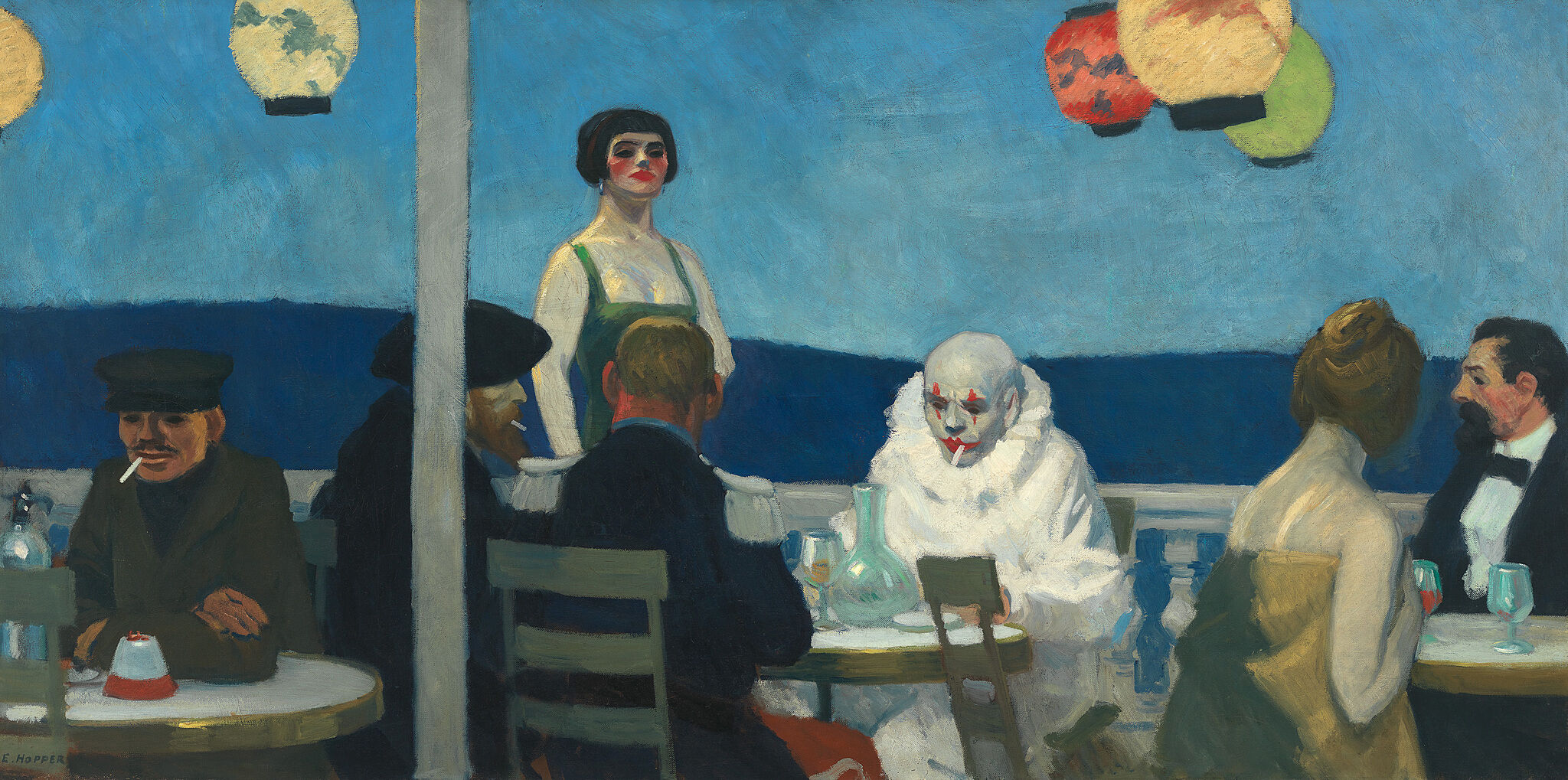
-
589
Edward Hopper, Le Bistro or The Wine Shop, 1909
Audio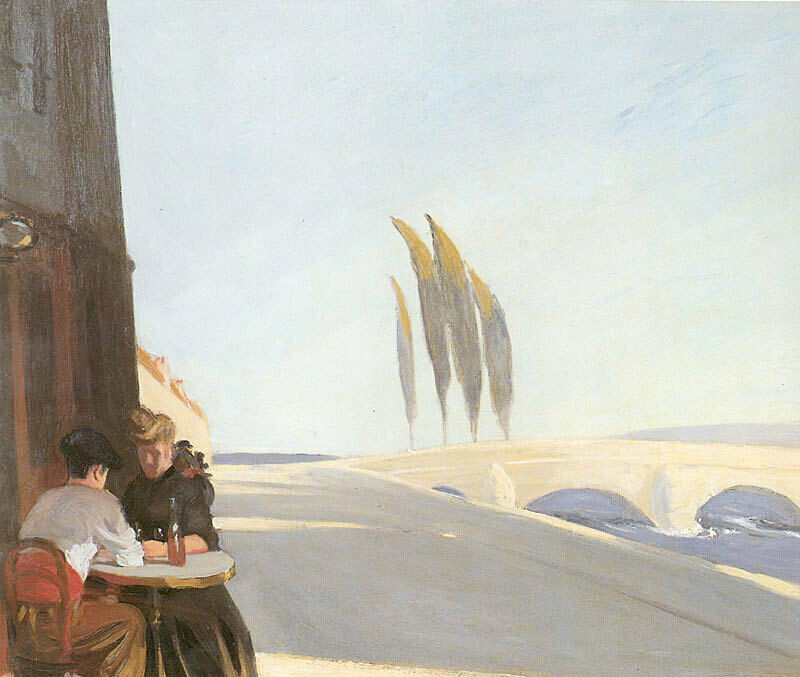
-
111
Edward Hopper, Gas, 1940
Audio -
112
Edward Hopper, The Sheridan Theatre, 1937
Audio -
669
Ben Shahn, Scott’s Run, West Virginia, 1937
Audio
Adam Weinberg: I’m Adam Weinberg, Alice Pratt Brown Director of the Whitney Museum, and I’m pleased to welcome you to Modern Life: Edward Hopper and His Time. In today’s global art world, it is hard to imagine that American artists of a hundred years ago were largely disenfranchised. No one wanted to show their work, much less buy it. It was a time when most patrons of the arts looked solely to Europe for creative achievement. Gertrude Vanderbilt Whitney—whose portrait you’ll see later in the show—was a major exception. She believed in—and supported—a group of American artists dedicated to depicting the authenticity of daily life and the rapidly modernizing world around them. Their subjects were not the refined classical themes taught in European art academies. These artists found beauty in skyscrapers and railroads, bridges, boats, and busy city streets quotidian subjects painted in bold styles. Gertrude Vanderbilt Whitney’s equally bold actions led to the founding of this museum, the first dedicated to supporting the work of American artists.
In the galleries ahead you’ll see what Mrs. Whitney saw in this generation of artists. The installation is chronological and drawn largely from the Whitney’s own collection. The Whitney was an early champion of Edward Hopper and as a result of a bequest from his estate, our collection includes the largest repository of his.
This exhibition presents a rare opportunity to see works by Hopper America’s most iconic realist painter alongside the art of his contemporaries.
Special thanks to Deutsche Bank for their generous support of this exhibition.
I hope you enjoy it.
Narrator: Dr. Rick Brettell is a professor of Aesthetic Studies at the University of Texas, and has written extensively about Hopper in Paris. He considers Soir Bleu the single most ambitious painting of Edward Hopper’s career.
Rick Brettell: Soir Bleu is an odd painting for Hopper, because Hopper’s oil paintings of any sort of decent scale, up until Soir Bleu were generally landscapes or cityscapes that were space positive and had tiny or nonexistent human figures. Soir Bleu is a figure painting. And it’s a figure painting that shows that Hopper had wanted to actually take on the big canvases of Matisse and Picasso. Even the title of Soir Bleu, which was, it is today, and when it was shown for the first time in 1915 in French. So he wants to make you think French and think of France. He doesn’t call it Blue Evening. He calls it Soir Bleu.
Narrator: Hopper depicts an odd assortment of people gathered under a tent at the end of a party. Among them: on the far left, a working-class man smoking a cigarette; in the center, a sex worker and a clown, and on the far right, a bourgeois or upper middle class couple.
Rick Brettell: No one is like anybody else. Everybody is separated from everybody else. Hopper kind of translates it into an everyman setting, in which most of the people in it, are part of a kind of world of alienated urban entertainment, in which one is always searching for a meaning somewhere else, in a costume or in a prostitute or in a drink or in a cigarette or in a party, And those sorts of worlds is the world that Hopper of course represents so importantly when he comes back to New York in 1910 and remains there until the end of his life.
Edward Hopper, Soir Bleu, 1914. Oil on canvas, Overall: 36 × 72 in. (91.4 × 182.9 cm). Whitney Museum of American Art, New York; Josephine N. Hopper Bequest 70.1208. © Heirs of Josephine N. Hopper/Licensed by VAGA, New York, NY
Adam Weinberg: Dr. Rick Brettell is a professor of Aesthetic Studies at the University of Texas, a noted Impressionist scholar and has written extensively about Hopper in Paris.
Rick Brettell: When Hopper painted Paris, he painted a city that was almost completely devoid of people. One sees like tiny people rushing across the Pont des Arts or on a distance bridge, or very far away in the suburbs. But there is a sense in which the city is almost a kind of empty stage set, waiting to be populated by others.
Adam Weinberg: By 1910, Hopper had left Paris and returned twice, staying once for a full year. Hopper was shy, uneasy in French, and likely spent a lot of time alone.
Rick Brettell: And I think it's pretty clear when you look at the paintings and drawings and watercolors that he made on those three trips to France that he actually became an American artist in France, and that it was this kind of alienating life of an American, a Protestant American, who's spoken French wasn't great, in this extraordinarily glittering capital city, that created the kind of, sort of sense of alienation and detachment and emptiness that is so much a part of Hopper's aesthetic until his death in the 1960s.
Edward Hopper, Le Bistro or The Wine Shop, 1909. Oil on canvas, Overall: 34 3/4 x 30 x 2 5/8 in. (88.3 x 76.2 x 6.7cm. Whitney Museum of American Art, New York; Josephine N. Hopper Bequest 70.1187. © Heirs of Josephine N. Hopper/Licensed by VAGA, New York, NY
Adam Weinberg: Whitney Curator, Barbara Haskell.
Barbara Haskell: The mood that permeates all of Hopper's paintings and becomes the kind of standard by which people view his work is this sense of isolation, not so much alienation, which is a word that's often used, but the sense that figures are isolated from their environment and lost in their own thoughts and that the primary existence of people is to be alone.
Adam Weinberg: But what is it in a Hopper painting—in this Hopper painting—that creates this sense of isolation? You might focus on the man standing alone. But it’s just as likely that you didn’t notice he was there at all. Or, that you can easily imagine that the sense of isolation would still be present even if he was not.
Barbara Haskell: It almost doesn't matter whether the figure is there. And in some of Hopper's pictures, he actually paints them out. In the end, he doesn't need them, that the quality of emptiness and silence creates this mood of introspection.
Adam Weinberg: Like other artists of his era, Edward Hopper was a great observer of modern life. But while his contemporaries painted bustling dance halls and frenetic burlesque theaters, Hopper chose instead to paint an empty movie theater. Curator Barbara Haskell.
Barbara Haskell:Hopper was an inveterate moviegoer and spent a lot of his time watching movies so that he was familiar with movie houses in New York. And many of his pictures depict individuals in the seats of movie houses or, in this case, lookingover a banister of a movie house.
Adam Weinberg: Hopper witnessed an exciting period in cinema history: the introduction of electricity and sound, and then, the rise of the Hollywood motion picture. Movie theaters were themselves being transformed—from dark halls to movie palaces that featured luxurious and exotic settings.
Barbara Haskell: The Sheridan Theater was one that was very near his house. It was one of the huge movie houses in New York at that moment. 2,000 people could-could fit into the Sheridan Theater.
Adam Weinberg: However what Hopper was after was not a literal representation of its interior.
Barbara Haskell: What Hopper would often do is he would make sketches of movie houses. And then, what actually appeared in his picture was a composite of various movie houses that he would pull together to create the image that he felt represented or mirrored what was in his mind.
Adam Weinberg: Senior Curatorial Assistant Sasha Nicholas.
Sasha Nicholas: Ben Shahn was hired in 1935 as part of the New Deal to go take photographs in a town called Scotts Run in West Virginia. And there were striking miners there. It was one of the areas that had been most severely hit after the Depression.
And he took a lot of photographs, which he then later, in the years to follow, transformed into paintings. This one is from 1937.
Adam Weinberg: Striking miners may call to mind people who are active and angry, whereas these men look abject and still. The one on the right has time to engage our view; the one in the middle is smoking a cigarette.
Sasha Nicholas: You can imagine that—you know, this is six years into the Depression—that there was probably, by this time, a real sense of hopelessness. I mean, this sense that things aren't getting better. And the economy is not recovering. These guys certainly have the feeling of people who've been waiting a long time for things to get better, and they're not.
Adam Weinberg: They are trapped not only by their real-life poverty, but formally, in this painting—between the line of train cars on one side and the line of houses on the other. The houses being the only addition that Shahn made to the photograph when rendering it in paint.
0:00
0:00