
Charles Burchfield: Elemental
2026
On view
Floor 7
Caroline Webb: My name is Caroline Webb. I’m a curatorial assistant at the Whitney and I’m the curator of Charles Burchfield: Elemental. When Burchfield was young, he thought he’d be a nature writer. And in his journals, he didn’t just document or sketch what he witnessed, but he instead imbued his drawings and notes with his own feelings about what he was seeing.
Burchfield was really intentional about what he wanted his paintings to do. He said that he wanted people to see not just how beautiful nature was, but how vital it is. And I think the immediacy of watercolor lent itself to his desire to work outside. But, at the same time, the fact that he returned again and again to older works—reinterpreting them, reworking them—helped him convey his ideas as they transformed and as he felt he grew wiser and more clear about what he wanted to say.
All of us living today are contending with an extremely vulnerable planet. We have an increasingly unpredictable climate, environmental catastrophes almost daily, and an exponential loss of ecological diversity. But, to me, I think that his work can be a blueprint for a life in which we can slow down and pay attention to the changes that are happening in the world. His work shows us how to care about it through visual expression, and how to recognize our own reciprocal relationship between the external environment and our own inner personal life.
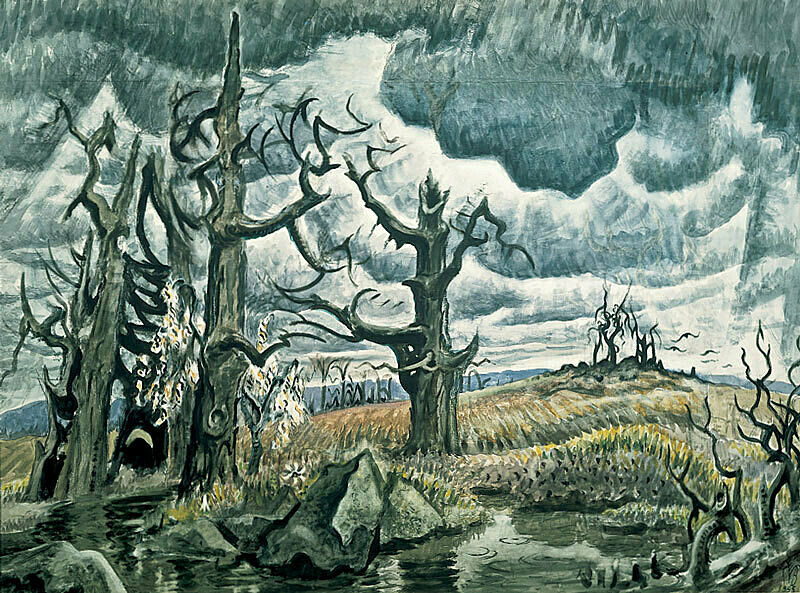
Charles Burchfield, An April Mood, 1946–55. Watercolor and charcoal on joined paper, 40 × 54 in. (101.6 x 137.2 cm). Whitney Museum of American Art, New York; purchase with partial funds from Mr. and Mrs. Lawrence A. Fleischman 55.39
All works by Charles Burchfield are reproduced with permission of the Charles E. Burchfield Foundation
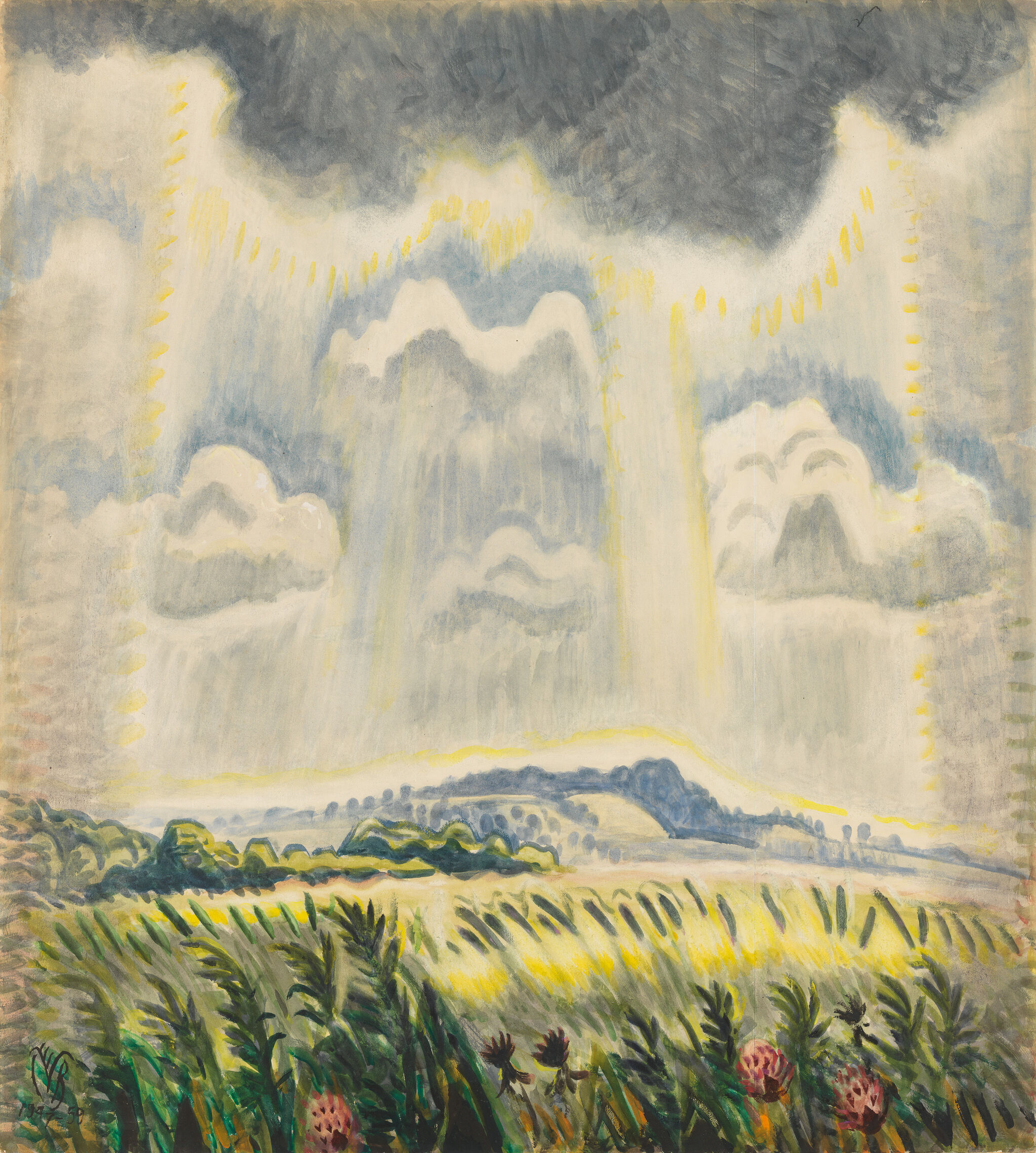
Narrator: Like many of Charles Burchfield’s paintings, Overhanging Cloud in July responds to nature emotionally rather than replicating its outward appearance.
James Welling: This painting has a lot of yellow in it, which is extremely unusual to paint yellow dashes and lines in the sky, and I think for Burchfield it represents a kind of force field.
Narrator: Photographer James Welling.
James Welling: He’s communing with nature and feeling the intensity of the heat and the sunlight, and he wants to put that physical response down on paper.
Narrator: Burchfield used color and form to communicate a feeling of nature’s majesty. He also used watercolor—usually thought of as a quick, casual medium—in a manner that suggests grandeur. He worked on this painting from 1947 to 1959.
James Welling: Burchfield had a very unique style of working with watercolor—dry, large-scale, and slow. One of the things that happens in watercolor is that the painting is never completely done and Burchfield exploits the fact that you can take a brush and water and re-wet the page in certain passages and remove parts of the painting, add new elements, as a way that watercolor is much more transitory than oil paint.
With oil, once it’s dry you have to really scrape to remove anything. With watercolor, you just re-wet it. In a painting like this, Burchfield’s working on it for ten years, he’s just able to pick up whenever he wants to and continue to work on the painting.
Narrator: Overhanging Cloud in July by Charles Burchfield is made from the years 1947 to 1959. It is a vertical watercolor painting mounted on a board. It measures about 40 inches high by 36 inches wide.
The painting illustrates an open meadow with swells of clouds taking up the majority of the composition. Burchfield has conveyed the energy of light, plants, and atmosphere with washy yet brilliant watercolor hues. At the very top, gray clouds gather in a brooding dark pool, in an otherwise radiant meadow. This painting encapsulates his lifelong interest in portraying the summation of a full day’s weather in a single image. In that, it brings together the phenomenon of the coexistence of sunshine with the intensity of sudden summer squalls. In this painting, Burchfield references that feeling through a more overtly spiritual symbolism. For example, the gray clouds could symbolize the omnipresent power of God over the earth. Below them, puffy white clouds hang in the expanse of the summer sky. The sky takes up the majority of the composition, and Burchfield once remarked: “I do not believe anything quite stirs our imagination as do clouds.” Represented with short dashes of yellow, the artist included yellow beams of light coming down from the clouds that illuminate a breezy meadow.
The glowing rays of light hover above the low horizon line. Blue hills sit behind an expanse of rolling fields with small green bushes on the left side. Ahead of the bushes are tall green and gold grasses and small pink flowers. The flowers stand at the lowest part of the composition as foregrounded details. The plants all lean to the left as if to show the July wind’s direction.
Burchfield created this painting with a dry-brush technique, mixing minimal water with the watercolor paint he used. Working on this composition for over ten years, he would take away elements and redo them, showing his skill with the medium. Burchfield’s lifelong fascination with cycles of the changing seasons took on an increasingly mystical tone in his late watercolors. He said, “I don’t know how much time I’ve got left, but I’d like to have at least another lifetime like I’ve had to say what I want to say about nature.”
Charles Burchfield, Overhanging Cloud in July, 1947-59. Watercolor on paper mounted on board, 39 7/8 × 36 in. (101.3 × 91.4 cm). Whitney Museum of American Art, New York; purchase with funds from the Friends of the Whitney Museum of American Art 60.23. Reproduced with permission from the Charles E. Burchfield Foundation and the Burchfield Penney Art Center
0:00
0:00