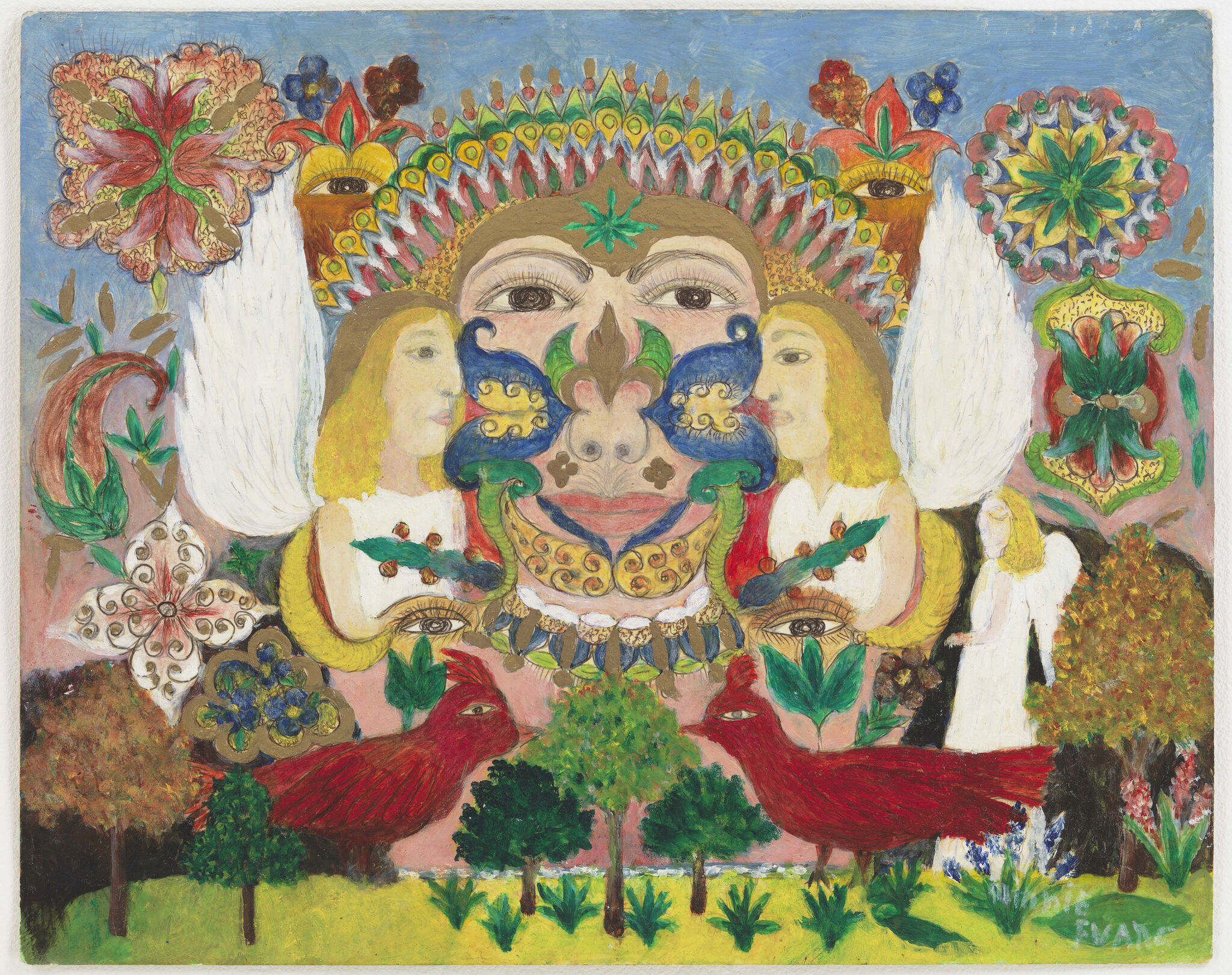
The Lost World: The Art of Minnie Evans
2026
On view
Floor 8
-
Intro/Untitled (Face, Flowers, Foliage Collage)
Audio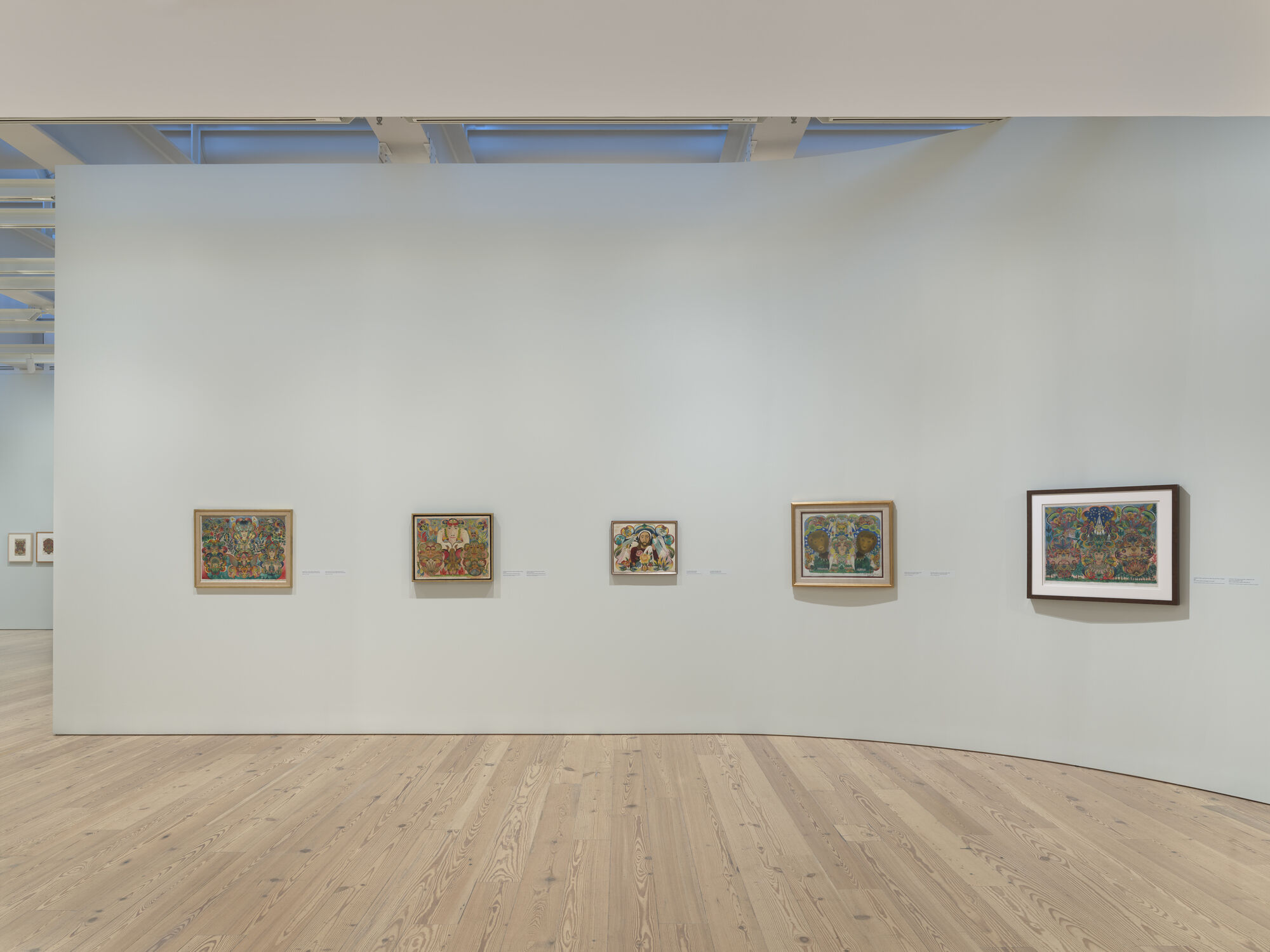
-
My Very First, 1935
Audio, Verbal description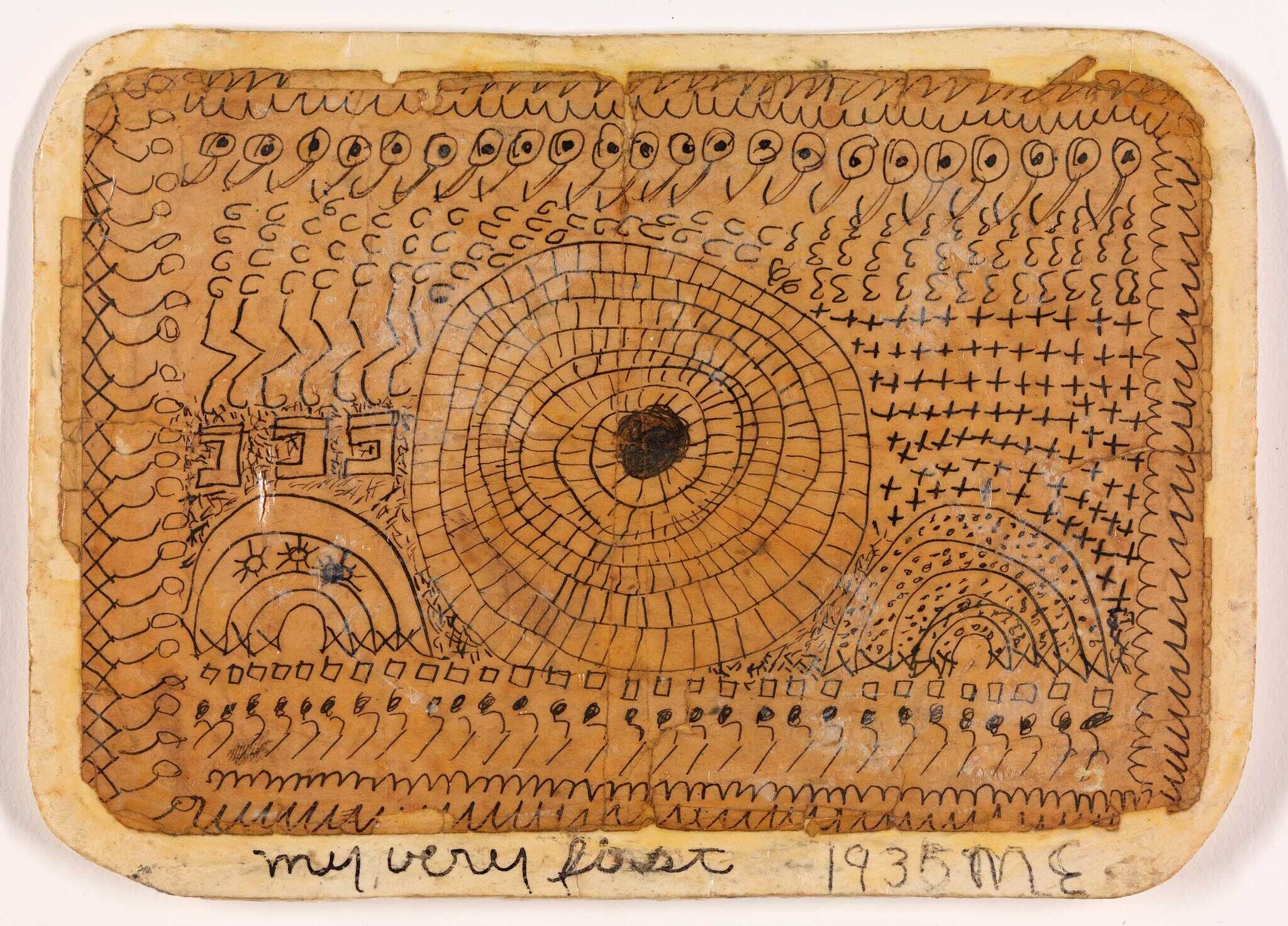
-
Untitled (Pom Pom Tree), 1943
Audio, Verbal description
Untitled (Pembroke Park Gate), 1940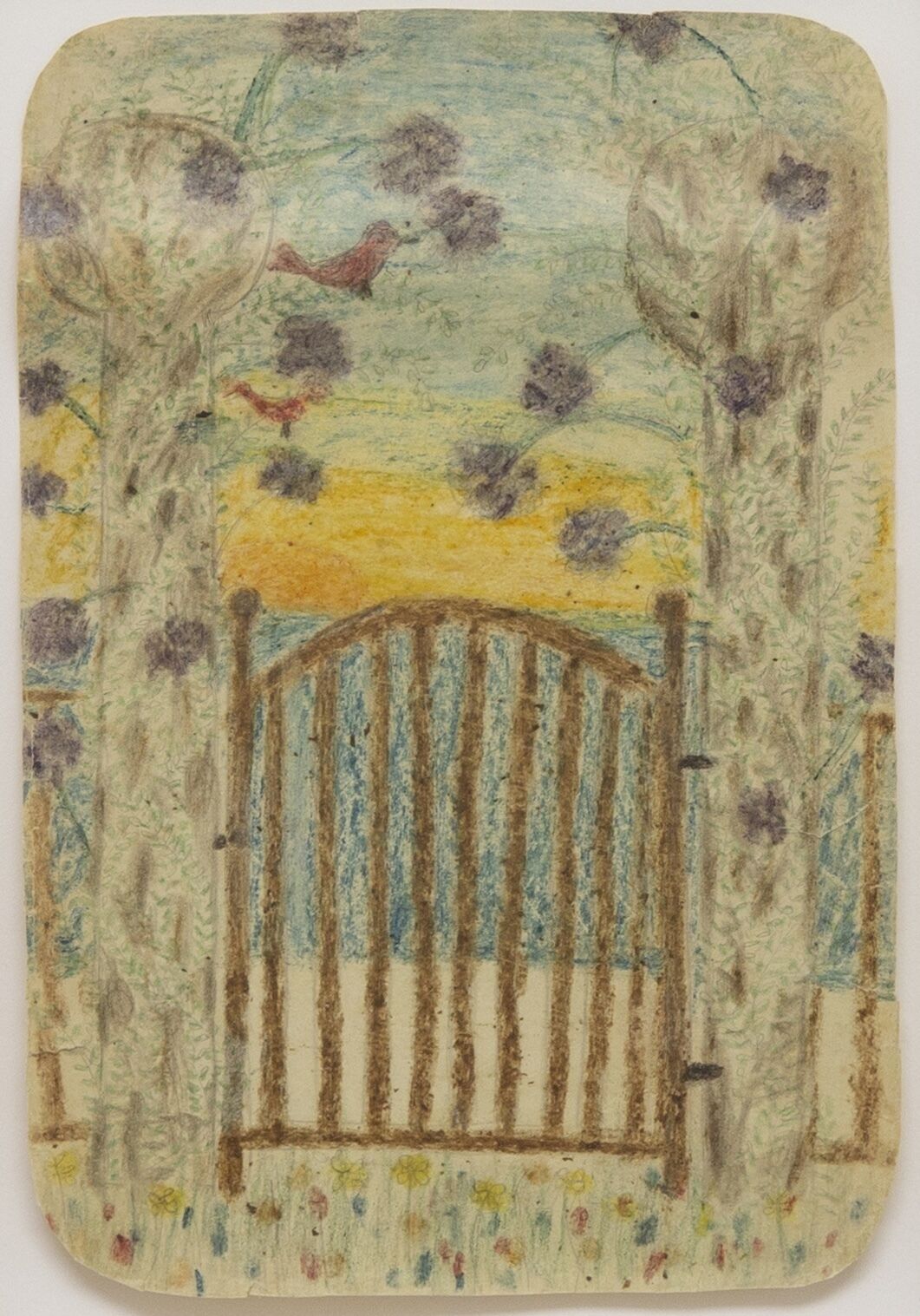
-
Mosquito Bombs, 1943
Audio, Verbal description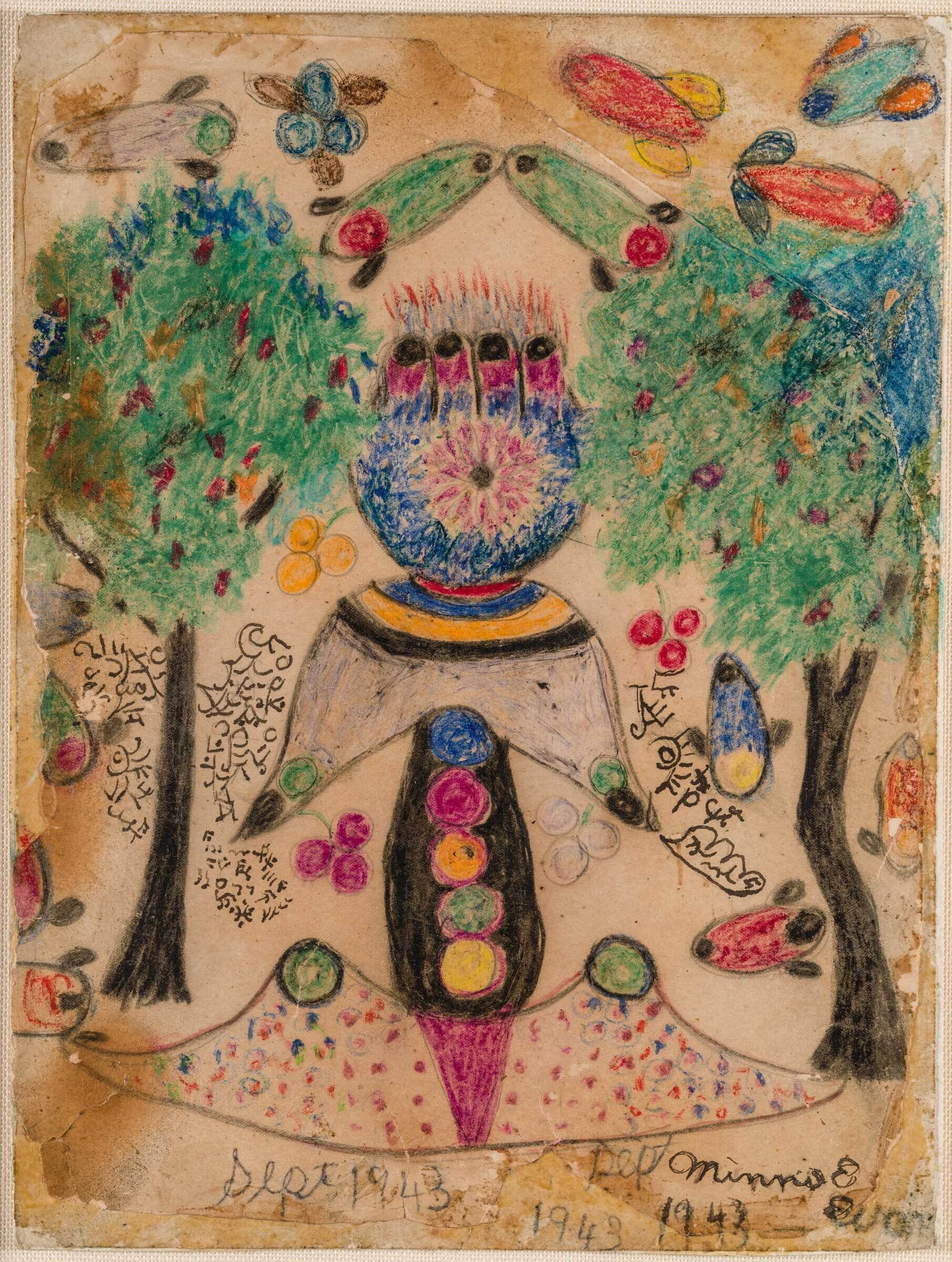
-
Modern Art, 1963
Audio, Verbal description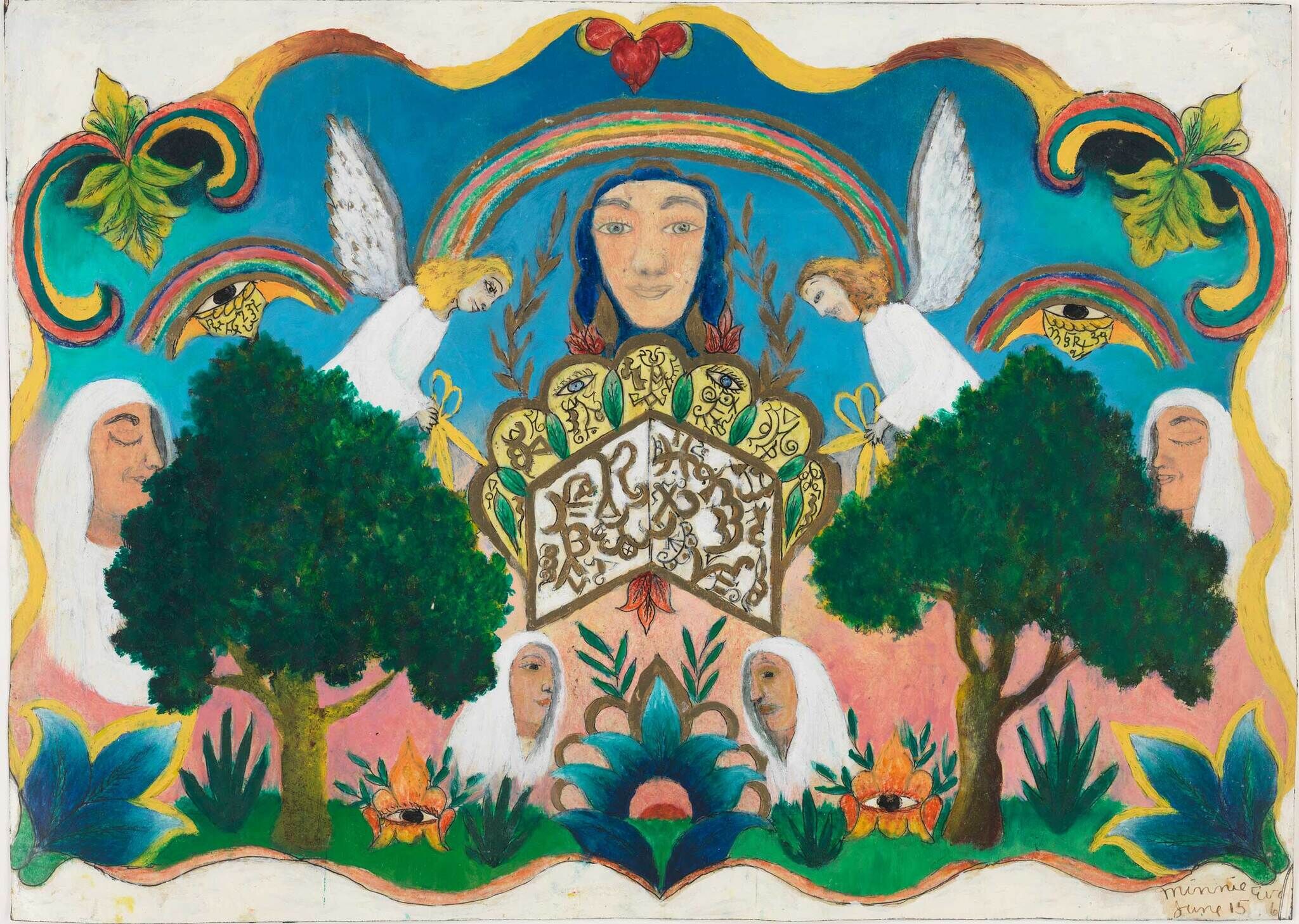
-
Untitled (Turnaround Picture with Pincher Forms), 1946
Audio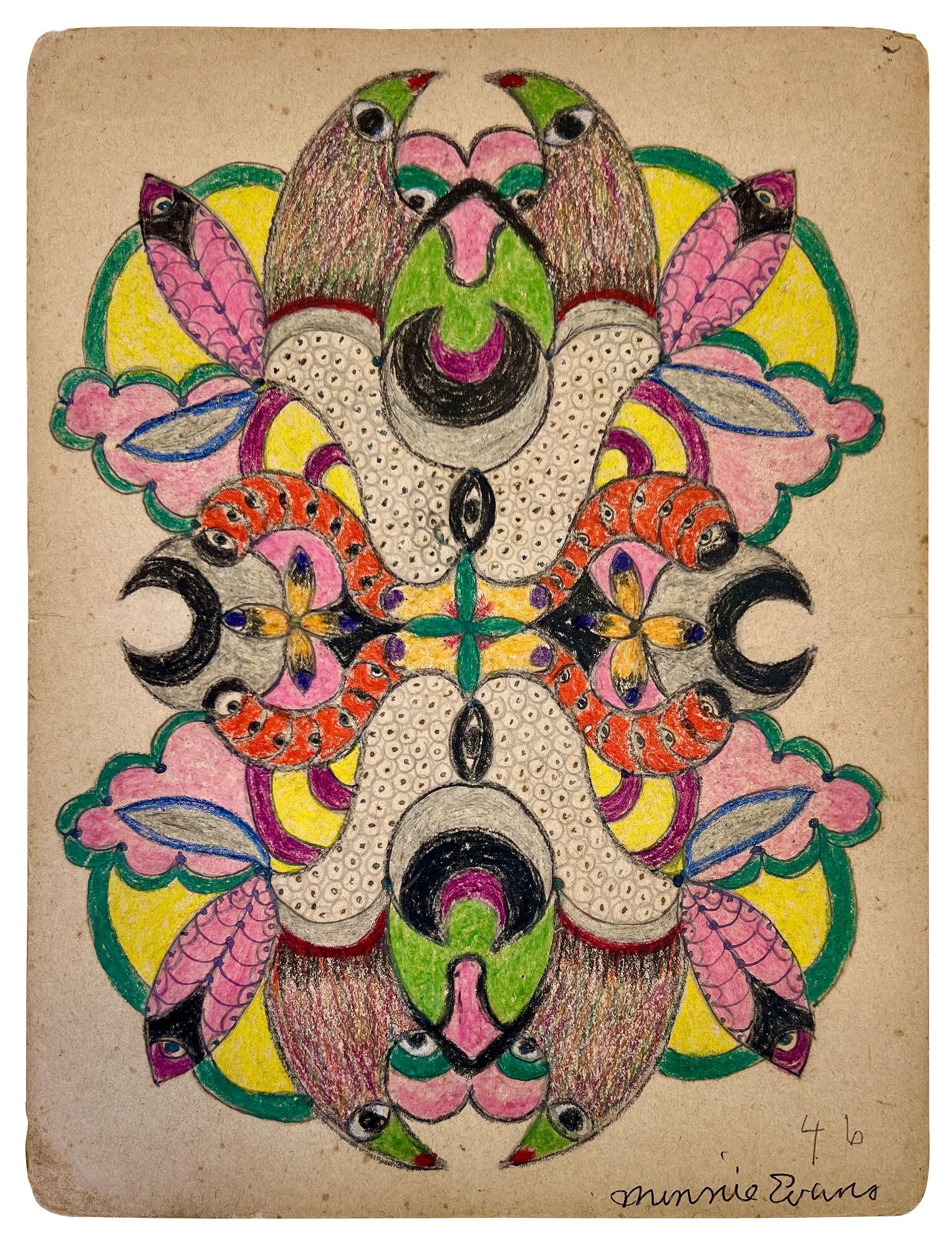
-
Resurrection, 1960
Audio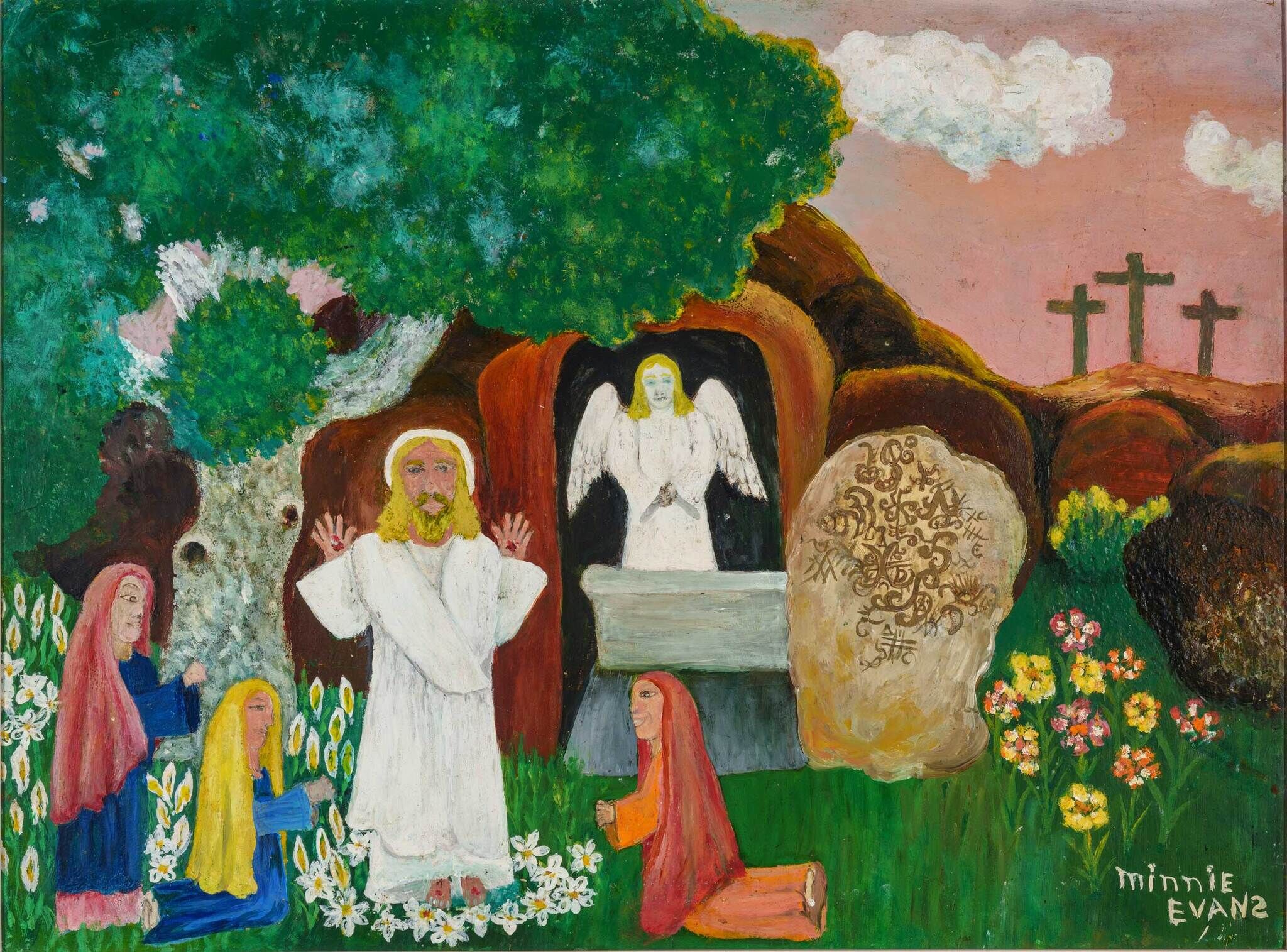
-
Airlie Oak, 1954
Audio -
Untitled (Bull’s Head with Sunset and Eyes), 1960
Audio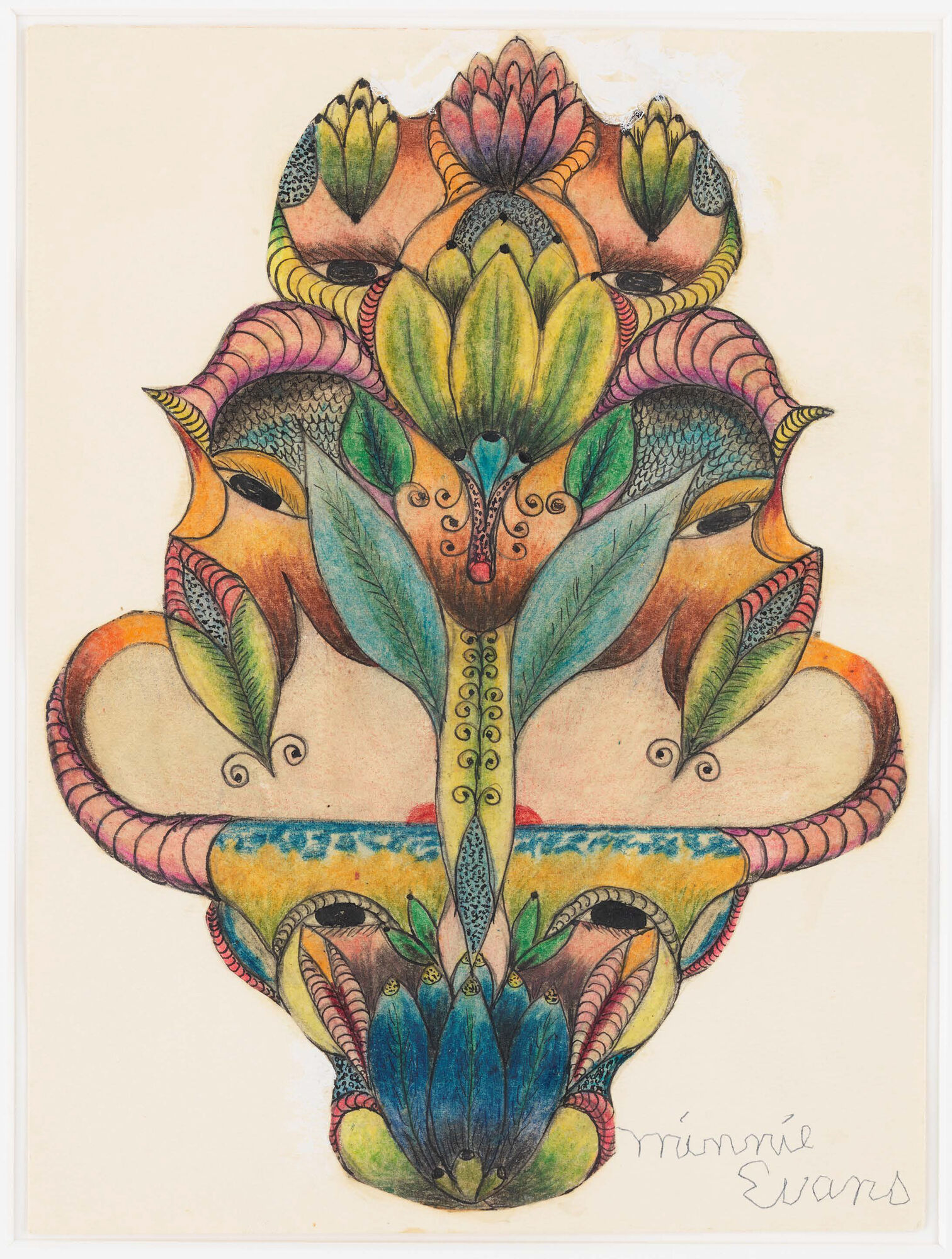
-
Design Made at Airlie Gardens
Audio -
Untitled (Angels with Centaurs and Creatures), 1978
Audio, Verbal description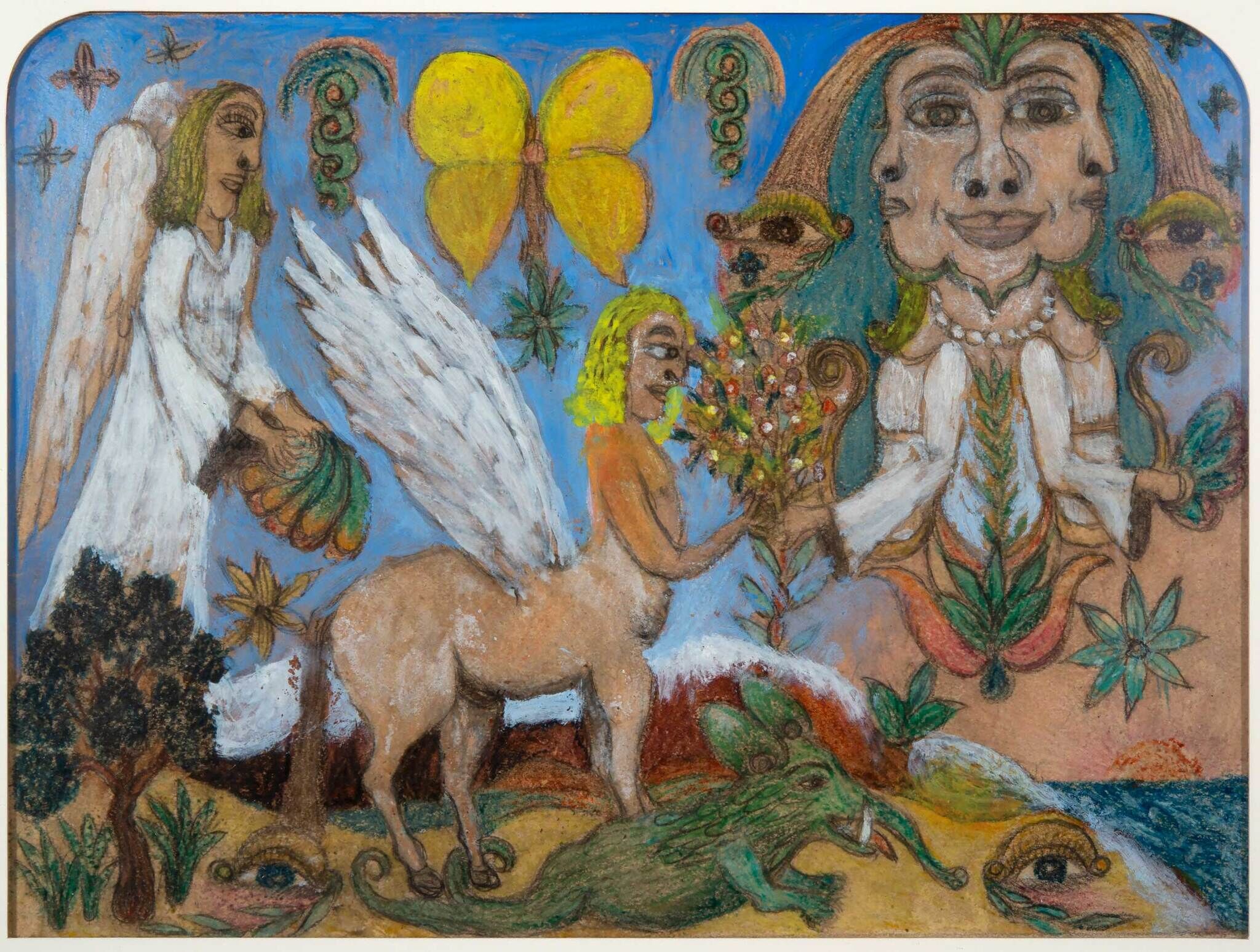
-
Untitled (Airlie Oak, Angels, Faces, Serpents), 1966
Audio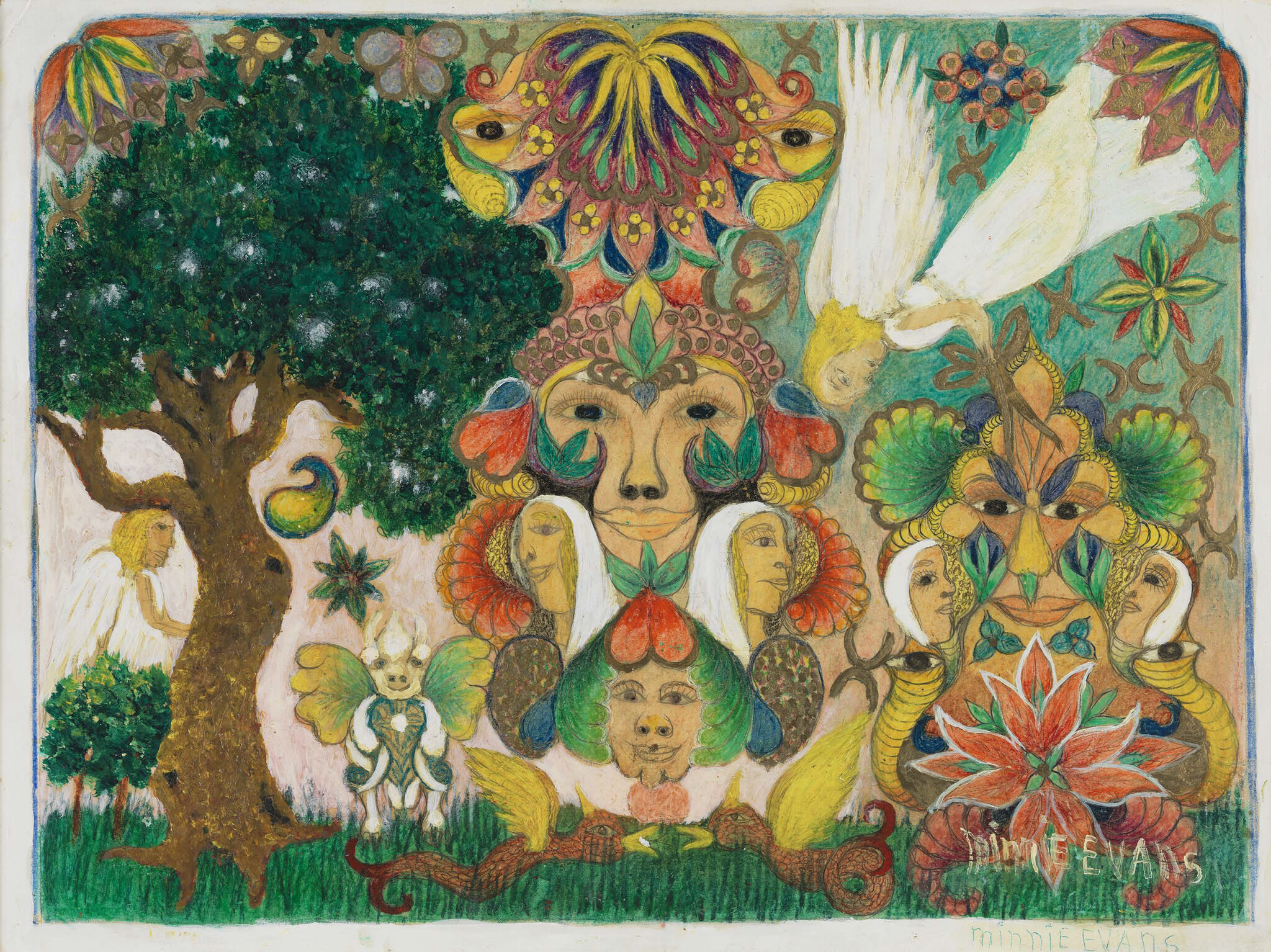
Narrator: Welcome to The Lost World: The Art of Minnie Evans. Evans began making art in the 1930s, and for many years was recognized primarily by her local community in Wilmington, North Carolina.
Curator Barbara Haskell organized this exhibition for the Whitney.
Barbara Haskell: Minnie Evans saw herself as an important intermediary between the world of God and the world of people that were involved in art. So the artist was a messenger... She wasn't just somebody making pretty pictures. She had a message to deliver and there's an urgency to her work because of that.
Narrator: As you look at the works in this introductory gallery, you’ll notice that Evans also includes a lot of eyes, often emerging out of lush natural imagery.
Katherine Jentleson: There are not only eyes in the faces of the figures that she's drawing, but there are eyes appearing just as part of the overall design.
Narrator: Katherine Jentleson curated Minnie Evans: The Lost World for the High Museum in Atlanta, where it originated.
Katherine Jentleson: And those eyes I think are such important symbols both of her own kind of visionary identity. So the way that she saw her art making as being made possible by these visions that she had of what she called the lost world. So that was one meaning I think for the eyes. There are others. She talked about them being the eyes of God who she worshiped dearly. And then of course also the watchful eyes I think that she operated under as a Black woman in the American South who really came of age in the wake of racial terror and was kind of always under the watchful eyes of white North Carolinians that she worked for and that she lived amongst.
Installation view of The Lost World: The Art of Minnie Evans (Whitney Museum of American Art, New York, August 22, 2026–January 10, 2027). From left to right: Untitled (Face, Flowers, Foliage Collage), 1946–67; Untitled (Face Flanked by Angels and Mandalas Collage), 1946–68; The Ministering Angels, 1963; Untitled (The Lions of Judah Collage), 1968; Untitled (Three Large Figures, Night Sky and Stars Collage), 1967. Photograph by Ron Amstutz
Alison Saar: My name's Alison Saar. I'm an artist and I've always had a real keen interest in self-taught artists or visionary artists.
Narrator: For Saar, it isn’t just Evan’s subject matter that’s visionary. It’s also the way she composed works like this one, which she called My Very First.
Alison Saar: I think she starts making these things that, if she makes one shape, then she's compelled to kind of repeat that shape and then this one loop then creates a shape within that shape and she makes the eyes within those shapes. And so it's kind of like it's not predetermined. I don't think she—even though she says she has these visions—I don't know if it starts out that she's like got this idea of this painting in her head before she even picks up a pencil. I think that she makes a mark and then the next mark responds to that mark.
I feel like there's some sort of spirit or something that's guiding her hand in a way that one line informs the next, that she's working from line to line and that these things build and they kind of co-create somehow.
Narrator: As the title suggests, this was Evans’s first work of art.
Alison Saar: She had these ideas and images, whether they came through dreams or whatever, that she just felt compelled to put on paper. And to me, that just feels so essential to the creative process and so essential to why we are artists.
Narrator: This abstract drawing by Minnie Evans is filled with geometric forms drawn with a black-inked pen on browned paper with rounded edges, colored and frayed with age. The composition contains multiple areas of repeated markings—glyph-like etchings, check marks, swooping lines—that are laid out in a configuration, almost resembling the design of a garden captured from a bird's eye view.
In the center of the drawing is a squiggly circle that spirally expands throughout the center of the page, resembling a coiled up snake whose head lies tucked away in the center. Beyond this central shape, the drawing holds symmetrical abstract motifs across the composition. The four sides and sections of the composition are similar, but unique. As a result of this intentionally imperfect symmetry, it can seem like the pictorial elements are coming apart and then coming back together in different corners of the picture.
A shrub-like pattern lines three sides of the work, but the left side is instead marked by repeated Xs. Emerging from these Xs are horizontal short curved lines that end in small circles and point towards the center of the work. Evans drew a similar shape at the bottom of the composition. The curved lines at the bottom of the drawing are vertically oriented, with small black circles at the top. At the bottom of both sides of the interior lie two colorless rainbows. The left one holds three suns. The right one has a polka-dot pattern that fills each of the rainbow’s five stripes. The bottom center of the drawing holds Evans’ now-scuffed handwriting, titling the work My Very First and marking the year of completion, 1935, and her initials, ME.
The automatic, meditative drawing process Evans used in this work is an integral component of what makes up its abstract composition. She herself described the process of creating My Very First: “I had wrote my grocery order and after I tore that off then I had taken my pencil and went to making some funny things. I don’t know why but I just kept on making a lot of funny things.”
Minnie Evans, My Very First, 1935. Pen and ink on paper, 5 1/2 × 7 7/8 in. (14 × 20 cm). Whitney Museum of American Art, New York; gift of Dorothea M. and Isadore Silverman 75.8.1. © The Estate of Minnie Evans
Narrator: These two early drawings depict Airlie Gardens on the Pembroke Estate in Wilmington, North Carolina. Evans worked for much of her life on the estate and became the gatekeeper when the gardens opened to the public in 1948. This role allowed her time to draw and explore.
Barbara Haskell: So every day, she was able to wander the gardens and really be part of this lush experience. And those images, she filtered into her work. So it was as if her dreams and her visions were channeled through the natural world that she observed every day.
Narrator: Jawole Willa Jo Zollar founded the dance group, Urban Bush Women. In 1991, she choreographed a work inspired by Minnie Evans and other visionary artists.
Jawole Willa Jo Zollar: I created this work called Praise House and the work Praise House was inspired by the life of Minnie Evans, but many visionary artists who are in rural communities, often rural Southern communities. Because that's where there is the most–I think maybe tolerance might not be the right word–but most capacity for them to be fully as artists who have these visions, that think different than society would have them think. In many cities or other places, they might be described as schizophrenic, they might end up institutionalized. And in the rural southern areas, they were able to thrive and just be a part of the community as somebody who was a little different, but who was able to have a place within the community.
Narrator: Minnie Evans’ Untitled (Pembroke Park Gate), from 1940, is a vertical drawing made with wax crayon and pencil on paper. It measures 7 by just under 5 inches
The drawing depicts a dream-like, ethereal scene. At the center, there’s a closed, muted brown-colored gate with vertical slats and a curved top. On each side of the gate stand two large, pale grey leafless trees. On the tree on the left stand two red birds–one of them holds a purple flower in its beak.
Beyond the gate, the background is an expansive landscape made up of a gold and blue sky with a glowing orange sun setting on what appears to be a stretch of blue ocean. At the bottom of the drawing, in front of the gate and trees, is grass with blossoming red, yellow, blue, and orange flowers.
This early drawing depicts Airlie Gardens on the Pembroke Estate in Wilmington, North Carolina. Evans worked for much of her life on the estate. First as a domestic worker, and then as a gatekeeper when the gardens opened to the public in 1948. This role allowed her time to draw and observe.
Minnie Evans, Untitled (Pembroke Park Gate), c. 1940. Crayon and pencil on paper, 7 × 4 3/4 in. (17.8 × 12.1 cm). Collection of Christian Daniel. © The Estate of Minnie Evans
Narrator: Minnie Evans completed Mosquito Bombs during World War II, while working at Airlie Gardens. A number of colorful flying forms buzz around the composition. The title likens them to the “Mosquito” combat aircrafts used during World War II.
María Elena Ortiz: You see this garden that it has this beautiful vegetation and it's this site of peace and beauty and tranquility, perhaps very much like the Airlie gardens were to her, even though she was a worker in the garden, but also it's a place of war when you see them as mosquitoes going on.
Narrator: Writer, curator, and contributor to the Minnie Evans exhibition catalogue, María Elena Ortiz.
María Elena Ortiz: So she's certainly playing with the garden in multiple entry points, not just as an idyllic space perhaps, but also as a space of contention.
She was given an opportunity to work in a garden, which is a beautiful space, but it's still a place of work where she was still seen and treated as a Black woman in the South. So even though she had an idyllic environment, it was still a site of tension just like you see in Mosquito Bombs.
Narrator: Two trees are symmetrically placed on either side of the composition, surrounding a central form that could be interpreted as a hand. Ortiz connects similar motifs to both Christian and Afrodiasporic religions
María Elena Ortiz: Because in a lot of these religions or perhaps all these religions, you don't have to choose to be one or the other.
Narrator: Minnie Evans made the drawing Mosquito Bombs in 1943 using wax crayon, ink, and pencil on paper. The vertical work stands at just under 12 inches tall by 9 inches wide. The paper’s color has become sepia with age, and it contrasts with the brightly colored crayon images on top of it. The drawing is busy and clearly hand-drawn, with detailed marks and objects filling the page.
Like many of Evans’ drawings, the imagery is symmetric, flowing out from a central point. Here, in the upper part of the center, is a blue hand with four purple fingers pointing upwards. The artist chose to render the hand in a simplified and even manner, adding to its solidity as a visual anchor within the composition. Above the fingers, pale blue flames shoot upward, giving the object a talismanic quality. Scholars have noted that the hand would have had religious resonance for Evans, connecting both to Christian iconography and Afro-diasporic religions like Santeria and Candomblé. Near the central column of the drawing are pools of small black writing in what Evans referred to as an “ancient language,” reflecting her interest in history and mythology.
The hand sits on a column that fans out at the top and bottom like a tulip or the wings of a butterfly. Surrounded by the lush nature in the gardens by where she worked, Evans often drew natural elements into her artworks. Here, two trees with full tops flank the central motifs. The trees have small marks of pink and yellow throughout their green canopies, perhaps suggesting fruit. Buzzing around them are the plump forms that give the picture its name: mosquito bombs. Although the artist used bright blues, reds, and oranges for these winged elements, the destruction brought by World War II would have been palpable to her in 1943 Wilmington, which served as a major military production hub.
Inside the vitrine behind you, located in the center of the room, is Minnie Evans at gatehouse, Airlie Gardens from 1962: a gelatin silver print measuring 8 by 10 inches. This portrait of Minnie Evans was taken by Nina Howell Starr, a photographer who became a key figure in propelling the career and exposure of Evans’ artwork.
Starr frames Minnie Evans in the center of the composition: a Black woman at the age of seventy with a slight, skeptical smile, furrowed brows, and a strong gaze. Evans’ ear-length light grey hair is mostly covered by a dark brimmed hat, and she is wearing a dark shirt with a lighter-toned sweater. Her cautious facial expression evokes the wariness she described feeling upon first meeting and being photographed by Starr, before deciding to trust her with her image and life’s work. She is leaning forward, with her hands clasped and fingers crossed, placing her forearms on the wooden frame of the booth’s window. Just above and behind her right shoulder is a wall calendar, emphasizing the narrowness of the space she worked in each day. The image itself is framed within the window booth, with the top of the photograph catching a sliver of the booth’s hooded covering.
Minnie Evans, Mosquito Bombs, 1943. Ink and crayon on paper, mounted on paper 11 3/4 × 9 in. (29.8 × 22.9 cm). Collection of Nathan Kernan. © The Estate of Minnie Evans. Photograph by Paul Takeuchi
Narrator: Evans made this work in 1963, after her first exhibition in New York. She called it Modern Art.
Barbara Haskell: The title of the work suggests that Minnie Evans really considered herself as part of the history of American twentieth century art
Narrator: Curator Barbara Haskell.
Barbara Haskell: She felt that her work was part of the canon and equal to anyone else's. In terms of subject matter, the work suggests the idea that nature was this repository of spirit, divine presence, that the world was united, that animals, plants, and humans were all part of one big spiritual cosmology and that's very much depicted in this work.
And then the other part that's very important is that she saw art as an important vehicle for delivering messages, that art wasn't just beautiful pictures, but that it had a very significant place in giving people information about the world and worldviews.
So in this case, she has a book that's open to the viewers. The pages are available for us to read and it's being presented by a female who is a surrogate for the artist herself.
Narrator: Minnie Evans made the horizontal painting titled Modern Art out of oil and ink on paper. It’s from 1963 and it measures 14 ½ by 20 inches. The work is symmetric: each shape and design is mirrored on both sides of the composition, surrounding a central motif.
Centered at the top of the painting is a beige colored human head with a navy blue hood-like covering, looking outward. The head sits under an arched rainbow bridged by two winged angels, who face inwards towards each other. Below the heads, Evans placed an open book with script-like designs that emulate ancient writing. The two angels emerge from large green trees that dominate the foreground, standing on either half of the composition. Above each tree sits a golden colored boomerang shape, with one open eye in front of it. Evans layered a miniature rainbow on top of this boomerang and eye shape. Behind each tree is a white hooded head pictured in profile with their eyes closed. Reflected on either side, at the bottom of the page she painted two similar but smaller white hooded faces with their eyes open, surrounded by blue and yellow flowers that rest on top of grass and leaves. On top of the grass are two yellowish-orange flowers with eyes, blooming from the ground. Evans made a border in the shape of a dark yellowish curling stream, with rainbow curved and colored corners at the top.
Titled Modern Art, this work differs from Evans's earlier works, which she often left untitled.
Minnie Evans, Modern Art, 1963. Oil, ink, and crayon on paper board, 11 1/4 × 14 1/2 in. (36.8 × 50.8 cm). Collection of Wendy Williams, New York. © The Estate of Minnie Evans. Photograph by Christopher Burke
Narrator: These works have come to be known as Evans’s “turnaround pictures” because she was happy for them to be viewed from any angle. Find one of them that uses more gray and black than the others, and looks like an abstract mix of flowers, butterflies, and caterpillars. The artist Alison Saar is drawn to the way Evans mixed eyes into this drawing.
Alison Saar: I was really intrigued with how she's kind of combined the way insects use false eyes on their camouflage to kind of ward off predators and how I think in her work that these eyes kind of represent a similar thing to kind of ward off evil or bad spirits.
Narrator: Alison Saar.
Alison Saar: What I really love about these pieces is that they kind of make me think of a little bit about the Congo cosmograms where they have a middle cross section and that they're dually symmetrical going from left to right and from up and down. And I love this idea that I think she's kind of tuning into this idea of this sort of crossroads of the intersection of the spirit world with our real world or whether that's the intersection of reality and fantasy.
Narrator: For Saar, it’s not important if or exactly where Evans might have seen African art.
Alison Saar: This idea that we have to have in the textbook evidence that she lived this or saw this in a book or somebody connected her with this, I feel really kind of denies and defies a lot of what her work is about. I mean, her work is really about these things coming to her from out of nowhere. And even you go back to the sources–the cross itself comes from places beyond these things as we understand here and now and so I love that it's a very sort of living sharing of traditions.
Minnie Evans, Untitled (Turnaround Picture with Pincher Forms), 1946. Crayon, pencil, and ink of paper, 11 1/2 × 9 in. (29.21 × 22.86 cm). Collection of John Jerit. © The Estate of Minnie Evans
Barbara Haskell: Minnie Evans's faith grounded her art and her worldview.
Narrator: Barbara Haskell.
Barbara Haskell: In a work like Resurrection, she is not illustrating the Bible, which she read constantly, but she's using the Bible as the springboard for her vision of the world. So in Resurrection, she's depicting Christ coming out of the cave. In the gospels, there's several Marys that appear at the cross. Very significantly she's not depicting a world of sadness. Resurrection for her is about the resurrection of humanity and the idea that God ultimately will prevail over evil in the world and that the natural world that she's observing, the world of everyday life, the earthly dimension will become a paradise. The Marys that are surrounding Christ are not mourning the way they are in many religious pictures. They're happy. There's a sense that this is a world to come.
Minnie Evans, Resurrection, 1960. Oil on board, 18 × 24 in. (45.7 × 61.0 cm). Collection of John Jerit. © The Estate of Minnie Evans
Narrator: To make this painting, Evans reworked green and brown dried paint from cans that had been used to paint the gatehouse where she worked in Airlie Gardens.
Katherine Jentleson: And the paint cans from that paint job were just lying around for a number of years. And Minnie Evans took the skins, the dried up paint around the edges of those paint cans and used that to create this incredible work. So she had an old kind of wooden crate lid, which is the frame and the backing of this work. And she took these paint skins and massaged them with turpentine to loosen them from the paint cans and create essentially these tiny nubs of paint that she layered on top of each other to create this incredible image of the Airlie Oak, which is the most iconic part of Airlie Gardens. It's an old growth live oak that is more than 500 years old at this point. Its circumference is almost 30 feet all the way around.
Narrator: Evans made this painting in 1954. That year, the Airlie Oak survived a category four storm that resulted in a flood of biblical proportions–something that would have resonated with Evan’s spiritual beliefs.
Katherine Jentleson: Also, the year prior to her completion of this work, her husband passed away, Julius passed away and Julius had been a huge source of support and strength in her life up until that point. And when I look at this work to me it really reads almost like a body and almost like actually an embrace. And so for me, I see this possibly too as a kind of symbolic portrait of Julius and their lives together and their kind of intertwinement and the stability that they were able to create in their lives and for their family in the face of so much chaos.
Katherine Jentleson: In Minnie Evans' work, there's so much beauty, the color, the kind of harmony of the forms, but in a lot of her pieces, there's also this kind of evil that lurks beneath the surface
Narrator: Take a moment to look at the works in this section. Mixed with their lush, vibrant forms, you may see pointed horns, sharp claw-like pincers, and faces that are more demonic than angelic.
Katherine Jentleson: And to me, these pieces are really expressions of Minnie Evans' harmonizing of the, again, beauty of her world, of the gorgeous natural setting that she lived in in this Wilmington area and the horror that she knew as a Black woman of her generation in the Jim Crow South.
And for her, visions that really gave her the permission and the impulse to create her art started in childhood and started as nightmares. They started as nightmares that came out of her experience of the 1898 Wilmington massacre, which is the only successful coup d'etat in United States history, meaning that a coalition of white supremacist groups were successful in overthrowing the local elected government of the city in that year. The story of the massacre is a long one that has been told very well in recent documentaries and books, but here I'll just say that Evans was only six years old when this white mob took to the streets based on an election that was taking place that November and burned Black businesses, murdered Black citizens. She could smell the fire. She had relations including her great-grandmother, who she was very close to, who had to flee the city and never come back.
And so Evans' community was traumatized from this experience and it wasn't only the night that she remembered having experienced this as a six-year-old, it was everything that came after. It was the fact that she would live the rest of her life in this kind of powder keg of an environment where Black citizens could not step out of the roles and the codes that they were forced to observe by the ruling kind of white class of Wilmington.
Minnie Evans, Untitled (Bull’s Head with Sunset and Eyes), c. 1960. Crayon, ink, and pencil on paper, 11 3/4 × 8 1/2 in. (29.85 × 21.59 cm). Collection of Wendy Williams, New York. © The Estate of Minnie Evans. Photograph by Christopher Burke
Narrator: Artist Alison Saar responds to the figures in the lower corners of this drawing.
Alison Saar: What immediately comes to mind are the costumes that we would see in the Trinidadian traditional parades that we have in Brooklyn and how you can just hold these things side by side. The similarities are so intense, and that this goes back to times when folks were enslaved and kind of pulling out the costumes and putting together things, whatever that they can to create these really otherworldly bodies that are part animal and part plant and embracing the natural world in a really crazy way. But also about, I guess one of the words that comes to me is “flourish” and flourish being not only to thrive and prosper, but also the ornamental stroke, the idea of spirals. This intense density of imagery opens and is inviting and honoring the spirit—whether that be a Christian spirit or whether that be a transatlantic spirit it's hard to say, but I think that it's very much about the sort of celebrating the spirit.
Narrator: Here, Evans mixes angels with centaurs and other mythical or magical creatures. Much of Evan’s imagery was Christian, but she also took inspiration from classical art and her own imagination. Jawole Willa Jo Zollar.
Jawole Willa Jo Zollar: One of the things she talked about is some of the animals that she's drawn or human animal kind of embodiments. She talks about that they're not here yet. They won't be seen on earth for...I think she said another 1200 years and the idea that she's making visual elements from the future and they're fantastic and fantasy and maybe not fantasy to her because I think it is what she saw, just incredible, even the way the faces I think about all the things that are happening with AI This may be how we look in the future [laughs] when things are implanted and growing out of us and we're half robots. But I felt like she talked about that she was seeing something that was not here yet.
Narrator: Minnie Evans’ Untitled (Angel with Centaurs and Creatures) is a wax crayon, watercolor, and pencil on paper drawing. It measures just over 9 inches by almost 13 inches. Evans drew mythical creatures and large faces among a fantastical landscape. This work brings together a number of the influences that reappear throughout Evans’ artwork. These include the Book of Revelations, Greco-Roman mythology, and the natural landscapes of Airlie Gardens where she worked each day.
Three large, pale-skinned and blonde-haired figures are the focal points of this work. While Evans often faced scrutiny by those who thought she only drew white people, she did not identify the whiteness of the biblical and mythological figures she drew in terms of race, but rather as a marker of their heavenly domain: “They are angels and all are white. All one grand beautiful white color.”
On the left and right sides are two angels both dressed in white gowns. The left angel has large wings, while the right one has three faces, two torsos, and no wings. The work’s central figure is a winged centaur creature with a soft smile. Its right arm is outstretched, grabbing a multi-colored bouquet of flowers from the tri-faced angel, who could be a reference to Janus, the Roman god typically depicted with two faces. Above the centaur is a large yellow butterfly. While the angels and butterfly are in the sky, the centaur stands directly on the ground, and crawling between its feet is a two-tailed alligator with the face of an elephant. Evans, inspired by the strange, hybrid creatures described in the Book of Revelation, includes this creature in another work in the exhibition, Untitled (Green Animal).
This scene of creatures is set against a cloudless sky that fades into a pink sunset over a sliver of water on the lower right side. Lining the rest of the bottom of the work is a fantastical, hilly landscape that recedes into snow-capped mountains.
Other important components of the work are the disembodied eyes that appear throughout. There are four in total, one on each side of the Janus figure and one on each side of the hybrid alligator—all with leaf-life tears streaming from the corner of the eyes. A number of the artworks in this show contain additional eyes, and Evans herself once related that she started “with the resolution to have no extra eyes, but then they work themselves in.”
Minnie Evans, Untitled (Angel with Centaurs and Creatures), 1978. Mixed media, 9 5/8 × 12 7/8 in. (24.4 × 32.7 cm). The Keen Collection, Philadelphia. © The Estate of Minnie Evans. Photograph by Karen Mauch
Narrator: Evans made many of her drawings using Crayola crayons. Here, it’s easy to imagine that she used every color in a box of sixty-four. Notice the wide range of greens she’s used in depicting the majestic Airlie Oak, as well as the natural and supernatural world she’s pictured around it.
Jawole Willa Jo Zollar: She said, "Green is God's theme color. There are over 400 shades of green." And I just love this idea of God's theme color and then you start looking at green when you're in a field and you see what she's seeing.
Narrator: Jawole Willa Jo Zollar.
Jawole Willa Jo Zollar: And she talked to angels. One of the things that she talked about or that was a part of her life is that she was what we would call a sleepwalker. Her mother would find her in the soldier's cemetery. She would walk to the cemetery and she would say the old ones called her and they were teaching her all night long. And so she talked about the angels, the angels that sat by her and sometimes were actually taking her hand and drawing the pictures. I think there's something that she tapped into that is beyond what most people see and experience, but I think it's absolutely real.
Minnie Evans, Untitled (Airlie Oak, Angels, Faces, Serpents), 1966. Oil, gold paint, crayon, and pencil on paperboard, 14 7/8 × 20 in. (37.78 × 50.8 cm). Collection of Wendy Williams, New York. © The Estate of Minnie Evans. Photograph by Christopher Burke
0:00
0:00