Mabel Dwight: Cool Head, Warm Heart
2026
Dan Nadel: Hi, I'm Dan Nadel, Steven and Anne Ames Curator of Drawings and Prints. Welcome to Mabel Dwight: Cool Head, Warm Heart.
Mabel Dwight was a New York based artist whose lithographs depicted all aspects of New York places, life, and ideas. I'll be reading from unpublished essays by Mabel Dwight.
Narrator: Here, the artist describes the subway as she observed it in 1932.
Dan Nadel: In New York, the subway is an asthmatic bronchial tube. And even though it coughs up at intervals, the disease congestion is never cured.
The disease is still there in ugliness, dirt, cheapness, and germs. Look at people's faces in the subway. Their eyes are dead and their jowls are fallen unless kept in motion by gum chewing. During the rush hours, the instinct of self-preservation keeps alertness alive, on edge and combative, and the appetite for horror glues the eyes of the victims on their unwieldy papers, but the riders between these stampedes sink into a semicoma, the discordant rhythm of sound and motion, the flying blackness outside, the bad air fanned into their lungs and the drug of boredom deadens consciousness. Sometimes their eyes are raised to the car signs opposite and seem to rest there as if too inert to change direction or their eyes are fastened on space, seeing nothing within or without.
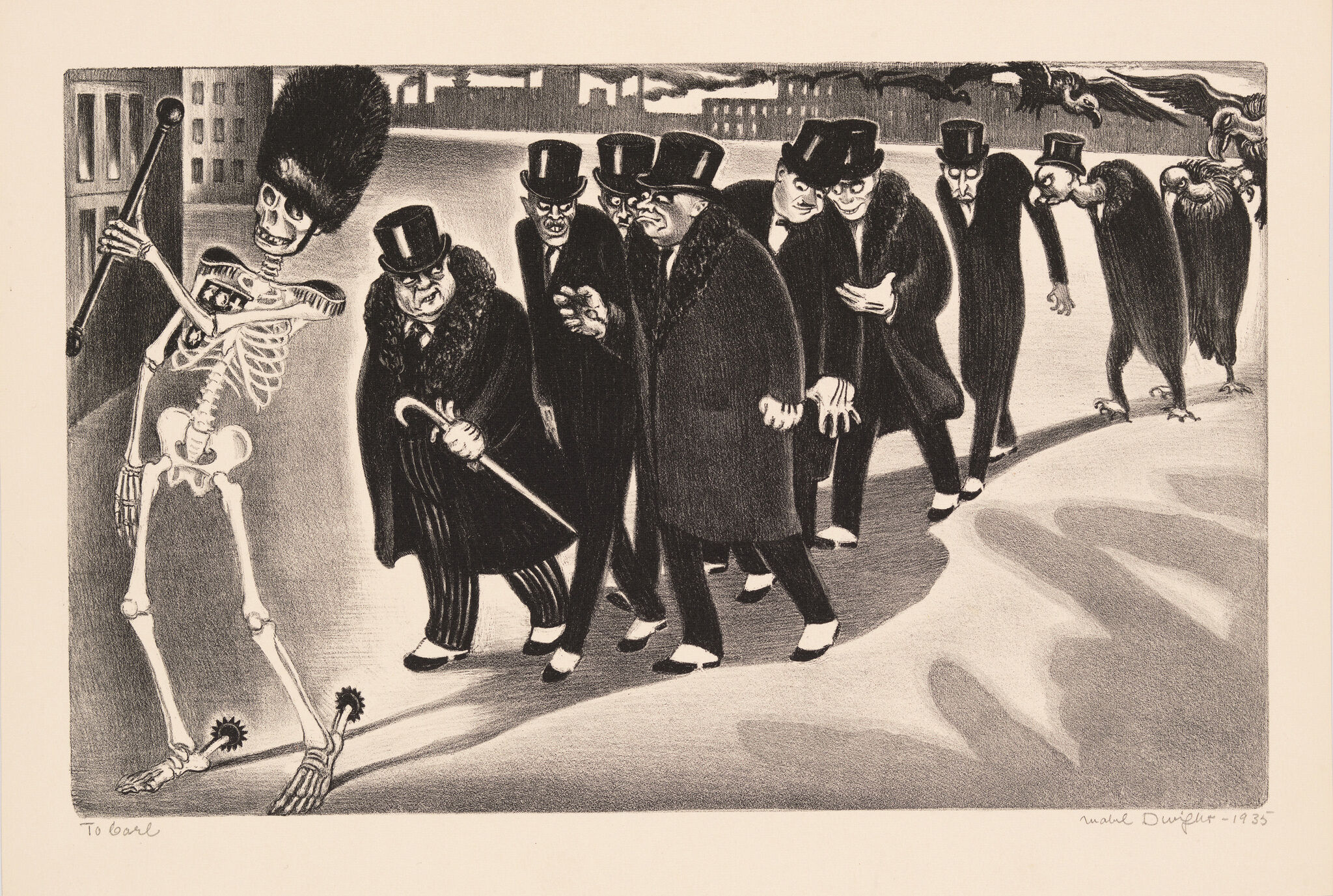
Mabel Dwight, Merchants of Death, 1935. Lithograph, 9 15/16 × 14 3/8in. (25.2 × 36.5 cm). Whitney Museum of American Art, New York; purchase with funds from The Lauder Foundation, Leonard and Evelyn Lauder Fund 96.68.94
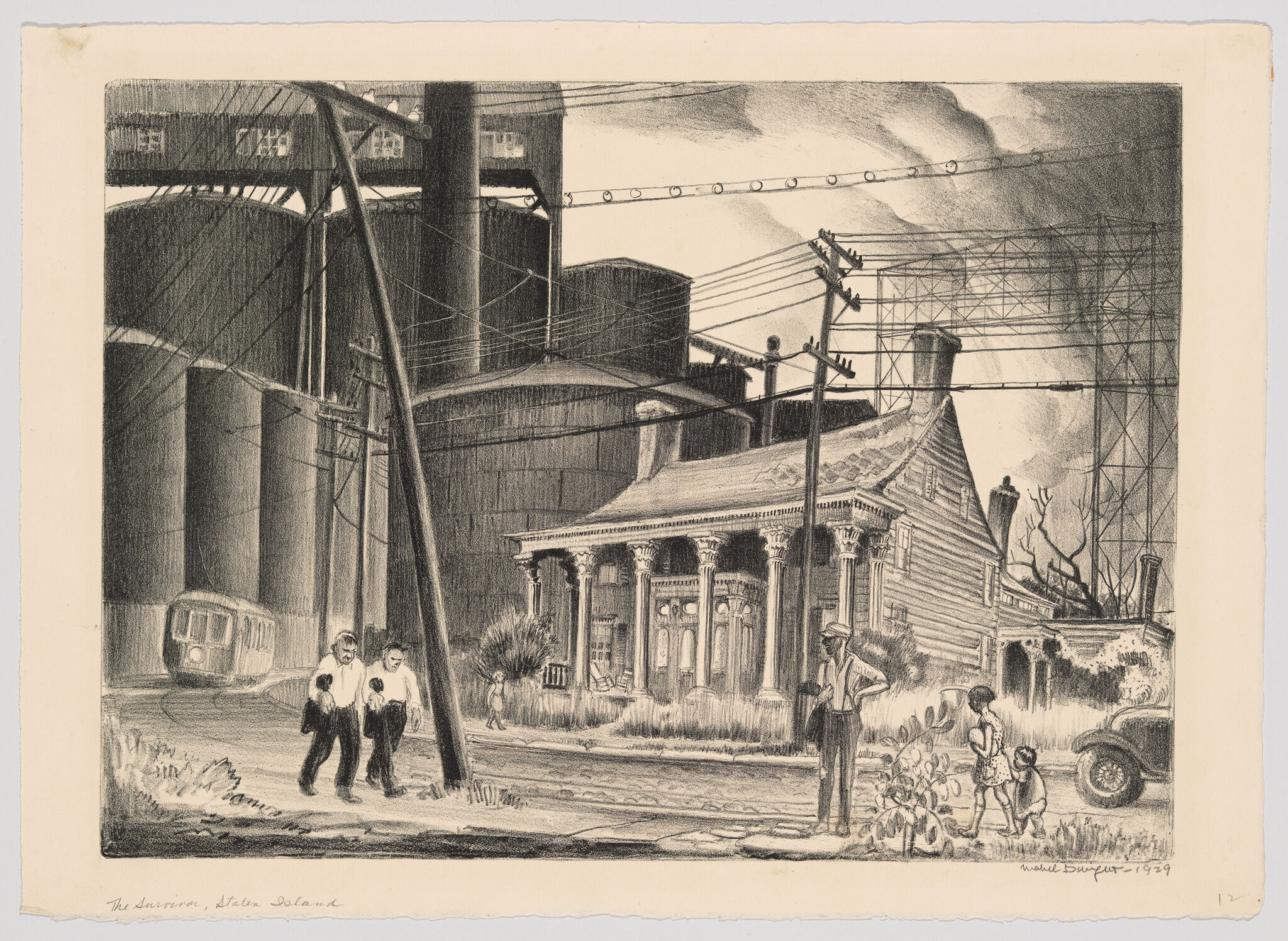
Dan Nadel: Mabel Dwight. I was told that sixty or seventy years ago, rich southerners had their summer homes on Staten Island. Some of the old houses have lived on to become ramshackle tenements or laborers boarding houses. In my lithograph, Survivor, one of these houses is seen. Their flower gardens that once sloped down to the water's edge are now traversed by trolley lines and trampled to death by giant tanks. Long enclosed passageways, high scaffolded and mysterious, stretch from one strange structure to another. Electricity, like a great unseen spider, has woven an intricate black web of lines against the sky. The lines go everywhere, from pole to pole, from tower to tower. They cross and recross the street. They enmesh the world about them. They arise as high spidery structures, all lines and no substance. A few gaunt trees raise naked arms. Only weeds thrive here now. They uproot the stones of the sidewalk. They grow high enough to look imputently in the windows of the poor old houses.
Mabel Dwight, The Survivor, Staten Island, 1929. Lithograph, 11 1/2 × 15 7/8 in. (29.2 × 40.3 cm). Whitney Museum of American Art, New York; gift of Mr. and Mrs. Michael H. Irving 78.85
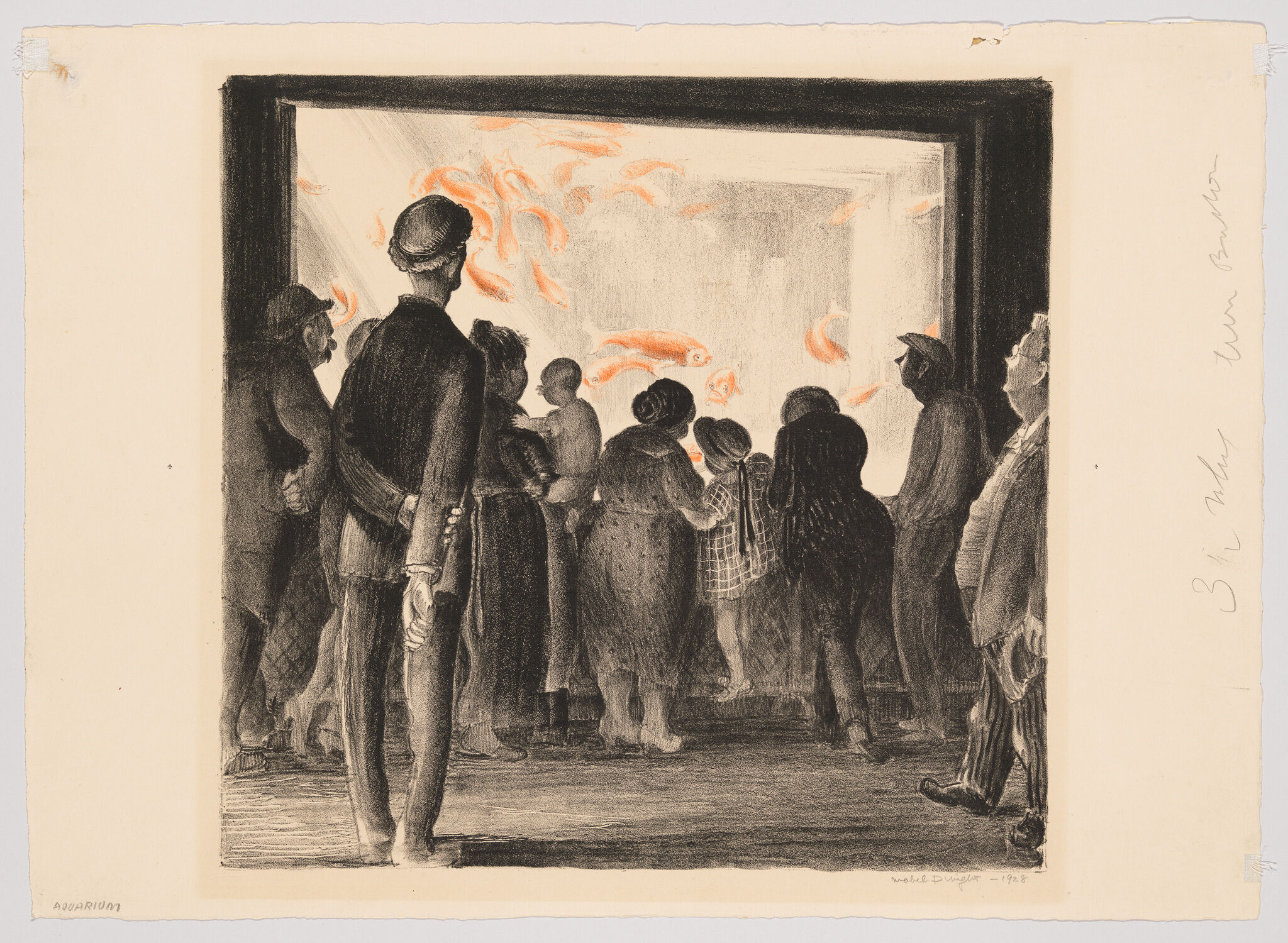
Dan Nadel: Mabel Dwight. The goldfish tank is very popular. Perhaps people feel closer to goldfish from small scale association. Until I saw this tank, I didn't know these fish ever grew so large. I suppose they were created especially for parlor sized glass globes.
When I made the lithograph called Aquarium, I got a bird's-eyed view of the alligators and seals from the upper balcony. The people that straggle about the floor and hang over the rails give both gay and somber color to the place. The drifters from the bench come in to get warm in the winter and to escape the sun in the summer and to kill time of which they have so much. They're always there. They stand in the shadows under the balcony and look at the fish and the small tanks that circle about the walls. They look at the fish and the fish look at them idly, vaguely. Then they drift off into the shadows of their separate worlds.
One day, I saw a huge grouper fish and a fat man trying to outstare each other. It was a psychological moment. The fish's mouth was open and his telescopic eyes focused intently. The man, startled by the sudden apparition, hid his hat behind him and dropped his jaw also. They hypnotized each other for a moment, then both swam away. Queer fish. We may be distantly related biologically. There's not much kinship in the feeling.
Mabel Dwight, Aquarium, 1928. Color lithograph, 11 5/8 × 16in. (29.5 × 40.6 cm). Whitney Museum of American Art, New York; Gift of Gertrude Vanderbilt Whitney 31.718
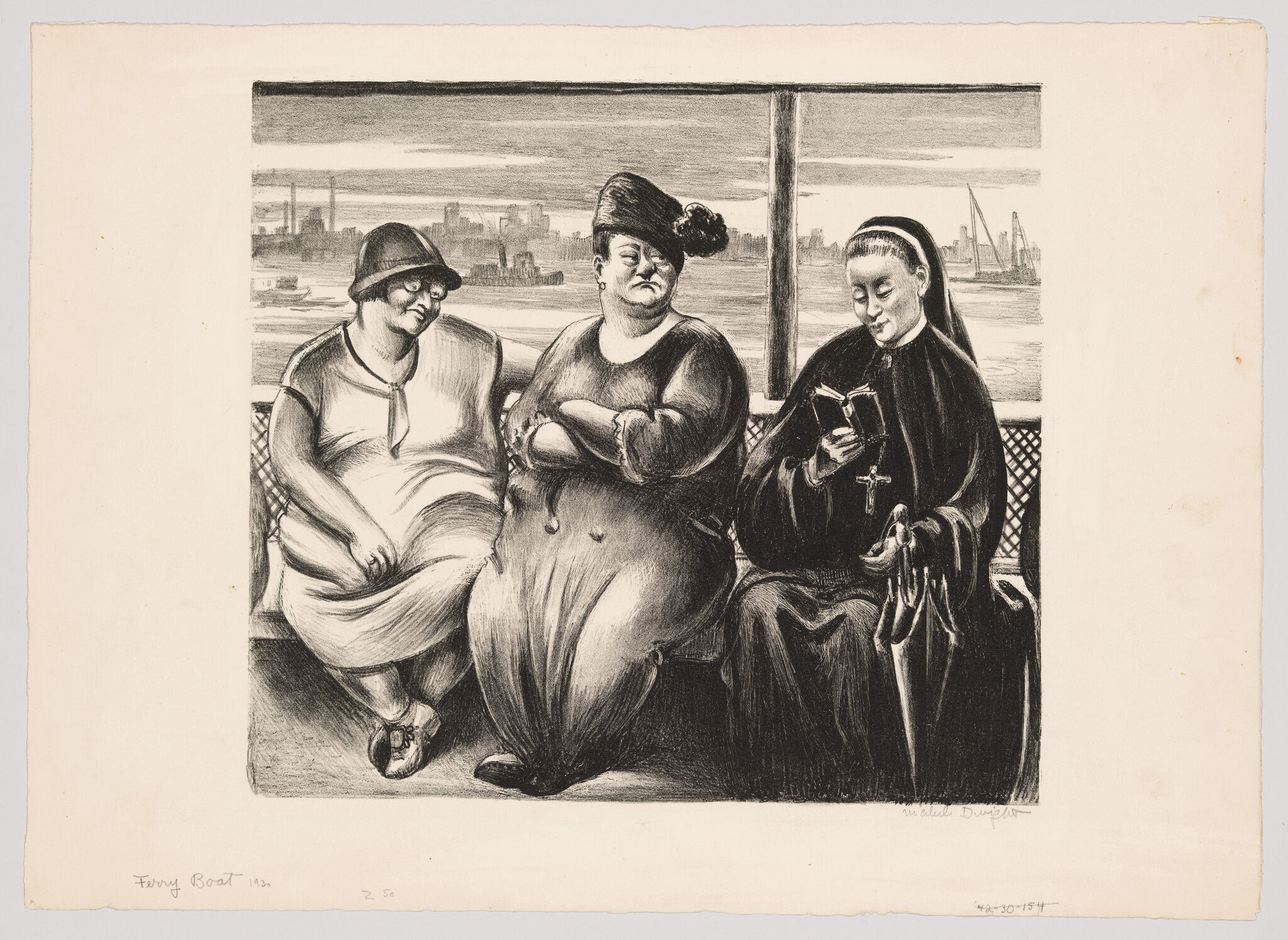
Narrator: The image measures 9 and a quarter inches tall and around 10 inches wide with around 2 inches of paper around the border. The print is representational, although Dwight's attention to detail and the sitters' slightly exaggerated features give it a wry, almost satirical demeanor.
The horizontal composition shows three women seated on a bench on the Staten Island ferry with an urban waterfront landscape behind them. From left to right, the three women occupy most of the picture. The woman on the left wears a light-colored, short-sleeved dress with a bow at the front, round glasses, and a round hat with a downward brim. Her head tilts slightly to the center, and her hand rests on her lap while the other extends on the rail behind.
The woman at center wears a darker dress with long sleeves and a hat topped with a round flower. She sits with her arms crossed on her chest and crossed ankles, looking at the woman on the right with corners of the mouth down and chin up. The woman on the right is a nun and is dressed in a long, dark habit with a cross hanging down in front of her chest. She holds a small book in her right hand and looks down toward its pages. Her left hand is holding an umbrella against her knee. While the nun's attention is clearly directed toward the book, the woman at center looks in her direction with crossed arms and her chest and nose upturned. Her pose suggests disapproval, but of what we cannot be sure as viewers.
Behind them, vertical bars of the ferry’s structure frame the view across the river, a hazy shoreline shows buildings, cranes, and smokestacks.
Mabel Dwight, Ferry Boat, 1930. Lithograph, 11 7/16 × 15 7/8 in. (29.1 × 40.3 cm). Whitney Museum of American Art, New York; purchase with funds from The Lauder Foundation, Leonard and Evelyn Lauder Fund 96.68.89.
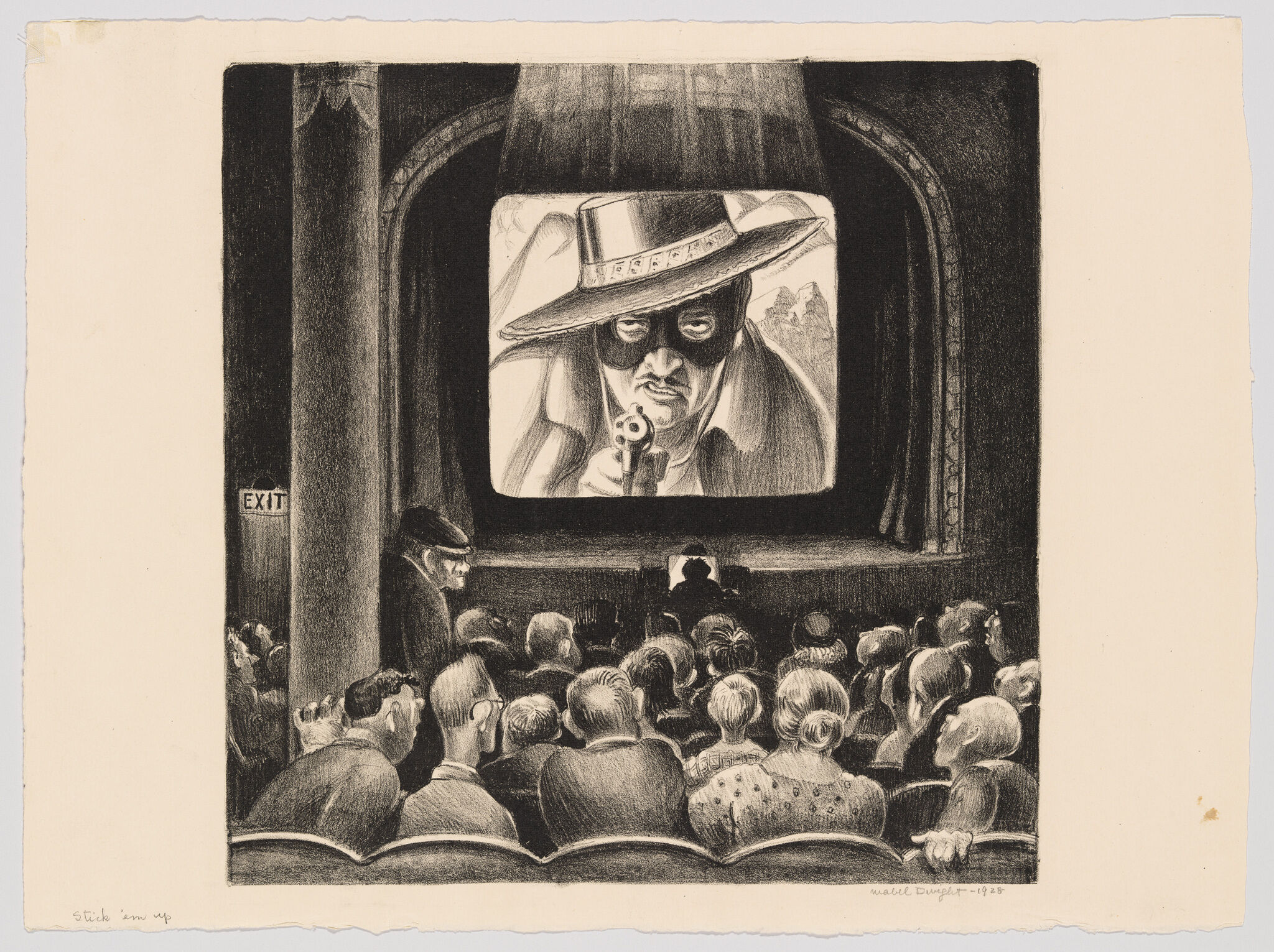
Mabel Dwight, Stick 'Em Up, 1928. Lithograph, 11 1/2 × 15 3/8in. (29.2 × 39.1 cm). Whitney Museum of American Art, New York; Gift of Gertrude Vanderbilt Whitney 31.724
0:00
0:00