High Wire: Calder’s Circus at 100
2025
Narrator: Welcome to High Wire: Calder’s Circus at 100. Alexander Calder began his Circus in 1926, as a young man living in Paris. Using miniature figures that he had sculpted out of wire and other everyday materials, he put on a spectacular, traveling show. His audience at the time included some of the most important artists of the day. The dynamic body of performance art presented an experience of sculpture in motion, a concept that Calder fully realized in his abstract “mobile” sculptures of the 1930s.
We invite you to explore the exhibition, with actor and performer Bill Irwin as your guide.
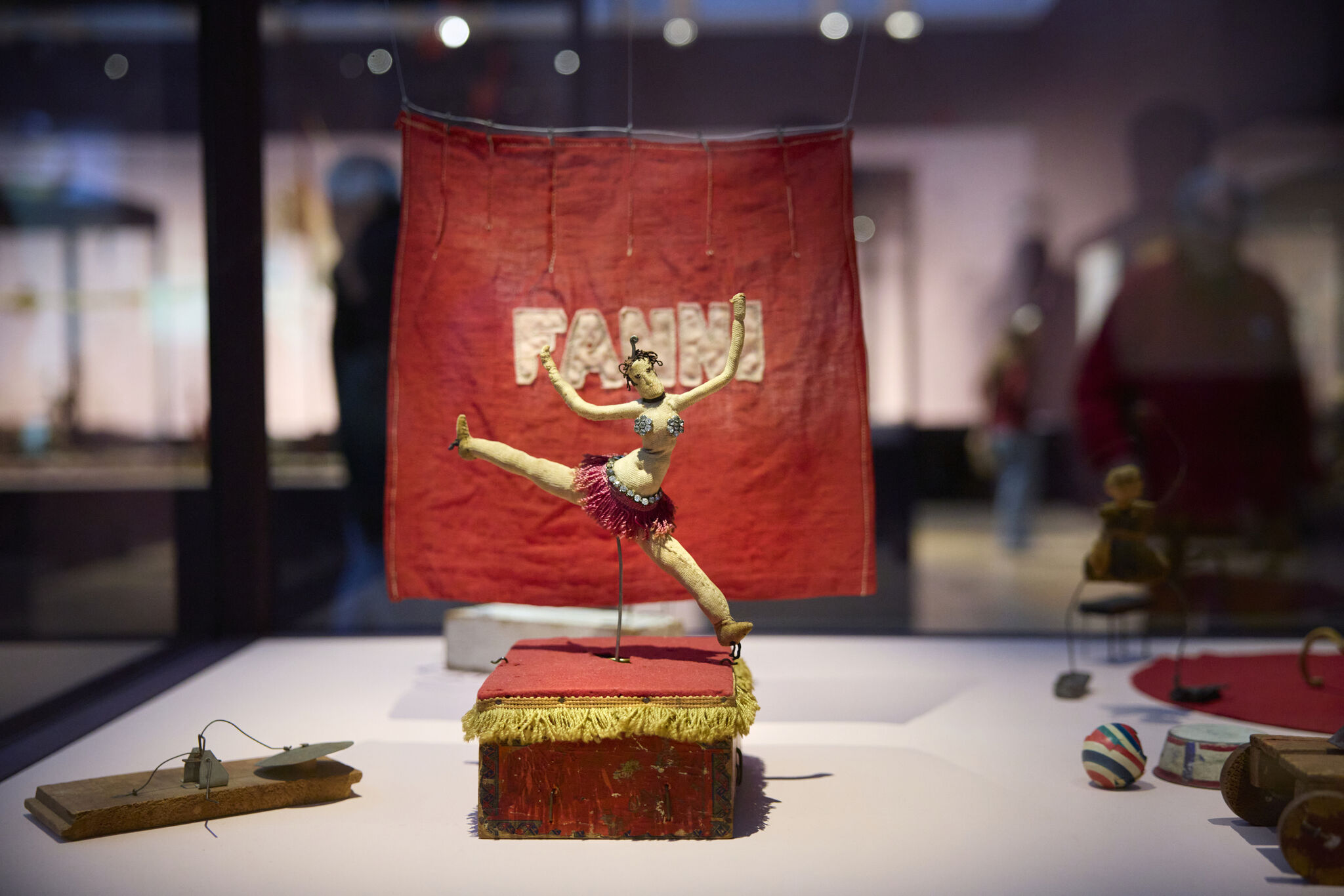
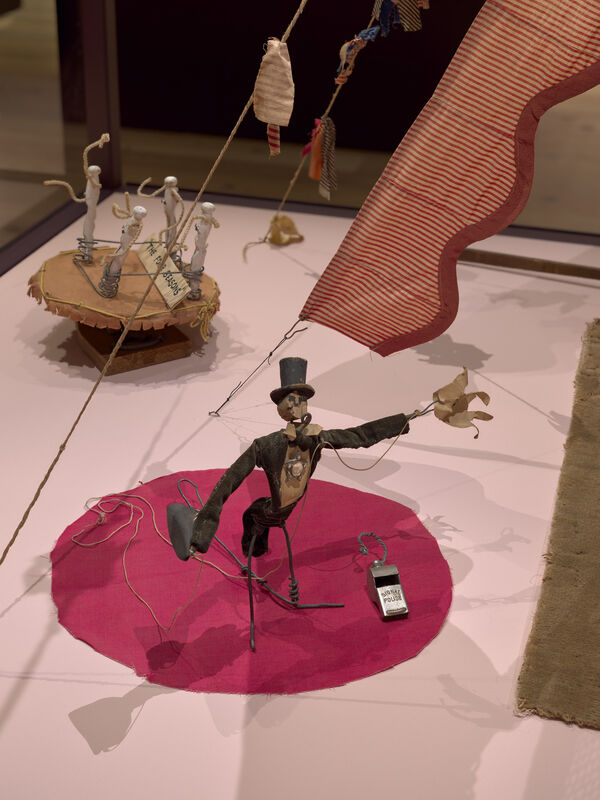
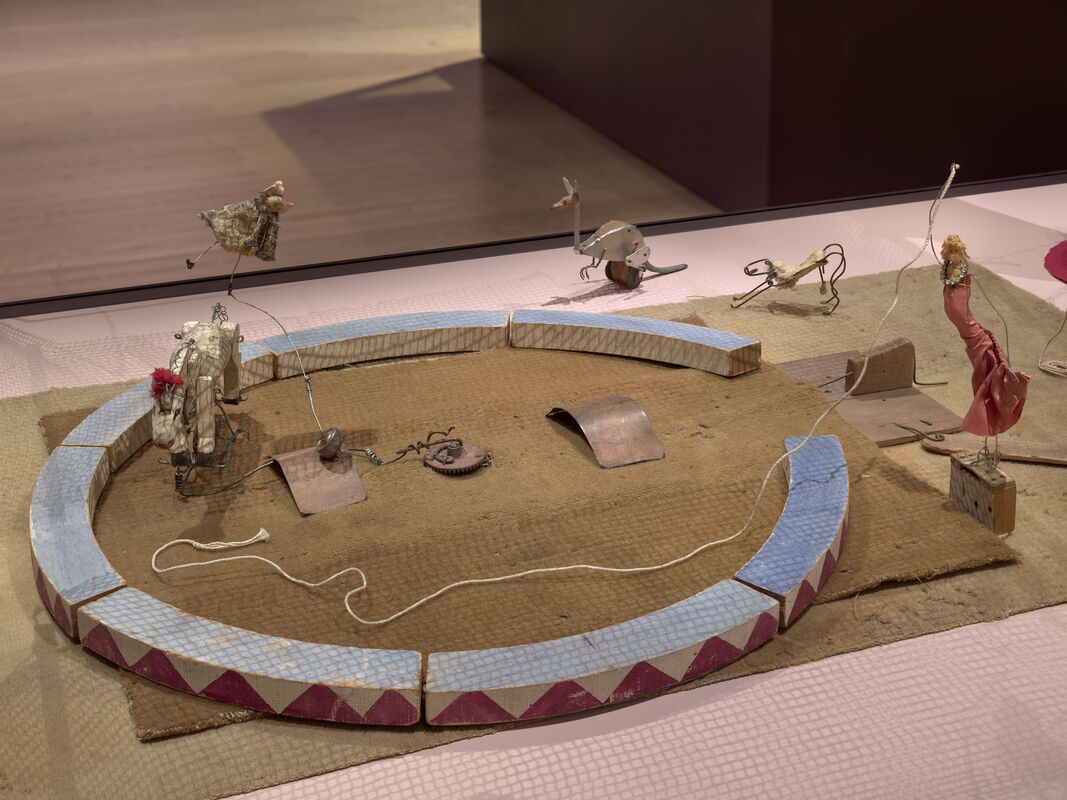
Alexander Calder, Calder's Circus (detail), 1926-31 (installation view, High Wire: Calder’s Circus at 100, Whitney Museum of American Art, New York, October 18, 2025–March 9, 2026). Wire, wood, metal, cloth, yarn, paper, cardboard, leather, string, rubber tubing, corks, buttons, rhinestones, pipe cleaners, and bottle caps, dimensions variable. Whitney Museum of American Art, New York; purchase with funds from a public fundraising campaign in May 1982. One half the funds were contributed by the Robert Wood Johnson Jr. Charitable Trust. Additional major donations were given by The Lauder Foundation; the Robert Lehman Foundation, Inc.; the Howard and Jean Lipman Foundation, Inc.; an anonymous donor; The T. M. Evans Foundation, Inc.; MacAndrews & Forbes Group, Incorporated; the DeWitt Wallace Fund, Inc.; Martin and Agneta Gruss; Anne Phillips; Mr. and Mrs. Laurance S. Rockefeller; the Simon Foundation, Inc.; Marylou Whitney; Bankers Trust Company; Mr. and Mrs. Kenneth N. Dayton; Joel and Anne Ehrenkranz; Irvin and Kenneth Feld; Flora Whitney Miller. More than 500 individuals from 26 states and abroad also contributed to the campaign 83.36.1-72. © 2025 Calder Foundation, New York / Artists Rights Society (ARS), New York. Photograph by Ron Amstutz
Bill Irwin: Welcome, ladies and gentlemen, mesdames et messieurs, to the circus. Beginning in 1926, Calder combined his fascination with movement, animals, and caricature into Le Cirque Calder. What you see here are a number of acts, each consisting of different characters—acrobats, a bearded lady, a lion tamer and his lion. When performed, Calder would manipulate the parts and figures before you—in one ring, one act at a time.
He would make bleachers from wood crates and planks; erect two tall poles for the high wire and trapeze; hand out cymbals and other noisemakers; cue up records on his gramophone and give his guests a full evening’s entertainment. It was what could be described as the first instance of performance art.
Through the Circus, Calder became good friends with an impressive list of artists, including Marcel Duchamp, Joan Miró, Fernand Léger, Edgar Varèse, Le Corbusier, and Piet Mondrian. These members of the Parisian avant-garde appreciated Calder’s love of play and spectacle—a performance of the Circus meant a very good time. But the artists were also drawn to the serious side of the Circus. Fun mixed with death and danger: the knife thrower aiming to hit a target perilously close to his favorite assistant sometimes missed—with tragic results. But Calder would use the same female figure in the next act, a clever touch his audiences appreciated.
In the first decades of the twentieth century, modernist artists across Europe were searching for ways to merge art and life, technology and design. As playful as Calder’s performance may seem, it beautifully exemplifies these avant-garde impulses. The fact that he put his objects in motion, the characteristic state of modernity, wouldn’t have been lost on any of his observers. And the individual acts were engineered with a great deal of technical skill.
Narrator: Calder’s Circus, which consists of miniature figures that the artist sculpted out of wire and other everyday materials, is presented in this show in six different glass-enclosed cases. The deep purple that bathes the exhibition’s walls and the dusty pink that covers the bases of the cases, lend the small yet well-lit figures a dramatic quality, as if they were each performing in their own spotlight. Calder designed his circus, or “Cirque” in French, to be performed for an audience, and although the figures are exhibited as stationary today, many are in fact kinetic, articulated sculptures that could move in a wide range of ways, including by the turn of a gear or the pull of a string.
Five cases circle the sixth one in the center, which contains the largest part of the circus: the tent. The tent is almost 5 feet high and 9 feet wide and contains two vertical poles attached to each other and to the case’s bottom by draped and tied string. Two tiny French flags jut up from each point, their colors faded with age. A few small figures, a few inches tall each, hang from the tent’s central high wire, dropping down from rectangular trapezes. Below them, arranged throughout the case, are multiple other small figures. Although they stand still, they appear as if in different states of motion, as if photographed midway through different circus acts. Calder made each figure by hand out of wire and other materials. He carefully articulated small details in each element of the circus: wavy thin wire for the horse’s tail billowing mid-gallop, pointed red shoes on the feet of a bearded lady, and the pale strings sprouting out of the plush elephant’s face for tusks.
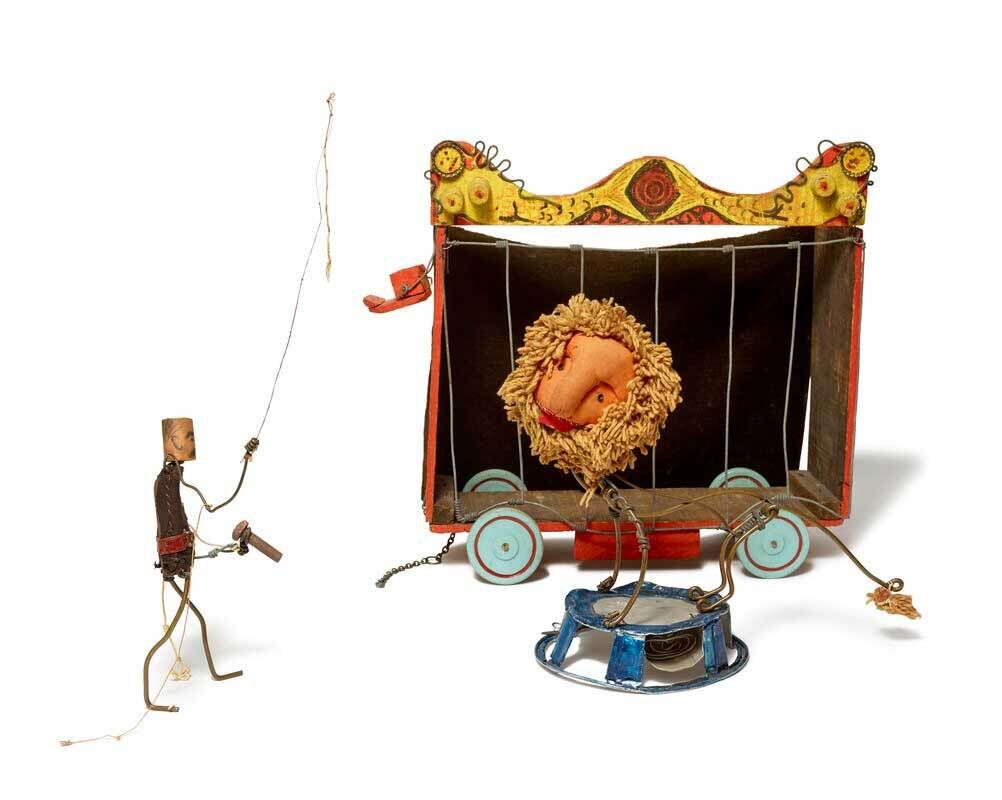
Throughout each display are more characters from the “Cirque Calder”. Nearer to the wall in another case stand the Lion Tamer, the Lion, and its Cage. The cage is the largest component of the three, standing at about a foot high with wires enclosing a rectangular ornate cage on light blue wheels. The lion rears a head ringed with tufted ochre yarn around a soft face. His body is slimly defined by a few single wires, ending in a flare of yarn again on the tip of his tail. The tamer stands nearby on thin wire legs and a torso and head made of pops of cork. He wears a thick red leather belt around his cylindrical waist and holds a thin wire with a thread at the end for his whip. When performing his circus, Calder could pull a string on one arm of the Lion Tamer, cracking the whip, and moving a part of the lion in a way that would make the animal rear up on its hind legs. In the 1961 film by Carlos Vilardebó playing nearby, Calder demonstrates the interplay of these two figures by having the lion first put the Tamer’s head in his mouth.
In another case, the small sewn figure of Fanni the Belly Dancer stands on a red velvet box. Calder constructed her body of pale beige fabric, adding bursts of rhinestones over her breasts and looped low around her waist. Her thin arms stretch up and out, as if mid-dance, and a central wire runs up through the box into her torso. Calder could rotate a gear system that he made using a hand-cranked egg beater that would manipulate the torso wire, making Fanni swivel her hips.
The miniature, multi-act spectacle of the Circus reveals Calder’s early interest and experimentation with movement—concepts that would shape his later sculptures.
Alexander Calder, Lion Tamer, Lion and Cage from Calder's Circus, 1926-31. Wire, yarn, cloth, buttons, painted metal, wood, metal, leather and string, dimensions variable. Whitney Museum of American Art, New York; purchase with funds from a public fundraising campaign in May 1982. One half of the funds were contributed by the Robert Wood Johnson Jr. Charitable Trust. Additional major donations were given by The Lauder Foundation; the Robert Lehman Foundation, Inc.; the Howard and Jean Lipman Foundation, Inc.; an anonymous donor; The T.M. Evans Foundation, Inc.; MacAndrews & Forbes Group, Incorporated; the De Witt Wallace Fund, Incorporated; Martin and Agneta Gruss; Anne Phillips; Mr. and Mrs. Laurance S. Rockefeller; the Simon Foundation, Inc.; Marylou Whitney; Bankers Trust Company; Mr. and Mrs. Kenneth N. Dayton; Joel and Anne Ehrenkranz; Irvin and Kenneth Feld; Flora Whitney Miller. More than 500 individuals from 26 states and abroad also contributed to the campaign 83.36.34.1a-f. © 2025 Calder Foundation, New York / Artists Rights Society (ARS), New York. Photograph by Jens Mortensen
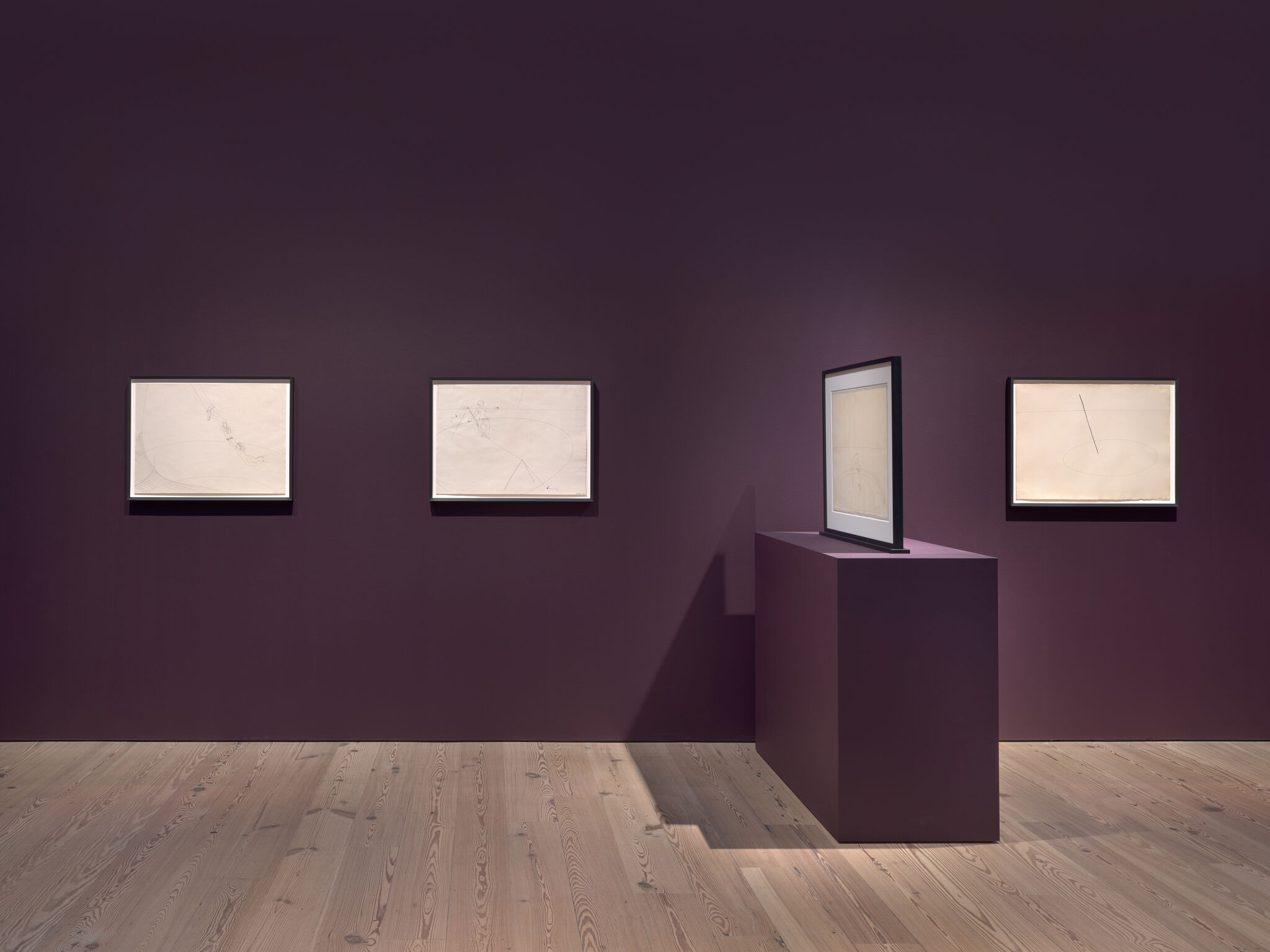
Caroline Simonds: The one where the two masculine figures, one hanging by his knees and the other almost being caught. For me, it's like a musical score where there's a suspension in the sound, and then there's also the very serious kind of Buddha-like quality of the acrobat hanging by his knees. That he is absolutely in the moment. He's absolutely, his hands are open. You can count on this guy. Whereas the partner, he's the risk-taker. He has to be extremely precise. I mean, Calder had the good sense to point his toes, and the hands are just about ready to grasp his partner's. And the man who's flying, he's looking at his partner. Whereas in a way, the one hanging from his knees, he's stopped time.
Bill Irwin: Part of the pleasure of the circus is the rhythmic passage from certainty to risk, from fun to danger.
Caroline Simonds: And you get to experience this sort of Shakespearean range of emotions from terror to exhilaration to jealousy, because the beautiful women and the beautiful men, their beautiful bodies, I mean, it's erotic also, and I see that Calder made sure there were breasts and penises.
Installation view of High Wire: Calder’s Circus at 100 (Whitney Museum of American Art, New York, October 18, 2025–March 9, 2026). From left to right: Alexander Calder, The Catch IV, 1932; Alexander Calder, Tightrope Walker, 1932; Alexander Calder, Two Acrobats, 1932; Alexander Calder, Lone Pole, 1932. © 2026 Calder Foundation, New York / Artists Rights Society (ARS), New York. Photograph by Ron Amstutz
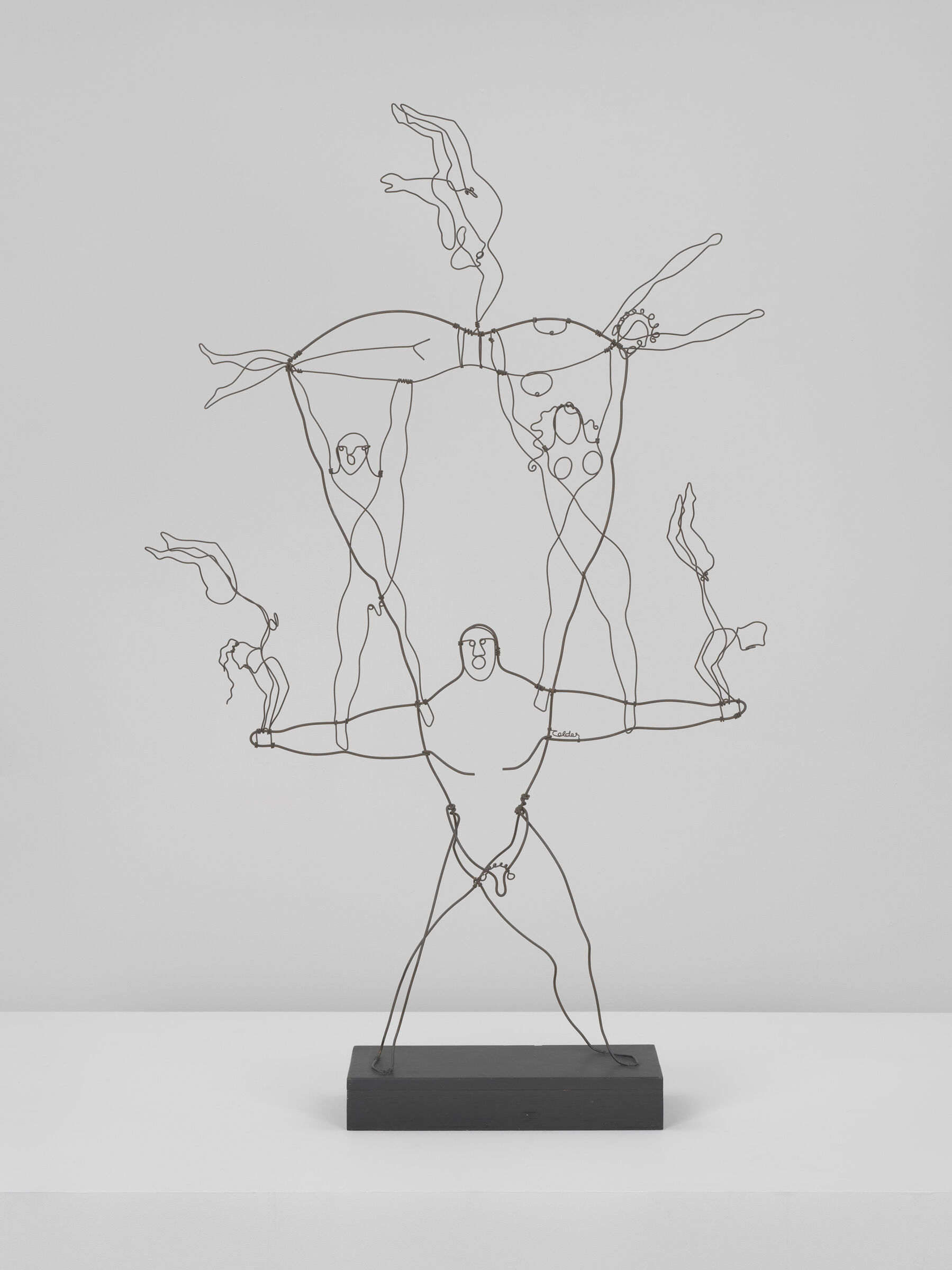
Bill Irwin: This large sculpture called The Brass Family is one of many sculptures of circus performers Calder made apart from his miniature circus. It's much larger than any of those elements, and its parts don't move. In fact, in many ways, it is a work about stability and immobility. The large nude man who anchors this family is rock solid, hugely muscular and constructed out of a heavy gauge wire. His graceful family is more daintily constructed and more vulnerably posed, but there's little sense of physical danger at the same time. It definitely reminds us that the circus is an entirely different world. The brass family doesn't have the family structure that most of us are used to.
Caroline Simonds: But in those days, in the twenties, you were born in a trunk. You were born into the circus.
Bill Irwin: Caroline Simonds is a clown and former acrobat. She runs the Paris-based organization Le Rire Médecin which brings clowns to the pediatric wards of hospitals.
Caroline Simonds: You just started off by standing on your father's shoulders when you were eighteen months old. As soon as you could walk, they made you stand on your father's shoulders and then on his head, and then they flipped you up in the air and they caught you by your feet. So families basically nurtured the art of acrobats, and then the acrobats became the clowns later on.
Narrator: This work is called The Brass Family by Alexander Calder and it’s from 1929. It is a large brass wire sculpture on a painted wood pedestal that stands at 5.5 feet tall and just over 3 feet wide. It’s mainly flat but the pedestal it stands on is 9 inches deep.
Calder used wire to shape a tower of human figures balancing on top of one another in a kind of acrobatic feat, and he depicted these figures in the nude. The wires curve and curl throughout the sculpture, each piece connected to another. The work is anchored by a muscular, male figure, whose arms are open in a T-shape. He supports all the other figures with his arms, and they form a pyramid-like shape as they ascend upward. Calder has depicted a family in this sculpture, as suggested by its name.
The sturdy strongman supports the second level of four figures that balance on his upper arms and hands. Two small figures that appear to be children curl outwards and upwards into handstands. The two adult figures, a man on the left and woman on the right, balance on minimally rendered feet that loop downwards on the strong man’s biceps. Their arms jut straight up toward the sky, hoisting up the figure on the third level, who lies on her side with arms outstretched above her head to the right. Tight coils of wire at her ankles, ribs, and neck show where Calder connected her to other figures. Another coil at her waist leads to the last small figure on the fourth level. A child balances his body upside-down with one hand, feet pointing towards the sky, leaning slightly to the left.
The Brass Family is one of many sculptures of circus performers Calder made in the 1920s in addition to his miniature Circus. However, it is much bigger than any of those elements. Its pyramidal form makes it appear sturdy, but it has the ability for motion, much like Calder’s Circus.
Alexander Calder, The Brass Family, 1929. Brass wire and painted wood, 67 × 41 1/8 × 8 7/8 in. (170.2 × 104.5 × 22.5 cm). Whitney Museum of American Art, New York; gift of the artist 69.255. © 2026 Calder Foundation, New York / Artists Rights Society (ARS), New York
Transcription: Conserving Alexander Calder’s Circus
Running time: 00:13:11
(Vinyl record spinning)
(Needle dragging across a record)
(Don Barreto & Son Orchestre Cubaine play "Runidera (Rumba)")
(Romantic Spanish guitar over soft percussions)
(Whistle blares over background instrumentals)
Alexander Calder: Mesdames et messieurs, je vous présente Le Cirque Alexander Calder.
Joan Simon: Alexander Calder's Circus is one of the most iconic, beloved works in the Whitney's collection by a major artist who changed the way we think about sculpture.
Anita Duquette: Alexander Calder's Circus is very important because it influenced his sculpture, his drawings, his paintings. It is the nucleus of his ideas.
Joan Simon: Alexander Calder's Circus is many things: the artist, the objects he made, his wife or someone else playing the Victrola. It was a total work of art. Alexander Alexander Calder made the components of the circus between 1926 and 1931, but he performed the circus for decades.
Eleonora Nagy: The very minute we started to research and look at the circus, we realized that it is a performance piece. Alexander Calder's Circus is an early example of performance art. Movement is the soul of the circus.
(Loud clattering noise)
(Light classical music instrumentals)
Joan Simon: Alexander Calder's Circus first came into the Whitney in 1970, when it was put on loan by the artist himself. Thirteen years later, the Whitney acquired it as part of its permanent collection.
Carol Mancusi-Ungaro: And when it arrived at the museum, it was packed in five suitcases that Alexander Calder had used to transport it around the world.
(Soft jazz instrumentals)
(Light flamenco instrumentals)
Carol Mancusi-Ungaro: The need to restore Alexander Calder's Circus arose because the materials were fragile, and we were concerned about their preservation over time. The initial response of the conservator is to treat the physical matter. In this case, we had to go beyond that.
Eleonora Nagy: We realized we had to preserve audio, video, real circus history, art historical, and all kinds of other aspects.
(Flamenco instrumentals continue playing in the background)
Carol Mancusi-Ungaro: This was a multidisciplinary project that involved the work of a conservator, an art historian, and an archivist. Most artworks are made static and they remain static, but that's not true of the circus; it was alive and moving. So how do you put life and movement back into objects that, over time, have become static? That was really our challenge.
(Alexander Calder makes low growling sounds)
(Low growling intensifies)
(Loud roaring sounds)
(Small audience laughs)
Eleonora Nagy: If you don't understand the full meaning of the work of art, there is no way you can know how to start preserving it.
Anita Duquette: Alexander Calder was born in Lawnton, Pennsylvania in 1898. His mother, his father, his grandfather were all artists. Since he was a child, he could make something out of nothing; scrap metal, found fabric, whatever was at hand. He would make sculpture out of bread.
Joan Simon: In his 20s, Alexander Calder went to the Ringling Brothers Barnum & Bailey Circus for two weeks with a press pass because he was doing illustrations for the National Police Gazette. He observed, he made notes, and what he saw affected his view of the circus… wherever.
(Upbeat band instrumentals play in the background)
Eleonora Nagy: At the beginning of the 20th century, circus was the single most important form of entertainment.
Joan Simon: It was a really big deal when the circus came to town. It arrived by train. The Ringling train had 100 cars.
Anita Duquette: They would set up these enormous tents, and then there would be this grand parade with all the circus performers and all of the animals.
Vintage recording of a man's voice, announcing: Here she comes. Everybody loves a parade. A circus parade, most of all.
(Band instrumentals conclude)
Joan Simon: The circus was... life. And it was a place of wonder.
(Romantic classical music instrumentals)
Eleonora Nagy: The history of the real circus gave us tremendous information and unexpected knowledge about Alexander Calder's Circus. We learned that Alexander Calder's ringmaster is actually Fred Bradna, Alexander Calder's little tightrope dancer is Con Colleano.
Announcer: Con Colleano!
(Applause)
Eleonora Nagy: His lion tamer is Clyde Beatty.
(Movie audio enters then fades back into classical music instrumentals)
Eleonora Nagy: Alexander Calder's little bareback rider is May Wirth, the most famous bareback rider of the time. Her attributes were the giant pink bow, her little pink dress, and we can see all of those attributes in Alexander Calder's little character. It is very important for us to understand that Alexander Calder's characters are based on real life circus celebrities. It shows us his theory and understanding about his circus was… that it depicts real life.
(Instrumental music ends)
Eleonora Nagy: There are two films that best depict Alexander Calder performing his circus. One is by Jean Painlevé and the other by Carlos Vilardebó. These are the primary sources we use to understand Alexander Calder's Circus as a performance. Out of the possibly 200 performances, every single performance was unique. The films only show a fraction of the movements in the many performances of Alexander Calder's Circus.
(Elegant classical music instrumentals)
Eleonora Nagy: During our research, we discovered photographs that showed the two acrobats performing movements that had never been filmed. This made us realize that the figures were capable of movements that we have never seen. In order to explore the possible additional movements. We created a replica of Alexander Calder's acrobats.
(Whistle blares)
Eleonora Nagy: We then worked with real life acrobats to understand how the movement of Alexander Calder's characters related to movement in the real circus.
Jonathan Nosan: The strength act, the hand-to-hand act, is a classic standard act of the circus.
(Light percussions quicken)
Jonathan Nosan: There are two generally men involved in this act. It's a base and a flyer. The base supports the flyer who does handstands upon the solid strength of the base.
(Light applause)
Jonathan Nosan: Alexander Calder takes the direct moves from classic acts, but then does put his own interpretation on the moves.
(Lively band instrumentals)
Jonathan Nosan: Alexander Calder's moves are not always physically possible in the realm of a circus. Only in his circus.
(Energetic band instrumentals)
Joan Simon: Alexander Calder identified and actually was each of the characters.
(Crash, roar)
Alexander Calder: La première favorita!
(Light audience laughter)
Joan Simon: He was every element.
Carol Mancusi-Ungaro: In the Alexander Calder Circus I don't think the artist's hand could be more apparent. He made everything. He changed things. He manipulated them himself. So some of the damage or some of the aging came as a result of that use.
Eleonora Nagy: The damage caused by the constant movement is part of the history of the work.
Carol Mancusi-Ungaro: One could say that that's something one wants to preserve.
Eleonora Nagy: There were a number of items which we thought were just badly repaired. Later on, it turned out that those so-called "bad repairs" are actually Alexander Calder's repairs. He was in the habit of repairing his own characters right during the performance. The black stitches here are quite clear. Alexander Calder probably did not have the white thread with him when this broke during the performance, so he just took the black one because that was the only one he had. So instead of fixing these old repairs, we leave them as they are because they are evidence of Alexander Calder's use and Alexander Calder's idea of his own circus. Alexander Calder commented on the importance of bright and brilliant colors. At close examination we discovered significant fading.
Carol Mancusi-Ungaro: Often you can determine that by seeing folds in the fabric that have been protected from light or air.
Eleonora Nagy: This shirt is also torn. The question is, can we replace the shirt to represent more how it originally looked? Well, we cannot really do it. And the reason is because Alexander Calder constructed this little figure by sewing together the little belt, the string, as well as the scarf. To replace the shirt, we would have to undo all of these original stitches, which we would completely lose. The times when we really intervened were the times when something was clearly broken and the films or photographs provided proof how they looked before. One tumbler was about to lose his head. It was hanging all the way to the back. We just saved the piece, specifically the head, very last minute before we would have lost it.
(Needle dragging across a record)
(Don Barreto & Son Orchestre Cubaine play "Runidera (Rumba)")
Carol Mancusi-Ungaro: Naturally, when you are restoring a work of art that once moved, the temptation to think about getting it to move again is great.
Anita Duquette: Alexander Calder's Circus cannot be performed for two reasons; one, for conservation and two, because the great performer is not with us.
Joan Simon: Theater is very different than performance art. Theater has a script. It has instructions and an assumption that other people will play it over time. Performance art is so closely related to the artist creator that, in the case of Alexander Calder, like many others, it cannot be performed without the artist.
(Whistle blares)
Carol Mancusi-Ungaro: Our research on this project is not an end in itself, but actually a beginning of a way to think about preserving a work of art of this nature. The Whitney has become the holder of the Alexander Calder's history and its future. We are determining how it is seen, how it is preserved, how it is presented over time. And that is very much to do with how the viewer interprets it.
Eleonora Nagy: Our work will help the public to understand much better what the circus really was.
Carol Mancusi-Ungaro: In the end, our hope is that one realizes that although the Alexander Calder Circus is physically still, it remains alive in our imaginations.
(Light flamenco music ends)
(Static noise)
(Upbeat band instrumentals)
(Cymbals clash as band instrumentals play a happy melody)
(Music is triumphant and energetic)
(Band instrumentals continue)
(Music builds to a finale)
(Music changes to upbeat instrumentals then fades)
(Needle drags across a record)
Alexander Calder, Calder's Circus (detail), 1926-31 (installation view, High Wire: Calder’s Circus at 100, Whitney Museum of American Art, New York, October 18, 2025–March 9, 2026). Wire, wood, metal, cloth, yarn, paper, cardboard, leather, string, rubber tubing, corks, buttons, rhinestones, pipe cleaners, and bottle caps, dimensions variable. Whitney Museum of American Art, New York; purchase with funds from a public fundraising campaign in May 1982. One half the funds were contributed by the Robert Wood Johnson Jr. Charitable Trust. Additional major donations were given by The Lauder Foundation; the Robert Lehman Foundation, Inc.; the Howard and Jean Lipman Foundation, Inc.; an anonymous donor; The T. M. Evans Foundation, Inc.; MacAndrews & Forbes Group, Incorporated; the DeWitt Wallace Fund, Inc.; Martin and Agneta Gruss; Anne Phillips; Mr. and Mrs. Laurance S. Rockefeller; the Simon Foundation, Inc.; Marylou Whitney; Bankers Trust Company; Mr. and Mrs. Kenneth N. Dayton; Joel and Anne Ehrenkranz; Irvin and Kenneth Feld; Flora Whitney Miller. More than 500 individuals from 26 states and abroad also contributed to the campaign 83.36.1-72. © 2025 Calder Foundation, New York / Artists Rights Society (ARS), New York. Photograph by Ron Amstutz
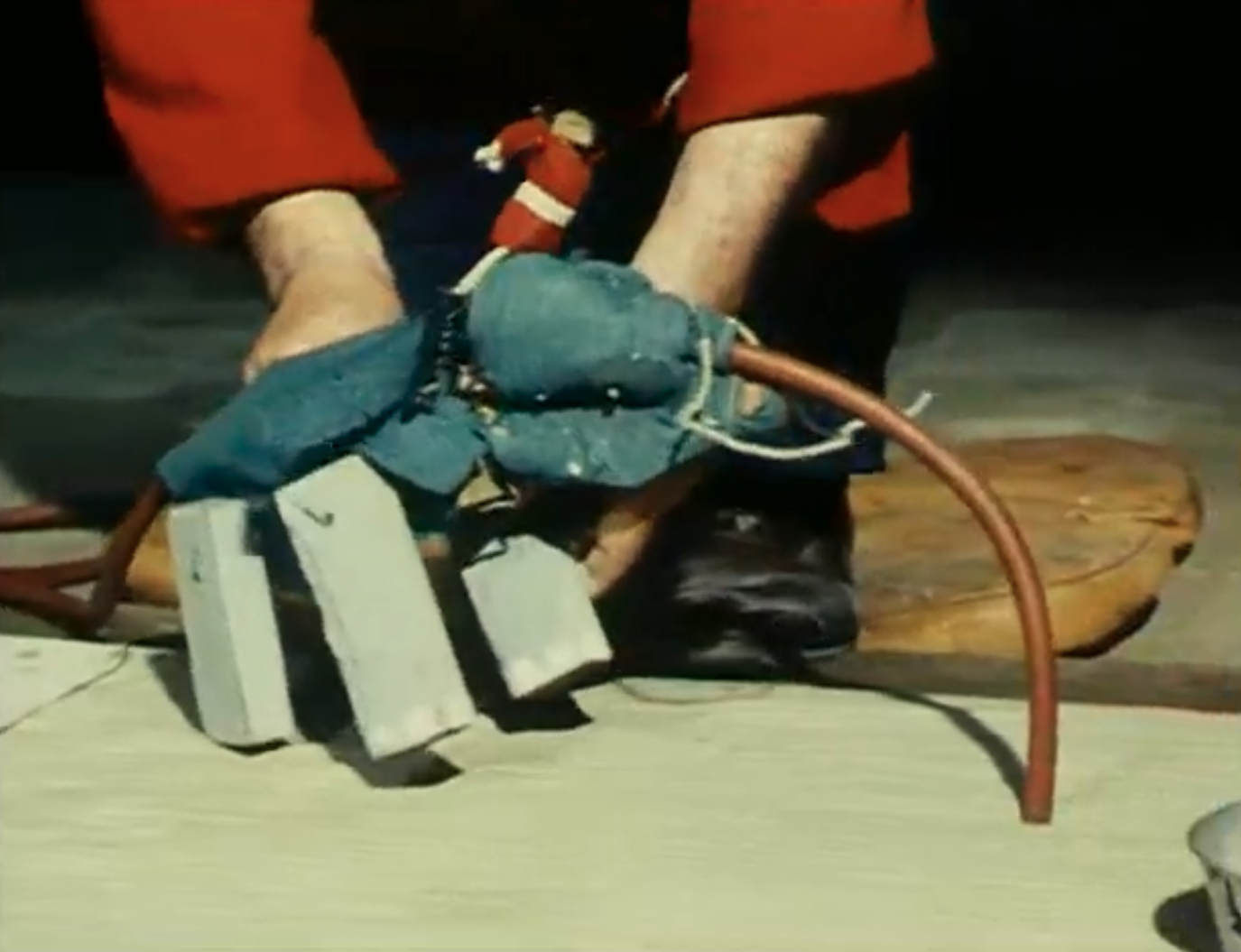
Transcription: Calder’s Circus (Le Cirque Calder), 1961
Running time: 28:00
Alexander Calder: Mesdames, Messieurs, je vous présente le Cirque Alexander Calder. (Ladies, gentlemen, I present to you Alexander Calder’s Circus.) It was a long time before I made the mobile and the stabile that I made the circus. It was 26, 27 in Paris… Then, I made in America and elsewhere. In 29 and 30 in New York, I made it much bigger. But finally, I understood that if it grew more, I would have to buy more suitcases, and since I already had 5, I had enough of it.
On the Western plains, there were wild horses…
…the Wild West.
What is that thing-a-ma-jig there?
I don’t know but I think it’s made to sell.
It’s not Alexander Calder who’s blowing up the balloon; it’s the balloon that’s blowing up Alexander Calder!
Shhhh… Ahhhhh!!!
Up, up.
Desperado, art thou ready?
Aye, sir, always ready!
Then go!
First this table, then this thing…
Ladies, gentlemen, I present to you the Maharaja of Sharina-be-damned and his first ballerina.
Strong body.
Help! Help! Now bring him out the other way…
Ladies, gentlemen, I present to you the second ballerina
Don’t forget to visit our large menagerie.
A woman’s voice off screen: It’s funny!
Alexander Calder: No, it’s twisted.
Ladies and gentleman, I present you Charles Rigolo, the strongest man in the world. First, drumroll… Wait ‘till he grips it. Go ahead.
Ushita et Kuyanagi!
Really, the fellow who has no hair is the son.
On the Western plains, there were wild horses…
[Inaudible]
The last time… was in 1135
The man of a thousand vests.
The writer that can write no matter what the colour. Darling, what colour?
Audience member: Red!
(a woman sings a quiet, soothing tune.)
♪Tell me you’re sorry♪
♪So sorry that you broke my heart♪
♪Let us break up♪
♪Let us make up♪
Alexander Calder: Ladies, gentlemen, I present to you Doctor He’s Got a Mine Gut… Doctor Boyau de Fer. Ladies, gentlemen, I assure you, it is real steel.
Silence! Quiet!
Woman off-screen: Oh! Oh!
Man off-screen: Ugh! Ugh!
Alexander Calder: Mr. Doctor Umschlag Wunderheit coming from Berlin.
Ladies, gentlemen, he is going to ride it. With wild animals, one must never be afraid.
Oh stop it. Don’t be afraid.
Woman off-screen: That’s funny!
Alexander Calder: No, this is doody. It’s twisted. It’s me who’s twisted
No, no music please.
Man and wife.
Carlos Vilardebó, Le Cirque Calder, 1961. 16mm film transferred to digital video, color, sound; 28 min. Courtesy the Calder Foundation, New York. © 2025 Calder Foundation, New York / Artists Rights Society (ARS), New York.
0:00
0:00