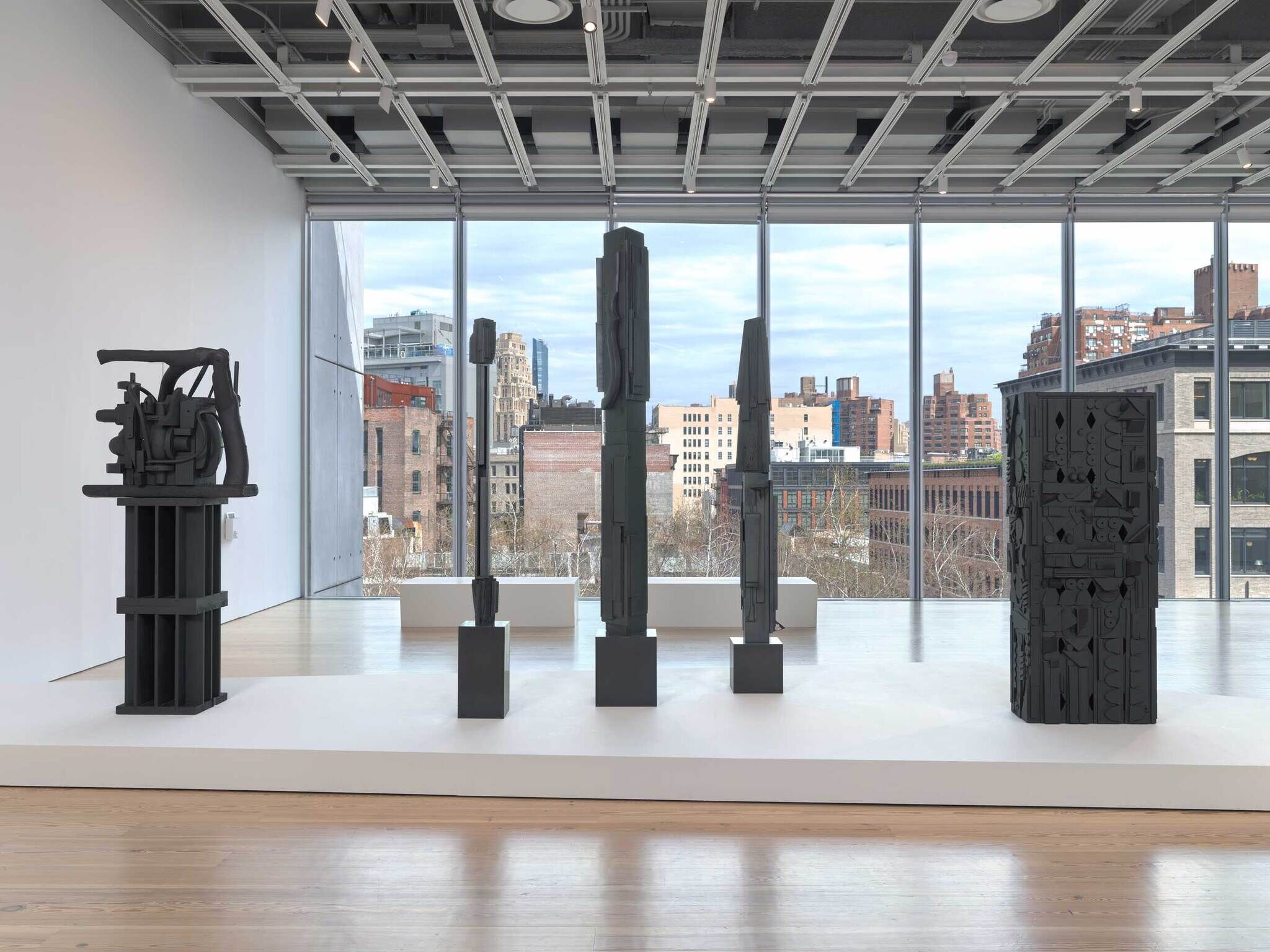
Collection View: Louise Nevelson
2025
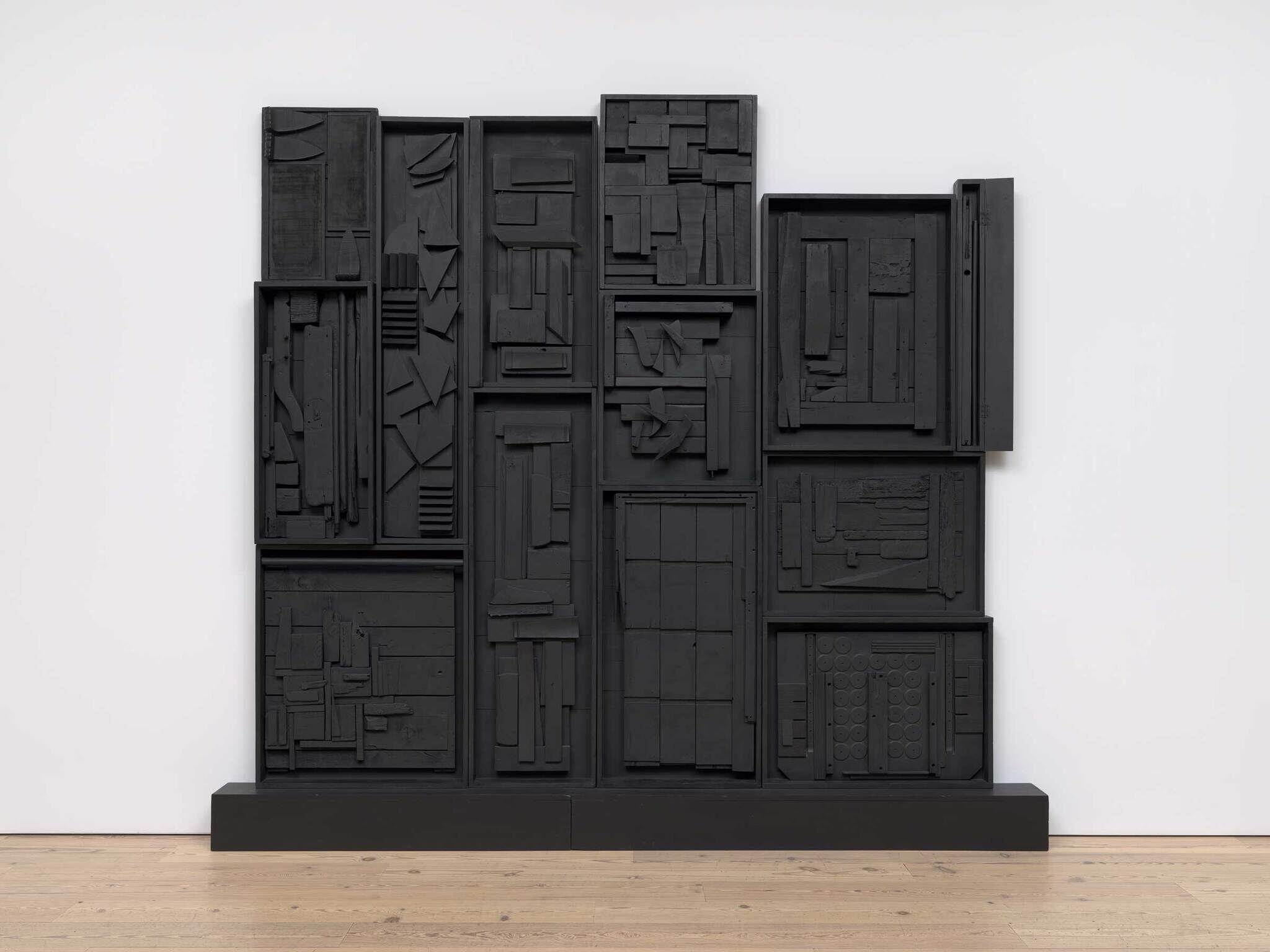
Narrator: The work Young Shadows by Louise Nevelson is an abstract wooden sculpture approximately 9-foot tall by 10-foot wide with a shallow depth of 8 inches. It is composed of thirteen interlocking black boxes set against the wall. The rectangular boxes are each different sizes and orientations since they are made up of milk boxes, lettuce crates, and other wooden containers scavenged by the artist. Each box has been stacked and arranged together to create the illusion of a single, but uneven black square. Like a pile of parcels, the composition is jagged and irregular. Because the entire piece is covered in matte black paint, it is difficult to discern what might be inside each box; however, on closer inspection, there are worlds contained in the sculpture’s building blocks.
Each of the thirteen boxes is open in the direction of the viewer. You could think of each box as a display case or cubby hole filled with assemblages of wooden scraps that the artist has carefully composed. While one box is full of uniform blocks in a perfect grid formation; another has thin panels chaotically woven together; and others are full of scattered wooden triangles. To create the assemblages, the artist collected and transformed broken furniture and other wooden fragments from around New York City. She painted each constituent part the same matte black, giving the overall sculpture an imposing presence. Nevelson poetically referred to herself as an “architect of shadows,” inviting viewers to perceive her works on the cusp of solid form and ethereal void.
Louise Nevelson, Young Shadows, 1959–60. Painted wood, 115 × 126 × 7 3/4 in. (292.1 × 320 × 19.7 cm). Whitney Museum of American Art, New York; purchase with funds from the Friends of the Whitney Museum of American Art and Charles Simon 62.34a-o. © 2025 Estate of Louise Nevelson/Artists Rights Society (ARS), New York. Photograph by Ron Amstutz
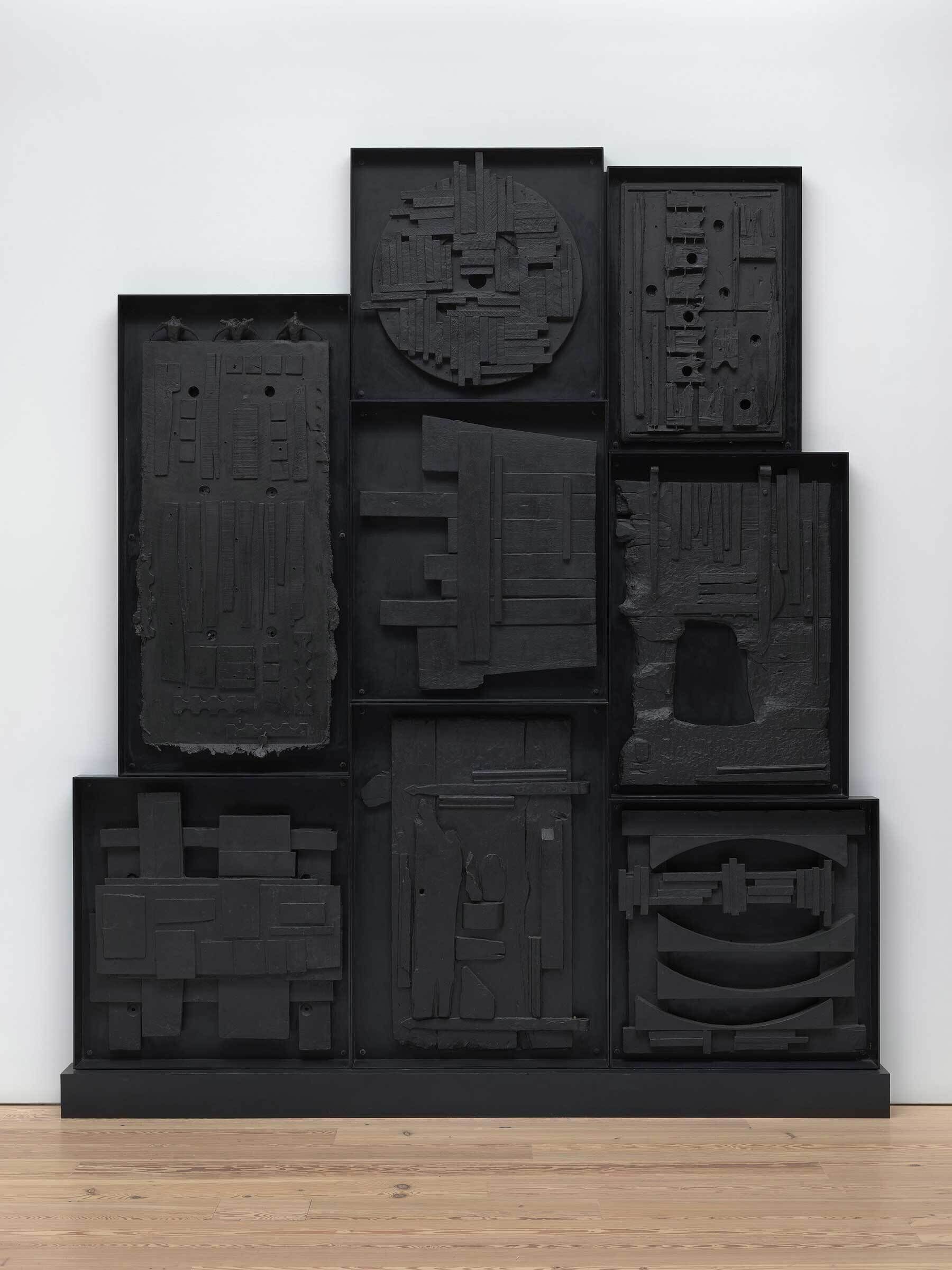
Narrator: The work Illumination—Dark by Louise Nevelson is a sculpture that references architecture. Approximately 12-foot tall by 9-foot wide, the work is composed of eight black boxes that are shallow in depth and open facing the audience. Each “box” displays an assemblage made of wooden scraps cast in bronze.
At the base of this sculpture are three boxes: two square boxes flanking a taller rectangular box at the center, much like the olympic podium. Nevelson arranged the second row of three boxes diagonally with the tallest box on our left and each subsequent box diminishing in size slightly as we move to our right. On the top row, two boxes crown the sculpture.
Inside each of the eight boxes are assemblages made of scrap wood the artist collected, manipulated, and carefully arranged before casting these assemblages in bronze; resembling precious relics of the past carefully displayed in individual cases.
Louise Nevelson, Illumination—Dark, 1961. Cast bronze, 131 1/2 × 111 5/16 × 8 7/8 in. (334 × 282.7 × 22.5 cm). Whitney Museum of American Art, New York; gift of the artist, dedicated to the Whitney Museum of American Art 69.160a-i. © 2025 Estate of Louise Nevelson/Artists Rights Society (ARS), New York. Photograph by Ron Amstutz
Kim Conaty: Welcome to this exhibition of works by Louise Nevelson. I’m Kim Conaty, Nancy and Steve Crown Family Chief Curator.
Nevelson lived and worked in Manhattan from the 1920s to the 1980s. She worked in many mediums, but became best known for sculpture. Assembling materials that she found on the street, she took inspiration from the city around her. In a 1972 interview with her art dealer, Arne Glimcher, she described returning home from a trip abroad.
Louise Nevelson: I returned to America and New York and I'd go into the subways. The columns in the subways are black iron. And for me, personally, they certainly had as much meaning, and in form as well as many of the things that are in museums. I didn't make that distinction, for me. And they still have that power and they still are grand and glorious.
Kim Conaty: Nevelson channeled that power through abstraction. She masked the identity of her materials, including milk crates and table legs, by painting them a single hue—often black.
Louise Nevelson: I don't want color to help me. And I think that is the key to my life. That has been the key. Why I chose the hard way I don't know.
Kim Conaty: Despite their monochrome surfaces, Nevelson’s sculptures contain a wide variety of forms, textures, and objects. The works on view here reward close looking, offering endless details for visitors to discover.
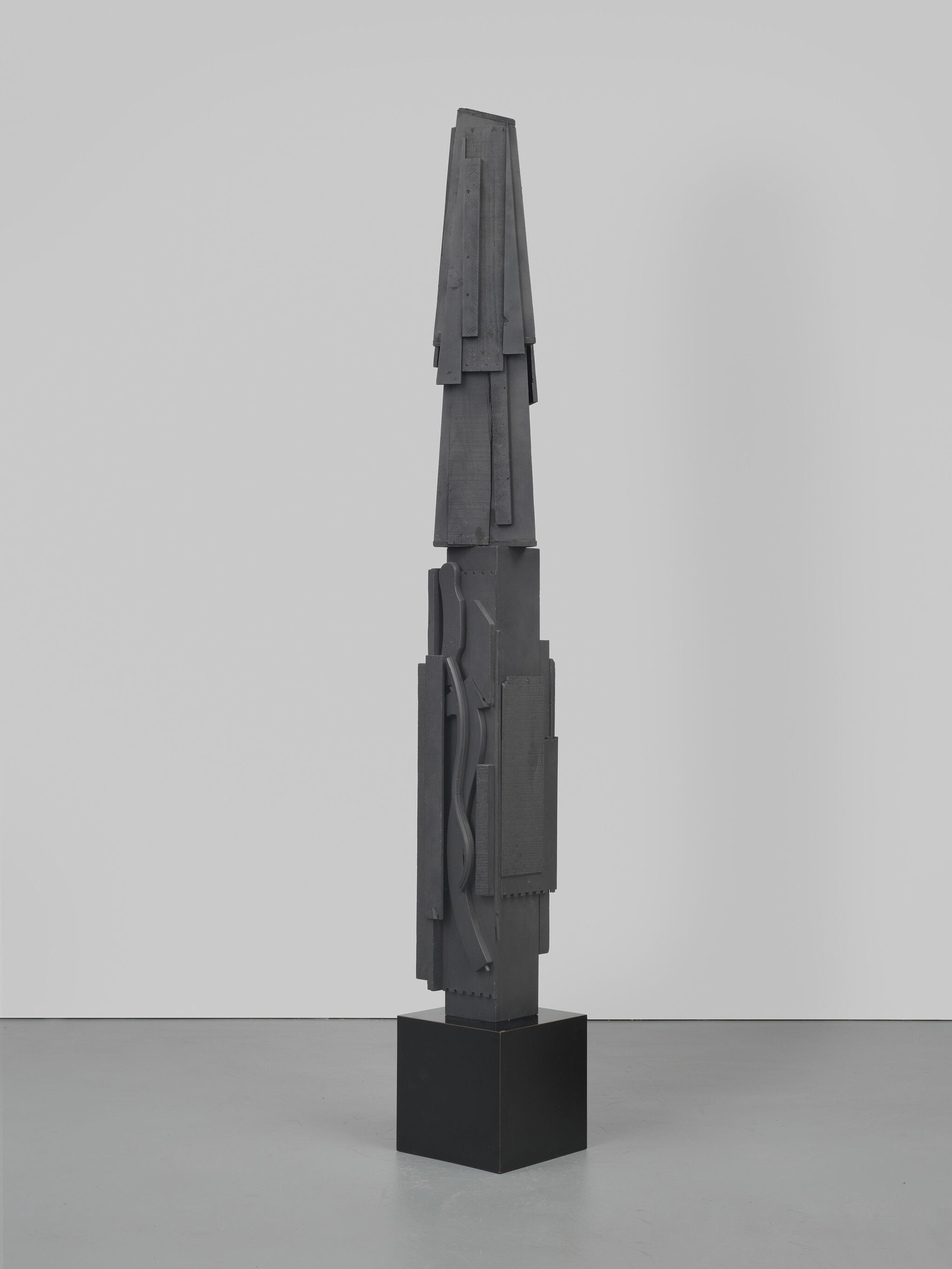
Louise Nevelson, Rain Forest Column XXIII, 1964–67. Painted wood and steel, 81 3/8 × 11 1/4 × 10 3/4 in. (206.7 × 28.6 × 27.3 cm). Whitney Museum of American Art, New York; gift of the artist 69.218. © 2025 Estate of Louise Nevelson/Artists Rights Society (ARS), New York
0:00
0:00