
Amy Sherald: American Sublime
2025
-
500
Introduction
Audio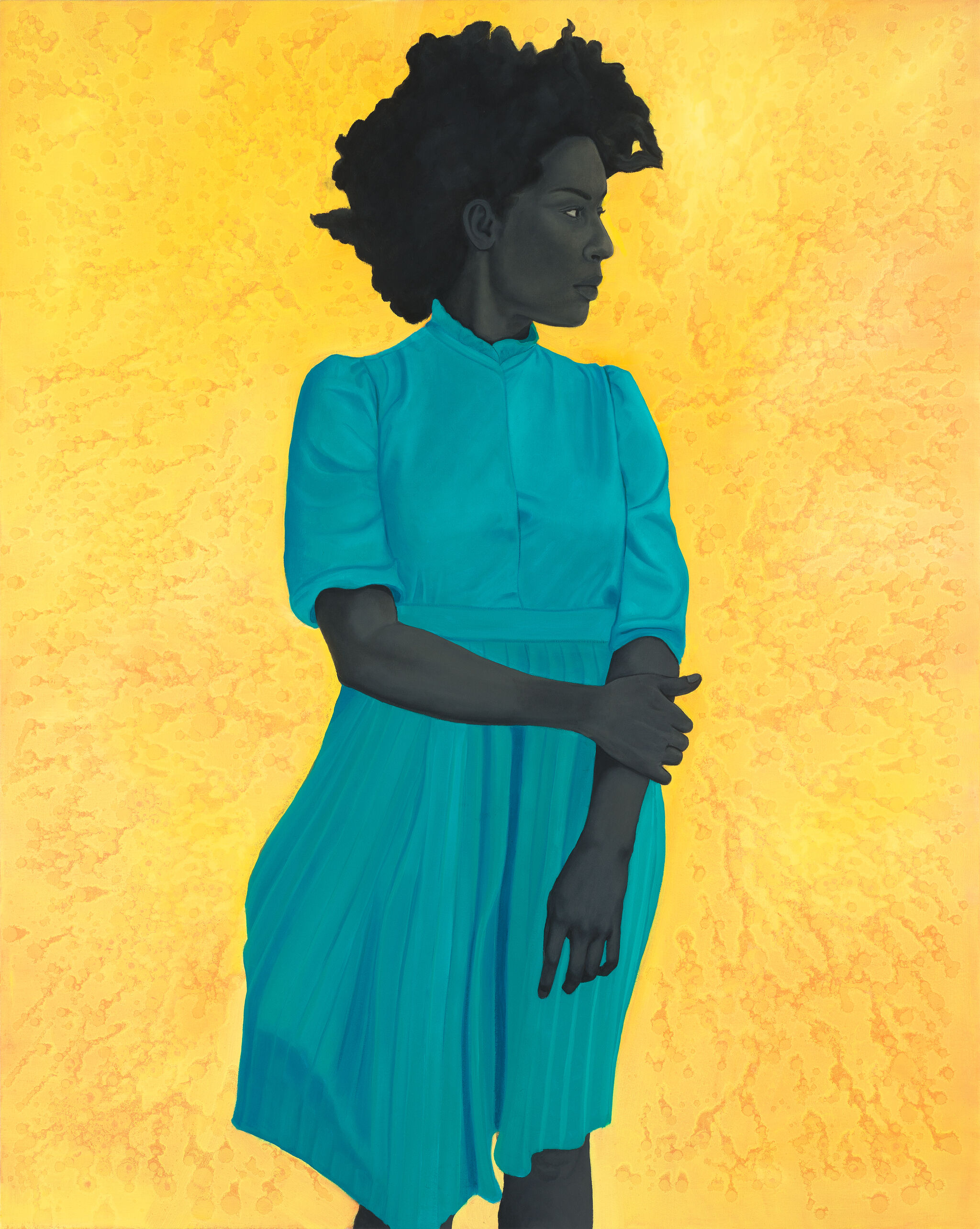
-
501
The Girl Next Door, 2019
Audio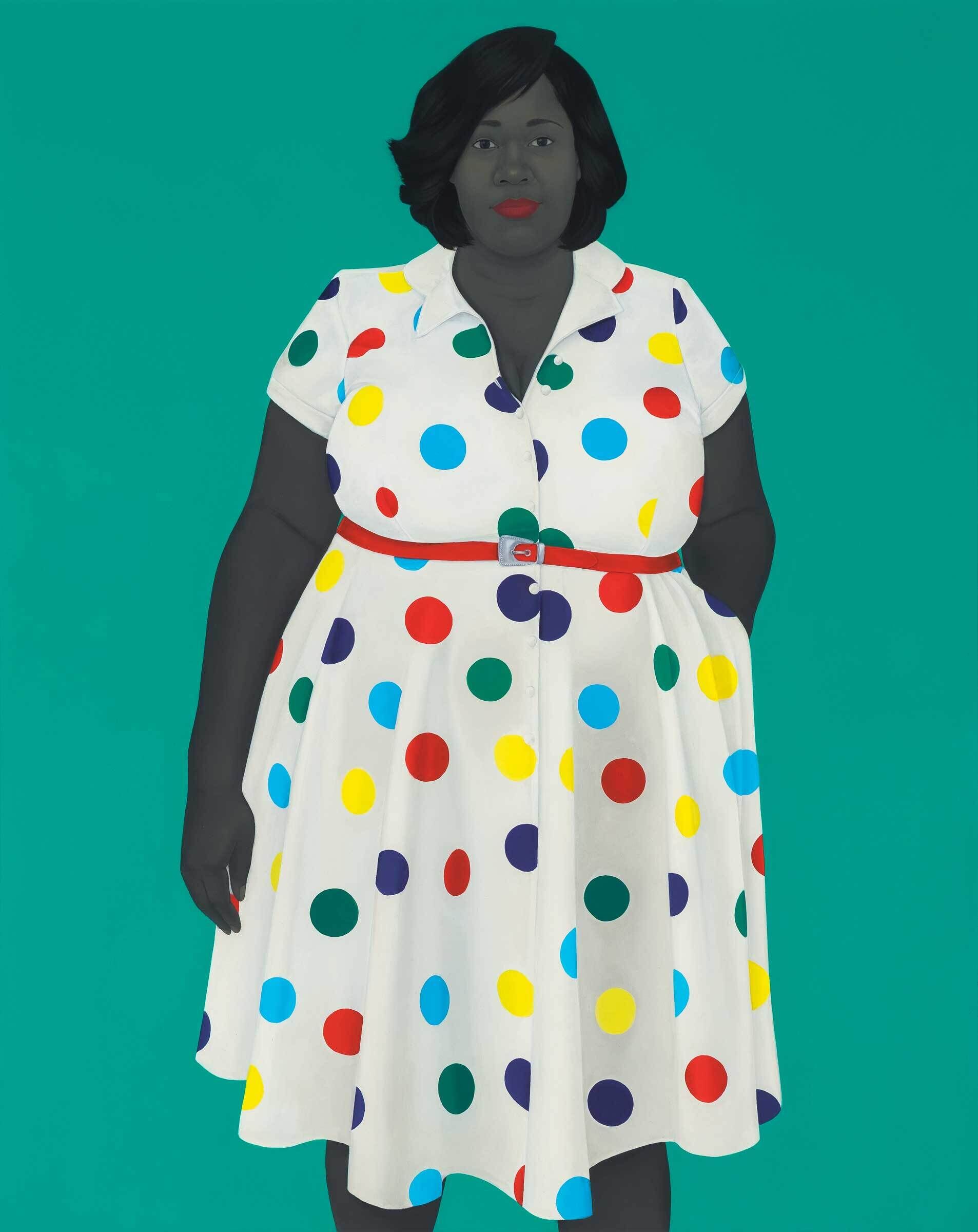
-
502
Try on dreams until I find the one that fits me. They all fit me., 2017
Verbal description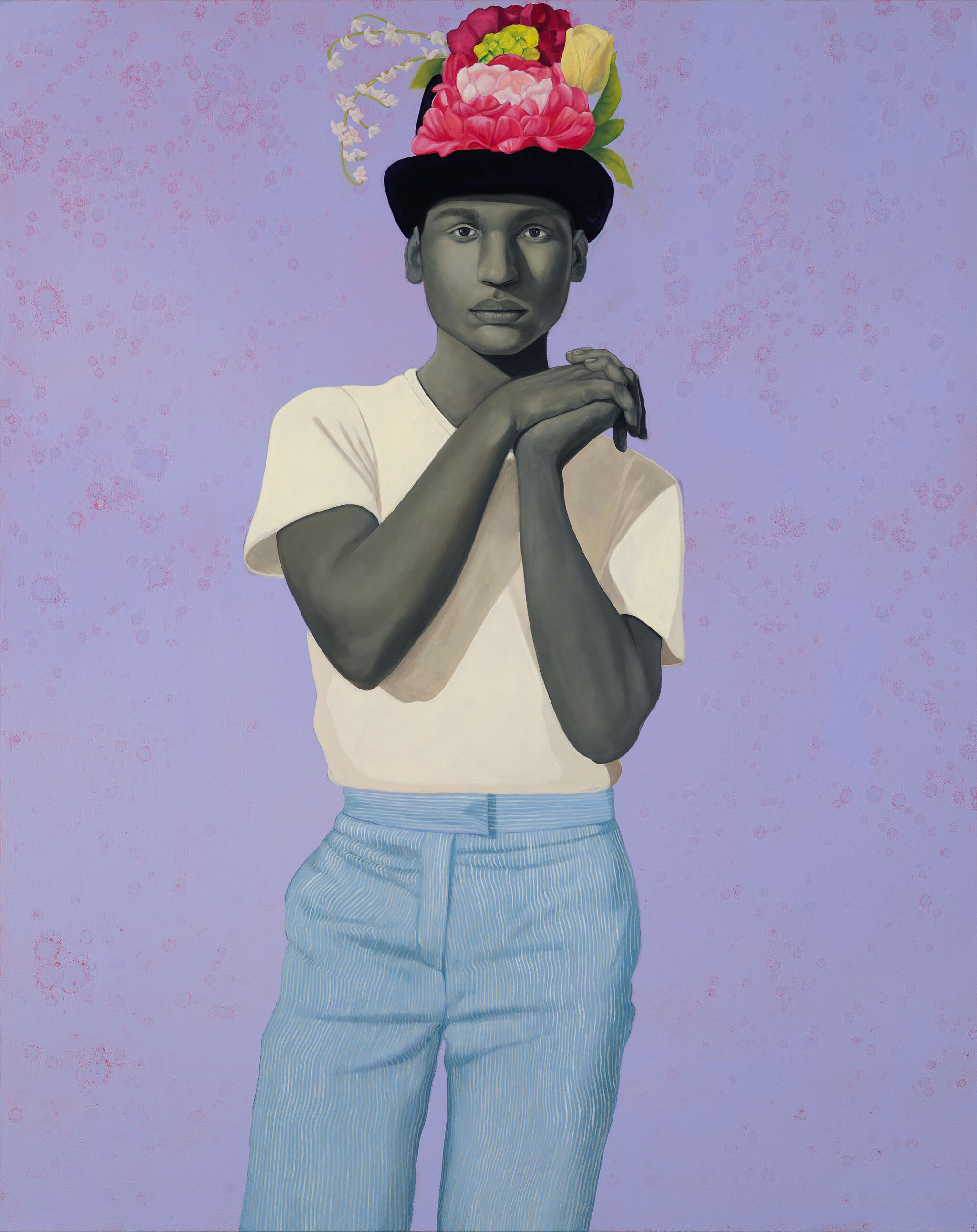
-
503
Hangman, 2007
Audio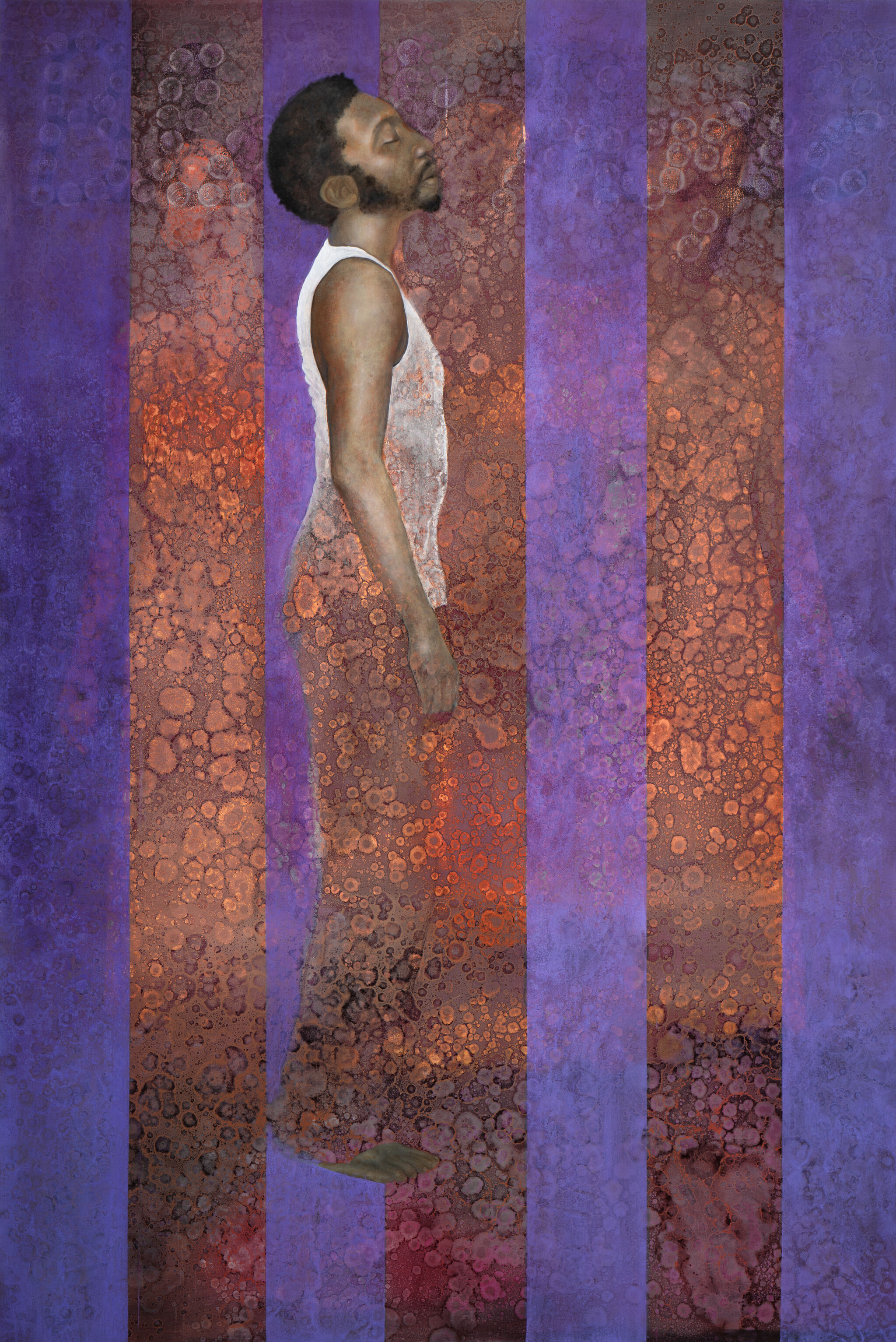
-
504
Listen, you a wonder. You a city of a woman. You got a geography of your own, 2016
Audio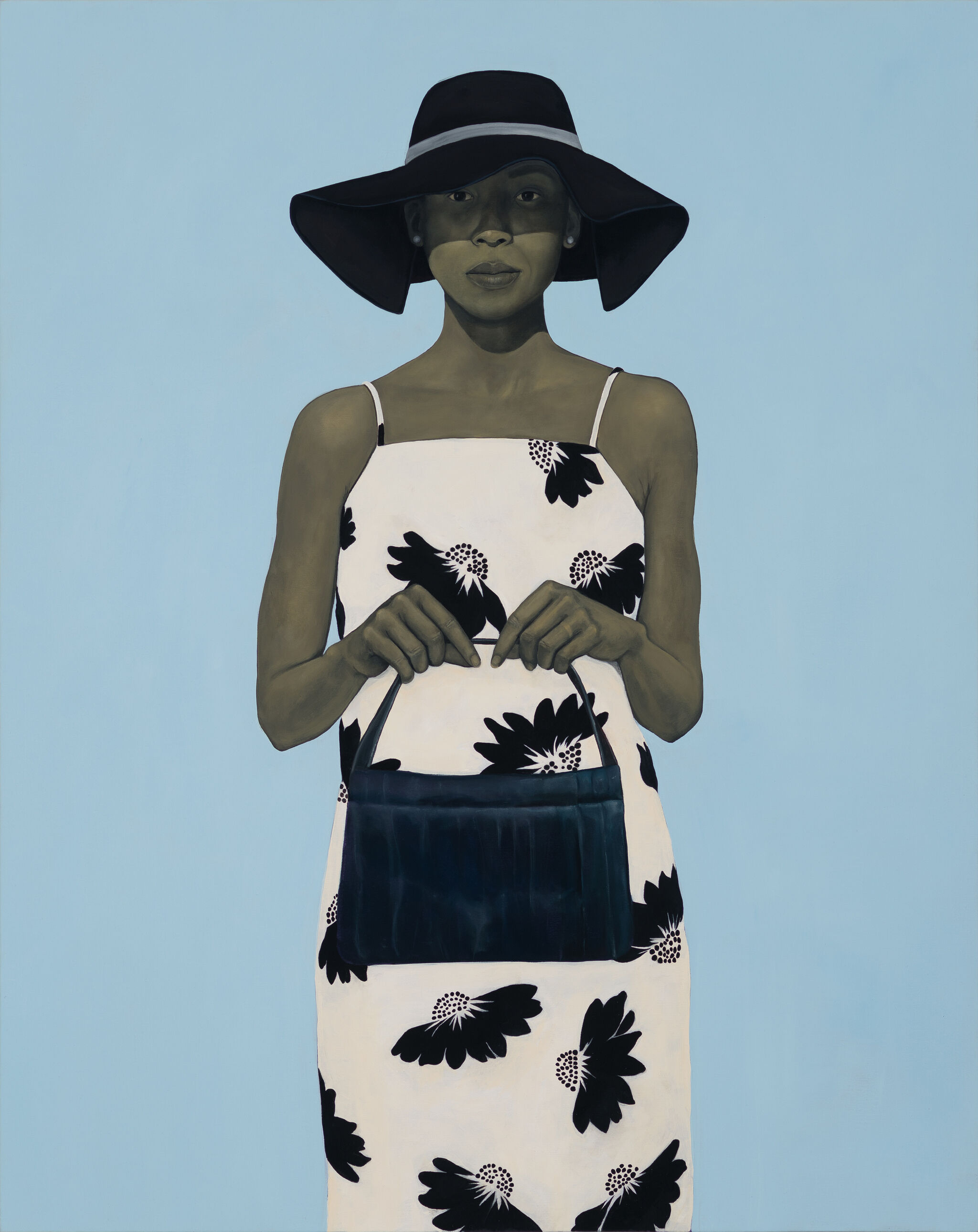
-
505
The Bathers, 2015, and Mother and Child, 2016
Audio, Verbal description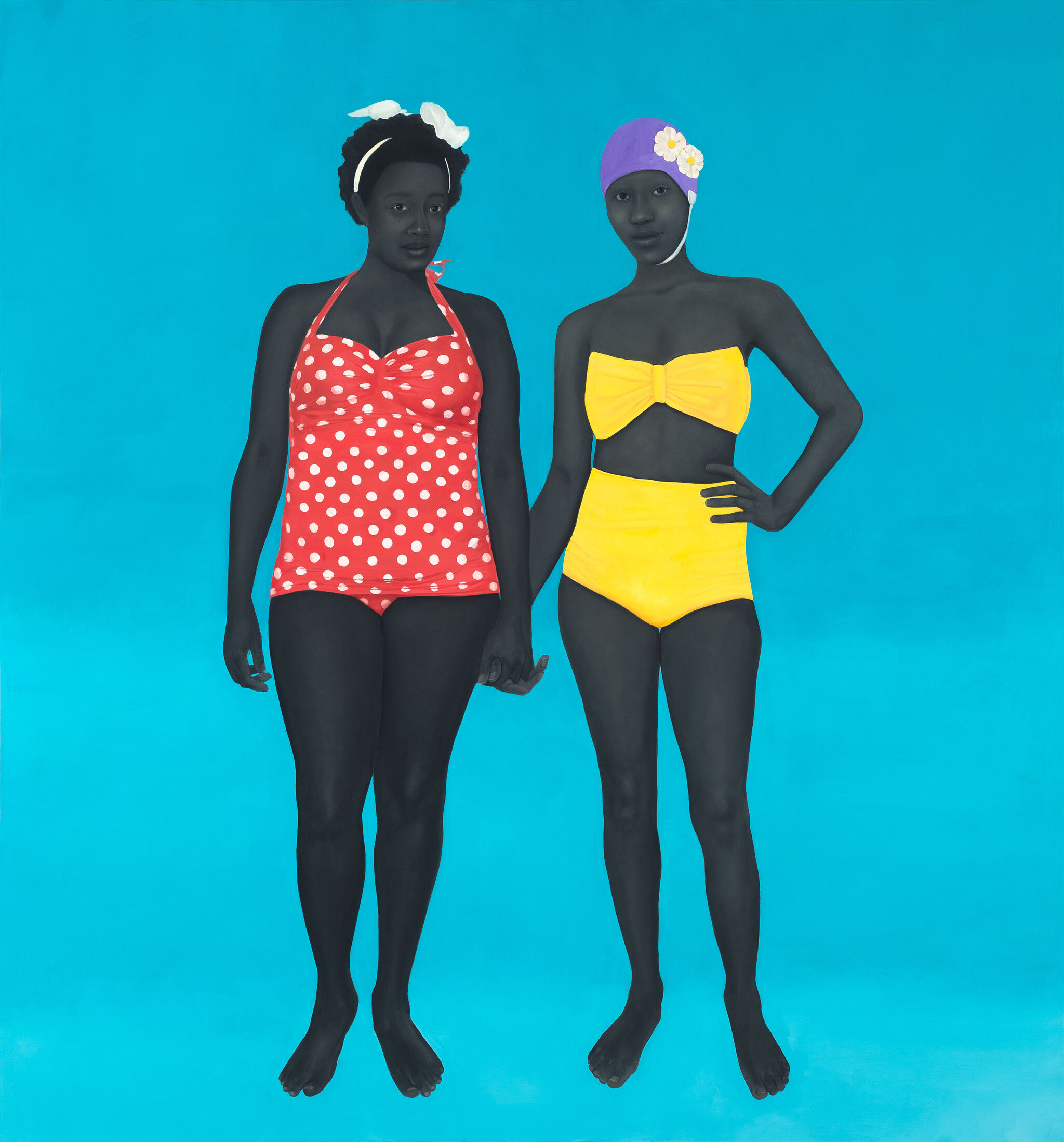
-
506
Amy Sherald in "Everyday Icons"
Transcription
-
507
Michelle LaVaughn Robinson Obama, 2018
Audio, Verbal description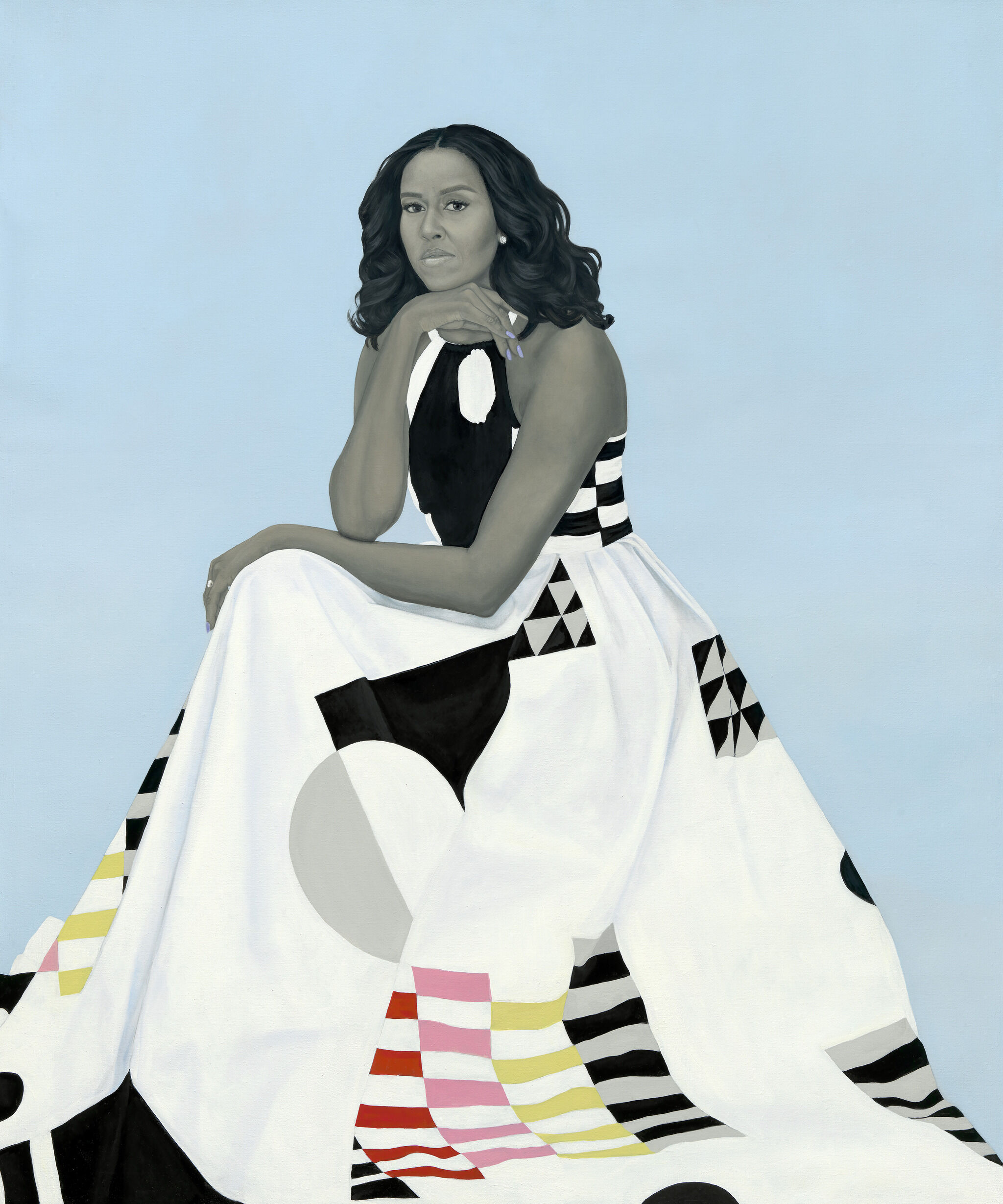
-
508
What's different about Alice is that she has the most incisive way of telling the truth, 2017
Audio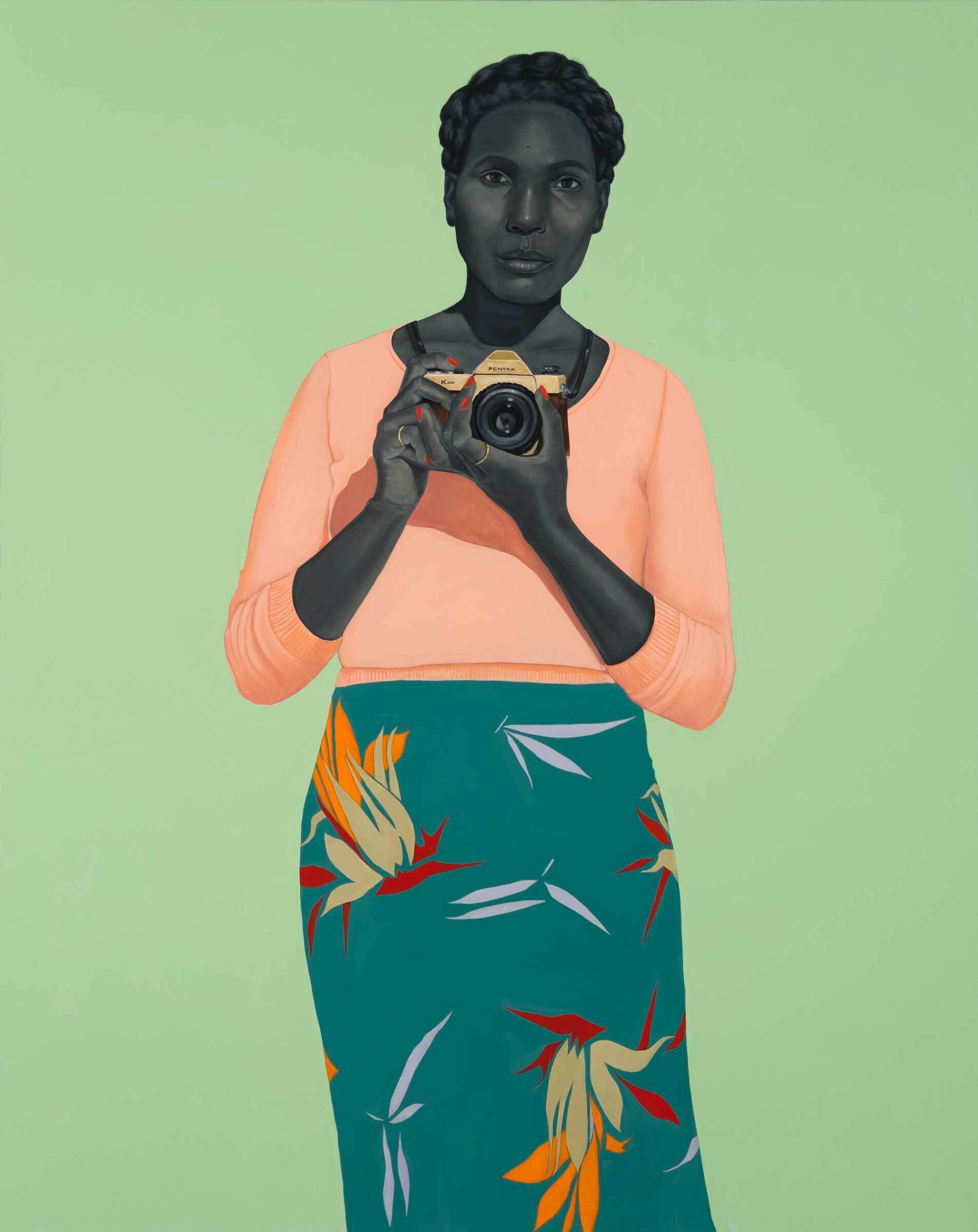
-
509
If you surrendered to the air, you could ride it, 2019
Audio, Verbal description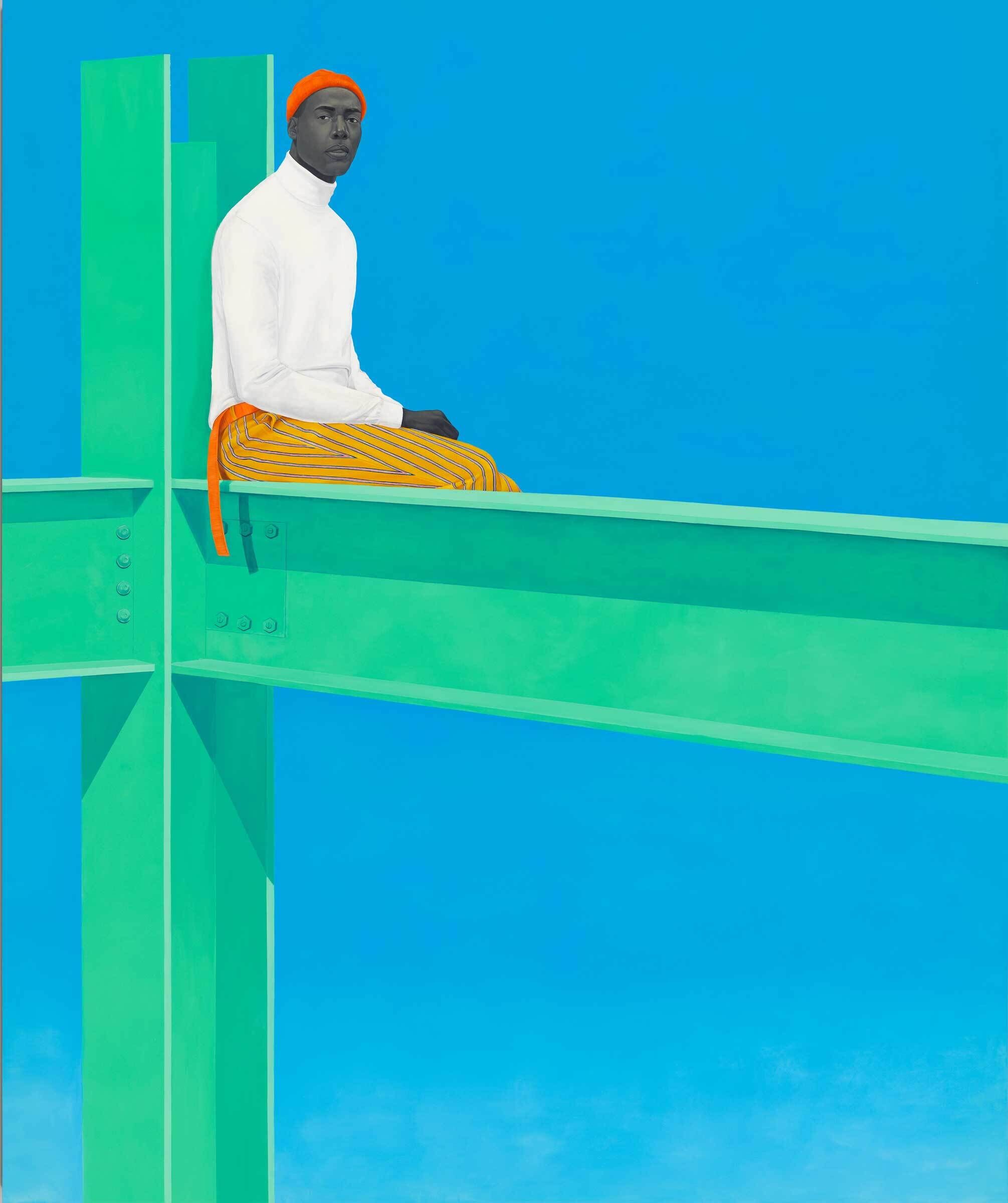
-
510
What's precious inside of him does not care to be known by the mind in ways that diminish its presence (All American), 2017
Audio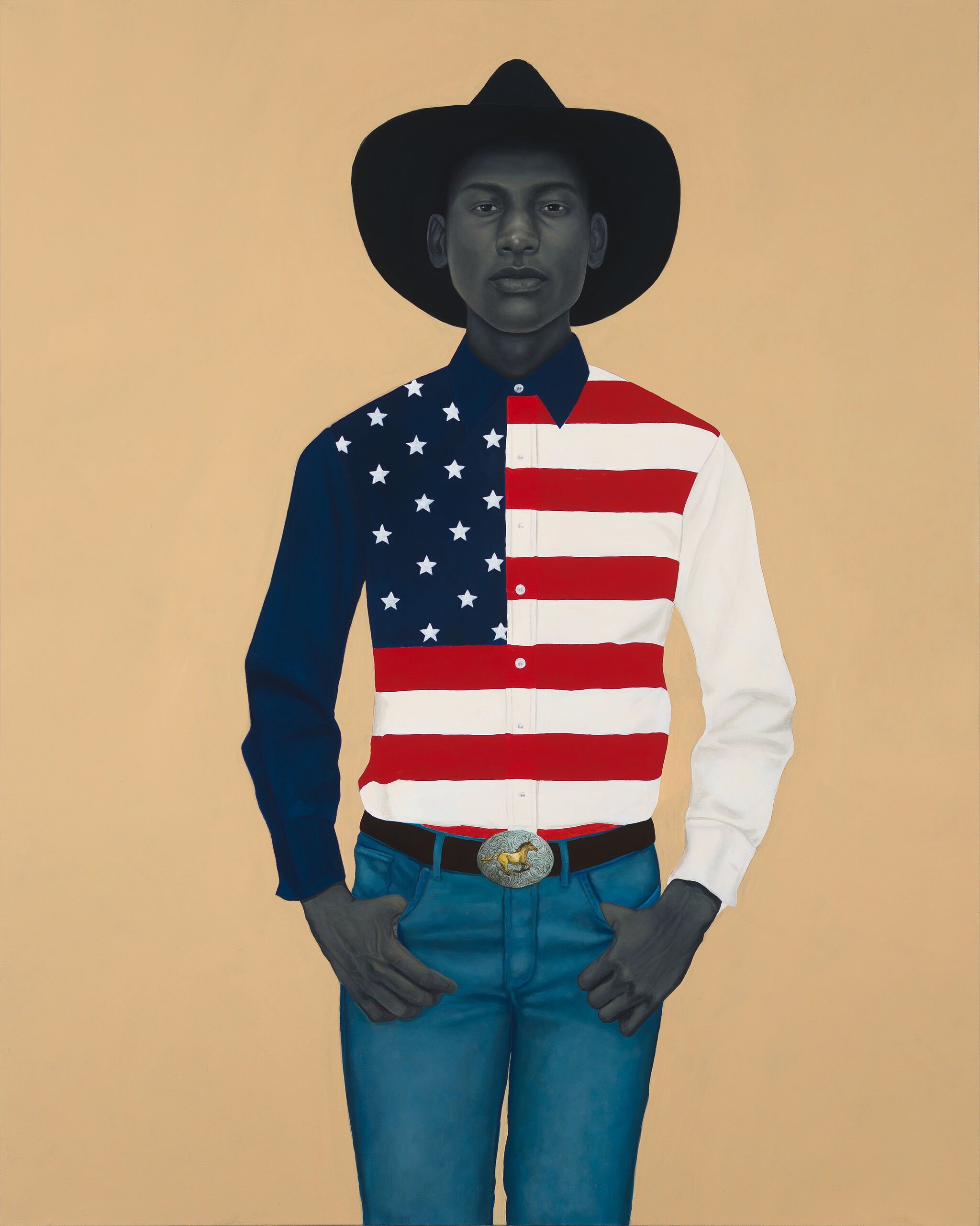
-
511
As American As Apple Pie, 2020
Audio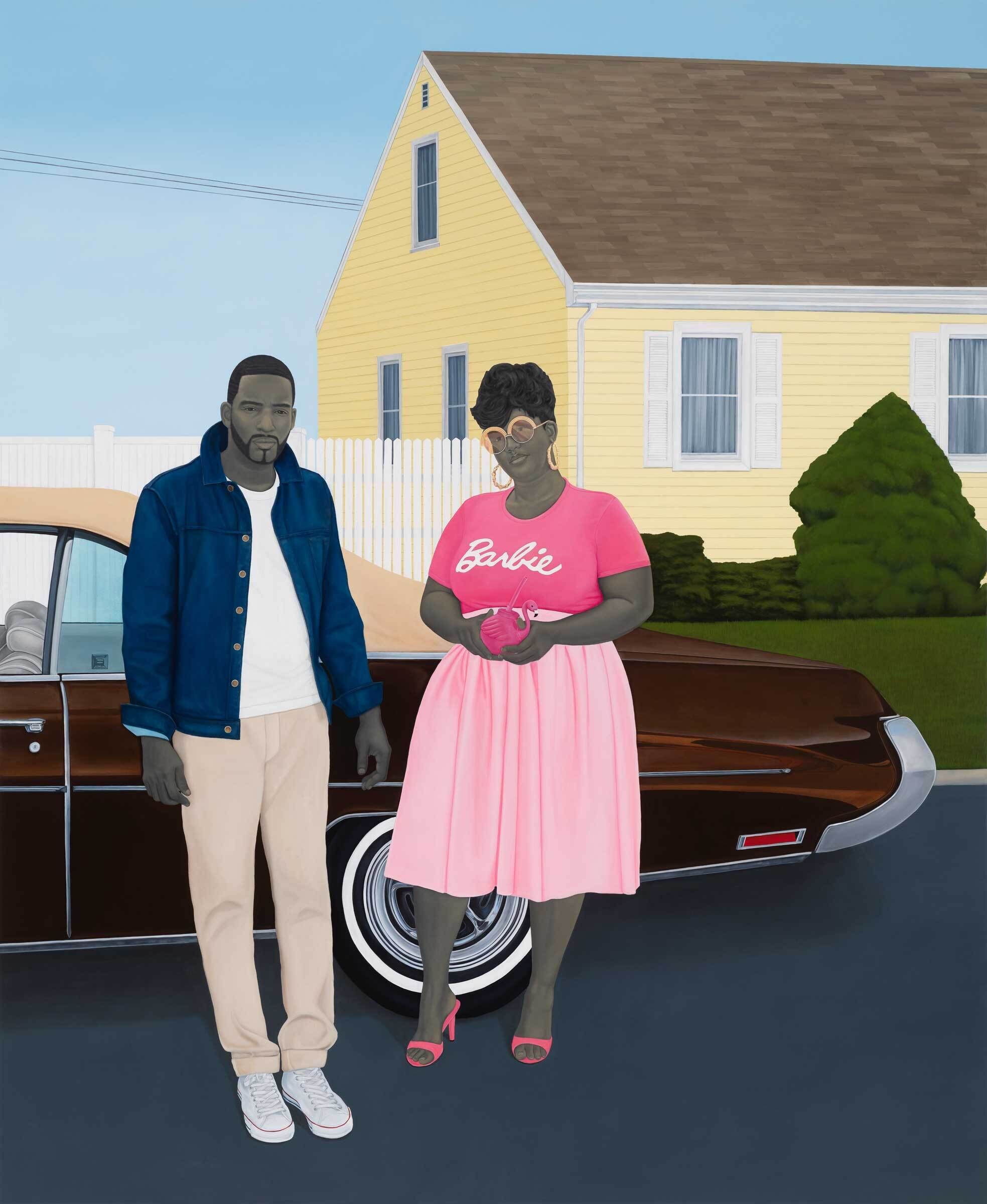
-
512
Planes, Rockets, and the Spaces in Between, 2018
Audio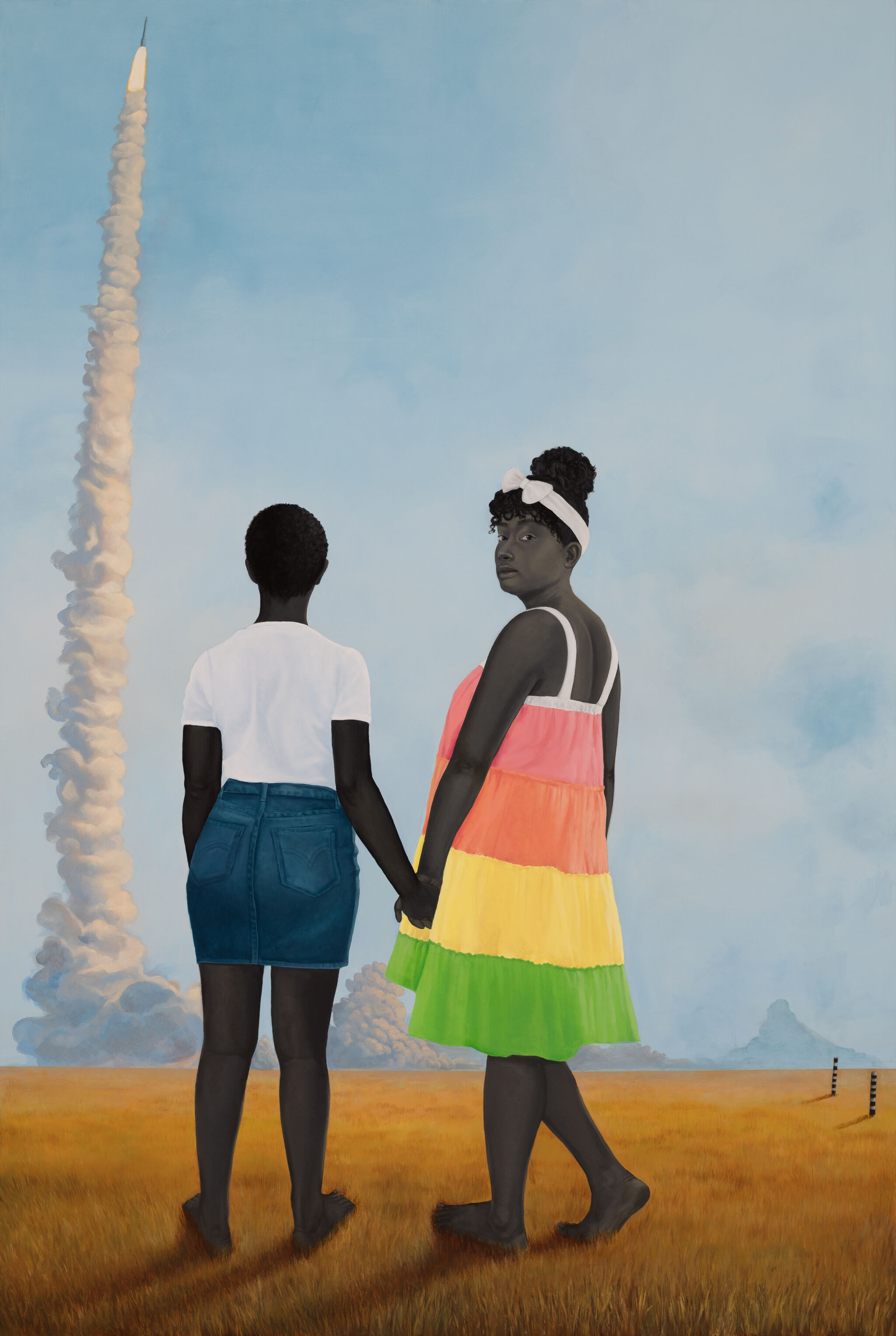
-
513
Breonna Taylor, 2020
Audio, Verbal description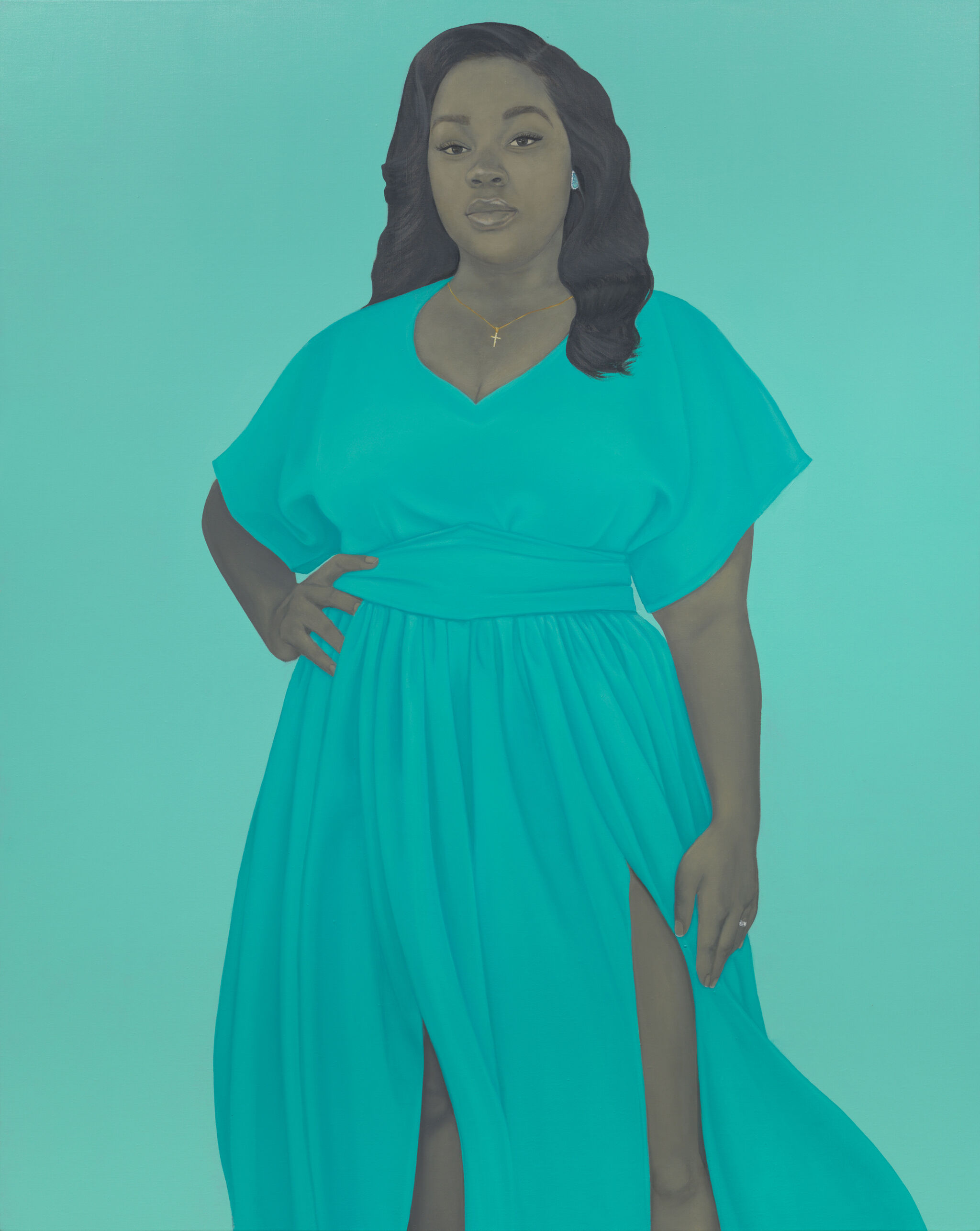
-
514
As Soft as She Is…, 2022
Audio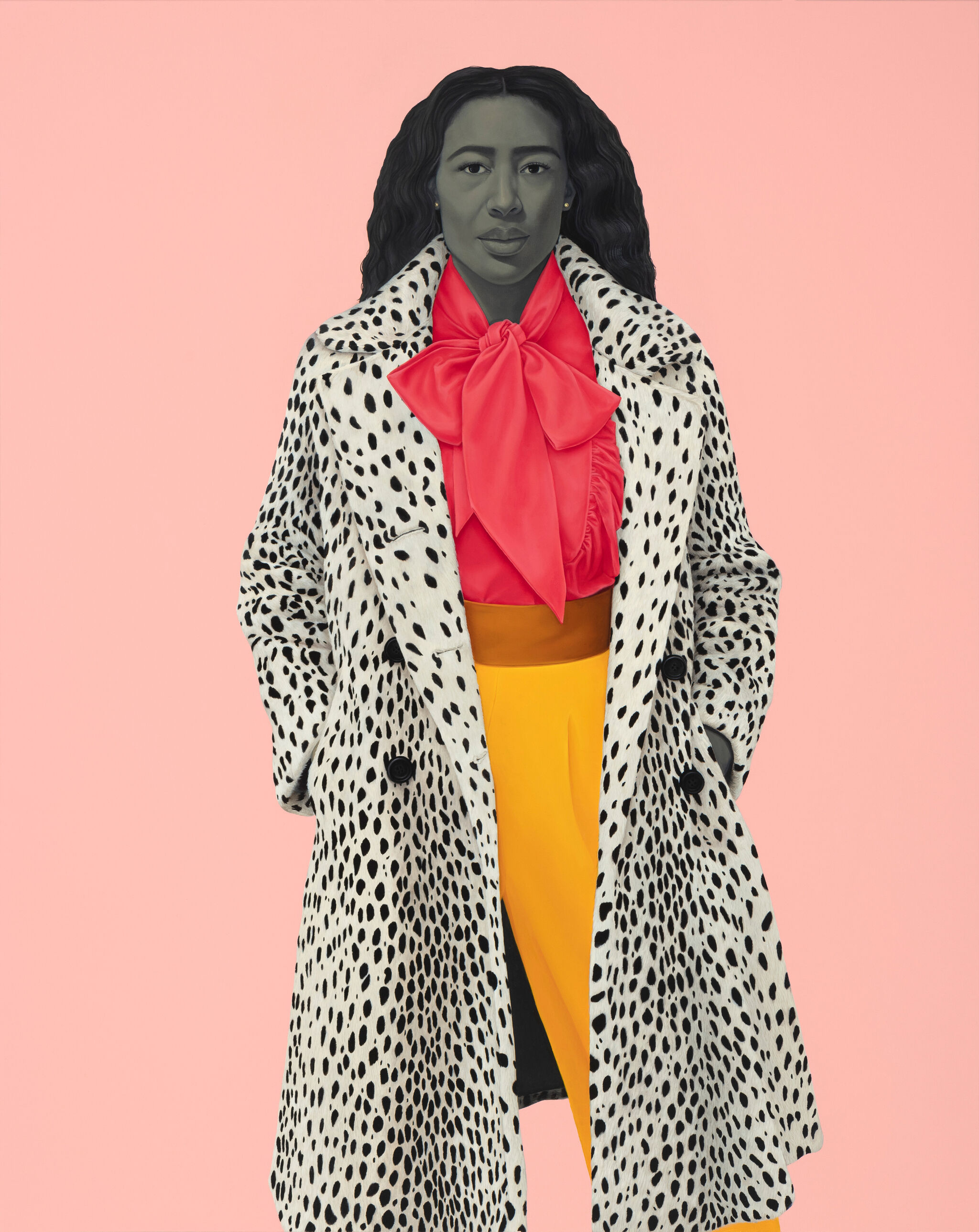
-
515
Ecclesia (The Meeting of Inheritance and Horizons), 2024
Audio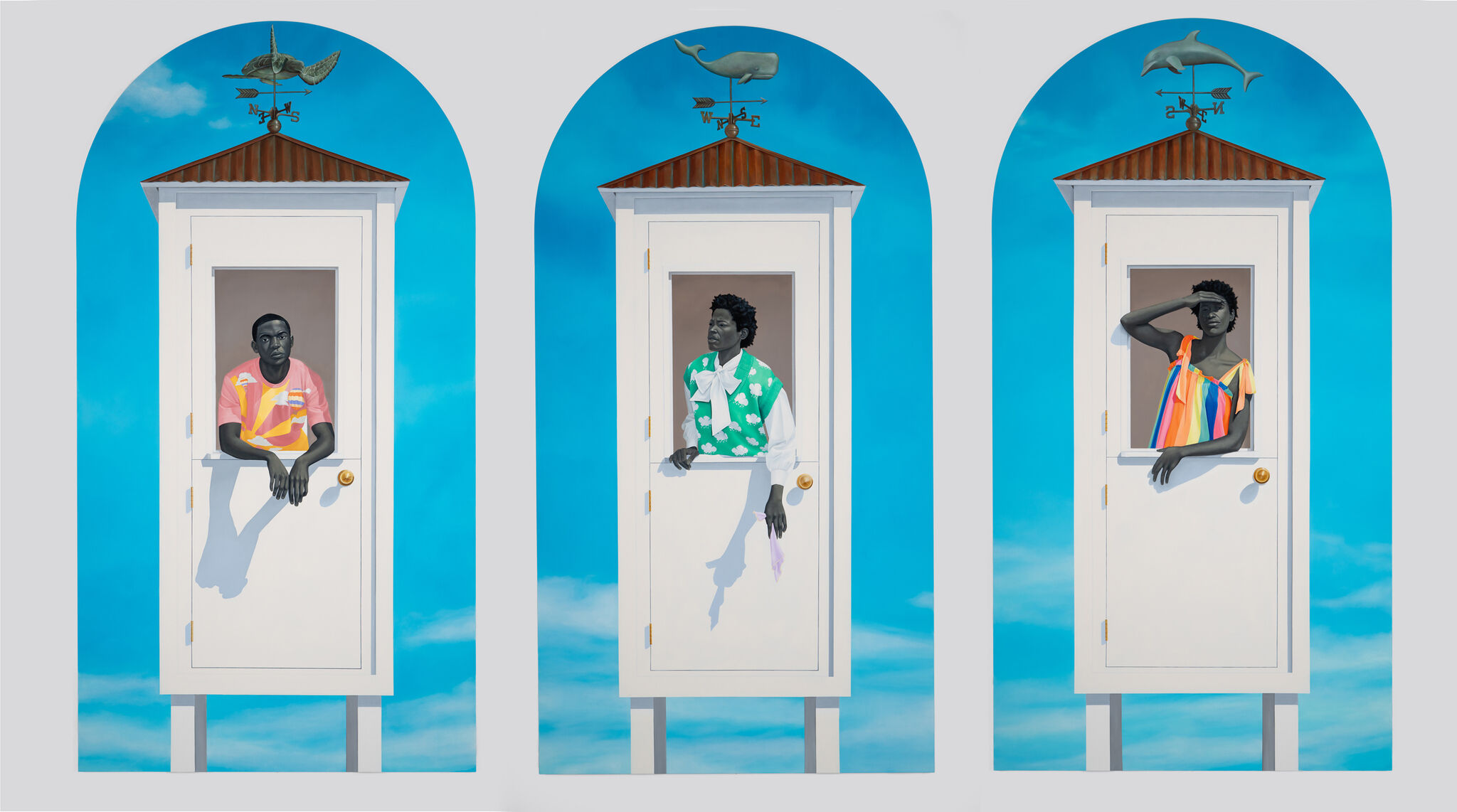
-
516
Trans Forming Liberty, 2024
Audio, Verbal description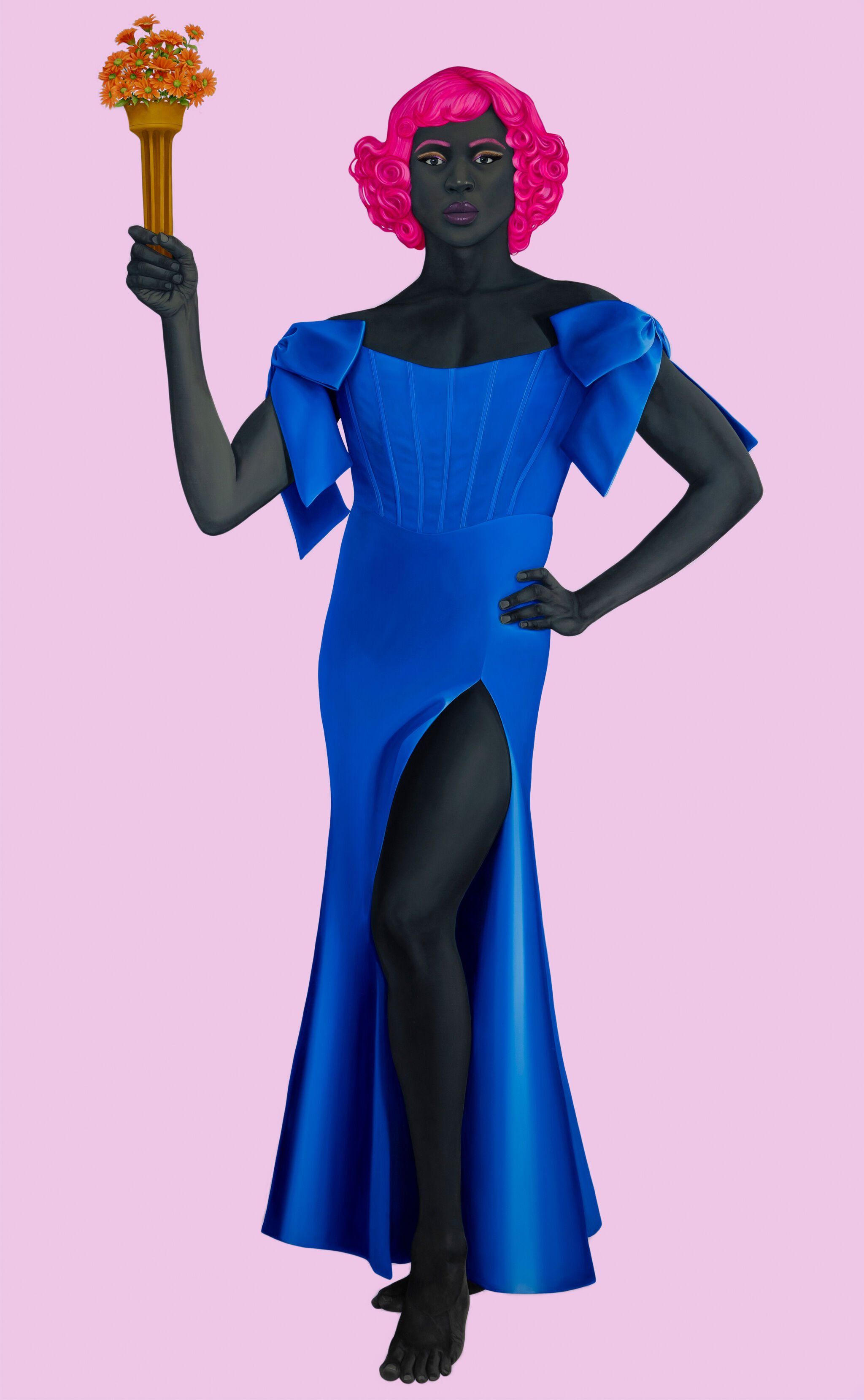
-
517
A God Blessed Land (Empire of Dirt), 2022
Audio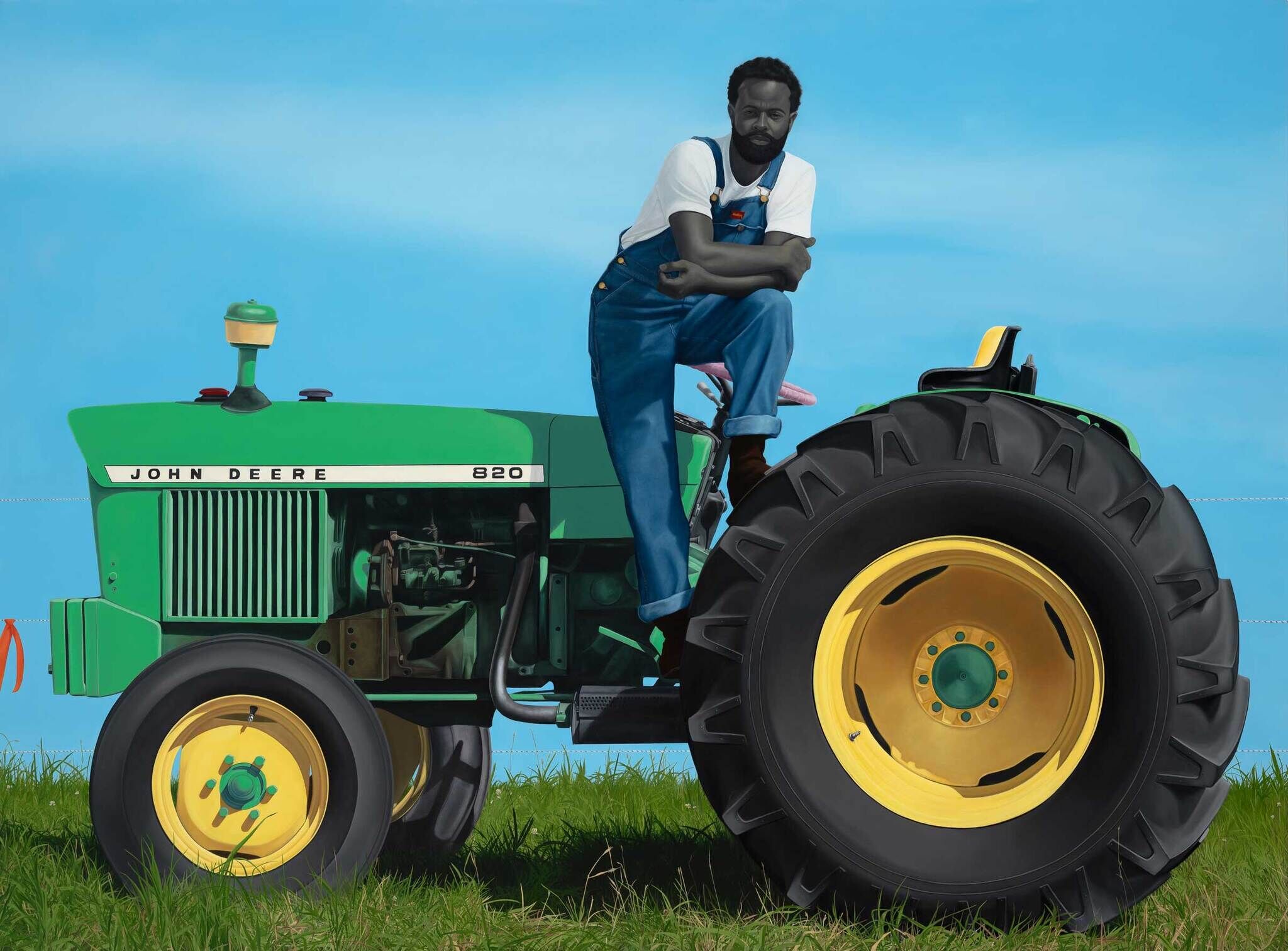
Rujeko Hockley: Hi, my name is Rujeko Hockley and I'm the Arnhold Associate Curator here at the Whitney Museum of American Art. In the audio guide, you'll hear from the artist herself, as well as a range of other individuals connected to the paintings and to Amy's practice in general.
Amy Sherald: Hi. My name is Amy Sherald, welcome to my show at the Whitney Museum, American Sublime.
Narrator: As you look around this opening gallery, you may notice something that the paintings share. Sherald has painted all of the figures’ skin tones using “grisaille”—or shades of gray.
Amy Sherald: And I did not want the conversation about the work solely to be about race and identity. Even though it can be employed that way. I wanted it to also have a universal leg to stand on as well for it to fit into the larger canon of work that has been made by an American realist.
Amy Sherald, Saint Woman, 2015. Oil on canvas, 54 × 43 × 2 1/2 in. (137.16 × 109.22 × 6.35 cm). Private collection. Courtesy Monique Meloche Gallery and Hauser & Wirth. © Amy Sherald. Courtesy the artist and Hauser & Wirth. Photograph by Joseph Hyde
Amy Sherald: If I think about the “girl next door” archetype, in historical paintings, we're looking for depictions of young women who appear approachable, natural, and embody an idealized version of everyday femininity.
In the beginning these paintings were not made with the idea of an archetype in mind, but I realized that as I got deeper and deeper into my practice, that these figures, these portraits that I was painting were to represent something bigger, like an archetype of a kind of person that was an American.
If you're looking at this painting, The girl next door or any of the paintings in this room right now, the deliberate use of a single figure in an often dreamlike suspended space allows the subjects to exist on their own terms, unburdened by context, yet deeply present. This strategy transforms the historical function of portraiture, creating a space where Black identity is not defined by struggle or stereotype, but by quiet power, self-possession and a sense of timelessness. She is my classmate. She's my neighbor. She's the woman that owns the boutique up the street. She's every woman. Not to sound like Whitney.
Amy Sherald, The Girl Next Door, 2019. Oil on canvas, 54 × 43 × 2 1/2 in. (137.16 × 109.22 × 6.35 cm). Private Collection. © Amy Sherald. Photograph by Joseph Hyde
Narrator: Try on dreams until I find the one that fits me. They all fit me. is a vertical oil painting of a young slender person standing alone in the center gazing forward with their hands clasped wearing a bowler hat covered in flowers.
Amy Sherald: You are standing in front of a painting that is 54 inches by 43 inches. There is a single figure in the center.
Narrator: The figure wears an earthy white T-shirt tucked into blue and white pinstripe trousers with fine lines that wrinkle along the contours of their body. Though the painting crops out the figure’s legs below their thighs, a slight contrapposto pose is visible in the subtle lean of their weight to one side. At the top of the painting, the subject’s hat is topped with blooming flowers resembling pink and red peonies, a pale yellow tulip and white lily-of-the-valley. The black color of the hat gives it a magnetism like velvet. The floral arrangement is both dense and lively, creating a living composition of its own. The brim, which neatly curves upward, casts a shadow over the right side of the brow suggesting that a bright source of light is coming from the left. Although the model’s skin is rendered in greyscale, the yellow glow of the light warms the open expression of their face. While their skin tone is rendered in grey in the painting, Sherald is primarily interested in painting Black figures because of their absence in art history. The model’s eyes are peaceful, direct and assured perhaps to the point of feeling piercing, and their mouth is closed gently. The life-like scale of the painting generates a feeling of standing eye to eye with the subject.
Amy Sherald: The background is a lavender purple that looks like it would feel very soft.
Narrator: This cool lavender background is patterned with faint but dark red rings like splatter from small popped bubbles.
Amy Sherald: When I made this painting, I painted the background red first. It's a very bright fiery red. I then let it dry and I painted the purple background over top. I use oil paint, so before the paint dries, I use turpentine to drip onto the background to break up the purple colors so that the red underneath shows through. So when you look at this painting, you see the purple, but you also see little speckled parts that show this color of red underneath.
Amy Sherald, Try on dreams until I find the one that fits me. They all fit me, 2017. Oil on canvas, 54 × 43 × 2 1/2 in. (137.16 × 109.22 × 6.35 cm). Kemper Museum of Contemporary Art, Kansas City, Missouri, Museum purchase made possible by a gift from the Bebe and Crosby Kemper Foundation. © Amy Sherald. Courtesy the artist and Hauser & Wirth. Photograph by Joseph Hyde
Rujeko Hockley: Hangman is a painting from 2007, which makes it the earliest painting in the exhibition.
It really is a hinge in her practice. You can see traces of self-portraits, actually, kind of submerged in the more orange or rust colored bands. And then there is a central figure, a Black man in profile with his eyes closed and his face turned up, perhaps to the sky. Amy has described this painting as a reverse lynching. It is probably the single most direct visual reference she has made to a very particularly American history of racialized violence. But the figure actually floats quite dreamlike and free of that history, though the title of the work is Hangman, and it is a reference to that history.
It represents a really important step in Sherald's thinking about her work in relation to a history of oppression of African-descended people in the United States, and her commitment to creating paintings that don't hide that fact or shy from that fact, but instead, represent different and complex narratives of Black life.
Narrator: Sherald achieved the mottled effect by layering different colors of paint, and then dripping turpentine on the surface, allowing the lower layer of color to show through.
Amy Sherald, Hangman, 2007. Oil on canvas, 100 × 67 × 2 1/2 in. (254 × 170.18 × 6.35 cm). Collection of Sheryll Cashin and Marque Chambliss. © Amy Sherald. Courtesy the artist and Hauser & Wirth. Photograph by Kelvin Bulluck
Amy Sherald: Listen, You a Wonder, You a City of a Woman, You Got a Geography of Your Own. The title for this painting comes from Lucille Clifton's poem, what the mirror said, which is a powerful affirmation of Black womanhood, self-worth, and embodied identity.
On the summer day in Baltimore that this model showed up for this photo shoot, I had her come around 11AM because I wanted the sun to be in a particular position to capture the shadow on her face with this hat. So it added a sense of mystery along with her posture and the way she's holding the purse. And if you look at her ring finger, you'll see that the ring is not there.
I have always worked from photographs along with using images on my laptop as reference. Photography has been essential to me because it was my earliest connection to history, both personal and collective. Growing up I had only two photographs of my grandparents. Those were likely the only time they had the opportunity to take portraits in their lives. The absence of imagery shaped my relationship to portraiture because they make me deeply aware of their power to affirm presence, identity, and lineage.
Amy Sherald, Listen, you a wonder. You a city of a woman. You got a geography of your own, 2016. Oil on canvas, 54 × 43 × 2 1/2 in. (137.16 × 109.22 × 6.35 cm). Collection of Rashid Johnson and Sheree Hovsepian. © Amy Sherald. Courtesy the artist and Hauser & Wirth. Photograph by Joseph Hyde
Rujeko Hockley: The Bathers is a painting of two young women holding hands and staring out at the viewer. In their appearance, in their dress, and in the title of the painting, they're connected to a very long history in Western art. We see paintings by artists like Paul Cézanne, Pierre-Auguste Renoir, Titian, etc., showing images of bathers. Sherald has been thinking about this connection to art history in which we have not historically seen Black subjects portrayed in this way, and certainly also not at leisure in the way that these young women very clearly depict.
Near to this painting is another painting called Mother and Child. Mother and Child, like The Bathers, is one of the most common and iconic topics of depiction in both Western art, but also going back into human history, ancient Egyptian art, ancient Greek art, cave paintings. This depiction of mother and child is uniquely human, and so again, Sherald is, here, interested in thinking about where do Black subjects fit into this arc of depiction and this arc of art history?
Narrator: The Bathers is an almost square oil painting on canvas from 2015. It is 74 inches by 72 inches.
Amy Sherald: The painting has two female figures in it that are standing in bathing suits and holding hands. The figure on the right has her hand on her hip, head slightly tilted down. The figure on the left has one hand and the hand of her friend and the other hand hanging down by her side. Her left foot is slightly lifted up. The figure on the left has on a one-piece bathing suit that looks like an orange sherbet ice cream. It's a peachy orange color. It's tied behind her neck. She has a white ribbon tied around a short kinky fro. The girl on the right has on a yellow bathing suit that in my mind I equate with lemonade. The top is one big bow that covers her from left to right. The bottom is a high-waisted bikini. Both of these bathing suits are vintage and I purchased them from a vintage store. The girl on the right has on a vintage purple swim cap with two large flowers on the side and the strap goes over her ears and under her chin.
Narrator: The figures' colorful retro bathing suits contrast with their skin tones, which are represented in greyscale. The women’s hands are firmly clasped together with interlaced fingers. Though they appear to be firmly standing on both feet, they each lean noticeably on the leg closest to one another with heads slightly tilted inward. Their expressions are relaxed and warm but not effusive. The intimacy of their bond is apparent yet enigmatic. Bathers have long been a subject of Western art, gaining particular popularity in nineteenth and early twentieth century European painting. While historical depictions of bathers have often been white subjects, Sherald places Black women at the forefront of this painting.
Amy Sherald, The Bathers, 2015. Oil on canvas, 72 1/8 × 67 × 2 1/2 in. (183.2 × 170.2 cm). Private Collection. © Amy Sherald. Courtesy the artist and Hauser & Wirth. Photograph by Joseph Hyde
Transcription: Amy Sherald
Running time: 00:14:50
(soft uplifting music)
(ethereal ambient music)
Amy Sherald: I really have this deep belief that images can change the world. It's not that I started making work with that belief, but it's what I've come to know. It's a beautiful way to tell a story. I consider myself an American realist. For me, it means just recognizing my Americanness first and wanting the work to join a greater ongoing conversation. Edward Hopper or Andy Wyeth—they're telling these American stories, and I'm also telling American stories.
Man Announcer: Miss Amy Sherald, portrait artist.
Woman Announcer: Last week, Amy Sherald went from being a virtual unknown to one of the most talked-about artists in the world. On Monday, her painting of Michelle Obama was unveiled alongside Kehinde Wiley's portrait of President Barack Obama. Both Sherald and Wiley were interviewed and chosen for the job by the Obamas themselves.
Amy Sherald: I wanted to paint a quiet and powerful portrait of her that offered the viewer a different kind of moment.
(sensitive piano music)
And make it truly about her and not about the "First Lady" title. And making everyone feel the way that she makes people feel in person, which is like she's very relatable. When they look at Michelle, they can see themselves. By being herself, she gives us permission to be our full selves.
It just so happens that painting Black people is kind of political. But these figures hanging on museum walls—it's more than just that; you know, it's more than just the corrective narrative. It's gotta be about humanity first, and then everything else has to follow.
The decision to paint the skin in gray—when I first started making this work, I think I had an anxiety about the work being marginalized and the conversation solely being about identity. This was something that I wasn't trying to escape necessarily, but I wanted the work to be bigger than that. I started to think of it as a way to allow the viewer to have an experience that was not about race first. These paintings, for me, are really about our interior lives.
(birds chirping) (sprinkler ticking)
Geraldine: Well, this is Amy. It's not a large one, but that's Amy, and I'm trying to think of her age at the time.
Amy Sherald: Six or seven, maybe second grade. And then this is all of my siblings.
Geraldine: Yeah, Amy was the bossy one.
(laughter)
Amy Sherald: That's funny.
Geraldine: She wanted to be an artist, and, of course, I would always say, "I don't want a starving artist. You can be a doctor, a lawyer, anything better than an artist. Do your art on the side." But she was determined to be an artist.
Amy Sherald: Yeah, and this is my mom when she was 19.
Geraldine: High school.
(sensitive piano music)
Amy Sherald: Having these here for me was the opportunity to understand my history and where I come from. And after using the grayscale painting, I really started to think about these images that I had growing up.
I was always drawn to the photograph of my grandmother, Jewel. I just think photographs from this time—those eyes really tell a story. You can really feel who they were in that moment. And I think that's what really draws me to black-and-white photography—it’s so special and saturated with so much emotional energy. Looking at her picture, I saw a woman who was dignified, who represented herself in a way that influenced how I wanted to be represented in the world as well.
I don't think I realized that I was missing seeing imagery of myself in art history. It wasn't until I came across a painting that actually had a person of color in it—a Black person—that I realized I had never seen that before.
As a sixth grader, my first time going to a museum, when I saw this painting by Bo Bartlett, I was shocked that I was looking at a figure of a Black man. He was standing in front of a house. He had on a belt that had, like, some handyman tools. I just remember standing there for a few minutes, and I realized when I saw that work that I wanted to make paintings like that. I was able to see my future in that moment.
This is my childhood bedroom, and it's pretty much exactly as I left it when I moved to Atlanta to go to Clark Atlanta University. I didn't have the kind of mom that let us put posters up in our room or anything like that. Everything had to be just like this when I left to go to school.
(smooth jazzy music)
I waited tables from the time I was 25 until I was about 37.
I kept painting. I was trying to figure out where I fit in and what my voice would be. And in my mind, I was like, "Well, I don't see just paintings of Black people just being Black." Like, we're just here, we're living our lives, hanging out, just being ourselves.
Post-grad school, I ran into this model who was like a six-one, young Black woman, and I asked her if she would come and allow me to take a picture of her. She had on a pink shirt that had white polka dots on it and a big bow tie. She’s standing there with her arms dropped down to her side, her gaze meeting the viewer, and she looks a little bit uncomfortable, a little bit awkward. She, in that moment, stood there as everything that I wanted to represent. She was fully herself in this out-of-the-box kind of way.
That painting was a seminal piece for me because it really solidified in my mind exactly what I was doing. I wanted to make images that told stories like this. I started finding the models that I wanted to find, creating these different narratives and scenarios that I wanted to see exist in the world.
(ethereal ambient music)
Amy Sherald: Hi, guys!
— Hi!
— How are you?
Very nice to meet you.
Amy Sherald: Nice to meet you.
— Nice to meet you too.
Amy Sherald: Oh...
Amy Sherald: Hi.
— Hi, very nice to meet you.
Amy Sherald: Nice to meet you. Thank you for doing this.
Amy Sherald: You're a medium?
— Yep, yes.
Amy Sherald: All right, let's head down. I just gotta get a visual of what this is gonna look like. I kinda... My process is that I find the painting. Like... You know, we're gonna do a lot of different poses.
— Cool.
Amy Sherald: Let's give it a shot and see how it goes.
— Like this? And then just like that.
Amy Sherald: Yup. And then move this foot up just a couple of inches.
— I did.
Amy Sherald: Oh, there we go.
(beep)
Okay, Raj, look at him in his eyes.
(beep) (camera snap)
(curious ambient music)
Amy Sherald: Photography is the beginning of the painting. It's how I begin to search for what I want in the work. I let the models feel their way through what's happening, and then each pose, I try to adjust to find exactly what I'm looking for—what the painting is going to be like. What is it going to feel like? Are the colors right? Are positions right?
— All right, we're shooting.
I rely on the organic in my work. I try not to over-plan. I just go in with my antennas up, looking for the right moments and waiting for that synergy to build between the models. And I leave the photo session with exactly the image that I’m going to work with, so it’s almost like it’s my sketchbook.
— That’s amazing.
That’s good.
(laughter)
— This is perfect 'cause the way your noses are, everything is great.
(uplifting ethereal music)
Amy Sherald: When I look back at my life, it seems fairly orchestrated, these kinds of moments that push you forward. I just feel lucky that I listened to my heart and my intuition. I was told by somebody in my life, "Don't listen to criticism and don't listen to praise. Just do what you do."
(ethereal ambient music)
Art21 proudly presents an artist segment, featuring Amy Sherald, from the "Everyday Icons" episode in the eleventh season of the "Art in the Twenty-First Century" series. "Everyday Icons" premiered in April 2023 on PBS. In her studio in New Jersey, artist Amy Sherald paints portraits that tell a story about American lives. Her face just inches away from a canvas, the artist carefully applies stroke after stroke, building her narrative through paint. “I really have this belief that images can change the world,” says Sherald, a belief she acts upon in her compelling paintings, which depict everyday people with dignity and humanity. Following the tradition of American realists like Andrew Wyeth and Edward Hopper, the artist uses her paintings to tell stories about America. Searching for models, settings, and scenarios that would convey the kinds of stories she wanted to tell, Sherald began to populate the world of her paintings with everyday people in everyday situations. Amy Sherald was born in 1973 in Columbus, Georgia, and lives and works in New Jersey. Receiving her BA in painting from Clark Atlanta University in 1997, Sherald went on to receive her MFA from the Maryland Institute College of Art in 2004. Reflecting the complexities of representation and identity, Sherald’s paintings challenge viewers to engage with her subjects in new and profound ways, calling attention to the universal stories told through her portraits.
Michelle Obama: Hi, there. It’s Michelle Obama.
The first time I saw Amy Sherald’s beautiful portrait of me, I have to admit, it felt surreal.
It’s me through Amy’s eyes… but somehow, it’s me through my eyes, too.
I’m in this big beautiful gown. My hand is resting on my chin. And I look so thoughtful and comfortable in my skin.
The moment I saw it, I couldn’t help but think of my parents, my grandparents, and all the generations that came before me.
I thought about how hard they worked… how talented and capable they were… and how extraordinary the journey was that led our family to the White House.
It was overwhelming in the best possible way.
Because it reminded me that if Barack and I could end up as President and First Lady, that means that any kid, anywhere, could go on this journey, too.
My hope is that when people look at this painting, they see that sense of possibility staring back at them.
I hope they feel braver, stronger, and stand just a little taller.
And I hope they realize they can grow up to be anything or anyone they want to be.
That’s why I’m so grateful to Amy for the gift of this portrait, and I hope you love it just as much as I do.
Narrator: Michelle LaVaughn Robinson Obama is a vertical oil painting on linen featuring a portrait of the American attorney and author who served as first lady of the United States from 2009 to 2017.
Amy Sherald: The painting you're standing in front of is 72 inches by 60 inches. There's a figure in the center. The figure is Michelle Obama. She's seated on a stool that you cannot see, and she has on a white cotton dress that falls over her lap onto the floor in front of her. The dress is lightly shadowed.
Narrator: Obama’s white gown takes up most of the bottom half of the painting. It is decorated with colorful geometric patterns.
Amy Sherald: The shapes on the dress are geometrical, circular and rectangular with triangles. The colors of the dress include black, white, a pink that feels like the bottom of a baby's foot, a yellow that might remind you of how the sun feels on a sunny day, a very light gray that might feel like a misty rain and a bright orangey red that might feel hot to touch. Her skin is painted gray. I mix this gray color using black and yellow, so that the tones of the skin are warm, her hair is hitting her shoulders and it has soft curls at the end. She's sitting with her arm crossed over the top of her lap and with one hand under her chin touching her arm. The weight of her face is on the back of her hand and she's looking at you, the viewer. She has on a pair of diamond earrings and she has her wedding band on her hand. The background is a soft blue. I worked on this color a long time to make sure that it captured the sense of airiness surrounding her. I wanted the figure to feel as if it was monumental and that there was space in front and behind her.
Amy Sherald, Michelle LaVaughn Robinson Obama, 2018. Oil on linen, 72 1/8 × 60 1/8 × 2 3/4 in. (183.1 × 152.7 × 7 cm). National Portrait Gallery, Smithsonian Institution. The National Portrait Gallery is grateful to the following lead donors for their support of the Obama portraits: Kate Capshaw and Steven Spielberg; Judith Kern and Kent Whealy; Tommie L. Pegues and Donald A. Capoccia. Courtesy of the Smithsonian’s National Portrait Gallery
Ekow Eshun: I'm Ekow Eshun. I'm a writer and a curator.
In this work, there's a couple of things going on. We have this figure who, let's call her Alice on the basis of the title of this painting. She's gazing out at us, but she's got this camera.
And I want to think about the camera for a moment, because, historically, the photographic image is, apparently, an objective image, but by situating it within this painting, Amy Sherald suggests that everything is in play, everything is subjective. This is not a photograph. This is the painting of a woman holding a camera. She's not looking through the lens of the camera. She's looking at us. There's a double gaze in process. Arguably, there's a triple gaze in process as well, because we are looking at Alice.
So, here, we have a subjective take on an apparently objective image. She's inviting us to think subjectively about this figure. The title gives a clue to that.
This painting, I suggest, is an invitation, not simply to look at a Black figure, but to look with and from the perspective of a Black figure, to think not just of what we see on the surface, but what we might imagine as the depths and richness of imagining and being that exist within this figure.
Amy Sherald, What's different about Alice is that she has the most incisive way of telling the truth, 2017. Oil on canvas, 54 × 43 × 2 1/2 in. (137.16 × 109.22 × 6.35 cm). The Columbus Museum, Georgia. © Amy Sherald. Photograph by Joseph Hyde
Narrator: Sherald came across the photograph that this painting is based off of when she was researching iconic American imagery. The 1932 photo has long symbolized American industrial ambition.
Amy Sherald: Yet, it omits the significant role Black Americans played in building this nation's greatness and its cities. My re-imagining does not dismiss the labor of the men in the original image, but instead broadens the narrative.
This painting started with multiple figures that I photographed and decided that one single figure was more powerful in representing my idea than several. Through this work, I want to underscore that historical reclamation is not about replacement, it's about expansion. By isolating a single figure where there was once a collective, I shift the focus from a broad historical moment to an intimate, deeply personal reflection on Black presence within America's built environment.
The original photograph represents the grit and determination of working class immigrants, many of whom were Irish, Italian and Mohawk iron workers who built New York's skyline during the Great Depression. It celebrates their role in shaping modern America. My re-interpretation and replacement of its original construction workers with a Black figure is prompt for a deeper consideration of whose stories get told.
History is not static, but constantly shaped by the perspectives that are amplified. I think there's a way to create equality without making the rest of the room feel like they're going to just disappear and they're not being acknowledged anymore. I think there's a balance.
Narrator: If you surrendered to the air, you could ride it is a vertical oil on canvas painting of a person sitting alone looking straight ahead atop a steel beam in the sky.
Amy Sherald: The painting you're standing in front of is 130 inches by 108 inches.
Narrator: The large size of this painting is striking and it is necessary to look up at the subject for a viewer of any height. The background of the work is a clear blue sky. Like the natural horizon, there is a gradient in the frame from a lighter tint of blue at the bottom to a deeper shade of the same hue at the top.
Amy Sherald: The painting is a re-imagination of an iconic American photograph called Lunch Atop a Skyscraper.
Narrator: Lunch Atop a Skyscraper is a 1932 photo attributed to Charles Clyde Ebbets of ironworkers having lunch midair that has become a defining symbol of U.S. labor, industry, and ambition.
Amy Sherald: The way that I've reimagined this painting is with a single figure. The beams are not the color of regular beams, which you might think are black or brown, but I've painted them a very pale green, think Easter egg green. There is a gentleman sitting facing you. You can see his hands, but you can't see his feet. His feet are on the back side of the beam, holding him steady. He has on a white turtleneck and he has on pants that have stripes on them. The main color of the pants are a golden ochre-y yellow. The stripes are navy blue with white and red. He has on an orange belt that would be the same color as the orange in candy corn. He also has on a hat. This hat is the same color as his belt. It's a very deep juicy orange. He's peering down at you, as you peer up at him.
Narrator: The figure in the painting sits in an L-shaped corner where perpendicular beams meet. His dark skin tone is represented in deep hues on a grey scale. The era of this person’s styling is ambiguous in that it could represent trends from the 1960’s or early 2000’s. His orange knitted hat envelopes his short hair except for a small amount of sideburn. His hand rests on his thigh, and the tail of his belt draws the eye toward a set of six large bolts holding the structure together.
Amy Sherald: The direction of light in this painting is coming from the top right-hand corner and there is a shadow cast on the center beam from that light and a little bit on the beam below. He's sitting pensively with his hand relaxed near his knee, ready to engage you.
Amy Sherald, If You Surrendered to the Air, You Could Ride It, 2019. Oil on linen, 130 × 108 × 2 1/2 in. (330.2 × 274.3 × 6.4 cm. Whitney Museum of American Art, New York; purchase with funds from the Painting and Sculpture Committee, Sascha S. Bauer, Jack Cayre, Nancy Carrington Crown, Nancy Poses, Laura Rapp, and Elizabeth Redleaf 2020.148. © Amy Sherald
Ekow Eshun: We see here a figure in a shirt that represents the American flag in a Stetson. We know that there have been and there continue to be Black cowboys. Perhaps, he's a cowboy, perhaps, he's a figure from the West or from the South.
And so, this figure, perhaps, is a figure of assertion, pride, display. Also, perhaps, a figure of refusal, resistance. Perhaps, he's a patriot. Perhaps, he wears this shirt as a sign of insistence upon offering a more complex, more layered and more mutable story of America and its making, and its ongoing invention. Or perhaps, he just likes the colors.
I think one of the things that Amy Sherald is very good at is suggesting possibility almost with quite, well, certainly, with very deft strokes. But to my mind, she's not a painter that has a single message, that's offering a single message. She's allowing us ways to think and see.
And in this painting, this figure stands against a blank backdrop, not a landscape, not an interior or exterior, just a blank space. And that space, I think, gives us space, gives us room to imagine further on what ground he's standing, on what basis he's asserting his presence, so, we can think of him as a patriot, or a rebel, or a resistor, or someone who chooses to assert their visibility in relationship to America as a nation, America as a story, America as an idea
Amy Sherald, What's precious inside of him does not care to be known by the mind in ways that diminish its presence (All American), 2017. Oil on canvas, 54 × 43 × 2.5 in. (137.16 × 109.22 × 6.35 cm). Private collection, courtesy Monique Meloche Gallery. © Amy Sherald. Courtesy the artist and Hauser & Wirth. Photograph by Joseph Hyde
Amy Sherald: In this painting, I'm presenting a vibrant re-imagining of what it means to embody the quintessential American identity. Every detail in the painting is a deliberate nod to classic Americana.
Yet beneath this carefully curated scene of traditional American symbolism lies a deeper conversation about identity, reframing the idea of the American dream to be more expansive, inclusive and reflective of the country's true history.
I met this couple on a weekend trip to Brooklyn to visit some friends. I had parked my car a couple of blocks away and had to walk back to my friend's house, and as I was walking past their house, there was this brown car in a front yard and a family sitting inside of the car. They were taking a look at the new interior that had just been installed and listening to music on the new speakers that he had just put in.
As soon as I saw them, I immediately knew that the scene was something that I wanted to capture and bring to life, so I shyly walked up. I asked them if they wouldn't mind participating, and they agreed. The car itself reminded me of my dad's Buick Skylark.
Some of the imagery in this painting, like the perfectly manicured shrubs, the white picket fence, the newly-paved streets remind me of my childhood. I think there's an aspect of biography in all of the paintings that I make.
Amy Sherald, As American as Apple Pie, 2020. Oil on canvas,123 × 101 × 2 1/2 in. (312.4 × 256.5 × 6.4 cm). Courtesy that artist and Hauser and Wirth. © Amy Sherald. Photograph by Joseph Hyde
Rujeko Hockley: Planes, Rockets and the Spaces in Between is one of the largest canvases she had realized up to that point, and it's one of the first times where we have a very detailed and complex background and composition.
Narrator: The title may suggest that the plume of smoke on the left has been made by a rocket launch. Still, the painting invites a lot of questions.
Rujeko Hockley: There's a sense of mystery, but also a sense of wonder in the sense that a rocket taking off or kind of exploration of outer space is always this incredible thing, this unimaginable achievement of humanity. Another thing that's interesting about this painting is that the two figures, though not explicitly, do seem that they could be a couple, the two young women standing and watching this happen. One of whom has her back to us and stares out at this scene, and the other of whom turns on her foot to look back at us, to look back at the viewers. And so the idea of these Americans, these young women, these people who are possibly in a relationship with one another, bearing witness to this spectacle, to this scientific achievement, but also in this surreal, dream-like expanse and landscape is something that I think is unique to this painting.
Amy Sherald, Planes, Rockets, and the Spaces in Between, 2018. Oil on canvas, 100 x 67 x 2.5 in. (254 x 170.1 x 6.35 cm). Baltimore Museum of Art, Purchase with exchange funds from the Pearlstone Family Fund and partial gift of The Andy Warhol Foundation for the Visual Arts, Inc. © Amy Sherald. Courtesy the artist and Hauser & Wirth. Photograph by Joseph Hyde
Amy Sherald: When I painted Breonna Taylor in 2020, I wanted to honor her not just as a symbol of injustice, but as a woman who lived, loved, and was deeply loved in return. The opportunity came through Vanity Fair and Ta-Nehisi Coates, during a moment when the world was grieving and demanding accountability. I worked from photographs provided by her family, but also a well-circulated selfie that I had found on Instagram. Choosing an image that captured her quiet strength and self-assurance. The soft blue of her dress, the gentle positioning of her hands.
These were choices meant to reflect the grace and dignity that should have carried her through a full life. As I painted, I found myself thinking about who she was beyond the headlines. A daughter, a partner, a dreamer. Looking back at the Black Lives Matter movement of 2020 from today's perspective, I see this portrait as both a tribute and a call to remember. The work of justice is unfinished, but memory is a powerful thing. My hope is that this painting offers a space to see Breonna fully, to hold her presence, to honor her life, and to never forget.
Narrator: This work is a vertical oil on linen portrait of Breonna Taylor, a twenty-six-year-old emergency room technician who was killed in March of 2020 by police officers from the Louisville Metro Police Department who forced entry into her home. Vanity Fair commissioned Amy Sherald to create this portrait of Taylor for its September 2020 issue, which was guest edited by the author Ta-Nehisi Coates. Taylor stands centered in the frame facing forward with one hand on her hip in front of a solid turquoise background visible from head to just below her knee. She wears a dress of a darker turquoise hue.
As in Sherald’s other portraits, skin tone is represented in grey scale, but here there is a warmer glow in the tinted surfaces of Taylor’s skin that have the effect of pulling her into the foreground out of the flat background. Taylor’s face is at rest without a smile but with a slight wrinkle under her lower eyelids suggesting comfort, satisfaction, or affection. Highlights catch the fullness of her lips, as if she is wearing a light coat of lipstick or gloss. Her thick hair is styled in soft waves that fall just over her shoulder. A single teardrop earring set with turquoise peeks from under her hair. A delicate gold chain sits just under Taylor’s clavicle, with light glinting off the chain’s links. A simple, fine cross pendant gleams on the center of her chest framed by the v-neck of her dress that comes to a point just below a small amount of exposed cleavage. The dress slopes off of Taylor’s shoulder’s opening into wide yet simple structured sleeves. The folds of fabric bunch into a wide waistband, showing that the fabric has both lightweight and sculptural qualities that give the dress a fashionable drape around Taylor’s body. Two slits open in the dress at the front of either of her legs, appearing to be moved gently to the right by a breeze. Taylor’s right hand sits on her hip with four fingers forward and her thumb wrapping back out of view. Her other arm rests along the side of her left thigh, extended finger tips grazing an open slit. She wears an engagement ring on her ring finger. Artist Amy Sherald speaks about her decision to paint this engagement ring.
Amy Sherald: Breonna was to be engaged in a couple of weeks. Her boyfriend, Kenneth Walker, had purchased an engagement ring that she didn't know about. And at that point I knew that I had to include that part of her life and love story in the work by including her engagement ring.
Amy Sherald, Breonna Taylor, 2020. Oil on linen, 54 × 43 × 2 1/2 in. (137.2 × 109.2 × 6.4 cm). The Smithsonian National Museum of African American History and Culture, purchase made possible by a gift from Kate Capshaw and Steven Spielberg/The Hearthland Foundation and the Speed Art Museum, Louisville, KY, purchase made possible by a gift from the Ford Foundation. © Amy Sherald. Photograph by Joseph Hyde
Candice Hoyes: I'm Candice Hoyes and I'm a multidisciplinary vocalist and composer, and I'm the model in As Soft as She Is….
When I look at this painting, I see a woman who stands out by nature, and I think it comes from this spectacular natural coat that she's wearing. I see so many qualities, emotional qualities in the colors themselves. Certainly the Black feminine divine comes through and in a way that's singular that I haven't seen anywhere else. And yet there's a ferocity and a tenderness that are twin flames in this.
The first time I got a look at the portrait, I was awash with emotion. The thing though that was intensely personal was I recognized my grandmother. I realized this gift of legacy that Amy had given me through the portrait and I just, to this day, gives me a feeling of utter wonder, like beyond words, to see the magic of the portrait work on me that way.
I'd say that I feel as a friend and an artist that Amy is devoted to the exquisite universe inside of quiet moments. The little moments between life's extremes, whether you're resting or healing or just walking into a room. And that these can be really moments that reveal so much. And she just catches these ephemeral moments that are fastballs that most can't catch. And in them are so many subtleties that tell a story of this depth below.
Amy Sherald, As Soft as She Is..., 2022. Oil on linen, 54 × 43 × 2 1/2 in. (137.16 × 109.22 × 6.35 cm). Tate, purchased with funds provided by the Tymure Collection. ©️ Amy Sherald. Courtesy the artist and Hauser & Wirth. Photograph by Joseph Hyde.
Rujeko Hockley: Ecclesia (The Meeting of Inheritance and Horizons) is one of the newest works in the exhibition. “Ecclesia” is another word for a meeting place or church, so there's thinking here about how we come together, about what it means to come together.
Sherald is also very interested in the work of Wes Anderson, the filmmaker, and there are references in this work, particularly in the structure that the figures stand inside, to films of his. The kind of weather vanes on top are unique in each one. There's a dolphin, a whale and a turtle atop each of these structures, and so there's lots of little embedded details, as well as this kind of overarching meaning of how we come together, how we may be able to or not across generations, across time and across space.
Amy Sherald, Ecclesia (The Meeting of Inheritance and Horizions), 2024. Oil on linen, three panels, 128 × 68 × 2 1/2 in. (325.1 × 172.7 × 6.35 cm). Courtesy the artist and Hauser & Wirth. © Amy Sherald. Photograph by Kevin Bulluck
Arewà Basit: My name is Arewà Basit. I am so honored to be a muse of Amy Sherald's.
When I see this, I see all of the years being told that I had to recite the Pledge of Allegiance. And when I found the truest meaning of what that pledge is, I see this version of Lady Liberty. And it's really just a lady who is empowered, empowering, and represents the fullness of what liberty and justice could give and what it can mean.
It's really, really wild, because I model. I'm a singer, I'm an artist, and so I'm very comfortable being in front of audiences and performing and to be completely honest, when I see this image, I see myself, I truly see myself, which is remarkable. What I'm seeing and feeling in this that I think excites me and makes me want to celebrate myself being perceived in this way is a pride. A full pride and acceptance of oneself.
And there are some moments where I think the world tries to tell us that being proud is a negative thing. Whether that be because of legislation, or the administration or other social systems that will try to tell me that I shouldn't be proud of who I am, I can always look back to this image and be reminded that the lack of pride will never serve me like the pride serves me.
Narrator: Trans Forming Liberty is a vertical oil painting on canvas from 2024. It depicts a figure in the likeness of the Statue of Liberty. Standing in the center, she gazes forward wearing a vibrant blue satin gown resting one hand on the hip with the other holding a golden torch full of bright Gerbera daisies above her head.
The figure stands against a solid lavender background. The hue is a pastel lavender that contrasts with a short curled electric pink bob and matching eyebrows. Unlike the gaze of many of Sherald’s subjects, which seem to meet the viewer’s own, her eyes gaze far beyond the viewer, as if she is fixed on a horizon, literal or figurative. Her almond-shaped eyes are decorated with sweeps of pink and gold eyeliner and full black lashes. Her skin tone is represented in grey scale, with highlights on her defined cheekbones and the tip of her nose. Her round lips are covered in warm sheer purple lipstick, allowing her dark skin tone to come through.
The figure’s monochrome gown features a corseted bodice with lines of boning that taper toward her waist, with oversized blue ribbons resting just off her shoulders. A smooth narrow skirt forms a mermaid silhouette that hems at the ankle. Her left leg peeks out of a daring slit in the dress, with the heavy silky fabric falling around each side of her leg.The subject of Trans Forming Liberty stands contrapposto like the Statue of Liberty but diverges from the original icon’s neoclassical style with the figure’s posture here falling on the back foot rather than the front foot.
The huge scale of this work brings a larger-than-life presence to the person pictured here, embedding glamour and feminine poise within a colossal iconic symbol of liberation. The model for this work was Arewà Basit, a Black, non-binary trans-femme artist. She describes looking at the painting:
Arewà Basit: When I see this, I see all of the years being told that I had to recite the Pledge of Allegiance. And when I found the truest meaning of what that pledge is, I see this version of Lady Liberty. And it's really just a lady who is empowered, empowering, and represents the fullness of what liberty and justice could give and what it can mean.
Amy Sherald, Trans Forming Liberty, 2024. Oil on linen, 123 × 76 1/2 × 2 1/2in. (312.4 × 194.3 × 6.35 cm). Courtesy the artist and Hauser and Wirth. © Amy Sherald. Photograph by Kevin Bulluck
Denzel Mitchell, Jr.: My name is Denzel Mitchell, Jr. I am a father, farmer, educator, cook, hip-hop head, and a friend of Amy Sherald's. I am that farmer in the painting, A God Blessed Land (Empire of Dirt). That's me.
Narrator: Mitchell is the Executive Director of the Farm Alliance of Baltimore. When asked what he sees when he looks at this painting, he said:
Denzel Mitchell, Jr.: One of the first things Amy said to me when we met years ago was that "I'm going to paint you," and this was before she was the Amy Sherald.
It wasn't until we sat down to this, and I had fully developed as a farmer, a farmer owner operator who's running a business, that this is what we settled on.
We had made a very conscious choice (and I say we, my family and folks that worked on the farm) to wear overalls. And that was kind of a specific nod to the Student Nonviolent Coordinating Committee as a uniform, as a political statement, but also the utility of that. I'm actually, by happenstance, wearing overalls today, that was not by design.
Narrator: The Student Nonviolent Coordinating Committee, or SNCC, was the student-led arm of the Civil Rights Movement.
Denzel Mitchell, Jr.: Agriculture is the basis of society. But at the same time, yes, Black people are very well aware of the fact that our labor was extracted and stolen, and was a very significant contribution to the wealth of this country. There's a lot to unpack, but it's important that Black folks stand up and be present in food production, and that all of us are present and active and engaged in shifting food production in a way that is not extractive to the earth, that is stewarding the land and creating a relationship of love with the land, because we all have to eat.
Amy Sherald, A God Blessed Land (Empire of Dirt), 2022. Oil on linen, 96 1/8 × 130 1/8 × 2 1/2 in. (244.1 × 330.2 × 6.35 cm.) Courtesy the Tymure Collection. © Amy Sherald. Photograph by Joseph Hyde
0:00
0:00