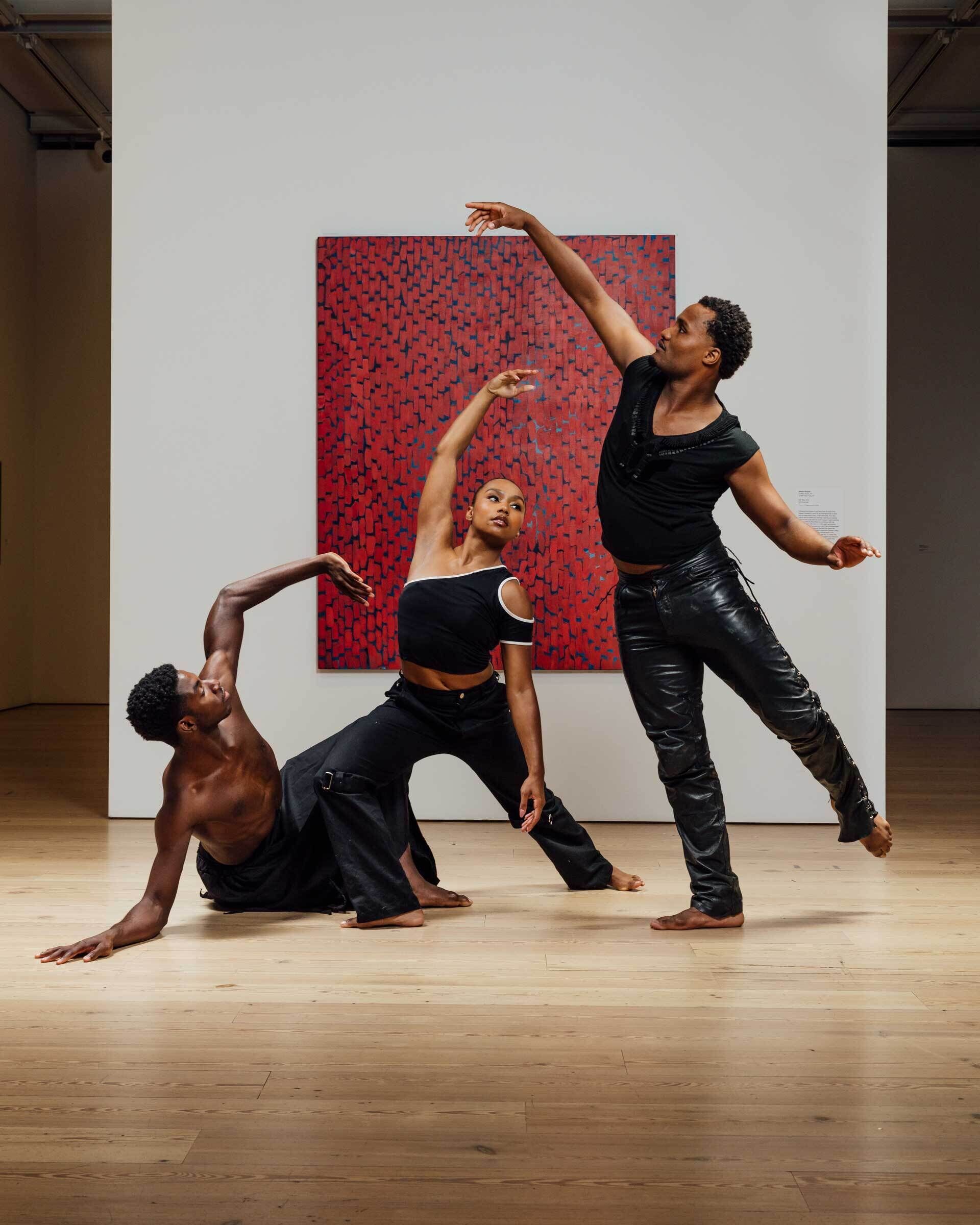
Edges of Ailey
2024
-
500
Introduction
Audio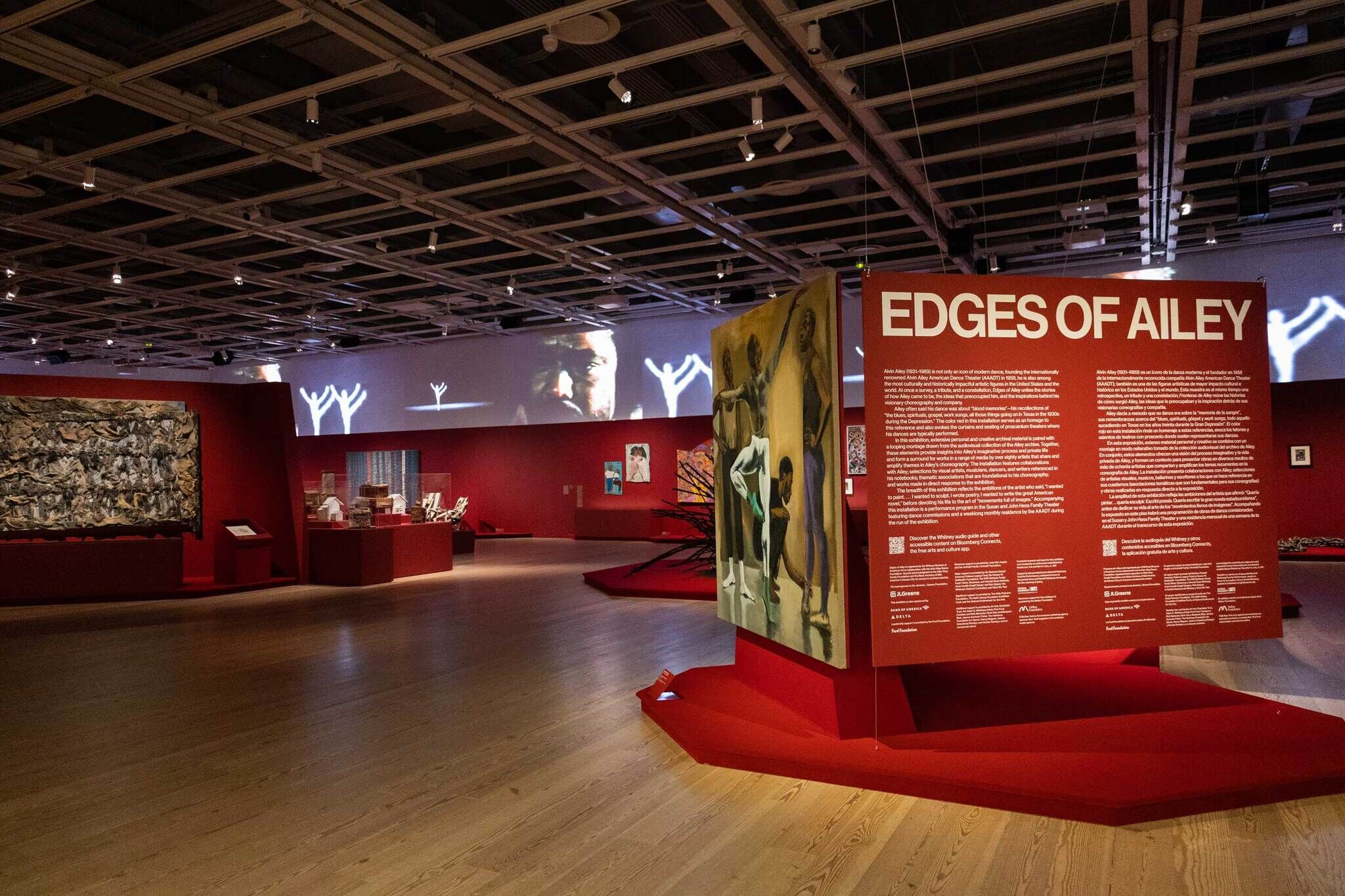
-
501
James Van Der Zee, Dancer, 1925
Verbal description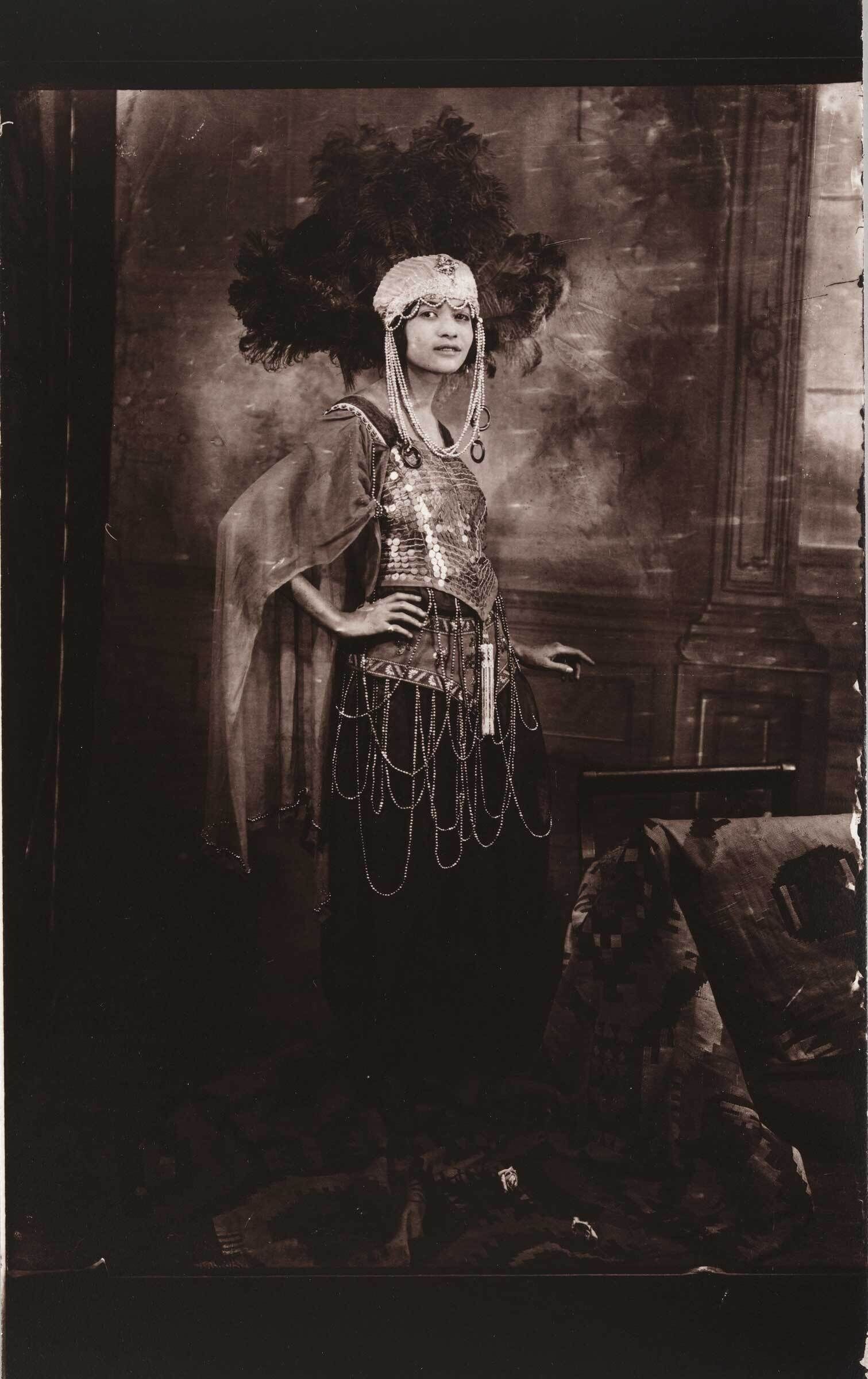
-
502
Kerry James Marshall, Souvenir IV, 1998
Verbal description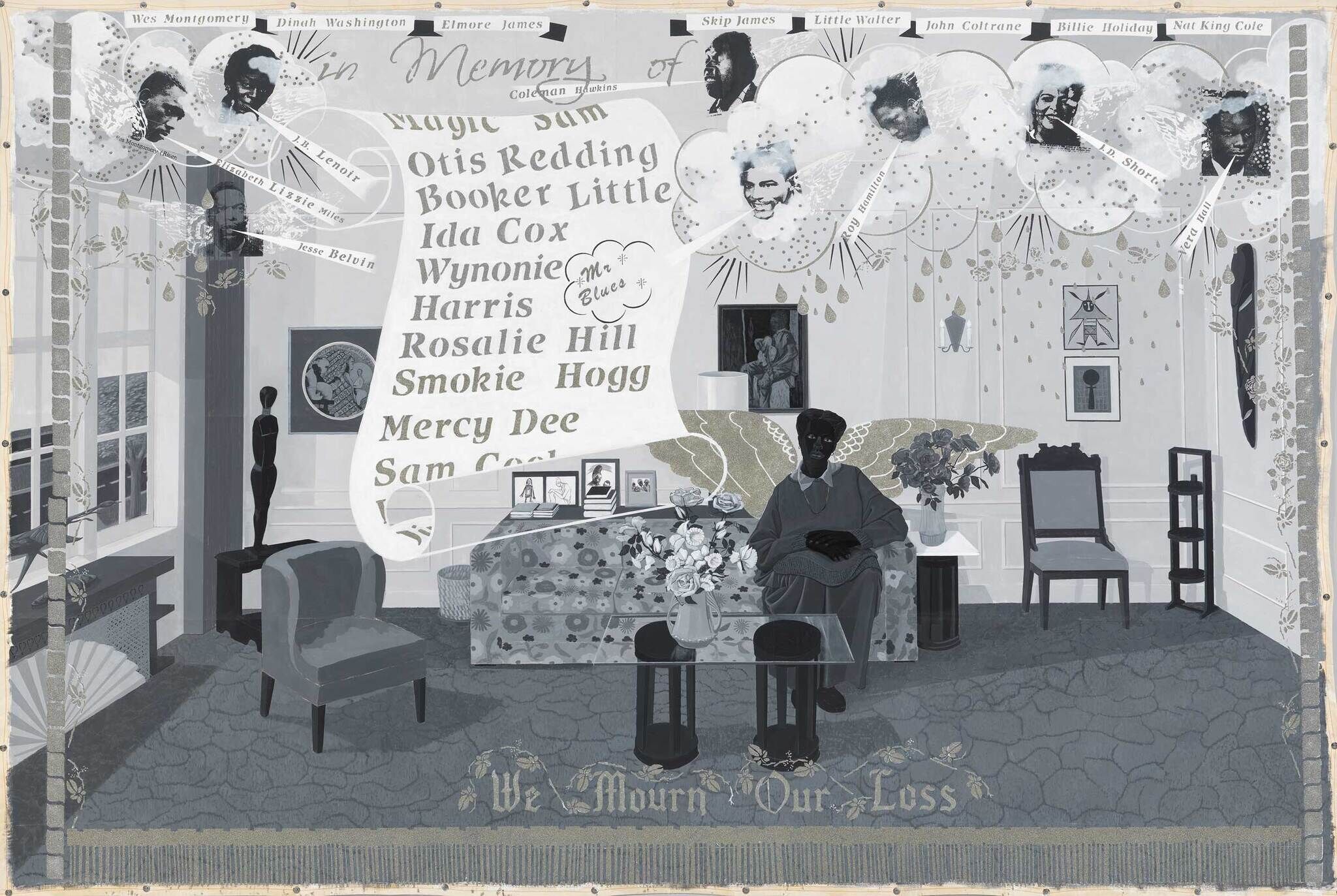
-
503
Archibald John Motley Jr., Gettin' Religion, 1948
Verbal description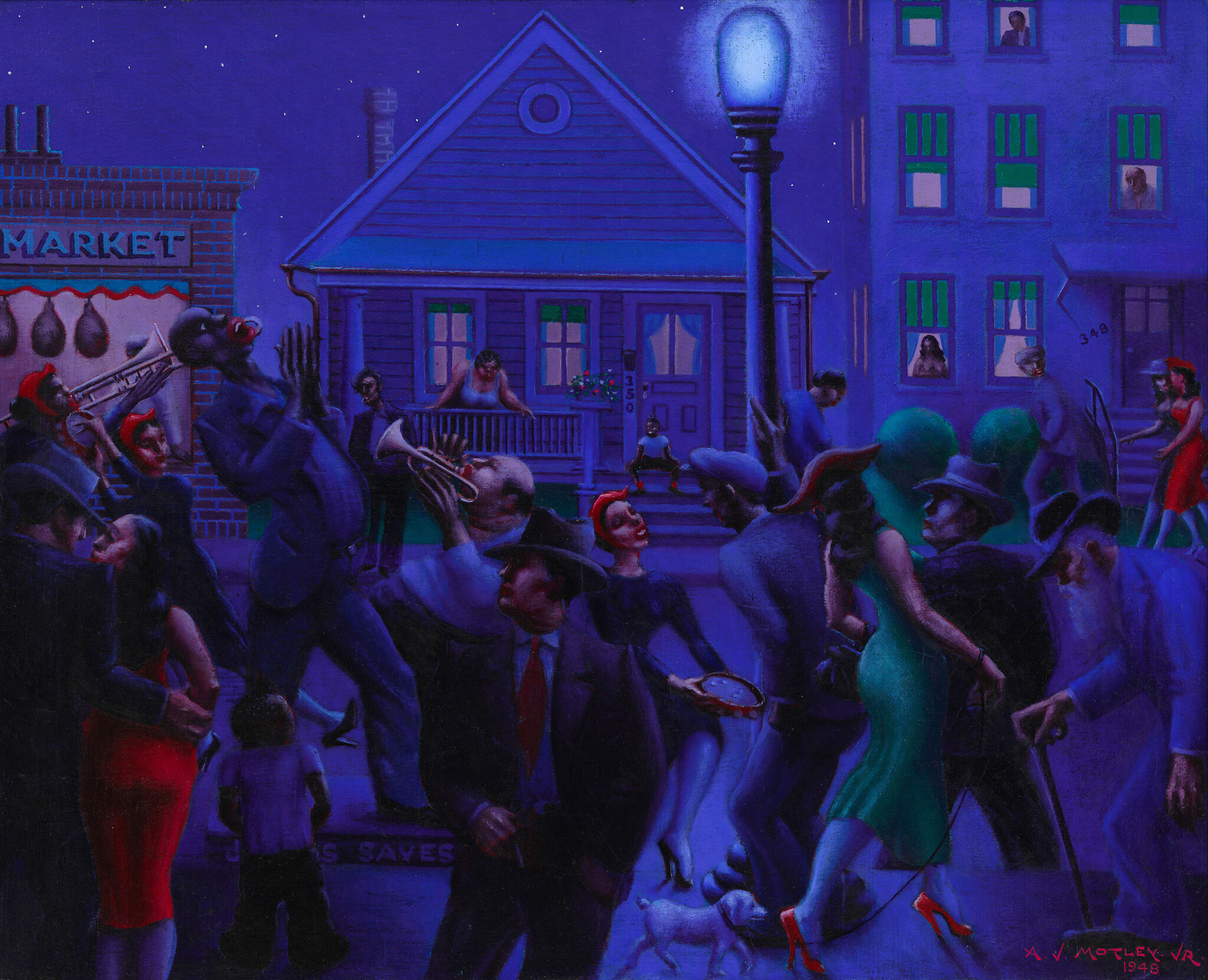
-
504
Anonymous, Alvin Ailey panel of AIDS Memorial quilt, 1987
Verbal description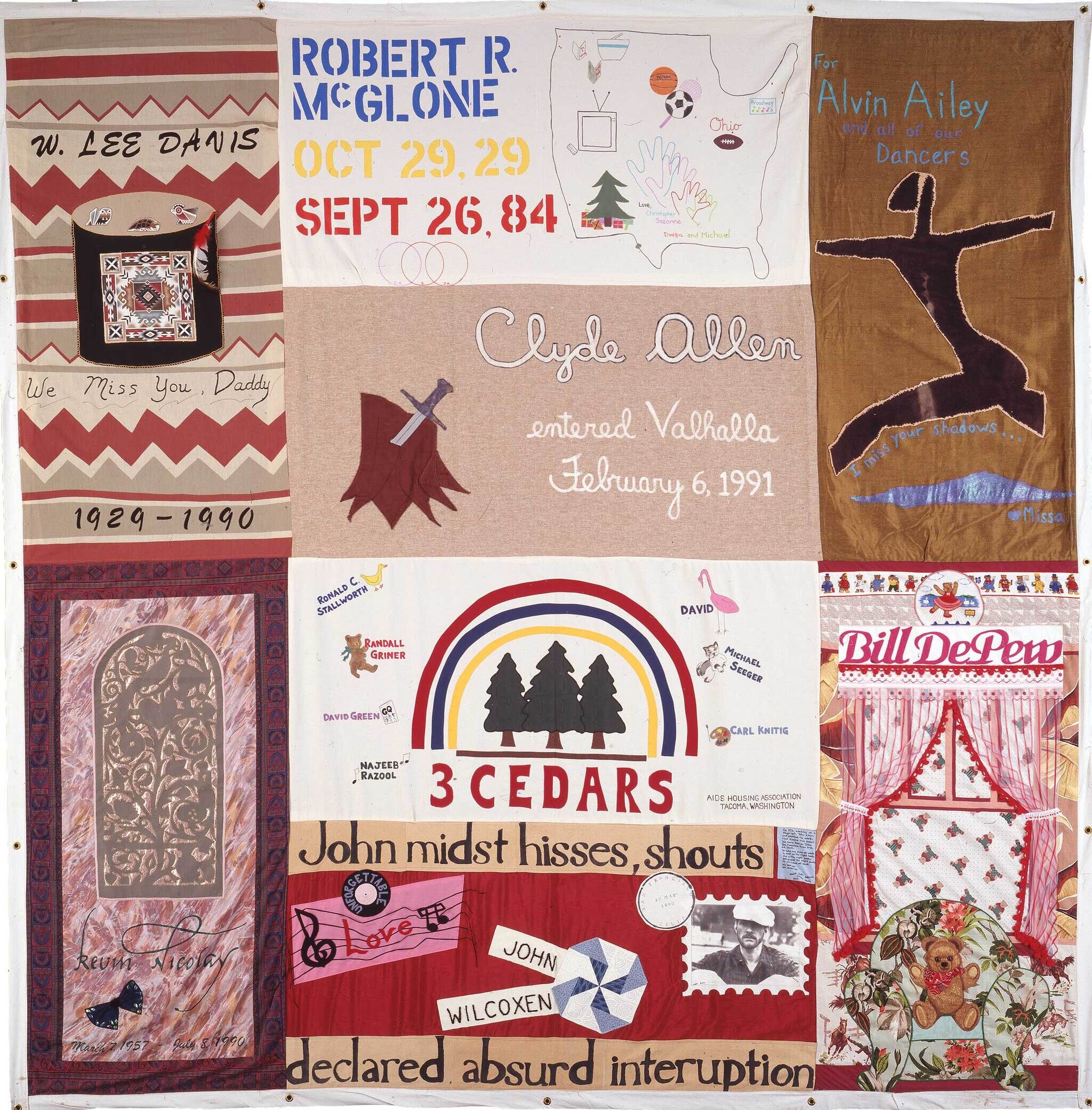
-
505
Kara Walker, African/American, 1998
Verbal description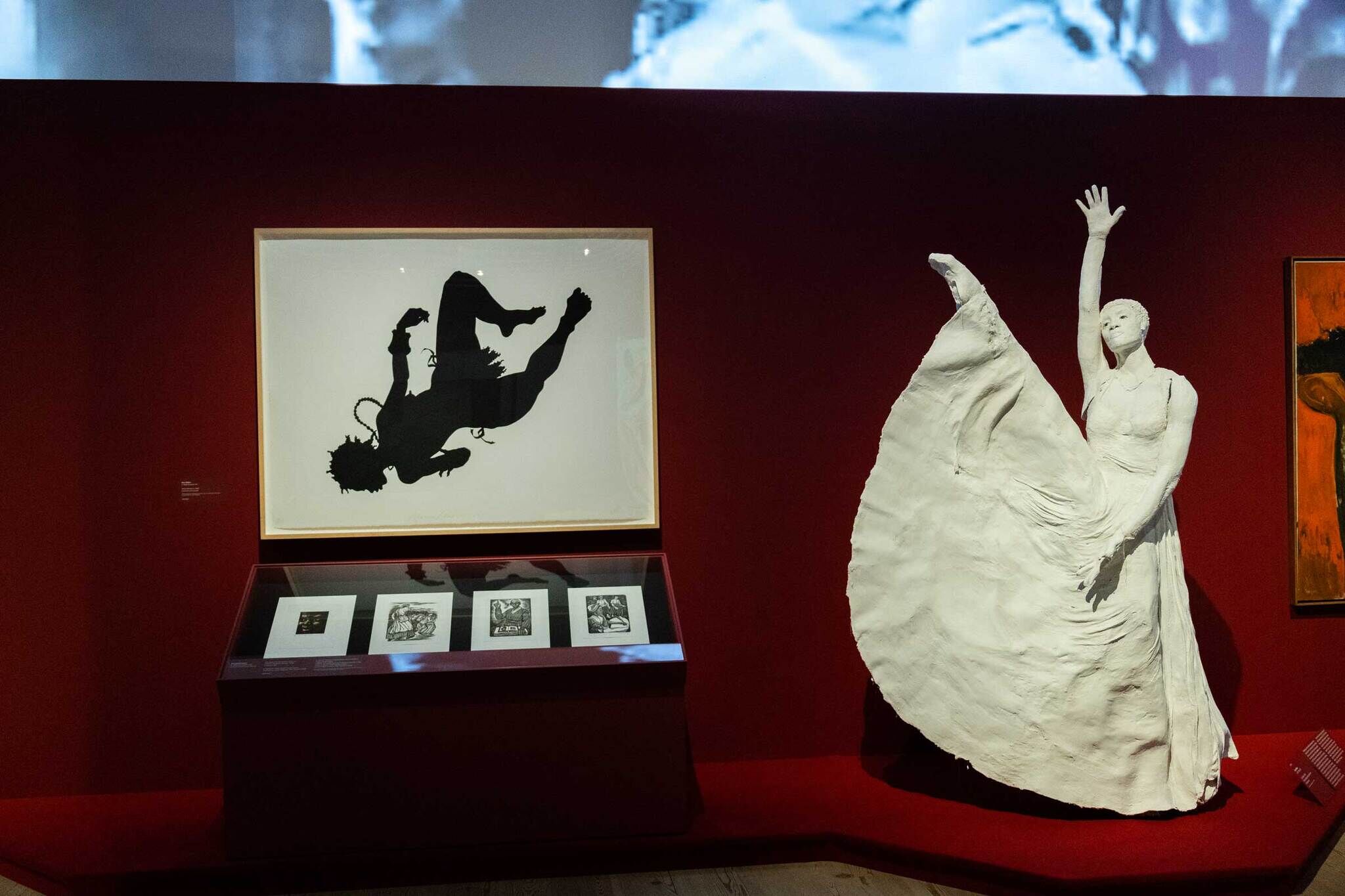
-
506
Elizabeth Catlett, In Sojourner Truth I fought for the rights of women as well as Negroes, 1947, printed 1989
Verbal description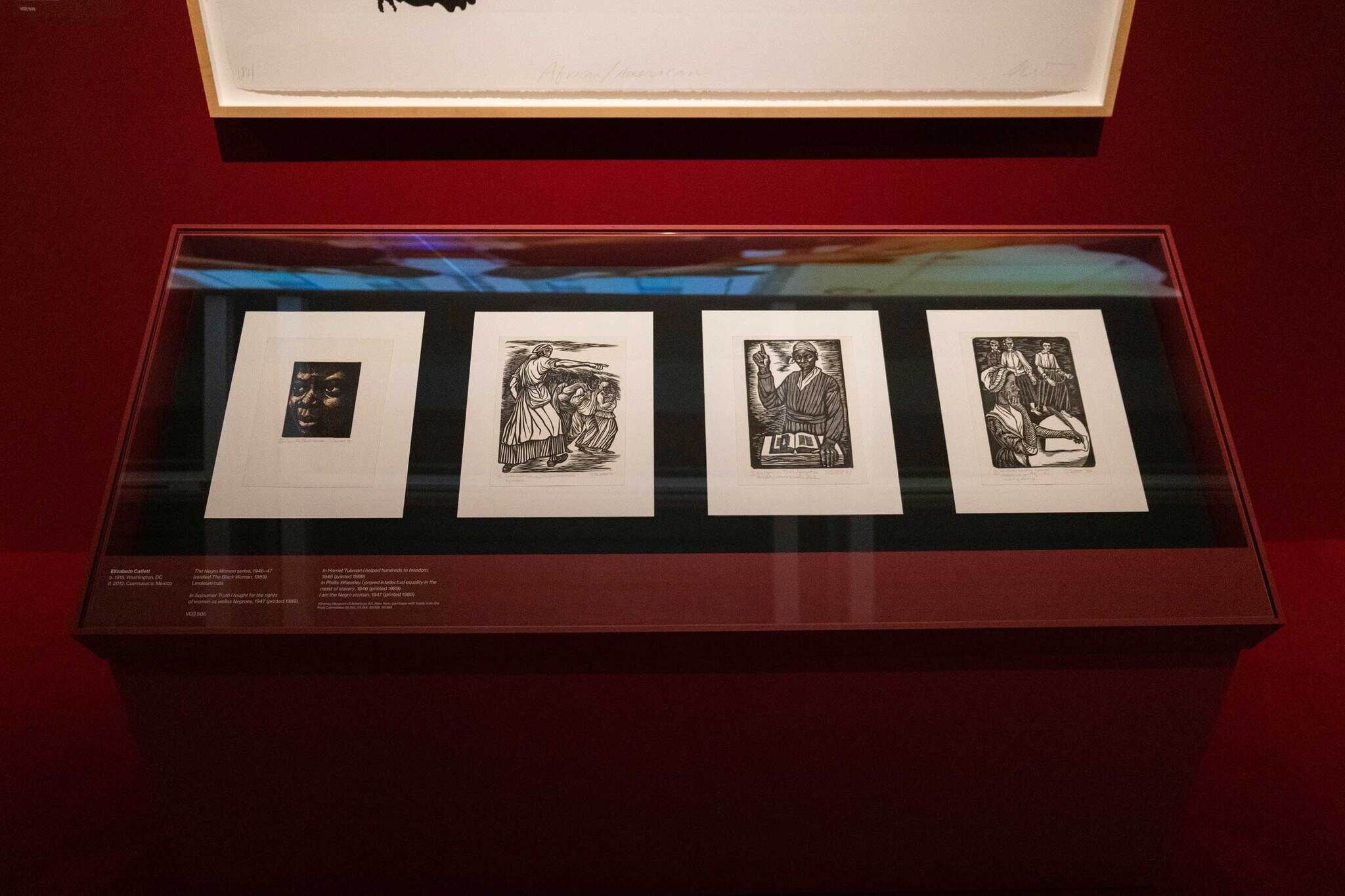
-
507
David Hammons, Untitled, 1992
Verbal description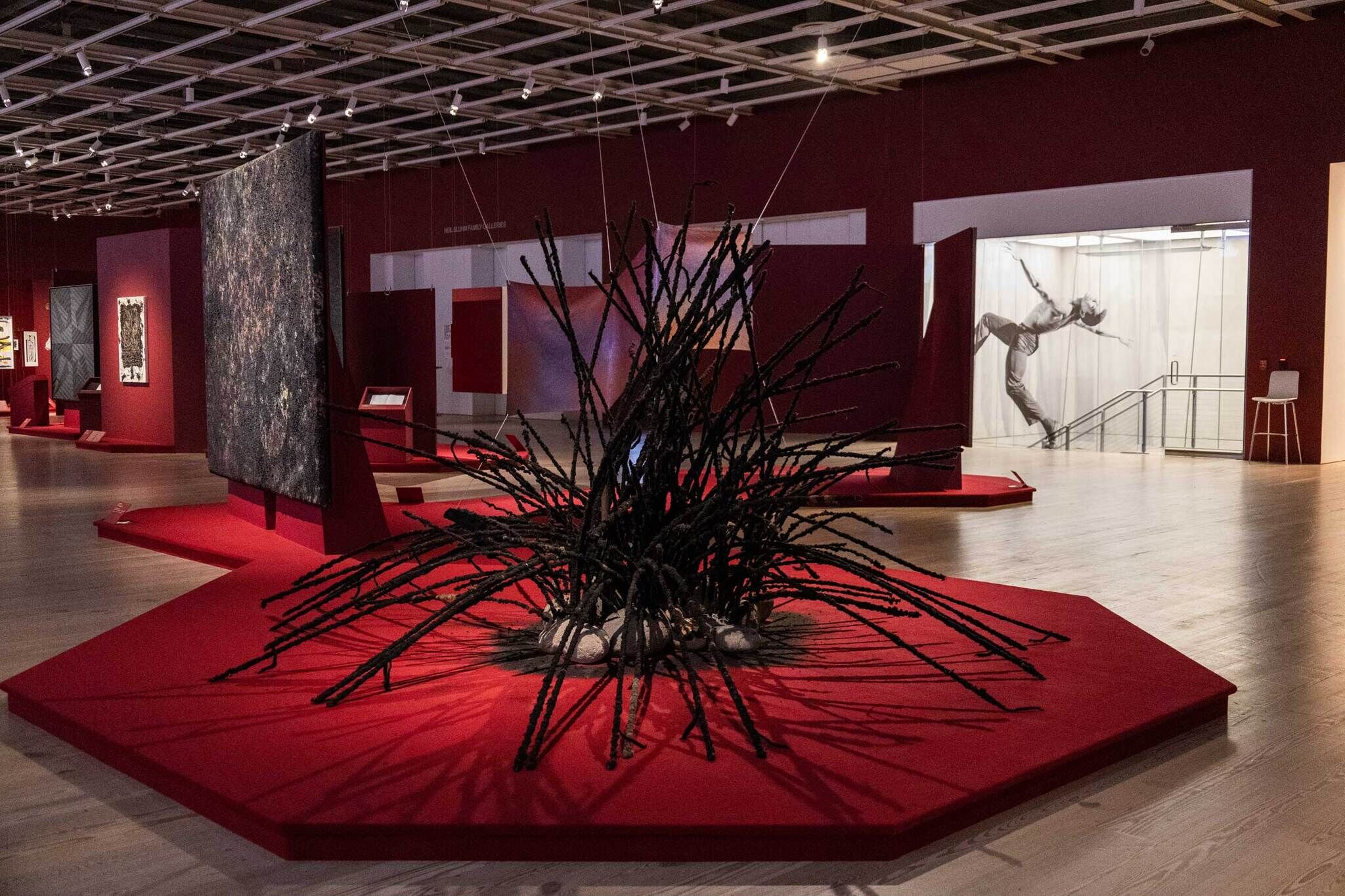
-
508
Ellen Gallagher, Ecstatic Draught of Fishes, 2022
Verbal description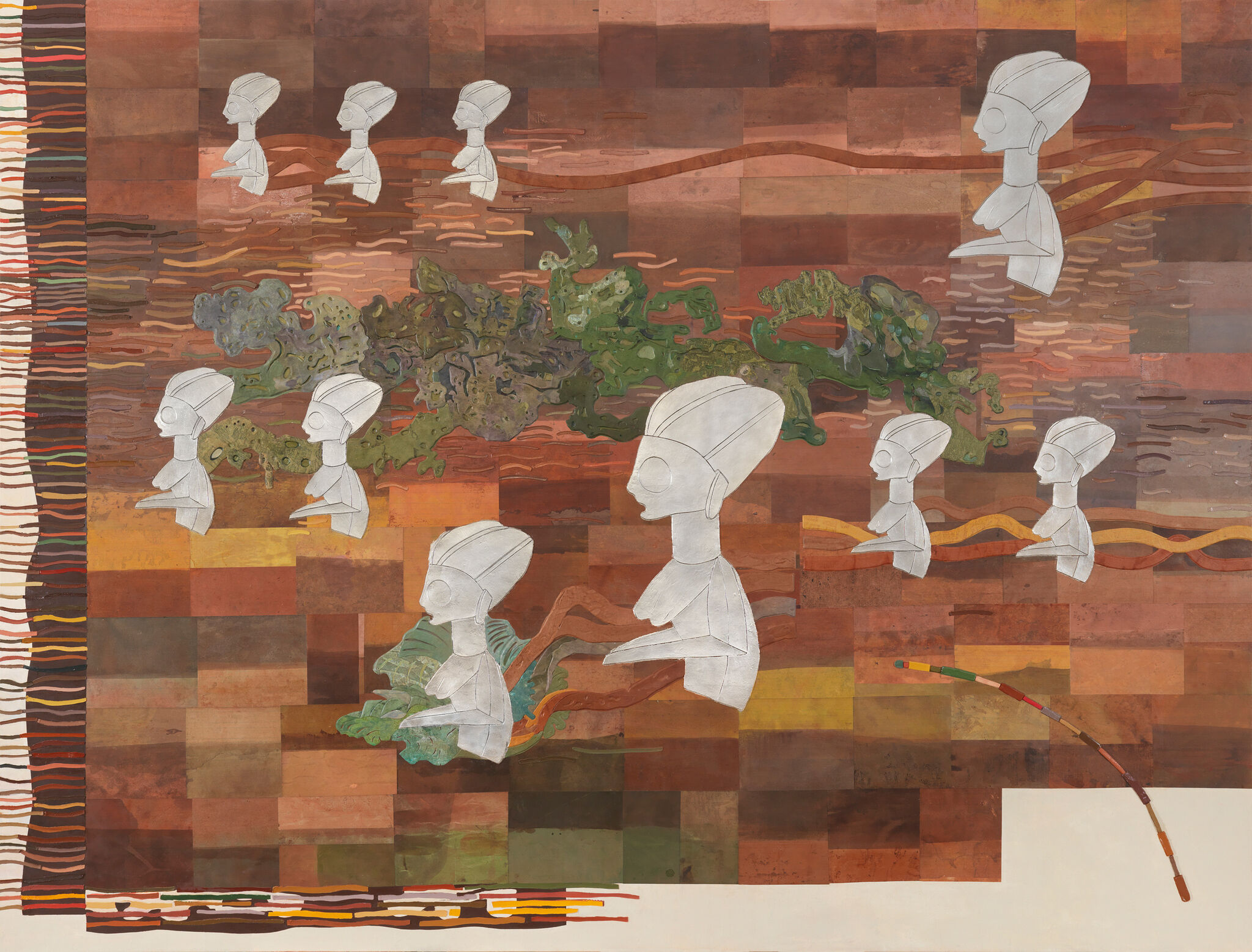
-
509
Jacob Lawrence, Tombstones, 1942
Verbal description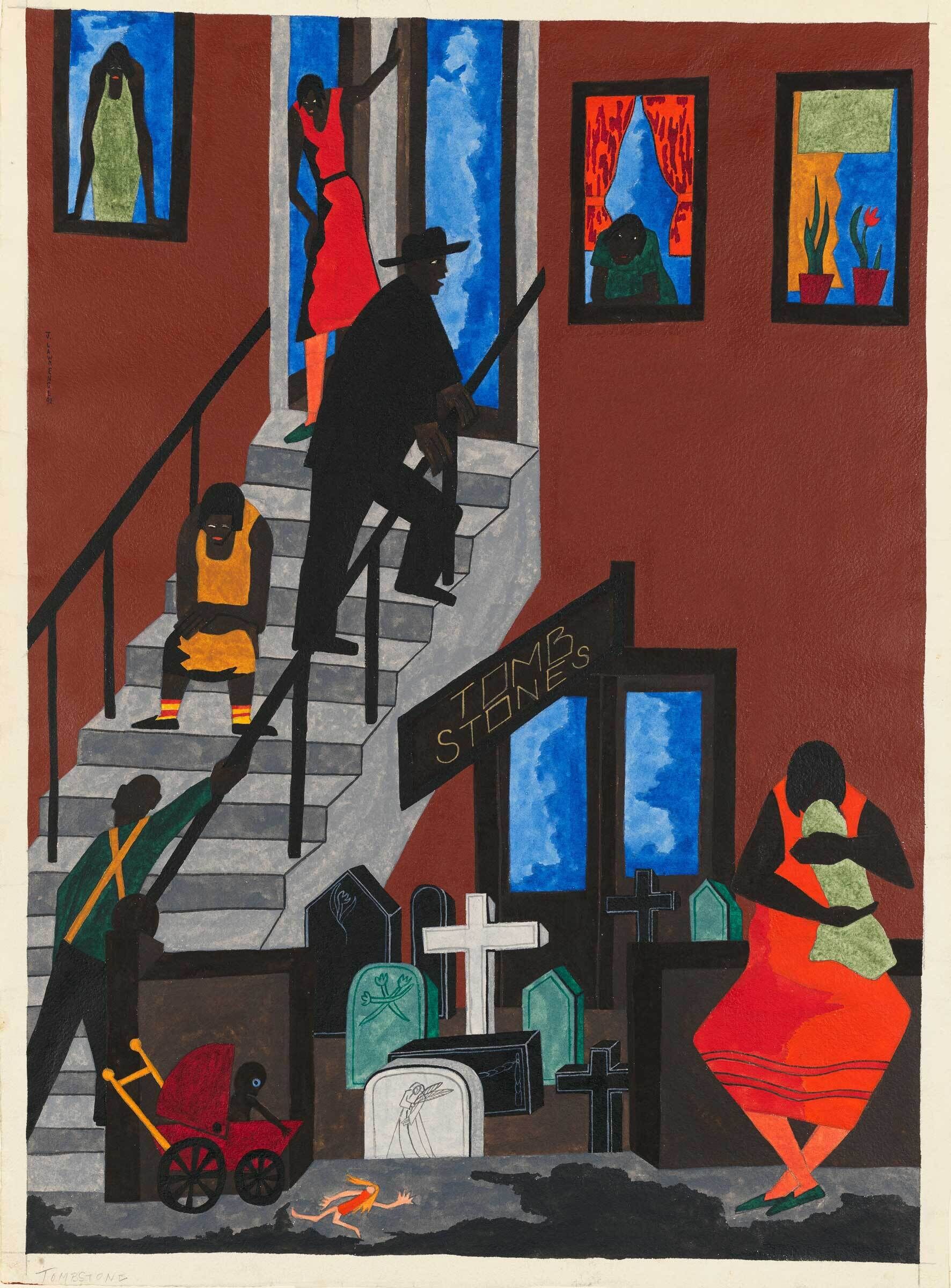
-
510
Palmer Hayden, Spirituals (Dreams), 1935
Verbal description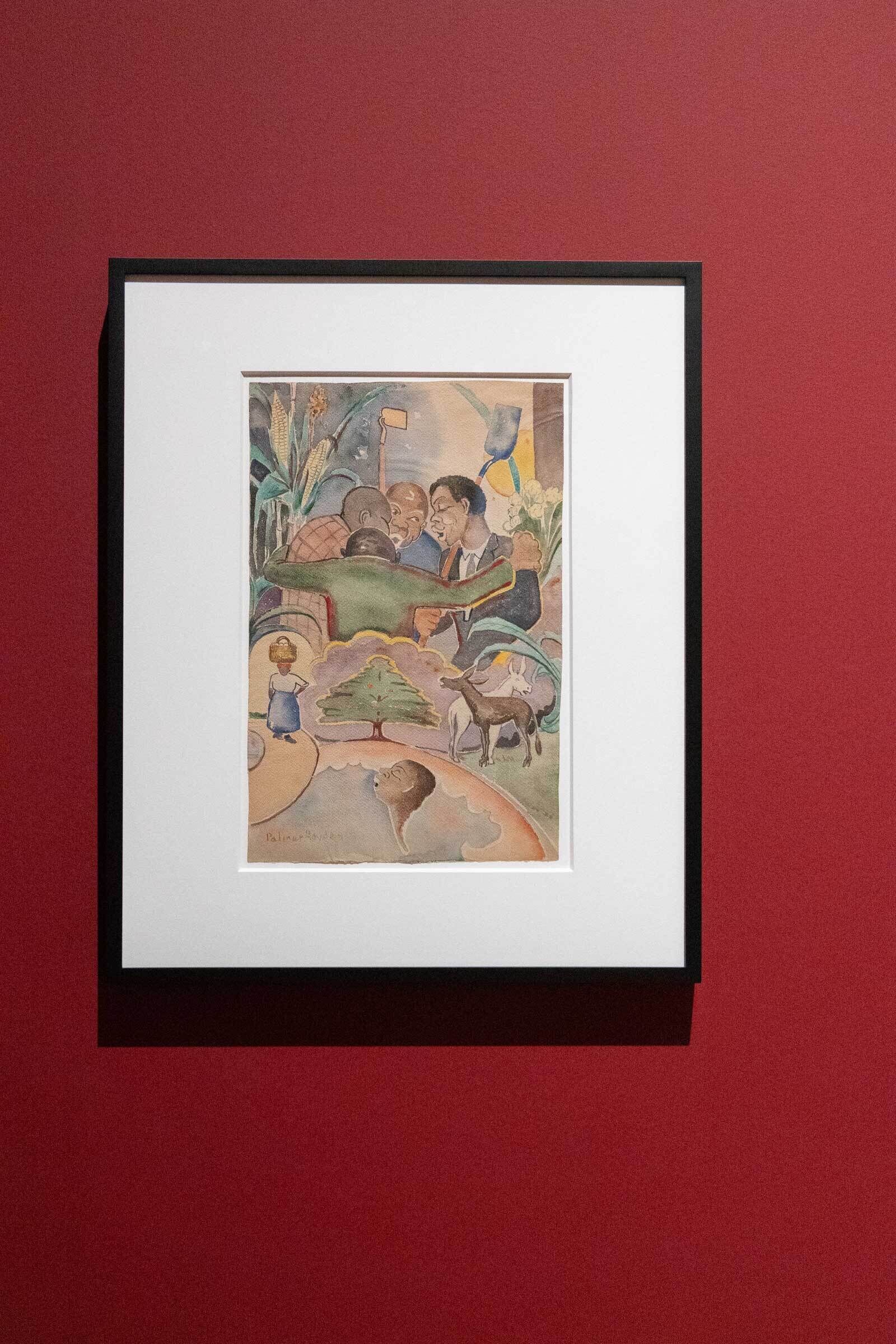
-
511
Edges of Ailey Surround Video
Transcription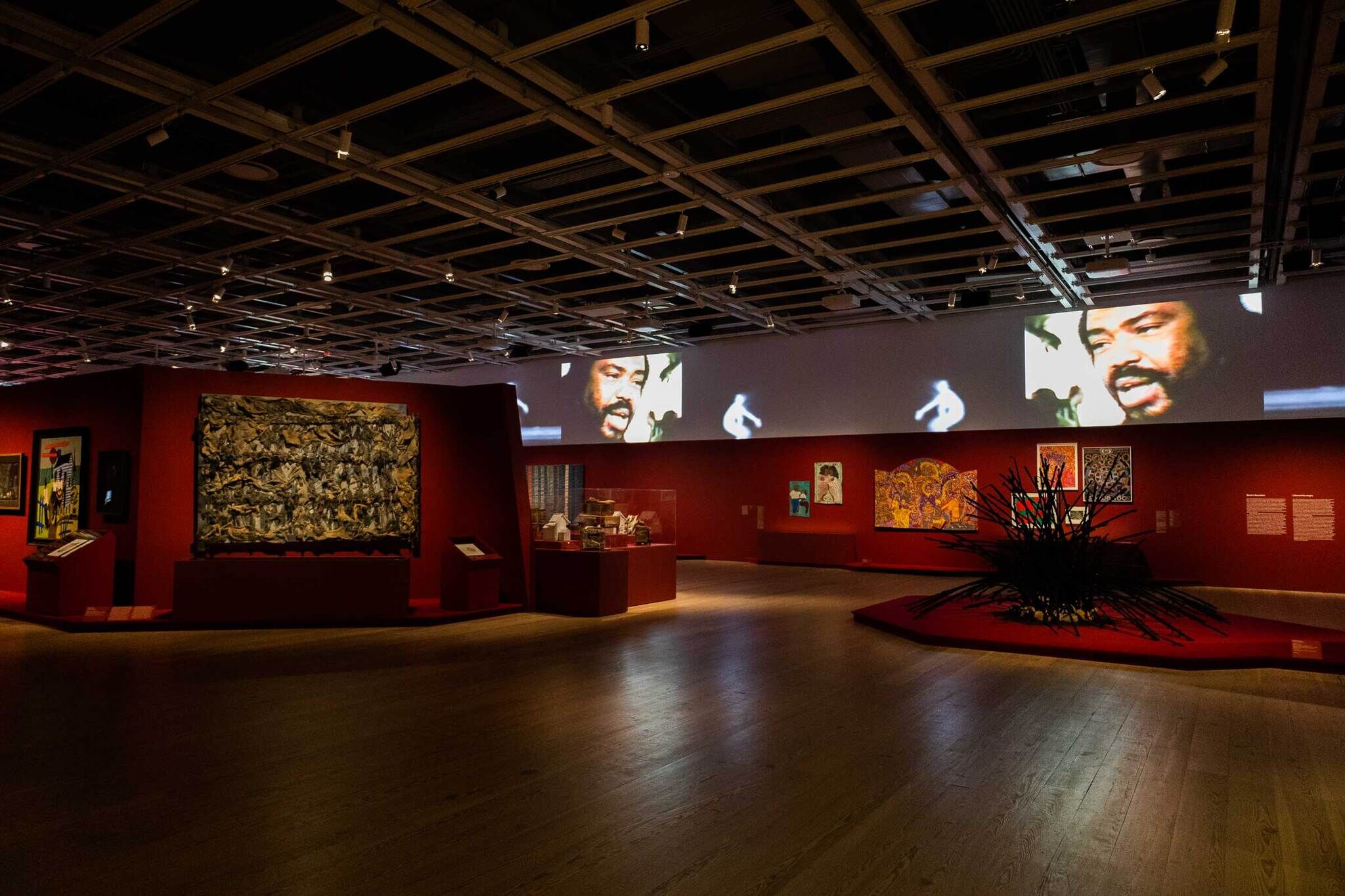
-
520
Minisode: exhibition curator Adrienne Edwards on Edges of Ailey
Audio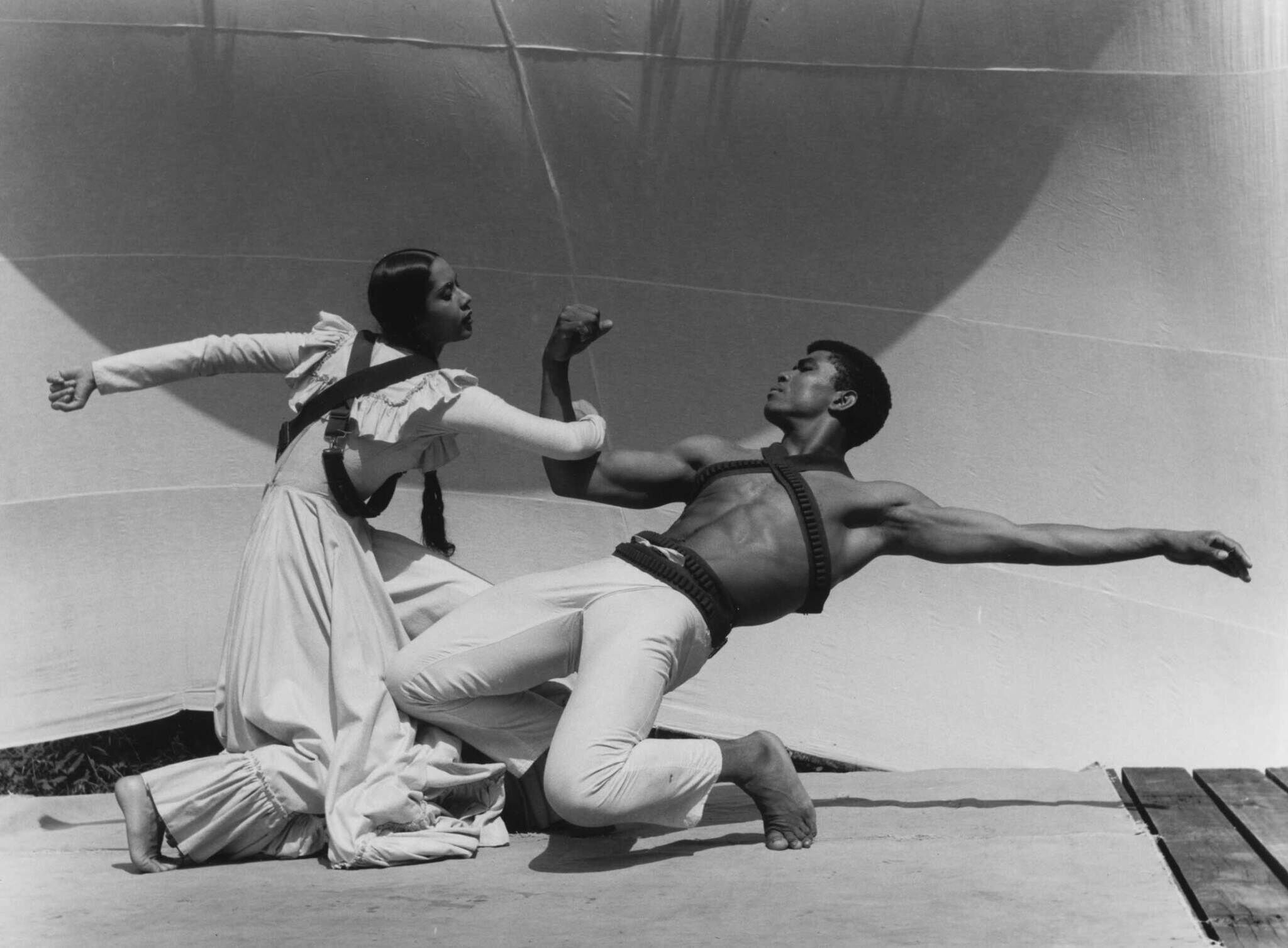
Narrator: Welcome to the exhibition Edges of Ailey. Most of the stops on this tour are verbal descriptions of artworks in the show. These detailed descriptions are primarily for people who are Blind or living with low vision.
To hear from Adrienne Edwards, the curator of the exhibition, go to whitney.org/audio, or find Artists Among Us wherever you listen to podcasts.
Installation view of Edges of Ailey (Whitney Museum of American Art, New York, September 25, 2024-February 9, 2025). Photograph by Audrey Wang
Narrator: Dancer (1925) is a gelatin silver print on a sheet measuring 8 by 5 inches. It was made by American photographer James Van Der Zee, who is most known for his photographs chronicling life in Harlem in the 1920s and 1930s.
This photo is a composed portrait of a light-skinned Black woman standing in an elaborate costume turned three-quarters to the right looking directly at the camera with a slight smile. The costume includes an elaborate dark feather headdress crowned in heavy beading with scallops of beads falling along the forehead, framing the face. Multiple strands of small pearls embellished with larger metal rings hang off the headdress from temple to temple, like the swoop of a necklace. The light catches on a metallic bodice shaping the dancer’s torso. A double tassel hangs from a single point at the navel. Two sets of long loops of dark shiny beads cascade from the bodice and waist belt, overlapping and falling at various lengths between thigh and knee. Both hands are at the waist level, one holds the hip lightly on the side closest to the viewer while the other floats in space with the fingers held horizontal in a delicate shape typical for an early twentieth century pose. Under the cascading beads is a long dark skirt or wide pantaloons.
The time of day is unclear and the lighting is most likely artificial for the purposes of capturing the desired exposure. The dancer is illuminated, creating a magnetic draw to the center of the image. The edges of the photograph are less exposed giving the background a darker shadowy appearance. In the foreground, a heavy blanket or carpet with woven geometric patterns is draped over a piece of furniture. The background looks like a detailed backdrop of decorative wood molding like a parlor, ballroom, or study.
James Van Der Zee, Dancer, 1925. Gelatin silver print: sheet, 8 × 5 in. (20.3 × 12.7 cm); image, 6 3/4 × 4 15/16 in. (17.1 × 12.5 cm). Whitney Museum of American Art, New York; gift of an anonymous donor 2001.38. © Estate of James Van Der Zee
Narrator: The title of this work is Souvenir IV, with IV written in roman numerals. It was painted in 1998, and is an acrylic grayscale painting that includes screen printed and glitter elements. It is very large, measuring almost nine feet tall and nearly 12 feet wide. It is displayed on a red supportive structure towards the center of the gallery.
In the center of the image, a singular Black figure with long silver wings sits in a middle class living room on a sofa against the back wall. This person is painted with similar features to the range of sitters depicted in other works by Marshall: very dark skin, full lips and noses, with serious eyes that stare back at the viewer. A large scroll unfurls from the top of the work filling the space where another figure might sit on the opposite side of the sofa. The following names of African-American Blues musicians are listed: Magic Sam, Otis Redding, Booker Little, Ida Cox, Wynonie, Harris, Rosalie Hill, Smokie Hogg, Mercy Dee, Sam Cooke.
A dream-like overlay of rolling clouds forms a border on the top edge of the work. Screen-printed portraits of African-American blues musicians are dispersed throughout the cloud mass suggesting that they are looking down from heaven. From each of their mouths, white beams taper open to hold more names: Jesse Belvin, Elizabeth Lizzie Miles, J.B. Lenoir, Coleman Hawkins, Mr Blues, Roy Hamilton, J.D. Short, Vera Hall. Along the top, cursive lettering reads ‘In Memory of.’ Silver stylized dots, water rain drops, and stenciled roses decorate the area around the clouds. A long line of fringe is printed at the bottom along with decorative borders on the side in the same silver.
Within the living room from left to right, there is a double paned window with sunlight casting a glow throughout the room. A credenza sits under the windowsill followed by a sculpture of a simple human figure that would be several feet in scale. In the center of the room before the sculpture there is a plush chair facing a glass coffee table with a vase of arranged flowers. The flowers both stand apart from and echo the floral upholstery of the sofa which is directly behind. Art work and portraits decorate the walls between sconces and molding. Before the coffee table at the bottom of the image are the words “We Mourn Our Loss” in highly decorative serif font.
The central Black angel figure sits on the right edge of the couch corner with hands clasped in her lap over the pleats of a gray dress. Her head is tilted slightly to the side with an enigmatic gaze which could range from contemplative to sorrowful.
Kerry James Marshall, Souvenir IV, 1998. Acrylic, glitter, and screenprint on paper on tarpaulin, with metal grommets, 107 5/8 × 157 1/2 in. (273.4 × 400.1 cm). Whitney Museum of American Art, New York; purchase, with funds from the Painting and Sculpture Committee 98.56. © Kerry James Marshall; courtesy Jack Shainman Gallery, New York
Narrator: Gettin’ Religion, made in 1948, is a horizontal oil painting on linen. The painting is displayed in the Black Music section of the exhibit. It is a little over 2 feet tall and 3 feet wide. This night scene shows a lively cluster of people with different skin tones moving around a sidewalk. Some are playing music or strolling by while others watch from windows and a porch on the far side of the road. Some of the people can be identified as Black but not all. In the background from left to right there is a brick building labeled market, a house and an apartment building running from one edge of the painting to the other. The entire painting is bathed in a deep blue color, matching the rich blue of the night sky shown above the tops of the buildings, which is punctuated by tiny stars.
Just right of the center, a prominent street light reaches the top border of the painting and casts a bluish white glow onto the contours of bodies, faces, and the surfaces of the street and buildings. While there are no street signs that make this immediately evident, the painting is set in Bronzeville, Chicago. Motley was one of the first Black artists to attend the School of the Art Institute of Chicago. A patch of grass, a flower planter, and two round hedges give a neighborhood feeling to the scene. The people’s gender, ages, roles, and time period are strongly suggested by their clothing: men wear hats and suits, women wear knee length dresses with steep heels and children wear t-shirts and plain bottoms. The features of the people in the background are undefined yet expressive.
A central focal point of the foreground scene is a tall Black man, so tall as to be out of scale with the rest of the figures, who has exaggerated features including unnaturally red lips, and stands on a pedestal that reads “Jesus Saves.” This caricature draws on the racist stereotype of the minstrel, and Motley gave no straightforward reason for its inclusion. The artist’s ancestry included Black, Indigenous, and European heritage, and he grappled with his racial identity throughout his life. He may have chosen to portray the stereotype to skewer assumptions about urban Black life and communities, by creating a contrast with the varied, more realistic, figures surrounding the preacher. To his right on the platform there is a short, stout, light-skinned man playing a trumpet. Behind him at the left edge of the painting are two women wearing red hats and long sleeved dresses playing trombone and tambourine. Another woman dressed the same presents a tambourine with coins smiling at a man who leans against the street light.
In the foreground from left to right, the majority of the crowd moves along the sidewalk across the street from the buildings; a man stands with his arm around a woman, a child watches alone, a man with a red tie stands contrapposto with a cigarette in his hand. A woman in a singular green dress walks her small white dog. Another man creates a formal repetition with the man holding a cigarette as their profiles both face left. At the right edge of the painting an older man with a long white beard enters the frame walking with a cane.
Archibald John Motley, Jr., Gettin’ Religion, 1948. Oil on linen, 32 × 39 7/16 in. (81.3 × 100.2 cm). Whitney Museum of American Art, New York; purchase Josephine N. Hopper Bequest, by exchange 2016.15. © Valerie Gerrard Browne
Narrator: Alvin Ailey panel of AIDS Memorial quilt, which is dated from 1987, is a square mixed-media textile work consisting of eight distinct panels measuring 12 feet square. The panels consist of layers of different fabric and a variety of text ranging from cursive, stencil, handwritten, and other stylized lettering marking dates, names, locations and personal sentiments. This work is one of approximately 50,000 quilt panels that makes up the AIDS memorial quilt. The AIDS memorial quilt is one of the largest community folk art projects in the world, and commemorates the lives of those lost to HIV and AIDS. The quilt panel is displayed in front of red curtains, between two glass vitrines.
The left top corner panel has a background of horizontal beige cream, red stripes, and zig zags. The name W. Lee Davis sits in the center of the panel above a black cylindrical shape, like a table or drum, hand sewn on with yellow blanket stitch, decorated with patterns resembling those of some Indigenous North American traditions. On top of the cylinder there are three stylized animals: an owl, a turtle and a rooster. A feather hangs off the side. Below the cylinder are the handwritten words “we miss you daddy” and the dates 1929 to 1990.
The top center panel is white with blue, yellow and red stencil lettering reading ‘Robert R McGlone October 29th 29 September 26th 84’. An open outline of the Eastern United States is marked with playful symbols: a bowl, two books, a television, a Christmas tree, four outlines of hands with names, a basketball, soccer ball, tennis racket, a football with Ohio written in cursive and a broadway musical ticket.
The top right panel has a bronze background with a black figure of a dancer whose partial limbs stretch open horizontally. The words ‘for Alvin Ailey and all of our dancers I miss your shadows… Missa’ curve between the dancer and an iridescent light blue shadow. Alvin Ailey passed away from an AIDS-related illness, at the age of fifty-eight on December 1, 1989.
The final panel in the right bottom corner depicts an open window with open sheer pink curtains. The top border is decorated with a horizontal line of bears in different vocational costumes. A single bear in a dancing costume is encircled at the top center over the name Bill DePue in fuchsia. A bear pattern fills the open window meeting an armchair with vibrant pink flowers and green leaves. On the upholstery, a single bear sits in the chair with a red neck scarf.
Anonymous, AIDS Memorial Quilt with Alvin Ailey panel, 1987. Mixed media, 144 x 144 in. (365.76 x 365.76 cm). National AIDS Memorial. Edges of Ailey is part of the National AIDS Memorial’s efforts to bring the Quilt to communities across the United States to raise greater awareness and education about HIV/AIDS and to remember those lost to the pandemic
Narrator: African/American, from 1998, is a black and white horizontal linoleum cut on paper measuring just under 4 feet tall by 5 feet. The linoleum that the print was made from is about 3 feet by 3 and a half so that the solid black image is insulated by a thick border of unmarked paper.
A single black human silhouette resembling a paper cut-out, which is characteristic of Walker’s works on paper, is suspended in the center. The figure appears to be falling on a diagonal with the head in the left bottom corner and feet toward the top right corner. Beads around the neck hang in an arc showing that they are lighter than the rest of the person’s body as gravity takes effect and pulls everything toward the bottom of the frame. Tufts of kinky hair protrude from the edges of the figure’s head as their face is turned so that their profile faces the bottom of the image. The top arm reaches toward the top of the image with a large bangle and fingers slightly curled. In the gap between arm and ribs, a prominent nipple projects from the curve of a single breast. The right arm is bent at the elbow, palm facing forward with three fingers visible against the continuous black of the silhouette. Waist ties spring away from the body curling like ribbon or another light woven material. The organic edges of a skirt fills the gap between thighs mirroring the hair on the figure's head. The left leg is rotated open revealing the side of the foot with the knee pointed towards the top of the image the right leg is extended but slightly bent showing the top of the opposite foot. The absence of light, shadow, landmarks or additional objects creates a bright void without temporal context beyond the suggested indigeneity of the person’s adornment.
Cut-paper art has been emblematic of Walker’s work since she first started using it in the 1990s. The art form was first made popular in nineteenth century portraiture, but Walker uses it as a way of addressing race, gender, and power. Walker describes this seminude figure as "your essentialist-token slave maiden in midair." The black and white colors of the work contrast with the red wall it is hung on. A video of the Alvin Ailey Dance Company performing is projected in the wall space above the work.
Installation view of Edges of Ailey (Whitney Museum of American Art, New York, September 25, 2024-February 9, 2025). Kara Walker, African/American, 1998. Photography by Audrey Wang.
Narrator: This work by Elizabeth Catlett is a vertical linoleum cut print on paper depicting nineteenth century formerly enslaved African-American abolitionist and activist Sojourner Truth at the center. It is titled In Sojourner Truth I fought for the rights of women as well as Negroes. The sheet of paper is a little over 10 inches by 7 inches, while the image is set about an inch in.
Truth commands the frame with a resolute expression. She faces the viewer with her right hand raised, elbow bent, finger pointing upward to the sky, almost arriving at the edge of the composition. Her left palm is planted firmly down on a podium with her fingers holding the front edge. Her hands define a diagonal tension in the composition like the graphic figures found on playing cards. Wood grain runs across the sides of the podium under her fingers while the top is completely white. A Bible lies open with a bookmark resting flat on the page. A stark white cross decorates the surface of the black bookmark. Two dense columns of solid lines suggest text on each page. The edges of the print are filled with a solid black border. The background is composed of short dense horizontal lines which reveal the direction cut into the linoleum to make the print. As they run toward the center of the image to frame Truth’s body, the lines end, creating a halo of white negative space around Truth’s body, as if a light was illuminating her from behind.
Truth’s head is wrapped in white cloth with a tied edge poking out from behind her head, seen on the side of her face. She looks straight ahead with lips slightly pursed. The horizontal lines that define Truth’s skin are closer together, swaying in more organic shapes which showcase the linoleum cut style. Gaps emerge at her forehead and cheeks suggesting light catching her bone structure. A white scarf winds around her neck to meet in a V-shape tucked into her dress. The dress is made of vertical lines that look like stripes or pleats that pass under a thick waistband. The vertical lines of her dress contrast strongly with the horizontal lines of the background, pulling Truth’s silhouette into the foreground. The title, artist signature, and date are written in graphite below the print along with the edition which is 14/20. This work is the sixth in a series of fifteen linoleum cuts made by Catlett to celebrate Black women’s labor. It is displayed in a row of four prints from this series.
Installation view of Edges of Ailey (Whitney Museum of American Art, New York, September 25, 2024-February 9, 2025). From left to right: Elizabeth Catlett, I am the Negro woman, 1947; Elizabeth Catlett, In Harriet Tubman I helped hundreds to freedom, 1946; Elizabeth Catlett, In Sojourner Truth I fought for the rights of women as well as Negroes, 1947; Elizabeth Catlett, In Phillis Wheatley I proved intellectual equality in the midst of slavery, 1946. Photograph by Audrey Wang
Narrator: Untitled, from 1992, is an abstract mixed media artwork of variable dimensions made with human hair, wire, metallic mylar, sledge hammer, plastic beads, string, metal food tin, panty hose, leather, tea bags, and feathers. Here the work appears to be around 3 or 4 feet around.
At first glance, this work looks like the results of a small explosion or rapid growth out of the floor. A cluster of irregular spheres of different shapes and sizes look like river stones or ostrich eggs sitting in fine black dust like ash or soot on the gallery floor. The tops of the spheres are pierced with copper wire forming the root of many spiky offshoots which reach toward the sky or droop in an arc toward the floor, like a firework. Each wire is wrapped in black human hair with gray and brown variations in color that soften the appearance of the wire offshoots. Most of the wire that is visible is at the bottom where they first emerge; however, there are some bare sections between clumps of hair toward the ends of the offshoots. Small clumps of hair sprawl in the ashy circle around the rocks on the floor as if they have gradually fallen off.
This sculpture is viewable from 360° as it sits on a low red plinth so the quality of the shadows is dependent upon the angle of the viewer. At the center of the work is a sledgehammer, a tool used for demolition. This item is not apparent from every angle but is nestled in the center. The work has a strong sense of movement, growth, or expansion as well as a rooted quality. Hammons' work often uses detritus coded as being representative of urban Black life, such as hair gathered from barbershop floors. The blend of organic and industrial materials gives an ambiguous feeling between animated and inert.
Installation view of Edges of Ailey (Whitney Museum of American Art, New York, September 25, 2024-February 9, 2025). David Hammons, Untitled, 1992. Photograph by Audrey Wang.
Narrator: Ecstatic Draught of Fishes, created in 2022, is a horizontal mixed media painting with oil, pigment, wax, palladium leaf and paper on canvas. The work measures about 7 and a half feet tall by just under 10 feet. Identical abstract sculptures of different sizes are seen from the side, suspended among waving lines like cords or strands and an organic green mass. All of these elements are raised from the canvas against a flat backdrop of earth-toned rectangles like an aerial map.
The figures evoke West African sculptural traditions while also suggesting futuristic materials and technologies. The figures’ gray metallic color is like stone or light metal. The variation in their color softens their appearance. Each figure has two smooth crests of hair, wide open orbits where eyes would be, and a gently sloping profile without strongly defined facial features. An ear or earring descends from the hairline, resting on the back edge of the cylindrical neck. Breasts jut forward over bent armlike shapes that bend together where hands would clasp. The figures are all shown in the same orientation, facing left, and cut off at the waist. Most are tethered to clay colored cords that waft across the topography of the work toward the right edge.
Horizontal multi-colored strands dance on the left border of the painting suggesting the movement of a current in water or wind. From top to bottom the strands cross from the off-white left edge of the painting over the wavering border of a dark brown column. Here they meet the edge of the rectangles which form the majority of the background. While many of the strands stop abruptly at this point, some trade their brighter colors for muted hues to permeate the background a quarter of the way down and meet the green mass that crosses the middle of the work horizontally.
This multicolored organic cluster of green resembles both small-scale organisms such as moss and lichens or a large ecosystem such as a swamp or canopy system. Gallagher’s work uses these oceanographic forms to highlight the significance of water in the slave trade, and to interrogate relationships between slavery, colonialism, and belief systems. This work is displayed on a red supportive structure towards the left side of the gallery, along other works in the Black Migration section of the exhibit.
Ellen Gallagher, Ecstatic Draught of Fishes, 2022. Oil, pigment, wax, palladium leaf and paper on canvas, 89 3/4 × 118 1/8 in. (228 × 300 cm). Whitney Museum of American Art, New York; gift of The George Economou Collection 2023.74. ©️ Ellen Gallagher
Narrator: Tombstones, from 1942, is a vertical opaque watercolor painting on paper showing a street scene with nine Black people who have the same dark skin tone at various points along a diagonal staircase in front of a building. It is just over 22 inches tall and 30 inches wide. It is hung on a red wall, which faces diagonally towards the windows on the left side of the gallery. There is a stylized representation of depth that gives the background a solid, flat appearance while the variation of angles in the foreground moves the eye around the composition. The people have minimal features yet expressive postures and perches within the composition.
The muted earthy red building facade contrasts with the bright color of the windows and people’s clothing. A young boy in suspenders holds the railing at the bottom of the stairs. In the middle of the staircase, a woman sits in an orange dress, hands folded over her lap looking sullen. To the right, just above, a man in a black suit and black hat leans on the railing with both hands appearing to converse with a woman leaning out of the window in a dark green dress between red drapes. To her right is another window where two wavy plants appear; one which dons a single red flower.
At the top of the staircase, a woman stands in the doorway in a red dress, orange stockings and green shoes leaning with one arm against the door frame and the other hand on her hip. A jagged black shadow or pattern snakes down the left side of her dress. To her left is another window where a woman in a light green dress leans with both of her hands on the sill. Both women appear to look down toward the bottom of the staircase. In all of the windows and doors the background is blue with white masses like clouds creating the impression that the building could be full of sky.
New life and death reckon with each other at the forefront of the painting. On the footpath in front of the building which is at the bottom of the image, a very young child in a red stroller reaches forward for a white doll which has fallen on the ground. On the low wall, a second woman in a red dress, orange stockings, and green shoes holds a baby swaddled in green cloth to her face. Just inside of the low wall between the street and the building, there are ten tombstones, like a small cemetery. They range in color including black, white, and green and vary in shape including pointed tops, rounded shoulders, crosses, or rectangles. Some feature engravings of flowers or figures. Behind the tombstones is a double door under a sign protruding from the building with thin white hand-lettering that reads “TOMBSTONES” in capital letters.
Jacob Lawrence, Tombstones 1942. Opaque watercolor on paper, 30 7/8 × 22 13/16 in. (78.4 × 57.9 cm). Whitney Museum of American Art, New York; purchase 43.14. © 2024 The Jacob and Gwendolyn Lawrence Foundation, Seattle / Artists Rights Society (ARS), New York
Narrator: Spirituals (Dreams), from 1935 is a vertical watercolor painting with graphite pencil on paper. The image measures almost a foot and a half tall by just over half a foot wide. It is hung on a red wall, on the left side of the gallery.
This work is a dream-like composite of scenes. Vignettes are seamlessly woven together meeting soft edges created by the variation in the saturation which is characteristic of water color. Four Black men seen from the waist up embrace in a warm huddle in the center of the image, their mouths open in a round shape suggesting that they are singing. From top left to right there is a dark bluish gray sky that transforms into pale yellow sunlight from a golden sun. Corn stalks frame the image on the top with white flowers blooming below the sun. From top to bottom, each scene comes further into the foreground. Below the sky, the group of men’s bodies form a tight circle. One holds a hoe while another holds a shovel. Their jackets are charcoal, navy, rust with brown cross hatching, and green. Of the four men you can see the faces of two, one is looking joyously toward the other, whose eyes are peacefully closed. You see the back of the man in the green jacket, arms outstretched holding the group together with yellow and red accents along the sleeves and collar. A trail curves around the side of the left edge of the painting. A woman with a basket on her head wearing a red head wrap, a white shirt, and a blue ankle length skirt walks down the path hand on hip. To her right, a conical tree with red fruits sits inside of a purple cloud with yellow scalloped edges. In the foreground on the far right, two donkeys facing away from each other but positioned side by side, one brown and one white, appear to bray or sing. Both the lone woman and the donkeys appear under long slender leaves springing from the edges of the composition. At the bottom in the center is the head of a fifth man who appears to sing, eyes closed. His neck tapers down to a point as if he is a spirit, ghost, or memory emerging from a pale multicolored portal under a sloping hill that the conical tree stands on. At the bottom left is Palmer Hayden's faded signature in brown.
Installation view of Edges of Ailey (Whitney Museum of American Art, New York, September 25, 2024-February 9, 2025). Palmer Hayden, Spirituals (Dreams), c. 1935. Photograph by Audrey Wang
Edges of Ailey Surround Video
Mobile captioning is available.
Edges of Ailey video surround created by Josh Begley and Kya Lou with Adrienne Edwards. Music licensing, clearance, and research by Reality Club; archival production by Rebecca Kent; archival clearance assistance by Alessandra Bellizia.
Installation view of Edges of Ailey (Whitney Museum of American Art, New York, September 25, 2024-February 9, 2025). Edges of Ailey Video Surround, created by Josh Begley and Kya Lou with Adrienne Edwards. Music licensing, clearance, and research by Reality Club; archival production by Rebecca Kent; archival clearance assistance by Alessandra Bellizia, 2024. Photograph by Audrey Wang.
Narrator:
Welcome to Artists Among Us Minisodes from the Whitney Museum of American Art, Alvin Ailey edition. We will be exploring the new Edges of Ailey exhibition or, as curator Adrienne Edwards calls it, “extravaganza,” dedicated to the life, dances, and enduring legacy of the artist and choreographer Alvin Ailey. The exhibition will be on view at the Whitney from September 25–February 9.
Through an immersive eighteen-screen video installation, illuminating archival materials, an ambitious performance program, and wide-ranging artworks by eighty-two visual artists, the exhibition explores a titan of modern dance whose impact reverberates across media and time, and whose beloved company, Alvin Ailey American Dance Theater, remains a global cultural force to this day.
In this minisode, Edwards takes us through her impetus and vision for the show and some of the discoveries she made along the way.
Adrienne Edwards:
Well, the show really came out of a kind of long-standing sort of trajectory in recent years. There have been so many museums that have done exhibitions about dance. And it occurred to me on multiple occasions, why not Alvin Ailey? There couldn't be a, I think, more international brand in terms of contemporary dance. And so I was really sort of asking that question of our field and also of our institutions.
Alvin Ailey was born in Rogers, Texas in 1931, and dies from AIDS-related complications in 1989. He is among the most important cultural figures, not only in the United States, but abroad. And he had a vision for dance that was incredibly modern, incredibly rigorous, incredibly imaginative, and it was about freedom, it was about love, and it was about excellence.
Ailey comes to New York in 1954, and like so many dancers did at the time, really made his living doing Broadway shows, and then uses these resources to gather a group of dancers to present his very first work that would become known as part of the Ailey Company in 1958 called Blues Suite. It's interesting because I've been going to see Ailey for so long, I feel like I'm actually hardwired with Ailey in a way that I can't actually remember the very first performance that I saw. So it was something I was very familiar with, and I actually thought maybe I was even too close to Ailey to get enough of a sort of perspective on how to think rigorously and critically about the work and who he was. But that all changed once I got into the archive.
Ailey was a copious keeper of journals and diaries, and they include everything from to-do lists to character studies for roles in his dances. What we found that was really surprising is his own short story writing, his own poetry. He also wrote things like “No Leg Warmers,” wonderful notes to his lovers reflecting on their positive and negative qualities. And then you would find just almost things that seemed very positive, like he was reassuring himself. One said, “We teach people to feel, to own their own feelings.” So we could see him unfold as a creative person. And it was just an incredible discovery for me as a curator and a scholar to have access to that.
The other thing is that we found almost 200 videos made during his lifetime alone. And then the question became, how do we present this to audiences? And there are many different approaches, but Mr. Ailey was always about spectacle, loved theatricality, knew that we didn't have the right to bore people just because we might have talent or knowledge. So in putting the show together, we've kept really close to Mr. Ailey and the things that he believed in. And he said, you know, I wanted to be a painter. I wanted to be a sculptor. I wanted to write the great American novel. I wanted to be a poet. And that, to summarize, dance somehow could hold all of those things for him.
I've been working with two wonderful filmmakers, Josh Begley and Kaya Liu to basically create a montage across eighteen screens in the gallery that will take you through a kind of arc and evolution of his life by focusing very specifically on key dances and the historical, political, and social context and cultural context that is occurring while he is making them.
And then there are eighty-two other artists in addition to Mr. Ailey who are in the show, some represented by multiple works. The earliest is from 1851 and the most recent are made especially on the occasion of the exhibition, so have been made this year. The ideas in Mr. Ailey's dances—which these artists share although they realize them in different ways—traverse the Black body in dance. Like, what is Blackness in dance? So many artists have made works representing this. But also a kind of Southern imaginary, the South for Ailey and those who preceded him was not only about the Southern United States, but was also very much about what is a Black diaspora. The Caribbean, South America, in particular Brazil for Ailey, but also the western coast of Africa.
So it's almost like a kind of circum-Atlantic history in a way. Southern imaginary also looks at Black spirituality, which is, of course, about a kind of Southern Baptist church or a kind of evangelism within the Black tradition. But it is also equally about Haitian voodoo. It is about Brazilian Candomblé. It is about the way those practices originate in different cultures on the west coast of Africa. So this idea of spirituality as the sustaining force, as a way of speaking to struggles and challenges and also desires is an incredibly important subject. Then there is this question of movement. And when I say movement, I mean like the movement of a people. So we think about ideas about Black migration, which include the Middle Passage from the West Coast of Africa to the Americas, but also even within the United States, thinking about the Great Migration, not only what were the sets of conditions that led to it, but also the unknown of what life elsewhere would be.
I mean Mr. Ailey himself, who was born in Rogers, Texas in 1931, goes with his mother in the early forties to Los Angeles, leaves Los Angeles, goes to San Francisco for a while, leaves San Francisco and ultimately comes to New York. And so he himself exemplifies this sort of migratory pattern that really became about directing us towards possibilities.
And I feel that that's something that Ailey thought a lot about. And then, of course, the openness of what is possible leads us to then demand our own liberation. And so for Ailey, this idea of freedom and how the body becomes the vehicle through dance in which to express that freedom, practice that freedom, embody that freedom, it's really very important to so many other artists. And that freedom is, you know, about a kind of Black liberation. But that Black liberation is also about a Black queer liberation. It is about the sort of acknowledgment of the complexity of who he was as a person. And so there are all of these ways in which there's a sort of sinew, obvious or not, between Ailey and these various artists in the show.
Everyone has an Ailey story, but I think I was surprised by the extent to which so many contemporary artists not only knew who he was, but really had thought about what he achieved and what he stood for. But artists are fundamentally curious people. And for that reason, much like Ailey himself, their interests are broad and deep and incredibly multilayered. And so I think that what became clear to me is that they really saw him as someone who exemplified excellence. I mean, a lot of the conversations were about, wow, can you imagine what it was like to achieve what he did in his lifetime? Like it's not today, we're talking about 1958 at a time where there was one place in New York City where the dance studios were integrated, where you could go to study at the New Dance Group. That's really quite something to contend with because we think about these aspects of American culture and life and politics as being really relegated to the American South when in fact it was throughout this country. And if you look at Ailey dancing, there's something so visceral and vital about the way that he held a stage. And I think that that kind of like insistence on telling his own story, but making it a kind of universal story, if you will, I think was quite an achievement on his part. And I think it's a big part of his legacy and part of the reason that it continues to be so exemplary.
Narrator:
Artists Among Us Edges of Ailey Minisodes are produced by SandenWolff with the Whitney Museum of American Art: Anne Byrd, Nora Gomez-Strauss, Kyla Mathis-Angress, Emma Quaytman, and Emily Stoller-Patterson.
Carmen de Lavallade and Alvin Ailey at Jacobs Pillow, 1961. Photo by John Lindquist. © Harvard Theatre Collection, Houghton Library, Harvard University
0:00
0:00