Mark Armijo McKnight: Decreation
2024
Mark Armijo McKnight: Hi, I'm Mark Armijo McKnight.
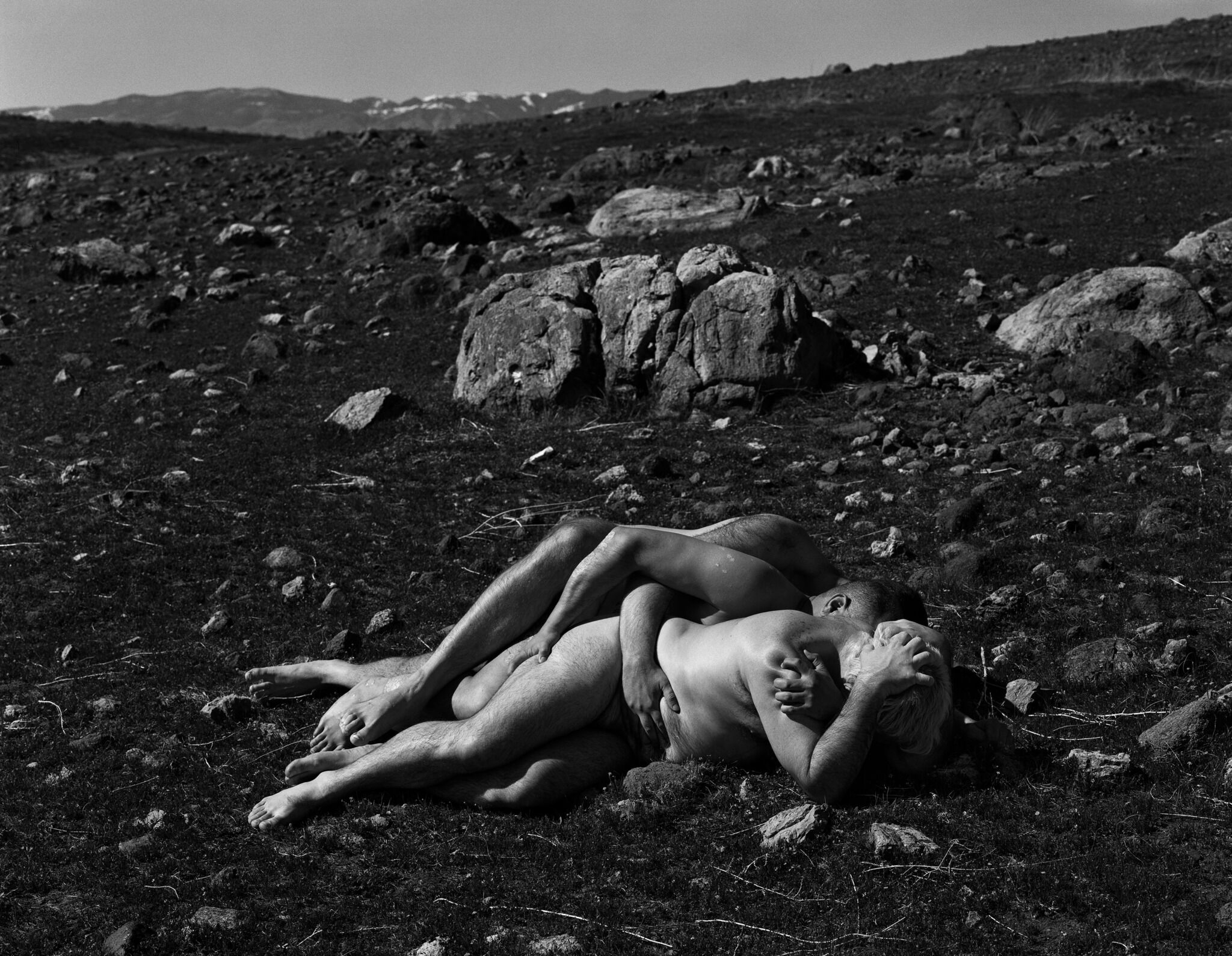
The photograph Somnia is three human subjects all embracing in this landscape. One of them is gripping his hair as if in either agony or ecstasy. I think there is a deliberate implication that they're in the realm of the erotic, but of course we don't actually see that. It speaks to something larger in my practice that I am very interested in, which is depicting especially queer subjects engaged in various forms of intimacy. This picture was made in a landscape that I know well, that I've made many photographs in that is not far from where I grew up.
And I think making pictures in this place and in the landscape generally, is really important to me. The public sphere, growing up as a closeted queer kid in a relatively conservative suburb at the edge of Los Angeles, being who I was didn't feel particularly safe, and it also felt like a thing that one should hide.
I think there's something, for me, that is really redemptive about describing this beauty and also doing it in a classical way in this landscape because it suggests that this sex and this intimacy belong to nature, that they, like so many figures throughout art history mostly describing heterosexual sex, deserve just as much to be a part of the canon.
Narrator: Somnia is a 4 feet high by 5 feet wide photo that pictures three friends of the artist, who are posed nude in a tangle of an embrace, lying horizontally in a rocky desert landscape. Although Armijo McKnight’s sitters are often Latinx, the ethnicities of the men in Somnia are left ambiguous to the viewer. They are portrayed in varying shades of grey: from the deep shadows that outline their limbs, to the rich dark grey and almost-white of their bare skin. They lie in the bottom third of the composition, closest to the viewer. Their faces are each turned downward, hidden, so the texture of their intertwined bodies is the predominant focus. The figure closest to us grips his hair as if in agony or ecstasy, and the sun gleams off the skin of his right shoulder and side. Around his belly and his upper arm, there are hands reaching, holding him tight, making small dark canyons in his muscles. Upon inspection, one limb is coming from the third, farthest back figure, but the tangle of arms and legs works to confuse where one body ends and another begins. The second figure, who is sandwiched in the middle, has darker skin than the first. His arm is adorned with small, lighter skin discolorations, a detail the silver gelatin print depicts in crisp textured clarity. Similarly, the hairs on the third figure’s arms and legs are legible, as are the bare twigs and soft dirt below them.
Mark Armijo McKnight: I think there is deliberately an implication that they're in the realm of the erotic, but of course we don't actually see that. Something that's really important about this photograph also is, it speaks to something larger in my practice that I am very interested in, which is depicting, especially queer subjects, engaged in various forms of intimacy. This picture was made in a landscape that I know well, that I've made many photographs in that is not far from where I grew up.
Narrator: Behind the three men, maybe twenty feet in the distance, a mound of large rocks mimics the figures clasped together. It stands in three round shapes covered in smaller cracks. If the figures depict a kind of queer intimacy, the visual cadence offered by the rocks seems to underscore this intimacy’s place in the natural world.
Mark Armijo McKnight: I think there's something, for me, that is really redemptive about describing this beauty and also doing it in a classical way in this landscape because it suggests that this sex and this intimacy belong to nature, that they, like so many figures throughout art history mostly describing heterosexual sex, deserve just as much to be a part of the canon.
Also, salt and peppered around this landscape are all of these differently sized stones, some of which have clearly fallen off from a much larger stone that looks almost monumental or something. I've photographed in this location so many times that rock always feels monolithic.
Narrator: The smaller stones blanket the dark ground taking up most of the picture around the figures and larger rocks. The earth underneath them stretches back, going on and on. The horizon cuts a sliver out of the top left part of the frame, revealing a clear stretch of sky behind snow-capped mountains.
Mark Armijo McKnight, Somnia, 2023. Gelatin silver print, 48 x 60 in. (121.9 x 152.4 cm). Courtesy the artist. © Mark Armijo McKnight
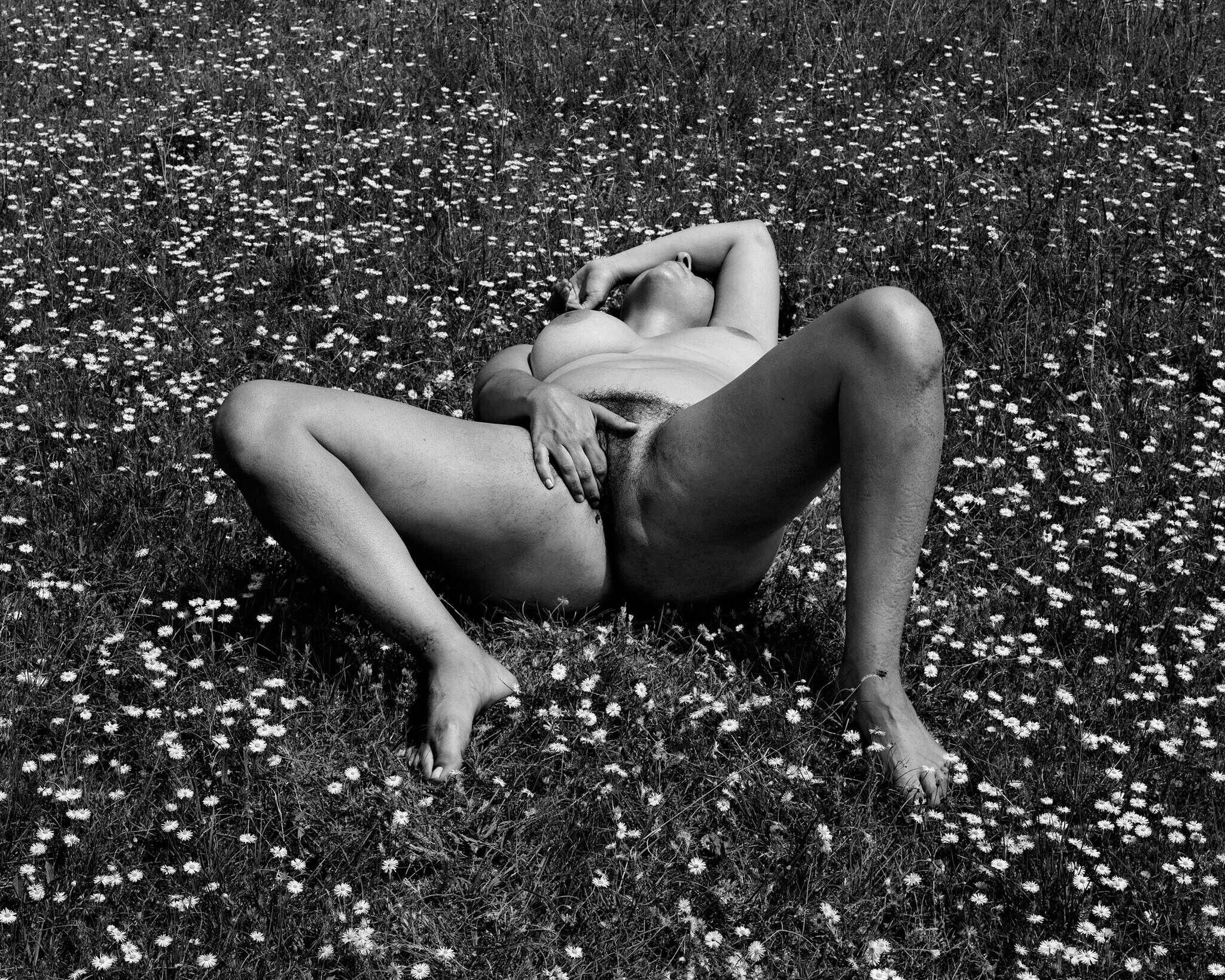
Mark Armijo McKnight: It's a photograph of a friend of mine and she's masturbating in a field with flowers all around her.
The title, Anti-Mater, I think has so much to do with thinking about the way that women have historically been depicted in relation to the natural world. The word mater, M-A-T-E-R, in Latin it means both mother, but it also means matter. This idea of, quote, unquote, Mother Nature, for example. I wanted to make an image and give it a title that refused some of those conventions or played with or prodded this archetype in some way.
I wanted this image of her totally engrossed in self pleasure, that she's public facing but there's nothing really demure about the picture by design, I guess I say that because it could be seen as exhibitionistic, but also it's a photograph that feels like she is totally directed inward. I think typically when we think of a body vertically against dirt, covered in bugs, that evokes for us an image of death more than anything. But I think in the photograph, she's very much alive.. and I wanted her to feel like she was in ecstasy.
I think often people get really stuck on the erotic facets of my work and think that maybe I have a desire to be transgressive, which I don't. I think there's a generation of really important artists who opened so many of those doors, and so I don't feel like there's anything new about picturing sex.
Narrator: This black and white photograph from 2023, entitled Anti-Mater, depicts a naked woman in a field who is a friend of the artist. At 4 feet high and 5 feet wide, the work itself is very large. A visitor could be matched in size by the image that appears on its surface. The figure is sprawled out, lying on her back and masturbating, with her bottom half facing the viewer so her torso and head recede back in space. She has light skin that is contoured by shadows, and she appears to be of light-to-average weight. Her knees are open to each side, creating a kind of symmetrical, centered shape. Her stomach and chest are illuminated by the sun overhead, creating a pool of light against the darker grass that surrounds her. Her head is thrown back, with one arm bent up over her face. The other arm stretches down, her hand partly covering a patch of dark bushy pubic hair.
Mark Armijo McKnight: She's pleasuring herself in a field. I wanted this image of her totally engrossed in self-pleasure. It could be seen as exhibitionistic, but also it's a photograph that feels like she is totally directed inward. She's both in this landscape, but also totally inside herself. I think maybe psychologically and emotionally, but also literally her finger is penetrating herself.
Narrator: Though this erotic scene is rendered head-on, the rich textures throughout are equally dominant. For example: the sloping grey gradient of the woman’s right leg, knee pointed out to the side, heightens the fleshy quality of the figure, including small hairs and colorations on her body since the picture is almost totally in focus. Surrounding her are what seem to be hundreds of small white flowers, whose tone matches the more highly-lit portions of her body. Most of the flowers face the sun. The figure’s pointed knees and raised elbow all create upward pointing triangles that, together with the flowers, seem to gesture skyward, towards the light source. These upward forces may suggest more metaphysical themes as well.
Mark Armijo McKnight: I wanted her to feel like she was in ecstasy.
Narrator: The artist also points out a small but important detail at the center of the work.
Mark Armijo McKnight: Meanwhile, there's all these bugs that are crawling up her body towards the orifice, towards this site of pleasure that maybe also suggest the photograph as an abjection, but maybe her connection to the natural world and also her mortality. I think typically when we think of a body vertically against dirt, covered in bugs, I think that evokes for us an image of death more than anything. But I think in the photograph, she's very much alive.
What I'm interested in is making images of sex that suggest transcendence, something spiritual that connects us simultaneously and maybe paradoxically to ourselves and our interior lives, but also the natural world to which we belong that ultimately becomes a stage and/or vehicle for these kinds of experiences. The title, Anti-Mater, also I think has so much to do with thinking about the way that women have historically been depicted in relation to the natural world. The word mater, M-A-T-E-R, in Latin it means both mother, but it also means matter. This idea of, quote, unquote, Mother Nature, for example. I wanted to make an image and give it a title that refused some of those conventions or played with or prodded this archetype.
Mark Armijo McKnight, Anti-Mater, 2023. Gelatin silver print, 48 x 60 in. (121.9 x 152.4 cm). Courtesy the artist. © Mark Armijo McKnight
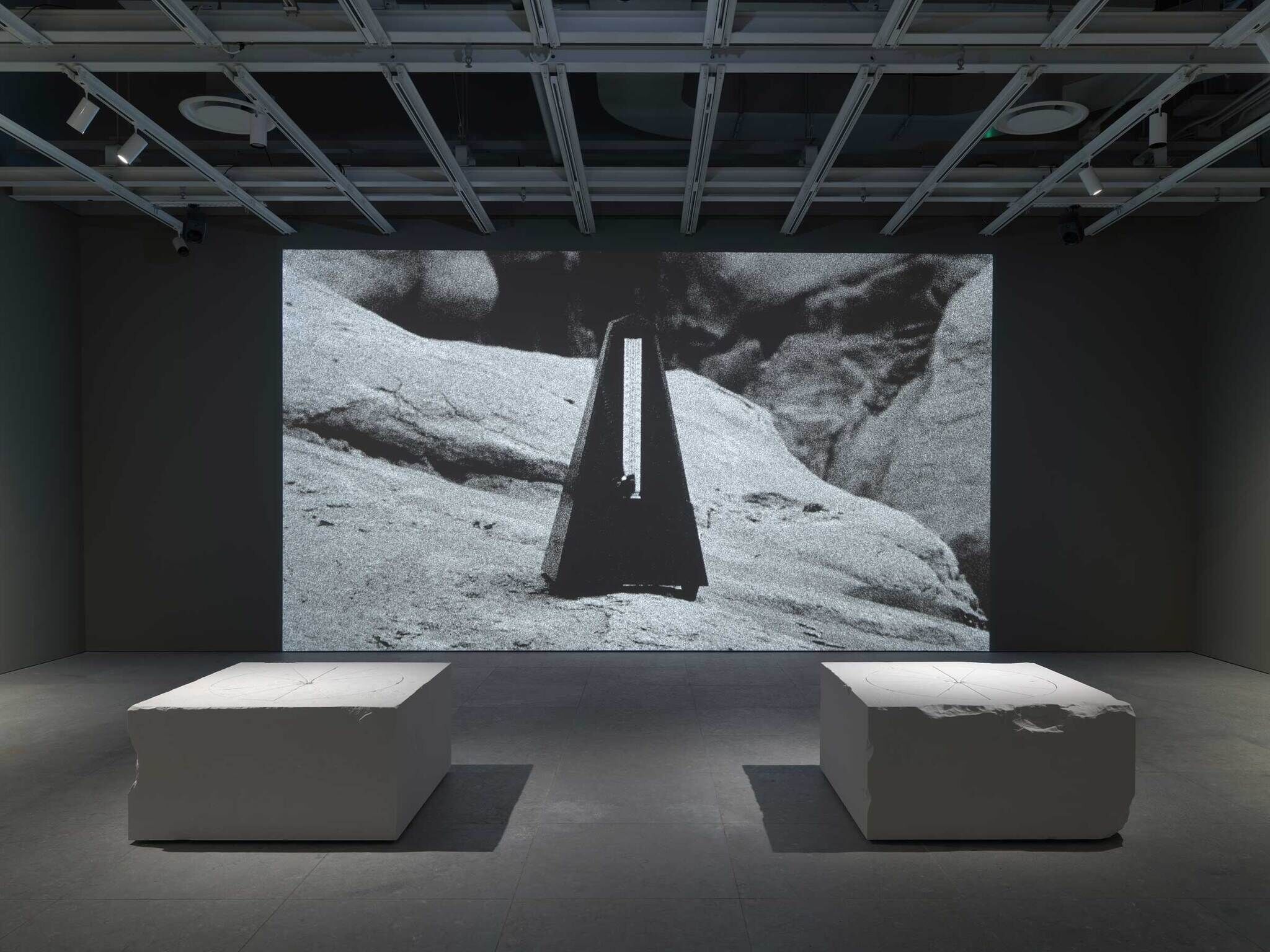
Sound Description: Mark Armijo McKnight, Without a Song, 2024
Running Time: 00:11:19
Sound Description: Atmospheric wind whooshes overhead as the film opens. A couple of minutes in, the rhythmic mechanical sound of several metronomes begins. They go on: tick tock, tick tock, tick tock, multiplied and mostly in-sync with each other, but adding to a chorus. This continues for several minutes, and the faint sound of the wind comes back, overlapping with the metronomes. As the film’s lens pulls back to reveal the full landscape of each metronome in the vast rocky landscape, the sound becomes more pared-down: soon, only the sound of one metronome against the whirring air continues. Tick Tock, each second is measured, until that metronome stops, and the only sound is the wind. The film continues, close to silent, for two more minutes. In the final minute, the faint sound of two birds chirping can be heard in the distance.
Installation view of Mark Armijo McKnight: Decreation (Whitney Museum of American Art, New York, August 24, 2024–January 12, 2025). From front: Duet (2024), Without a Song (2024). Photograph by Ron Amstutz
0:00
0:00