What It Becomes
2024
-
301
Catherine Opie, Self-Portrait/Cutting, 1993
Audio, Verbal description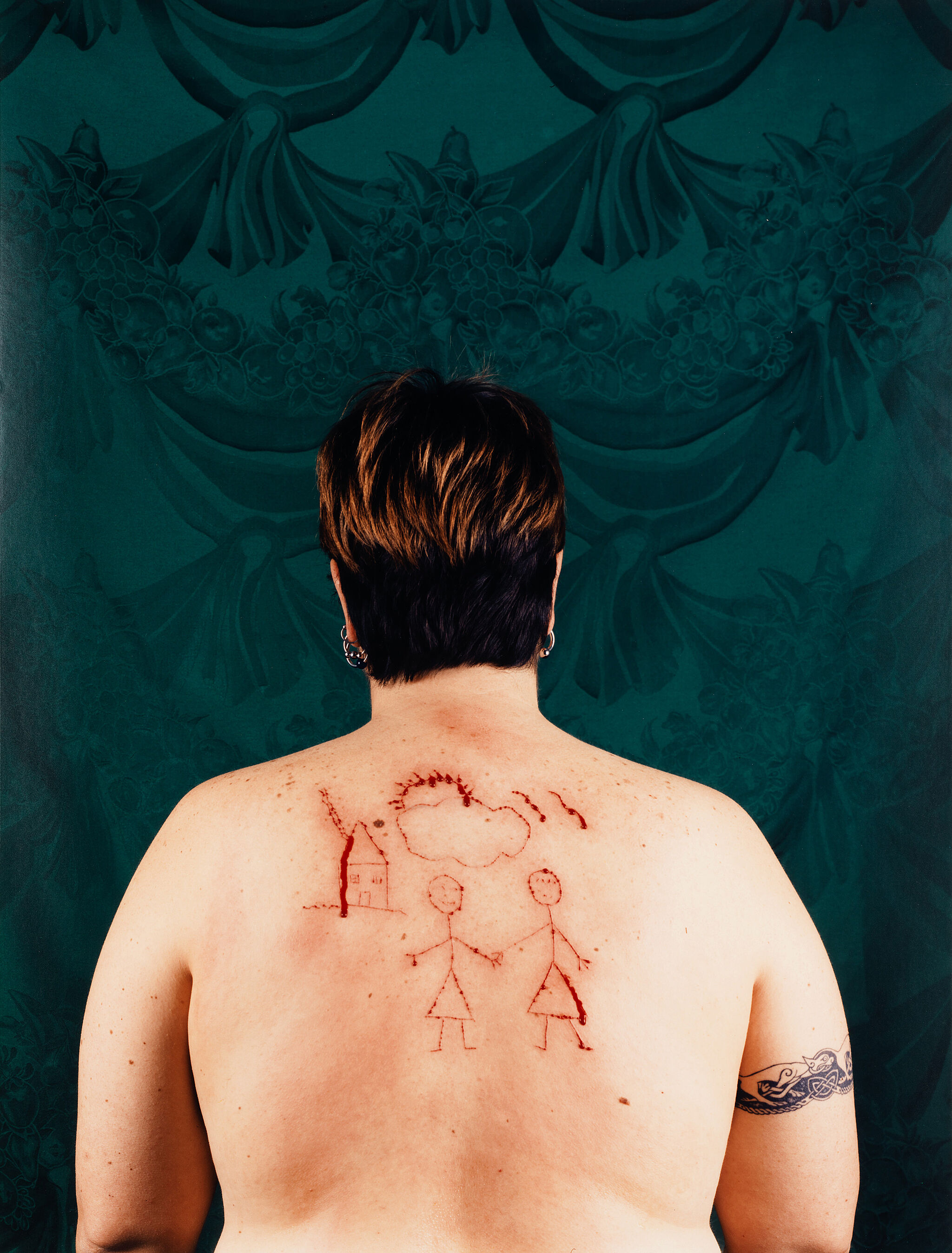
-
302
Wendy Red Star, Déaxitchish / Pretty Eagle, 2014
Audio, Verbal description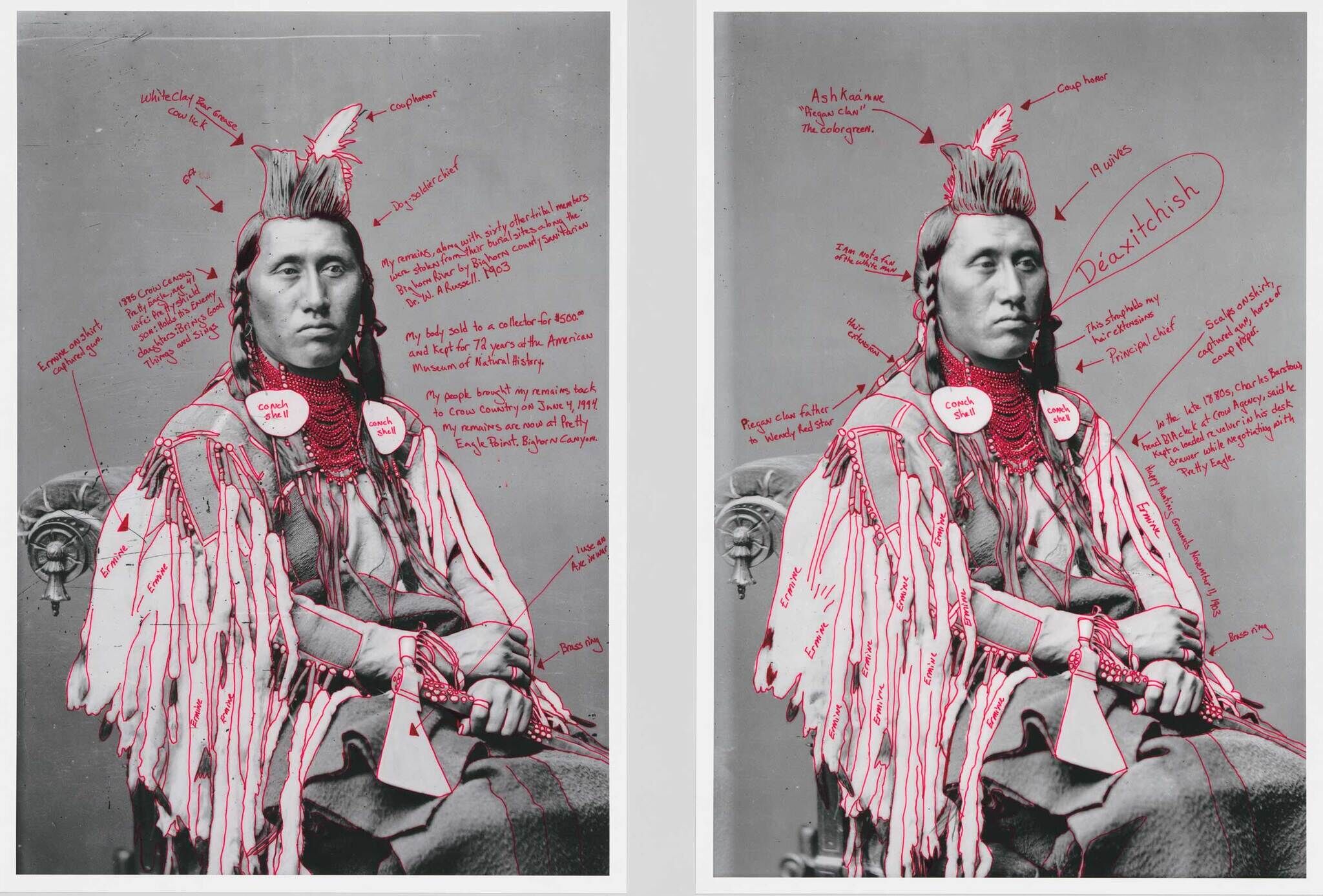
-
303
Jim Hodges, Untitled, 1992
Audio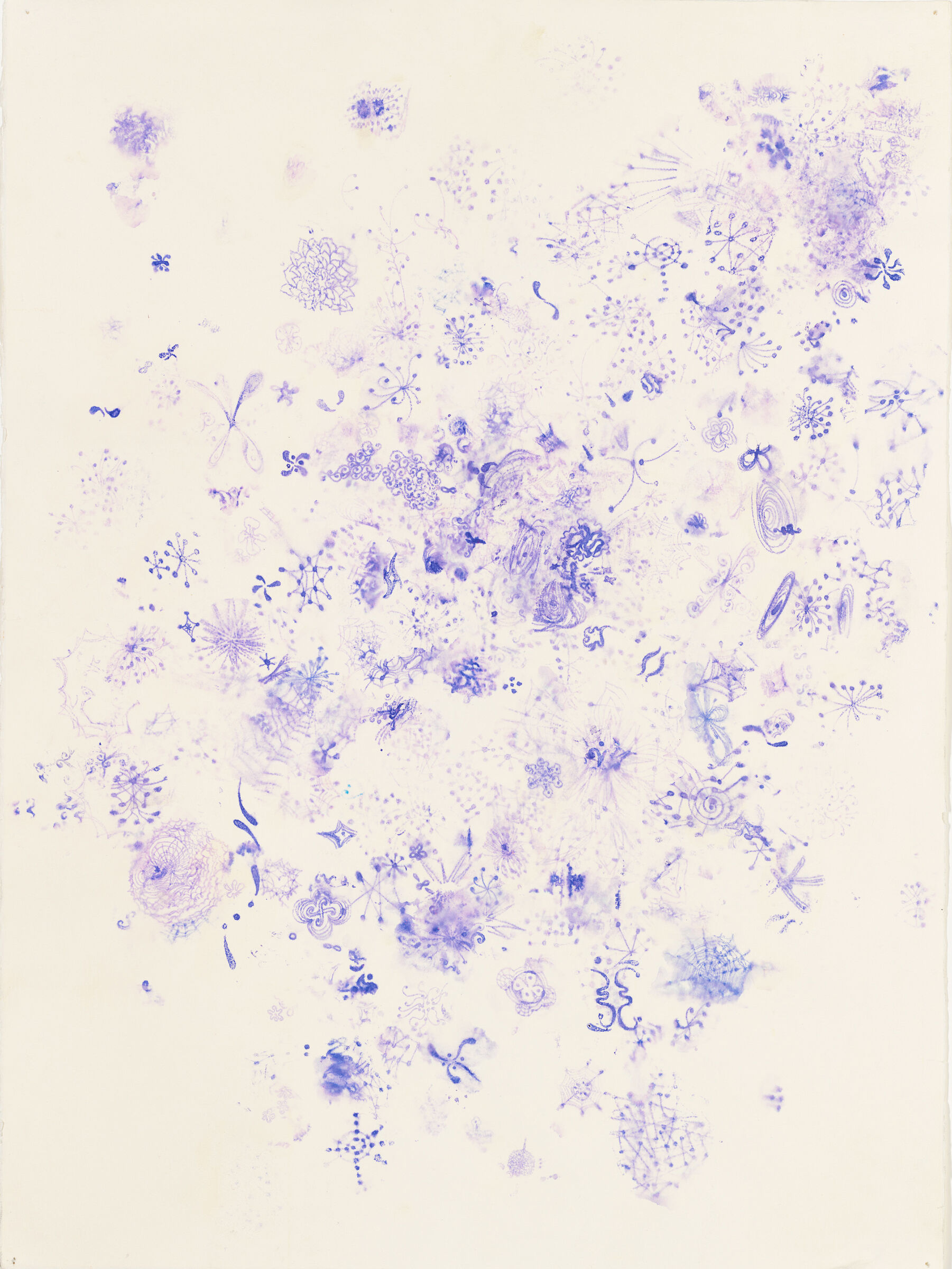
-
304
Maren Hassinger, Daily Mask, 1997–2004
Audio description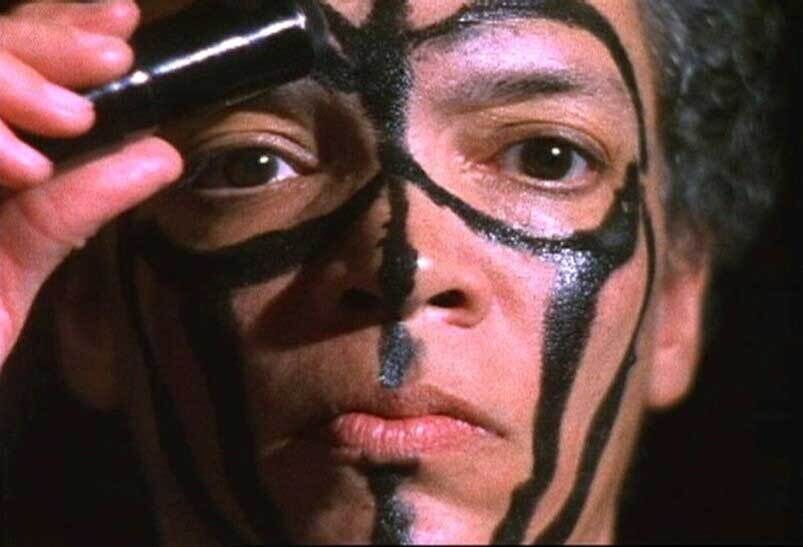
-
305
Ana Mendieta, Alma, Silueta en Fuego, 1975
Transcription
Catherine Opie: Self-Portrait/Cutting in 1993 was really a really very personal portrait.
Narrator: Photographer Catherine Opie.
Catherine Opie: And personally what was going on in my life is I had gone through my first major domestic breakup. And so the cutting on my back, which was made by the artist Judie Bamber, was just this very simplistic drawing that I had made. You know, every kid in kindergarten draws the stick figure portrait of their parents. And so to draw two stick figure girls with triangular dresses became this moment for me to really talk about the longing for domesticity in relationship to a very homophobic world that I was inhabiting at that moment.
I would say that the work in certain ways is different than it was in 1993 because it's a very different kind of political position. We have the right to marry, I myself am married to a wonderful woman. I did get to have my domestic bliss and dream. There is a certain kind of idea of family that is allowed—television programs represent this, you know, and so forth—but that doesn't mean that homophobia doesn't exist and that we're being completely pushed always against the wall in relationship to that right of marriage potentially being taken away from us by the conservative right.
Narrator: This photo is a self-portrait of the artist, who is seated in front of a dark emerald green wall with her back turned to the viewer. The large-format photograph is 40 inches high and 30 inches wide. Catherine Opie’s naked torso takes up the bottom two thirds of the frame, with the bottom of the photo ending at her waist. Opie describes herself as a dyke, and even without clothing and facing away from the camera she reads as butch, due to her short brown cropped haircut, caramel-dyed tips, and thick silver hoop earrings. Her skin tone is pale with red undertones, featuring a smattering of light brown freckles across her shoulder blades and slight pink coloration down her back.
The artist has a black ink tattoo banding her right bicep that features an illustration of wave-like shapes and a rope tying into a knot. In the center of the artist’s back, there is a fine-line illustration carved into her skin, with beads of deep red blood dripping from some areas of the thin linework. The style of the illustration is akin to that of a young child, as it utilizes simple shapes to create a rudimentary landscape with two stick figures. The figures have circular heads and triangular torsos, and to their left, there is a house with a triangular roof and squares to indicate a door and windows. Above the two figures, there is a cloud with a portion of the sun peeking out from its upper left. To the right of the cloud, there are two short lines following the contour of the cloud shape, like line drawings of birds flying in the sky. Both the stick figures wear triangle skirts.
While the act of carving an image into skin is visceral, the figure in the photograph appears comfortable, with her arms resting at her sides and her shoulders level. Behind her is a plush dark green backdrop that features a pattern of monotone illustrations of fruits, such as apples, grapes, and cherries, piled upon draped fabric. During this period, Opie was an active member of the SM queer community in San Francisco, and other works from the time feature markings and accessories that nod to this subculture. Opie has explained that when she made this photograph in 1993, it depicted a dream that felt out of reach:
Catherine Opie: To draw two stick figure girls with triangular dresses became this moment for me to really talk about the longing for domesticity in relationship to a very homophobic world that I was inhabiting at that moment.
Catherine Opie (b. 1961), Self-Portrait/Cutting, 1993. Courtesy Regen Projects, Los Angeles
Wendy Red Star: I was doing research on two images of Medicine Crow, and what I found was that they were delegation portraits taken in 1880. Medicine Crow and five other chiefs traveled to Washington, D.C. to meet with the president, discussing land and territory, and the Pacific Railroad was going to be placed through our territory.
From Montana, they had to take a wagon train with horses through the snow to Utah. From Utah, they went to Chicago. They actually became very ill, because this is the first time they’ve been around so many people. From Chicago, they were able to connect to Washington, D.C.
This trip—they actually spent several months in Washington, which is a tactic that the government liked to use for getting Native people to sign documents: make them homesick or just show them all your military, they’ll become afraid and realize they have no chance. But the fact that they brought all of their regalia shows that they knew that they needed to show their best to the president.
For me, the damage done to Indigenous people, the erasing of who they are, was very important to bring that back. As a Crow woman who grew up on the Crow Indian reservation, I am viewing these men as something totally different than a non-Native person or a non-Crow. It was really important for me to have them assert themselves like, “This is who I am. This is my name. I’m here to ensure the future generation of Crow people.”
Narrator: This interview was excerpted from a Smarthistory episode on this series. To hear more, check out smarthistory.org.
Narrator: This work is part of artist Wendy Red Star’s 1880 Crow Peace Delegation series. Each print is 24 inches tall, and around 17 inches wide. In these works, Red Star manipulates reproductions of historical portraits taken by a white man, Charles Milton Bell, in 1880. The original photographs are black and white, and document a delegation of Apsáalooke (or Crow) leaders who met with the U.S. government to negotiate land rights and tribal borders. At the time, the Northern Pacific Railroad was set to be built through Apsáalooke territory, and the tribe sent a group to advocate for the area’s preservation.
In both prints, Chief Pretty Eagle sits in an armless chair. The photos depict him in the same pose, as if taken moments apart at slightly different angles, with his gaze extending beyond the camera in different directions.
In both photos, Pretty Eagle is unsmiling, and sits with his arms crossed in his lap and his left hand loosely holding an axe that rests in his lap. Red Star has outlined the contours of his outfit and body in a bright red ink that contrasts with the grey tones of the original image. Around the edges of the figure and throughout the background, Red Star has added notations in the same red ink. Some of these writings simply note the accoutrements the wearer has on, such as an arrow which points to a ring on his right hand and reads “bone ring”. Other annotations provide insight into the significance of certain aspects of Pretty Eagle’s clothing. One such example of this is a note on the right-hand photograph with an arrow that points at a fur trim on his shirt. The note reads, “ermine on shirt, captured gun”. Red Star also writes first person annotations from Pretty Eagle’s perspective in the margins to disclose information about the sitter in these portraits. In the right photograph here, Red Star has written, “My body sold to a collector for $500.00 and kept for 72 years at the American Museum of Natural History. My people brought my remains back to Crow Country on June 4, 1994. My remains are now at Pretty Eagle Point, Bighorn Canyon”. In the left photograph, Red Star has drawn a speech bubble emerging from the mouth of the figure that reads “Déaxitchish”.
In this series, Wendy Red Star reappropriates and reclaims widely-circulated historical portraits that perpetuate false and stereotypical narratives of Native Americans. She highlights the individuality of each sitter and rewrites the narrative centering her cultural identity and historical perspective as an Apsáalooke artist.
Wendy Red Star, Déaxitchish / Pretty Eagle, 2014, from the series 1880 Crow Peace Delegation. Two inkjet prints: sheet (a): 25 × 17 1/2 in. (63.5 × 44.5 cm); sheet (b): 25 × 17 7/16 in. (63.5 × 44.3 cm); image, 24 × 16 1/2 in. (61 × 41.9 cm). Whitney Museum of American Art, New York; gift of Loren G. Lipson 2019.289.4a-b. © Wendy Red Star
Narrator: To make this drawing, the artist Jim Hodges used his own spit to get the runny, watery quality of the ink marks. He spoke to writer Cynthia Carr about his process in 2017.
Jim Hodges: I was thinking about kissing, for sure. And I was thinking about, my saliva and about my body and…
Cynthia Carr: Yeah.
Jim Hodges: It was something that I got from Bazooka bubble gum when I was kid. You got Bazooka bubble gum, you open it up and if you lick your, you licked your skin, you could transfer a fake tattoo onto you and that was—
Cynthia Carr: Yes, right.
Jim Hodges: That was what I did. So it was like that was, that's childhood. …
Cynthia Carr: [Laughs.]
Jim Hodges: Transfer drawings with spit. With my saliva. And, and funny, you know, I don't know if I was using it—I was spitting on my drawings then too. … And I still use spit when I make drawings, especially charcoal drawings. …Because it provides—it just opens a material in one more way. I don't have to grab water—I don't need any of that. I can just use myself.
Cynthia Carr: Right.
Jim Hodges: I'm into that.
Narrator: This interview is from the Archives of American Art.
Jim Hodges, Untitled, 1992. Saliva-transferred ink on paper, 29 5/8 × 22 1/8 in. (75.2 × 56.2 cm). Whitney Museum of American Art, New York; purchase with funds from the Drawing Committee 2007.30. © Jim Hodges
00:00-00:07 Black screen. African drums patter polyrhythms.
00:08-00:19 Light raises to reveal the face of Maren Hassinger in 16mm color film. Eyes closed. Loosely curled hair into a cropped cut. She opens her eyes, staring. Camera pulls back, discloses a mirror.
00:20-00:29 Camera retreats unsteadily. Hassinger looks into a mirror; double reflections stare back.
00:30-00:44 Hassinger lifts black grease stick up. Profile shot. She presses the grease stick to her forehead and pulls down. Camera turns. Reflection lies bare. One hand holds hair back; one hand pulls grease stick, bifurcates face.
00:45-00:53 Black grease does not cover lips, grease continues onto chin. Both hands pulled down to sides of body.
00:54-01:16 Front shot. Stony faced. Grease stick travels above and along curve of eyebrow. Draws semi-circle from bridge of nose to eye’s outer corner. Camera tracks in semi-circle. Gestures repeat on opposite side of face.
01:17- 01:34 Camera facing mirrors. Hassinger’s face reflects on three different mirror panels. Different perspective of face in each panel. Artist continues drawing on face with black grease stick. Drawing increasingly resembles a mask.
01:35-01:52 Close-up of Hassinger’s face. Dark eyes focus forward. More light brown skin covered by deliberate small marks of black grease stick.
01:53-02:05 Camera, facing mirrors, shifts from left to right exposing Hassinger’s marking gestures in divided perspective of reflection. More grease fills open areas of skin.
02:06-02:25 Close-up of grease stick mark-making beneath Hassinger’s untouched lips. Black grease covers entire chin and upper lip/area above her lip.
02:26-02:41 Still in close view, camera pans to eyes and nose. Hassinger continues filling exposed skin with black grease. She lifts her pinky finger to her nose bridge, smudges grease into small, sensitive creases next to nose, beneath eyes.
02:42-02:45 Ears, face, and neck covered completely with black grease paint. Eyes closed. Mouth pursed.
02:46-02:56 Head tilts up. Shocked expression. Visible teeth. Quick switch to toothy grin. Lips hidden, pink gums apparent.
02:57-03:05 Eyes and mouth closed. Head tilts down slowly.
03:06-03:16 Drumming diminishes. Fade to black.
Maren Hassinger, Daily Mask, 1997-2004. 16mm film, color, sound; 3:32 min., transferred to video. Whitney Museum of American Art, New York; purchase with funds from the Film and Video Committee 2020.77. © Maren Hassinger
Ana Mendieta, Alma, Silueta en Fuego, 1975
Content forthcoming.
0:00
0:00