
Survival Piece #5: Portable Orchard
2024
.jpg)
Kim Conaty: Hi, my name is Kim Conaty. I'm the Nancy and Steve Crown Family Chief Curator, and I'm the organizer of this exhibition. The project is called, Survival Piece #5: Portable Orchard.
Narrator: Welcome to Artists Among Us minisodes from the Whitney Museum of American Art. We recorded this Artists Among Us minisode while Kim and the rest of the exhibition team were putting together this exhibition of a work the Harrisons made in 1972.
Kim Conaty: The Harrisons were a husband and wife artist duo. This was Helen Mayer Harrison and Newton Harrison.
Roxanne Smith: My name is Roxanne Smith, and I'm a senior curatorial assistant.
It was a commission from California State, Fullerton. The art gallery there commissioned Newton Harrison to create a work of his own choosing. The project that he put forward was an entire gallery room with eighteen citrus trees laid out in a formalist grid. Each of the citrus trees is planted in a hexagonal box, a hexagonal redwood planter topped with a light box.
The intention of the show was in some ways an experiment to see how the trees would fare within the gallery space, but the real goal was to raise awareness and think through the potential that they saw to be pretty imminent of there being as a result of the deforestation and environmental degradation of the area of Southern California where the Cal State Fullerton is located of the diminishing citrus groves there. So they envisioned this as this last citrus grove alive in California and were challenging or wondering about the possibility to create an artificial system within an art museum space.
Kim Conaty: It was important for them at that moment, to think hard about a question they continued to ask themselves. Which was, "How will we continue to survive as a species, if we don't know how to sustain ourselves in very basic ways?" So if it were no longer possible to, let's say, get groceries from your corner store that were pesticide free, or if crops were no longer growing healthily throughout farms within the U.S., what would we do?
The Harrisons met in the 1950s in New York, where they married in 1953. And it wasn't until the late 1960s, that they began their artistic collaboration together.
And there was a moment in their time together, it was really important as a sort of spark to their artistic collaboration. And that was their reading of Rachel Carson's Silent Spring in 1962, when it was published. This book, which really catalyzed the early environmentalist movement for many individuals across the US, was one of the first times that the ideas around food sources, pesticides, around concerns with ecological conditions, came into view in a very popular way.
Although Portable Orchard was about the orange trees in Southern California, it was also about creating a microcosm that asked the question, could we create a food supply through urban farming? Could we actually feed people if we needed to, by raising crops indoors? And thus, this project here today at the Whitney, has that, I think greater resonance. So although one would be hard-pressed to find many citrus trees growing in the wild here, in the New York City environment, this indoor orchard asks those same questions of us.
Roxanne Smith: I think the most interesting thing to me about working on this was that I've never done any project in an art museum that involves living things.
The possibility of failure in the sense of the citrus trees not living through the end of the exhibition, which will be up for six months, is an extremely unusual problem to be confronted with when you're putting on a show.
Tim Kerins: My name's Tim Kerins and I'm the gardener that's employed by the Whitney to take care of some of the exhibits that they have going on. Currently, I will be helping out to take care of the Harrison tree exhibit. And it's fun, it's fun to work on things like this that wouldn't normally crop up in my normal day-to-day working. It's definitely growing citrus trees indoors in New York City in an environment that doesn't really have natural light is a challenge for any gardener so it’s going to be really interesting to work on.
We really wanted to try and work to keep the trees and source the trees within a range that was as close as we could to the museum to try and cut down as much as we could, like carbon emissions and everything else.
It's hard on the East Coast to find a grower that will have trees that will be mature enough to get to an age that it’s going to produce fruit for us.
sage donahue: So my name is sage donahue and I'm a coordinator in the exhibitions and collection management department.
I found a citrus nursery called Simply Citrus in South Carolina, and that's who we're actually working with now.
Tim and Ben, one of the owners of the nursery, were able to talk through the project.
They're holding onto them, taking care of them and in contact with us about how they're doing. And we're going to have a final conversation before they hand them off to our shipper to just hear what Ben thinks about which trees are the best and how they're fruiting and any advice he might have. Because he's like, we really want you to have the best trees.
Roxanne Smith: Kim and I have been bracing ourselves in our own feelings of prophecy for the potentiality that a lot of these trees might fail and we've been thinking about that as trying to get into the spirit of the Harrison's philosophy and ethos that these are proposals or projects or inherently experiments. It also, in an art gallery setting, there's so much concern always about aesthetic value and ensuring that this is going to look really beautiful and the prospect of having trees that are failing and not looking good is so at odds with the typical expectations of perfection and standing still that a museum typically puts forward.
As part of the work when we acquired it, we were given permission in the form of a letter from Newton Harrison, who was still living at the time, which basically gave us the curatorial right or leeway to interpret the work or the diagram. So that means that one could produce this work with a different variant of citrus trees, for instance, or different types of soil, or modify the number of planters in the room.
There were a number of things also, like for instance, what type of wood we would choose for the planter boxes At the time of the Fullerton exhibition, they were made from redwood, which was a tree local to California, and then not as endangered as it is now. There is a supply that we were able to procure of salvaged redwood wood that had once been used to make water towers on the roofs of New York City buildings.
It would be impossible for us to precisely replicate the conditions under which it was first made.
sage donahue: Kim and Roxanne from the very beginning wanted to focus on…figuring out more sustainable ways to work through different things.
Kim Conaty: And the hope is that some of the questions that we have asked for this project, and some of the learning, some of the new sources that we've found for how we make our work…Even thinking about opportunities where we can reuse items that we have made for other exhibitions, and have them fit perfectly well here, it is in many ways, adopting those very central and simple principles of reduce, reuse, recycle. And if we continue to think through those concepts in the way that we work, then it feels like there's a longer term impact that we hope to make.
Narrator: Artists Among Us minisodes are produced at the Whitney Museum of American Art by Anne Byrd, Nora Gomez-Strauss, Kyla Mathis-Angress, Sascha Peterfreund, Emma Quaytman, and Emily Stoller-Patterson.
Narrator: This floor is entirely open, making way for the artwork to take up the majority of the space. It is called Survival Piece #5: Portable Orchard, and consists of eighteen citrus trees in distinct hexagonal planters, spaced throughout the floor in three neat rows of six. There are a few benches around the edges of the room, so visitors can sit and observe the orchard as if they were sitting in a garden.
Every tree in this small orchard is a real, living citrus tree! Each hexagonal planter is the same, and comes up to almost 30 inches high. They are made with vertical slats of wood that are actually reclaimed Redwoods that have been used since the 1800s to build water towers throughout New York City. The dirt in the planters is called sandy loam, which is light and drains easily. Tim Kerins, the gardener helping the Whitney with this show, waters the soil once a week. There are eleven distinct types of citrus trees in this gallery, including lime, lemon, grapefruit, kumquat, orange, and tangelo varieties. The height of the trees varies by about 2 feet, and the leaves and branches differ slightly tree to tree.
One tree, located in the row closest to the elevators is a meyer lemon tree, a type known for its almost herbal smell and mild taste. Overall, this tree is on the small side, and is three years old. It stands at just over 6 feet tall, propped up within the wood planter box. Its trunk is about the width of a soda can and has smooth, warm brown bark. A few turns and knots punctuate the length of the trunk, making it somewhat bent, like a person standing with their hip cocked to one side. As the branches grow tinier and more numerous towards the top of the tree, they point outward with the very smallest outshoots dropping into its leaves, which hang downwards. The leaves, which are shaped like eyes, have lightly rippled and shiney green surfaces. They fold a bit along the center spines of each leaf and are slightly thicker than printer paper.
Above each tree hangs a matching hexagonal light box that is suspended from the ceiling by vertical wires. The light box illuminates the tree branches and any citrus fruit growing from the tree, glinting off bright surfaces.
Taken all together, the room of trees creates an ordered environment of contained nature. When Helen Mayer Harrison and Newton Harrison made this work from 1972-1973, they were already thinking about climate change. They considered the prompt: what might we need to survive in the future as our natural world becomes threatened and, eventually, less livable? This orchard was realized twice before--first at Cal State Fullerton in 1972, and then in 2015 at the Walker Art Center. The Whitney’s installation is similar, but near the title of the show and along the wall to the left is a series of cases containing archival materials and documentation of the first iteration. There is a verbal description of one of the original blueprint drawings, which resides in the first case.
The Harrisons, Survival Piece #5: Portable Orchard, 1972–73 (installation view, Art Gallery at California State University, Fullerton). Citrus trees, soil, wood, and lights, dimensions variable. © Helen and Newton Harrison Family Trust. Courtesy Various Small Fires, Los Angeles/Dallas/Seoul
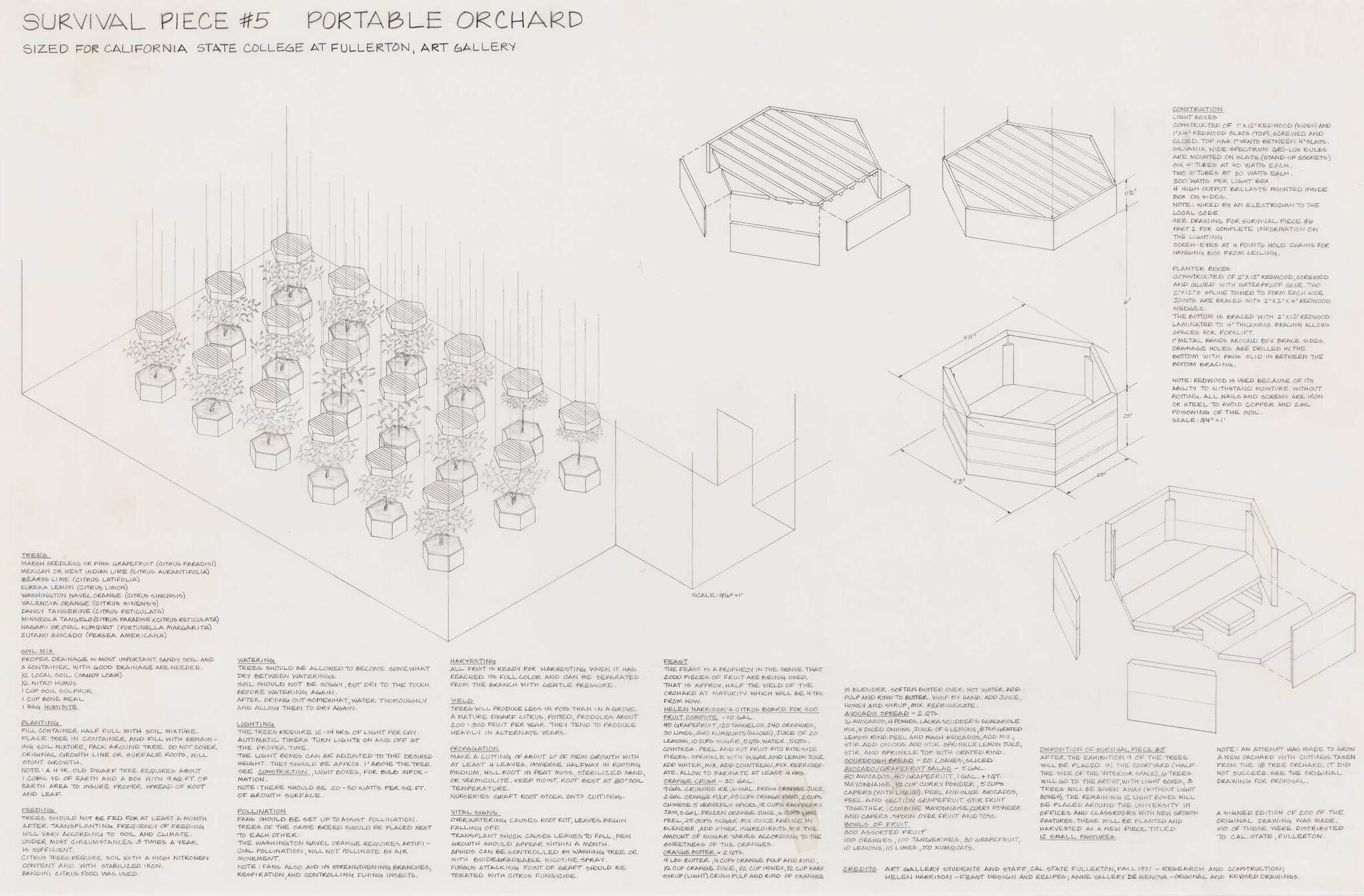
Narrator: This drawing is almost 24 inches tall by almost 36 inches wide and is a thinly-drawn black line diagram on white paper. It features the Harrisons’ original plan for Survival Piece #5: Portable Orchard, and shows how all the planters, trees, and light boxes would have been laid out.
The bottom quarter of the diagram lists details about the work in handwritten but tidy lettering, and on the right side of the page are specifics about how the planters would be built.
In the center left side of the page are eighteen trees displayed in what is called an axonometric diagram, as if viewed from a top corner of the room in diagonal. This allows for each planter, tree, and light box to be drawn in a more three-dimensional way than a simple bird’s eye view would allow.
The boxy shapes in the blueprint are the planters that are under the trees and the corresponding six-sided grow lights that are over the trees. They create a honeycomb-like pattern on the page. There are also many vertical lines in the top half of the drawing, which are wires attaching each corner of the light boxes to the top of the undefined ceiling.
While the built aspects of the installation are uniform, each tree is rendered slightly differently. Apart from a few lines of writing at the lower left corner of the page, the trees are the only part of this diagram that are clearly hand-drawn. One tree, for example, has a trunk assembled of multiple vertical pencil marks. Six tidy thin branches move away from its center, with matching numbers of oblong leaves on each side.
Even though it is sketched, with small flicking marks throughout the leaves, the tree appears somewhat stylized, like a flower pressed in a book. There is a scientific quality to the drawing, and the text in the lower left adds to this feeling. Included are four lines indicating the different types of citrus trees intended for the grove. In parentheses, each one's latin name is included. Indian lime is Citrus Autantifolia, and so on.
Roxanne Smith, one of the curators working on the show, explains the importance of this diagram:
Roxanne Smith: As part of the work when we acquired it, we were given permission in the form of a letter from Newton Harrison, who was still living at the time, which basically gave us the curatorial right or leeway to interpret the work or the diagram. The directions for producing the portable orchard in whatever way would best bring forward the spirit of the work without necessarily adhering to every specification. So that means that one could produce this work with a different variant of citrus trees, for instance, or different types of soil, or modify the number of planters in the room. One could take it in an even more extreme direction and wonder if this work could be transposed for us to think about trees that actually grow in New York, for instance. In that case, we would've had a portable orchard of apple trees, for instance, something closer to home.
There's lots of other contradictions within this about the fact that, this is an ecological artwork, and that its aims were explicitly to find solutions for and to raise community awareness about the conditions of climate change and we thought about those contradictions in terms of what it meant for us to be transporting trees thousands of miles into our gallery for them to artificially grow.
The Harrisons, Survival Piece #5: Portable Orchard, 1972-1973. Graphite pencil on paper, 23 13/16 × 35 3/4in. (60.5 × 90.8 cm). Whitney Museum of American Art, New York; purchase with funds from the Drawing Committee 2019.297.1. © Helen Mayer Harrison and Newton Harrison/ The Harrison Studio
0:00
0:00