Yayoi Kusama
2012
This audio guide features selected works from Yayoi Kusama and the artist's installation, Fireflies on the Water.
-
400
Introduction to Yayoi Kusama
Audio -
401
Yayoi Kusama, Lingering Dream, 1949
Audio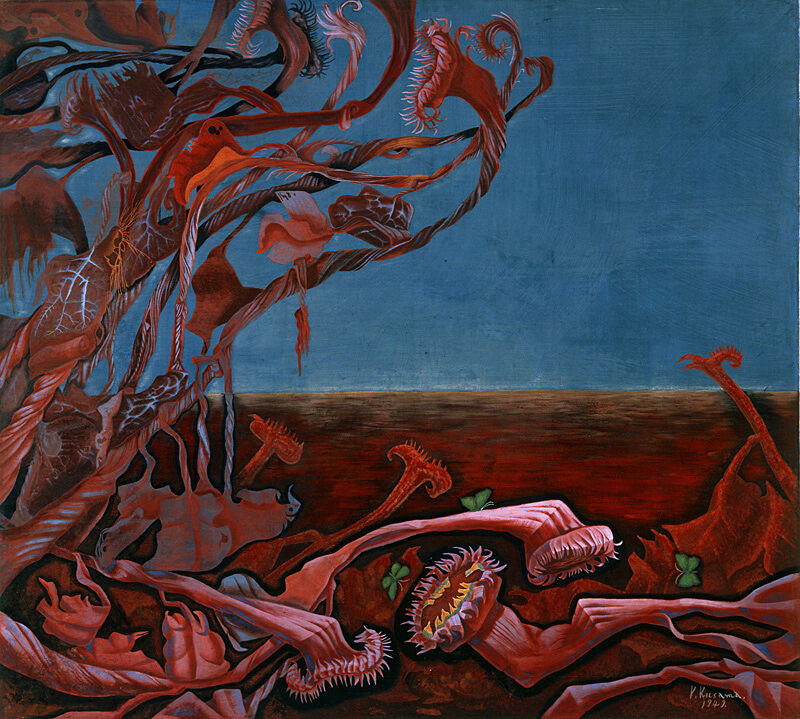
-
402
Yayoi Kusama, Corpses, 1950
Audio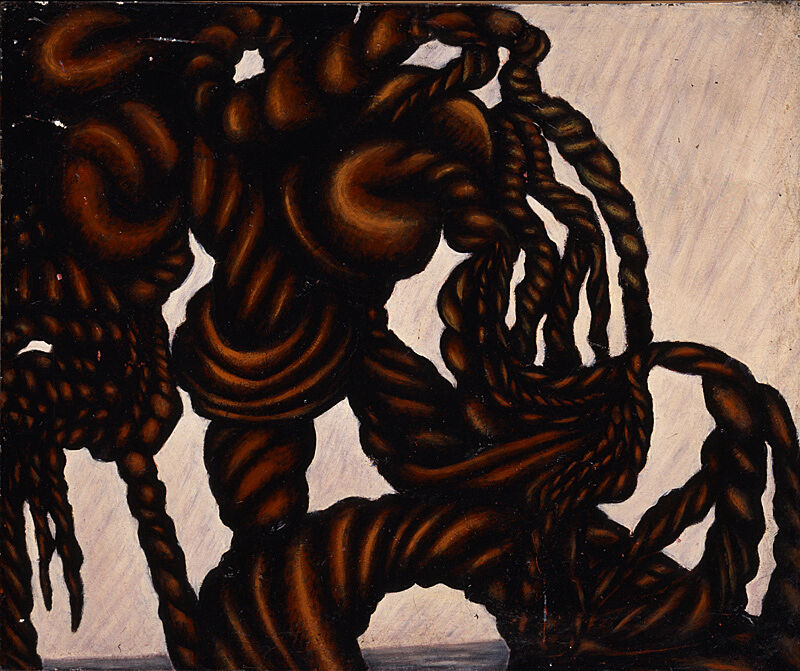
-
100
Yayoi Kusama, Fireflies on the Water, 2002
Audio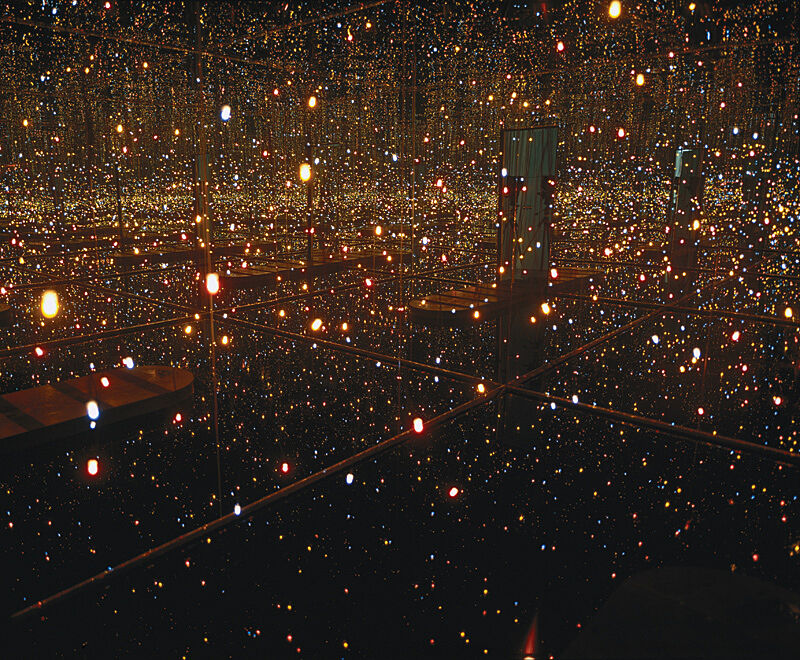
-
403
Yayoi Kusama’s early works on paper
Audio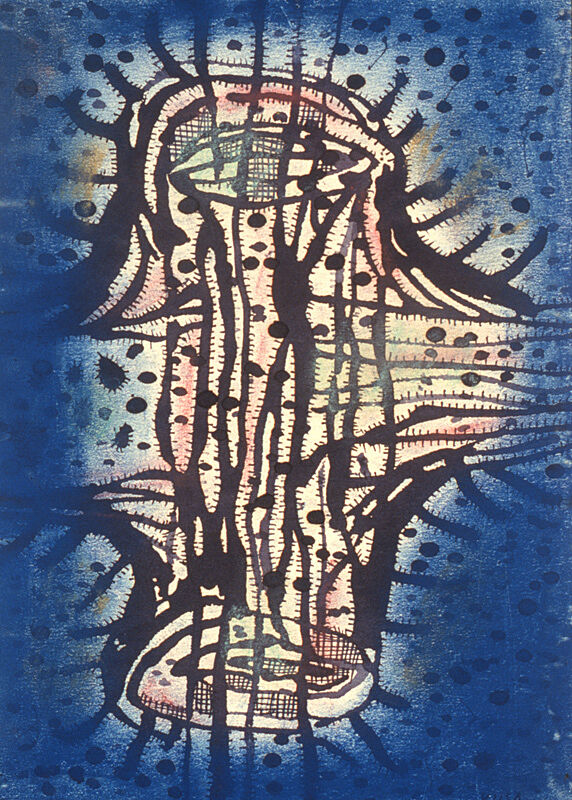
-
404
Yayoi Kusama, Pacific Ocean, 1960
Audio -
405
Yayoi Kusama, No. A.B., 1959
Audio -
406
Yayoi Kusama archival material
Audio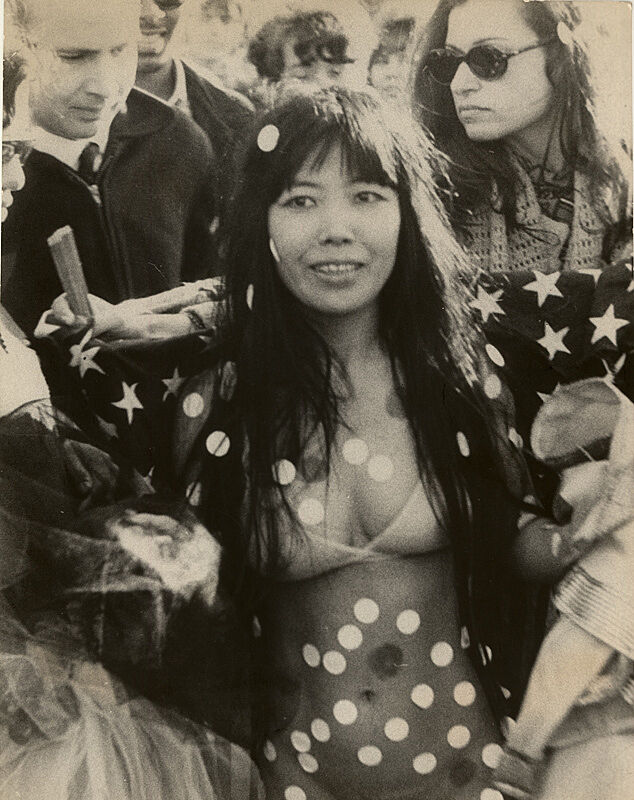
-
407
Yayoi Kusama, Walking Piece, 1966
Audio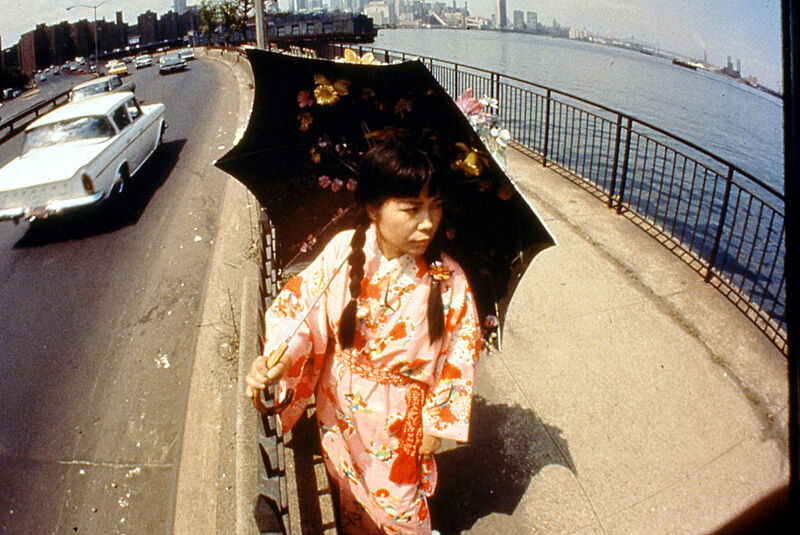
-
408
Yayoi Kusama, Accumulation, c. 1963
Audio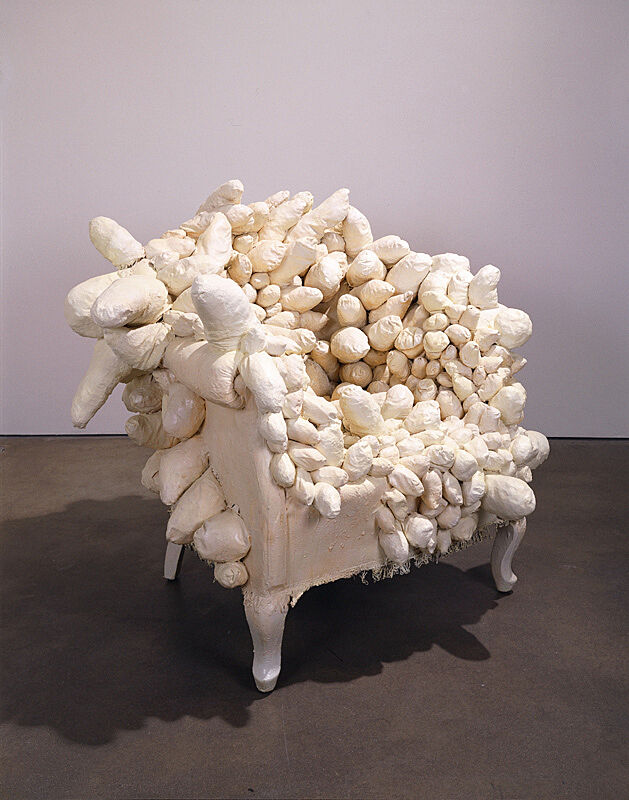
-
409
Yayoi Kusama, For Walking on the Sea of Death, 1981
Audio -
411
Yayoi Kusama, Love Forever Collage, 1966
Audio -
412
Yayoi Kusama, Flowers and Self-Portrait, 1973
Audio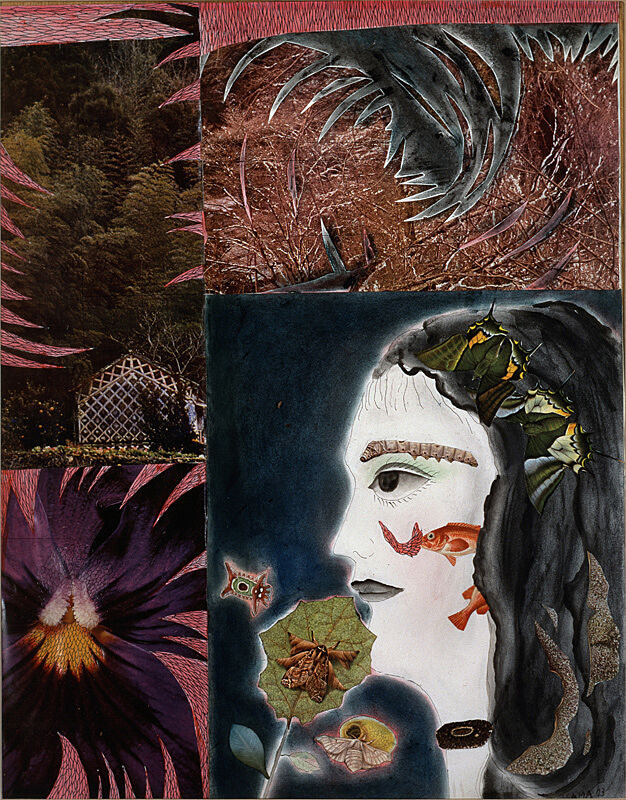
-
413
Yayoi Kusama, The Clouds, 1984
Audio -
414
Yayoi Kusama, Sprouting (The Transmigration of the Soul), 1987
Audio -
415
Yayoi Kusama, Heaven and Earth, 1991
Audio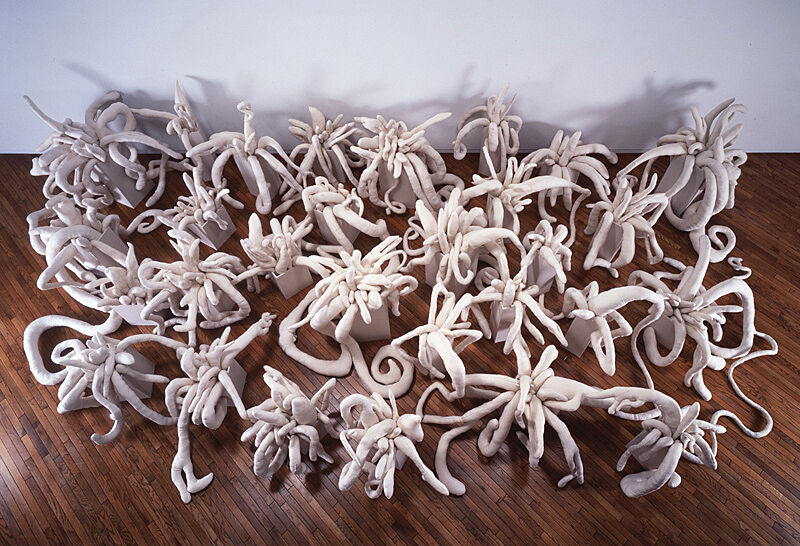
-
416
Yayoi Kusama’s recent paintings
Audio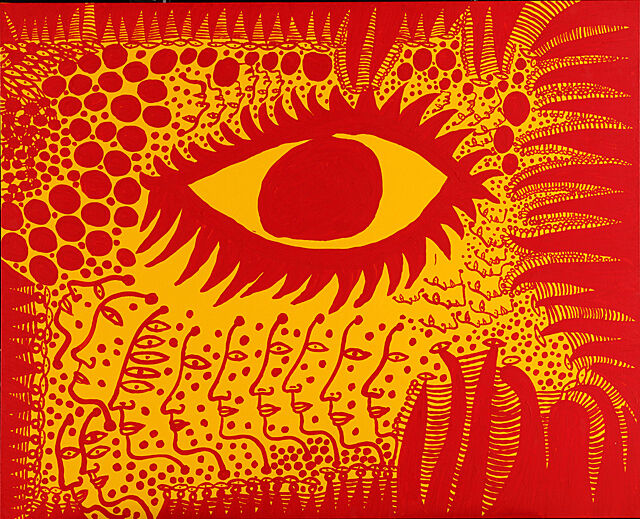
-
417
conclusion to Yayoi Kusama
Audio
Narrator: Welcome to this exhibition, Yayoi Kusama. The artist Yayoi Kusama was born in 1929; she is now eighty-three years old. In this exhibition we will look at six decades of her pioneering work—a testament to a life dedicated almost entirely to art.
Kusama grew up in Matsumoto City, a provincial town 130 miles west of Tokyo. Her family was upper-middle-class, and her mother believed the life of an artist was unsuitable for a girl of her station. But as a child, Kusama always found a way to draw, first exhibiting her work in her teens. Our exhibition begins with paintings and drawings that she made as a student in Kyoto, challenging the Japanese artistic tradition. We’ll see radically new paintings and sculptures that she made soon after arriving in New York in the late fifties. We’ll witness her innovative development of entire art environments, and the convergence of art and life in her Happenings. In the last galleries of this exhibition, we’ll see some of the work that Kusama made after returning to Japan—collages, paintings, and sculptures that have helped make her the country’s most prominent contemporary artist.
Let’s get started. Please enjoy the exhibition.
Narrator: Kusama made Lingering Dream as a twenty-year-old studying painting in Kyoto. The landscape it presents to us seems more nightmare than dream. The foreground is crowded with red sunflowers. Some have fallen to the ground, their stems broken and contorted—an image that suggests human pain, not floral abundance.
War-torn landscapes preoccupied Kusama during the early years of her studies—unsurprisingly, since World War II had ended just a few years before. Flowers and vegetable growth were also a constant subject for her—and had been since she was a young girl. Her family made its money managing wholesale seed nurseries. Drawing the flowers for hours on end, she became an extremely skilled still life artist.
Over her mother’s objections, Kusama entered the Kyoto Municipal School of Arts and Crafts in 1948. There she took courses in Nihonga—literally, “Japanese painting.” By the mid-twentieth century, Nihonga had combined Japanese pictorial traditions with Western imports such as modeling and perspective. As the preferred style of the wartime dictatorship, it had also been tainted by nationalist politics. Kusama’s Nihonga training lingers here in the exquisite details. Notice especially the fine veins lacing the stems of the living flowers climbing at left. But the painting’s subject matter and the psychological intensity are all Kusama’s own. Very soon, she would reject the traditions and hierarchies of Nihonga all together.
Yayoi Kusama, Lingering Dream, 1949. Pigment on paper, 53 3/4 × 59 3/4 in. (136.5 × 151.7 cm). Collection of the artist. © Yayoi Kusama. Image courtesy Yayoi Kusama Studio Inc.; Ota Fine Arts, Tokyo; Victoria Miro Gallery, London
Narrator: Like the earliest painting in this gallery—called Lingering Dream—this work is a kind of abstracted landscape. A low horizon binds the gray earth, while a uniformly atmospheric sky tilts in from above. The painting’s title, Corpses, suggests that we are still facing the aftermath of the war. But the twisting, evolving, rope-like forms don’t literally depict corpses. Instead, they evoke feelings—entanglement, horror, anxiety.
Kusama learned a good deal about art while in Kyoto. But many of the most important developments came while she was alone in her room, skipping class. She taught herself western-style oil painting, and began experimenting with materials and techniques. She also studied magazines intently, hungry for encounters with cubism, surrealism, and other modernist approaches. Corpses is a testament to these efforts. In it, Kusama has married her own visual vocabulary—rich with plant-like growth and decay—to the Surrealist love of eerie, hybrid figures.
Yayoi Kusama, Corpses, 1950. Oil on canvas, 24 × 28 5/8 in. (61 × 72.7 cm). Collection of the artist. © Yayoi Kusama. Image courtesy Yayoi Kusama Studio Inc.; Ota Fine Arts, Tokyo; Victoria Miro Gallery, London
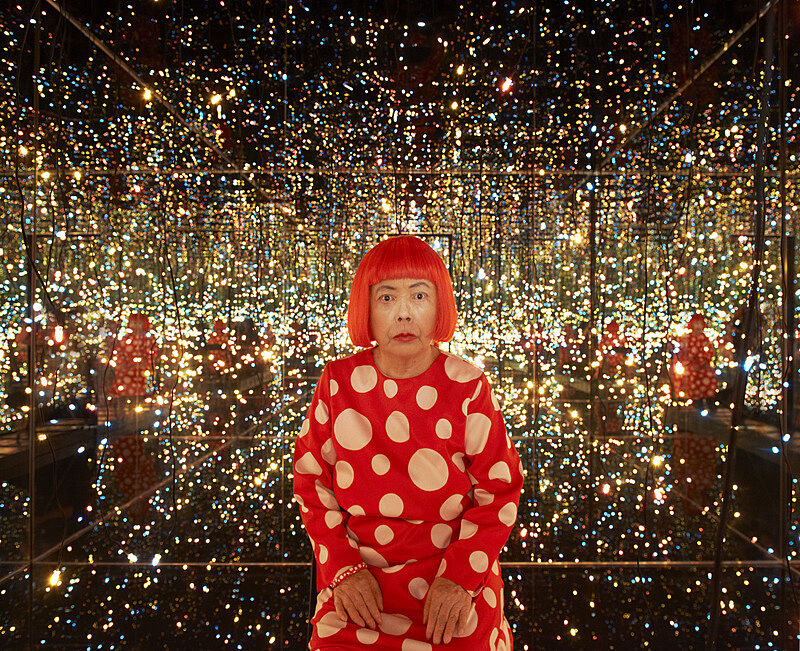
Narrator: On the other side of this door is Yayoi Kusama's 2002 installation, Fireflies on the Water. It's materials are simple—mirrors, water, and one-hundred-and-fifty small lights—but its effects are complex.
As the title suggests, the lights feel almost natural, like fireflies like a tranquil summer night. The pools of water create an incredible sense of stillness. And as you enter the mirrored space, you see endless images of yourself, reflected off into the deep distance.
The work creates the feeling of being everywhere and nowhere at once. Kusama is eighty-three years old. She’s been an incredibly prolific artist—in part because her psychic life has been marked by struggle, and art has been her best weapon. As a young child, Kusama had hallucinations in which certain images or patterns would overwhelm her visual field—growing to infinity, threatening her with obliteration. In some of her earlier works, there’s something unnerving about the idea that things might go on and on without end. But the feeling of this work is very different. After five decades as a productive artist, Kusama had become free to invite us to forget all limits, to abandon our sense of self, and to give in to a kind of meditative magic.
Yayoi Kusama, Fireflies on the Water, 2002. Mirror, plexiglass, 150 lights and water, 111 × 144 1/2 × 144 1/2 in. (281.9 × 367 × 367 cm) overall. Whitney Museum of American Art, New York; purchase, with funds from the Postwar Committee and the Contemporary Painting and Sculpture Committee and partial gift of Betsy Wittenborn Miller 2003.322a-tttttttt. © Yayoi Kusama. Photograph courtesy Robert Miller Gallery
Narrator: During the early 1950s, Kusama made hundreds of works on paper—lyrical, ambitious experiments far removed from the Japanese realistic tradition. Many of the works are distinctively patterned: the dots for which Kusama is best known begin here. The images are basically abstract, but filled with details suggesting life. As you look around this gallery you’ll find eggs, seeds, trees, the cilia of microscopic organisms, and sperm-like forms. These kinds of subjects—all growing, transforming, and proliferating—are central to Kusama’s work.
Kusama’s output was tremendous—and so was her will to be known. The exhibitions of the works in this gallery were very well received. But as she made them, she felt constrained by life in Japan.
She later wrote:
“For art like mine—art that does battle at the border of life and death, questioning what we are and what it means to live and die—[Japan] was too small, too servile, too feudalistic, and too scornful of women. My art needed a more unlimited freedom, a wider world.”
Kusama had her sights set on New York. With no introduction, she sent her work to the American painter Georgia O’Keeffe—and was shocked when the famous artist replied. O’Keeffe—another painter of flowers—responded to Kusama’s work positively. But she also warned that the life of an artist was very difficult in the United States. Kusama came anyway, arriving in New York—via Seattle—in 1958.
Yayoi Kusama, The Germ, 1952. Ink and pastel on paper, 9 3/4 × 7 1/16 in. (24.7 × 18 cm). Collection of the artist. © Yayoi Kusama. Image courtesy Yayoi Kusama Studio Inc.; Ota Fine Arts, Tokyo; Victoria Miro Gallery, London
Narrator: When Kusama arrived in New York, she began an ambitious series of paintings—the Infinity Nets. The four canvases in this gallery are among the earliest of them. In each, Kusama worked methodically, forging semicircles of dense white oil paint into nets that stretch across a black background. Then she applied a thin layer of white wash across the whole, so that the black dots seem to be bathed in a kind of fog. In this painting, called Pacific Ocean, the net becomes denser near the center of the canvas. Towards the edges, its energies grow more expansive. In some of the other works you’ll see here, the pattern is more regular, the mood more controlled.
Kusama exhibited the Infinity Nets in 1961, receiving excellent reviews from The New York Times and in the art magazines. She’d managed to distinguish herself from the Abstract Expressionists—painters like Jackson Pollock and Willem de Kooning, whose work largely dominated the New York scene. Kusama’s work matches or exceeds theirs in scale, but is radically different in intent. Abstract Expressionist paintings hinge on dramatic, expressive gestures. By contrast, Kusama’s begin from a place of order and regularity—the same brush stroke applied, with just a little variation, over and over and over again. The paintings’ powers lie in the cumulative effect of that action. The texture is remarkable, but so is the sense of the labor and energy required to paint like this on such a large scale.
Narrator: No. A.B. is the largest painting in this gallery—but some of Kusama’s Infinity Nets were even larger. The activity of painting them, she’s said, overtook everything.
At an early age, Kusama began experiencing frightening hallucinations in which a single image would multiply again and again, taking over her field of vision. There were patterns, flowers, and—most of all—dots. All were part of an overwhelming accumulation and growth, which she felt threatened to obliterate her. Kusama is an incredibly productive artist—in part, she’s said, because it is through her art that she channels these forces.
Describing these works in her autobiography—also called Infinity Net—Kusama wrote:
“My desire was to predict and measure the infinity of the unbounded universe, from my own position in it—with dots, an accumulation of particles forming the negative spaces in the net. How deep was the mystery? Did infinite infinities extend beyond our universe? In exploring these questions I wanted to examine the single dot that was my own life. One polka dot: a single particle among billions. I issued a manifesto stating that everything—myself, others, the entire universe—would be obliterated by white nets of nothingness connecting astronomical accumulations of dots. White nets enveloping the black dots of silent death against a pitch-dark background of nothingness. By the time the canvas reached 33 feet it had transcended its nature as canvas to fill the entire room. This was my ‘epic,’ summing up all that I was. And the spell of the dots and the mesh enfolded me in a magical curtain of mysterious, invisible power.”
Narrator: Kusama’s work as an artist has been incredibly varied. She has been a painter, sculptor, creator of environments, fashion designer, and orchestrator of happenings. In all media, she’s worked to erode the boundaries between herself, her work, and the wider world. Here, you’ll find photographs that demonstrate how central the artist’s own person is to the work that she created. You’ll also see tickets to performances, manifestos, broadsides advertising her projects, and documentation of the events themselves.
Of all Kusama’s works, her happenings—which she began orchestrating in 1967—depend the most on archival materials like the ones in this gallery. Some of her earliest happenings, the Body Festivals, were multimedia performances. Kusama, illuminated by a black light, would paint fluorescent-colored dots onto the bodies of bikini-clad models. As protests against the Vietnam War intensified the following year, she turned theater into protest, and took these actions to the streets. In the Anatomic Explosions, she again painted the bodies of her performers—who were now usually nude—but did so in front of sites such as New York Stock Exchange and the United Nations Headquarters. After Nixon was elected, she staged a nudist protest in lower Manhattan.
Kusama at Bust Out Happening at Sheep Meadow in Central Park, 1969. Collection Yayoi Kusama. Image courtesy Yayoi Kusama Studio Inc.; Ota Fine Arts, Tokyo; Victoria Miro Gallery, London
Narrator: In the slide projection Walking Piece, Kusama walks the streets of New York, dressed in a bright pink, floral kimono. She carries a large umbrella, also bedecked in flowers. The outfit is deliberately exotic, but the streets she walks are anything but. She travels through abandoned industrial environments, past lonely cars and cheap advertisements, and encounters a homeless man sprawled out under a tree.
The work is a performance, photographed by the Japanese photographer Eiko Hosoe. At home in Japan, Kusama’s preferred mode of dress had been consistently modern. In New York, she would sometimes wear traditional Japanese clothing as a means of declaring her outsider status. In Walking Piece, the delicate kimono contrasts with and highlights the cruel, commercial, alienating side of the city.
Yayoi Kusama, slide from Walking Piece, 1966. Slide projection, dimensions variable. Courtesy Victoria Miro Gallery, London; Ota Fine Arts, Tokyo; and Yayoi Kusama Studio. © Yayoi Kusama. 24 Photos by Eikoh Hosoe. © Eikoh Hosoe.
Narrator: Kusama called this sculpture Accumulation—referring to the proliferation of soft, pillowy phallic forms that cover the underlying chair. There’s something surreal about seeing an ordinary piece of furniture treated in this way. And of course the whole psychic resonance of the phallus changes when there are hundreds upon hundreds of them: the form becomes absurd.
In her autobiography—which was first published in Japan in 2002—Kusama wrote that the sculptures helped her work through her feelings of trauma.
“People often assume that I must be mad about sex, because I make so many such objects, but that’s a complete misunderstanding. It’s quite the opposite–I make the objects because they horrify me. I began making penises in order to heal my feelings of disgust towards sex. Reproducing the objects, again and again, was my way of conquering the fear. It was a kind of self-therapy, to which I gave the name ‘Psychosomatic art." . . . I make a pile of soft sculpture penises and lie down among them. That turns the frightening thing into something funny, something amusing. I’m able to revel in my illness in the dazzling light of day. By now, the number of penises I have made easily reaches into the hundreds of thousands.”
Yayoi Kusama, Accumulation, c. 1963. Sewn and stuffed fabric, wood chair frame, paint, 35 1/2 × 38 1/2 × 35 in. (90.2 × 97.8 × 88.9 cm). Whitney Museum of American Art, New York; purchase 2001.342. © Yayoi Kusama. Photograph by Tom Powel
Narrator: Kusama made this boat sculpture—which is covered in plastic fruit and metallic paint as well as her trademark phalluses—in 1981. In it, she revisits an earlier work.
One day in 1963, Kusama and the sculptor Donald Judd—a good friend, whose studio was upstairs from hers—found a boat lying on the side of the road. They retrieved it, and she covered it in phallic forms. She printed nine-hundred-and-ninety-nine photographs of it, and wallpapered a small room in a gallery with them, floor to ceiling. She called it Aggregation: One Thousand Boats Show. Andy Warhol complimented her on the exhibition; three years later he would make his own Cow Wall Paper.
Kusama’s Accumulation sculptures don’t look anything like the Infinity Nets, which she’d made just before this work. But the paintings and the sculpture come out of the same impulse—the feeling that an action or form might overtake the visual field, perhaps even the whole world. That feeling also gave her the idea of making art that would take over a whole room—that would become an environment.
Narrator: In this collage, Kusama gazes into a mirrored environment, a bespectacled man peering over her shoulder. They’re looking into Kusama’s Endless Love Show—a small octagonal room that was mirrored on all sides, and empty except for blinking, colored electric lights. Because the reflections bounced between the mirrors, the space seemed infinite. Kusama gave each visitor to the exhibition a badge that read “LOVE FOREVER.” She also handed out brochures that read, in part:
“Endless Love Show 1966 is about Mechanization, Repetition, Obsession, Impulse, Vertigo, and Unrealized Infinite Love. I prefer the title Kusama’s Peep Show for this exhibition, because it allows you to see things that you cannot touch.”
Fireflies on the Water, the installation on view on the first floor of the Museum, develops the ideas that Kusama explored in the Endless Love Show.
Narrator: In the lower-right quadrant of Kusama’s Flowers and Self-Portrait, we see a woman’s face. It doesn’t look much like the artist, despite the work’s title. She’s drawn parts of the face—the eyes, the nose, the contours of the profile—in simple ink contours. But the eyebrow is a collaged-on caterpillar. The cheekbone and jaw line are given form by a goldfish. And the hair consists partly of butterflies.
In 1972—a year before Kusama made this collage—the artist Joseph Cornell passed away. Known for his exquisitely odd box collages, Cornell was something of a recluse. But in the early 1960s he and Kusama developed a relationship that she has described as passionately romantic, but platonic. The collage elements in this work–and others she made around the same time—were magazine cutouts and other found materials that Cornell had given to her. In part, these collages are her memorials to him.
At the same time, the modestly scaled works in this room are testaments to Kusama’s changed circumstances. In the late sixties she had begun to focus more on producing happenings, and less on making paintings and sculptures. Her financial situation grew shaky, as did her state of mind. She moved back to Japan in 1973. Her hallucinations returned, and she was hospitalized three times between 1975 and 1977. That year, she voluntarily entered a residential psychiatric hospital in a Tokyo suburb, where she has lived ever since.
Yayoi Kusama, Flowers and Self-Portrait, 1973. Collage, watercolor, and ink on paper, 20 7/8 × 16 9/16 in. (53 × 42 cm). Ota Fine Arts, Tokyo. © Yayoi Kusama. Image courtesy Yayoi Kusama Studio Inc.; Ota Fine Arts, Tokyo; Victoria Miro Gallery, London
Narrator: In the 1980s, Kusama maintained her dedication to her art—but at first, her studio was in the hospital. She continued to explore the infinite, but she was more spatially confined than she’d been while working in a New York loft. In the day-to-day she worked on a small scale, all the while thinking on a large one. The Clouds consists of one hundred unique hand-sewn objects. Together, they form a fluid sculptural constellation. There are no instructions on how to install it—it’s up to the curator to relate one piece to the next. And there’s no requirement to use all hundred pieces.
Though she continued to live in an open ward in the hospital, Kusama soon began working in a studio that she built nearby. She commutes back and forth, putting in a full eight-or-nine-hour workday in the studio. In the evening, she writes. Since returning to Japan, Kusama has written twenty novels and an autobiography, Infinity Net.
Narrator: Kusama’s 1987 painting Sprouting (The Transmigration of the Soul) is grand in scale, like her Infinity Nets. And like those paintings, this one is largely covered in dots. But these dots have tails–like sperm, or germinating seeds–and suggest life and growth. This effect is heightened by optical illusions at work in the painting: the white multiplying forms are so closely interrelated that they seem to move against the green background.
What’s incredible is that this sense of growth and mobility should be matched by such a tremendous feeling of control. Look closely. At times Kusama triples and quadruples the contours linking one dot to the next. In other places she wraps the lines tightly around the circular forms. Yet they never touch or cross: the “sprouting” action seems to be random, yet almost perfect. This feeling of eerie clarity is heightened by Kusama’s use of acrylic paint, which results in a smooth, flat finish. Acrylic has been her preferred painting medium since the 1980s. It gives the paintings a mass-produced appearance, allowing Kusama to play off of the love of pop culture and spectacle that characterize contemporary Japanese commercial art.
Narrator: In Kusama’s early Accumulation sculptures, phallic forms multiply over the surfaces of objects, seeming to colonize them totally. In Heaven and Earth, by contrast, those forms are literally boxed in. During the eighties and nineties Kusama often staged her sculptures in containers or dioramas, as if in response to her own relatively confined circumstances. At the same time, the sculpture testifies to her lifelong exploration of growth and transformation. Many of the forms overrun their containers. Long, sinuous curves make some of them seem more plant-like than phallic. As in the early Accumulations, there’s something comic about the proliferation of phalluses. But that humor is charged with the desperation of confinement, and tempered by the sculpture’s moments of formal elegance.
Yayoi Kusama, Heaven and Earth, 1991. 40 wooden boxes covered with muslin and 285 stuffed muslin forms, 16 × 12 × 12 in. (40.6 × 30.5 × 30.5 cm). Private collection, courtesy Robert Miller Gallery, New York. © Yayoi Kusama. Image courtesy Yayoi Kusama Studio Inc.; Ota Fine Arts, Tokyo; Victoria Miro Gallery, London
Narrator: This gallery contains works that Kusama has made in the last few years. In this time, she’s both adopted new limits and expanded her range. The limits are in her palette: she begins each painting by covering the entire ground with a single color, often a bold one. She then animates its surface using just a few more colors. The reduced palette means that the pigments radiate against each other, creating bold visual effects: the deliberate limitation becomes a source of power.
At the same time, Kusama broadened her subject matter. There are still dots and nets, but also images drawn from the artist’s early work—flowers, eyes, and hieroglyphic portraits in profile. By coming full circle in these latest works, Kusama makes clear how consistent her ideas and passions have been—even as the appearance of her artworks has changed.
Yayoi Kusama, I Want to Live Honestly, Like the Eye in the Picture, 2009. Acrylic on canvas, 51 5/16 × 63 3/4 in. (130.3 × 162 cm). Collection of the artist. © Yayoi Kusama. Image courtesy Yayoi Kusama Studio Inc.; Ota Fine Arts, Tokyo; Victoria Miro Gallery, London
Narrator: In March of this year, Kusama celebrated her eighty-third birthday. She has been an enormously prolific artist. This exhibition has focused on her most intense moments of innovation. A much, much larger show might demonstrate how she deepened and broadened the visual language of the Infinity Nets and the Accumulations, how her environments have grown increasingly complex—both formally and philosophically. It would include her large-scale public sculpture. But Kusama’s art—which has always been about breaking boundaries—has now literally exceeded them, as her work continues to grow in her ninth decade.
Please be sure not to miss Kusama’s immersive environment from 2002, Fireflies on the Water. It’s in the Anne and Joel Ehrenkranz Gallery, on the lobby level.
In conjunction with this exhibition, there are a number of projects by Kusama on view around the city. Check for information in the lobby, or look for details on whitney.org.
Thank you for joining me today.
Yayoi Kusama, I Want to Live Honestly, Like the Eye in the Picture, 2009. Acrylic on canvas, 51 5/16 × 63 3/4 in. (130.3 × 162 cm). Collection of the artist. © Yayoi Kusama. Image courtesy Yayoi Kusama Studio Inc.; Ota Fine Arts, Tokyo; Victoria Miro Gallery, London
0:00
0:00