
Harold Cohen: AARON
2024
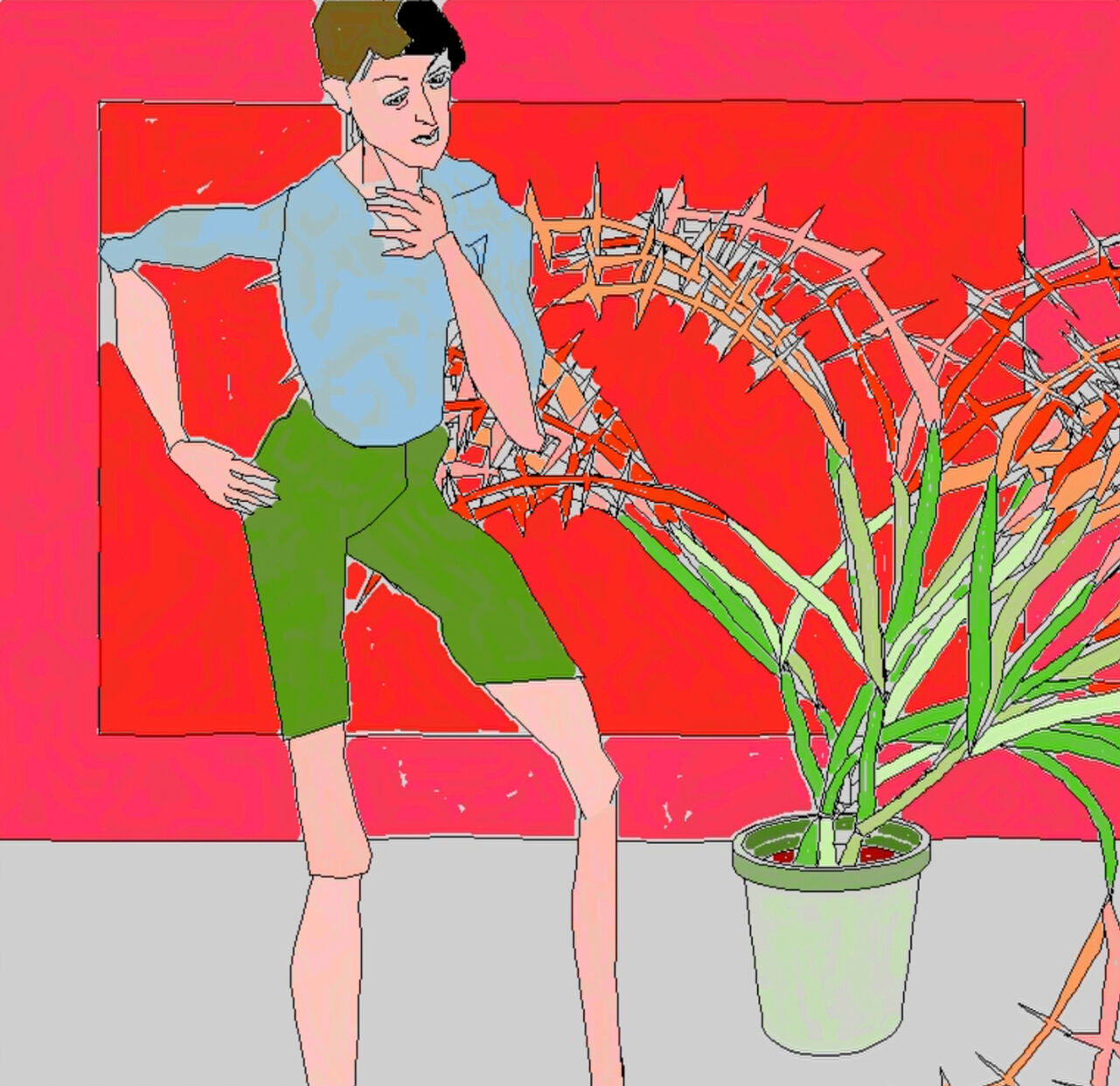
Narrator: Welcome to Harold Cohen: AARON. Cohen imagined an artmaking software in the late 1960s, which he named AARON in 1973. It was the first Artificial Intelligence program designed for making art.
Christiane Paul: I'm Christiane Paul, Curator of Digital Art at the Whitney Museum. What distinguishes Harold Cohen's work is that he tried to get to the core of art making itself, and what it means to be an artist by creating a software for making art and thereby also generating an abstraction of what the artistic process is like. So, this obviously is a remarkable and extremely ambitious endeavor. It is almost impossible and Harold devoted his life to it.
David Lisbon: Hi, my name is David Lisbon. I'm the Curatorial Assistant who worked on the Harold Cohen: AARON Show with Christiane Paul. AARON is a software that progressed over time to envelop more and more of what Cohen imagined human touch to be across analog mediums, but also across the digital screen.
Narrator: In the past year or so, text-to-image programs like DALL-E, Midjourney, and Stable Diffusion have been in the news a lot.
Christiane Paul: Cohen's AARON represents an earlier phase of artificial intelligence practice, when AI systems were more symbolic, meaning they were manipulating their own formulas and rules. And today's AI programs are more statistical, meaning they are trained on and learning from existing data sets. For example, specific painting styles, such as surrealism.
Narrator: Cohen’s rules weren’t just intended to create images—their aim was to create art, with expressive qualities and aesthetic value. Cohen had already achieved success as an abstract painter in 1960s London. He began experimenting with coding as a means of making art in 1968, when he began teaching at the University of California, San Diego. Some of his earlier works are on view in the room to the right, through the door by the window.
Harold Cohen, AARON KCAT, 2001. Screenshot. Artificial intelligence software. Dimensions variable. Whitney Museum of American Art, New York; purchase, with funds from the Digital Art Committee 2023.20. © Harold Cohen Trust
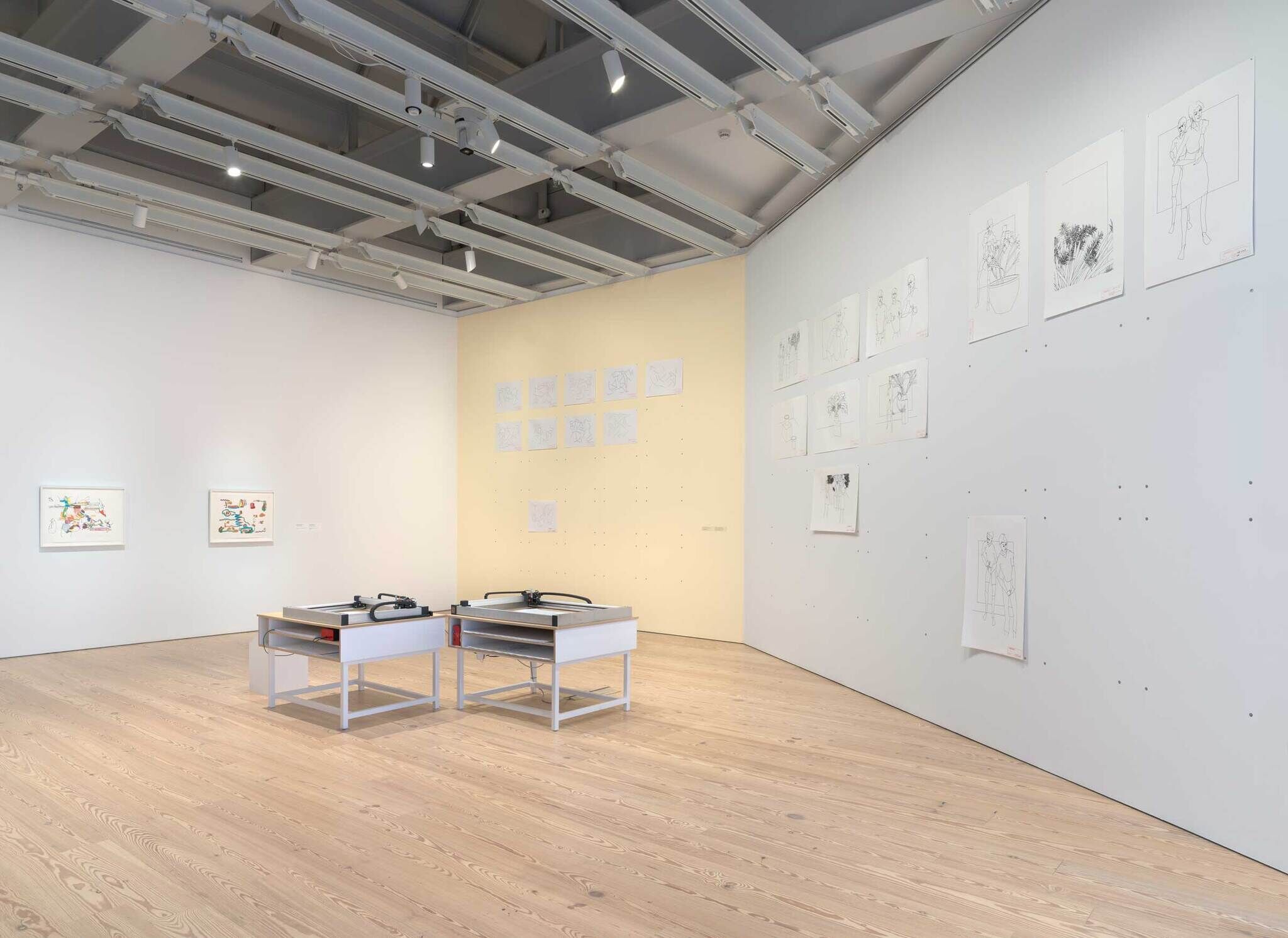
Christiane Paul: Two of the stages of AARON's evolution are being drawn in the gallery here with the plotters that are modern recreations of the drawing machines that Harold Cohen would build. And over the course of the exhibition, the drawings that are produced on a daily basis are hung on the gallery walls, which is something that Cohen himself has done in exhibitions.
Narrator: One of the plotters executes abstract line drawings.
Christiane Paul: We are starting with one of the earliest versions of Cohen's software, the Mazes, which are colored lines that are partitioning the paper. The idea of the Mazes was to partition the space of the drawing without ever enclosing any part of it and making it possible that every area of the drawing could be reached by navigating through the maze without crossing a line.
Narrator: The Mazes may be simpler compositionally than Cohen’s later works. But at the time he was programming the software for them, they required some remarkable feats of imagination. Initially, as an art professor at UC San Diego, he didn’t even have his own computer.
Tom Machnik: He would have to go late at night, past midnight or so, down to the university because nobody's using a computer at that time and he can have access to it
Narrator: Tom Machnik met Cohen later, in 2008. He became the artist’s assistant and archivist.
Tom Machnik: So the computer at that time, he didn't even have a computer screen. When he's typing code, he's at a typewriter device, he's typing, punching cards and these cards go into a machine, and then the machine outputs.
Narrator: The other plotter in this room executes a program that Cohen developed later, after he had coded AARON for figuration. What the two plotters have in common is that the drawings they produce are a collaboration between Cohen and Aaron.
Christiane Paul: Harold Cohen used to joke that he will be the only artist who ever posthumously makes work.
Narrator: Christiane Paul.
Christiane Paul: And while there is some truth to that in the fact that we are seeing AARON producing work here in the gallery, it is questionable if that work is a real Harold Cohen or a real AARON. Because there were always different elements in terms of the collaboration between the two that made this work happen, and that was Cohen himself and his code, the process of creation of AARON and the AARON software. And only these three elements together, I would argue, can generate a real AARON or real Harold Cohen. So, there also is a good argument that AARON effectively ended in 2016.
Installation view of Harold Cohen: AARON (Whitney Museum of American Art, New York, February 3–May 19, 2024). From left to right: Untitled, 1982; Untitled [Amsterdam Suite], 1978; Active plotters drawing images from different periods of the AARON software; Mazes, 1971–72 (restored 2023); KCAT AARON 2.1.010719, 2001. Photograph by Ron Amstutz
.jpg)
Narrator: This is a lithograph, produced by hand, but rendering a computer-generated image. In the late 1970s, Cohen did a series of works that used this method to transfer AARON’s creations onto paper and then hand-colored them. It is typical of Cohen’s approach to translating AARON’s creations onto paper in the late 1970s.
Paul Cohen: To me, these always look like what you see through a microscope if you're looking in pond water, they look like little bacteria and various kinds of bugs and things. And they always to me have a two-dimensional look as if you're looking at a microscope slide from the top.
Narrator: Paul Cohen is the artist’s son, and an AI researcher.
Paul Cohen: For Harold, these were really important explorations of some of the rules of making evocative images. Those rules included things like the difference between figure and ground, the difference between open and closed shapes, how color interacts when it butts against another color, the use of white space, the addition of some mechanical aspects like the crosshatching.
And Harold was inspired here by two sources. One is Native American rock carving where the material has quite a lot to do with what gets carved. That is, there are natural constraints in the material that he was interested in emulating. The other source was children's drawing. And what you see in kids' drawings are these very early distinctions between open and closed things that look vaguely human-like, but not really human-like, things that look like potatoes that the kids say are actually a car, that kind of thing, right? So he got really interested in how children's drawing developed and you can see some of those influences in this picture.
Harold Cohen, Untitled [Amsterdam Suite], 1977/Jan'78. Colored pencil on lithograph, 22 × 28 3/4 in. (55.9 × 73 cm). Whitney Museum of American Art, New York; gift of Robert and Deborah Hendel 2023.151. © Harold Cohen Trust
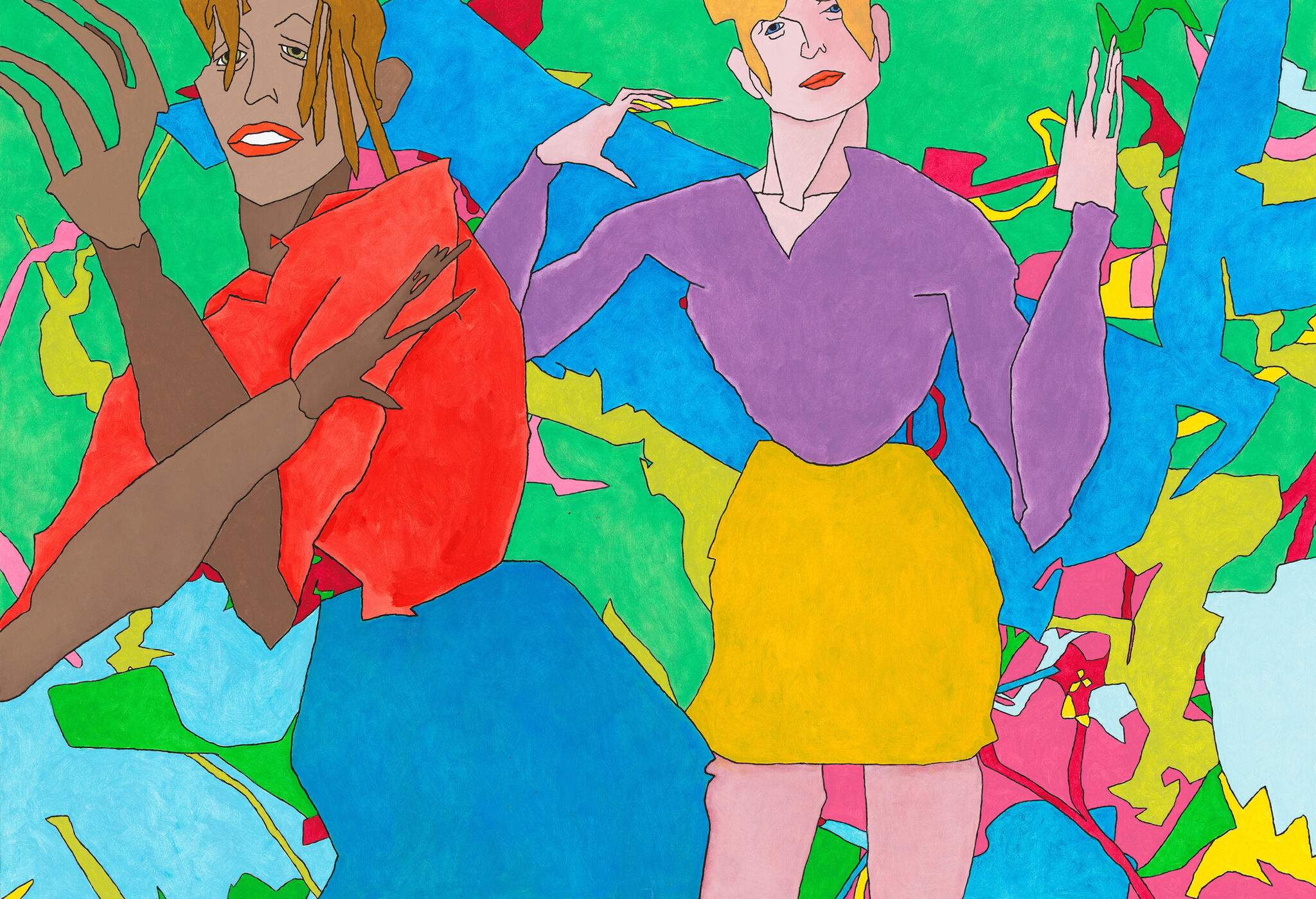
Narrator: In Stephanie & Friend, we see evidence of the thinking behind AARON.
Paul Cohen: Very, very early in Harold's career, he became convinced that a machine would never generate an image that looked like it had human intention behind it unless that line looked like it was made by a human.
Narrator: Paul Cohen.
Paul Cohen: So there are no straight lines, there are no Bézier curves, there are no logarithmic spirals. What there is this really rather marvelous algorithm for making a line that looks like it was drawn by a person.
Narrator: But to make images like this one, Cohen had to do more than think about how to represent a believable human. He had to consider the nature of representation itself. Christiane Paul.
Christiane Paul: Any kind of software created specifically for the purpose of art making would need to have a certain kind of knowledge of the world and of the objects in it. It would need to understand how these objects are being placed and what basic rules of representation are, and this requires a procedural kind of evolution of rules and formula.
Paul Cohen: One thing that Harold had to deal with was the whole issue of occlusion. How do you put people or plants in a really complicated scene like this and make sure that all of the occlusion is done right? So you want a human and you want a human to be waving and you want the human's arm to be in front of the plant, but you also want a branch of the plant to be in front of the human. It turns out that's not an easy thing to do to draw a picture so that you don't mess any of that up, especially when it's a really complicated picture.
Narrator: Cohen essentially had to teach AARON to handle these complexities.
Paul Cohen: So basically what you have to do is you have to draw the picture, and Harold used to say, "You have to draw the picture from front to back," Everything that you see in front has to be drawn first and you fill in the back as you go backwards into this third dimension.
Harold Cohen, Stephanie & Friend, 1993. Acrylic and plotter pen on canvas, 54 × 78 1/4 in. (137.2 × 198.8 cm). Whitney Museum of American Art, New York; gift of Robert and Deborah Hendel 2023.144. © Harold Cohen Trust
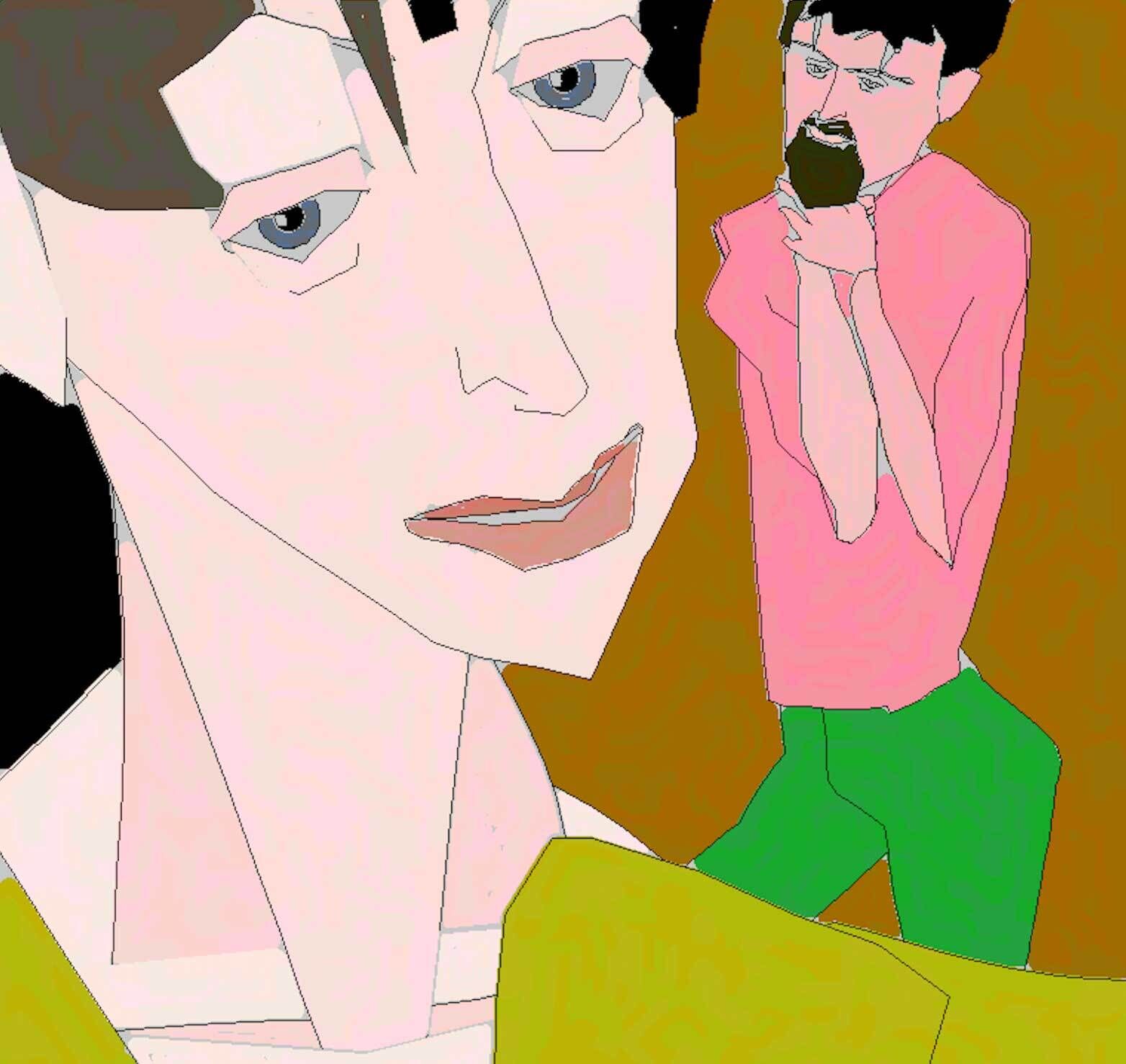
Narrator: This projection, AARON KCAT, follows the earlier phase of plotter drawings and paintings.
David Lisbon: My name is David Lisbon. I'm the Curatorial Assistant who worked on the Harold Cohen: AARON Show with Christiane Paul.
Although these images seem sort of very similar, none of them are exactly the same. And so you're really seeing a software produce thousands and thousands of images in real time using not a set of images, but a set of rules. And that's why these images feel so similar.
Narrator: In this projection, we can see some of the differences between AARON and current text-to-image programs that draw on artificial neural networks.
David Lisbon: One of the rules that Cohen implemented into the expert system is the five digits. And artificial neural networks can come close because they understand the concept of a hand as sort of a central piece with its multiple digits. But because the concept of digits isn't a finite thing for an artificial neural network, they work to approximate what they see across images. Whereas with Harold Cohen, every figure has five digits and sometimes those digits are exaggerated, but it shows you that the expert system is more robust when it comes to creating barriers. An artificial network is really good when it comes to creating a mean of a bunch of different images, but that mean doesn't have rules. And so that's how we see these kind of distorted, uncanny valley images that we think of when we think of AI in a contemporary sense
Harold Cohen, AARON KCAT, 2001. Screenshot. Artificial intelligence software. Dimensions variable. Whitney Museum of American Art, New York; purchase, with funds from the Digital Art Committee 2023.20. © Harold Cohen Trust
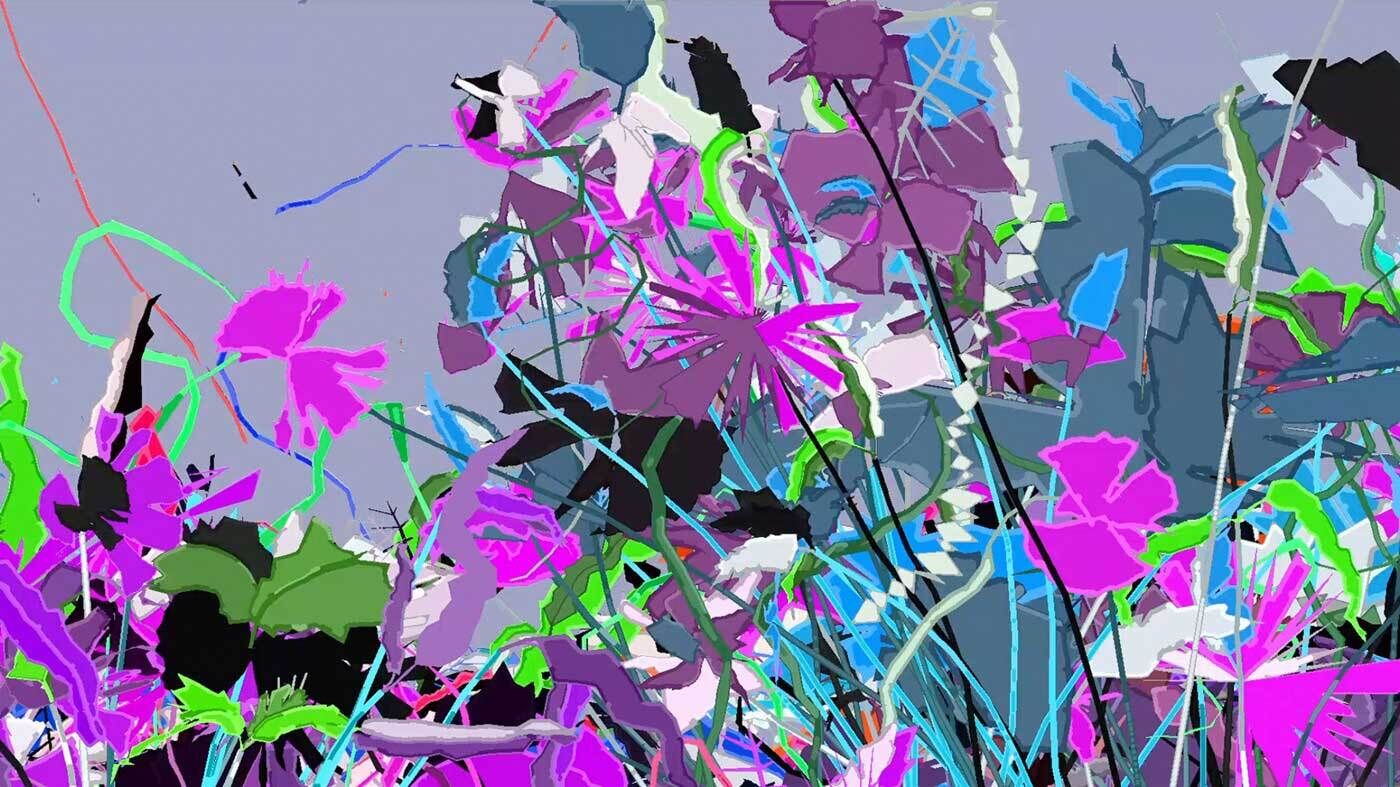
Narrator: Cohen called the work projected here AARON Gijon.
Christiane Paul: In the later years of his career, Cohen became increasingly focused on depicting plant life. It became a means of working semi-abstractly. In some ways, this was a return to the beginnings of his career as an abstract painter in the 1960s. But early on, Cohen had become frustrated by the limits of painting. He wanted his paintings to capture a sense of systems. It was this limitation that drove him to working with computers to make art—and it’s part of what makes his work seem vital to artists working today.
Stephanie Dinkins: I'm always thinking something about an unveiling of a system, in a sense, and when I say in a system, whether that's a human brain or the mind brain connection, or in this case, the mind software connection that comes through, that's really interesting to me, because it doesn't feel detached. That's where I feel like this depth, to me, there's an emotional context to it as well in my viewing of it.
Narrator: Stephanie Dinkin’s own AI artworks are in the Whitney’s collection.
Stephanie Dinkins: That's something I also find very, very attractive of Cohen's work, the way that it feels like this partnership where the human brain is still pretty evident in massive ways, because sometimes in art, especially computer-based art, I think we lose the human once the computer gets ahold of it, and this holds on to whatever was going on in Cohen's brain to me, and I love that.
Harold Cohen, AARON Gijon, 2007. Screenshot. Artificial intelligence software. Dimensions variable. Whitney Museum of American Art, New York; purchase, with funds from the Digital Art Committee 2023.21. ©️ Harold Cohen Trust
0:00
0:00