Dyani White Hawk
2024
On view
Floor 8
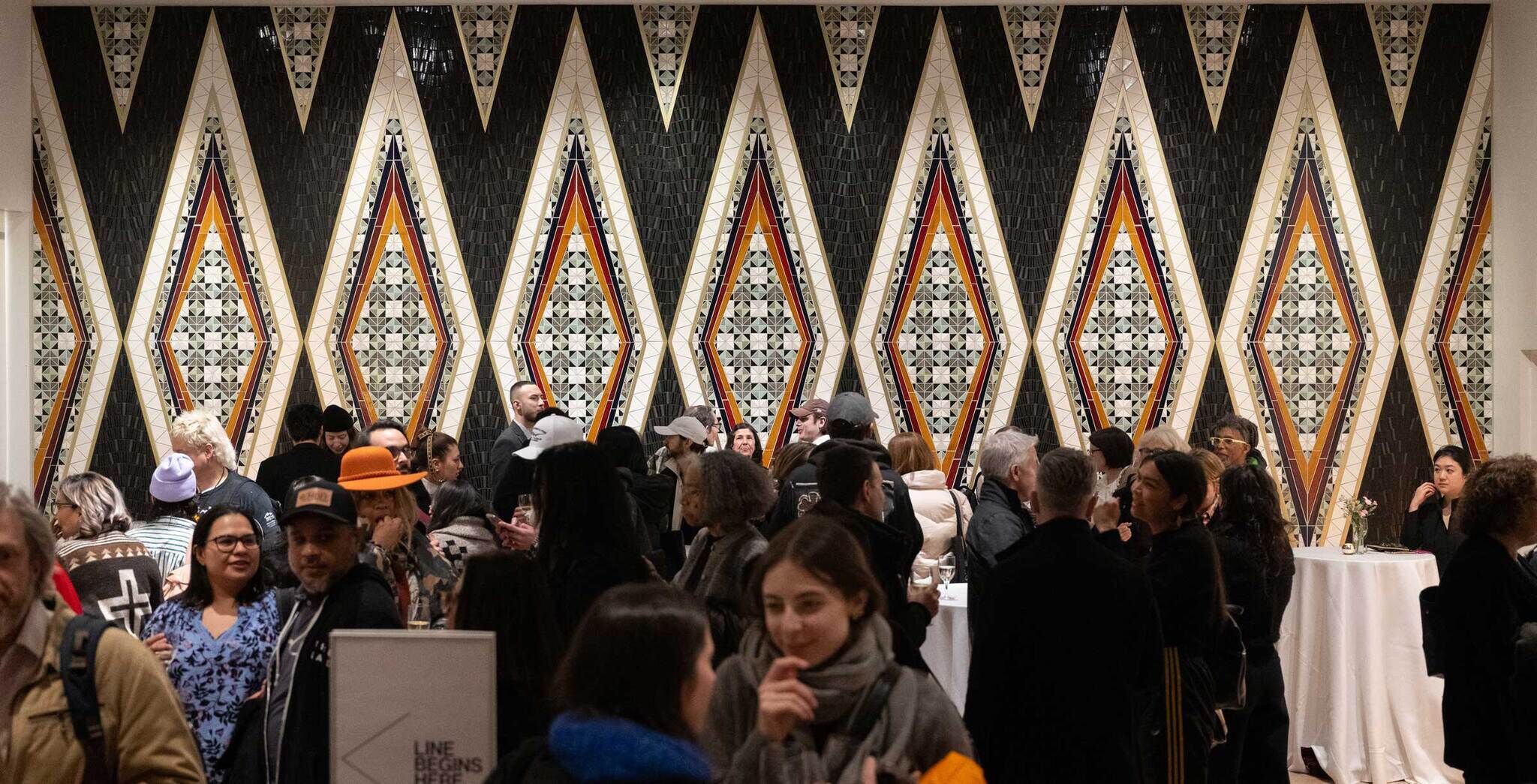
Narrator: Spanning the entire west side wall of the 8th floor studio bar space is a large mosaic created by Sicangu Lakota artist Dyani White Hawk. The entire work is 14 and a half feet tall, by almost 31 feet long.
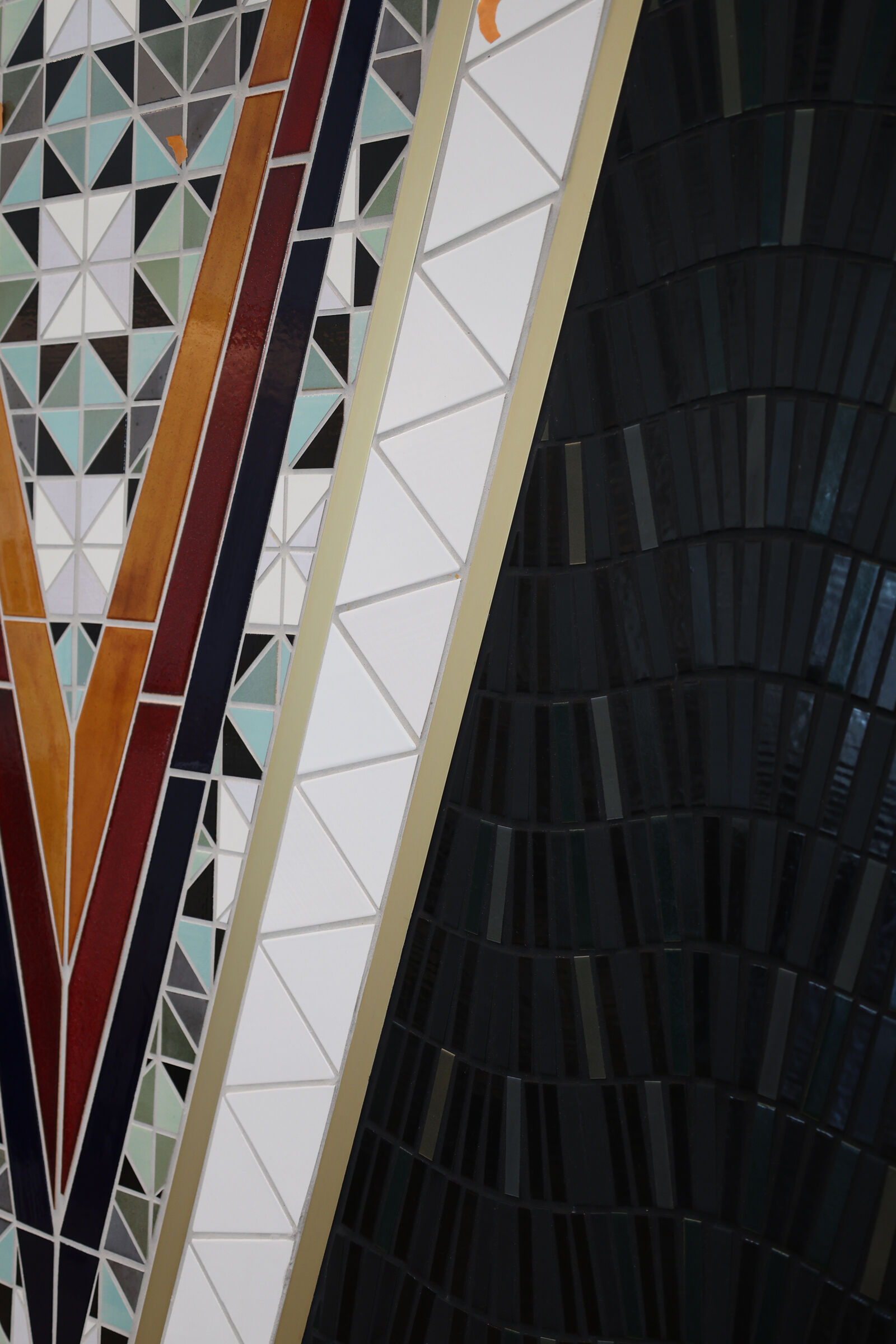
The mosaic pattern is a configuration of seven full diamond shapes that span the horizontal length of the wall and are flanked on the left and right by two half diamonds. In the center of each diamond, the artist has embedded two distinct patterns side by side. One is a column of segmented white and cream squares, stacked on top of quartered diamonds made of jade and light blue tiles. The other is a column of tiles with quartered diamonds in darker green hues on a black background, alternating with a steel-colored tile in the shape of a simplistic house outline, which the artist calls “Tipi Door.” The Tipi Door tiles are outlined with a thin satin brass. Three bands in the same diamond shape are embedded in this green and blue pattern; the bands thicken in width toward the top and bottom points and thin toward the left and right points. The innermost band is a warm mustardy bronze with an aged patina, the middle band is a deep red garnet, and the outermost band is a saturated dark blue. There is one final layer of the green and blue tile outside of these three bands, outlined in a thicker band of the same satin brass which outlines the Tipi Door tiles.
The next layer, moving outward from the center of the large diamonds, is a thick boxy outline of the diamond in a repetitive pattern of white triangle tiles. They alternate between the point of the triangle facing up and the point facing down, snugly embedded together, and this pattern fills in the shape of the diamond and is outlined by a thick shiny brass band. Each instance of this white triangle outline meets at the left and right corners of the large central diamonds, meaning that each rippling layer outward from this point does not create a whole diamond, but looks instead like the bottom and top halves of separate diamonds nestled between the central completed diamond shapes.
Moving outward, the next layer is filled with wavy lines of different shades of black tiles and is also outlined with a thick satin brass band. Nestled next to this brass band is a layer of the same blue-green-white pattern which fills in the center of the large diamond shapes. All four sides of the mosaic are outlined with the thick satin brass band.
Regarding the use of the bold geometric abstraction in her work, the artist, Dyani White Hawk, has said:
Dyani White Hawk: It’s interesting because the way that abstraction is taught in academia is this idea that European and European-American men founded abstraction, which is just completely false. Abstraction is a human practice that has been practiced across the globe for millenia, way beyond and before the ‘40s and ‘50s. But the names of Native artists and often even the tribes that the work is coming from is not spoken to, is not given the same kind of relevancy, importance as their non-Native counterparts. So my work, really, is meant to pull out and honor those intersections.
Dyani White Hawk, Nourish, 2023 (detail). Handmade tile mosaic. Whitney Museum of American Art, New York; purchase with funds from the Whitney Acquisition Fund
0:00
0:00