Natalie Ball: bilwi naats Ga’niipci
2023
Natalie Ball: Dwaa neepga [what’s happening?], my name is Natalie Ball. My work always calls back to narrative, and my work always calls back to community, to ancestors, to right now, and identity.
To claim my Blackness doesn't disqualify me or water down how Indian I am even though it does when you're thinking about blood quantum and blood politics that are used to self determine who we are as a tribe or a nation or as a people. So I'm using that, “we smell like the outside,” of colloquialism to push back against this really static idea of Indian.
My idea for materials in my studio was always to deconstruct it, to make new meaning from it. To choose materials that are charged with meaning, to choose materials that are strong markers for Indian. That say Indian really loud. What's more Indian than a ribbon skirt? What's more Indian than a star quilt? That's where the work really starts at. And the narrative informs the materials.
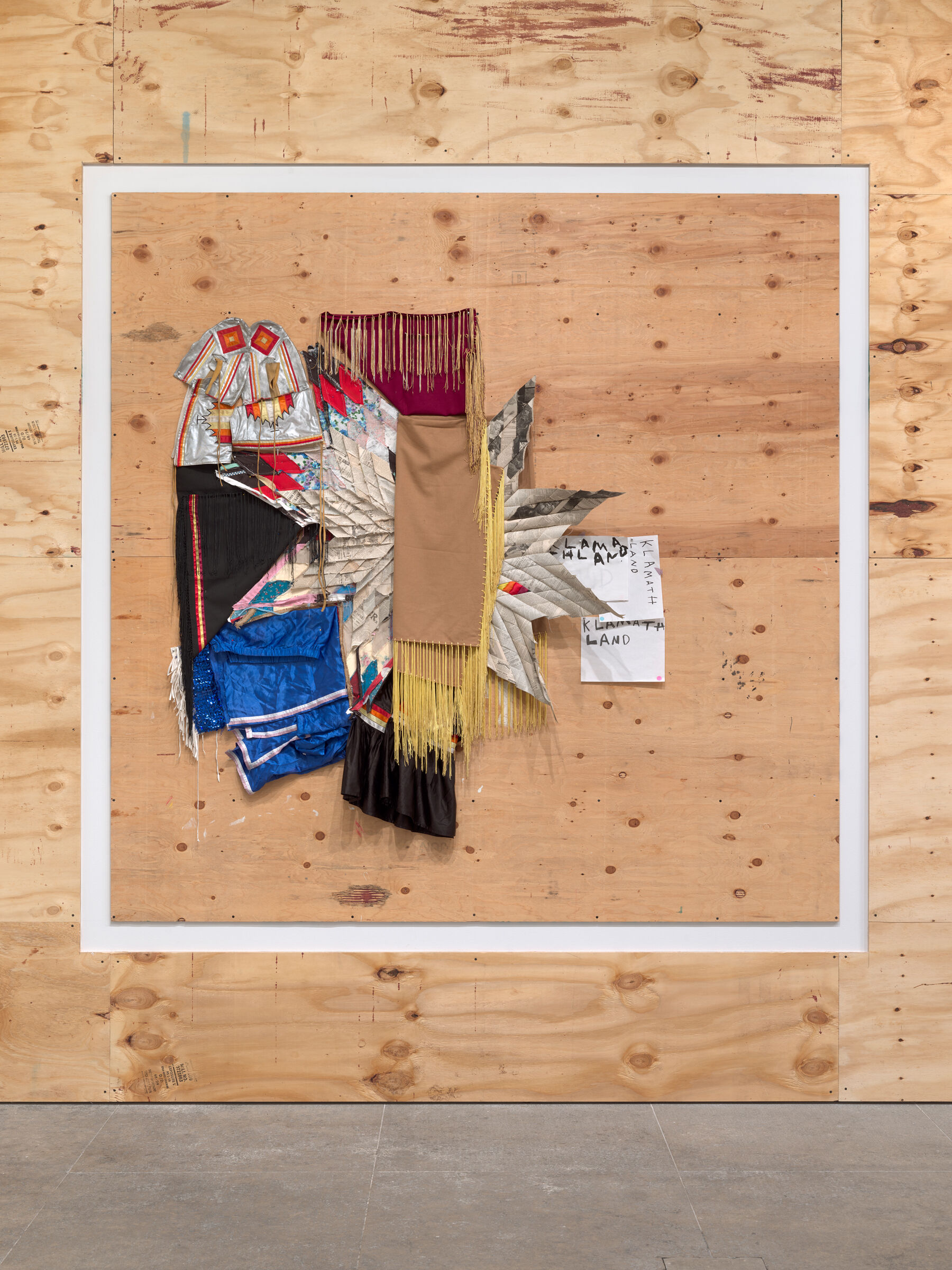
Narrator: One work where Ball literally stitches historical narratives into carefully chosen materials is the plywood-mounted work with a paper quilt, which is on the north gallery wall, to the right after you enter.
Natalie Ball: I've been sitting on these Modoc War newspapers or these newspapers that cover the Modoc War from 1872 to 1873. I've been sitting on those for a while. I am Modoc and those materials, I just never knew what to do with them and now I do. I've been collecting quotes from my auntie, top quilts from my auntie, she's passed now. This is the last one that I have of hers. And I just feel like you can't think about quilting without thinking about Black history in America.
Narrator: Like the quilts, the hanging works collage different objects together to complicate their meanings. Ball describes the animal hides in particular as continuations of the idea brought forth by the exhibition’s title, which in maqlaqsyals—the Klamath peoples’ language—is “bilwi naats Ga’niipci.”
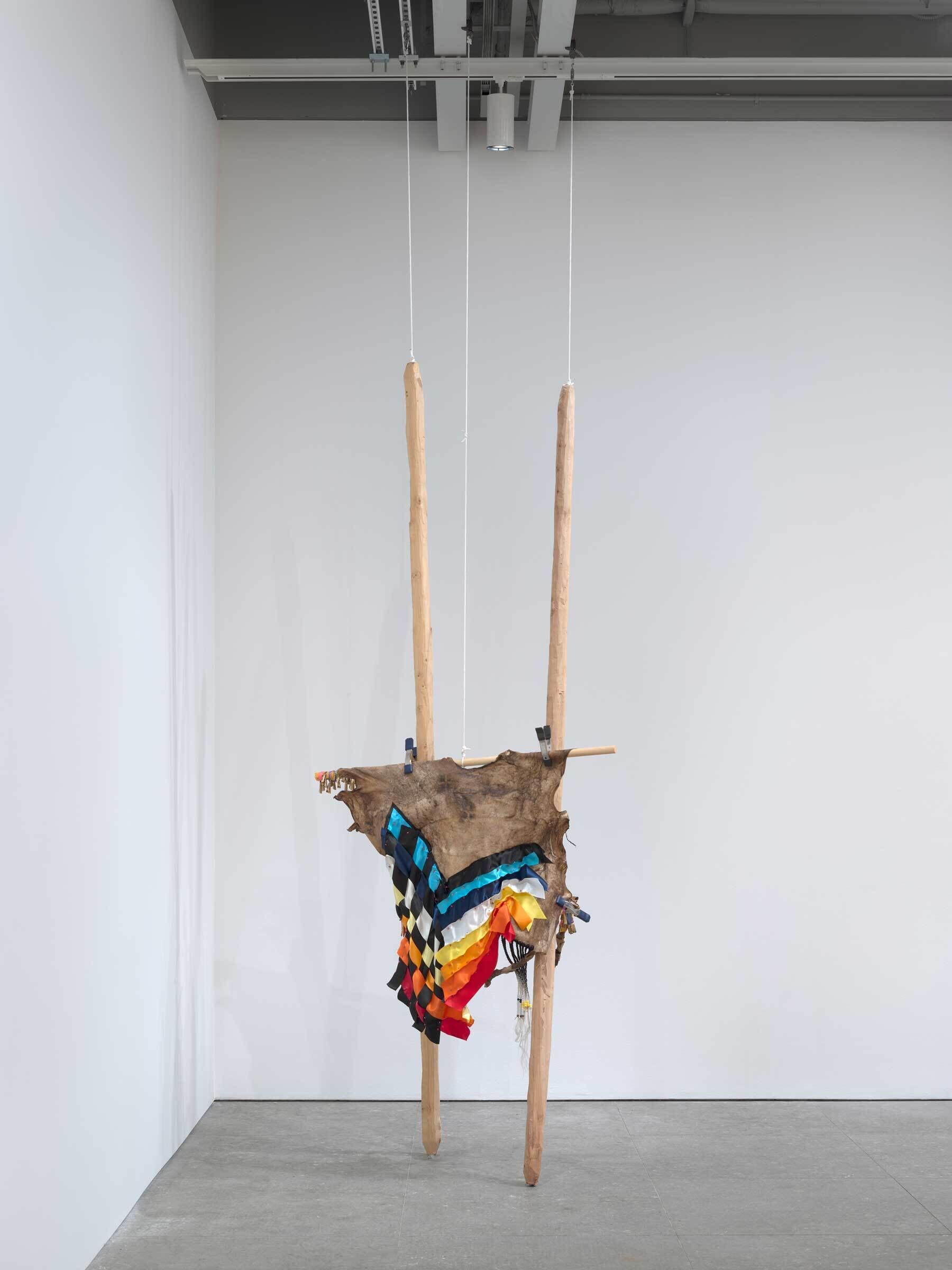
Natalie Ball: So I started this work last year thinking through the animals that come from the outside that come home into the inside of my home.
The community home here where I'm from, in Chiloquin, Oregon. It's a Native American community. It's my tribal community. So when your deer elk is hunted, it comes home gutted, it hangs and it cures a while and it's hung from its hind legs onto a pole that extends from a rope to the ceiling or some sort of bar usually in your garage where it cures for a few amount of days and it's covered with fabric and it hangs there.
I think this idea of Pan-Indianism, I think this idea of my Blackness being a way to disqualify me from belonging in these spaces, and to exist in this space of being othered in the Indian community is where the beauty of the work lies. I think the really fun part about this and the really beautiful thing about being who I am is knowing that belonging looks really different in both communities. I can honestly say that I'm free in this space to make this kind of work, that's critical. So when I'm thinking through this idea of belonging through the work, it allows me to be free with my materials as well.
Usually you don't rip up your auntie's blanket who's passed. You don't rip up a baby blanket that was given to your son, through community. But I do because I just feel like everything's sacred in here and nothing is sacred in here. Everything can be deconstructed here to make meaning that I feel is really important because it holds a certain kind of space that needs to be held not only for me and my babies, but also for those that are coming, that hold the same kind of space that I do.
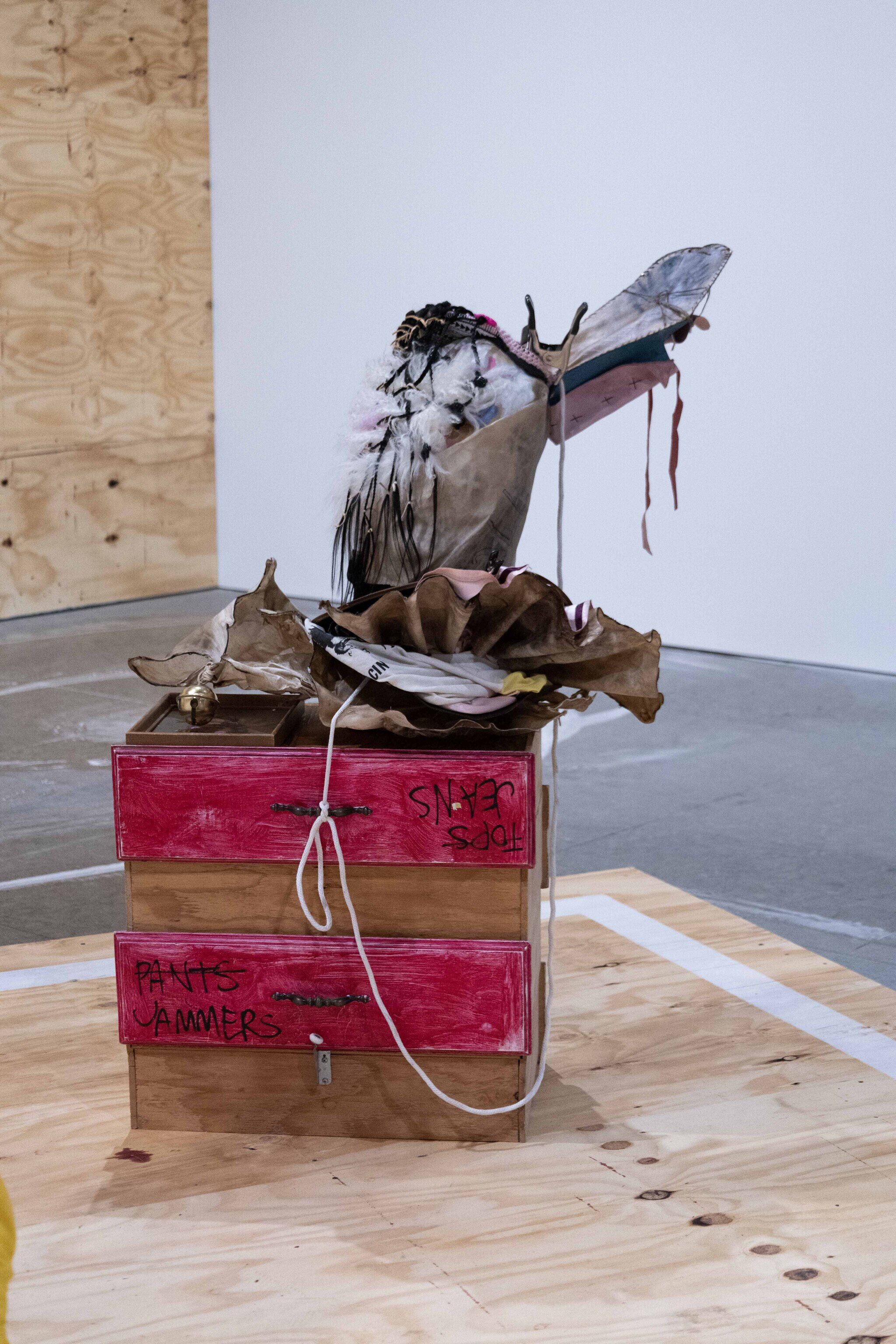
Narrator: Natalie Ball: bilwi naats Ga’niipci is located in the Lobby gallery of the Museum, which is free to enter. To access this gallery, you are welcome to walk north through the hallway on the far east side of the Lobby. Upon entering, you will notice a multitude of metal folding chairs are dispersed throughout the space; visitors are invited to move them and sit in them at will. Directly in front and to the left of the entrance, the sculpture Title [chest of drawers - power object 1 and 2 rest inside of a drawer, placed on top of dresser], is stanchioned off by thin, white wire stanchions. A large, 4 inch tall platform in the shape of a blocky X has been situated in the center of the room. Two hanging works and two smaller sculptural works are highlighted on this platform; visitors are not intended to step on the platform. A verbal description for one of the hanging works, Title [Hanging sculpture 2, one rib], is included on this mobile guide.
The far north wall is clad in unfinished plywood. The work mounted on this wall, Title [Plywood mounted work with paper quilt], also has a verbal description available on the mobile guide. Moving clockwise around the platform in the center of the room, in the far southeast corner of the gallery leans Title [Hanging sculpture 3, ribs and poles], a sculptural piece which includes a hanging element and two long poles made of wood which are angled back toward the wall. This work is also preempted by thin wire stanchions.
The exhibition is made up of only this one gallery space, and visitors are invited to exit through the same hallway on the south side of the space. To access interviews with the artist and curators, as well as the verbal descriptions, scroll through this audio guide or go to whitney.org/guide. Thank you for joining us!
Installation view of Baby Board by Natalie Ball, 2023
Joseph Dupris: Natalie Ball?am s’os’atiipgas, geeks hesl?a. Natalie giwlGa tq’op’oowatga coy wonip’ni tew’nip’ant ndan ?iLoolatk. “bilwi naats Ga’niipci” honk seesatk. Natalie?am honk sa s?as?aaMaks s?abiiya. Hemkanks geeks mna s?aaMaks s?aba. dadaa honk “naat” s’os’atiipgas seesatk, Natalie, hasaswaak’ya honk baats Natalie maans’ni s?aaMaks, maqlaqs,
bosbasdin, coy takbasdin, s?ott’iiya honk sa maqlaqs?am ciisGeeniiyat. Ball c’elks’la, skodas’la,
beybas’la, coy papGas’la. st’ek’lGa, sLo’la, coy sqena naanokdwaa, coy s?ott’iipga honk dwaacgas, maqlaqsas ciiya coy maans’ni maqlaqsas. Natalie s?ott’a lac’asdat coy yay’aa’ka Gogedat. stinta mna honk sa “studio” maansni maqlaqs, le waq s?aaMaks, coy honk sa mna hemkank’la. “bilwi naats Ga’niipci” ?ams sa has?iiwakt, lobiidaa’nat gatba. Glegwapk honk sa basdin?am hohas?is, honk sa sle?wapgok. ho’mas gi, s?os?att’iipgas geeks sa Walp’aqtwapk, maans’ni maqlaqs.
Installation view of ...with a hat to match! by Natalie Ball, 2023
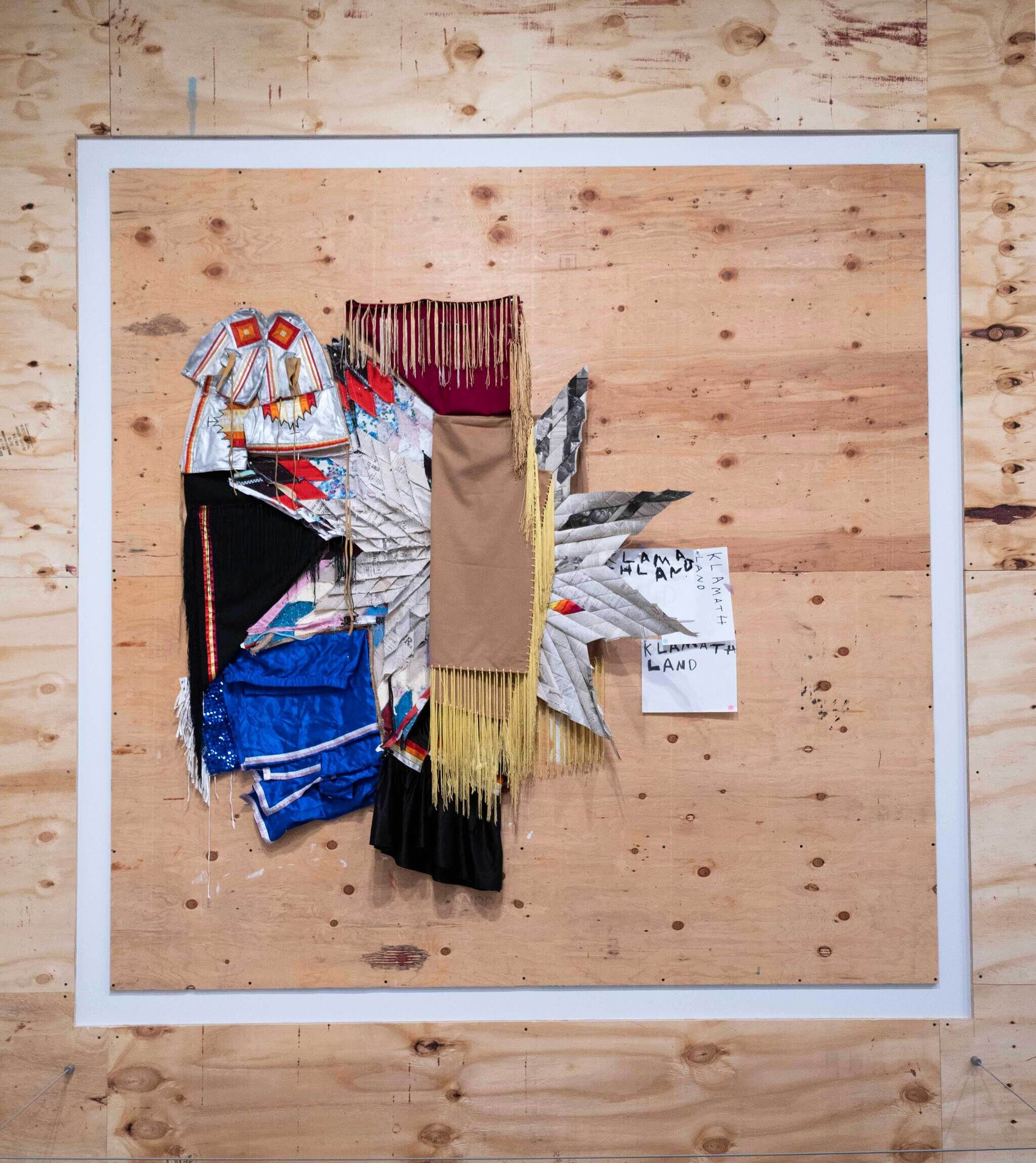
Narrator: This is Dance Me Outside, which is double dated with 2009 and 2023 because the artist, Natalie Ball, utilized a star quilt which was previously part of an earlier work from 2009, but created this work in 2023. There are many different materials collaged together to make this work, including plywood, polyester, cotton, sequins, newsprint, burlap, yarn, leather, acrylic, oil stick, and wool. The work is 8 feet by 8 feet wide, and the three dimensional collaged aspects create about 5 inches of depth.
All of the fabric and paper components of this sculpture are affixed to a wall-sized slab of unfinished warm yellow plywood dotted with darker brown knots. Beginning at the top center of the work, a burgundy rectangular piece of fabric is mounted to the plywood; its trim of sparse yellow fringe is draped in front of and to the right of it. Moving counterclockwise to the top left, a pair of moccasins hang with the toes pointing up and the shafts of the boots hanging down; they are primarily a whitish gray color, accented with satin-y ribbon work in red, orange, and yellow. Regarding the striking use of these colors, the artist said:
Natalie Ball: They're like fire colors. Every native person probably has some sort of fire colorway in some sort of bead work, ribbon work, quilts.
Narrator: Below the moccasins a large swath of black fabric with a red and yellow stripe running along the leftmost edge is tacked to the plywood. Two points of a large, eight-pointed star sprawl across the fabric. Below the black fabric is a smaller rhombus of shiny, sequined royal blue fabric. A cascade of gray thread falls as if in a ponytail from the upper left corner of this fabric. Continuing counterclockwise, a tall rectangle of deep blue fabric with white piping is layered behind the star; it looks to have a texture similar to nylon or polyester, like if you were wearing it, it would swish as you walked. To the right of this blue nylon is a ruched bit of black fabric, which is also hanging mounted behind the star. This black fabric is hung in a way such that it resembles a skirt, billowing around itself, and it is shot through with four stripes of satiny ribbon sewn in a stack of red, orange, yellow, and white–more fire colors.
In the most foregrounded center of the work, below the burgundy rectangle at the top, light brown burlap fabric, also trimmed with yellow fringe, is draped over a large, central eight-pointed star shape. The star shape is resting on top of all the aforementioned fabric pieces. This large feature of the sculpture was taken from a star quilt, and is made up of many different textures and colors of quilted fabric and paper, sewn in a decorative pattern of tessellated diamond shapes. The paper quilted into the star is from newspapers the artist has collected with coverage of the Modoc Wars. The Modoc Wars refers to the conflict which took place from 1872-1873, in which the United States Army violently displaced the Modoc people. Today, the Klamath tribes include the Modoc, Klamath, and Yahooskin-Paiute people. On the far right in the center, mounted partially behind the star, is a piece of white paper with thick, handwritten letters in black felt tip pen; the letters “L-A-M-A-T-H”, and the word “LAND” are visible. This paper overlaps a larger, creamier piece of paper which, on the couple of inches which peek out on the right, has handwriting in a thinner, black marker reading “KLAMATH” clearly; the tops of the letters for the word “LAND” can be barely discerned from beneath the paper on top. Moving slightly down and to the right, in a different handwriting alternating between thick and thin but in noticeable black marker, the phrase “MATH” is stacked on top of the phrase “LAND”, the words made partially indiscernible by one of the points of the star shape. Taken altogether, it is as though three separate people wrote “KLAMATH LAND” on three irregularly shaped pieces of paper and those pieces of paper were tacked to the plywood board. These assertions of Klamath land, taken in contrast to the newsprint detailing the Modoc Wars which is quilted into the star, offer resistance to dominant narratives of settler colonialism.
Installation view of Dance Me Outside by Natalie Ball, 2009/2023
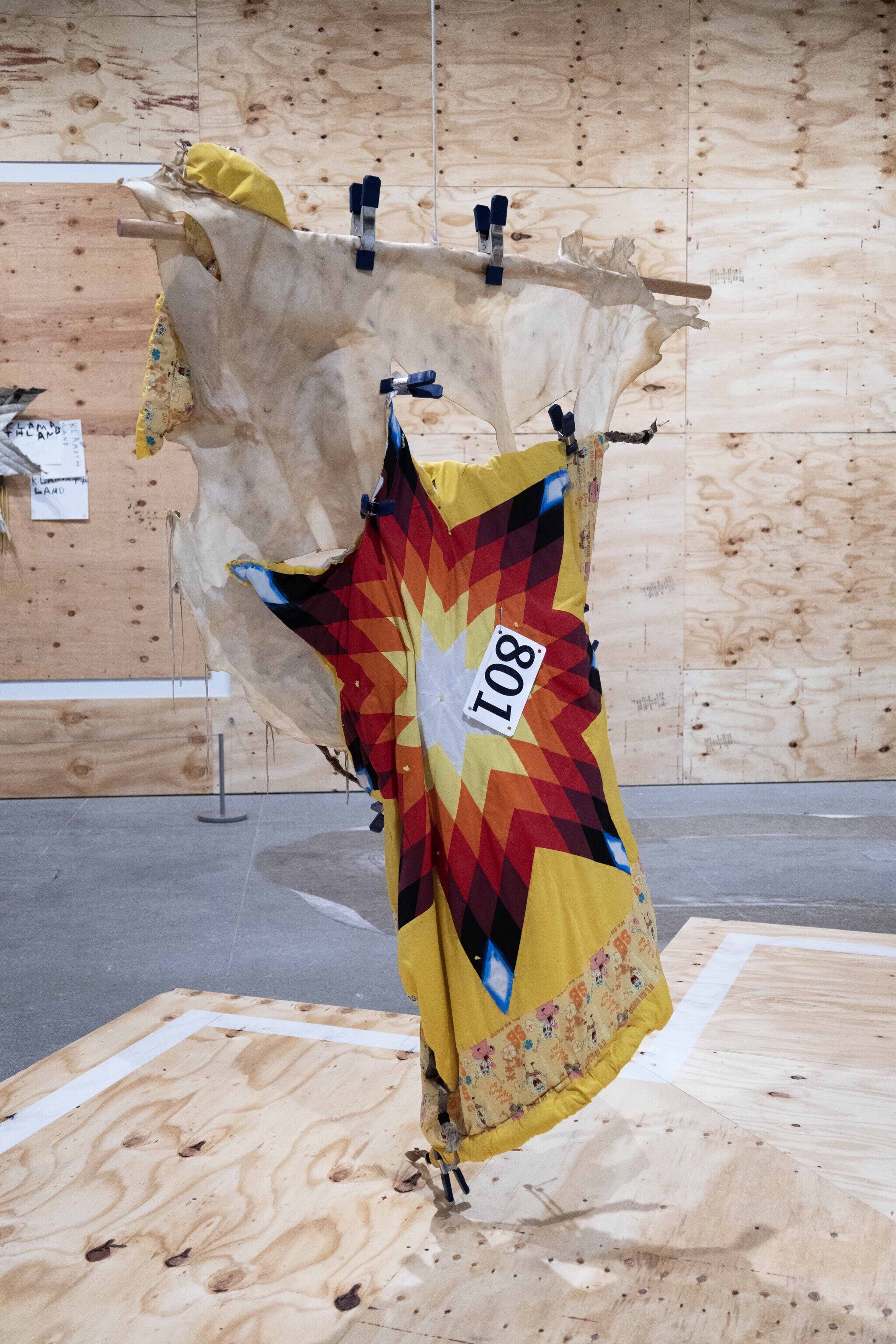
Narrator: This is ribbon skirt There’s Indian and then there’s Indian., from 2023 by Natalie Ball.
Natalie Ball: So you're looking at a hanging sculpture that hangs from the wall by a white rope that's tied onto a horizontal pole. And from that horizontal pole is a draped and dried elk hide that's cut into a star pattern at the top. But from that hangs a textile piece. So the textile, the star quilt is cut out and only the star remains, and the star quilt is hanging from the elk hides by three clamps. My Aunt Peggy chose the colors. They're very much Christmas colors. I know she loved Christmas and I love that about her. But the colors are tones of green, olive, evergreen even, and reds.
Narrator: Star quilts have particular significance to many Indigenous North American communities, and feature imagery of a many-pointed star prominently in their design. Two multicolored stars of this quilt have been cut out and layered on top of one another, such that a few inches of one star on the bottom expand past the borders of the star on top. The bottom points of the stars have also been cut off; only one point on the top and one point on either side remain. Large blue spring clamps hold the points of the tops of the stars to the edges of the elk hide.
Natalie Ball: And the cutout part of the star quilt, the edging, the edges are folded and nested towards the bottom of the hanging sculpture. And what gives that part form and shape are quilted Modoc newspapers that are on the Modoc War. So the star quilt is halved and folded. And then from that are the ribbons. And there's 1, 2, 3, 4, 5, 6 ribbons that are pinned horizontally to that star quilt. Top to bottom is a dark red, a red, orange, yellow, white, and a royal blue.
Narrator: The ribbons are made of smooth, shiny satin. The edges of the star are connected with two gray three-strand braids made of elk hide; these braids extend outward in a semicircle shape. The vibrant color of the bottom half of the hanging sculpture contrasts strongly with the cream-colored elk hide on the top.
Installation view of Natalie Ball: bilwi naats Ga’niipci (Whitney Museum of American Art, New York, November 17, 2023 – February 19, 2024). ribbon skirt There’s Indian and then there’s Indian., 2023. Photograph by Ron Amstutz
0:00
0:00