Feelings Are Things: A Sixties Surreal
Dan Nadel, Laura Phipps, and Elisabeth Sussman
Related exhibition
The exhibition Sixties Surreal is on view September 24, 2025–January 19, 2026.
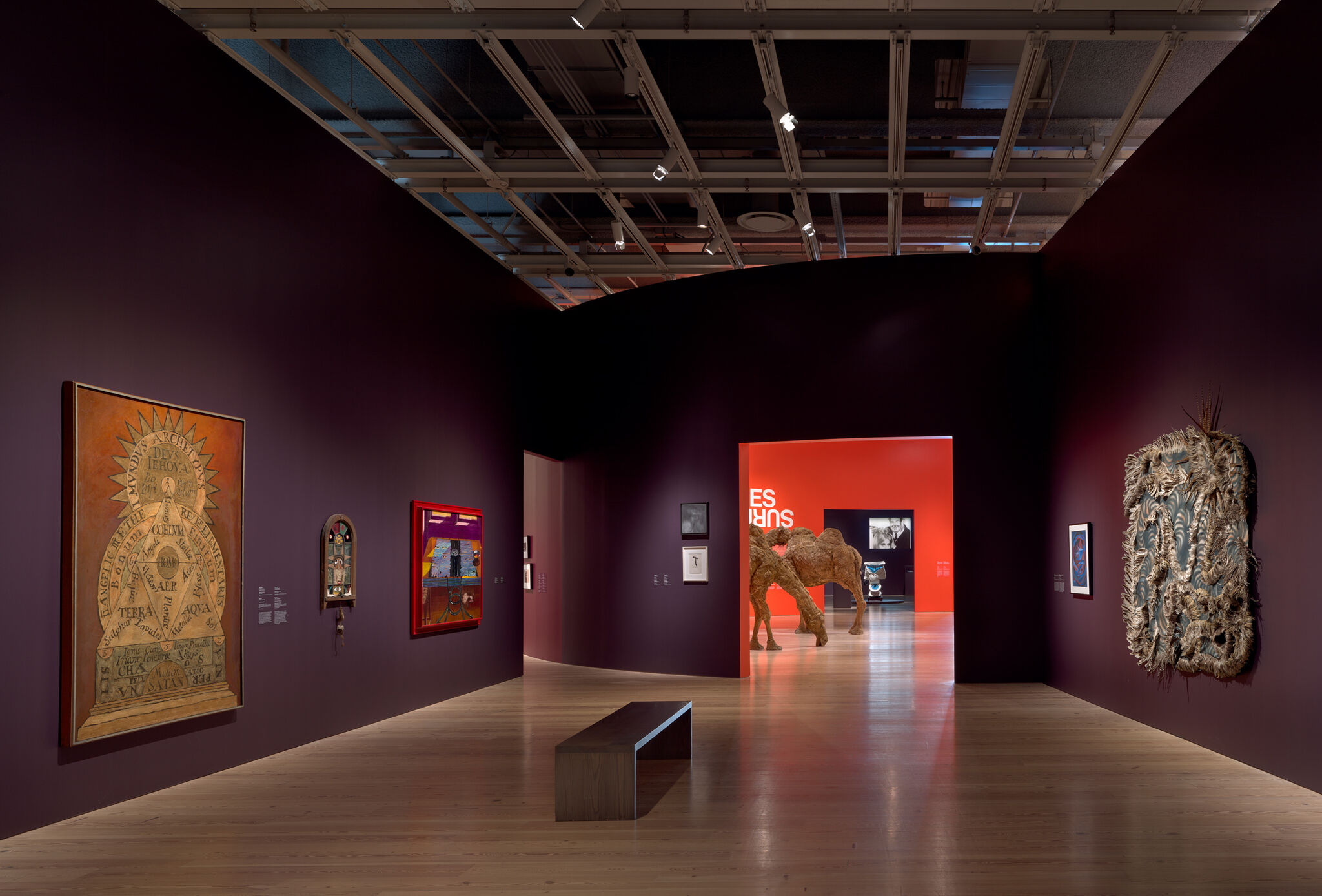
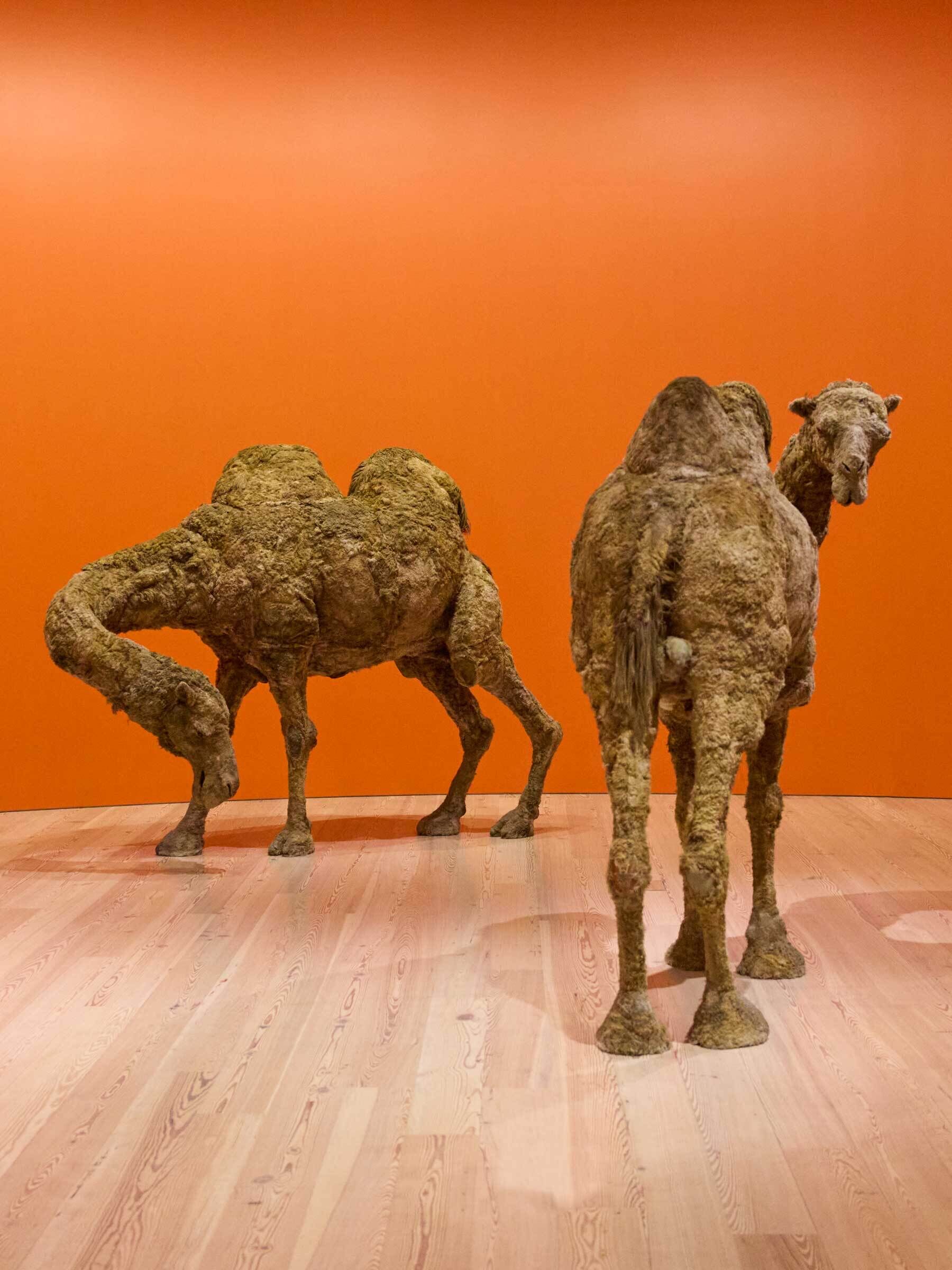
Installation view of Sixties Surreal (Whitney Museum of American Art, New York, September 24, 2025–January 19, 2026). From left: Wally Hedrick, HERMETIC IMAGE, 1961; Betye Saar, Ten Mojo Secrets, 1972; Eduardo Carrillo, Testament of the Holy Spirit, 1971; Jack Whitten, Christ, 1964; Claes Oldenburg, Drainpipe, 1966; Nancy Graves, Camel VI, Camel VII and Camel VIII, 1968–69; Claes Oldenburg, Soft Toilet, 1966; Gunvor Nelson and Dorothy Wiley, SCHMEERGUNTZ, 1965; Oscar Howe, Retreat, 1968; Carlos Villa, My Roots, 1970–71. © Whitney Museum of American Art, photograph by Ron Amstutz; © Wally Hedrick; © Betye Saar; © The Estate of Eduardo Carrillo; © Jack Whitten Estate, courtesy Jack Whitten Estate and Hauser & Wirth; © Claes Oldenburg; © Nancy Graves Foundation / Licensed by VAGA at Artists Rights Society (ARS), NY; Courtesy Filmform and the artists
This project began with a counterfactual: What if Surrealism, not Cubism, had emerged as the dominant force to shape the course of postwar art in America? Proposed in 1966 by critic and curator Gene Swenson, in his formulation this meant: What if it were subject matter, not form, that had been primary to artists in those crucial Atomic years in the United States?Gene R. Swenson, The Other Tradition (Philadelphia: Institute of Contemporary Art, University of Pennsylvania, 1966), 12–16. For Swenson, who was just in his early thirties at the time, the critical veneration of European abstraction and fetishization of form had all but eclipsed the work of artists who were taking up other ideas—psychological, emotional, queer—that could be traced to an entirely distinct artistic precedent. In charting an alternative nonformal lineage for this kind of contemporary art of the 1960s, Swenson was intentionally opening the way for a plurality of voices, among them his friends Paul Thek and Joseph Raffaele, whose largely figurative mode merged the psychosexual concerns of Surrealism with the cool, impersonal imagery and facture of Pop art. His exhibition The Other Tradition (1966), at Philadelphia’s Institute of Contemporary Art, which brought together historic Surrealist and then-contemporary artists, demonstrated this idea.
Swenson was onto something. His tragic death three years later cut short his championing of other 1960s artists whom he might have brought into his surrealist fold, a project that is enthusiastically taken up here. With Swenson’s provocation as a guide, Sixties Surreal offers a reappraisal of American art during one of the country’s most socially and politically turbulent eras. Whether well known today or less so, the artists in this exhibition have often been considered marginal, eccentric, or provincial actors in relation to the period’s heroic “-isms,” such as Pop and Minimalism, which functioned at an emotional remove from the audience. Yet this panoply of artists from diverse backgrounds and geographies were protagonists in what may be the era’s most fundamental, if underrecognized, aesthetic current—an efflorescence of psychosexual, fantastical, spiritual, and revolutionary tendencies. The revisionist—and additive—survey here focuses on the heady tensions that took hold of the American psyche in the 1960s: between cohesion and rupture, repression and freedom, sex and death. These artists, largely born after 1930, in the wake of the “Greatest Generation,” mirrored these conditions through processes that included found-object assemblage, dismantling and reimagining bodies, and picturing altered consciousnesses through surreal forms.
Drawing on ideas embedded in the period’s curatorial and theoretical networks that run counter to what would become the prevailing modernist narrative, Sixties Surreal proposes a new art-historical framework that recontextualizes the decade. The era begins in 1958, at the moment when the artistic, social, and political currents that manifested the “Sixties” began to coalesce, and it ends with 1972, when the aesthetic pluralism that had been on view in museums and in print began to give way to the idea of a single formalist mainstream centered in New York (which, not coincidentally, was also the center of the art market), with the unfortunate consequence that most other places were cast as “regional,” including major centers of activity like San Francisco and Chicago.
The so-called Long Sixties are also what Native American scholar and philosopher Vine Deloria Jr. has called “the rugged 1960s,” a time “when any type of change was considered beneficial, and the institutions of society were considered not only obsolete but malignant.”Vine Deloria Jr., God Is Red: A Native View of Religion, 3rd ed. (Wheat Ridge, CO: Fulcrum Publishing, 2003), 45. Deloria's characterization comes as he reflects on the American Indian Movement's 1972 occupation of the Bureau of Indian Affairs headquarters in Washington, DC, and its occupation the following year of Wounded Knee, South Dakota. That he describes these protest events as the "final spasm" or "last hurrah" of the sixties makes his characterization no less true, but it does introduce a poignant sense of finality to this revolutionary era.For artists, this anti-institutional, anti-establishment ethos extended far beyond academia and the art market as they confronted the structures of politics, religion, gender, sex, family, education, and housing through their art in ways both subtle and combative. This was the decade of the escalation of the Vietnam War; the burgeoning civil rights movement for Black people as well as Native Americans and Chicanos; the dawn of second-wave feminism and the push for reproductive freedom; the early days of queer liberation; the youthquake, drug experimentation, rock and roll, and so much more. As the 1960s progressed it was infused with darker currents, with hope yielding to righteous anger at the fierce suppression of the civil rights and antiwar movements by reactionary forces. The brutality they unleashed was splashed across the mass media in horrifying images from Vietnam and from protests at home, creating a disorientating and polarizing era of change.
Indeed, mass media became both a record and a tool. As the tidal wave of young Americans who came of age during this time of both incredible social upheaval and economic prosperity set out to determine their own identities and fates—whether through political action, artistic activity, or upending the conventions of everyday life—they had those activities reflected back at them through television, magazines, and newspapers. Artists, in turn, pulled from this profusion of language and imagery and made it their own, whether in underground newspapers and video art or through traditional studio practices, often expanded and redefined. Suddenly the contemporary situation was broadcasting from within galleries and museums, which themselves were changing. Artist-run spaces and commercial galleries launched by people of color, community art projects, and other exhibition venues proliferated throughout the decade, challenging the artworld’s historic gatekeepers and providing bases—and an expanded public—for the era’s dizzying proliferation of expression.
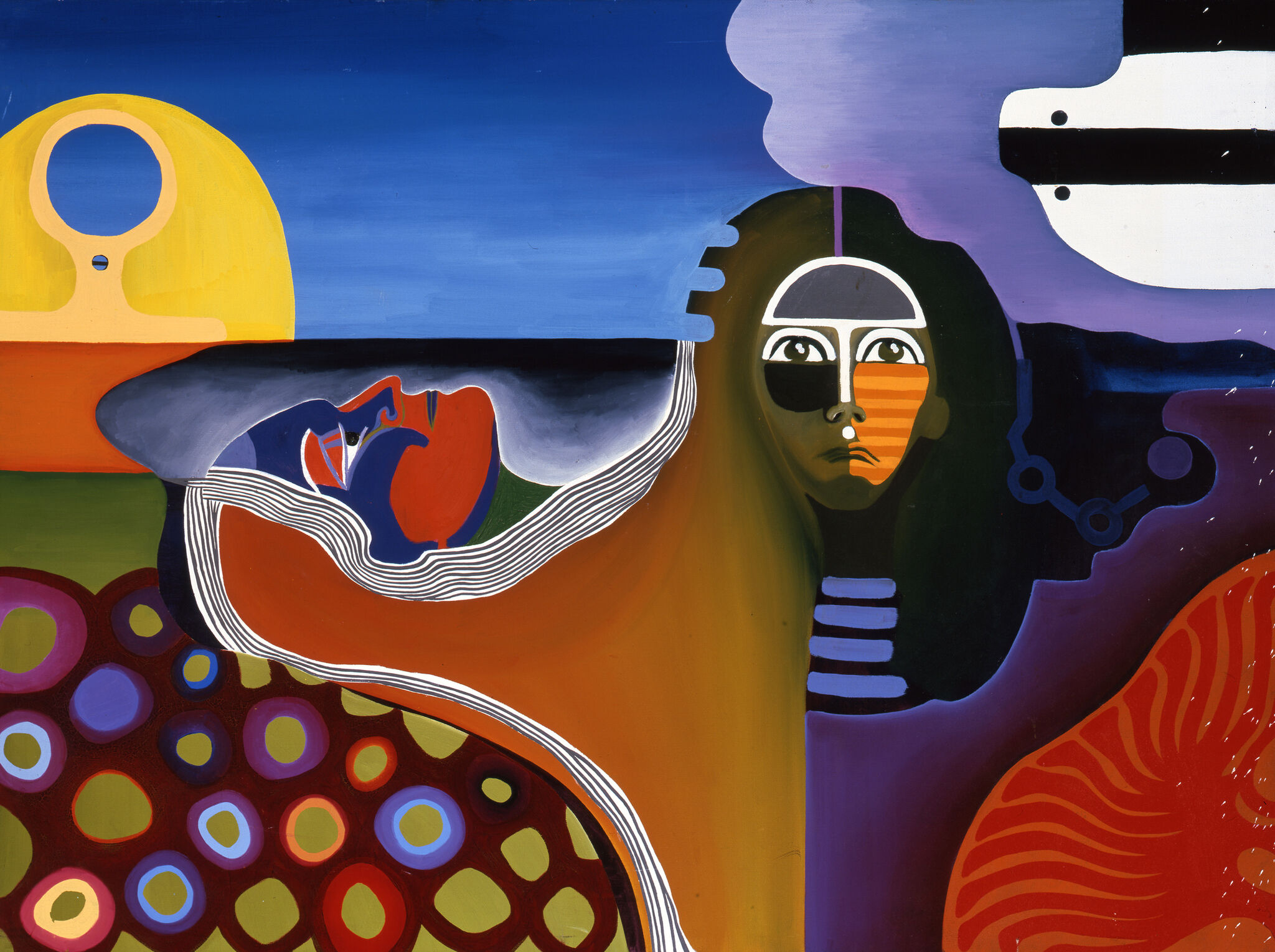
Linda Lomahaftewa, Untitled Woman's Faces, 1960s. Oil on canvas, 36 × 48 in. (91.4 × 121.9 cm). Heard Museum, Phoenix; Gift of the artist. © Linda Lomahaftewa
Sixties Surreal is imprinted by the many meanings and geographical touchpoints of Surrealism as it permeated the zeitgeist of the Long Sixties; as well as its origins as a literary movement in interwar Paris, as expounded by André Breton in his foundational 1924 manifesto. Given its liberatory political dimensions, Surrealism also became a calling card for those revolting against a supposedly rational world that oppressed the working class and stifled free expression.
Surrealism as a movement was broadly disseminated in the United States through exhibitions and publications, along with the wartime immigration of many of its key European practitioners to New York. Yet by the early 1950s, formalist critics and curators had largely reduced Surrealism to a wellspring of automatism and abstraction and dismissed its “literary content.” But even as formalist critics discredited Surrealism, most of its visual and philosophical aspects had become baked into American culture at large through film, advertising, commercial art, and literature, while Abstract Expressionism had become doctrinaire and Pop was beginning to percolate. Soon, with the emergence of psychedelia, Surrealism’s influence on popular culture would only become more pronounced.
Meanwhile, the energy of the country was growing increasingly tumultuous, and the social and political convulsions of the 1960s were for many “surreal,” a feeling reflected in mass culture. This sense of the surreal operating on an almost osmotic level perhaps explains why it manifested itself in the work of so many artists and the organic nature of their connection-building. They coalesced in loose geographical networks—especially in California, Texas, and Chicago—that functioned as a de facto opposition to the demands of New York–centric formalism, and they were linked through group exhibitions, magazine articles, and their own publications.
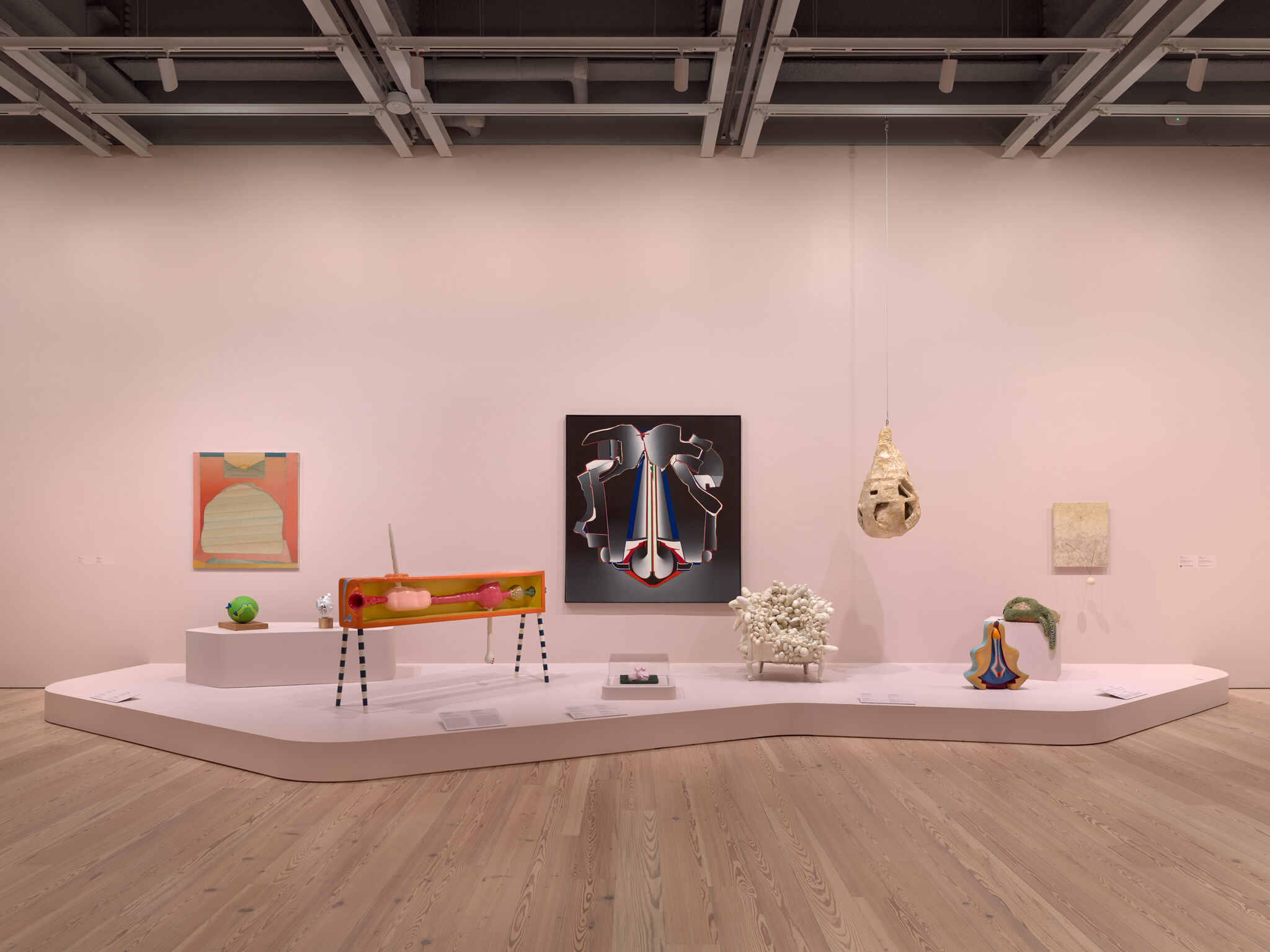
Installation view of Sixties Surreal (Whitney Museum of American Art, New York, September 24, 2025–January 19, 2026). From left: Miyoko Ito, Untitled, 1970; Kenneth Price, S.L. Green, 1963; Michael Todd, Fetish 3, 1963; Jeremy Anderson, Riverrun, 1965; Deborah Remington, Haddonfield, 1965; Hannah Wilke, Teasel Cushion, 1967; Yayoi Kusama, Accumulation, c. 1963; Louise Bourgeois, Fée Couturière, 1963; Judy Chicago, In My Mother’s House, c. 1962–64; Franklin Williams, Untitled, 1967; Eva Hesse, C-Clamp Blues, 1965. © Whitney Museum of American Art, photograph by Ron Amstutz; © Estate of Miyoko Ito; © Estate of Ken Price, courtesy Matthew Marks Gallery, New York; © Michael Todd; © Estate of Jeremy Anderson; © Deborah Remington Charitable Trust for the Visual Arts / Licensed by VAGA at Artists Rights Society (ARS), New York; © Marsie, Emanuelle, Damon and Andrew Scharlatt, Hannah Wilke Collection & Archive, Los Angeles / Artists Rights Society (ARS), NY; © YAYOI KUSAMA; © The Easton Foundation / Artists Rights Society (ARS), New York; © Judy Chicago / Artists Rights Society (ARS), New York; © Franklin Williams; © The Estate of Eva Hesse
This project attempts to wrangle the freewheeling, multivalent art that made the sixties surreal into a reasonably cohesive survey, without rehashing history or redoubling categorizations. The work started by identifying six historic exhibitions that took place in 1966–67 and were organized by artists and curators for whom the surreal provided an alternative means to understand art making in the contemporary moment: The Other Tradition, Hairy Who, New Documents, Eccentric Abstraction, Funk, and 66 Signs of Neon. As the 1960s progressed, Minimalism and Pop art became recognized in the modernist canon as the acceptable reactions against Abstract Expression, each in its own way a turn from the painterly, expressionist, or personal yet still possessed of a formalist vocabulary. (Even as Pop could be said to link to Surrealism through its sense of incongruity, it refused psychological or emotional readings, focusing instead on the layers of commercial imagery swamping the imaginations of the postwar public.) Examining the material or formal tendencies of the artists who appeared in these exhibitions and tracing their networks revealed modes of art making that sit outside this modernist canon. Using the key exhibitions as a starting point, the thematic galleries of Sixties Surreal pose critical arguments that both complement and expand upon the organizing principles of the historic shows. Objects are organized by their positions within histories and themes that have been expanded and reimagined based, in part, upon the work of building the chronology that follows here, a voluminous account of our Long Sixties punctuated with informative and inventive essays and the artworks from the exhibition. If the exhibition argues for imagining a new visualization of the decade, this book as a whole, we hope, offers innumerable pathways to further expand that imagination—geographically, thematically, and aesthetically.
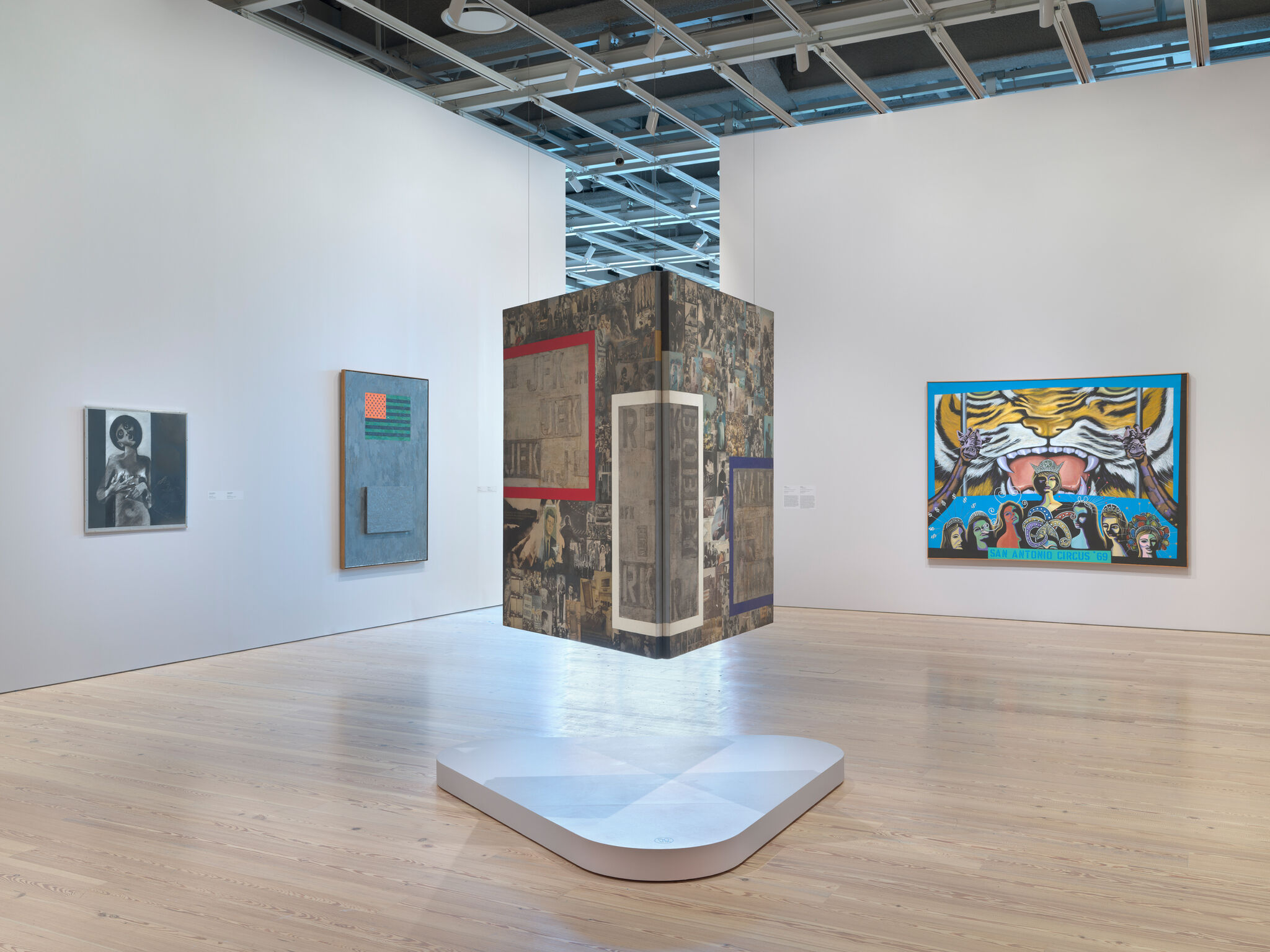
Installation view of Sixties Surreal (Whitney Museum of American Art, New York, September 24, 2025–January 19, 2026). From left: Timothy Washington, Viet Nam, 1970; Jasper Johns, Flags, 1965; Ralph Arnold, Unfinished Collage, 1968; Mel Casas, Humanscape #56 (San Antonio Circus), 1969. © Whitney Museum of American Art, photograph by Ron Amstutz; © Timothy Washington; © Jasper Johns / Licensed by VAGA at Artists Rights Society (ARS), NY; © Estate of Ralph Arnold; © The Mel Casas Family Trust
Making a world anew, even in the palm of your hand, is at the core of both Surrealism and Sixties Surreal. Transmuting a feeling into a thing, and then examining and learning from it, allowing it to occupy space with oneself, moving past repression and into recognition: this was Gene Swenson’s psychoanalytic–artistic mission. But this doesn’t mean that Sixties Surreal advocates for one-to-one meanings. In our expanded read of art in the Long Sixties, the permission-giving ethos of Surrealism that permeated artistic cultures from coast to coast allowed for and encouraged subject matter that was in some way “cloaked,” as Karl Wirsum once said.Karl Wirsum, quoted in Dan Nadel, “A Hairy Who’s History of the Hairy Who,” The Ganzfeld 3 (2003): 144.Sixties Surreal surfaces art that embraced content, that trafficked in ideas surrounding sexuality, religion, gender, class, liberation, and the often disorienting conditions of everyday modern life, and yet refused literal readings; this is art that courted ambiguity.
The ambiguity in which this project is steeped is what makes Sixties Surreal so unyieldingly contemporary. As we are all too aware in our current moment, both repression and freedom thrive in ambiguity. But whereas the politician might use ambiguity to obfuscate intent, the artist might seize upon it as a way to encompass contradictory feelings—to make something that is generous enough to speak to people in the language they bring to it. And while we cannot argue collective intent across such a diverse array of talent, it could be true that the artists in this exhibition wanted to knock themselves and their viewers slightly off-kilter so as to make all involved reconsider their own attitudes. This could mean the act of gently squeezing one’s own arm to check its elasticity, or it could mean contemplating just what was lost or gained in the Watts Rebellion—art making that is not embarrassed by its own earnestness or emphasis on subject matter. The specific qualities of societal distrust that rendered the 1960s destabilizing pushed artists to imagine new futures; surrealism gave explosive, kaleidoscopic dimension to those imaginings. From our current vantage point, we envision Sixties Surreal as a reassessment of history that allows for continued imagining—of futures and future histories.
This essay is excerpted from the exhibition catalogue Sixties Surreal.