
UBERMORGEN.COM: CLICKISTAN
2010
UBERMORGEN.COM: CLICKISTAN
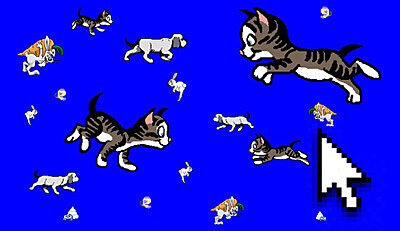
UBERMORGEN.COM, screenshot of CLICKISTAN, launched December 2, 2010
During the summer of 2010, UBERMORGEN.COM, an artist duo composed of lizvlx and Hans Bernhard, were commissioned to create an interactive, engaging work designed to introduce a new worldwide audience to the importance of supporting the Whitney’s Annual Fund—and by extension, art in an increasingly global community.
For a limited time, users could support the Annual Fund by playing the games included in CLICKISTAN, a work of computer game art that references early net art and classic coin-operated arcade games such as Space Invaders (1978), Donkey Kong (1981), and Pac Man (1980). As you move through levels, you’ll score points in ways that aren’t immediately obvious. The retro feel of the games will inspire the inner gamer in many, and for those visitors who are knowledgeable about the history of net art, the visit will be even more rewarding.
The CLICKISTAN soundtrack is inspired by early computer games, and is supplied by the 8-bit music website micromusic.net.
UBERMORGEN.COM is an artist duo created in Vienna, Austria, in 1995 by lizvlx and Hans Bernhard. Behind UBERMORGEN.COM we can find one of the most unmatchable identities—controversial and iconoclastic—of the contemporary European techno-fine-art avant-garde. Their open circuit of conceptual art, drawing, software art, pixel painting, computer installations, net.art, sculpture and digital activism (media hacking) transforms their brand into a hybrid Gesamtkunstwerk. The computer and the network are (ab)used to create art and combine its multiple forms. the permanent amalgamation of fact and fiction points toward an extremely expanded concept of one’s working materials that for UBERMORGEN.COM also include (international) rights, democracy and global communication (input-feedback loops). “Ubermorgen” is the German word both for “the day after tomorrow” and “super-tomorrow.”
lizvlx (A/CH, *1973) is an Austrian net.artist working in the fields of digital imagery, media actionism and programming. She studied both commercial sciences and fine arts in Vienna and now works out of St. Moritz and Vienna. Using technology, computers, and sculpture as media since 1994, she has exhibited her net.art works in venues like the Ars Electronica (Austria), the Konsthall Malmoe (Sweden), the NTT ICC Museum (Japan), ARCO (Spain) or the Lentos Kunstmuseum (Austria). lizvlx was also a founding member of 194.152.164.137 and of netznetz.net. lizvlx is allergic to milk protein and enjoys changing hair colors.
Hans Bernhard (USA/CH/A, *1973) is a Swiss-American writer, actionist and digital artist working in the field of media hacking, txt-modification, conceptual art and net.art. Living and working in Vienna and St. Moritz. Since the mid-1990’s, he has been a frequent speaker at conferences and universities worldwide, and has exhibited his work in venues such as Laboral Gijon (Spain), SFMOMA (USA), ZKM (Germany), New Museum New York (USA), Museum of Contemporary Art Tokyo (Japan), MOCA Taipei (Taiwan) or Mumok Vienna (Austria). Hans Bernhard is a co-founder of etoy (www.etoy.com). He studied visual communication, digital art, and aesthetics in Vienna (Weibel), San Diego (Manovich), Pasadena (Lunenfeld), and Wuppertal (Brock). Hans Bernhard weighs 130 kgs (290 pounds), is keen on attention, and gets a new haircut in every city he travels to.
From the curator
CLICKISTAN by the artist team UBERMORGEN.COM (lizvlx and Hans Bernhard) is a work of game art and an homage to the net art of the mid-90s: it invents its own territory—ruled by the click—and celebrates the pixel in imaginative variations. UBERMORGEN.COM are the new masters of Minimalist pixel painting. Transparent pixels are blown out of proportion in order to create graphic shapes and abstractions, while copied-and-pasted scripts are resampled and recombined in order to—in UBERMORGEN.COM's words—use as many pre-existing pixels and produce as few originals as possible. This latter strategy is a nod to early net art, in which recycling and reproduction of existing information were the artistic method of choice. Likewise, in the spirit of early net art—such as the Form Art Competition organized by Russian net art pioneer Alexei Shulgin in 1997—CLICKISTAN plays with the formal elements of the Web, enticing its players to click away on canvases of radio buttons and flying scroll bars. Players also encounter elements of net culture, such as a reference to the famous 2000-2002 Internet meme "All your base are belong to us," a broken-English phrase originating from the opening scene of the video game Zero Wing, poorly translated from Japanese. CLICKISTAN's visual style and playful typography—such as the mixing of upper and lower case—allude to the “dirt style” design of net art before the dot com gold rush—the degraded aesthetic of the hobbyist, amateur, and geek. The work’s title references both early net art's exploration of the Web territory—in its resistance to traditional notions of ownership, authority, and the nation state—and the arrival of the click as the main paradigm of interaction, overruling previously established norms of dragging and dropping.
CLICKISTAN is also indebted to early computer games, particularly the coin-operated arcade games of the late 1970s and early 1980s, such as Space Invaders (1978), Pac-Man (1980), and Donkey Kong (1981), whose pixellated characters were created with great economy of means. The new musical form inspired by early computer games—known as 8-bit or chiptune music and consisting of sound textures synthesized by the computer or video game console's sound chip—is referenced in CLICKISTAN's soundtrack supplied by the 8-bit music website micromusic.net.
As with other game art projects, CLICKISTAN does not simply create an environment for play that follows established conventions, but instead engages, questions, and undermines them. UBERMORGEN.COM takes a decisively “userunfriendly” approach to many gaming routines: players' actions do not yield the expected results; some choices are impossible to make, some actions redundant, but, as in “real life,” they all lead to the next level or sometimes even have the same consequences; scores do not necessarily relate to the performed actions in any rational way. Players become aware of their expectations and are challenged to ask who or what created them in the first place.
UBERMORGEN.COM's mode of operation has always been playfully subversive, and many of their projects have addressed the intersections of Internet culture, money, and branding. Their Ekmrz Trilogy (2005-2009) took critical approaches to Google and Amazon. Their Generator series included tools such as the Injunction Generator (2001), which allowed users to automatically generate a standard court order—in .pdf or .rtf format—claiming that a website of their choice was operating on an illegal basis. CLICKISTAN's use of visuals, text, and language reflects the overall tone of Ubermorgen's work, referencing their website's home pages (from 2000-2005) as well as the generators. CLICKISTAN is a territory that lies somewhere at the core of Ubermorgen's work: a game that plays with art and commerce, celebrates the early days of net art and computer games, has an anarchic sense of humor, and only delivers the expected when it is time to pay.
artport
View more on artport, the Whitney Museum's portal to Internet and new media art.