 |
© Clark Atlanta University Art Galleries
Artwork © Gwendolyn Knight Lawrence, courtesy of the Jacob and Gwendolyn Lawrence Foundation
INFO
During the 1920s and 1930s, as a result of the combined forces of the Great Migration, the Depression, the Jazz Age, and the Harlem Renaissance, Harlem blossomed into a community with a unique identity. An enclave for African American literary and visual art, this new cultural arena enjoyed a sense of optimism in spite of economic difficulties. Like many writers and artists of his time, Jacob Lawrence was inspired by the dynamic vitality of the Harlem community.
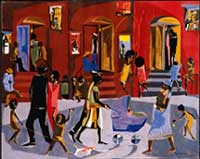
In this image, Lawrence depicted a city street teeming with activity. Lawrence used repetition and patterns to create the rhythm of this city scene. Unlike earlier works where people and places are portrayed in flat color, in this painting, Lawrence created depth through the use of shadow.
A young boy walking a dog directs the viewer's attention to the center of the image, where a couple pushes their baby carriage. Other couples and pairs appear throughout the image. In the center of the painting, two young girls are poised in mid-air as they jump rope. Figures in the background relax and engage in conversation on their stoops. Lawrence also offered multiple views into the brownstone's open windows.
LOOK
Look closely at this painting and identify five to ten different activities that people are engaged in.
What palette has Lawrence used in this image?
What time of day do you think it is? How can you tell?
What do you see in the windows?
What animals do you see?
EXPLORE
What makes a neighborhood?
How would you describe your neighborhood?
How is your neighborhood similar or different to this one?
• Observe and make sketches of a favorite place in your neighborhood at a particular time of day. Include people, shadows, repeated shapes, and patterns in your sketches.
